Clemente Attolico and colleagues with the delicious lunches they are taking to Farm Street.
By Nathalie Raffray
A prestigious Private Members Club in the heart of Mayfair has got involved with a project providing meals to people living on the streets.
Mark’s Club, in Charles Street, is one of several exclusive clubs to offer food donations to a homeless lunch project organised by the Central London Catholic Churches.
Annabel’s, George and Harry’s Bar, similarly exclusive clubs with a VIP list closed to most people, have also got involved, joining five-star hotels including the Connaught, Claridges and the Mandarin Oriental.
Set up in 2020 at the start of the coronavirus pandemic and supported by Westminster City Council, the homeless lunch service is run from Farm Street Church twice a week and can serve up to 180 people.
Clemente Attolico at Mark’s Club, told ICN that they heard about the project through Harry’s Bar.
They offer a variety of food, depending on the availability of the produce in the kitchen.
Clemente added: “We simply got involved so that we could participate more actively in our community’s wellbeing. A lot of properties were helping and it was only fair for us to participate as well. We are a small club, but we try to do our part.”
Father Dominic Robinson, parish priest at Farm Street church, said: “I’m so grateful to all the clubs for coming on board. It makes this such a wonderful community project which shows that a neighbourhood as wealthy as Mayfair also has a heart for the poorest.”
Besides the homeless lunch, served in the Arrupe Hall, the London Jesuit Centre, 114 Mount Street, also hosts the Cana Lounge Café downstairs where they serve tasty treats, hearty soups, sandwiches and hot cooked meals on Tuesday, Wednesday and Thursday between 11am and 2.30pm.
All items are offered for a reasonable recommended donation. All Café staff are volunteers, typically homeless or unemployed. The café’s mission is to help leverage skill development to get folks back into employment. Come and be a part of their journey. All food is made and prepared onsite. Daily specials, always fresh!
Takeaway and catering services are also available. For more details see links below.
They are known as some of London’s most elite venues with a string of VIP guests going through their doors.
But Annabel’s, George, Harry’s Bar and Mark’s Club are also helping to feed the homeless at a West End church thanks to a service set up by a group of churches during the pandemic.
On 16th April the Lord Mayor of Westminster, Cllr Robert Rigby, visited the project and helped serve lunch to around 75 people on a visit to the Central London Catholic Churches Homeless lunch service run from Farm Street Church. Dario Mazzzolli, Dimitris Panopoulos and Camllia Fabbio, deputy director and managers at Annabel’s, who had provided the day’s food, also came to lend a hand.
Set up in 2020 at the start of the coronavirus pandemic and supported by Westminster City Council, the service offers lunch twice a week in a large dining room. It is already supported with donations of food from five-star hotels including the Connaught, Claridges and the Mandarin Oriental.
The addition of the private members’ clubs will mean the service can continue to serve around 140 people per week.
Volunteers led by Father Dominic Robinson, parish priest of Mount Street Jesuit Centre at Farm Street, refer to the homeless diners as guests and serve them sitting at tables – making the point that those sleeping rough are deserving of dignity and respect.
‘Coming Home’ – the annual Service of Commemoration for people who have been homeless, who have died in London in the past year, took place at a packed St Martin in the Fields, Trafalgar Square on Thursday. In this very touching service, the names of 129 people were carefully read out – another 64 people who died were not named. The congregation included friends and relatives of the deceased as well staff and volunteers of the various homeless charities.
Organised by St Martin in the Fields, The Connection at St Martin’s, Housing Justice and the Museum of Homelessness, the service began with Simon and Garfunkel’s song ‘Homeward Bound, played by Alistair Murray, John Deacon and Chris Bluemel.
In his introduction, Rev Richard Carter pointed out that these people were originally not homeless. “They came to London looking for a home” he said…
Mushy peas with fish and chips from a Mayfair restaurant were served yesterday to homeless people at a West End church thanks to a service set up by a group of churches during the pandemic.
The Lord Mayor of Westminster, Cllr Robert Rigby, helped serve lunch to around 60 people on a visit to the Central London Catholic Churches Homeless lunch service run from Farm Street Church of the Immaculate Conception in Mayfair.
Set up in 2020 at the start of the coronavirus pandemic and supported by Westminster City Council, the service now offers lunch twice a week in a large dining room. Donations of food from nearby five-star hotels and restaurants including the Connaught and Claridges means around 140 people a week are fed free. The lunch served by the Lord Mayor was courtesy of the Mayfair Chippy in nearby North Audley Street.
The Lord Mayor talked with guests, ranging from a 90-year-old lady to 39-year-old Miles, a first-time visitor to the Farm Street Church, who has been rough sleeping since arriving in Westminster from Manchester. Miles said: “I am still getting used to the pace of life in London but services like Farm Street are great. It feels like somewhere friendly I can dip into while I get my life back together.”
The Lord Mayor said: “Talking to people having lunch at the Farm Street centre it’s clear the reasons why people end up sleeping rough or facing homelessness are complex and varied. While some may have substance problems in the past, for others it can just be bad luck or family rifts that mean they fall through the cracks.
“Thanks to the generosity of the hospitality trade, the team at Farm Street return a sense of dignity to people who are served at the table like regular restaurant diners. Father Dominic deserves credit for a project that began as a pandemic response but has flourished into something which is helping the homeless in the long term.”
If you would like to join the team of volunteers at Farm Street Church or donate to their projects see: www.farmstreet.org.uk/support
‘Homeless Jesus’ by sculptor Timothy Shmalz in Farm Street Church. Photo: Sue Bingham
Fr Dominic Robinson SJ, Chair of Westminster Justice and Peace Commission and Parish Priest at Farm Street Church, Mayfair, has joined other clergy from the main churches in London’s West End in writing an Open Letter to local MPs Nickie Aiken and Sir Keir Starmer, to express serious concerns over changes proposed in the Criminal Justice Bill, which would criminalise many people sleeping on the streets of their parishes.
The full text of their letter follows:
Rt Hon Nickie Aiken MP and Rt Hon Sir Keir Starmer MP House of Commons London SW1A 0AA
9th April 2024
Dear Nickie, Dear Sir Keir
As Christian clergy responsible for parishes and churches in the West End of London we are writing to you as our two constituency members of Parliament about the provisions in the Criminal Justice Bill relating to rough sleeping.
As clergy in the West End of London we have a particular interest in this matter. We see rough sleeping every day in our parishes. Our churches and local charities are at the forefront in efforts to support the many more currently sleeping rough.
We are deeply concerned by the current proposals and hope that you will reconsider the measures before the Bill is next considered in Parliament.
We are very grateful for your support in repealing the Vagrancy Act 1824 but are extremely concerned with recent proposed updates which makes begging and some forms of rough sleeping a criminal offence. The Government committed in 2022 to repeal and replace this legislation, but this must be done with proper consultation.
We are extremely concerned that the changes proposed in the Criminal Justice Bill are being made following the publication of a policy paper from the Home Office, without a public consultation. It is vitally important that any changes to the law in this area are made following consultation in the usual way, giving groups and individuals involved to have their say.
The Home Office says that the new powers in this Bill are needed to “help move vulnerable individuals off the streets and direct them to the appropriate support they need, such as accommodation, mental health or substance misuse services.” The Bill, however, contains nothing that would increase support for rough sleepers and contains no new additional funding for these services as far as we can see.
We are extremely concerned that the definition of “public nuisance” in this Bill is poorly defined and open to broad interpretation by the police and local authorities. Equally, we are concerned by the scope of the powers in this Bill allowing the police and local authorities to “address” rough sleeping.
The penalty proposed for breaching these offences of £2,500 or one month in prison is in no way proportionate and risks criminalising and jailing some of the most vulnerable people in our parishes.
We would be happy to work with you to make sure that any new legislation supports rough sleepers and genuinely helps to tackle homelessness in this country.
We look forward to hearing from you.
Yours Sincerely
Revd Jennifer Mills-Knutsen, American International Church in London, Tottenham Court Rd jmk@amchurch.co.uk
Revd Dominic Robinson, SJ, Farm Street Church, Mayfair, and Chair of Justice & Peace in the Diocese of Westminster dominicrobinson@rcdow.org.uk
Revd Simon Buckley, St Anne’s, Soho
Revd Pascal Boidin, SM, Notre Dame de France, Leicester Square
Revd Richard Carter, St Martin-in-the-Fields, Trafalgar Square
Revd Stephen Coleman, Grosvenor Chapel, Mayfair
Revd Philip Dawson, St Giles-in-the-Fields
Revd Simon Grigg, St Paul’s, Covent Garden
Revd Roderick Leece, St George’s Hanover Square, Mayfair
Revd Pascale Renaud-Grosbras, French Protestant Church, Soho
Revd Scott Rennie, Crown Court Church of Scotland, Covent Garden
Revd Alan Robinson, Corpus Christi Maiden Lane, Covent Garden
Revd Adam Scott, House of St Barnabas, Soho
Revd Simon Woodman, Bloomsbury Central Baptist Church
Revd Lucy Winkett, St James’s Piccadilly and St Pancras Euston Rd
Fr Dominic Robinson SJ, commented: “When this new legislation to criminalise the homeless was proposed, the clergy across the West End of London were of one voice in expressing their horror and disbelief and demanding to be consulted.
It is clear to us all, who serve on the ground in parishes and churches of different traditions, that rough sleeping is a complex matter which deserves an integrated response.
This response needs to see the homeless we serve in our parishes not as people to be punished for begging but which treats the poorest of our flock with care and respect for their human dignity. Any policy or law needs to get to the roots of the issue in trafficking and find ways to help people get back on their feet.
All this requires funding for dignified accommodation and professional help rather than fining those who have nothing to give. It is clear to all of us who work with the street population that the proposed law will simply result in locking people away in prison where they can be conveniently forgotten by the rest of society. And that must be resisted strongly by the Christian community and by anyone who cares about creating a civilised society”.
Mayor of London Sadiq Khan and Housing Justice CEO Kathy Mohan OBE holding the Charter.
On 7 December 2023 the Mayor attended St John’s Church in Waterloo, to sign the charter alongside more than 40 organisations including homelessness charities, local authorities and business representatives.
The Charter is backed by the ‘Life Off the Streets’ programme, a coalition of organisations working together to end rough sleeping in London.
The Charter started with a small group of organisations and city government officials – the Connection at St Martin’s, Groundswell, Housing Justice, The Passage, YMCA St. Paul’s, Bloomberg Associates, the Greater London Authority and London Councils — who wanted to engage better with the community and build a bigger movement around the goal to end rough sleeping.
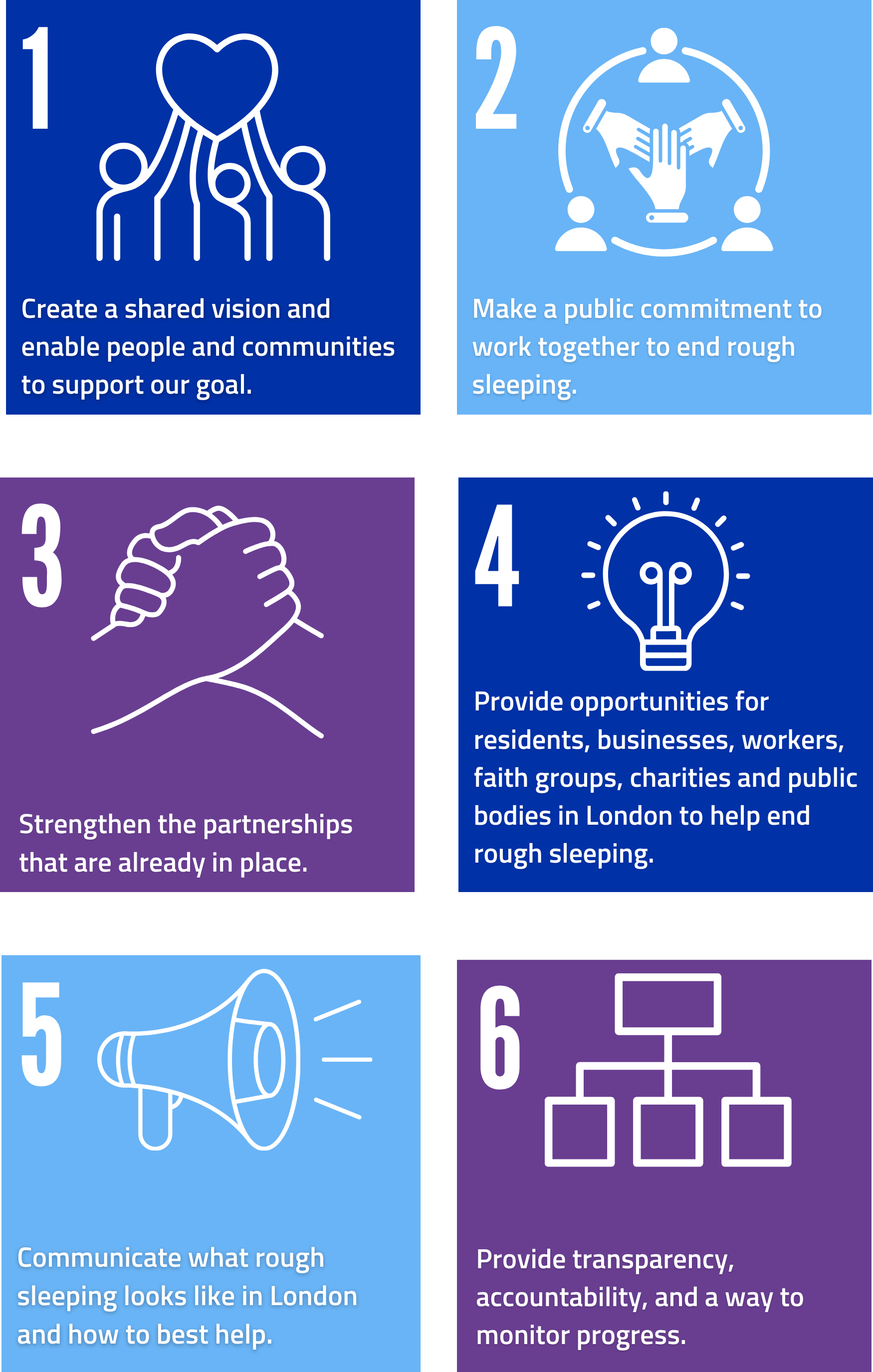
More than 100 charities, faith groups, businesses and people with lived experience have helped to design and develop the Charter, creating a shared purpose and vision for tackling the challenge of rough sleeping in the capital.
The London Charter to End Rough Sleeping follows six guiding principles:
People sleeping rough may have problems but they aren’t problem people.
Help needs to be in place to prevent people from sleeping rough in the first place; addressing the underlying causes of street homelessness not symptoms.
Everyone who sleeps rough is unique and there should be meaningful options for all, regardless of immigration status.
People who have experienced sleeping rough must be involved in the development and delivery of solutions.
Support, community links and accommodation needs to be in place so that people can thrive.
People sleeping rough must be safe from violence, abuse, theft and discrimination and have the full protection of the law.
Home Secretary Suella Braverman announced on Saturday she is planning to propose new laws to limit the use of tents by homeless people, saying many of them see it as “a lifestyle choice.”
She said on X: “We cannot allow our streets to be taken over by rows of tents occupied by people, many of them from abroad, living on the streets as a lifestyle choice. Unless we step in now to stop this, British cities will go the way of places in the US like San Francisco and Los Angeles, where weak policies have led to an explosion of crime, drug taking, and squalor.
“Nobody in Britain should be living in a tent on our streets. There are options for people who don’t want to be sleeping rough, and the government is working with local authorities to strengthen wraparound support including treatment for those with drug and alcohol addiction.”
Fr Dominic Robinson SJ Chair of Justice and Peace, Diocese of Westminster said: “On behalf of those homeless we serve and for whom it is our duty to advocate, it is deeply disturbing to hear reports of further moves which will criminalise and punish the homeless simply for being homeless. We know from our work on the ground in central London and further afield that there is a tragic lack of fit for purpose accommodation for those who, through no fault of their own, find themselves without the basic human right to shelter. The guests we see at our services are not making a ‘lifestyle choice’ – rather they have no options left.
“Banning tents from public places and criminalising agencies that provide them is cruel beyond belief and unacceptable in civilised society. The success of the repeal of the Vagrancy Act is now in danger, as politicians from across the party divides have been pointing out, of being replaced by even harsher legislation which will push the street population further into a subculture of society.
“The principles of Christian social teaching demand that any move to further punish those homeless who already suffer on the margins of society through no fault of their own must be resisted as robustly as possible.”
Mick Clarke, Chief Executive of The Passage in Victoria, central London, said: “The Passage strongly condemns the new enforcement powers outlined by the Home Secretary, regarding street homelessness.
“We believe everyone deserves a place to call home; that no one should ever have to sleep on the streets, or indeed in a tent on the streets. This policy risks demonising the poorest in our society without even beginning to address the real issues facing our country regarding poverty and homelessness. In the long term, building more social housing and seeking to prevent homelessness occurring in the first place must be the priority, yet the simple fact is that the government could be taking immediate steps to alleviate the homelessness crisis, such as unfreezing Local Housing Allowance and creating more emergency accommodation.
“The Home Secretary states that homelessness is a ‘lifestyle choice’ and that ‘there are options for people who don’t want to be sleeping rough..” However, the stark reality on the ground is that many local authorities are no longer able to provide accommodation for those most in need; some have even been forced to either give, or direct people towards tents as they are simply unable to offer any other housing solution. The people that we work with have certainly not chosen to be on the streets; circumstances have put them there.
“When the Home Secretary speaks of wanting to stop crime blighting our communities, this is of course something with which we all agree. However, these measures will do nothing to address the causes of crime and it is important to realise that those on the streets are far more likely to be victims of crime rather than perpetrators. Instead, to focus on addressing issues such as drug dealing and modern slavery – which puts many who are street homeless at risk – would be significantly more effective than criminalising homelessness.
“All of this comes days after the highest monthly increase ever recorded for those sleeping out on our streets since records began. Instead of taking the opportunity to repeal the archaic Vagrancy Act and address the anti-social behaviour that those on the streets and in the wider community are victims of, we are presented with a set of measures designed for show with no substance to tackle the real cause of the scandal – that being far too many people now experiencing street homelessness.
“There are so many good people and organisations – charities, voluntary and community groups, companies, and local and central government civil servants – who are working tirelessly to address the scandal of street homelessness in our country and we’re very proud to work with and alongside such committed partners.
“During the Covid-19 pandemic, street homelessness was treated as a public health emergency, which led to society coming together to implement the Everyone In initiative. Instead of headline grabbing politics, we need policies that address the core issues; we urgently need to re-frame street homelessness and adopt measures that will prevent it from happening in the first place.
“The latest official figures show that as winter approaches, the number of people who are street homeless is going to be at a level not seen for over two decades. Every single one is a human being and a personal tragedy. With the impact of the cost of living crisis, we are seeing more people at risk of street homelessness who would never have thought they would be in that position.
“This winter, we are facing an emergency on our streets. We desperately need the right policies in place to address the scandal that is street homelessness. Frontline staff at The Passage, in collaboration with our partners, work tirelessly to support some of the most vulnerable people in our society. We will not stop until we have ended the national shame that is street homelessness in 21st century Britain and instead of criminalising homelessness, we strongly encourage the government to work with us, and countless others, to bring about lasting change. As evidenced during the pandemic, there is so much more that can be achieved by working together to end street homelessness.
“We therefore urge the government to once again take this collaborative approach and work with us to end homelessness for good.”
Martin, a homeless man who has lived around Fitzrovia in London for the past two years told ICN: “A tent really makes a difference. In the winter it keeps you a bit warmer, out of the rain and safer. It also gives you some privacy. You’re less likely to get kicked or spat on.”
There will be a Service of Commemoration for those who have died homeless in London in the last year at St Martin in the Fields, on Thursday, 9 November, from 11am -1pm.
With the number of people experiencing homelessness rising sharply around the UK since the pandemic, this year’s Homelessness Sunday is an important way to raise awareness of the plight of so many who have become marginalised in our society, and to reflect on what we as Churches and communities can do to help alleviate this very serious problem on our doorstep.
We organise Homelessness Sunday on the Sunday before World Homeless Day each year, and this year’s Homelessness Sunday falls on 8th October. The theme is ‘Love and Justice’ as this is a key part of our mission to alleviate homelessness and the housing shortage in the UK.
Below you will find a range of resources to use if you are planning your own Homelessness Sunday Service either on 8th October or on another date of your choosing. These resources will be added to over the coming weeks and include pre-recorded prayers, hymns, homilies, Junior Church resources and much more.
If you would like to attend the Homelessness Sunday Service at St Mary’s Church, Upper Street, Islington, London N1 2TX at 3pm on 8th October, please RSVP to j.whitney@housingjustice.org.uk
Central London Catholic Churches (CLCC) is a consortium of volunteers that came together in April 2020 to provide refreshments to homeless people during the pandemic. Originally operating out of a van in Trafalgar Square, it has now transformed itself into a very popular twice-weekly lunch service based at Farm Street church and catering to over 100 homeless guests a week. In addition to enjoying limitless tea and coffee and top-quality lunches sourced from local suppliers, guests can participate in job fairs to learn about employment opportunities, be referred to other services, join in scripture study groups and even get a haircut, all without leaving the Farm Street premises.
What has made all of this possible is the team of around 50 committed volunteers. They range in age from 20 to 85 and include students, doctors, lawyers, housewives, those in religious life and retired people. What is very striking is how well everyone gets on together and how much we share a sense of common purpose. The happy atmosphere created by the volunteers is one of the reasons that guests speak so highly of the service and keep returning to it.
It is hugely rewarding for us to work with what is one of the nicest teams of volunteers that we have ever encountered and we want to put on record how much we appreciate everything you do.
Thank you to our volunteers.
Fr Dominic Robinson SJ, Ade Owusu-Ansah and Linda McHugh
There has been a dramatic increase in homelessness in England in the past year. At the same time, latest data shows there has been a huge rise in the number of empty properties. Campaign group Action on Empty Homes estimate that the proportion of long-term empty homes – vacant for six months or more – hit a record 248,633 in 2022, over 11,000 more than the previous year.
In London, some 34,327 properties are described as “long-term vacant”, meaning that they had not been lived in for more than six months and were “substantially unfurnished”, as of March 31, 2022.
Between April and September 2022, 5,712 people were sleeping rough in London, a 21% increase compared to previous year – Shelter reports.
The number of individuals sleeping rough across the country is 74% higher than it was in 2010, when the data started being collected. These figures are likely to be an underestimate of rough sleeping, as people spending the night in less visible locations like parks and buses are often missed.
During the ‘Everyone In’ scheme during the Covid pandemic, nearly all rough sleepers in towns and cities across the country were brought from the cold and housed in hotels and hostels. But very few were offered permanent accommodation. Once the pandemic ended, people were forced back on the streets.
While the number of single people sleeping rough continues to grow, many more families are also struggling to find accommodation. The government’s latest statutory homelessness figures, which show the number of households who approached their local council between July and September 2022 and were found to be homeless or at risk of homelessness within the next eight weeks, reveal:
– 72,320 households in England became homeless or were at imminent risk of becoming homeless – a 4% annual rise on the same period last year.
– In the same period, 25,570 families with children faced homelessness – an 8% annual rise on the same period last year. Many of these families will end up in unstable and poor-quality temporary accommodation, including hostels and B&Bs.
Fr Dominic Robinson, SJ, Parish Priest at Farm Street Church, Mayfair, and Chair of Westminster Diocese Justice and Peace Commission, told ICN: “These staggering statistics are not just extremely worrying but should be a wake-up call to those who can make a difference to work with charitable agencies and faith groups more closely to address the housing crisis in the capital.
“Our volunteers are seeing every day how the issue of ‘homelessness’ is not just more serious than ever but more complex than traditional rough sleeping and we need to realise that.
“Appalling housing conditions, sofa surfing, living on and off of night buses is a daily reality and it is getting worse. Surely this outrageous revelation of the amount of empty property in London represents an opportunity to do something about this.
“But it is not the only solution of course. Affordable housing, community integration and above all treating those in desperate need more humanely must be at the heart of policy decisions both locally and nationally.”





 Diocese of Westminster Justice and Peace Commission