Seeking Sanctuary Latest News – Justice and Dignity for Migrants

Monthly Prayer Vigil outside the Home Officenext Vigil 17 March 2025

Source: Ben Bano and Phil Kerton

According to the Pas-de-Calais prefecture, “in 2024, 77 people died trying to reach Great Britain aboard a small boat”, a record since the start in 2018 of the use of this means of crossing the Channel. According to British authorities, in 2024, 36,816 migrants managed to cross the Channel on boats, 25% more than in 2023.

According to the count of migrant aid associations, which also includes deaths on land, 89 exiles died on the coast of northern France in 2024. Support groups and political parties organised a march “for justice and dignity” in Calais recently to draw attention to these figures.

First deaths of 2025

The body of Abdul Raheem, a Yemeni aged around 24, was discovered on the morning of 22 January on the sand of Salines beach at Sangatte, facing England, where illegal boats regularly depart.

On the night of Friday to Saturday, 11 January, Suleiman, a Syrian migrant in his early twenties, died at Sangatte during an attempt to cross the Channel. He was one of about 60 people who left on a small boat, only to return very soon, soaked to the skin, leaving the victim on the floor of the boat in a state of cardio-respiratory arrest, probably crushed by the others.

In the early hours of 4 February, a Portuguese driver found the body of a migrant at the side of the A16 motorway near Calais. He was of Eritrean origin and had been hit by a truck.

The prefecture states that two people have been arrested as part of an investigation opened by the Boulogne public prosecutor’s office and entrusted to the office for combating illicit migrant trafficking.

Small boats

According to a 2024 report from the Global Initiative Against Transnational Organized Crime, there has been the rise in the use of ‘small hands’ – migrants who recruit others for the smuggling gangs, helping them to fill their boats. They recruit migrants of their own nationality or ethnicity and know the embarkation points from the beaches, working in groups to prepare and launch boats.

These middle men in the supply chain may charge for their service – a fee of between €1,000 and €1,500 for each boat that leaves the French shore. With up to four hands working on a boat, this is an additional cost for the smuggler of up to €6,000 (on condition that if the boat is intercepted no payment is made). The hands sometimes recruit a third person to act as ‘security’, for which they are paid €200 to €500, or a free passage on a boat after they have worked some shifts. The hands can make some extra cash by adding their own clients to the boats, increasing the overcrowding.

Some smugglers have developed low-cost options for poorer clients (for example, Sudanese and Eritreans), who are offered passage for around €1000. To make up the margins, smugglers may load the boats with more low-paying customers.

Allegedly, for those migrants, generally from sub-Saharan Africa, who cannot afford the crossing, even at a low fee, there is still hope in the shape of what are known in local jargon as ‘zig-zag’ brokers. For a fee of €100 to €400, these brokers take a migrant to a point on the coast where a boat is being prepared for launch, so that the migrant can attempt to board it, by force if necessary, without paying the fare. The migrants already on board often have little option but to comply.

The Vietnamese phenomenon

In recent months, more Vietnamese nationals have attempted to cross the Channel in small boats than any other nationality. Many wonder why so many risk their lives trying to reach Britain. On one hand, Vietnam is a rapidly growing economy, often referred to as “mini-China”. Over the past two decades, per capita income has increased eightfold and the country boasts beautiful landscapes and a vibrant culture, attracting tourists from around the world. Yet, despite these advancements, many Vietnamese feel a sense of “relative deprivation.”

The country is a one-party Communist state, where political dissent is not tolerated. While most Vietnamese have learned to navigate this system, the lack of political freedom and economic disparity between urban and rural areas drives many to seek opportunities abroad. Average wages remain low, especially in rural areas, where many workers lack job security.

The desire to migrate is deeply rooted in Vietnam’s history. In the 1970s and 1980s, many fled the country due to economic hardships and political repression. The shift in the economy in 1986, which opened Vietnam to global markets, fuelled a new wave of migration. The narrative of “catching up and getting rich” became prevalent, leading many to believe that success lay beyond their borders. Families pool resources to finance the migration of one member, hoping they will send money back home to improve living standards. This cycle perpetuates the desire to leave, even as the risks grow.

Events in Calais

Despite the hardcore survival conditions with storms and negative temperatures, the ‘Severe Cold Plan’ hangar was only open to take in people from the street for 15 nights. Furthermore, they have to take a bus to get there and must be gone by 9am sharp the next morning. When it is unoccupied (i.e. almost the rest of the year) the hangar is closed and monitored.

Harassment and evictions remain the norm. Every 48 hours, four to seven living spaces are cleared without a legal framework. People are arrested and tents, tarpaulins and personal belongings regularly stolen.

The ‘BMX Site’ near the Town Hall has been fenced off and cleared by order of the town council which has also requested the “evacuation” of migrants surviving under two bridges and on two quays. Likewise, the ‘Fontinettes’ camp has been cleared and fenced off to prevent people from resettling. Witnesses say that police turn up every morning in Black Mercedes, using batons to wake up and arrest people in tents.

Vocabulary in the UK

The word “illegal” has been one of the terms most strongly associated with migrants in UK parliamentary debates over the past 25 years, research by the Runnymede Trust has found.

After Theresa May’s 2012 pledge to “create a hostile environment for illegal immigrants”, media coverage containing hostile rhetoric around migration and migrants more than doubled (a 137% increase) compared with the two years before.

It seems plausible that the acceptance of such language may have supported growth in racial unrest, especially given a scarcity of well-presented factual media accounts that speak well of migrants.

Ben Bano writes: 

The demonisation continues …

Have we lost all sense of proportion? Have we been infected by ‘Trumpism’? Across Europe migrants and refugees are seen as a threat to civil order and anyone who does not have a white skin is suspect. The narrative fostered by Angela Merkel has given way to something much more sinister which conflates migration with a threat to our society – never mind the fact that our care homes and farms would be severely affected by reductions in migration. We need to put a halt to the point scoring between the two major parties on who can do better on halting migration. 

And can we find ways of being prophets of hope in responding to these events, as major parts of the world are affected by climate change, war, and much else? Those of us who are activists need to continue to speak out about the tragic effects of climate change which is an existential threat to so many, particularly in Africa. A recent estimate by the UN suggested that 420 million people are affected by climate change, drought, and war. The latest news from Goma in the Democratic Republic of Congo suggests that another tide of displaced people is very possible, adding to the millions who are seeking refuge from Syria, Sudan, and other war zones and areas of unrest.

We need to talk about global citizenship and our responsibilities to help those around us, not least to our MPs. In terms of awareness raising of the issues I fear that we are going backwards at a time when Trumpism and allied ideologies are making too much headway.

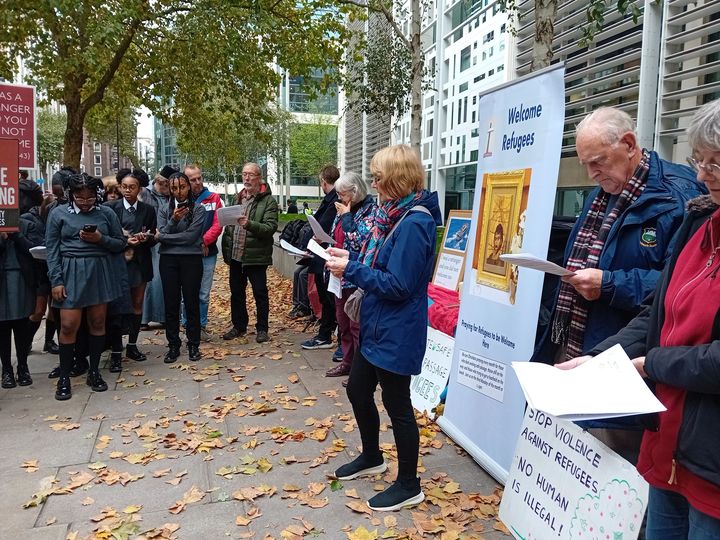
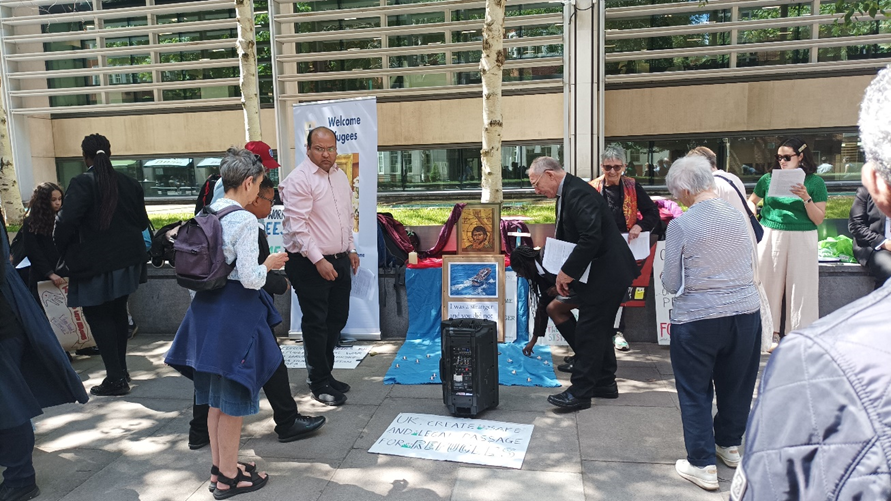
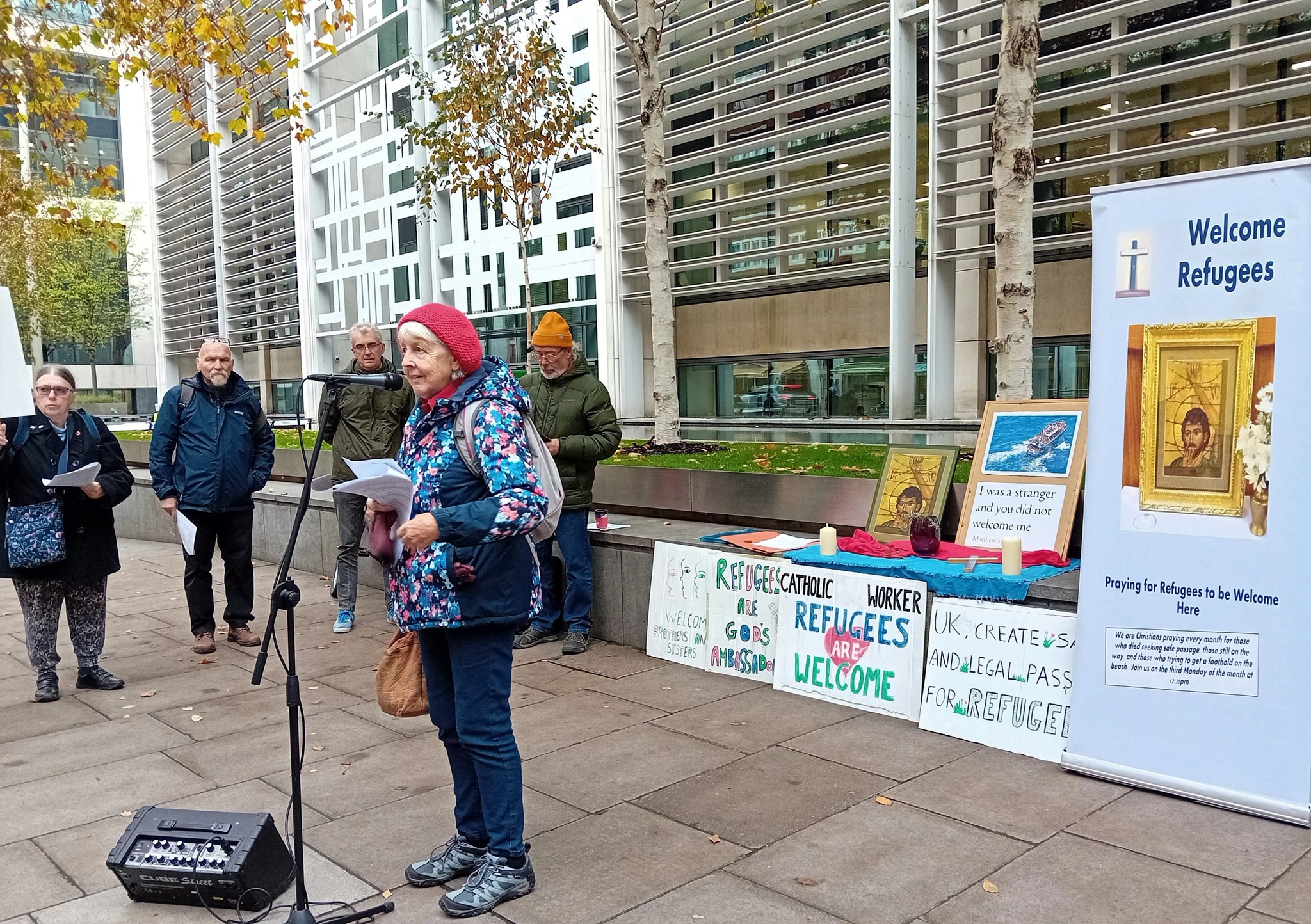
A Vigil sponsored by Westminster Justice and Peace, London Catholic Worker and the London Churches Refugee Fund, is held outside the Home Office from 12.30pm-1.30pm, 2 Marsham St SW1, on the third Monday of each month to pray for migrants who have died attempting to reach England. The next one will be on 17 March 2025.

LINK

Seeking Sanctuary: https://seekingsanctuary.weebly.com/

Bishop Paul McAleenan urges UK government to address causes of forced migration

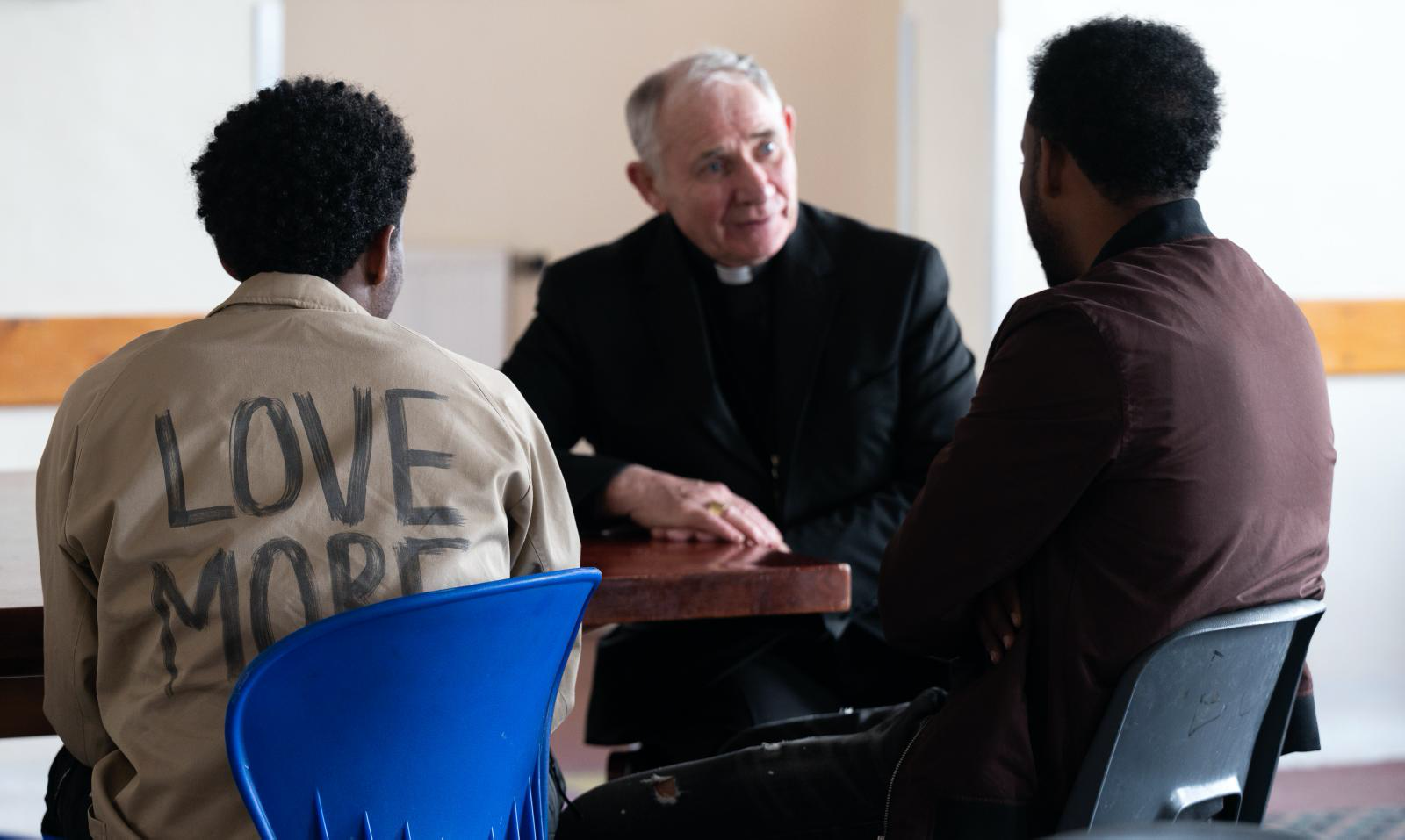
Bishop Paul talks with asylum seekers. Photo: CBCEW

Source: CBCEW

Following the second reading of the Border Security, Asylum and Immigration Bill on Tuesday, 11 February, Bishop Paul McAleenan urged the government to address the root causes that force many to make dangerous journeys in search of safety.

The new law would put new crimes on the books and grant harsh counter-terror-style powers to tackle people smugglers bringing migrants across the the English Channel from France.

Bishop McAleenan, Lead Bishop for Migrants and Refugees, said: “Sadly, this government’s approach to immigration and asylum seems very similar to that of the previous one. As before, this bill seems to favour criminalisation over compassion and protection.

“We know of the fragile state of the world today; wars, conflicts and other factors which motivate or force people to flee their homeland are not decreasing. In the absence of safe and legal routes, as has been said many times before, the afflicted and persecuted are left with no choice other than to risk dangerous journeys.

“The new government has done little to address the lack of safe and legal routes – genuine alternatives remain unavailable. Instead, the government has proposed even harsher measures, such as expansion of detention powers and reduced protection for survivors of trafficking and modern slavery.”

Bishop McAleenan continued: “While the ambition to combat exploitative gangs and human trafficking is certainly welcome, it is difficult to see how measures that criminalise asylum seekers will achieve these aims. A distinction must be made between victims and those who profit from their vulnerability.

“Some of the proposed measures will increase the hardship of those who have been exploited. Relief, not presenting further difficulties, should be the government’s priority. With this bill, will refugees ever have the opportunity to find safety? We must resist closing the door of hope on asylum seekers and refugees.

Bishop McAleenan concluded: “I urge the government to reconsider its approach and instead focus on addressing the real drivers of forced migration, ensuring access to safe routes and upholding the fundamental principles of compassion.

“The words of Pope Francis are perpetual: ‘Every migrant has a name, a face and a story.'”

National Justice and Peace Network Webinar, 6 February: Open the Doors to Freedom from Trafficking and Exploitation

At this webinar, participants will learn a little more about the insidious issue of Human Trafficking and Modern Slavery in the UK and importantly what we can do as ‘Pilgrims of Hope’ during this Jubilee Year to help victims of Human Trafficking as we shine a light on this important issue.

Brian O’ Toole, who is a member of the National Justice and Peace Network (NJPN), Act to Prevent Trafficking (APT Ireland) and the Religious in Europe Networking Against Trafficking in Europe (RENATE) and Talitha Kum will be hosting this webinar entitled: Open the Doors to Freedom from Trafficking and Exploitation on Thursday 6 February 2025 at 7pm. 

Register here: https://tinyurl.com/3ps67cec

National Justice and Peace Network

Home Office Vigil Prayers – 18 November 2024

Barbara Kentish outside the Home Office 18 Nov 2024. Photo: Pat Gaffney

This month those gathered at the regular Prayer Vigil outside the Home Office remembered the following people who died a year ago, in November 2023, attempting to reach sanctuary in Europe:

DateDetails
?8 people from Gambia died of exhaustion during a 15-day boat journey from Gambia to the Canaries. Their bodies were thrown in the sea; 55 survived. 
3/11A boy died from exhaustion in hospital, having arrived at El Hierro (Spain) by boat from West Africa one day earlier; 83 survived.
4/11134 people from Senegal, including at least 3 children and 6 women, drowned when a Canaries-bound boat on the way from Senegal sank off Nouadhibou (Morocco);15 191 survived.   2 people died of unknown cause, their bodies found on board a boat during rescue off the Canary island of El Hierro. 2 others died on the way to hospital.   A man of 23 from Syria died, his body found by nature researchers in Białowieża Forest (Poland) near Narewka River at the Poland-Belarus border.
5/1115 people were presumed drowned off Nouadhibou (Morocco), missing from 7 canoes on the way from Senegal to the Canaries.   13 people, including 2 children, from sub-Saharan Africa died of hunger and thirst on the way to Spain, their bodies in state of decay found in boats off Nouadhibou.   A body, probably of a woman, wearing a white shirt & tied to a tire used as a life vest was found between rocks on the coast of Lampedusa (Italy).
6/11Dinh Anh Nguyen, a man of 37 from Vietnam, was hit by a train near Calais (France) while walking on railway tracks in the dark.   182 people from Guinea, Mali, and Senegal drowned off Gadaye (Senegal) on the way from Bargny (Senegal) to the Canary Islands (Spain). 87 survived.
8/1117 people from Algeria drowned when a boat went missing on the way to Murcia (Spain) after embarkation from Mostaganem (Algeria).   2 men, both aged around 30, drowned off Gadaye (Senegal) on the way to the Canary Islands, their bodies found at Diamalaye beach (Senegal); 87 survived.
9/11A body was found by the Spanish Civil Guard, after a boat from West Africa arrived south of El Hierro (Spain); 79 survived.   Mohammed Amine Saidat, a man of 26 from Morocco, was hit by a train in Bolzano (Italy) while looking for shelter for the night. He had camped near the site of his death.
10/11A man’s body was found by journalists while reporting in the Kupa Riverbed in Netretić (Croatia) on the Croatia-Slovenia border.
11/117 people, including an infant, drowned, their bodies recovered in the Mediterranean Sea off Sfax (Tunisia) by the Tunisian National Guard.   2 people from sub-Saharan Africa drowned on the way from Sfax (Tunisia) to Lampedusa (Italy) when they fell from a small boat when rescuers neared; 67 survived.
12/11A body was found by Belarus border guards in Belarus near the 82nd Belarusian pillar of the border fence with Latvia.   A man of about 30 from sub-Saharan Africa drowned off Gadaye (Senegal) on the way to the Canary Islands, his body found at Déni Guedj Nord beach (Senegal); 87 survived.   A man of 29 from Eritrea died of unknown causes on the way to Lampedusa (Italy), his body found on board a boat by Italian coast guards.
13/117 people from Liberia, Palestine, Syria and elsewhere, including a child and 2 women, drowned when a rubber boat on the way to Chios (Greece) sank in stormy weather off Cesme (Turkey); 6 survived.   Abdelbassit Mohammad, a man of 22 from Sudan, had his throat slit during a brawl between migrants under the Mollien bridge in Calais; his attacker fled.
14/1111 people from Algeria drowned in the Mediterranean sea, off Murcia (Spain) on the way from Mostaganem (Algeria).   16 people drowned when a boat hit rocks on the way from Senegal to the Canaries (Spain), their bodies found on a beach of Lagouera (Morocco).
15/11A person from Gambia died of exhaustion during a 15-day boat journey from Gambia to the Canaries, their body found during rescue; 55 survived.   19 people from Algeria drowned when a boat missing on the way to the Balearic Islands (Spain) after embarkation from Algiers (Algeria).
Mid Nov.A person died of unknown causes on the way from Africa to Lampedusa (Italy), buried in Palma on the island of Sicily.
16/1119 people from Algeria drowned when a boat went missing on the way to the Balearic Islands (Spain) after embarkation from Algiers (Algeria).
17/1135 people, including 2 children and 5 women, from Morocco and sub-Saharan Africa, drowned, when a boat capsized in high waves south of Guelmim (Morcco) on the way to the Canaries; 10 survived.   Baysal Recep, a man of 42, and Geçsöyler Mehmet Ali, a man of 37, both from Turkish Kurdistan, were hit by a truck and killed while walking on the emergency lane of the A16 near the Calais ferry terminal.   An Albanian man of 37 died in hospital after attempting suicide in Brook House removal centre in Gatwick in fear of deportation.
19/1118 people from north Africa went missing on the way to Alicante (Spain) after embarkation from Tipaza (Algeria).
20/11A girl of 2 from Guinea died of unknown causes on a rescue ship on the way to port after shipwreck off Capo Ponente (Italy); 43 survived   8 people from sub-Saharan Africa, including 2 children, drowned on the way from Sfax (Tunisia) to Lampedusa (Italy) after shipwreck off Capo Ponente (Italy); 43 survived.
21/11A woman of 36 drowned off Lampedusa (Italy) on the way from Sfax (Tunisia) when a metal boat sank during rescue; 46 people, including her sister, survived.
22/11Mulu Wolde Tsehaye, a woman of 34, and Eskiel Sebsbea Tsgaye, a woman of 37, both from Ethiopia, and a man named Aman, drowned when a Britain-bound boat capsized after leaving a beach near Equihen-Plage (France); 58 survived.
26/11Mikhail Zubchenko, a man of 24 from Russia, committed suicide after 14 months in Asylum Seekers Center in Echt (Netherland). He was a LGBT asylum seeker.
27/11A person from Egypt was found frozen to death in the outskirts of Sofia (Bulgaria), part of group of 10 migrants; 9 survived.
29/11A body was found on an inflatable boat during rescue off Gran Canaria (Spain); 50 survived.   2 people drowned, having been thrown into the sea near Cadiz (Spain) by traffickers using a fast drugs-smuggling boat from Morocco; 23 survived.

Service Sheet for the November 2024 Prayer Vigil

Sign up to receive email news & alerts of changes or cancellation at: homeofficevigil@gmail.com

Three Years of Home Office Vigils for Migrants

October 2024 Vigil outside the Home Office. Photo: Pat Gaffney

By Abi Yendole

This month’s Migrants Vigil at the government’s Home Office in London marked three years of monthly prayers there for people who have died trying to reach the UK and for the UK to be a more welcoming nation. An organiser, Barbara Kentish, said. “If only we could say things were better, but alas, we need to pray harder than ever.” The one-hour vigils are co-sponsored by Westminster Justice and Peace Commission, London Catholic Worker and London Churches Refugee Fund.

Brother Johannes Maertens of the London Catholic Worker gave a reflection on his visits to Calais and the work of an arts refugee project that uses maps and art to encourage refugees to tell their stories. He commented that some of the young men he met had been on the road for six years.

The names of people who died a year ago – in October 2023 – trying to enter Europe or the UK were read out and a prayer of repentance said afterwards: “You told us to welcome strangers in our land, but we have hated, humiliated, imprisoned, and killed those who have asked for our hospitality. Forgive us and help us to change.”

Around 30 people attended the latest vigil on Monday 21 October. James Trewby (Columban Justice, Justice, Peace and Ecology coordinator) and Abi Yendole (Columban Faith in Action Volunteer) accompanied the Justice and Peace Committee of 16 Year 10 students and one teacher from St George’s School in Maida Vale to the vigil.

One student said afterwards: “Hearing all the names and stories of those who have died meant I was able to personify every victim; give every victim a face; it was powerful.” Pope Francis has said something similar, captured on the refugee memorial in Dover, that, “every migrant has a name, a face and a story.” Another student said: “As a member of the justice and peace group, going to the Home office to pray for refugees has been a profound and humbling experience. Standing in solidarity praying for those seeking safety and refuge, I felt the weight of their struggles and the urgency of advocating for justice. In the quiet moment of prayer, we offered up hope for a system that could see beyond the borders to the humanity of those in need. It was both a spiritual act of compassion and a call for action, reminding me of the power of community and faith in pursuing change.”

Also present on Monday were representatives from churches around London, Jesuit Refugee Service, London Catholic Worker, Pax Christi England and Wales and Seeking Sanctuary.

Intercessions included the prayer: “We pray for the end of the hostile environment, and the creation of safe, legal routes to claim asylum in this country.”

Watch: Refugee Action Video: www.youtube.com/watch?v=fcaM89VzkEY

NEXT PRAYER VIGIL FOR MIGRANTS OUTSIDE THE HOME OFFICE: MONDAY 21ST OCTOBER 2024, 12.30-1.30PM

A monthly Memorial Prayer Vigil for refugees and asylum-seekers takes place on the 3rd Monday of every month outside the Home Office, SW1P 4DF, 12:30pm to 1:30pm.

Praying for

  • Those who died trying to reach the UK
  • Victims of current wars
  • Those in detention and who are homeless
  • The UK to be a more welcoming nation

Sign up to receive email news & alerts of changes or cancellation at: homeofficevigil@gmail.com

Co-sponsored by Westminster Justice and Peace Commission
London Catholic Worker and
London Churches Refugee Fund

Sunday 29 September: World Day of Migrants and Refugees

In a message to mark the World Day of Migrants and Refugees, Bishop Paul McAleenan has praised the Catholic community in England and Wales for the generous welcome and kindness many offer to refugees and migrants.

“Fundamental to our Christian faith is the belief that we are all a pilgrim people on our journey to our true homeland. God is with us and we travel together,” says Bishop McAleenan, the Lead Bishop for Migrants and Refugees for the Bishops’ Conference. “They are looking for a place to settle, where they can live in peace with their families and have the opportunity to prosper. They are, indeed, a pilgrim people. And God walks with them.”

Bishop McAleenan believes that many parishes have responded positively to those fleeing harm and seeking sanctuary to rebuild their lives:

“I wish to thank all of you in parishes and communities who are providing support and welcome to migrants and refugees who reach these shores… There are many, many parishes in this country who have positively responded to the stranger seeking asylum… Surely through your actions, migrants and refugees who experience such hospitality can more easily believe that God is with them.”

Participation

The theme of the World Day of Migrants and Refugees is ‘God walks with His People’. We have many days of prayer in the Catholic calendar, so it is always useful to offer some practical advice to the faithful to encourage participation in the day.

“I’d like to suggest how you might celebrate this day in your parish, in your school or community,” says Bishop McAleenan. “Perhaps you can have a short prayer vigil, reflecting upon on a scripture passage which recounts how God accompanied his people on a long and dangerous journey through the desert and ask him to protect those on the move today.

“If you do have a prayer vigil, please invite migrants and refugees to join you. If your parish is blessed with grounds, you may consider having a procession – walking around the area in silence, or reciting an appropriate prayer – that would be a demonstration of solidary with all those on the move.

“If you know someone who is a refugee you may wish to invite them to join you and your friends for a tea or coffee. Why? Simply to encounter them – a word beloved by Pope Francis – to speak to them, to listen to their story, if they wish to share it.

“In such ways, we open our minds and hearts to our brothers and sisters and perhaps any prejudices or misunderstanding we may have will be dispelled.”

Saturday 28 September: An International Mass with the Ethnic Chaplaincies will be celebrated at Westminster Cathedral by Cardinal Vincent Nichols

NEXT PRAYER VIGIL FOR MIGRANTS OUTSIDE THE HOME OFFICE: MONDAY 16TH SEPTEMBER 2024, 12.30-1.30PM

A monthly Memorial Prayer Vigil for refugees and asylum-seekers takes place on the 3rd Monday of every month outside the Home Office, SW1P 4DF, 12:30pm to 1:30pm.

Praying for

  • Those who died trying to reach the UK
  • Victims of current wars
  • Those in detention and who are homeless
  • The UK to be a more welcoming nation

Sign up to receive email news & alerts of changes or cancellation at: homeofficevigil@gmail.com

Co-sponsored by Westminster Justice and Peace Commission
London Catholic Worker and
London Churches Refugee Fund

NEXT PRAYER VIGIL FOR MIGRANTS OUTSIDE THE HOME OFFICE: MONDAY 19TH AUGUST 2024, 12.30-1.30PM

A monthly Memorial Prayer Vigil for refugees and asylum-seekers takes place on the 3rd Monday of every month outside the Home Office, SW1P 4DF, 12:30pm to 1:30pm.

Praying for

  • Those who died trying to reach the UK
  • Victims of current wars
  • Those in detention and who are homeless
  • The UK to be a more welcoming nation

Sign up to receive email news & alerts of changes or cancellation at: homeofficevigil@gmail.com

Co-sponsored by Westminster Justice and Peace Commission
London Catholic Worker and
London Churches Refugee Fund

Bishop Paul McAleenan condemns acts of violence and stands with those supporting migrants and refugees

Source: CBCEW

Bishop Paul McAleenan, Lead Bishop for Migrants and Refugees, has condemned the riots that have taken place across the UK, saying such violence threatens the values of our society:

“I condemn the appalling violence over the past week, especially that directed at migrants and their places of residence,” said Bishop McAleenan. “They demonstrate a complete disregard of the values which underpin the civil life of our country.”

He went on to praise charities, faith groups and volunteers who work in the community to welcome migrants and refugees:

“Today, and always, we need to continue to pray, work and stand together for peace in our country. The actions of the few involved in violence stands in stark contrast to the work of charities, church groups and volunteers who tirelessly extend the hand of welcome to migrants in acts of solidarity. We hope and pray that they will re-double their efforts so that we can rebuild communities after the terrible events of the last few days.”

Bishop McAleenan had a particular message for refugees and those working for the emergency services:

“My prayers are particularly with those who are sheltering in hotels or are feeling threatened. You are loved and welcome here. We all should do what we can to make sure that you feel safe. My prayers are also with the emergency services, who selflessly continue to work despite the risks. Thank you for all that you do in the service of the common good.”

In the aftermath of the horrific Southport attack, Bishop Tom Neylon, Auxiliary Bishop of Liverpool, stood in solidarity with other faith leaders in Merseyside to call for peace.

Like Bishop McAleenan, he too appealed for calm and an end to violence:

“There are non-violent means to resolving issues that we might not agree on in our society, so let’s use those methods to bring about the peace and healing we need at this moment.”