A monthly Memorial Prayer Vigil for refugees and asylum-seekers takes place on the 3rd Monday of every month outside the Home Office, SW1P 4DF, 12:30pm to 1:30pm.
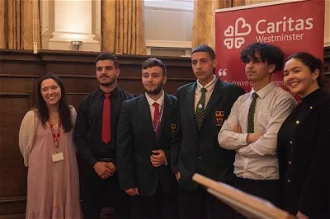
Caritas Westminster recently hosted a reception ahead of Refugee Week (17th – 23rd June), a festival which celebrates the contribution and resilience of refugees in our communities and around the world.
The reception at the London Jesuit Centre heard from Fr Dominic Robinson SJ, parish priest at Farm Street and Chair of Westminster Justice and Peace alongside Ahlam Hamed, who supports students at St Elphege’s School, Wallington.
Ahlam spoke about the importance of community in welcome and the many different ways in which people can support. She spoke particularly about the Community Sponsorship scheme and the Sutton Deanery Refugee Community Sponsorship Group (Diocese of Southwark) who welcomed her and her family via the scheme.
Hannah Sansom, Community Building Lead at RESET shared her reflections on the Wisdoms Report. RESET supports Community Sponsorship groups to welcome refugees into their local area, and funded the Wisdoms Report.
A group of students from Newman Catholic College shared their ideas for the future, highlighting the need for young people to live in a place where they can feel safe and the role we all have in shaping a better future.
The event celebrated contributions to the Wisdoms Report, a listening exercise led by the Mayday Trust in partnership with Caritas Westminster which was open to anyone who had arrived in the UK seeking sanctuary. Those who took part shared about the need to have control over their lives and to feel safe and secure.
A total of six recommendations we made in the report, which can be read in full HERE
Hannah Sansom, Community Building Lead at refugee charity RESET, said: “This report is hugely powerful and has the potential to educate people on the complexities of seeking safety, what people really need and how important and significant choice, freedom, safety and community really is. Thank you to everyone who was a part of it.”
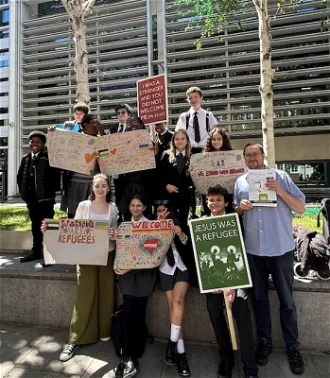
St George’s pupils at Home Office vigil. Image ICN/JS
Refugee Week began on Monday, with a moving prayer service outside the Home Office in Westminster.
The names of hundreds of refugees who lost their lives in just one month, last June, trying to seek safety in Europe or the UK were read out.
Many are unknown, but as Pope Francis said, ‘Every one has a name, a face and a story’.
They included: ’15 people, including a baby, were presumed drowned, their bodies found by a Tunisian fisherman in his nets in the Mediterranean Sea.’
‘A young girl from Cameroon drowned, her body wrapped in a pink winter suit recovered by Tunisian coast guard off Kerkennah, Tunisia.’
‘20 Syrians, including at least 2 children, 3 women, and 3 men, drowned when a boat on the way to Spain sank of Arhat, Algeria; 7 bodies were probably found, 2 survived.’ (Read the prayers and full list of names HERE.)
The event was co-ordinated by Barbara Kentish. Among participants were representatives of Westminster Justice and Peace, Fr Martin Newell and Brother Johannes and others from the London Catholic Worker, Pax Christi, Columban J&P, and a group of students from St George’s School, Maida Vale who made some striking placards. Their messages included: ‘Jesus was a Refugee’ and ‘I was a refugee and you did not welcome me’. The students – several who were from migrant families – also contributed some heartfelt prayers.
In his reflection, Fr Joe Ryan thanked everyone present and said: “In this Monthly Vigil we remember those who have lost their lives in their efforts to escape war, violence, persecution and starvation to come to another place where they hope to find a new home and security for their family.
“The theme for this Refugee Week is: OUR HOME- and we are also invited to recognise the contribution made by migrants and refugees who settle in another country. This truth is remembered each year at the Migrant Mass.
“OUR HOME- home is where we like to live in peace and harmony, with security and shelter and have the basic elements of human living.
“We stand outside another Home, the Home Office- it is here for the security of our nation, but also should be a living example of security for the stranger, the asylum seeker and the refugee.
“None of this is evident in the modus operandi of the Home Office.
“Fine words and vocabulary may be used, but the reality is that migrants and refugees are seen as VERMIN! What do you do with vermin? Get rid of them at all costs!! They are ostracised and demonised!
“These Refugees and Migrants are our brothers and sisters. They need to be treated as such….
“Politicians and officials create a blanket of fear and warn us that we will be overrun by migrants.
“We are reminded that they will take our jobs and homes… Now that Nigel Farage is back on the scene, the spin against migrants is all the greater!
“Yes, we know that homelessness is a factor in our society, but there are at other solutions.
“We are asked this week to remember the contributions made by Migrants: look around you in the UK; where would the NHS be, our care homes, our corner shops and transport be if it were not for people who come from overseas?
“Think of the millions of pounds spend on building fences and barriers to keep people out.
“If only some of those resources were used to investigate and negotiate in nations where people have to flee for security! What a difference it would make if only the millions and billions spent on so-called security could be spent on negotiations and building bridges between nations.
“Looking at the manifestos for the General Election, the signs are not hopeful. All we see is, cutting back on net migration. The flights may or may not take off for Rwanda.
“I would like to declare here and now to Mr James Cleverly, Secretary of State, or whoever may be in charge, that I would be hoping to be standing on the runway to prevent the plane taking off or suffer the consequences. Would I be alone? I don’t want to be accused of mob incitement, but then if it happened at the White House, and I could still run for President.. the I’m ok!
“We need to sow seeds of hope just like we have heard in our gospel reading today. The mustard seed, the smallest of all, can grow into a large tree. We need to be people of hope. We need to be people who show solidarity with our brothers and sisters in desperate situations.
“This is the significance of us being here today so that the world may know that we are standing shoulder to shoulder and offering a welcome to the migrant and refugee.
“It’s as simple and complicated as that.
“We mustn’t lose hope in the face of what seems like an impossible challenge. It is always better to light one candle than to curse the darkness!
“There are so many like-minded people who can inspire us.
“Pope Francis has been an inspiration over many years.
“He has been challenging to nations, governments and ourselves. He has called us to welcome, protect, promote, and integrate people fleeing from conflict and persecution.
“We have the words of Jesus himself, ‘I was a stranger, and you made me welcome’.
“We need to see the face of Jesus in our brothers and sisters and those we are remembering today.
“We need to extend the hand of welcome. Many have already done so and are still showing to those in need, that we do care and that there are so many who want to help, not ostracise.
“The crisis in Ukraine has shown the compassion and care that is evident in so many people in our nation. That Spirit of welcome needs to be highlighted and promoted, rather than the fear for ourselves… We’ll be back. The witness goes on. Thank you for being here and spread the message please.”
The final blessing was given by Bishop McAleenan, Lead Bishop for Migrants and Refugees for the Bishops Conference.
This monthly Memorial Prayer Vigil for refugees and asylum-seekers takes place on the third Monday of every month outside the Home Office, SW1P 4DF, 12:30pm to 1:30pm.
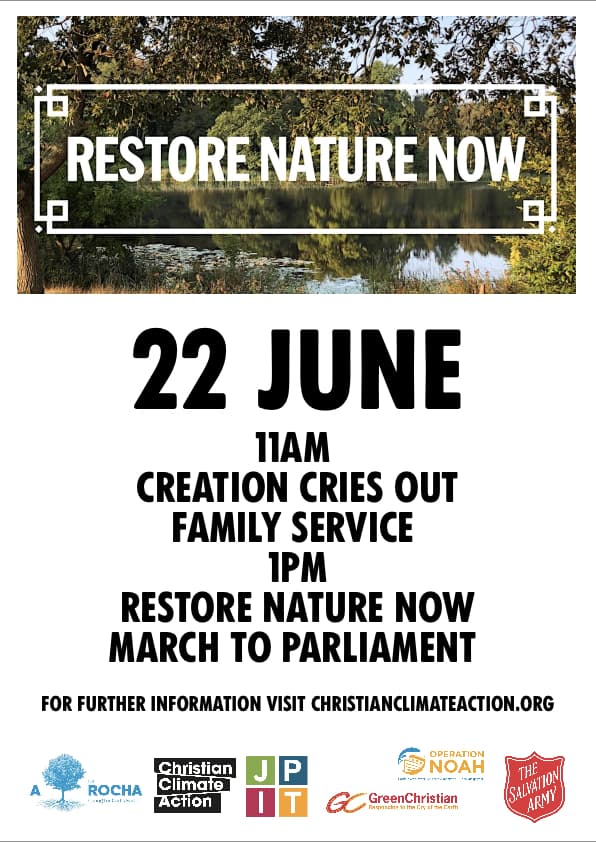
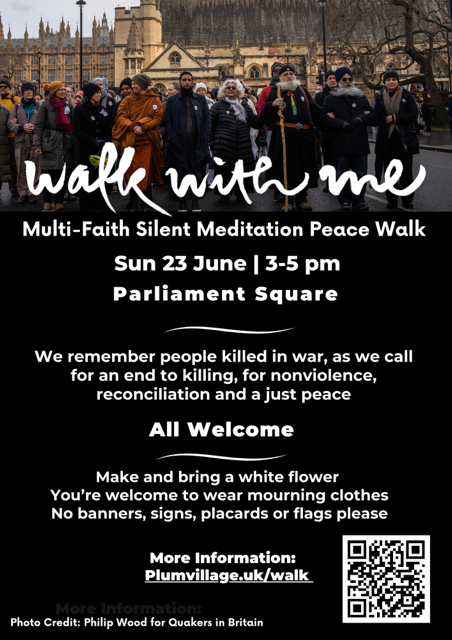
The weekend of 22/23 June 2024 is a busy one for Westminster Justice and Peace.
On Saturday, 22 June, we will be participating in the ‘Restore Nature Now’ rally, alongside Chris Packham and thousands of other people from organisations that care for and protect our natural world. Before the rally, we are hosting an Ecumenical Service – ‘Creation Cries Out’ – at Farm Street Church at 11.00am, with participation from a wide range of Christian charities and activists. Please come along and join us! Nature Rally
On Sunday, 23 June, we are joining a Multi-Faith Silent Meditation Walk for Peace. Every day on our screens we see reports of the horrors of war. We want to show our commitment to a more peaceful world by uniting in this visible coming together of people from many different faith communities. Join us in Parliament Square and be part of a multi-faith movement. Peace Walk
This weekend also sees the conclusion to Refugee Week, 17-23 June 2024. This is an important time for showing our solidarity with all those who come to the UK seeking sanctuary from war and violence. Refugee Week
To mark Refugee Week, that runs from 17 – 23 June 2024, Bishop Paul McAleenan, Lead Bishop for Migrants and Refugees for the Bishops’ Conference, offers a reflection on three themes – his recent visit to the Bibby Stockholm barge, the impact of the Rwanda Bill, and societal attitudes towards refugees and migrants.
In late April, Bishop McAleenan was invited by the Home Office to visit the Bibby Stockholm. The vessel is a large floating barge moored off Portland Harbour in Dorset that accommodates asylum seekers – many who have fled torture and persecution.
The visit offered a chance to meet with residents, reflect on their plight and consider the pastoral care we could offer. At the time of the visit, Bibby Stockholm housed over three hundred asylum seekers, but numbers fluctuate depending on departures and arrivals.
“The most memorable part of the visit was undoubtedly meeting the residents and hearing their stories,” said Bishop McAleenan. “I was deeply moved by their resilience, the commonality of their aspirations and their willingness to share their experiences, which are, sadly, often traumatic. Despite the hardships they had endured, their desire to find a home here and belong to a society to which they can contribute to, is a testament to our shared humanity.”
“Indeed, I heard many positive stories from the local community – many going out of their way to provide support and a welcome for the residents. It was edifying to see Staff on the vessel genuinely engaging with residents, providing advice and helpful information to assist them to integrate more effectively.”
Bishop McAleenan was also pleased to reflect on the wider welcome extended by many Catholics in our countries to asylum seekers:
“In the last few years, we have witnessed the wonderful work of Catholic communities across England and Wales, who have welcomed migrants from Ukraine, Hong Kong and elsewhere with acts of solidarity and practical help.”
However, Bishop McAleenan’s visit coincided with the recent passing of the Rwanda Bill. He remarked on the distressing impact the legislation was having on Bibby Stockholm residents:
“The result of the passing of the bill was certainly felt onboard. A number of residents had received letters from the Home Office mentioning the possibility of deportation to Rwanda. It is an unjustifiable policy and has created an unnecessary sense of fear and anxiety.”
“The UK Government has a responsibility to ensure that we have an immigration system that upholds the dignity of human life. The Rwanda scheme does not do that.”
Bishop McAleenan concluded his reflection by calling for Catholics to use Refugee Week as an opportunity to pray for refugees and asylum seekers:
“During Refugee Week, I invite everyone to join in prayer and reflect on our understanding and belief that every person is made in the image and likeness of God. Let us remember that we all seek the same fundamental needs – safety, acceptance, and a place to call home.”
“Let us be thankful for the work of so many people in England and Wales to welcome migrants, but not be afraid to ask ourselves what else can we do to assist migrants and refugees”
Bishop McAleenan will be leading the prayer vigil outside the Home Office on Monday, 17th June from 12.30-1.30pm, Marsham Street, SW1P4DF
A monthly Memorial Prayer Vigil for refugees and asylum-seekers takes place on the 3rd Monday of every month outside the Home Office, SW1P 4DF, 12:30pm to 1:30pm.
A monthly Memorial Prayer Vigil for refugees and asylum-seekers takes place on the 3rd Monday of every month outside the Home Office, SW1P 4DF, 12:30pm to 1:30pm.
Archbishop John Wilson gave the following homily at today’s London Migrant Workers Mass at St George’s Cathedral, Southwark.
It’s wonderful see everyone here today. And I hope you all feel at home. Maybe you could turn to the person behind you or in front of your or beside you and if you don’t know them just say “I’m glad you’re here.” … I’m glad you’re here… its OK they don’t need your life story – we can do that afterwards..”
Dear brothers and sisters in Christ, today we honour St Joseph with a specific title: St Joseph the Worker. And we know from the Gospels that he was a carpenter.
He was the husband of Our Blessed Lady, and the foster father of the Lord Jesus. And it’s good to remember, and it’s in the Catechism if you want to look it up, that for most of his life before he began his public ministry, the Lord Jesus lived a life like most of us, like most people in history. A daily life kind of hidden. No evidence of greatness at that point. And a life of manual labour. A life of work. Like his foster father Joseph, the Lord Jesus was a worker a carpenter.
He would of course become a miracle worker. And the worker of our salvation.
But it’s right today as we gather, that our celebration focuses on the dignity and the importance of human work.
There’s a story told – and you may have heard it before – but please laugh at the end anyway – whether you’ve heard it or not. During a parish retreat the parish priest invited a group of priests from different religious orders to take part. And in preparation they went in to the church to pray. And as they began to pray – the lights went out.
And so the Benedictines – they prayed from memory. The Jesuits had a discussion about whether if there was no light did they have to pray. The Franciscans composed a song, praising God for the gift of darkness. The Dominicans restarted their debate about how light is sign of the transmission of faith. The Carmelites just became silent. Eventually up gets the parish priest, and goes to the hallway, replaces the fuse and the lights come on.
Now prayer is important. Our spiritual life is vital. But so is work. So is work. And the Catholic social tradition teaches that work is both a duty and a right. It’s through work that we collaborate with God our creator. That we exercise an authentic stewardship over the earth’s resources. That we provide for ourselves and our families and our communities and especially for the weakest and the poorest. It’s through work that we recognise and harness the gifts and the talents given by God to each person. All different. All needed. It’s through work that we grow in virtue. Not least patience and perseverance . It’s through work that we grow in holiness, uniting our work to the great work of salvation in Christ.
St John Paul II said that work helps us to be more human, (I don’t know what you think about that – do you agree?) Work helps us to be more human. And just as we need work we also need rest. We need to recreate, humanly and spiritually, honouring God’s own rest at the end of creation.
Work is part of God’s plan for us. It helps us understand our identity. And fulfil our mission. So many people in the past and today have come here to seek and to provide essential work for our nation.
Recent information shows that foreign-born people make up nearly one fifth of the working population in the United Kingdom. That surprises me. That’s a big number.
Many highly educated migrant workers are over-qualified for the jobs they do here in the United Kingdom. Significant numbers of workers from overseas support the UK in the hospitality sector, in transport, in communications and in information technology.
And here’s a really amazing statistic which is true: almost one fifth of the NHS in England are people of nationalities other that British.
The contribution of migrant workers to the United Kingdom is immense. So much so – that we wonder how could we survive without them. But the decision to leave one’s homeland – which many of you have taken – to leave one’s family sometimes as well and to search for work here – that’s not an easy decision to take. It demands courage and sacrifice.
So how important it is to today to say thank you. To say thank you to everyone here and by extension to say thank you to everyone who had migrated to our country to work here in the United Kingdom. Because that’s you and thank you. Generously sincerely thank you.
It’s important that you know that our life together is better because you’re here. That our life together is better because of the skills and the service and the contribution that you give. That our life together is better because of the diversity of cultures that you bring to our and your communities We are better in our country because you are here.
The Catholic Church in the UK has always been a migrant church long before any of us were born. Members coming from across the world . Our parishes or schools, our chaplaincies, not least across London in our three dioceses, are a beautiful mosaic of people from all nations who find here in the Church a home. We are proud of this as a Church in our country. We are proud that our doors are open and there is a welcome for everyone. We celebrate our diversity of nations with joy. The blessing of our unity in Christ gives witness in the Church to the harmony of humanity and this is a precious sign which we send out to our country – not least to those who would argue otherwise!
Catholic Social teaching upholds the dignity and the rights of workers. It condemns all forms of injustice toward working people whatever their country or origin or status in life. The human person is always more important than the product they produce. The human person is always more important that the service they provide.
Work is for the person. Not the person for work. Employment should never use a person, placing on them intolerable burdens and unacceptable conditions. Rather work its a noble calling to share the life of our Creator.
Work enables the human person to flourish in their families and in society. And while work contributes to our fulfilment we must remember we must never forget that every person is more than their job. First and foremost every person, each of you, is a son or daughter of God. Valuable and respected for who you are. Not for what you achieve or what you do.
Today dear friends the Church points us to St Joseph for encouragement. He’s a model for us who work. A model who provided dedication and protection for his family. Who was faithful to what God asked of him.
And so today we ask the prayers of St Joseph. We ask him to pray with us for the protection of workers and their rights. We ask St Joseph to pray with us for respect for the dignity of human labour. And we ask St Joseph to pray with us for an increased appreciation of the valued role of workers from overseas in our communities. That they, that you, are treated honourable and properly.
Like our Church in this country the history of humanity is a history of migration, of movement, of shifting people across land and sea through time.
The history of our faith is a history of migration from Abraham to the people of Israel, From the Holy Family to the countless asylum seekers, refugees and migrants of our own day.
The experience of being a stranger in a strange land is somehow woven into the fabric of our human existence, therefore we must be people of welcome. We must be people of welcome and in welcoming our we encounter in them the face of Christ. In listening to their story we begin to understand their unique identity. In offering refugee and asylum and the opportunity to work we build a better future together.
My brothers and sisters, the foster child of St Joseph the Worker the carpenter’s son is the Word made Flesh.
The Lord Jesus our brother, our friend, our Saviour, himself learned to work as a carpenter. And that prepared him for the work of salvation on the wood of the Cross.
The Lord Jesus gives us a commandment that has no exceptions. To love God to love our neighbour as we love ourselves.
May the example and the prayers of St Joseph the Worker inspire us to go from here renewed with a mission of welcome of solidarity and of justice. So that the gifts of all may rise in the service of all. Amen
The Jesuit Refugee Service UK (JRS UK) has called for supporters to stand in solidarity with refugees, amid reports that the Home Office is launching a major operation to detain people in preparation for their deportation to Rwanda.
Senior Policy Officer Sophie Cartwright said: “Right now, people who came to the UK in search of sanctuary are living in fear of this reckless attack on human rights. As a society we cannot stand by while our obligations towards refugees are abandoned, and people are subjected to the horrors of detention and deportation.”
JRS UK accompanies, serves and advocates for the rights of refugees. As well as providing services to meet people’s immediate needs such as food and accommodation, the charity offers casework and legal support to help people navigate the asylum system. Since its founding JRS UK has accompanied people in detention – providing practical support and shining a light on the shocking conditions in the UK’s Immigration Removal Centres.
Sophie Cartwright added: “We urge anyone who is appalled by what is happening to raise their voice and to help JRS UK’s work supporting those who are put at risk by these inhumane policies. In detention centres, through our services, and through our advocacy we will continue to stand alongside people seeking safety in the UK.”








 Diocese of Westminster Justice and Peace Commission