Next Saturday, 6th August, is the anniversary of dropping the first atomic bomb in 1945 on Hiroshima, Japan, killing around 146,000 people, devastating the city and leaving a legacy of radiation-induced cancers and disability. The second nuclear bombing on the city of Nagasaki, which killed up to 80,000 people, is commemorated three days later on Tuesday 9th August.
Both days now provide annual opportunities to foster peace, pray and work towards a world free of nuclear weapons.
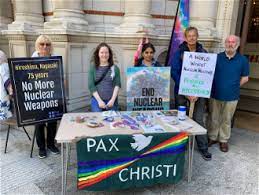
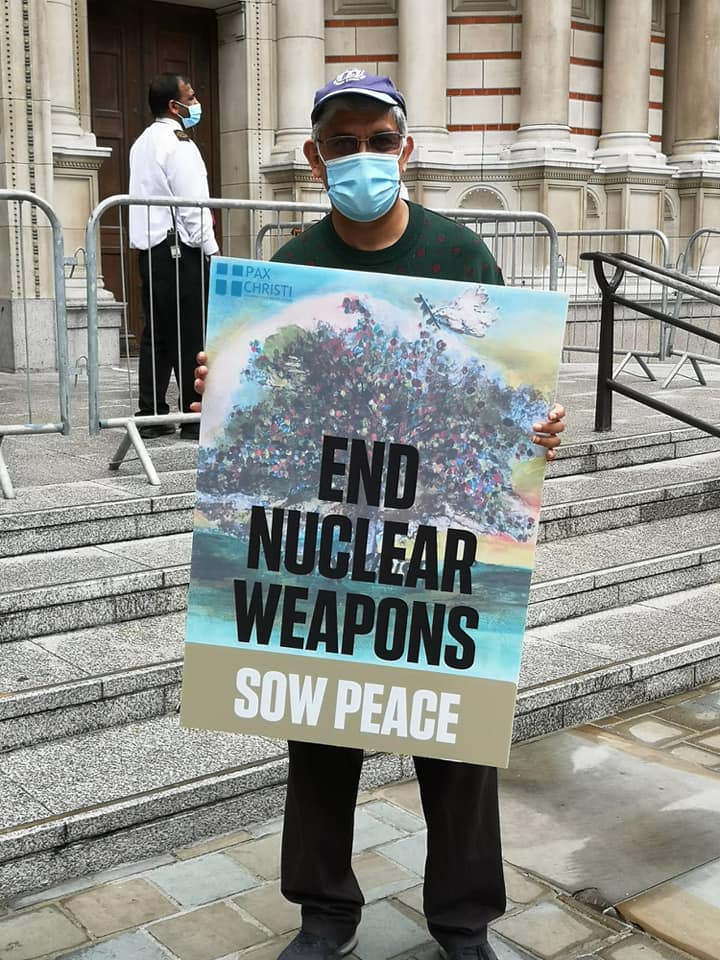
Saturday 6 August – Hiroshima Remembrance – Pax Christi will be present with a stall in front of Westminster Cathedral from 11.00am – 1.00pm. Prayer at 1.00pm.
Tuesday 9 August – Nagasaki Remembrance – Pax Christi will be present with a stall in front of Westminster Cathedral from 11.00am – 1.00pm. Prayer at 1.00pm.
All supporters of Justice & Peace and friends of Pax Christi are welcome to come along to show their support and especially to join in the time of prayer at 1.00pm.
Franz Jägerstätter Memorial Service
Pax Christi are also organising a service to commemorate Blessed Franz Jägerstätter in the Crypt at Westminster Cathedral on Tuesday 9 August, 6.30pm. Franz Jägerstätter was executed on 9th August 1943 at Brandenburg Prison for his conscientious objection to serving in Hitler’s army. He was beatified in 2007.
Following the service, people may wish to join the interfaith walk to the London Peace Pagoda for the Nagasaki Day memorial.
The use of #NuclearWeapons, as well as their mere possession, is immoral. Trying to defend and ensure stability and peace through a false sense of security and a “balance of terror” ends up poisoning relationships between peoples and obstructs real dialogue. #NPTRevCon
By Maggie Beirne, West London Justice and Peace Network Co-ordinator
We have all watched our TV screens with horror since the 24th February when Ukraine was invaded. Russia’s unprovoked attack, and the nature of its assault – indiscriminate bombing and killing of civilians leading to the internal displacement and mass exodus of refugees, and the apparent threat to use biological/chemical and even nuclear weapons – has left most of us shocked. And who has not felt a strong sense of solidarity with the plight of the Ukrainians? We empathise with their plight; we pray as individuals or in community for their survival; and we try to help practically with financial or other donations. We feel one with their cause.
The West London Justice and Peace Network reflected at a recent meeting on the challenge of pacifism in times like this. How would we as individuals respond in similar circumstances? Would we start training to use Kalashnikovs or insist on suing for peace at whatever cost? When we experience a sense almost of pride in seeing these ‘plucky’ Ukrainians giving their all to defend their freedom, do we become part of the problem; and what is the Christian response to these challenges?
Martin Birdseye, member of the Network and long-time peace activist, helped us reflect on some of the difficult issues involved.
We were reminded of the fact that history is full of examples where in time of conflict, pacifism gets swept away on a tide of solidarity. We have certainly seen our own elected politicians rush to bolster arms supplies, talking up the importance of ‘hard power’’ and the strength of our military alliances, while unsaid but very apparent, is the increased risk of nuclear war. Our very human instinct for personal and human security can lead us into an aggressive response, but is this so different from the desire of Russians for security following their terrible experience of WW2 and their fears of NATO ‘expansionism’?
In Britain, our taxes are spent on maintaining a nuclear arsenal, supposedly for our defence. But is this arsenal keeping us safe, or does it not lend a false justification for both NATO and Russia to vie for control of their respective ‘spheres of influence’? Instead of nuclear weapons strengthening our security, have they rendered the world a more unsafe place? Would our taxes have been much better spent on tackling injustices in our own society and actively building peace globally – via aid, tackling government corruption, support for refugees, or fighting climate insecurity.
In the longer term, we also need as Christian peacemakers to examine the role of Britain as probably the world’s second largest arms exporter. Arms companies and suppliers may be the only ones to gain from the current tragedy in Ukraine. Most local West London residents were unaware of the international arms fair that was recently held this year in Twickenham, yet such gatherings feed and fuel the violence that we then subsequently deplore around the world (whether in Ukraine, Yemen, or the Horn of Africa). This trade is taking place in our name as the UK government provides export licenses for ‘suitable’ arms manufacturers but claims to bear no responsibility for the resultant human rights abuses.
The network noted that the Ukrainians, like all of us, have a right to self-defence and that pacifism is not ‘passivity’. But nor can we ignore the fact that the violence perpetrated by one side tends only to beget violence from the opposition, in a never-ending cycle of retribution. Or, as better said by Mahatma Gandhi, “an eye for an eye makes the whole world blind”. So, the real challenge is to find out how we can turn to God and help others do so in these times of turmoil.
In our discussion, the network noted that concepts such as ‘justice’ and ‘peace’ can at times like this appear to be in tension but are instead totally inter-dependent. “No justice, no peace”, albeit a slogan, is accurate. As Christians we have to be active peace makers. Peace groups have organised zoom prayer meetings; had a spontaneous turn-out of people on the day of the invasion to a prayer gathering; and Religions for Peace UK have submitted a letter to the Chiswick-based Bishop of the Russian Orthodox church, to be sent to the Moscow Patriarch asking him directly to appeal to Putin. What should we be doing practically all year around to promote the educational efforts of groups such as Pax Christi and the Christian Campaign for Nuclear Disarmament?
When time permits, events in Ukraine may also encourage more reflection on the Catholic teaching around the ‘just war theory’. This theory sets out some of the principles that will determine if the cause of any war be ‘just’, and if the tactics used in warfare can also be considered ‘just’. But there is now much debate as to whether the idea of a ‘just war’ has become an obsolete concept given that the massive predominance of civilian casualties in modern warfare undercuts the moral ground for conceiving of almost any war as just.
So, whilst we need to focus over the longer term on eliminating the underlying causes of violence and war and re-introduce the power of non-violent action, what can be done in the short term? Right now, Ukraine is being destroyed and its people scattered. Alongside all the practicalities (of sending humanitarian assistance and being welcoming to refugees), Pope Francis, pleaded: “Let the weapons fall silent. God is with those who seek peace, not those resorting to violence.”
As Christians, we have to join him in condemning those who “trust in the diabolic and perverse logic of weapons” and pray for guidance on how to engage ever more effectively in the search for peace.
August 2021. The eyes of the world are focused on Japan. The world’s athletes compete for gold, silver and bronze medals.
August 1945. The eyes of the world are focused on Japan. The two most destructive weapons ever produced fall on Hiroshima and Nagasaki.
A Message from the Mayors of Hiroshima and Nagasaki:
“In August 1945, atomic bombs instantaneously reduced our cities to utter ruin and took over 201,000 precious lives. Many of those who survived have since suffered the devastating after-effects of radiation, the never-ending horror of a nuclear weapon. Even today, the full scope of radiation effects is unknown, and survivors still live in dread.
Hiroshima and Nagasaki have consistently followed the lead of our survivors, who arose from the depths of despair to warn the world about nuclear weapons. Through the efforts of many, we have thus far prevented a third use of such weapons, but sadly, our cherished hope of eliminating them has yet to be fulfilled.”
We at Christian CND find that many people are still ignorant of the horror of what happens after a nuclear blast. If they truly understood, they could not contemplate how a so-called civilised country, let alone one that shelters under the label of “Christianity,” would base its security on such evil. Pope Francis understands this absolutely and has called even the possession of such instruments of death, immoral. The Vatican has led the nations of the world in signing the Treaty to Abolish Nuclear Weapons.
This is what happened in Hiroshima on 6 August 1945. The temperature on the ground was 3,000 to 4,000 degrees. An observer writes that, “on the riverbank I saw figures that seemed to be from another world. Ghost-like, their hair falling over their faces, their clothes ripped to shreds, their skin hanging in tatters. A cluster of these injured persons moved wordlessly towards the outskirts.”
The Shiroyama National School lost 1,400 primary aged children, 31 teachers, and 105 students. The Shima Hospital was directly under the hypocentre. The initial radiation emitted was lethal as far as 1000 metres from the hypocentre. Most in that area died within a few days and many others, including relief workers, within the next few months. Many developed cancers five to 30 years later.
Many of those who could, escaped to Nagasaki. “This is a Christian City”, they said; “we will be safe here.” Three days later Nagasaki also received an atomic bomb!
Keiji Nagazawa was a child of six when the bomb fell on Hiroshima. When he grew up he became a film maker. ‘Barefoot Gen’ is a Manga film of his memories of that 6 August. It is still available online, intensely moving and a passionate plea for the end of war.
Knowing what these terrible weapons do to God’s beloved people and the beautiful home given to us, how can we ever contemplate their use? How can we tolerate our own government’s increasing its lethal stock of warheads, each one over eight times as powerful as the one dropped on Hiroshima? How can we allow more than two billion pounds being spent to renew and expand our Trident weapons programme? How can we tolerate the frequent convoys carrying these horrendous instruments of death up and down our public roads between Aldermaston and Coulport in Scotland?
If you want to know more about what can be done, or help in the campaign to rid the world of such evil, please get in touch with us at Christian Campaign for Nuclear Disarmament or Pax Christi.
Michael and Patricia Pulham are on the Christian CND Executive
Church leaders across seven denominations have issued a statement following the publication of the UK Government’s integrated review of foreign and defence policies.
The Catholic Bishops’ Conference Chair of the International Affairs Department, Bishop Declan Lang, and the Lead Bishop on Peace and Disarmament Issues, Bishop William Kenney, have signed the statement.
The full text follows
“The Government’s decision in the integrated review of defence, security and foreign policy to increase the number of Trident nuclear warheads the UK can stockpile by more than 40 percent is a retrograde step that will not make any of us safer.
“Our Trident submarines already carry warheads that in total have an explosive yield equivalent to hundreds of the bombs that were dropped on Hiroshima. It is immoral that the UK government is committing resources, which could be spent on the common good of our society, to stockpiling even more.
“Over the last 50 years, the Nuclear Non-Proliferation Treaty has restricted the increase in the number of nuclear weapons worldwide as well as the number of new nuclear-armed states. This announcement puts those gains in jeopardy and weakens collective action on non-proliferation.
“Progress on reducing the threat from nuclear weapons will come through dialogue, diplomacy and principled action. The Government’s announcement today will complicate rather than aid this process.
“The entry into force of the UN Treaty on the Prohibition in of Nuclear Weapons is an encouraging development. As people of faith, we join with millions across the world who are working towards the elimination of nuclear arsenals.
“Living up to our responsibilities under the Non Proliferation Treaty would be a step towards realising that vision. We believe that ‘Global Britain’ should strive for peaceful and cooperative international relationships, and joint endeavour on climate change, global poverty and other challenges. This announcement takes us in a worrying and wholly wrong direction.”
Signatories
The following Christian leaders signed the statement:
Most Revd and Rt Hon Stephen Cottrell Archbishop of York
Most Revd John Davies Archbishop of Wales
Revd Clare Downing Moderator of General Assembly, United Reformed Church
Bob Fyffe General Secretary, Churches Together in Britain and Ireland
Bishop William Kenney Auxiliary Bishop of Birmingham International Affairs Department, Catholic Bishops’ Conference of England and Wales
Bishop Declan Lang Bishop of Clifton, Chair, International Affairs Department Catholic Bishops’ Conference of England and Wales
Carolyn Lawrence Vice-President of the Methodist Church
Revd David Mayne Moderator of the Baptist Union Council
Paul Parker Recording Clerk, Quakers in Britain
Revd Dr Joanna Penberthy Bishop of St Davids
Revd Richard Teal President of the Methodist Church
The Treaty was negotiated at the United Nations in 2017 and supported by 122 states. It will enter into legal force on 22 January 2021, banning nuclear weapons under international law.
THANKSGIVING SERVICE
On Friday 22 January at 11.30am the Network of Christian Peace Organisations will be gathering to celebrate the entry into force of the Treaty on the Prohibition of Nuclear Weapons with a short Thanksgiving Service hosted by the Network of Christian Peace Organisations. It will take place on Zoom and they hope to finish with bells ringing in celebration of nuclear weapons being banned. Click here for the Zoom link.
On Friday 22 January 2021 the Treaty on the Prohibition of Nuclear Weapons comes into force. This is an historic milestone on the path to nuclear disarmament and an opportunity to refocus on genuine peacebuilding rooted in dialogue, justice, respect for human dignity, and care for our planet.
In setting out the “moral and humanitarian imperative” for complete elimination of nuclear weapons, Pope Francis reminded us that “international peace and stability cannot be based on a false sense of security, on the threat of mutual destruction or total annihilation.” [1]
We urge support for the Treaty and repeat our call for the UK to forsake its nuclear arsenal. The resources spent on manufacturing, maintaining and upgrading these weapons of mass destruction, should be reinvested to alleviate the suffering of the poorest and most vulnerable members of our society, for the Common Good of all peoples. [2]
At the same time, we implore the government to strengthen its arms control regulations, tackling the manufacture and sale of other weaponry, which continues to destroy so many lives throughout the world.
Above all we pray: “Lord, Father of our human family, you created all human beings equal in dignity; pour forth into our hearts a fraternal spirit.
Move us to create healthier societies and a more dignified world, a world without hunger, poverty, violence and war.” [3]
+Declan Lang Bishop of Clifton Chair, International Affairs Department, Catholic Bishops’ Conference of England and Wales
+William Nolan Bishop of Galloway Commission for Justice and Peace, Catholic Bishops’ Conference of Scotland
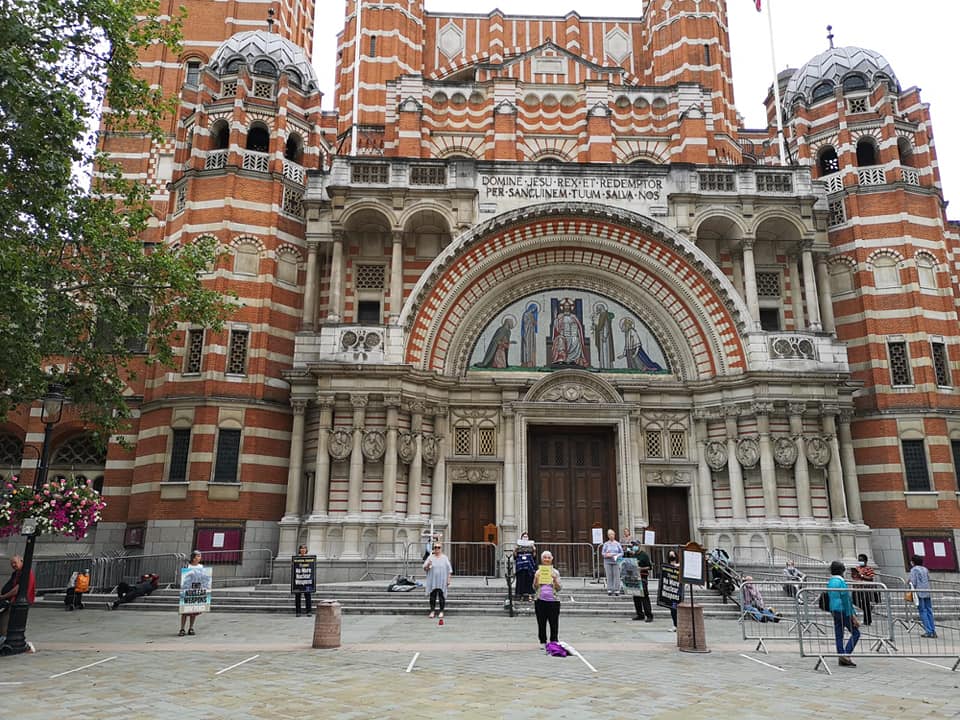
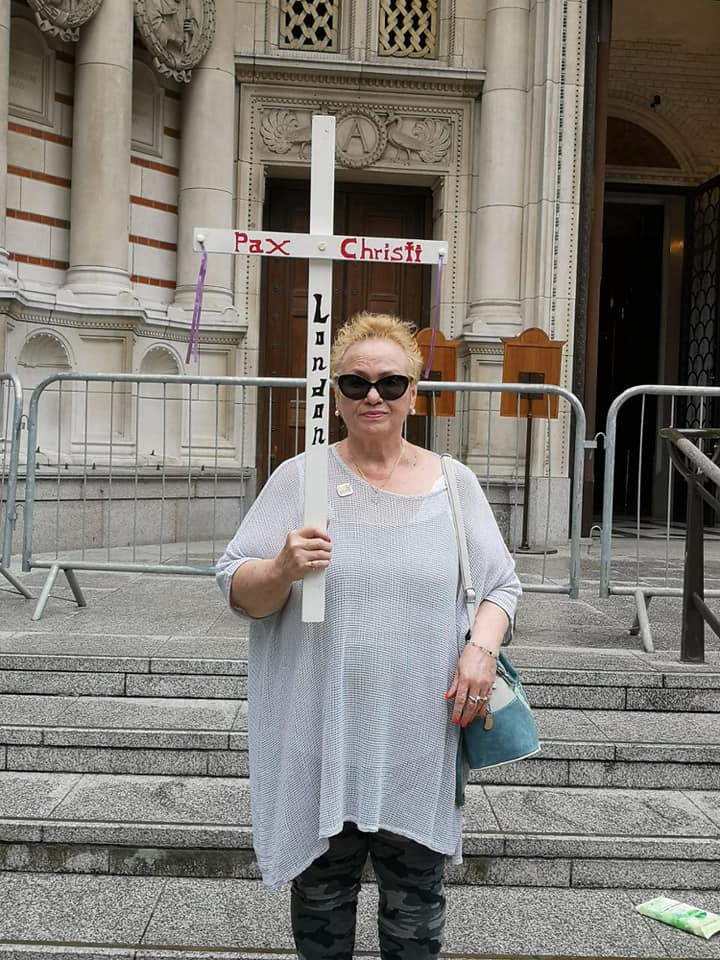
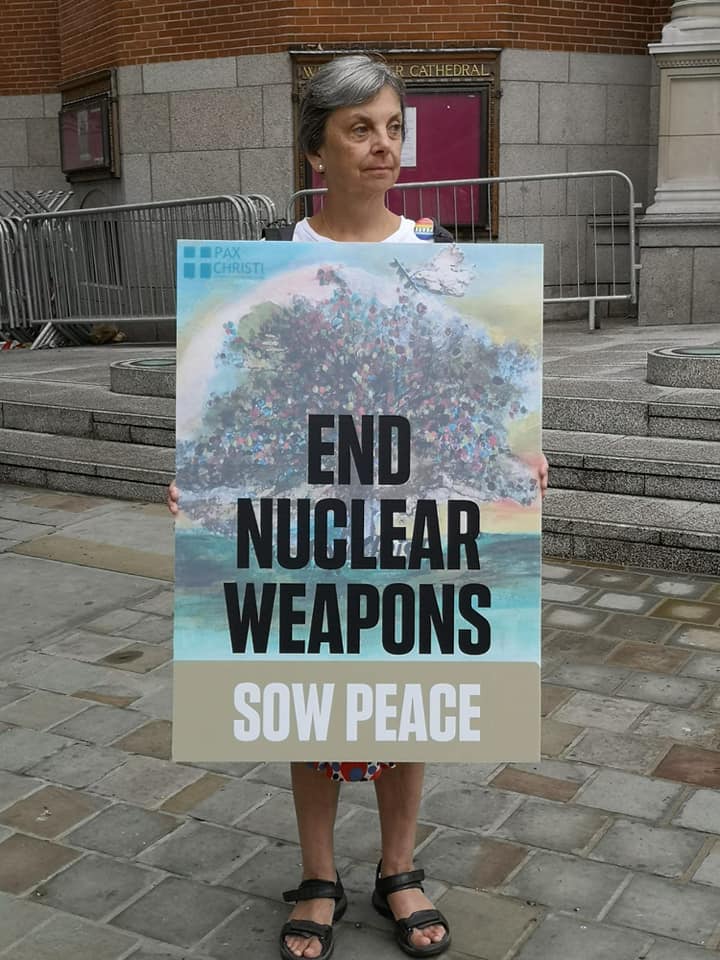
Peace campaigners stood in the Piazza outside Westminster Cathedral on Sunday for the annual vigil commemorating those who died when the second atomic bomb was dropped on Nagasaki killing about 80,000 people. A vigil was also held outside the Cathedral on Thursday 6 August, marking the first atomic bomb on Hiroshima which left 146,000 dead.
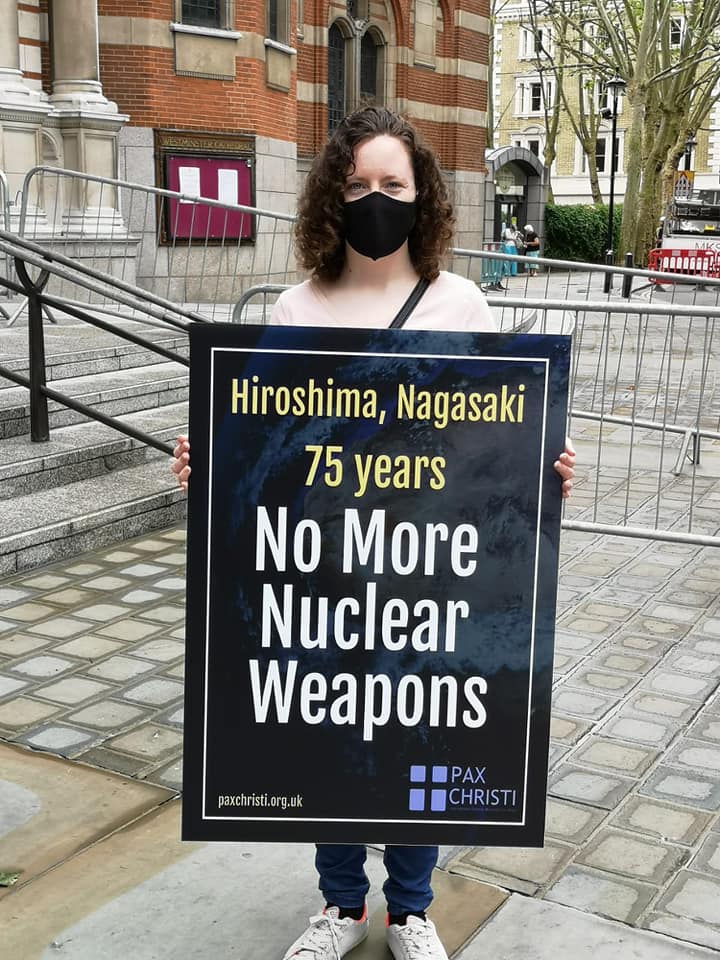
Pat Gaffney, former general secretary of Pax Christi, told ICN: “It was good to be with members of Pax Christi and Westminster J&P for the annual Nagasaki vigil outside Westminster Cathedral. To witness to the horror and suffering inflicted on that city was especially important this year, the 75 anniversary.
“Our messages were clearly presented in a safely distanced way to those waiting to attend the two Masses in the Cathedral. Our call and prayer were for the abolition of nuclear weapons with the practical ask to our own Government to become a signatory to the Treaty on the Abolition of Nuclear Weapons.”
Pax Christi and J & P members outside Westminster Cathedral, 6th August 2020
Westminster Justice & Peace joined Pax Christi this morning for a silent witness outside Westminster Cathedral to remember those who died in the nuclear bombing of the Japanese city Hiroshima 75 years ago today, and to call for a ban on nuclear weapons. We will return on Sunday for another witness to recall the bombing of the second city, Nagasaki.
Statement from the Westminster Justice and Peace Commission:
In August we as a country will want to mark the 75th anniversary of the atom bomb attacks on Hiroshima and Nagasaki. This was the world’s first, and only ever, use of nuclear weapons in conflict. Pope Francis visited both cities last year, laid a wreath at the memorials, and prayed for the more than 200,000 people who died instantly or in the months after the two attacks. He said “this place makes us deeply aware of the pain and horror that we human beings are capable of inflicting upon one another”.
In marking this important anniversary, we commend to our fellow Catholics, and all people of goodwill, Pope Francis’ call for a world without nuclear weapons. We can surely all agree with Pope Francis when he said that “In a world where millions of children and families live in inhumane conditions, the money that is squandered and the fortunes made through the manufacture, upgrading, maintenance and sale of ever more destructive weapons, are an affront crying out to heaven”.
75 years on from Hiroshima and Nagasaki, we have an opportunity now to demonstrate creative moral courage. We have a particular responsibility to reflect on Pope Francis’ conviction that possessing or deploying nuclear weapons “is immoral”. So as we look forward to the UN Treaty for the Prohibition of Nuclear Weapons passing into international law soon, we call on the government, along with the other nuclear powers, to sign the treaty and be part of a future built on just international relationships and the common good of all humanity.






 Diocese of Westminster Justice and Peace Commission