As Liz Truss prepares to take the reigns in Downing Street – Christian CND Development Manager Russell Whiting examines one of her first jobs as Prime Minister.
After months of campaigning and endless talk in the media, Liz Truss has now been elected as Leader of the Conservative Party and will take up the position of Prime Minster after visiting the Queen later in the week.
Much has been made throughout the campaign of the various crises facing the new Prime Minster, from energy costs, Ukraine and the wider cost-of-living crisis. Yet little has been said about one of the first duties Liz Truss will undertake when she arrives in Downing Street as Prime Minister for the first time.
Before any announcements on the economy, or even the appointment of the cabinet, Ms Truss will be asked by Senior Civil Servants to write the ‘letters of last resort’ – instructions for the submariners aboard the UK’s nuclear-armed Trident submarines in the event of an attack on the UK.
During a hustings in Birmingham Ms Truss said she was “ready” to give the instructions to launch nuclear weapons, despite the host prefacing his question by saying “it would cause global annihilation”. Despite the gung-ho rhetoric in public, we will never actually know what the letters say. As soon as Ms Truss has written her letters the ones delivered on behalf of Boris Johnson in 2019 will be destroyed without being opened.
According to an article in The Guardian in 2016 the options for the submarine commanders are “Put yourself under the command of the US, if it is still there”, “Go to Australia”, “Retaliate”, or “Use your own judgement”.
The issue of whether or not a politician would “press the button” to launch a nuclear attack has become increasingly political in the past decade – and especially since Jeremy Corbyn said he would not give the instructions were he to become Prime Minister.
Writing to Timothy in the New Testament, the Apostle Paul gives us clear advice on what our response to the new Prime Minister should be. We are to offer “petitions, prayers, intercession and thanksgiving” for everyone, including “kings and all those in authority” which he says “is good, and pleases God our Savior”. While that instruction is always applicable, regardless of our own views about any Prime Minister’s policy agenda, we should be especially fervent in our prayers this week as Ms Truss prepares to undertake this most solemn duty, away from the political and media pressure to act tough.
Pax Christi is an international Catholic movement for peace, based on the gospel, inspired by faith and Catholic Social Teaching.
The well-established British section of Pax Christi works within the Church, with ecumenical partners and with all who are putting into practice the work of peace, built on justice, reconciliation, and active nonviolence.
Chief Executive Officer
Pax Christi England and Wales are looking to appoint a creative and energetic peacemaker to be responsible for developing, co-ordinating and implementing the work of their membership organisation.
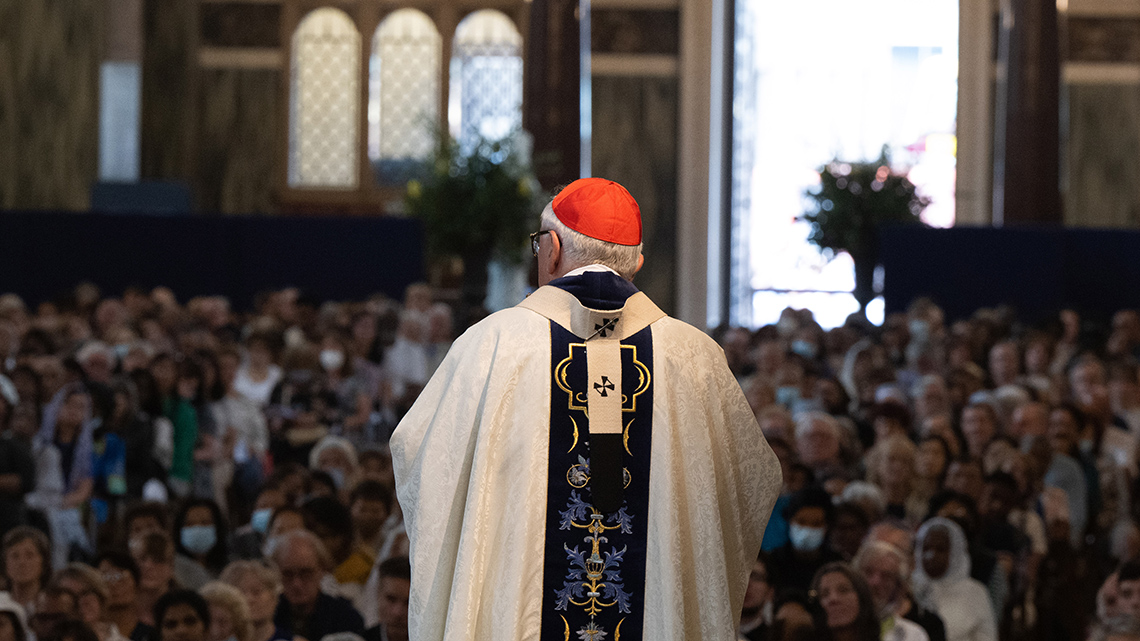
In a statement marking the announcement of a new Prime Minister today, Cardinal Vincent Nichols assures PM Liz Truss of his prayerful support and stresses that the needs of the poorest in society must be given urgent attention.
As President of the Catholic Bishops’ Conference of England and Wales, I offer my congratulations to Liz Truss on her election as leader of the Conservative Party and her consequent appointment as Prime Minister. I wish to assure the Prime Minister of my prayerful support.
Her appointment comes at a time when many crises have to be faced, at home and across the world. Prominent among them is the crisis in the cost of living.
Catholics are present in every local community, seeking to contribute constantly to the support of those in need. So we are well aware of the dramatic impact this crisis is having, with many people knowing they face choices between ‘heating or eating’, especially as winter approaches. The affluence to which our society has become accustomed seems to be seeping away.
I, and my fellow bishops, recognise the complexity of the causes, both short and long-term, that bring about the crisis now affecting so many. There are many Catholics in public life and in the charitable sector who are engaging in trying to produce long-term solutions to these political and economic challenges.
Catholic Social Teaching
Catholic Social Teaching indicates key principles which help to fashion just solutions to urgent and dire need.
The principle of serving the common good means that the needs of the poorest in society must be given urgent attention. The time for giving priority to factional interests has passed. Today our focus should be on the elderly, families who have the care of children, and all those least able to absorb the huge increases in the cost of living that we face. This means giving immediate attention to issues such as the level of welfare benefits and the impact of the two-child cap on universal credit payments, among other possible actions. Businesses too, especially small businesses, are facing acute challenges and will need help to survive. Their support for employment and family income is crucial.
Similarly, the principle of subsidiarity can be applied to our centralised system of welfare and public services to make delivery more effective and more efficient. This principle, long part of the social teaching of the Catholic Church, seeks “the active participation of private individuals and civil society” through which “it is actually possible to improve social services and welfare programmes, and at the same time save resources” (Pope Benedict XVI, Caritas in Veritate 60).
Parishes and Charities
The work of our local parishes, and of Catholic charitable agencies, is based on the firm conviction of the inherent dignity of every person. No one is to be cast aside or ‘discounted’. I am confident that throughout this crisis, the Catholic community will do all we can to act on this conviction and promote this principle.
I know that parishes will continue to do everything possible, including innovative ways of providing further material help and pastoral support. I also urge all Catholics to give whatever time and financial resources they can to charitable endeavours that support those who are affected by the current crisis. The work of Catholic schools, that have long been supportive of, and responsive to, children whose parents might be struggling financially or in other ways, is to be strongly applauded and encouraged.
The spiritual needs of the poor and their special gifts should never be forgotten. As Pope Francis wrote:
“The great majority of the poor have a special openness to the faith; they need God and we must not fail to offer them his friendship, his blessing, his word, the celebration of the sacraments and a journey of growth and maturity in the faith” (Evangelii Gaudium – The Joy of the Gospel – 200).
I trust that our parish communities will always be open to those suffering from hardship and in particular need of companionship and spiritual support at this time. They can help us to understand the humility we must have before God.
Finally, I ask that we all offer our prayers for those who are suffering from the cost of living crisis. I pray that all in our society will work together to find ways, both short and long term, to alleviate this crisis which threatens the well-being of so many people.
St. Thomas More, pray for all who serve in political and public life.
St. Bernadette, pray for the poor.
Cardinal Vincent Nichols President, Catholic Bishops’ Conference of England and Wales
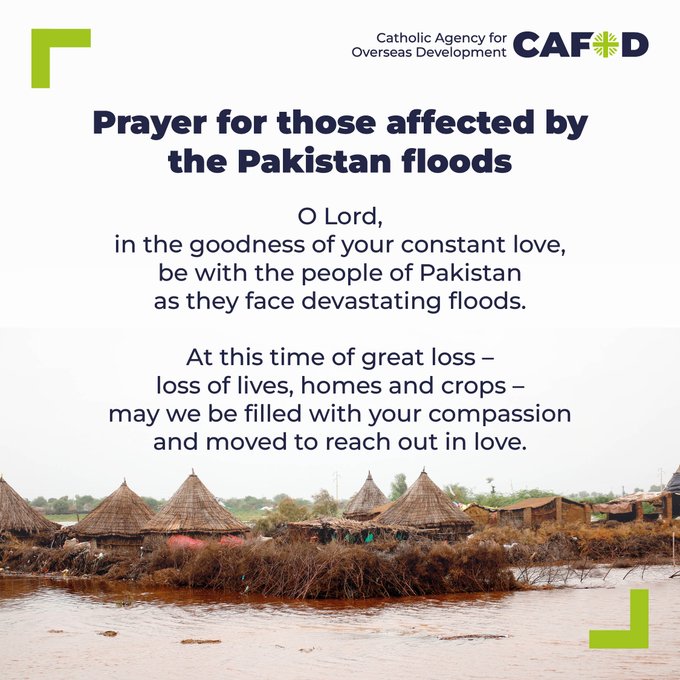
30 million people have been affected. A third of the country is underwater. Lives, homes, and livelihoods have been lost. Today, the DEC is launching the #PakistanFloodsAppeal. Please donate if you can to help save lives.
Former Prime Minister Gordon Brown has joined with 56 faith groups, charities and politicians to call on the government to take urgent action to bridge the cost of living gap faced by the lowest income families.
The call responds to a report written by poverty expert and Loughborough University Professor Donald Hirsch which reveals the gap between the support the government is currently offering to households and the anticipated rise in living costs.
The report concludes that the current flat-rate payments offered by the government will fall at least £1,600 short of making up for recent changes to living costs and benefits faced by a couple with two children.
The report assesses the extent to which cost of living measures announced in May will compensate for three blows experienced by millions of low-income families: cuts in Universal Credit, inadequate uprating of benefits with accelerating inflation in April and the further rise in the energy cap anticipated in October.
It shows that the package of support measures falls well short of making up for these losses, even with the October increase in the cap.
The groups, supported by Gordon Brown, are urging the Government to consider appropriate measures to bridge the shortfall in family finances, which is only anticipated to rise into the winter months.
Some charities are calling for benefits to be uprated in line with inflation, and for debt deductions from Universal Credit to be paused.
The report is endorsed by 56 charities, faith groups and politicians, many of whom are providing front-line support for families hit by rising costs, including Archbishop Leo William Cushley, Archbishop of St Andrews and Edinburgh, representatives of Caritas, Paul Southgate, Chair, National J&P Network and Fr Dominic Robinson SJ, Chair, Westminster J&P Commission.
It has also been endorsed by the Trussell Trust, the Joseph Rowntree Foundation, the Child Poverty Action Group as well as the Methodist Church, the Bishop of Durham, the Hindu Council UK and the Muslim Council of Britain, Welsh First Minister Mark Drakeford, Metro Mayors, Tracy Brabin of West Yorkshire, Andy Burnham of Greater Manchester, Jamie Driscoll of North Tyne Combined Authority, Sadiq Khan of Greater London, Dan Norris of West of England, Steve Rotheram of Liverpool City Region and Mayor of Bristol Marvin Rees.
The report contains stories of first-hand experience of the impact of the rise in the cost of living. Lowri receives Universal Credit and cares for her father and daughter.
Her food and fuel bills have doubled, and she’s had to sell her daughter’s bike to make ends meet: “I have spent the last 5 years living in survival mode, just about surviving each day, worrying about money constantly.
“I am emotionally and mentally exhausted living like this. It is not living, merely existing. There is just no way people can manage to pay all their bills, and all we are doing is existing to pay bills. Terrified is an understatement.”
Prof Hirsch said: “The shortfall families are facing between skyrocketing costs and the support government have offered continues to grow. Families were falling behind with the anticipated rise in costs even when the measures were announced, and since then the food and energy costs forecast for this winter have continued to rise sharply.
“The flat rate emergency payments announced so far leave families with children particularly far behind, because they are not sensitive to the extra costs that children bring.
“A new package needs to address the fact that by the autumn, living costs could have risen by as much as 14% for low-income families, who have received only a 3% increase in benefits.
“An additional across-the-board uprating to Universal Credit and other benefits would address family need far more effectively than further flat rate payments.”
The former Prime Minister Gordon Brown commissioned the report, after facing the realities of rising costs alongside churches and charities in the UK
He said: “This is a crisis that Britain hasn’t seen in decades. The most urgent and immediate challenge for the incoming Prime Minister is to ensure that families with children and disabled people aren’t neglected to struggle through the challenges ahead.
“We need targeted support for families on the lowest incomes, not just cuts in taxes or flat rate payments which don’t account for the specific needs of people on the brink of poverty.
“There should be no argument that a permanent increase in Universal Credit is the only way to take a sure step towards a solution.
“This crisis goes far beyond politics; this is a moral issue – our responsibilities to our neighbours and in particular to those who have the least and whose needs are the greatest.
“The incoming Prime Minister has a moral responsibility to ensure that everyone has enough to live on, through this crisis and beyond. We cannot be at ease when millions are ill at ease and cannot rest content as long as there is so much discontent.
“Our society will be stronger when we help the weak and will be richer when we help the poor.”
Revd Graham Thompson, President of the Methodist Church in Britain, who have endorsed the report, said: “Churches and other faith groups are on the front line of offering support to families who are already being swept under by rising costs. We know that millions of families aren’t simply making hard choices between heating and eating, but are having to go without both completely.
“If people aren’t given enough support to live, we don’t dare to imagine what will happen this winter. The government now have a duty to step up and take firm and long-lasting action to ensure not only that this crisis doesn’t deepen, but that it doesn’t happen again.”
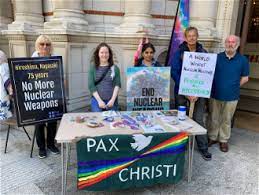
Hiroshima Day, 6th August 2022, Outside Westminster Cathedral
Westminster Justice & Peace joined Pax Christi, London Catholic Worker and other peace campaigners to remember the devastation caused by the atomic bombs dropped on the Japanese cities of Hiroshima and Nagasaki on 6th and 9th August 1945.
We mourned for those who lost their lives, prayed for an end to nuclear weapons and handed out leaflets to visitors to the Cathedral.
On 9th August, the 77th anniversary of the atomic bombing of Nagasaki, we also joined a procession from Westminster Cathedral – following the memorial service for Blessed Franz Jagerstatter – to the Peace Pagoda by the Thames in Battersea Park, led by Buddhist monk the Rev Gyoro Nagase with several monks and a nun from the Nipponzan Myohoji Buddhist Order.
Arriving at the Peace Pagoda, we were welcomed by Mr Shigeo Kobayashi from Japan Against Nuclear (JAN).
Colourful lanterns on the steps of the pagoda represented souls of the 74,000 people who perished in the bombing in 1945.
The monks led prayers and ceremonies with incense and chanting for all victims in Nagasaki and offered prayers for peace in the world.
Fr Alan Gadd, from the South London Interfaith group, offered a Christian prayer. Hannah Kemp-Welch, CND co-chair, gave a brief address in which she voiced fears over the increasing tensions in the world where so many countries have nuclear weapons.
Shigeo Kobayashi spoke about the urgent necessity of implementing promises made in the nuclear non-proliferation treaty and hopes for the tenth Review Conference of Parties to the treaty (#NPTRevCon) which is currently taking place at the UN in New York. He said the danger of a catastrophic accident has never been greater – pointing out that the bomb on Nagasaki was actually an accident – the original intention was to drop it somewhere else but plans were changed because of the weather.
The Peace Pagoda was presented to London in 1984 by the Venerable Nichidatsu Fuji, founder of the Japanese Buddhist movement, Nipponzan Myohoji. Following the atomic bombing of Hiroshima and Nagasaki, he pledged to build pagodas worldwide as shrines to peace. Altogether, there are now 80 peace pagodas worldwide.
“Civilisation is not to kill human beings, not to destroy things, nor make war; civilisation is to hold mutual affection and to respect one another.”
Rev Fuji
All are invited to join us next year to mark the 78th anniversary of the bombings and to continue, in the meantime, to work for an end to these weapons so that all may live without fear of them ever being used again.
The use of #NuclearWeapons, as well as their mere possession, is immoral. Trying to defend and ensure stability and peace through a false sense of security and a “balance of terror” ends up poisoning relationships between peoples and obstructs real dialogue. #NPTRevCon
On 1st August, Bishop John Sherrington visited the Syria Summer Camp, an educational, fun and therapeutic event for children from refugee backgrounds hosted by Newman Catholic College and supported by Caritas Westminster. Now in its sixth year, it was initiated in 2016 by Amanda Wooster as a summer activity for refugees who came from places such as Syria and Afghanistan. Bishop John shares his experience of the visit.
I was warmly welcomed by Inayat and Anisa. Inayat, a young man and student at Newman Catholic College, whose name means ‘bounty, kindness, favour’, enthusiastically introduced me to other groups of young people at the Syrian Summer Camp. Anisa, an older woman, known as Auntie, whose name means ‘pleasant companion’ was a quiet and comforting presence with us throughout the day. Sister Silvana from Caritas Westminster, a passionate and dedicated promoter of the summer camp, had organised the visit and accompanied us.
We first met the young lionesses, younger children, being coached by a QPR woman trainer. Many had watched the Women’s Euro football final on Sunday evening and wanted to follow in the women’s footsteps. They were enthusiastic about football, if a little shy in our presence. The next group were waiting patiently to travel by train to London Zoo. The boys were keen to see the lions which were their favourite animal but were worried that the lions might be asleep and hidden in their lair.
Inayat introduced us to a group of boys who were discussing the meaning of culture. With origins in Iran, Iraq, Syria, Afghanistan and other countries, they talked about whether they had grown up in a city or a rural area, the meaning of flags, sport and the culture they had left behind. They said that London was a safe place for them and that was more important than many other things. Learning English to communicate was at the heart of this activity. Football crossed all boundaries. Sr Silvana spoke about women footballers being paid less than men and asked whether this was right? Most accepted the difference!
A further group of teenage boys and girls were exploring the meaning of their names. Each told me their meaning which was beautiful and very moving. I learnt that Fatima, daughter of the Prophet, was translated as ‘flower’. They were painting a symbol of their names to express the meaning. Many included light and sun, though some were much darker. I was asked about the meaning of the white collar in my shirt. I explained that it is a sign of being a bishop or priest.
‘What does a ring mean,’ I asked? They spoke of marriage and love. I said a bishop’s ring is a sign of the love of Christ and his Church. Sr Silvana explained the meaning of her ring of consecration as a woman religious. We then discussed some common elements of Christianity and Islam, pilgrimage, prayer times, almsgiving and charity, but didn’t get into detail about our views of the person of Jesus Christ. We also learnt that Ramadan is a much harder fast than Lent!
The final visit was to group of very young children exploring sound and movement with a patient teacher. They created a dance with rhythm and movement which they all thoroughly enjoyed although it was hard to work together. Fun was had by all.
Hospitality is central to Arabic culture and so we enjoyed the blessings of lunch together. Inayat presented me with his Afghani wristband and spoke of his hopes for A-Levels and the future. Anisa remained the motherly presence throughout the day.
Driving home from Harlesden made me think about the journeys they had made to be in a safe place in London. The helicopters whirring above Wembley on the day of the Women’s Euro final had clearly created anxiety for some of the young people and no doubt brought back terrible memories. Behind each face, a story and a family which is unknown to most of us. Yet each face revealed joy and friendship and appreciation of the work of the volunteers to help them over this period of the summer school.
Thank you to Newman Catholic College, Caritas, and all the volunteers trying to help these children and young people to find a safe home and some blessings.
The episcopal lead for the Catholic Bishops of England and Wales on the Environment, Bishop John Arnold of Salford, has called for more urgent action on the climate crisis. In a statement on his diocesan website on 23 July, after a record-breaking heatwave in the UK, he said:
“This is not going to just peak and then we’ll hear no more of it. It’s going to get gradually worse. We are warming the globe and we’re not reacting quickly enough to avoid the damage or to even begin to repair the damage that we’ve done. We’ve already been told that some of the damage is irreparable, so we’ve got to think and we’ve got to act. Unfortunately, the government is not fulfilling the promises made at COP26…. The politics of our nation must take full measure of climate change and the climate crisis.
“I know that we’re jogging along, showing an interest in climate change – but jogging is not enough. We’ve got to start sprinting at this stage to make sure that we are caring for our common home and our brothers and sisters.”
He described the recent heatwave as a “wake-up call,” saying, “this week, we’ve witnessed temperatures never before reached here in the UK and, here in our own diocese, temperatures also saw record highs as some parishes nudged 40 degrees and firefighters battled flames in nearby communities.”
Bishop John thanked parishes and schools already working to live more sustainably and campaign for environmental justice. Bishop Arnold invited involvement in the second diocesan Walk for Creation on Sunday 2nd October.
Next Saturday, 6th August, is the anniversary of dropping the first atomic bomb in 1945 on Hiroshima, Japan, killing around 146,000 people, devastating the city and leaving a legacy of radiation-induced cancers and disability. The second nuclear bombing on the city of Nagasaki, which killed up to 80,000 people, is commemorated three days later on Tuesday 9th August.
Both days now provide annual opportunities to foster peace, pray and work towards a world free of nuclear weapons.
Saturday 6 August – Hiroshima Remembrance – Pax Christi will be present with a stall in front of Westminster Cathedral from 11.00am – 1.00pm. Prayer at 1.00pm.
Tuesday 9 August – Nagasaki Remembrance – Pax Christi will be present with a stall in front of Westminster Cathedral from 11.00am – 1.00pm. Prayer at 1.00pm.
All supporters of Justice & Peace and friends of Pax Christi are welcome to come along to show their support and especially to join in the time of prayer at 1.00pm.
Franz Jägerstätter Memorial Service
Pax Christi are also organising a service to commemorate Blessed Franz Jägerstätter in the Crypt at Westminster Cathedral on Tuesday 9 August, 6.30pm. Franz Jägerstätter was executed on 9th August 1943 at Brandenburg Prison for his conscientious objection to serving in Hitler’s army. He was beatified in 2007.
Following the service, people may wish to join the interfaith walk to the London Peace Pagoda for the Nagasaki Day memorial.
The use of #NuclearWeapons, as well as their mere possession, is immoral. Trying to defend and ensure stability and peace through a false sense of security and a “balance of terror” ends up poisoning relationships between peoples and obstructs real dialogue. #NPTRevCon
I have been privileged to attend the ‘Southern Environment Diocesan Network’ meetings, which are open to all with participants including members of CAFOD, Diocesan staff and volunteers, Laudato Si’ Animators, clergy, parishioners, religious and activists. We have met together for mutual support and encouragement for our efforts to tackle climate change in our work and home environments.
We were fortunate to receive input on all aspects of the climate, in order for us to inform those around us. Recently we learnt about ‘Biodiversity’ and how Climate Change is causing widespread devastation to all species and habitats on this planet. Clearly, there needs to be a dramatic reduction in our carbon emissions as individuals and organisations in order to protect the future and diversity of all life on earth. The mission of the network is inspired by the principles of Catholic Social Teaching set out by Pope Francis in his encyclical ‘Laudato Si’ which draws upon scripture to highlights our duty as Catholics to care for the earth and each other.
For me the experience highlighted the reality and urgency of the crisis which is often easy for us to forget amongst the business of our lives and the fact that real change is only possible if we take responsibility as individuals. It is only by the accumulation of our efforts that there can be hope for the future of life on this earth. With prayer and support of one another, we can have the strength to ‘take up our cross’ (Matthew 16: 24,26) whatever form this may take so we can protect God’s creation for future generations.






 Diocese of Westminster Justice and Peace Commission