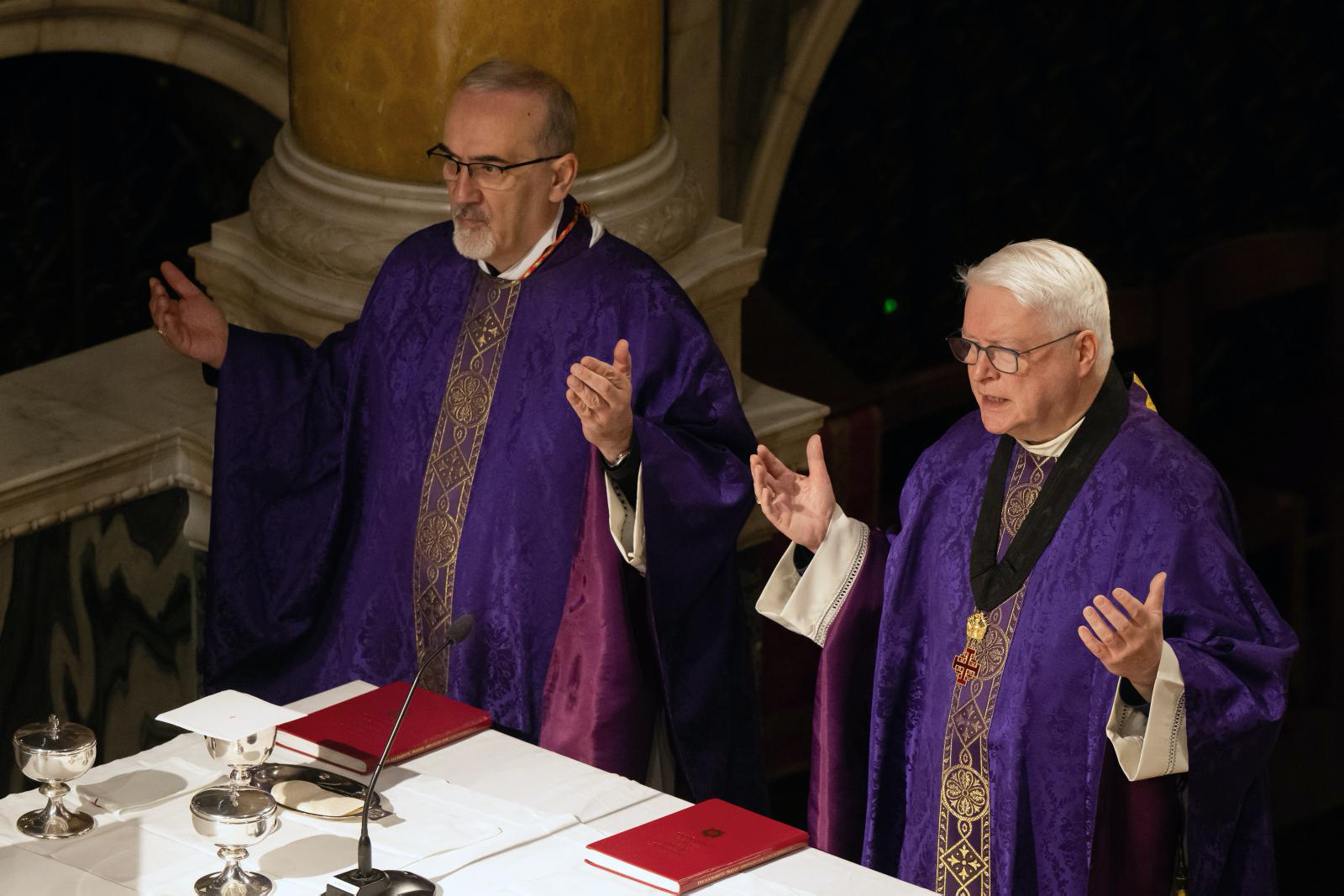
Bishop Curry says that when Christians pray for peace in the Holy Land, it can be both supplication and a cry of protest

Photo: CBCEW

Bishop Jim Curry is an auxiliary bishop in the Diocese of Westminster

Bishop Jim Curry, the Lead Bishop for the Holy Land for the Bishops’ Conference, has joined our former Middle East North Africa consultant, Dr Harry Hagopian, as a special guest on his monthly Middle East Analysis podcast. Contributing to a discussion on Gaza, the West Bank and the wider region of the Holy Land, Bishop Curry said that when Christians pray for peace, it can be both supplication and a cry of protest.

“Obviously, the Christian always wants to pray, and we can’t just dismiss prayer as fanciful. Prayer is a cry of protest as well as supplication,” says Bishop Curry. “The fact that we can pray in our churches publicly for the situation in Palestine and Gaza, in the West Bank, that we remember our Christian brothers and sisters and the wider community is important. So we can’t ever dismiss it.”

Bishop Curry also spoke about the Christian presence in the Holy Land as foundational and a vital part of the rich tapestry of the region:

“One of our fundamental tenets is to go on pilgrimage, because these lands are holy to us, they are holy to the Jews, and to Muslims. Christians have been part of the mosaic of those lands for over 2,000 years, they belong there. They’re not interlopers. They’ve built schools, they’ve built churches, they’ve built communities. So going to visit them is important for us. When we last visited [for the Holy Land Coordination], we were able to visit Bethlehem, Beit Jala, where the Latin Patriarch has a seminary, Aboud, and Taybeh. We were able to show that they are not forgotten. But I’m always conscious that afterwards, we walk away. We walk away and leave communities to struggle with lack of access to jobs, to security, to freedom of movement.”

The Bishop also shared his first impressions of the Palestinian city Ramallah, the administrative capital, that he visited in January 2025 as part of the Holy Land Coordination meeting, organised by the Bishops’ Conference:

“I’d never been to Ramallah, and as I looked around as we entered the city I saw a peaceful, busy, bustling city with cafes and buses, restaurants and shops, and people about their business.

“It was a warm day, with a blue sky, and I thought ‘that’s what normality looks like’. People don’t run away from normality. We were asking ourselves, ‘what would normality look like?’ And there we saw it. Someone whispered into my ear, ‘You should have seen Gaza. It was bigger and more well-organised’. Now all we see are these images of rubble and people being displaced – hungry and frightened. I’d seen a different reality in Ramallah, a place that worked. I’m sure people complain about the services there, but I saw something different and it stayed with me.”

In the face of conflict, death, destruction and extreme hardship, Bishop Curry offers a suggestion to enable us to cling to a shard of hope:

“What can we do? We can go on advocating that normality is possible, that people can live well together. People want to live well together… Everywhere we went, we heard this plea, ‘We just want to live normal lives. We want jobs, we want our kids to go to school, we want them to be able to play their part in this land when they come back after university’. It still comes back to me, that image of what normality is. People don’t run away from normality.”

He reserved special praise and heart-felt prayers for the small Catholic community of the Church of the Holy Family in Gaza:

“They are giving a witness to the possibility that our despair can’t be the final word about the human situation. That little community there, the Holy Family in Gaza, they are a living sign that human beings can live together, and they can work together for each other’s good.”

Listen

You can listen to the full June 2025 episode of Middle East Analysis on the Catholic Bishops’ website or on Soundcloud.

Bishop Hudson says peacebuilding is a vital aspect of international security

Source: CBCEW

Bishop Nicholas has responsibility for Justice & Peace in the Diocese of Westminster

In response to the government’s recently announced Strategic Defence Review, Bishop Nicholas Hudson, Chair of the International Affairs Department at CBCEW, expressed the strong hope that the government will not neglect international peacebuilding efforts.  

Bishop Hudson said: “I understand that the government has a very difficult decision to make given the current fiscal position and international environment.” 

“However, if defence spending is to increase, it should not be at the expense of other ways of promoting peace and justice. Peacebuilding is a vital aspect of international security that must not be sacrificed to an increased emphasis on defence.” 

Earlier this month the government announced the review, with wide-ranging measures, including building 12 attack submarines and a commitment to raise defence spending to 2.5% by 2027-28 with the aim of 3% by the next parliament. 

Bishop Hudson added: “It is important to ensure that the expansion of military funding does not result in the diversion of resources away from foreign aid and support for the world’s poorest people. Without a balanced investment in diplomacy, multilateralism, and assistance to the poor as vital means of securing peace, we risk deepening the very crises we seek to prevent. 

“I also hope that the UK approaches the development of autonomous weapon systems with great caution, always upholding the principle that machines must never replace human moral judgment or responsibility in matters of life and death.

“I urge our government leaders to remember that true security comes not only from strength, but also from compassion and active peacebuilding.” 

Read the Catholic Bishops’ document on disarmament and the ethical use of weapons:

 ‘Called to Be Peacemakers’

16 June 2025, 12.30pm: Home Office Vigil Prayers for Refugee Week

Everyone is welcome to join us for the monthly Memorial Prayer Vigil for Refugees and Asylum-Seekers outside the Home Office, SW1P 4DF, on Monday, 16 June from 12:30pm to 1:30pm.

This month is of particular significance as it takes place during Refugee Week 16-22 June 2025.

The theme of this year’s Refugee Week is ‘Community as Superpower’. Come and raise your voices and swell our community so that together we can have a much greater impact!

Praying for:

  • Those who died trying to reach the UK
  • Victims of current wars
  • Those in detention and who are homeless
  • The UK to be a more welcoming nation

Sign up to receive email news & alerts of changes or cancellation at: homeofficevigil@gmail.com

Co-sponsored by
Westminster Justice and Peace Commission
London Catholic Worker
London Churches Refugee Fund

Cardinal gives thanks for 10 years of Caritas Bakhita House

Source: RCDOW

Cardinal Vincent Nichols has shared a message for the upcoming tenth anniversary of Caritas Bakhita House, the Diocese of Westminster’s safe house for survivors of trafficking and exploitation.

To mark the anniversary, the Cardinal will celebrate a Mass of Thanksgiving in Westminster Cathedral on 30th June at 5.30pm, which will be attended by the centre’s staff, volunteers and supporters.

Cardinal Nichols extends the invitation to the faithful and general public, noting: ‘It’s a moment for us to thank God for the new life given through the work of [Caritas] Bakhita House, inspired by the compassion and the love that Jesus has for everyone; as he gave his life, that we might live life to the full.’

Opened in 2015, the initiative began as a response to Pope Francis’ injunction for the Church to contribute to combating human trafficking. Since then, the safe house has offered round-the-clock support to over 200 women, including tailored support plans, access to medical and psychological support, therapeutic activities and support with bringing perpetrators to justice.

Cardinal Nichols reflects: ‘I’m most proud of [Caritas] Bakhita House for the way it builds a community… of women who have been rescued from trafficking and found their way back to healthy, productive lives — along with many of their babies, too.’

Caritas Bakhita House

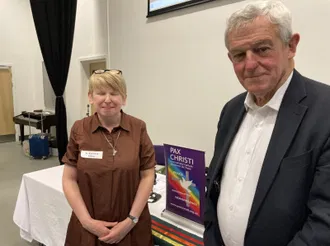
Report on Pax Christi AGM: “The world is looking for prophets of peace”

Sr Katrina Alton and Oliver McTernan

Source: Ellen Teague / Independent Catholic News

“The old rules of war have gone, and this is something to which we should give full attention.” Oliver McTernan, the Co-Founder and Director of Forward Thinking, was guest speaker on Saturday at the Annual General Meeting of Pax Christi England and Wales in London. The experienced mediator in conflict situations called for Pax Christi and other peace groups to highlight the moral and ethical issues in modern warfare. “We are not impotent,” he said, “we have the power to challenge.”

The theme of his talk was ‘Prophets for Peace in a Changing World’. The Chair of Pax Christi England and Wales, from Pax Christi Merseyside, Kathryn Lydon, told around 60 in-person participants and 20 online, that “the world is looking for prophets of peace.”

Dioceses represented included Birmingham, Hallam, Leeds, Liverpool, Middlesbrough, Southwark and Westminster. Groups represented included the Archbishop Romero Trust, Columbans and the National Justice and Peace Network of England and Wales.

Devoting much of his talk to the Gaza conflict, McTernan deplored Israel’s use of powerful Artificial Intelligence (AI) systems to identify targets in Gaza…

Continue reading on Independent Catholic News

4 June 2025, 11am, Red Line for Palestine: Christian Groups meet at Methodist Central Hall

Westminster Justice and Peace will be joining Christians for Palestine and representatives from other Christian groups to take part in this national action for Palestine outside of Parliament on Wednesday 4th June 2025, during Prime Minister’s Questions.

The organisers say: “Last week, the UK government announced a suspension of trade negotiations with Israel and sanctions on a limited number of individuals. It is too little and too late, especially given that Israel has clearly stated, and has shown over the past days, that it intends to deepen its genocide. However, as Israel openly uses starvation as a weapon of war, cracks are appearing in the political establishment. Now is the time to put pressure on the Government, MPs and Parliament to act.

People will begin to assemble at 11.30am around parliament to coincide with Prime Minister’s Questions at noon. Dress in red and join others holding a fabric red line to encircle parliament.”

Look for us outside Methodist Central Hall, Storey’s Gate, London, SW1H 9NH, at 11.00am.

Christians for Palestine Facebook Page

Palestine Solidarity Campaign – Red Line for Palestine

Event Report: Artificial Intelligence, Faith and Ethics at a Crossroads

l-r: Fr Michael Baggot, Jen Copestake, Fr Dominic Robinson, Dr Karen Singarayer, Matthew Sanders. Image: Diocese of Westminster

Dr Philip Crispin

From the outset of his pontificate, Pope Leo XIV has explained how the development of Artificial Intelligence (AI) inspired the choice of his papal name.

Speaking to the College of Cardinals after his election, he said: “I chose to take the name Leo XIV. There are different reasons for this, but mainly because Pope Leo XIII in his historic encyclical Rerum Novarum addressed the social question in the context of the first great industrial revolution.”

“In our own day, the Church offers to everyone the treasury of her social teaching in response to another industrial revolution and to developments in the field of artificial intelligence that pose new challenges for the defence of human dignity, justice, and labour.”

With serendipitous timing, the Catholic Union, in collaboration with Farm Street Church, Mayfair, hosted a panel discussion last Sunday 18th May entitled ‘AI, Faith and Ethics at a Crossroads: Discerning the Way Forward’ which explored the moral and spiritual challenges in this time of technological transformation. The event was convened and chaired by Farm Street Parish Priest, Fr Dominic Robinson SJ.

In her opening remarks, Dr Karen Singarayer, Vice-Chair of the Catholic Union of Great Britain, highlighted the opportunities and risks of the development of AI. She said: “The artificial intelligence revolution holds both promise and peril. The AI revolution seems to be impacting not only manual labourers but also professionals. The written word, once the exclusive realm of the human mind, is now increasingly the domain of machines. Video and audio too are more and more frequently AI-generated. Professions that long commanded social respect as learned or creative vocations now seem vulnerable in the face of the machine.”

She added: “These developments prompt us to ask difficult questions – what does it mean to be truly present to another human being? How are relationships, education, healthcare, and even evangelisation being reshaped by the advent of AI?”

Dr Singarayer paid tribute to the late Pope Francis as the leading moral voice regarding AI. He was ever mindful of the common good she said and noted his warning about the catastrophic consequences of allowing instruments of war to develop way beyond human oversight.

Jen Copestake, Correspondent at China Global Television Network Europe, said: “AI is no longer a matter of speculation; it is deeply embedded in all of our lives. We stand at a crossroads-not just technological, but moral and philosophical. As AI becomes more capable, present and even humanlike, the question is not just what it can do, but what should we do.”

She pointed to the pitfalls of AI which was not always programmed to embrace human diversity and posed the question whether soul-less machines with no human history could replicate human empathy and dignity.

Ms Copestake cited a prediction that, by 2030, 375 million workers globally would be forced to migrate or ‘transition’ and recollected that in Laudato Si Pope Francis had insisted that technological change should never render a person obsolete.

She spoke of the “seismic effect” of a predicted 70 per cent of jobs being transformed by AI and the imperative of protecting workers and the meaning behind the work they did which might, as Pope Francis had pondered, necessitate the move to introducing a universal basic income in order to preserve human dignity.

Furthermore, she continued, it was necessary to work upon improving the ecological impact of AI which was dependent on massive energy consumption. According to Catholic social teaching on ethical stewardship, harnessing the world’s resources should be sustainable not extractive.

Speaking on AI’s use in Evangelisation, Matthew Harvey Sanders, CEO of Longbeard, Creator of Magisterium AI, said: “What we found is that there’s a lot of people out there who aren’t ready to step into a church and talk to a priest or share their concerns, but they are ready to test their problem, their query out on a chatbot. . . . This isn’t a question of trying to replace the priest at all. It’s just recognizing where people are at. . . . We’ve seen testimonials of people who started a journey to the church or had misconceptions clarified. It’s been a beautiful project.”

He hailed the accelerated polyglot digitization of the Church’s library holdings and the World’s first Catholic language AI model Ephrem designed to offer deep insights into the teachings of the Church.

Fr Michael Baggot, Professor of Theology at Pontifical University of St Thomas Aquinas, Rome, spoke about how the Church is founded upon relationship, with God and each other. He said: “We are masters of communion. We are masters of relationship. We follow a God of relationship, not a solitary God, but a God who is eternal exchange of interpersonal love. If we’re made in the image of that God, we are called into being by a God of communion for communion-with that God and with the other persons made in the image of that God. We were made for interpersonal communion.”

The Church, he said, is “expert in humanity'” adding “I hope we know how to accompany people and their most profound needs.”

He warned against the abuses of AI’s virtual world, seductive and damaging as it moved from an attention economy to an affection economy but was lacking in compassion and an interior life.

Fr Baggot warned, too, against the possibility of “outsourcing” moral agency. While AI worked with data and statistical patterns it should never replace human responsibility. The Church insisted on equity, sexual and racial, he said.

Responding to audience questions, the panel hoped that greater efficiency through AI could liberate from certain forms of toil but feared that job losses could lead to social unrest and scapegoating. They feared, too, information overdrive and saturation.

AI should never replace the gift of humanity and personhood, underscored by the fundamental truth of the incarnational God, who took on our human flesh and blood, and served ‘fleshly’ human beings. Rather AI should be based upon human wisdom. Now was the time for discernment.

Watch the entire event HERE.

Read: Caritas Westminster Annual Review 2024

Source: Caritas Westminster

Caritas Westminster has announced the publication of their Annual Review for 2024, showcasing their areas of service and achievements from the previous year.

Richard Harries, Director of Caritas Westminster, commented: “2024 marked my first full year as the new Director of Caritas Westminster, and it gives me great pleasure to share with you the many milestones we achieved together over the course of the year.

“The Annual Review offers an overview of our efforts to serve the most vulnerable and empower charity in our communities. It brings together the many strands of our work, which ranges from direct services to enabling social action in diocesan parishes and schools. It also includes compelling stories from the people and communities supported, as well as significant events and highlights from 2024.

“Caritas Westminster’s direct services include a safe house for survivors of trafficking and exploitation, support for the Deaf Community and those with intellectual disabilities, a start-up hub for social impact entrepreneurs, financial aid, and resources to tackle domestic abuse.

“Caritas Westminster also strives to be the ‘voice of charity’ within the Roman Catholic Diocese of Westminster, facilitating voluntary service and social action. The Caritas Community Development team offers expertise, network links and project management support to help parishes and schools start or grow charitable initiatives that address the needs of their local communities.”

Highlights from the Annual Review include:

– 47,500 people supported by social action projects run by diocesan parishes and schools
– Recognising outstanding volunteers at the ‘Love in Action’ Volunteering Awards
– 2,964 miles travelled by the Caritas Deaf Service team for liturgies and events in British Sign Language
– Celebrating ‘Achievement Day’ at Caritas St Joseph’s
– 128 therapists and counselling professionals trained by Safe in Faith
– 50 businesses supported by Seeds Hub
– 30 women passed through the doors of Caritas Bakhita House

Bishop Paul McAleenan, Chair of Caritas Westminster, said: “This Annual Review recounts the activities of Caritas Westminster; may it also inspire us in our journey of faith and service as we read of Christ’s work being carried out in our midst.”

Read the Annual Review 2024 here:  https://caritaswestminster.org.uk/annual-review-2024/

Bishop Jim Curry: The Suffering in Gaza Must End

Bishop Jim Curry (r). Photo: Mazur/cbcew.org.uk

Source: CBCEW

Auxiliary Bishop in Westminster and Lead Bishop for the Holy Land for the Bishops’ Conference, Bishop Jim Curry, has echoed Pope Leo XIV’s call for an immediate ceasefire in Gaza1:

“This is a humanitarian disaster. Desperately needed aid supplies must be allowed into Gaza to be urgently distributed to civilians. The human cost is intolerably high with tens of thousands of weary, regularly displaced people threatened with starvation. We need an immediate ceasefire to end the suffering.

“As Pope Leo said at his first General Audience2, children, the elderly and the sick are paying a very heavy price, and I would echo the Holy Father’s heartfelt appeal for ‘dignified’ humanitarian aid to be allowed to pass into Gaza – not just an inadequate trickle of food and supplies that has been promised in recent days.”

Bishop Curry also referenced Prime Minister Keir Starmer’s joint statement, with the leaders of Canada and France, on the situation in Gaza, released on 19 May:

“International humanitarian law has to be respected and a viable pathway to de-escalation and peace sought by Israel and Hamas, supported by the international community,” said Bishop Curry.

“The remaining hostages in Gaza, held for 19 months since the Hamas terror attack on 7 October, must be released to put an end to their suffering and that of their families. I welcome the statement by the UK Prime Minister and the leaders of France and Canada, particularly the assertion that the best hope of achieving this and alleviating the pain and hardship facing the civilians in Gaza is to work tirelessly for a long-term political solution.

“It is important not to lose sight of the legitimate right of Palestinians to self-determination. The Church has consistently advocated for a two-state solution to enable Palestinians and Israelis to live side by side in peace.”

Bishop Curry said he was also praying for the Christians of Gaza:

“I continue to pray for Fr Gabriel Romanelli and the Christian community sheltering in the compound of the Holy Family Church, north of the Wadi. It is a humbling inspiration to all of us outside the conflict zone to witness their strength of faith in the Risen Christ, and how they continue to lead a humble sacramental life despite the incredible hardship and distress they are facing.”

Bishop Jim Curry is the Lead Bishop for the Holy Land for the Catholic Bishops’ Conference of England and Wales and is a member of the Department for International Affairs.

References 

1 Pope Leo XIV, first Regina Coeli address, Sunday, 11 May 2025.

2 Pope Leo XIV, first General Audience, Wednesday, 21 May 2025.

Bishop McAleenan Responds to Government White Paper on Immigration

Photo: Mazur/cbcew.org.uk

Source: CBCEW

Following the recent publication of the government’s White Paper on immigration, Bishop Paul McAleenan, Lead Bishop for Migrants and Refugees, called on the government to reconsider the important role of immigration in shaping our shared history, and highlighted the vital contribution of those in low-wage, low-skilled employment.

Bishop McAleenan said:

“Whilst the Government’s commitment to skills training and education is understandable, I urge the government to carefully consider its approach to so-called ‘low-skilled work’ which is often carried out by those who come from abroad.

“We must remember the words of Pope Francis in Fratelli tutti, written in the wake of the Covid-19 pandemic: ‘…our lives are interwoven with and sustained by ordinary people valiantly shaping the decisive events of our shared history: doctors, nurses, pharmacists, storekeepers and supermarket workers, cleaning personnel, caretakers, transport workers, men and women working to provide essential services and public safety, volunteers, priests and religious… They understood that no one is saved alone.’

“The essential work carried out every day by people in low-paid, low-skilled roles must be recognised and valued. For many migrants, such jobs are the first step on the way to becoming fully integrated into our society. Without their contribution, dedication and hard work, our hospitals, schools, and care homes might not be able to function. The Catholic Church in England and Wales has been enriched by migrants throughout its recent history. Our ethnic chaplaincies, eparchies and schools have been models of integration.

“I also appeal to our political leaders, of all parties, whom we have entrusted with shaping the future of our country, to refrain from using rhetoric that risks sowing mistrust, fear, or division. Such language is unhelpful and serves only to create unnecessary fractures within our communities.

“To our Catholic community and all people of goodwill, I encourage you to welcome migrants into your communities with open hearts, offering friendship and support. In doing so, we help ensure that no one is left behind, undervalued or made to feel isolated.”