Maggie Beirne reflects on the Synod Synthesis: ‘Blindness’ to issue of racism

Maggie Beirne

Source: Independent Catholic News

The national Synthesis developed by the Catholic Bishops Conference of England and Wales (CBCEW) is a marvel of lucidity, and one which tackled a series of difficult, and potentially controversial, issues in a thoughtful and sensitive manner. It constitutes an incredible contribution to the global debate about how the People of God should journey together to live out our Gospel values.

There is so much in it to be welcomed that it seems petty to focus on a serious weakness, rather than proceed to embed this model of a listening church into our faith lives in our homes, our parishes, our places of work etc. Still, this moment should not be let pass, without some recognition of the blindness that the Synthesis seems to show with regard to the issue of racism.

There is a paragraph devoted in the ‘marginalised groups’ section to “People of Colour” (paragraph 71), which might be considered an improvement on some of the diocesan reports which did not allude to this issue at all. However, the paragraph is, in my view, very wrong headed. The national Synthesis notes that there are few references in the diocesan reports to ‘people of colour’ being excluded (the word racism still does not appear anywhere), but this silence is ‘explained away’ on the grounds that our congregations are often so ethnically diverse. The impression is given either that racism is not a problem within our church, since people of colour themselves did not raise it in the diocesan reports; or, alternatively, racism cannot be a problem experienced in our church because we have such ethnically diverse congregations. Neither interpretation is credible.

The commitment to addressing the need for more diversity in leadership roles is important but insufficient.

Talking with others, they confirmed my view that the final Synthesis seems “totally blind to the issue of racism” and some felt “let down” by its silence on the topic. I accept that the diocesan submissions might not have addressed the issue of racism explicitly but surely our duty as a church is to listen to what the Holy Spirit is saying in the silences too? Were ‘people of colour’ engaged in the process in proportionate numbers (I was a parish synodal rep and noted in our written report that no non-white people engaged in our process)? If they did engage, were they comfortable in raising sensitive issues such as their treatment within broader society, and maybe also the treatment received from fellow parishioners? Maybe it is worse still if people of colour engaged in their parish or synodal processes but did not raise any concerns about exclusion because they did not feel that their experiences of racism had anything much to do with their faith journeys? There is plenty of documentation to show that racism is a problem that needs to be addressed from a faith perspective – just read the ground-breaking Rooting Out Racism report carried out by White City parish in Westminster diocese; or the submission to the national synodal process by the Catholic Association for Racial Justice (CARJ).

The Bishops will present this national Synthesis to the global church and (rightly) alluding to the fact that “the racial and cultural diversity of Catholics is seen as one of the great gifts of the Church in England and Wales”. However, I think that they must also be willing to see that racism is experienced by many in our society, and even in our pews. We, the People of God, need support in celebrating our diversity but also in recognising that many of the people we are journeying with experience racism. Absent this support, many faithful Catholics will remain blind to racism and, even perhaps quite unthinkingly, engage in it.

LINKS

‘Rooting out Racism’ Report –
www.cbcew.org.uk/wp-content/uploads/sites/3/2021/01/Rooting-Out-Racism.pdf

Catholic Association for Racial Justice Synod Submission –https://mcusercontent.com/3d2b3ff9853eab9381ba677d5/files/e100ecc9-e9fb-cbd8-158a-71dda217ad55/CARJ_Synodality_Sessions_Report_Feb_2022.pdf

National Synthesis Document – Catholic Bishops’ Conference of England and Wales –
www.cbcew.org.uk/wp-content/uploads/sites/3/2022/06/synod-national-synthesis-england-wales.pdf

Maggie Beirne, coordinator of the West London J&P network, is writing in a personal capacity.

10 Environmental Priorities from Friends of the Earth

Source: Friends of the Earth

The next leader of the Conservative Party and the next Prime Minister must aspire to make the UK a global leader on climate change, nature restoration and environmental health. The environment needs to be centre stage in their campaign. Below are 10 commitments that a candidate, who’s genuinely  commited to the environment, should be comfortable in making. If delivered, they would make a substantial difference to people’s lives and the environment and demonstrate global leadership.

  1. Invest in the biggest ever UK-wide home insulation programme through a council-led street by street programme and provide additional financial support to low-income households.
  2. Reject calls for the scrapping of the moratorium on fracking and the development of any new oil, gas, or coal extraction and instead say ‘yes’ to the rapid growth of onshore and offshore renewable energy.
  3. Accept the Office for Environmental Responsibility’s recommendations for stronger targets for nature restoration and air quality, reverse plans to weaken habitats and environmental assessment laws, and swiftly implement the Environmental Land Management Scheme to reward nature-friendly farming.
  4. Support calls for the human right to a clean, healthy and sustainable environment to be recognised by the UN General Assembly and put this into UK law, as an essential part of protecting people’s health and eradicating environmental inequalities.
  5. Fix the Net Zero Strategy so it delivers on legally binding carbon reduction targets and the commitments made at COP26, ensuring all departments in Whitehall deliver their part, including the Treasury.
  6. Decentralise power and resources to devolved nations and councils so that they can properly eradicate environmental inequalities, deliver on the Climate Change Act, restore nature and ensure planning rules are in line with the climate and ecological emergency.
  7. Introduce a new UK Business, Human Rights and Environment Act to make companies accountable for environmental damage and human rights abuses in their overseas supply chains and to eliminate the UK’s role in global deforestation.
  8. Follow through on the UK’s world-leading commitment to ending the financing of fossil fuel projects abroad by speeding up the decarbonisation of the UK Export Finance agency’s portfolio. This must include withdrawing funding from the Mozambique gas project and switching financial support to renewable energy.
  9. Ensure all new trade deals have strong, enforceable climate change and nature protection safeguards and that food standards and nature-friendly farming are not undermined by imports produced to lower environmental standards.
  10. Make the UK a beacon of democracy by reversing draconian restrictions on protest, guarantee the independence of the Electoral Commission, stop the attacks on the Human Rights Act, and ensure citizens can challenge unjust decisions through the courts.

More details on Friends of the Earth’s policy recommendations

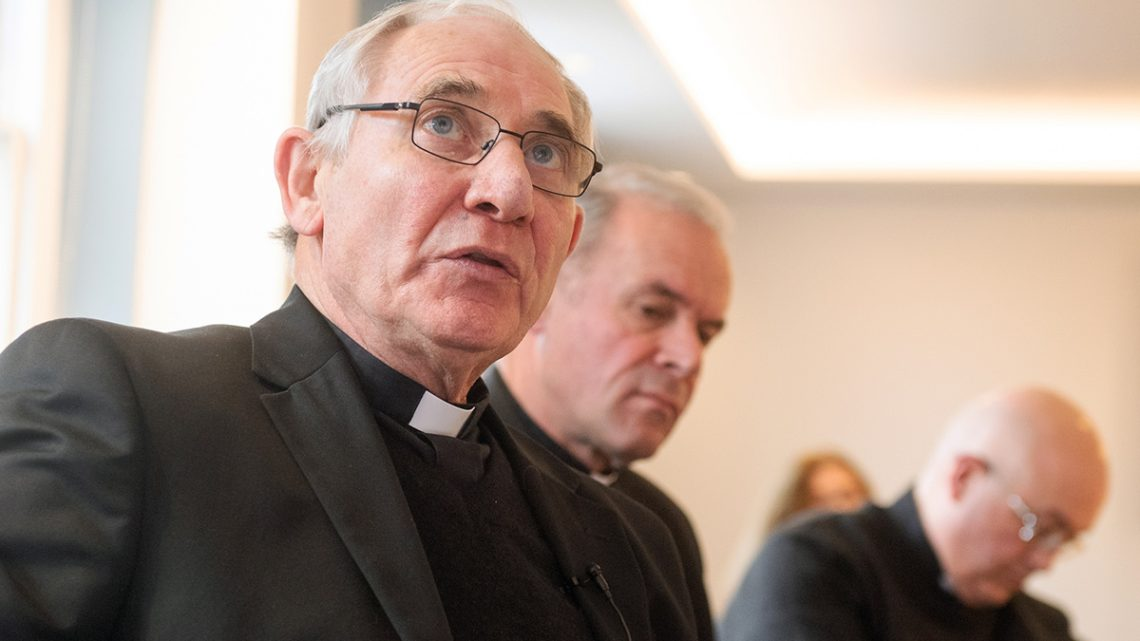
Bishop Nicholas Hudson is new Chair for the Holy Land Coordination group

Watch the interview with Bishop Nicholas on his passion for the region.
Bishop Nicholas oversees Justice & Peace in the Diocese of Westminster

Source: CBCEW

Bishop Nicholas Hudson, auxiliary Bishop of Westminster and long-term bishop delegate of the Holy Land Coordination, has been named the new chair of the group.

The Holy Land Coordination, made up of bishops from across Europe, North America and South Africa, was set up at the end of the twentieth century at the invitation of the Holy See. The purpose was to visit and support the local Christian communities of the Holy Land.

The Coordination’s main remit is often expressed using four Ps: Prayer, Pilgrimage, Pressure and Presence.

The bishops are present every year, and by their presence they hope, above all else, to remind the ‘living stones’ – the Christians of the Holy Land – that they are not forgotten by their brothers and sisters in other parts of the world.

Bishop Hudson’s predecessor in the role, Bishop Declan Lang, stood down at the end of the May 2022 Coordination.

In an interview given from a rooftop overlooking the holy city of Jerusalem, Bishop Hudson talked about his previous visits to the Holy Land and why he’s so passionate about the region and its people.

Transcription

Interviewer:

Bishop Nicholas Hudson, standing here with me in this holy city, looking out across Jerusalem, and it’s a beautiful view, actually, in a city that means so much to us. You’re here as part of the Holy Land Coordination and you’ve been here half a dozen times or more now. Tell us where your passion comes from for this wonderful place…

Bishop Nicholas Hudson:

I think I’ll always remember the first pilgrimage I came on when we visited Bethlehem and Jerusalem, and I was deeply, deeply touched by it. It had more of an impact on me than I even expected, really, to be in the places that we don’t just associate with, but actually are the places of Jesus’s life, Passion, death and Resurrection. And it was deeply powerful.

I remember as well, part of the pilgrimage was going out to a refuge for elderly women where we were made truly welcome. It gave me a sense of something that I began to discover more through the Holy Land Coordination, just how much social outreach Palestinian Christians do – especially for those who are more on the margins of society. Then I was so pleased to be asked to be part of the Holy Land Coordination and began to get a deeper sense of what life is like for Palestinian Christians. When we talk about the Holy Land Coordination, we talk about the three Ps that describe the essence of what it is – prayer, presence and pressure.

Interviewer:

Meetings with people making a really big difference in society, those on the margins, whether it’s migrants, asylum seekers, the undocumented, those have no status in this country – these are very important meetings. But it is actually those parish visits, isn’t it? Standing alongside people, learning from them and understanding them a little bit more, understanding the pressures on their lives… I found that the most moving aspect, despite the fact that both components are important.

Bishop Hudson:

That’s very well said. There’s something deeply touching, not least the fact that you’re aware in some places that the parish communities have become quite small. And when, with respect and gentleness, you talk to the parish priest about it, he’ll tell you, well, yes, a lot of families left because they felt they needed to plan for their children’s future. But one of the signs of hope that we’ve seen during this Holy Land Coordination is the number of people, especially young people, who are saying, “whatever happens, we’re going to stay”. Now, that’s a very significant statement for us to be hearing out of Palestine’s Christian community, and we’re going to have to see to what extent that remains
a possibility for them.

The other thing that I find really touching, is when we actually go and pay visits to some of the communities who are being cared for by members of those parish communities. I think a real highlight was when, a few years ago, we were in Bethlehem and we went to visit L’Arche.

L’Arche means the Ark, Noah’s Ark, and is a community founded about 60 years ago to welcome people with learning disabilities. There’s a centre just behind the Nativity Grotto very, very close to where Jesus was born, in Bethlehem. What I find really impressive about it is that it’s a mixed Muslim and Christian community. There in the heart of Bethlehem, they’re welcoming Muslim and Christian people with disabilities and really giving them life. The name of this community in Arabic is Ma’an lil-Hayat, which means ‘together for life’ and that really is part of the essence of what L’Arche is. L’Arche says to someone with learning disabilities, you can stay with us forever.

On another occasion we visited one of the sites which is thought to be the place of the Emmaus story called Abu Ghosh. Emmaus may have actually been in one of three places, but Abu Ghosh is one of the places where the story is revered. And I was so touched that alongside the church was another home where women, many of whom have learning disabilities, are welcomed and, again, they’re being valued and given life. We had another experience of going to a refuge for children of migrant workers. So there’s a great deal of Christian social outreach taking place and it truly warms one’s heart.

Interviewer:

It has been said, but it probably bears being said once more, that a lot of the Christian charity projects aren’t just for Christians, are they? This is a complicated region in many ways – a beautiful one, but a complicated one. You must be heartened, as a bishop, to see the Christian communities under pressure, providing for way more than just themselves.

Bishop Hudson:

I really am, and I think this is certainly a feature of those communities I’ve mentioned, but it’s writ large in the schools, the Christian schools under the care of the Latin Patriarchate, where they are truly open to having Muslims who want to send their children there. One hears from Muslims who do send their children to these schools something similar to what we hear from Muslims who want to send their children to our Catholic schools in England and Wales. That is “we like your values” and implicitly, therefore, “we want those values to communicate themselves and be communicated to our children.” So it’s writ large, particularly in the schools, yes.

Interviewer:

Now, it would be remiss of me not to point out that this is a bustling, busy, chaotic city. We can hear the trams, we hear the noise, we hear the beautiful bells, and, to be honest, the muezzin, the Islamic call to prayer, the Jewish life and culture is imprinted all over the city as well. It is a lovely place, but many people in England and Wales may not be able to come here. It’s not easy to come here. What would you say to them in terms of bringing a little bit of these holy lands back to England and Wales?

Bishop Hudson:

Well, I’d want to say straight away, that Jerusalem belongs to all of us, and there are 13 Christian denominations in Jerusalem, and it belongs to all Christian men, women and children. But we have to be careful when we say that and how we say that. Because one of the lessons of this Coordination, which has been focusing on Jerusalem the city, as a sacred city, is that we’ve been sensitised to the fact that we’re not the only ones who say “this is our city”. The Jews say “this is our city”, the Muslims say “this is our city”. I think we’ve woken up as a group to the reality that this is a Jewish city, this is a Christian city, this is a Muslim city. And that calls for us to be deeply respectful, but it also calls us to witness as Christians in and around this city to our conviction about all that Jesus says in the Gospels about loving your neighbour as yourself, to be respectful to those of other faiths, but also to have a special care for the poor. Christians, both in Jerusalem and around Jerusalem, are exemplary in that regard.

Refugee Week Report 2022, 20th-26th June

Asylum Seeker Maimuna Jawo, speaking at the Stories of Welcome event Monday 20th June 2022

Stories of Welcome 20th June, 2022

This Refugee Week (20-26 June 2022), Caritas Westminster alongside the Anglican Dioceses of Westminster and Southwark wanted to share some ‘Stories of Welcome’ from communities across the London and east Surrey. Resources, including five videos, a booklet and an infographic were launched on World Refugee Day. Each account detailed demonstrates how simple a welcome can be, which is in contrast with the transformative power of the encounter that the welcome enables.  

The ecumenical launch event, held at The Church of the Immaculate Conception, Farm Street, opened with a prayer from the Bishop of Stepney, the Rt Revd Dr Joanne Grenfell Woolway. Those assembled heard key-note speeches from the Auxiliary Bishop of Westminster, the Rt Revd Paul McAleenan, Maimuna Jawo and the Bishop of Southwark, the Rt Revd Christopher Chessun.  

Read Rosa Lewis’ blog of the launch event here – Stories of Infinite Worth and Dignity

Bishop Paul’s Address

Watch the videos:

Revd Dr Sam Well’s Lecture, London Churches Refugee Fund 20th June, 2022

Click here for the link to Reverend Sam Well’s talk on ‘So Many Kinds of Wrong’ concerning the Rwandan refugee crisis (held Monday 20th June at 7.00pm, St Martins-in-the-Fields, Trafalgar Square.)

Westminster Social Justice and Peace Forum

Save the Date! The next Forum will be addressing contribution made by the Catholic Church to meet the needs of refugees and asylum seekers. All are welcome to join us.

Saturday, 17th September, 10am – 1pm
‘To Accompany Refugees’
St Aloysius Church Hall, 20 Phoenix Road, NW1 1TA

Hosted by Bishop Paul McAleenan and Bishop Nicholas Hudson

Register with Eventbrite

Join the TUC ‘We Demand Better’ Demo, Saturday 18th June, 10.30am, Central London

Stop the Rwanda plan – All Refugees Welcome

As members of the Together With Refugees coalition, Westminster Justice & Peace and Caritas Westminster invite you to join us at Saturday’s demonstration ‘We Demand Better’ organised by the TUC.

Coalition member, Care for Calais, along with Stand Up To Racism, are leading a refugee bloc in the TUC demo about the Cost-of-Living Crisis in London, on Saturday 18 June 2022.

When there are social problems in the UK refugees and migrants are often blamed. As the Cost of Living Crisis worsens the government is using racism as way to divide and rule people. We say #AllRefugeesWelcome – we won’t let racism divide us. We need unity in the face of the Cost of Living Crisis. The TUC’s demo offers a great opportunity to show solidarity and unity and promote the rights of refugees.  

Let us know if you would like to join us in the ‘Stop the Rwanda plan – All Refugees Welcome’ bloc by emailing Colette Joyce at colettejoyce@rcdow.org.uk or call 07593 434905.

Gather at 10.30am, Portland Place, London, W1B 1, United Kingdom

More event details

Refugee Week 20th-26th June 2022 – Theme ‘Healing’

Refugee Week is a UK-wide festival celebrating the contributions, creativity and resilience of refugees and people seeking sanctuary. This annual event founded in 1998 is held every year around the UN World Refugee Day on 20th June and is a growing global movement.

It will involve a dynamic programme of arts, culture, sports, educational, media and creative campaigns. Refugee Week aims for UK refugees from different backgrounds to connect and share their experiences, perspectives and creative work. Hopefully this will encourage understanding of why people are displaced and the challenges they face when seeking safety. Refugee Week’s vision is for refugees and asylum seekers to be able to live safely within inclusive and resilient communities, where they can continue to make a valuable contribution.  This reflects our values that everyone has a right to be safe, and treated fairly with respect and kindness.

Refugee Week is an umbrella festival, and anyone can get involved by holding or joining an event or activity. The events will happen in a variety of spaces ranging from arts festivals, exhibitions and film screenings and museum tours to football tournaments, public talks and activities in schools.

Christian events in London include:

20th June, 12.30-1.30pm: Prayer Vigil outside the Home Office with Westminster Justice & Peace and London Catholic Worker to pray for migrants seeking safe passage to the UK. Contact Barbara Kentish (J & P) barbarakentish@talktalk.net 

20th June, 7pm: London Churches Refugee Fund Annual Speaker Meeting. Revd Dr Sam Wells ‘So Many Kinds of Wrong: A Theological Response to the Rwanda Asylum Initiative‘ – St Martin-in-the-Fields, Trafalgar Square, WC2N 4JH. Further details www.lcrf.org.uk  Email info@lcrf.org.uk

20th June 2022, 6-8pm: Stories of Welcome. Farm Street Church (‘Arrupe Hall’), 114 Mount Street, London, W1K 3AH. Share and celebrate the stories of how our London churches and parishes are welcoming asylum seekers, migrants and refugees from Syria, Afghanistan, Iraq, Eritrea, Ukraine, Hong Kong and so many other countries.

Speakers will include:

The Right Revd Paul McAleenan (Diocese of Westminster and Lead Bishop for Migrants and Refugees)

The Right Revd Joanne Grenfell (Bishop of Stepney, Diocese of London)

The Bishop of Southwark, The Rt Revd Christopher Chessun

This event is hosted jointly by the Compassionate Communities Team (Diocese of London), the Diocese of Southwark and Caritas Westminster.

Refugee Week Website

Click here for the Vatican Document: The Love of Christ Towards Migrants

Prayer for Refugee Week:

God creator of all,
For people who are displaced,
may they find a safe refuge.

For people who have lost control of their lives,
may they know a sure foundation.

For people who live in fear,
may they be given a strong fortress.

For people who are disillusioned,
may they have hope in a future.

Loving father in times of crisis, sorrow and uncertainty
we ask that you draw near.

Amen

London climate action week, 25th-3rd July 2022

London Climate Action week 2022, the largest independent climate change event in Europe, will take place from 25th June to 3rd July and focuses on delivering the promises from COP-26 in this post pandemic era.  It will involve a mixture of in-person and virtual events which anyone is free to host and hopes to embrace the diversity of London’s experience and heritage. Events will be a mixture of panel discussions, digital campaigns, announcements from business leaders and much more.

This annual event aims to harness the power of London for global Climate action to help us move towards a net-zero future. It will feature many world leading climate professionals and communities across London and beyond with the hope of finding practical solutions to the climate crisis.

As we recover from COVID-19, we need to embrace a new normal that puts tackling the climate emergency at the heart of everything we do.

To find out more click here

Bishop Paul McAleenan on Rwanda Deportations: “Crime is defeated by confronting the perpetrators not by punishing victims”

Bishop Paul McAleenan

Source: Catholic Bishops Conference of England and Wales

The UK’s plans to forcibly deport to Rwanda some of those seeking refuge in our country is shamefully illustrative of what Pope Francis has called the ‘loss of that sense of responsibility for our brothers and sisters on which every civil society is based’.

The plan is presented as a humanitarian response to combat people trafficking and smuggling yet the result will compound the suffering of those who are already victims. Crime is defeated by confronting the perpetrators not by punishing victims. This scheme will increase the difficulties of those hoping for a new beginning, and it does nothing to address the problems which cause people to flee their homes.

Migration is a complex issue, but it is not resolved by delegating our roles and responsibilities to other countries. Our starting point should be the innate dignity of every person, created in the image and likeness of God. Our Christian faith demands that we respond generously to asylum seekers whose dignity must be protected and upheld.

Whether or not the flight to Rwanda takes off today we are now in a new situation. With greater force we insist that asylum seekers are not commodities for profit, nor are they problems to be rejected and deported by government. Instead we should be guided by the four verbs provided by Pope Francis in our approach to migrants and refugees, ‘Welcome, protect, promote and integrate’.

Bishop Paul McAleenan
Lead Bishop for Migration Issues

Next Vigil Outside Home Office – Monday 20th June 2022, 12.30-1.30pm, UNHCR World Refugee Day

All are welcome to join us for prayer and reflection at the next monthly Vigil outside the Home Office, Marsham Street, SW1P 4DF, on Monday 20th June 2022,12.30-1.30pm.

This month’s Vigil takes place at the beginning of Refugee Week on UNHCR World Refugee Day.

This year’s theme for World Refugee Day:
Whoever. Wherever. Whenever. Everyone has the right to seek safety

We remember:

  • those who have died trying to reach the UK,
  • the many victims of the war in Ukraine
  • those who work with asylum seekers in detention centres, and those who are homeless
  • those who struggle to inject welcome and humanity into our legislation.

For further information contact johanmaertens@hotmail.com or barbarakentish@talktalk.net

Links

Refugee Week, 20-26 June 2022. Theme: Healing

Refugee Week 2022: Stories of Welcome. Monday 20 June, 6.00-8.00pm. Farm Street Church (Arrupe Hall), 114 Mount Street, London, W1K 3AH. Joint event hosted by the Roman Catholic Diocese of Westminster and the Anglican Dioceses of London and Southwark. Join us to hear stories of our churches and parishes across London welcoming refugees, migrants and asylum seekers. Free. Book in advance with Eventbrite.

Update on Rwanda Deportations from Care 4 Calais

Source: Care 4 Calais

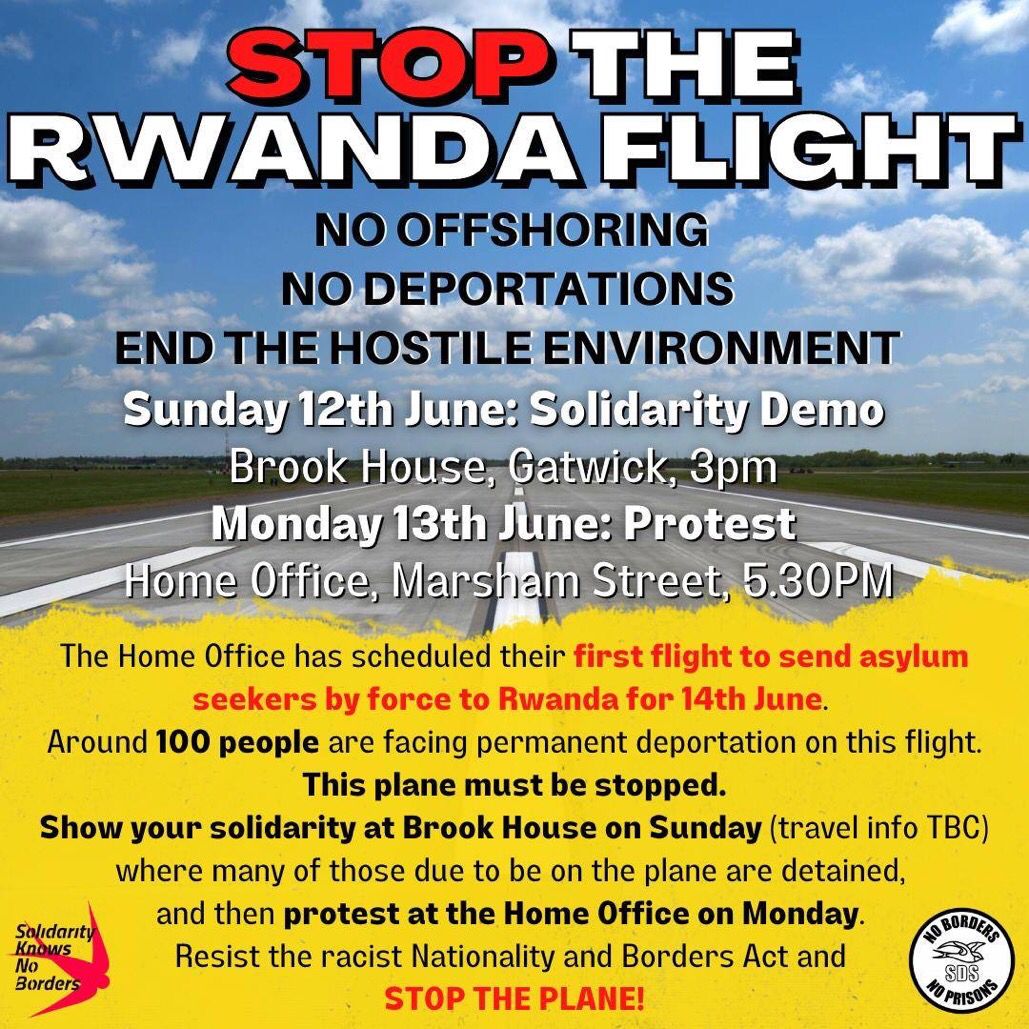
The refugee support organisation, Care4Calais, are challenging government proposals to begin deporting asylum seekers to Rwanda as soon as 14th June. They circulated the following update on 6th June:

We are now working with 80 out of the 100 people that the Government have sent ‘Notices of Intent‘ saying that they will be sent to Rwanda. 17 have received notices to say their deportation is imminent, ten of which mention 14 June. They are all in detention centres and they are all very scared.

Priti Patel says the Rwanda plan will offer migrants “an opportunity to build prosperous lives in safety”. However every single one of the people we have spoken to is shocked and traumatised at the thought of being forcibly sent. We’ve had a five day hunger strike and numerous late night conversations with people who feel suicidal. One said “They can send my dead body to Rwanda, but I would rather die than go there”.

The Home Office say they are only sending single men to Rwanda, but the reality is that they are sending men who are not accompanied by their wives, children or other dependent relatives at this point in time.

The reason that many embark on these incredibly dangerous journeys is that they see it as the only way to find a safe future for their families. I spoke to a man from Sudan who left his wife and unborn child in a refugee camp where they could be trapped for many years if he did not find an alternate future for them. His journey took two years and has left horrific scars, but now he is terrified he has let them down. If he gets sent to Rwanda he may never meet the child that was born after he left.

Another man will be forced to leave his 16 year old brother behind in the UK, and another, the wife that he came here to join and has not seen for three years. Many are fearful of the effect that being sent to Rwanda will have on their families back home.

We have not yet been told how people are selected to go to Rwanda but around a third of those we are talking to in detention are from Sudan. The next biggest group is from Syria. In our experience this is not representative of those who generally cross the Channel.

By contrast, we only have three Afghan refugees in our sample with a Rwanda notice – yet we are told that Afghans make up 25% of those crossing in small boats.

Two of the boys say that they are just 16 years old. The Home Office say they are 23 and 26 so it is essential that proper age assessments are done before any deportation takes place. One 16 year old saw his brother killed in front of him when his village was raided in Sudan. He escaped and went back later to find the whole village gone.

We estimate that over 70% of those with Rwanda notices have suffered torture or trafficking either in their home countries or on the incredibly dangerous journeys they have made. As a result, many have serious physical and mental scars and are finding the intense stress of detention, coupled with the threat of being sent Rwanda, intolerable.

One man who endured extreme torture in Libya told me that every time the door to his room bangs shut it gives him flashbacks to being tortured in Libya. This makes him feel like he is going insane.

Every single one of these people has a devastating account of the horrors they have escaped from in their home countries. Be it war, torture or persecution, they are all difficult to hear. The fact that our Government is putting them through the intense trauma of a deportation to another dangerous future is simply barbaric.

I spoke to another man who was tortured In Libya. They broke his nose and his shoulder twice; he has scars on his back and stomach from being electrocuted. He said “Things like that can happen in Libya, there is no government and it is lawless. But I never expected to be put in prison in the UK for committing no crime.”

He said that when he was being tortured the one thing that kept him going was hope in the UK as being a place where fairness and equality exists. Now, being told that the UK will forcibly deport him to a country that has been condemned for human rights violations smashes that hope to pieces.

That people believe that the UK is a good place that will treat them fairly is something we should be proud of; that throughout the world the UK is a beacon of all that is good is an amazing reputation that we could now lose.

The ‘logic’ to the Rwanda plan is that we take people who, by definition, have escaped from the very worst things in this world, who are so desperate they are willing to get in frightening and flimsy boats to cross the Channel, and present them with something that fills them with even more terror in order to deter them from coming. Is this really what we as a civilised nation want to do?

There is a more humane and civilised solution right in front of us now. If we gave all refugees visas to cross the Channel, in the same way we do with Ukrainians, no one would need to risk their lives in small boats, and people smugglers would be put out of business overnight. This must be possible – we are taking seven year’s worth of Channel refugees in our 200,000 Ukrainians this year.

Over the four day bank holiday weekend the Care4Calais access team and our fabulous refugee volunteers have worked right through to stay in touch with everyone, sort out paperwork, keep people up to date and reassure them. We cannot thank them enough for their efforts. The work of this team is essential; more than ever given the Nationality and Borders Act. We are raising funds for a new caseworker and need all the help we can get. Please donate now – no amount is too small to help bit.ly/c4caccess

What can I do?

Plans to send asylum seekers to Rwanda have been criticised by a number of Christian leaders including Catholic Bishop Paul McAleenan. Read – Bishop Critical of Rwanda Plans

Visit Care 4 Calais website – Stop Rwanda

Write to your MP – Bail for Immigration Detainees Website

Sign the Parliamentary Petition – Stop the Government’s One Way Ticket Plan

Demonstrate – Demo Dates and Venues