Pacifism in the face of aggression – the Christian response?

By Maggie Beirne, West London Justice and Peace Network Co-ordinator

We have all watched our TV screens with horror since the 24th February when Ukraine was invaded.  Russia’s unprovoked attack, and the nature of its assault – indiscriminate bombing and killing of civilians leading to the internal displacement and mass exodus of refugees, and the apparent threat to use biological/chemical and even nuclear weapons – has left most of us shocked.  And who has not felt a strong sense of solidarity with the plight of the Ukrainians?  We empathise with their plight; we pray as individuals or in community for their survival; and we try to help practically with financial or other donations.  We feel one with their cause. 

The West London Justice and Peace Network reflected at a recent meeting on the challenge of pacifism in times like this. How would we as individuals respond in similar circumstances?  Would we start training to use Kalashnikovs or insist on suing for peace at whatever cost?  When we experience a sense almost of pride in seeing these ‘plucky’ Ukrainians giving their all to defend their freedom, do we become part of the problem; and what is the Christian response to these challenges?   

Martin Birdseye, member of the Network and long-time peace activist, helped us reflect on some of the difficult issues involved. 

We were reminded of the fact that history is full of examples where in time of conflict, pacifism gets swept away on a tide of solidarity.  We have certainly seen our own elected politicians rush to bolster arms supplies, talking up the importance of ‘hard power’’ and the strength of our military alliances, while unsaid but very apparent, is the increased risk of nuclear war.  Our very human instinct for personal and human security can lead us into an aggressive response, but is this so different from the desire of Russians for security following their terrible experience of WW2 and their fears of NATO ‘expansionism’?

In Britain, our taxes are spent on maintaining a nuclear arsenal, supposedly for our defence.  But is this arsenal keeping us safe, or does it not lend a false justification for both NATO and Russia to vie for control of their respective ‘spheres of influence’?  Instead of nuclear weapons strengthening our security, have they rendered the world a more unsafe place?  Would our taxes have been much better spent on tackling injustices in our own society and actively building peace globally – via aid, tackling government corruption, support for refugees, or fighting climate insecurity.

In the longer term, we also need as Christian peacemakers to examine the role of Britain as probably the world’s second largest arms exporter.  Arms companies and suppliers may be the only ones to gain from the current tragedy in Ukraine.  Most local West London residents were unaware of the international arms fair that was recently held this year in Twickenham, yet such gatherings feed and fuel the violence that we then subsequently deplore around the world (whether in Ukraine, Yemen, or the Horn of Africa). This trade is taking place in our name as the UK government provides export licenses for ‘suitable’ arms manufacturers but claims to bear no responsibility for the resultant human rights abuses.

The network noted that the Ukrainians, like all of us, have a right to self-defence and that pacifism is not ‘passivity’.  But nor can we ignore the fact that the violence perpetrated by one side tends only to beget violence from the opposition, in a never-ending cycle of retribution.  Or, as better said by Mahatma Gandhi, “an eye for an eye makes the whole world blind”.  So, the real challenge is to find out how we can turn to God and help others do so in these times of turmoil.

In our discussion, the network noted that concepts such as ‘justice’ and ‘peace’ can at times like this appear to be in tension but are instead totally inter-dependent.  “No justice, no peace”, albeit a slogan, is accurate. As Christians we have to be active peace makers.  Peace groups have organised zoom prayer meetings; had a spontaneous turn-out of people on the day of the invasion to a prayer gathering; and Religions for Peace UK have submitted a letter to the Chiswick-based Bishop of the Russian Orthodox church, to be sent to the Moscow Patriarch asking him directly to appeal to Putin.  What should we be doing practically all year around to promote the educational efforts of groups such as Pax Christi and the Christian Campaign for Nuclear Disarmament?

When time permits, events in Ukraine may also encourage more reflection on the Catholic teaching around the ‘just war theory’.  This theory sets out some of the principles that will determine if the cause of any war be ‘just’, and if the tactics used in warfare can also be considered ‘just’.  But there is now much debate as to whether the idea of a ‘just war’ has become an obsolete concept given that the massive predominance of civilian casualties in modern warfare undercuts the moral ground for conceiving of almost any war as just. 

So, whilst we need to focus over the longer term on eliminating the underlying causes of violence and war and re-introduce the power of non-violent action, what can be done in the short term?  Right now, Ukraine is being destroyed and its people scattered.   Alongside all the practicalities (of sending humanitarian assistance and being welcoming to refugees), Pope Francis, pleaded: “Let the weapons fall silent. God is with those who seek peace, not those resorting to violence.”

As Christians, we have to join him in condemning those who “trust in the diabolic and perverse logic of weapons” and pray for guidance on how to engage ever more effectively in the search for peace.

Links

Pax Christi: www.paxchristi.org.uk

Christian Campaign for Nuclear Disarmament: www.christiancnd.org.uk

SVP responds to Chancellor’s Budget – another missed opportunity

Source: James Robert Welton, SVP / Independent Catholic News

The St Vincent de Paul Society has issued the following response to the UK Government’s Budget today:

Today’s Budget announced by Chancellor Rishi Sunak is delivered against the backdrop of an inflation rate expected to peak four times above the Bank of England’s 2% objective, and an economic outlook which is at best uncertain.

A recent Resolution Foundation report suggests that the conflict in Ukraine could push peak inflation in 2022-23 above 8%, which could leave the typical real household income for non-pensioners 4%, or £1,000, lower than in 2021-22.

Wholesale energy prices have risen much faster than expected since the last Budget, and the war in Ukraine is expected to further increase fuel and food prices over the coming months. The resultant gut-wrenching rise in energy bills has produced a palpable sense of anxiety for millions, while petrol and diesel prices approaching £2 per litre means the commute to work has now become a dangerous drag on household incomes.

The cost of living crisis is affecting millions of households, many of whom are being supported by members of the St Vincent de Paul Society (SVP) and St Vincent’s centres across England and Wales. Without the support of the SVP, tens of thousands of families would fall into poverty and be denied the help they need to survive and the empowerment to pull themselves out of poverty and regain their dignity.

The doubling of the £500 million Household Support Fund for local authorities to help families most in need is simply not enough and should have gone much further.

For lower income households which depend on social security, the crisis is having a disproportionate effect simply because benefits rise in line with inflation. The 3.1% rise in benefits, which equates to £10.07 per month for Universal Credit claimants, will leave low-income households much worse off.

We welcome the rise in the National Insurance threshold by £3,000 to £12,570, which means thousands on lower incomes will take home more money. However, we are disappointed that no benefit uprating has been announced, which adds to the issue caused by the £20 cut to Universal Credit late last year.

The decrease from 5% to 0% VAT for homeowners to install energy-saving materials such as solar panels is a good move, but it does not go far enough. Most people feeling the financial squeeze are those who are not home-owners, and therefore this measure missed an opportunity to combat climate change for all households.

The SVP has been extremely vocal over its concerns with the Levelling Up White Paper, which can be found here. We pointed out the need for policies which promote secure employment, and we urged the government to listen to the experiences of frontline service providers, such as the SVP, to better inform plans to revitalise communities.

Today’s Budget is a missed opportunity to add momentum and commitment to the Levelling Up agenda. In a recent letter to the Secretary of State for Levelling Up, Housing and Communities, Michael Gove, about the UK Shared Prosperity Fund (UKSPF), the SVP highlighted the need for better guidance and clarity around the objectives of UKSPF. However, Mr Sunak failed to provide further details, leaving significant doubts over the UKSPF’s effectiveness in tackling the economic disparity.

The government continue to squander opportunities to lead the country out of the pandemic and into a fairer and more just future built on every sector of society. This Budget could have addressed the financial mechanisms which unfairly punish those on lower incomes as inflation rises. Mr Sunak could also have lessened the impact of rising wholesale fuel prices on people who simply cannot afford the startling increase in heating and fuel bills, and the government could have better consulted with frontline service providers, such as the SVP, to provide more robust and targeted solutions to the epidemic of poverty effecting England and Wales during these uncertain times.

Saint Vincent de Paul Society

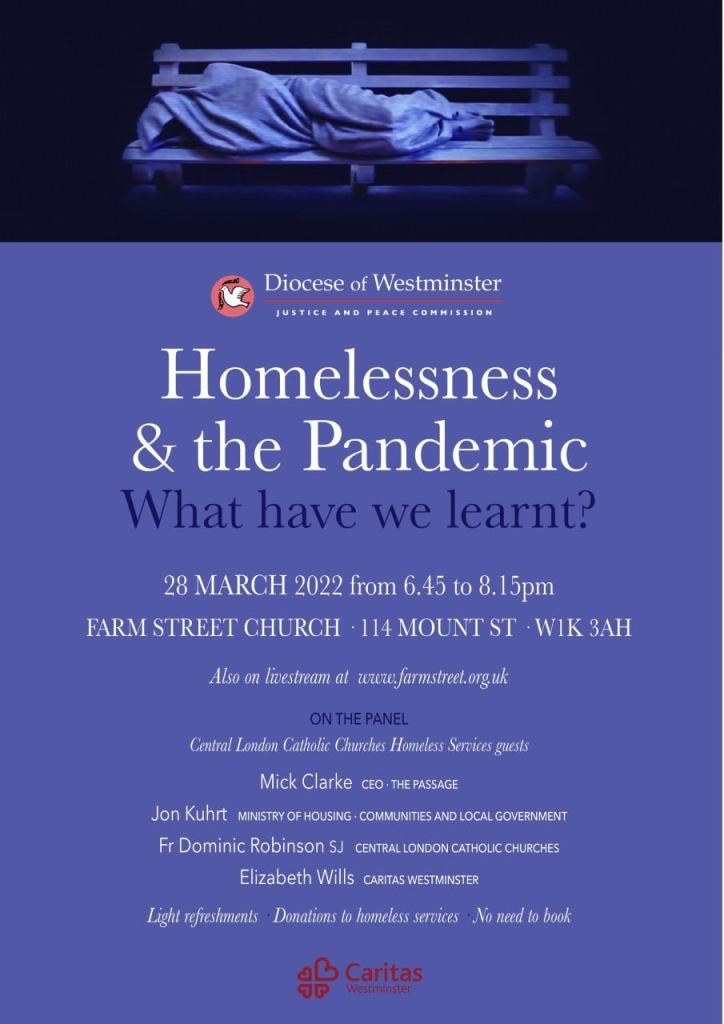
Homelessness and the Pandemic: What have we learnt? 28 March, 6.45-8.15pm. Farm Street Church

How have the churches responded to people sleeping rough or in insecure accommodation during the pandemic and what lessons have been learnt for the future?

Open to everyone with an interest in this area, from those who have participated in homelessness projects as staff, volunteers or guests to donors, advocates and clergy.

The event will also be recorded and available on the Westminster Justice and Peace website if you would like to catch up afterwards.

Please register your email address on the right hand-side panel and click ‘Follow’ if you wish to get notifications of website news and updates.

Join us for this live panel event at Farm Street Church or watch online

Watch on Livestream from Farm Street Church

Bishop John Arnold among church leaders urging UK government to cut use of fossil fuels

Source: A Rocha / Independent Catholic News

Former Archbishop of Canterbury, Rowan Williams, and more than 50 Anglican and Catholic Bishops have signed letter to the UK government calling for a windfall tax on fossil fuel companies to tackle the cost of living crisis and energy efficiency measures to reduce heating bills.

Ahead of the Government’s Spring Statement and energy security strategy, more than 200 UK church leaders have written to Prime Minister Boris Johnson and Chancellor Rishi Sunak calling on them to use these opportunities to tackle the climate emergency and address the cost of living crisis.

The letter, signed by former Archbishop of Canterbury, Rowan Williams, says: “We call on you to use the Spring Statement to provide financial and fiscal support for renewable energy and energy efficiency, especially solar and wind energy and the retrofitting of homes and other buildings across the UK. These measures would reduce heating bills, decrease carbon emissions and increase our energy security.”

Other signatories to the letter include the lead environment bishops for the Church of England, Rt Rev Graham Usher, the Bishop of Norwich, the Catholic Church in England and Wales, Rt Revd John Arnold, Bishop of Salford, and the Catholic Church in Scotland, Most Revd William Nolan, Archbishop of Glasgow.

Church leaders from across the country have signed the letter including leaders of the Methodist Church, Scottish Episcopal Church, Church in Wales, United Reformed Church, Baptist Union, Quakers and Jesuits in Britain, among others.

They urge the Government to implement a windfall tax on fossil fuel companies to address the cost of living.

They write: “The Spring Statement must include no support for new oil and gas developments. The International Energy Agency has stated that there can be no new fossil fuel developments if we are to limit global heating to 1.5°C. New oil and gas production will not deliver lower energy bills for families facing fuel poverty and will have no impact on energy supply for years.

“We urge you to increase support for vulnerable households across the UK facing a cost of living crisis as a result of increasing food and energy prices, through measures including a windfall tax on oil and gas companies.”

They add that many of their churches have set a 2030 target for reducing their emissions to net zero:

“Many of our Churches have set 2030 net zero targets and are taking action to decarbonise our buildings, including through the installation of solar panels, heat pumps and other energy efficiency measures. More than 2,000 churches across the UK participated in Climate Sunday ahead of COP26 and called on the UK Government to unleash a clean energy revolution and limit global heating to 1.5°C.”

A number of charities support the statement:

Patrick Watt, Interim CEO of Christian Aid, said: “The war in Ukraine has been a stark reminder that a world which relies on oil and gas is a world that is economically and politically combustible, as well as being environmentally disastrous. This is the moment we need to fundamentally rethink our energy system, and break the power of petro-autocrats for good by switching to clean, affordable, home grown renewables as fast as we can.

“If the UK is to be taken seriously as a global leader on climate change it needs to take this opportunity to accelerate the roll out of renewables as well as widespread energy efficiency measures which have been overdue for many years.

“A rush for fracking or more North Sea oil would undermine efforts to tackle climate change and endanger some of the poorest and most vulnerable people in the world who are dealing with the impacts of the climate crisis and look to the UK to lead the way in decarbonisation, not pursuing more polluting fossil fuels.”

Christine Allen, Director of CAFOD, said: “This statement next week comes at a crucial time for the world’s energy industry. It’s never been more clear, nor more urgent, that we need a just transition to a low carbon economy. For the world’s poor, access to energy is a matter of survival.

“For humanity to be sustainable, all of our energy must come from renewable sources if we are to have any chance of protecting our common home for all of our sakes. The time to finally move away from fossil fuels is now, we hope the government with all its power and resources will lead by example to make this ground-breaking transition a reality.”

Revd Dr Darrell Hannah, Chair of Operation Noah and Rector of All Saints, Ascot , one of the signatories of the letter, said: “The Prime Minister and Chancellor must act now to insulate millions of British homes, scale up renewable energy, give more support to struggling households and immediately stop all new oil and gas developments, as scientists say we must to avoid catastrophic climate impacts.

“It would be completely irresponsible for the UK Government to enable new fossil fuel projects in the North Sea only four months after the COP26 climate talks in Glasgow. The time is now for bold measures including a windfall tax on oil and gas companies, who are reaping billions of pounds in profits while families around the UK, including many of our parishioners, are struggling to heat their homes and put food on the table.”

Andy Atkins, Co-Chair of Churches’ Environmental Issues Network, and CEO of A Rocha UK, said: “Thousands of churches are sending aid to Ukraine, continuing to deepen their own action on climate change and supporting the poor and vulnerable locally, through foodbanks and other means. Next week’s statement is a crucial opportunity for the government, with its far greater resources, to wholeheartedly embrace a rapid and fair transition to a low carbon economy.”

Dr Ruth Valerio, Director of Advocacy and Influencing at Tearfund, said: “The Ukraine conflict has exposed the fragility of our energy system if it relies on fossil fuels. Let’s not go back to polluting oil and gas when renewable solutions are cheaper, cleaner and more secure. Our response to the energy security crisis can’t add fuel to the climate crisis.”

See the full text of the church leaders’ open letter and full list of signatories here: https://docs.google.com/document/d/1ZVkcT5VKz45P3tzdv2mKwznhyKRduubUqrx5_pcNX9U/edit

Bishop John Arnold Speaks to the Southern Dioceses Environment Network https://westminsterjusticeandpeace.org/2022/02/14/bishop-john-arnold-speaks-to-the-southern-dioceses-environment-network-14th-february-2022-showthelove/

Pax Christi England and Wales seeks new CEO

Pax Christi England and Wales are looking to appoint a new Chief Executive Officer.

The agency is seeking “a creative and energetic peacemaker to be responsible for developing, co-ordinating and implementing the work of our membership organisation.”

If you would be interested in applying for this post, please download the job description and the application form on the link below.

Completed application forms should be sent with a covering letter to chair@paxchristi.org.uk

Closing Date: 19th April 2022

Successful applicants will be informed by 27th April 2022

If you would like more information, please contact admin@paxchristi.org.uk

Download the Job Description and Application Form here: https://paxchristi.org.uk/work-for-us/

Orthodox theologians issue declaration rejecting Moscow Patriarch’s teaching

Church in village of Bobryk, Kyiv region after a "special military operation"  Image: @nexta_tv

Church in village of Bobryk, Kyiv region after a “special military operation” Image: @nexta_tv

More than 530 Orthodox theologians from around the world have issued the following letter and declaration strongly rejecting ‘Russkii Mir’ or (Russian World) ideology currently being promoted by the leader of the Russian Orthodox Church in Moscow…

Dear Friends,

In the wake of Vladimir Putin’s unconscionable and horrendously destructive invasion of Ukraine, Orthodox Christians across the globe must face a difficult question: how can a nation whose majority embraces Orthodox Christianity possibly justify attacking and killing the people of a sibling nation, who almost all share the same faith?

How, at the beginning of Great Lent, when our tradition calls us to forgiveness, fasting, and prayer, can Orthodox Christians unleash violence and bloodshed against their brothers and sisters in Christ?

The painful truth, but one that we need to confront in this time of repentance, is that our own leadership, and specifically, the leadership of the Russian Orthodox Church, has developed and promoted a false teaching known as “Russkii Mir” or “Russian World,” providing Mr Putin with the religious “blank cheque” that underwrites his heinous invasion and annexation of Russia’s peaceful, democratic neighbours: Ukraine.

During this sacred season, Orthodox Christians throughout the world need to declare in no uncertain terms that the “Russian World” ideology is both false and destructive, feeding violence and bloodshed, causing scandal and division in the Church. Nor can we fool ourselves that this ideology is an exception in the history of Orthodoxy: we must condemn all Orthodox ethno-phyletist ideologies akin to the false teaching of the “Russian world” in every age, nation and culture.

Orthodox scholars and theologians have drafted a powerful Declaration (see link below) concerning the theologically condemnable “Russian World” ideology. We urge you to read this Declaration, sign it, and share it with those around you.

We urge you to pray for repentance for those who propagate this evil teaching, which continues to feed the megalomaniacal ambitions of Vladimir Putin. Pray also for the repentance of every Orthodox Christian, for our own complicity in this evil through silence, obfuscation, and denial.

Only if we confront this evil, which thrives both within and outside us, bowing low in repentance with the simple words of the Canon of St Andrew of Crete-“Have mercy on me, O God, have mercy on me!”-can we truly reaffirm our divided, bloodied community as the one, holy, catholic and apostolic Church, united only by our broken and contrite hearts in the person of Jesus Christ, who alone is with us in adversity.

See the Declaration here: https://bit.ly/3KD1HOC (There is a form at the end if you wish to add your name)

The Coordinators on Behalf of the Drafting Committee
Revd Dr Brandon Gallaher
Dr Pantelis Kalaitzidis

Blog on Climate Change by Amy Smith

Amy Smith is a Communications Volunteer for Westminster Justice and Peace

As Christians we know that the earth is not ours to do with as we wish, regardless of the consequences, but is gifted to us by God for us to live and share with the rest of His creation which He values equally. If God is love then all of His creation is worthy of love and protection. God trusts us and believes in our capacity to be responsible stewards of the earth; hopefully we can see this role as an honour and privilege. In Mark (12:31) we are instructed to ‘love thy neighbour as thyself’; our actions towards our planet have a direct impact on our brothers and sisters, especially those in poorer countries who will likely suffer the most.
 
The parable of the Good Samaritan shows us how we are all interconnected despite our circumstances and how our actions can make a real difference to the lives of those in need. Any brother or sister of God’s should be our responsibility to help. Often, we might feel we would like to help but it isn’t really up to us or we can’t make much impact by ourselves, such as the Levite who felt pity and would like to help if only it cost him no trouble. The poor man hasn’t done anything to deserve his predicament just as poorer communities have done little to contribute to the global warming crisis but are suffering the worst consequences. They have fewer resources to mitigate the effects of climate change and are more vulnerable to extreme weather. This only exacerbates poverty and deepens inequality. It seems only right that rich countries whose actions are the root cause of climate change must bear the responsibility for resolving the problem.
 
In Laudato Si’, the encyclical published in 2015, the Pope reiterates the Bible’s message that there should be a relationship of mutual responsibility between humans and nature, in order to protect it for future generations. This act of care for our ‘Common Home’ is the responsibility of ‘every living person on this planet.’ He instructs us to take steps in our daily life to change the attitude of wastefulness and greed brought on by the consumerist culture we live in which is detrimental to our relationship with each other, the earth, and God. Already the Earth’s temperature has increased by 0.8°C over the last 30 years mainly due to human activity, especially the burning of fossil fuels. A target of keeping temperature rises below 1.5 degrees has been given as a limit which is essential to preventing the most detrimental effects to our planet such as sea level rises, but even this is looking unlikely unless more actions can be agreed upon by world leaders.
 
What can we do as individuals, as Christians to play our part in this crisis? Perhaps we can think of ways we can change our lifestyle, something that is not always easy when we are used to living a certain way. Maybe there are small steps we can take before progressing further such as having a meat free day, reducing the use of our phone, trying to travel green such as cycling/walking more and using a renewable energy provider in our homes. Often we can feel discouraged when our efforts seem insignificant, but if everyone plays their part and supports each other there is potential for real change. Hopefully we can call on God in prayer during this season of Lent to help us contemplate our relationship with Him, each other and our world.
 
I have been privileged to attend the Southern Dioceses Environment Network meetings which happen once a month to share the initiatives that are taking part in each parish to tackle climate change.

Participants include CAFOD and diocesan staff and volunteers, Laudato Si’ animators, clergy, parishioners, religious and activists. All are welcome. The next meeting will be held on Monday 14th March, 12.45-2.00pm.  

Southern Dioceses Environment Network

To register for the Zoom meeting:
https://www.eventbrite.co.uk/e/255432404197

Cardinal Vincent Nichols among church leaders urging PM to speed up process for refugees waiting to enter UK

Ukrainian Catholic Cathedral, Duke Street, London, W1K 5BQ

Source: London Church Leaders

Christian leaders in London sent the following letter to Prime Minister Boris Johnson on 9th March 2022, urging the government make it possible for Ukrainian refugees to enter the UK as quickly as possible. At the present time, hundreds of desperate women and children, disabled and elderly people with family in the UK, who survived the arduous journey from Ukraine to France have been kept waiting for days while the British government establishes a procedure for granting them visas.

The text of the letter and full list of signatories follows:

We London Church Leaders met today at the Ukrainian Catholic Cathedral of the Holy Family to pray with Bishop Kenneth Nowakowski and his people and to share our concerns at the greatest humanitarian crisis since the end of the Second World War now unfolding in Europe. We are encouraged by the government’s family sponsorship programme and welcome the intention to establish a pathway to humanitarian sponsorship.

As the number of Ukrainian citizens seeking shelter outside the borders of Ukraine is estimated to reach close to two million, we cannot but emphasise the urgency to act swiftly and without delay.

As the children and grandchildren of those who experienced the horror of war seven decades ago, it is our moral obligation to provide protection and hospitality to those who are undergoing the same horrors today, unthinkable as that may seem in the 21st century.

Just as so many British children were sent to the countryside far from harm’s way during the bombing of London, so today tens of thousands are hoping to find refuge far from Russia’s relentless, unconscionable, and indiscriminate attacks on homes, hospitals and schools throughout their homeland. Surely, we feel compassion today for Ukrainian mothers with young children, the elderly and those with disabilities, who have undertaken dangerous and arduous travel, and look to the United Kingdom with hope and are now reaching out to us in Ukraine’s greatest hour of need.

How can mothers with young children, the elderly and the disabled, who have travelled a thousand miles be expected to complete online application forms in a language foreign to them? Times of war require swift action and flexibility, the easing of normal procedures and the removal of complex bureaucratic obstacles that can easily turn hope into despair and resignation.

We would ask that sponsorship not be limited to those with family members in the UK, but that those sponsorship criteria be expanded to include all Ukrainian refugees on humanitarian grounds, allowing them to enter the UK as quickly as possible.

Cardinal Vincent Nichols, Archbishop of Westminster
Archbishop Nikitas, Archbishop of Thyateira and Great Britain
Bishop Christopher Chessun, Bishop of Southwark
Archbishop Angaelos, Coptic Orthodox Archdiocese of London
Rev Phil Barnard, Team Leader London Baptist Association
Rev Dr Jongikaya Zihle, Methodist Conference
Revd George Watt, Moderator URC Thames North
Lt Colonel David Shakespeare, Salvation Army
Les Isaac OBE, President of the Ascension Trust
Andy Frost, Moderator of Free Churches Group Jesus International
Bishop Lynne Cullens, Bishop of Barking
Rev Msgr Kevin Hale, Vicar General Diocese of Brentwood
Ven Elwin Crockett, Archdeacon of West Ham
The Ven Luke Miller, Archdeacon of London

Online Free Film: Britain in Palestine 1917- 48, 14 March, 5.00-6.15pm

Image Balfour Project

Image: Balfour Project

The Balfour Project’s 20-minute film ‘Britain in Palestine 1917-48’ is being shown online from 5pm to 6.15pm on Monday 14 March, as part of the Oxford Human Rights Festival.

There will also be an opportunity to ask questions of historian and film-maker Dr Mary Embleton and Peter Riddell, founding trustee of the Balfour Project. Mary and Peter know their subject – Britain’s role in Palestine from the Balfour Declaration to the sorry end to the British Mandate to govern Palestine.

To reserve your free place for the film screening and Q and A, see:

www.eventbrite.co.uk/e/britain-in-palestine-1917-1948-britains-role-short-film-qa-online-tickets-278254565897

See the programme for the entire (free) Festival including the Balfour Project film: www.oxfordhumanrightsfestival.net/book-tickets.html

The Balfour Project – https://balfourproject.org/

Westminster Catholics represented in Trafalgar Square at Rally for Ukraine

l-r: Bishop Kenneth Nowakowski, Papal Nuncio Archbishop Claudio Gugerotti, Archbishop Anba Angaelos

l-r: Bishop Kenneth Nowakowski, Papal Nuncio Archbishop Claudio Gugerotti, Archbishop Anba Angaelos

An estimated 2,000 people, gathered in Trafalgar Square on Saturday, 5 March, for a peace rally organised by the main Ukrainian community groups in the UK.

The Apostolic Nuncio to Great Britain, Archbishop Claudio Gugerotti, told those gathered: “Today we are all Ukrainian.” He brought a message from Pope Francis assuring everyone present and all those who have family and friends in Ukraine that the Holy Father is remembering them in his prayers.

Bishop Kenneth Nowakowski, Bishop for Ukrainian, Belarusian and Slovak Eastern Catholics in Great Britain also attended with Coptic Orthodox Archbishop Anba Angaelos, the Archbishop of Birmingham, Most Rev Bernard Longley, Mgr Keith Newton from the Ordinariate of Our Lady of Walsingham, Fr Dominic Robinson SJ, head of Westminster Diocese Justice and Peace Commission, who represented Cardinal Vincent Nichols and a group of priests and seminarians from the Ukrainian Catholic Eparchy of the Holy Family.

There were calls from several speakers for the EU to provide a ‘no fly zone’ over Ukraine.

In a speech, journalist and author Paul Mason appealed for the British parliament to pass emergency legislation confiscating property and fortunes of the billionaire Russian oligarchs living in the UK. “They made their fortunes by stealing from the Russian people” he said. Mason proposed that this money could be used to help provide medical care, food and shelter for the more than one million refugees who have been forced to flee their homes by invading Russian forces.

A Russian couple attending the rally, Anna and George from Moscow, told ICN: “We came here to show our support for the Ukrainian people. Our family and friends do not support Putin. We feel this invasion was a savage act. We are concerned for the safety of our own families and very worried about the situation in Ukraine. This is a tragedy.” Anna said: “I have hardly slept since this began..”

Two Ukrainian sisters from a town near Lviv who are working as nurses here, said: “We have family near the Russian border. On the first day of the invasion we were able to speak with our parents. Our mother has diabetes so she needs regular medication. They said if things looked dangerous they would go to another place but since then we have heard nothing. We are desperately worried and praying for their safety.”

The day was organised by Euro-Maidan, The Association of Ukrainians in Great Britain, the Ukrainian Women’s Organisations in Great Britain, the Ukrainian Greek Catholic Church and the Ukrainian Orthodox Churches in Great Britain, among others.

If you would like to support organisations working with Ukrainian refugees see: www.gofundme.com/f/helpukraine

Watch a clip from the day: www.youtube.com/watch?v=FEmzlh8h3J0&t=8s