Little Amal Takes Her First Steps on The Walk

Photo: Hüseyin Ovayolu

Photo: Hüseyin Ovayolu

Source: Independent Catholic News

Little Amal will be in Central London on 23rd October, waking up on the steps of St Paul’s Cathedral and being welcomed by many faith leaders

Little Amal took her first steps last night, 27 July, marking the start of The Walk and her 8,000km journey from the Syria-Turkey border to the UK. The 3.5m puppet of a nine-year-old Syrian refugee girl started her journey in Gaziantep, Turkey. Many streets in the ancient heart of the city were illuminated by lanterns creating a path for Little Amal to follow to reach a special concert for her at Gaziantep Castle.

The Walk continues until 3 November 2021, through Greece, Italy, France, Switzerland, Belgium and Germany before reaching its finale in Manchester. In each village, town or city she visits Little Amal will be welcomed by major new arts commissions, city-wide community performances and intimate events. All events are free and have been designed by The Walk, in collaboration with each local partner to create one of the most adventurous public artworks ever attempted. Audiences will be able to follow Little Amal’s journey online and across social media, as well as joining in with events in their local area.

Little Amal represents the millions of displaced refugee children separated from their families. Her urgent message to the world is “Don’t forget about us”. Produced by Stephen Daldry, David Lan, Tracey Seaward and Naomi Webb for Good Chance Theatre, the producers of The Jungle, in association with the Handspring Puppet Company, the creators of the War Horse puppets, and led by Artistic Director Amir Nizar Zuabi.

It takes three puppeteers to operate Little Amal; a stilt walker who also brings her face to life and one on each of her arms. There is a total team of eleven puppeteers, including two from refugee backgrounds. The puppet is crafted from moulded cane and carbon fibre.

The Walk has developed an Education Programme which will connect young people from refugee and host communities to forge bonds of friendship. The programme includes:

A 70+ page Education & Activity pack and Teachers’ Notes in six languages featuring illustrations by Syrian artist Diala Brisly. This can be downloaded from The Walk’s website: www.walkwithamal.org/education/activity-pack/
A series of free online education events for teachers and educational leaders “Make With Amal” – an online engagement programme of art activities inspired by Amal’s route.

The Walk today launches ‘City Through Their Eyes’, a new digital guide on the Bloomberg Connects app – a free digital guide to cultural organisations around the world that makes it easy to access and engage with arts and culture from mobile devices, anytime, anywhere – to elevate and celebrate the voices of refugee and migrant artists across Turkey and Europe. Drawing from the cultural richness of their homelands, artists from refugee and migrant backgrounds offer intimate and unexpected insights into the towns and cities they now call home, alongside contributions from people who have lived in these towns and cities all their lives. To coincide with Little Amal’s first steps in Gaziantep, audio guides from artists and cultural leaders across Turkey are now available exclusively on the app. As Little Amal approaches each country on her journey, a new collection guides will be added. The app also offers a suite of six exclusive interviews with the cast and creative team of The Walk.

The Walk brings together celebrated artists, major cultural institutions, community groups and humanitarian organisations as well as municipalities, civic and humanitarian organisations, faith leaders and schools. For a full list of partners please visit: www.walkwithamal.org/friends/

The Walk website contains a donation page which invites the public to help to fund Amal’s journey at £1 per step.

The full programme is available on The Walk’s website: www.walkwithamal.org/events/

Two Augusts in Japan

Urakami Cathedral - largest church in East Asia.  It took 30 years to build, 30 seconds to destroy
Urakami Cathedral – largest church in East Asia. It took 30 years to build, 30 seconds to destroy

Source: Independent Catholic News

August 2021. The eyes of the world are focused on Japan. The world’s athletes compete for gold, silver and bronze medals.

August 1945. The eyes of the world are focused on Japan. The two most destructive weapons ever produced fall on Hiroshima and Nagasaki.

A Message from the Mayors of Hiroshima and Nagasaki:

“In August 1945, atomic bombs instantaneously reduced our cities to utter ruin and took over 201,000 precious lives. Many of those who survived have since suffered the devastating after-effects of radiation, the never-ending horror of a nuclear weapon. Even today, the full scope of radiation effects is unknown, and survivors still live in dread.

Hiroshima and Nagasaki have consistently followed the lead of our survivors, who arose from the depths of despair to warn the world about nuclear weapons. Through the efforts of many, we have thus far prevented a third use of such weapons, but sadly, our cherished hope of eliminating them has yet to be fulfilled.”

We at Christian CND find that many people are still ignorant of the horror of what happens after a nuclear blast. If they truly understood, they could not contemplate how a so-called civilised country, let alone one that shelters under the label of “Christianity,” would base its security on such evil. Pope Francis understands this absolutely and has called even the possession of such instruments of death, immoral. The Vatican has led the nations of the world in signing the Treaty to Abolish Nuclear Weapons.

This is what happened in Hiroshima on 6 August 1945. The temperature on the ground was 3,000 to 4,000 degrees. An observer writes that, “on the riverbank I saw figures that seemed to be from another world. Ghost-like, their hair falling over their faces, their clothes ripped to shreds, their skin hanging in tatters. A cluster of these injured persons moved wordlessly towards the outskirts.”

The Shiroyama National School lost 1,400 primary aged children, 31 teachers, and 105 students. The Shima Hospital was directly under the hypocentre. The initial radiation emitted was lethal as far as 1000 metres from the hypocentre. Most in that area died within a few days and many others, including relief workers, within the next few months. Many developed cancers five to 30 years later.

Many of those who could, escaped to Nagasaki. “This is a Christian City”, they said; “we will be safe here.” Three days later Nagasaki also received an atomic bomb!

Keiji Nagazawa was a child of six when the bomb fell on Hiroshima. When he grew up he became a film maker. ‘Barefoot Gen’ is a Manga film of his memories of that 6 August. It is still available online, intensely moving and a passionate plea for the end of war.

Knowing what these terrible weapons do to God’s beloved people and the beautiful home given to us, how can we ever contemplate their use? How can we tolerate our own government’s increasing its lethal stock of warheads, each one over eight times as powerful as the one dropped on Hiroshima? How can we allow more than two billion pounds being spent to renew and expand our Trident weapons programme? How can we tolerate the frequent convoys carrying these horrendous instruments of death up and down our public roads between Aldermaston and Coulport in Scotland?

If you want to know more about what can be done, or help in the campaign to rid the world of such evil, please get in touch with us at Christian Campaign for Nuclear Disarmament or Pax Christi.

Michael and Patricia Pulham are on the Christian CND Executive

LINK

Christian CND – https://christiancnd.org.uk/

Pax Christi – https://paxchristi.org.uk/

Westminster Diocese committed to becoming carbon neutral by 2030

Photo: Lawrence Lew OP

Photo: Lawrence Lew OP

Source: Diocese of Westminster

The Diocese of Westminster has committed to do its utmost to become carbon neutral by 2030 in its parishes and curial buildings. It has also expressed its commitment to working with schools to encourage them to follow the same path.

As Pope Francis explains in Laudato Si’, caring for God’s created world and cooperating with the Holy Spirit in this work of creation is everyone’s responsibility, not least that of the faithful.

Taking the lead and setting an example for others is an important part of this work. To that end the diocese has been working for a number of years to transition away from reliance on carbon fuels and to implement policies that will promote a greener future.

The comprehensive plan, which currently includes 14 policies and 43 separate project streams, focuses on four pillars:

1. Clean energy sources: Since 2017, a concerted effort has been made to transition towards cleaner sources of electricity and gas supply for parishes and diocesan offices. We have worked proactively with other dioceses to establish Inter Fuel Management (IFM), a Catholic mutual which sources energy from green sources. Together with Churchmarketplace, another Catholic mutual owned by the dioceses of England and Wales, which increases our collective purchasing power, we rely on these partners to help us find solutions that will enable the transition to a carbon neutral future. Currently, 100% of the electricity supply is from green sources, as over 70% of the gas supply comes from the by-product of biological processes, with the remainder being offset. As the bio gas market expands, we expect that 100% of our gas supply will come from green sources.

2. Investment policy: For a number of years, we have been working with other churches to use our collective investment portfolios to engage with energy companies to encourage them along the path of decarbonisation. Our investment portfolio does not include shares in any major coal producers, producers of oil from oil sands or in companies that do not engage fully with disclosure projects. In the past couple of years we have taken the additional decision to divest entirely by the end of 2021 from electrical utility and fossil fuel companies that have not taken any steps to manage their businesses in line with the Paris Accord (that is, to limit temperature rises to well below 2C above pre-industrial times). We are on track to meet this objective.

3. Carbon emissions from energy usage in parishes and diocesan buildings: There are two simple, but difficult, steps that will be taking to reduce carbon emissions: a) reducing consumption, and b) eliminating carbon being burnt. Reducing consumption requires a change in each of us, a conversion, to understand that it is up to each one of us to reduce energy use. Today, more than ever, priests and people are very aware of the need to reduce consumption and are already taking steps. It is our hope to continue to encourage everyone to reduce their consumption.

Eliminating carbon emissions as a by-product of consumption is more challenging. It will require changing heating systems in all properties, including diocesan offices, residential units, presbyteries, churches and other ancillary parish buildings. Some of these will be easier to change than others. With changes in technology, it will be possible to install heating systems that use clean energy, such as ground source heating, in residential properties. Changing heating systems in our churches can be substantially more challenging because of the size and nature of these buildings, and the historical listing of some of them. However, we are committed to helping parishes along this journey, and will be focusing on helping those parishes that have higher energy consumption at present to find the right solution, such as underfloor heating which uses electricity.

4. Generating energy: With technology continuing to evolve, we hope that it will be possible for us to generate energy using the various parish and diocesan properties. Some clean energy generation, such as solar panels, can be difficult because of the nature of church roofs, particularly on listed churches. However, other sources, such as ground source energy and wind energy, may prove viable options. We already have a number of successful examples of energy generating systems in parishes and other diocesan properties. These sources of energy can help us accelerate the move away from carbon sources, and provide a viable alternative to the benefit of our communities.

As part of the culture shift, we are also embedding these pillars in our decision-making processes. This will affect every project we undertake, including building and/or refurbishing properties.

We have already made some strides along the path to a carbon neutral future. It is not an easy process, but this is a calling and a responsibility for us all. Working together with everyone, as well as anticipated technological advances and changes in government policies, will enable us to achieve our goal of becoming carbon neutral by 2030.

Caritas Westminster Statement on Nationality and Borders Bill

Source: Caritas Westminster

One of the principles of Catholic Teaching is the “Preferential Option for the Poor”. This means going beyond treating people equally, but rather working to bring people out of their desperate situations, enabling them to live full and dignified lives. It means we can judge our decisions, and the decisions of policy makers on their impact on those who have the least. It also means, as Pope Francis says, to put the poor at the centre of our thinking

On 6 July the Nationality and Borders Bill entered parliament. The government has said this Bill will produce a fair and just asylum system. But many Catholic charities have said that the proposals are unfair, unjust and will not work. They also do nothing to address the root causes of forced migration and trafficking.

Bishop Paul McAleenan spoke at the latest Diocese of Westminster network meeting for those working with migrants and refugees, saying, “one can look at what is immediately before us, refugees seeking shelter, and address that question, which we should do. We can also be bolder and ask, ‘How did this happen?’ Are we somehow responsible for creating this situation?” For example, when people flee from conflict, we could ask “who supplied the weapons for that war?” And if someone needs to leave their home because it has become uninhabitable due to the changing climate, we know that wealthier countries like the UK have contributed more to climate breakdown.

Watch Bishop Paul’s contribution at this meeting on YouTube: www.youtube.com/watch?v=LSdhV-_KCFc

The Nationality and Borders Bill treats people who have been forced to flee their home, as a problem to be solved, rather than as a product of an unjust global situation. Its aim is national self-preservation and self-interest, rather than compassion, and care for humanity.

Those working in foodbanks, homeless drop-ins and other projects supported by Caritas Westminster, witness first hand how our asylum system forces people into destitution.

The new Bill will make this worse by deliberately dividing refugees into two groups – those who came here under a government resettlement scheme, and those who had to make their own way using unsafe and so-called “illegal” routes. This in itself is discriminatory.

As Bishop Paul said: “Catholic Social Teaching states that each person must be treated with equal care, equal compassion and equal dignity, all are made in the image of God. They are all refugees, all fleeing for whatever reason.”

The Government also claims that penalising those who have been forced to pay traffickers for unsafe boat crossings will put those traffickers out of business. But as Bishop William Kenney, a member of the Santa Marta Group, said of these proposals: ‘Across the world it has been consistently demonstrated that policies criminalising those seeking sanctuary and introducing new border security measures do not save lives but are simply a charter for trafficking’

The Bill includes plans to expand the use of asylum accommodation centres. Centres like the Napier Barracks have been housing asylum seekers in prison like conditions, effectively punishing people who have arrived using “illegal” routes. This could be against article 31 of the 1951 Convention on Refugees. The use of such centres is not only inhumane, but provides little support for people to navigate their way through the complex asylum claim system. It also prevents refugees integrating into British community life, creating more division and suspicion in our population.

Caritas Westminster, along with other Catholic Charities sees three main issues that the Government needs to address:

The asylum system should never penalise people for arriving spontaneously or without documents, or differentiate asylum claims on the basis of how people got here. Most refugees have no choice of how they travel.

Asylum claimants should have safe and dignified accommodation within British communities.

Secure safe routes to the UK and prevent dangerous Channel crossings. We need ambitious, compassionate and detailed plans that will meaningfully expand safe routes to the UK for refugees – until then, people will continue to risk dangerous journeys to reach protection and loved ones.

What can you do?

Responses from Catholic charities with expert knowledge of refugees and the asylum system:

The SVP says: “In a nutshell, only those who have travelled directly to the UK from a country where their life or freedom was at risk will be able to claim asylum on arrival. Those who arrive via a third country will have no opportunity to claim asylum on arrival and will be at risk of being sent offshore, leaving them vulnerable and stripped of their human rights. This approach abandons the principle of international protection and ignores the reality of forced migration. This proposal is unlikely to deter people making dangerous journeys to the UK to find safety.”

“The Refugee Convention does not state that a person must claim asylum in the first safe country they reach. We believe that by penalising asylum seekers based on their mode of transport to the UK and the route they took to arrive on our shores the Government is creating an asylum system lacking any kind of empathy or compassion for human beings in need.”

On the publication of the Bill, Sarah Teather the Director of JRS UK said: “Today is a dark day in British history. Punishing people seeking safety for how they travelled to the UK is a shameful violation of our commitment to international law & puts many more lives at risk. Those seeking refuge on our shores deserve to be welcomed with humanity, and fair process – not a barbaric culture of hostility.”

LINKS

Nationalities and Borders Bill – https://bills.parliament.uk/bills/3023

JRS report published earlier this year: Being Human in the Asylum System – www.jrsuk.net/publications/

Message of Pope Francis for World Day of Migrants and Refugees 2021 – www.vatican.va/content/francesco/en/messages/migration/documents/papa-francesco_20210503_world-migrants-day-2021.html

Response to the Bill from Safe Passage – www.safepassage.org.uk/news/2021/7/7/our-response-to-the-borders-bill

Supporting the Young Christian Climate Relay

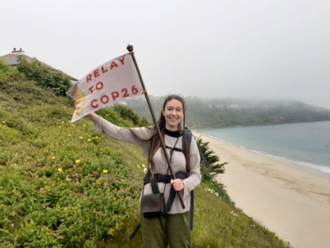
Day 1 – Molly Clarke sets outs on the first leg of the Relay

A group of young Christians (18-30s) are organising a Relay, walking from the G7 in Cornwall (13th June) to COP26 in Glasgow (1st November) for climate justice. People are joining the Relay from thousands of different churches all along the route. Walkers can be of all ages but to be one of the leaders you have to be under 30!

The Relay reaches London on 2nd August and Hertfordshire on 10th August. There will be overnight stops in the parishes of Ashford, Twickenham, Muswell Hill, Borehamwood, Hemel Hempstead and Tring.

Two events are beings hosted on behalf of the Diocese of Westminster in Central London on 6th August – a vegan lunch at Farm Street Church, Mayfair, at 1pm followed by a walk to Westminster Cathedral and an Ecumenical Climate Prayer Service at the Cathedral at 3.30pm.

Friday 6th August, 1.00-3.30pm : YCCN Climate Relay  Lunch at Farm Street and Walk to Westminster Cathedralhttps://www.eventbrite.co.uk/e/163375276851

Friday 6th August 3.30-4.00pm: Ecumenical Climate Prayer Service at Westminster Cathedral Welcoming the YCCN Relayhttps://www.eventbrite.co.uk/e/163372454409

To find out more about the YCCN Relay, the route, events at all the other churches, and how to sign up to join the walkers or support the Relay for a day or more visit – https://www.yccn.uk/

#RiseToTheMoment

Countdown to COP26

Source: Independent Catholic News

The United Nations climate talks (also known as the Conference of Parties or COP), that were scheduled to have taken place in Glasgow in 2020, will now take place 1-12 November 2021. COP26 will be biggest summit ever hosted in the UK – Covid permitting – with around 30,000 attendees expected.

It is the most significant climate event since the 2015 Paris Agreement. That is because COP26 is the first summit when countries must report back on their progress since the Paris Agreement and set out more ambitious goals for ending their contribution to climate change.

DATES

23-25 July The Hayes Conference Centre, Swanwick: Annual Justice and Peace Conference- Action for Life on Earth’ With talks and workshops linked to COP26.
www.justice-and-peace.org.uk/conference/

18-26 September Great Big Green Week – Action on Climate Change
https://greatbiggreenweek.com/

4 October – Launch of the Laudato Si Action Platform
www.laudatosiactionplatform.org

1-12 November Civil Society Convergence Spaces – creative hubs across Glasgow where activists can gather and connect together, warm up with food and drink, book meeting rooms, produce artwork and socialise.
https://cop26coalition.org/

5-6 November Days of Action in Glasgow and across the UK

7-9 November Alternative Summit in Glasgow in-person and online

WALKING TO COP26

Young Christian Climate Network
www.yccn.uk
Cornwall to Glasgow 13 June – 30 October

Camino to COP26
https://caminotocop.com
London to Glasgow 5 September – 29 October

WEBSITES

Glasgow COP action
https://cop26coalition.org/

The Climate Coalition
www.theclimatecoalition.org/

Global Catholic Climate Movement
https://catholicclimatemovement.global/

Green Christian COP26
https://greenchristian.org.uk/cop-26-glasgow-2021/

CAMPAIGNS

Healthy Planet, Healthy People Petition
https://thecatholicpetition.org/

Catholic Climate & Ecological Emergency Network (CCLEEN) – Fostering ecological conversion in the spirit of Laudato Si’, authenticated by action within the Church and advocacy in society.
https://christianclimateaction.org/2020/10/25/new-catholic-cca-initiative/

Reclaim our common home CAFOD Campaign includes calling on banks to cancel the debt of the world’s poorest nations. https://cafod.org.uk/Campaign/Latest-campaigns

Eyes of the World – CAFOD Schools Campaign on climate change.
https://blog.cafod.org.uk/2021/06/08/schools-leading-the-way-on-climate-campaigning/

Operation Noah’s Bright Now Campaign for fossil-free churches
https://brightnow.org.uk

Climate and Ecological Emergency Bill. The Bill asks the UK to take responsibility for its fair share of greenhouse gas emissions. www.ceebill.uk

Global Justice Now
www.globaljustice.org.uk/

Updated by the National Justice and Peace Network (NJPN) Environment Working group.

Fr Tom O’Brien Address for London Climate Action Week Interfaith Service

Father Tom O’Brien, Parish Priest of Our Lady Immaculate and St Andrew, Hitchin, and member of Westminster Justice and Peace Commission, gave the following address at the online interfaith service to mark the start of London Climate Action Week “Take Care for our common home” on 27th June 2021.

Coming together as we are today, united in a passionate concern for our common home and sharing our insights and beliefs, is precisely what Pope Francis wanted to happen when, in 2015, he wrote a letter to everyone in the world called Laudato Si or Praise be to you. Recognising that we face a catastrophic crisis, Pope Francis publicly proclaimed and clarified our deep concern for the destruction happening to our planet. He also recognised that this crisis can only be addressed together and globally. Whatever our differences of faith or of non-faith, we are all united in our growing concern for the future of our planet. The letter spells out the challenges we face clearly and succinctly and also recognises that we need to act now before it’s too late.

We believe that God called us to be stewards of creation which Pope Francis summarises as cultivating, ploughing, working, as well as caring, protecting, overseeing and preserving the natural world. This implies a relationship of mutual responsibility between human beings and nature. Each community can take from the bounty of the earth whatever it needs for subsistence, but it also has the duty to protect the earth and to ensure its fruitfulness for coming generations. It is a call to work with a creation that is only too willing to work with us.

The letter recognises that: “We urgently need a humanism capable of bringing together the different fields of knowledge, including economics, in the service of a more integral and integrating vision. Today, the analysis of environmental problems cannot be separated from the analysis of human, family, work related and urban contexts, nor from how individuals relate to themselves, which leads in turn to how they relate to others and to the environment” (#141).

Throughout the letter care for the earth is conjoined with care for the poor. They are indispensably connected. Laudato Si: “The human environment and the natural environment deteriorate together; we cannot adequately combat environmental degradation unless we attend to causes related to human and social degradation. In fact, the deterioration of the environment and of society affects the most vulnerable people on the planet: ‘Both everyday experience and scientific research show that the gravest effects of all attacks on the environment are suffered by the poorest'” (#48).

Our exploitation and abuse of the resources of the earth have led to increased Tsunamis, a continuing global rise in temperature that affects climate in a way that the poor, who depend on the land for sustenance, face long term droughts leading to a lack of clean water and starvation (25,000 a day, UN). Seeking survival leads them into underpaid jobs in which they are exploited, their basic rights are ignored and their freedom denied, so that we can have cheaper food and cheaper clothes to which they have no access. Laudato Si states There can be no renewal of our relationship with nature without a renewal of humanity itself. There can be no ecology without an adequate anthropology” (#118).

We are called to an inner conversion to a radical change in lifestyle, to living more simply, being less wasteful, to recycle and re-use, to be more generous to those in need. We must urgently lobby the government not to decrease our overseas support aid and even increase it.

Some of the fastest growing businesses in America are in energy efficiency and renewable energy helping produce the same output for half the energy.”

Businesses, who promote sustainability through the supply chain, have reduced their costs. They see pollution as a form of waste.

An organization that doesn’t waste anything is proved to be more efficient and more profitable.

Young people, led by the likes of Greta Thunberg, are calling for and fighting for a radical reduction in Co2 emissions. The recent G7 meeting has committed to fading out the use of fossil fuels and investing in renewable energy.

Being positive and hopeful is actually an important way to combat climate change. “We must look toward our positive shared future. The more we articulate the ability to get to that place, the more likely we are to get there.”

Expression of Hope;

Encouragingly, in Laudato Si, Pope Francis adds:

“Yet all is not lost. Human beings, while capable of the worst, are also capable of rising above themselves, choosing what is good, and making a new start, whatever their mental and social conditioning. We are able to take an honest look at ourselves, to acknowledge our deep dissatisfaction, and to embark on new paths. No system can completely suppress our openness to what is good, true and beautiful. I appeal to everyone throughout the world not to forget this dignity which is ours. No one has the right to take it from us. (#205)”

This was the first time London Climate action week had held an interfaith service and it was organised by South London interfaith group and Faiths Forum for London. Among the wide range of speakers there was humanist Richard Norman and pagan Robin Horne. Dr Ruth Valerio of Tearfund, Rabbi Jonathan Wittenberg, Zahra Kanani from Streatham mosque, Zoroastrian Vista Khosravi, Robert Harrap General director of SGI-UK, Sikh Balbir Singh Bakshi and Jain Varsha Dodhia all spoke about what there faith teaches about Creation and some of the practical actions their communities have undertaken. Bishop Karowei Dorgu, Anglican Bishop of Woolwich spoke about Southwark as an eco-diocese and what parishes are doing.

The recording can be found at: www.youtube.com/watch?v=Np08uqSWiok

A Celebration of Trees

Tree Walkers, Morpeth Terrace, behind Westminster Cathedral, London, SW1

Source: Ellen Teague, Independent Catholic News

How often do we notice the trees in places familiar to us?..

Why is it important to do so?..

And what does care of trees have to do with our faith?..

On Sunday 27 June, I joined a group finding out about trees in the vicinity of Westminster Cathedral. I’ve visited the area many times since childhood, but hardly noticed them before now.

This was an event as part of London Climate Action Week. The experience, organised by Westminster Justice and Peace, was special because it seems to be the first time that valuing trees was firmly on the agenda of a diocesan body.

It seemed strange to be gathering outside the Cathedral under a banner, ‘Tree Walk from Westminster Cathedral,’ but it shouldn’t have been. Care of Creation is an element of Catholic Social Teaching, all underlined by the 2015 Encyclical, Laudato Si’.

Colette Joyce, Westminster Justice & Peace Co-ordinator, led the two-hour walk. She reflected on the importance of trees within Christian tradition and invited contemplation of some of the many beautiful trees within easy walking distance of Westminster Cathedral.

As we strolled, we were encouraged to think about the nature and purpose of trees, especially their role in maintaining a stable climate that enables all life Earth to exist and thrive. Trees bind soil, remove carbon dioxide from the air and release oxygen, as well as providing a home for many species of birds and insects. Along the way we considered, too, the significance we attach to trees – from the solemn prayer before the wood of the Cross to the celebratory decoration of Christmas trees.

When we met outside Westminster Cathedral’s West Door we were immediately invited to admire the two mature London Plane trees in the piazza. Plane was widely planted as a street tree during the 18th and 19th centuries, being sturdy and suitable for city life for many reasons. It requires little root space and can survive in most soils and a wide range of temperatures. One of these two trees provided welcome shade for my son James who spent a number of hours standing with young people from dioceses around England and Wales waiting to see Pope Benedict during his visit in 2010. The Westminster youth contingent was under the Plane tree nearest the West Door, and he was very grateful.

We learnt that more than half of London’s eight million trees are Planes and they provide the important service of removing pollution from the atmosphere. The mottled olive, brown and grey bark breaks away in large flakes to reveal new cream-coloured bark underneath, a process which cleanses the tree of pollution stored in the outer bark. Each year London’s trees remove 2,241 tonnes of pollution which is a major contribution to public health.

When we moved off down Morpeth Terrace we passed rows of Plane trees and stopped at the end under a statue of St Francis of Assisi for a short reflection and prayer. Then there was Willow Place, named after Willow trees that were formerly common here. And Ginkgo in Rochester Road, a tree which survived the dinosaurs and the ice age, and, Colette told us, was the first tree to recover in Hiroshima after the city was destroyed by a nuclear bomb in August 1945. Then we walked around Vincent Square, a 13-acre green space lined with mature trees including London Plane. In Rutherford Street we admired the Silver Birches, whose white bark reflects heat and whose tolerance to pollution makes them a common sight in urban landscapes. Silver Birches also provides food and habitat to more than 300 insect species.

By gardens near the Cardinal Hume Centre we heard the tenth century, ‘The Dream of the Rood’ and heard how trees are mentioned in the Bible more than any living thing other than God and people. 56 Bible verses talk about trees.

We crossed Victoria Street and sat down in a grassy area for a short reflection on what trees mean to us. “Daily walks in the trees of Dulwich Wood got me though Covid” said one person. “This walk is a spiritual journey, about making a connection with trees,” said another.

“They’re the lungs of the world,” and “we must learn to keep the mature trees, not just plant new ones,” seemed to be common concerns about global deforestation and the HS2 project in particular in Britain. One member of the group lamented the disruption around Euston Station where she lives and has seen several public gardens destroyed and trees axed. We considered the quote from JRR Tolkien on our flier: ‘Every tree has its enemy, few have an advocate. In all my works I take the part of trees against all their enemies.’

Of course, London used to be covered in forest. This is reflected in the fact that so many parts of London are named after trees and woods. There’s the three Oaks (Burnt, Gospel and Honor), Nine Elms, Royal Oak Station, Wood Green, Forest Hill and Forest Gate.

Our final stop was St James’ Park, a green gem of 57 acres and we stopped to admire a Black Mulberry, Weeping Beech and a Caucasian Wingnut! There are around 1,250 individual trees in St James’s Park from around 35 species. The two islands in the lake, with their secluded woodlands and shrubberies, serve as nesting sites and refuges for birds. As we watched the ducks and geese waddling between the trees we thanked Colette profusely for this beautiful experience.

The walk was so successful that she has organised another one on 5 September! Several people have booked in already.

London Climate Action Week Events – 26th June – 4th July 2021

Circular Tree Walk from Westminster Cathedral – Sunday 5 September 2021, 3-5pm
Book with Eventbrite. Free.

Message from the Global Catholic Climate Movement

We cannot afford to have what happened at the G7 meeting happen at two big United Nations summits in October and November.

We must do better: Join Catholics everywhere and sign the “Healthy Planet, Healthy People” petition.

The G7 meeting did produce some good news for our common home, but right now, to be honest, good isn’t good enough. We need bold leadership. We need inspiring action, and we need prophetic agreements from world leaders.

Sign the Health Planet, Healthy People Petition

As Catholics, we owe it to our sisters and brothers around the globe to make sure that world leaders do better later this year. At the United Nations Biodiversity Conference (COP15), scheduled for October in China, global leaders will have the opportunity to set meaningful and robust targets to protect creation.

In November, at the United Nations 26th annual Climate Change Conference (COP26), countries must announce their plans to meet the goals of the historic 2015 Paris agreement.

Between now and October, it’s our responsibility as Catholics to make sure world leaders know how to care for God’s creation.

In the petition we’re calling for leaders to tackle the climate emergency and biodiversity crisis together, and to limit warming to 1.5 degrees Celsius, among other must-dos.

This year, we have an opportunity like no other. We can and must let world leaders know what’s at stake. Tell world leaders what you think: Sign the “Healthy Planet, Healthy People petition.”

Blessings,

Tomás Insua
Executive Director
GCCM