In the context of increasing complexity and geopolitical uncertainty surrounding peace in Ukraine, the Presidency of the Commission of the Bishops’ Conferences of the European Union (COMECE) issued a statement on Tuesday, 4 March 2025, expressing strong support for Ukraine.
“Ukraine’s struggle for peace will also be decisive for the fate of Europe and the world.” COMECE
The statement emphasises that “Ukraine’s struggle for peace and the defence of its territorial integrity is not only a fight for its own future. Its outcome will also be decisive for the fate of the entire European continent and of a free and democratic world.”
In a geopolitical landscape that the EU bishops describe as “complex” and marked by “the unpredictability of actions taken by some members of the international community”, the Presidency of COMECE calls on the European Union and its Member States to remain united in their commitment to supporting Ukraine and its people.
“Russia’s invasion of Ukraine is a blatant violation of international law. The use of force to alter national borders and the atrocious acts committed against the civilian population are not only unjustifiable but demand a consequent pursuit of justice and accountability,” the statement reads.
The EU bishops affirm that a comprehensive, just, and lasting peace in Ukraine can only be achieved through negotiations, which should be backed by strong transatlantic and global solidarity and must involve Ukraine. “In order to be sustainable and just – state the EU bishops – a future peace accord must fully respect international law and be underpinned by effective security guarantees to prevent the conflict from re-erupting.”
Furthermore, COMECE urges the international community to “continue to assist Ukraine in the reconstruction of the destroyed infrastructure” and specifies that Russia “must adequately participate in this effort.” The Presidency of COMECE emphasises that Ukraine is the victim in this war and Russia the aggressor, stressing that any attempts to distort the reality of this aggression must be firmly rejected.
Regarding Ukraine’s request to join the European Union and the internal reforms undertaken to achieve this goal, the EU bishops call on the EU “to advance with the enlargement process in a timely and fair manner alongside other candidate countries.”
The statement concludes by expressing hope that the European Union “will remain faithful to its vocation to be a promise of peace and an anchor of stability to its neighbourhood and to the world”, particularly at a time when the contours of a new global security architecture are being redrawn.
The declaration follows the recent interview (read the interview: EN – IT) with H.E. Mgr. Mariano Crociata, released last week to mark the third anniversary of Russia’s invasion of Ukraine. In the interview, the President of COMECE not only underscored the need for a just and lasting peace in Ukraine but also warned against “a disgraceful spectacle” that falsely portrays the victim as the aggressor.
Interim communications officer, Jon Chew, reflects on the recent multi-faith eco-summit on 23 February, 2025.
Colette Joyce (Westminster Justice and Peace Co-ordinator and Trustee of Faith for the Climate) and Fr Dominic Robinson SJ (Justice and Peace Chair) were in attendance on behalf of the Diocese.
“Out beyond ideas of wrongdoingand rightdoing there is a field. I’ll meet you there. When the soul lies down in that grass, the world is too full to talk about.” – Jalaluddin Rumi
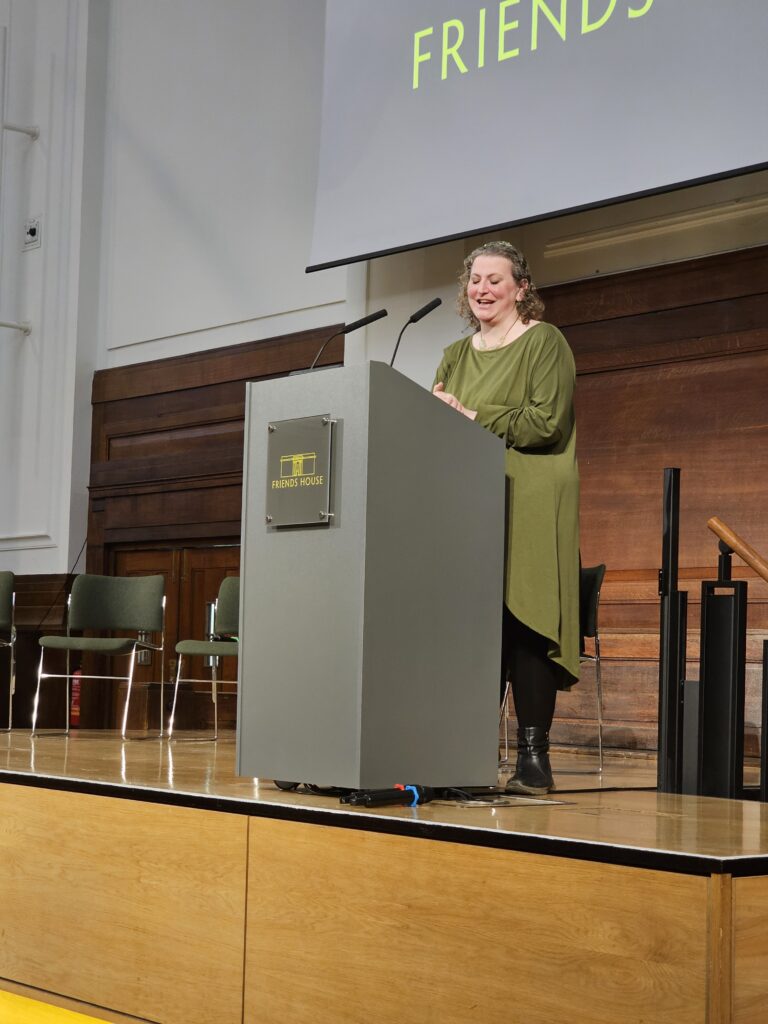
Rabbi Debbie Young-Somers, trustee of Faith for the Climate. Photo by Jon Chew
As Rabbi Debbie Young-Somers, a trustee of Faith for the Climate, led us in ‘Hinei Ma Tov’ – a Jewish hymn sung at Shabbat feasts – I was reminded of the field the Sufi poet Rumi speaks of. While evocative, this translation by Coleman Barks has been accused of de-Islamifying Rumi a bit too much.
There is another translation by the British scholar A.J. Arberry that is closer to the original meaning of the Persian:
“Beyond Islam and unbelief there is a ‘desert plain.’ For us, there is a ‘passion’ in the midst of that expanse. The knower [of God] who reaches there will prostrate [in prayer], (for) there is neither Islam nor unbelief, nor any ‘where’ (in) that place.”
In this rendering, the middle ground between belief and unbelief feels like a blank canvas, a place that may be too scary for some to enter. But here, a worshipper of God finds a unique passion, where your heart and devotion to truth and healing fills the expanse. A passion that is no less devoted, that causes us to prostrate in prayer, but maybe, a place where fellow pilgrims are feasting with each other. A place where we are bound not by the ferocity of our arguments, but by our need to find kinship.
Hinei mah tov umah na’im / Shevet achim gam yachad. Behold how good and pleasing it is, for people to sit together in unity.
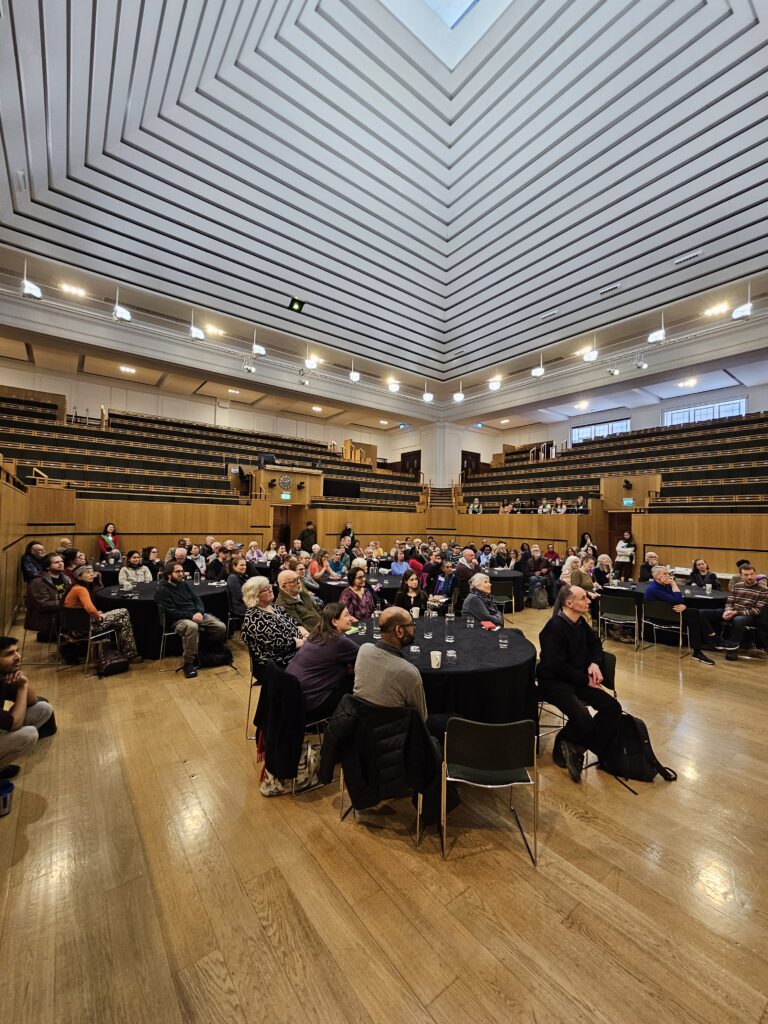
An act of gathering can be a provocation for our times, because these are the times we live in. On February 23, around 150 of us spent an afternoon at Friends House in London for our ‘Healing the Earth, Healing Ourselves’ summit. Co-organised with Christian Climate Action and Quakers in Britain, we came together in The Light Auditorium, where a vaulted roof stretched with holy hands to the skylight above, almost in recognition that the sacred provides safety for the extra-ordinary.
Event attendees gathering inside The Light Auditorium. Photo by Jon Chew
We are asking people to send a pre-prepared email to UK Prime Minister Keir Starmer calling for debt cancellation.
By sending the emails on the same day we hope to have greater impact. Please go to our Debt Campaign webpage and follow the instructions to take part in this simple action. It only takes a couple of minutes. You’ll also find more information about why debt cancellation is vital.
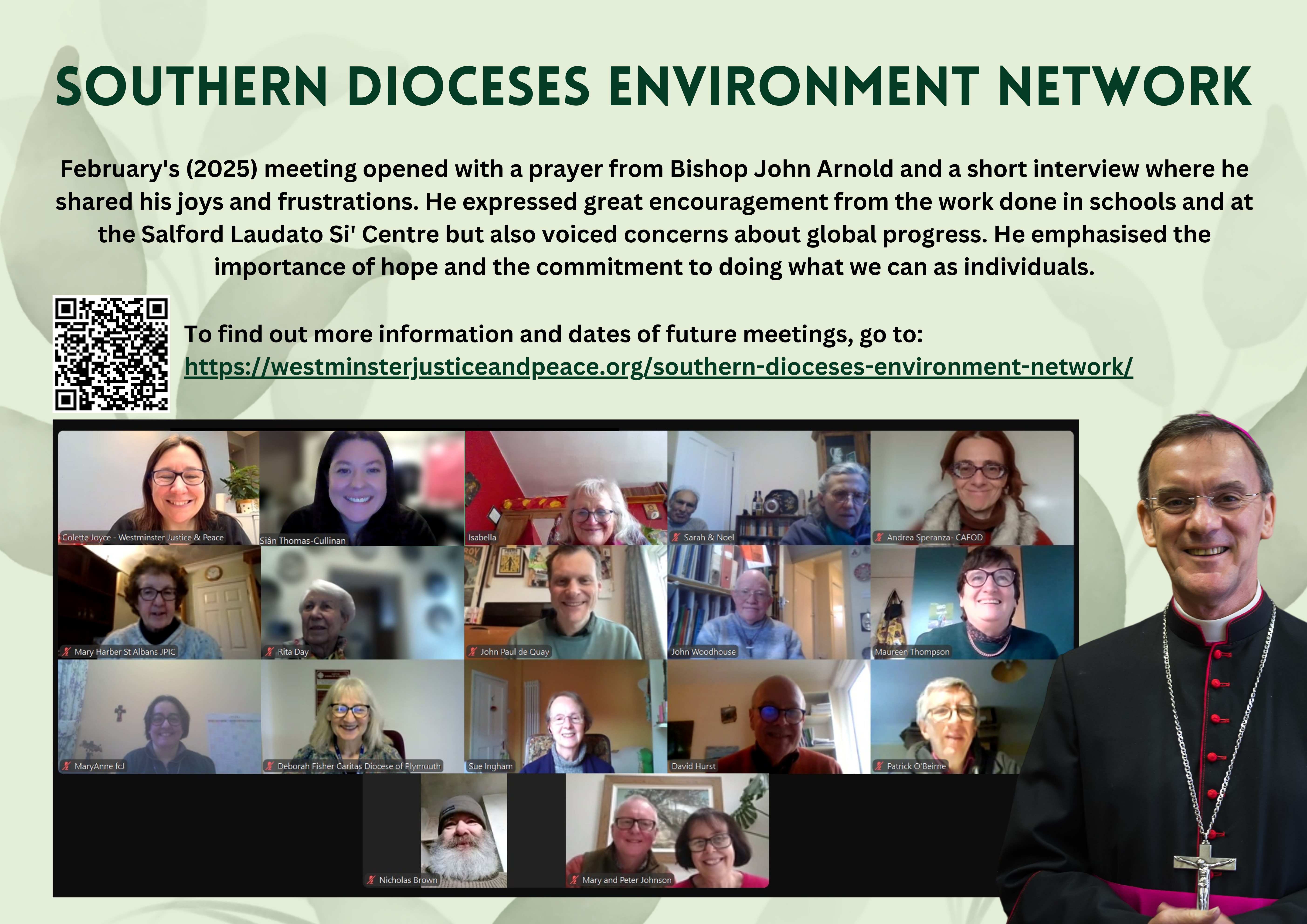
Now in its fifth year, this monthly Zoom meeting is a valuable space for sharing and learning about the many significant initiatives across the Southern Dioceses focused on our care for creation. It also serves as a source of support as we navigate various challenges together. This month’s meeting was a review of the past year, reflecting on the inspiring talks we’ve had. All of these sessions are available for viewing on the current page:
February’s (2025) meeting opened with a prayer from Bishop John Arnold and a short interview where he shared his joys and frustrations. He expressed great encouragement from the work done in schools and at the Salford Laudato Si’ Centre but also voiced concerns about global progress. He emphasised the importance of hope and the commitment to doing what we can as individuals.
To stimulate discussion, John Paul from Journey 2030 and Maureen, a parishioner from Portsmouth Diocese, shared practical and spiritual reflections, along with resources for action linked to the Jubilee Year and the 800th anniversary of the Canticle of Creation. They also posed an important question: how might we continue our journey beyond this Jubilee year, looking ahead to Jubilee 2033?
These open meetings provide a valuable space for diocesan staff, charities, and parish supporters to unite in small groups, fostering collaboration and generating ideas for future meetings. This format offers an excellent opportunity to stay informed, exchange ideas, and support one another in our shared mission.
We are always looking to welcome new voices and hear about the progress in caring for our common home. Please join us on the second Monday of each month!
Additionally, a sister group with the Northern Dioceses is actively collaborating, and we are planning a special event to mark 10 years of Laudato Si’ Week, featuring Austin Ivereigh as a keynote speaker. Keep a look out for further information!
With blessings from the Southern Dioceses,
Arundel and Brighton, Brentwood, Clifton, East Anglia, Portsmouth, Plymouth, Southwark and Westminster.
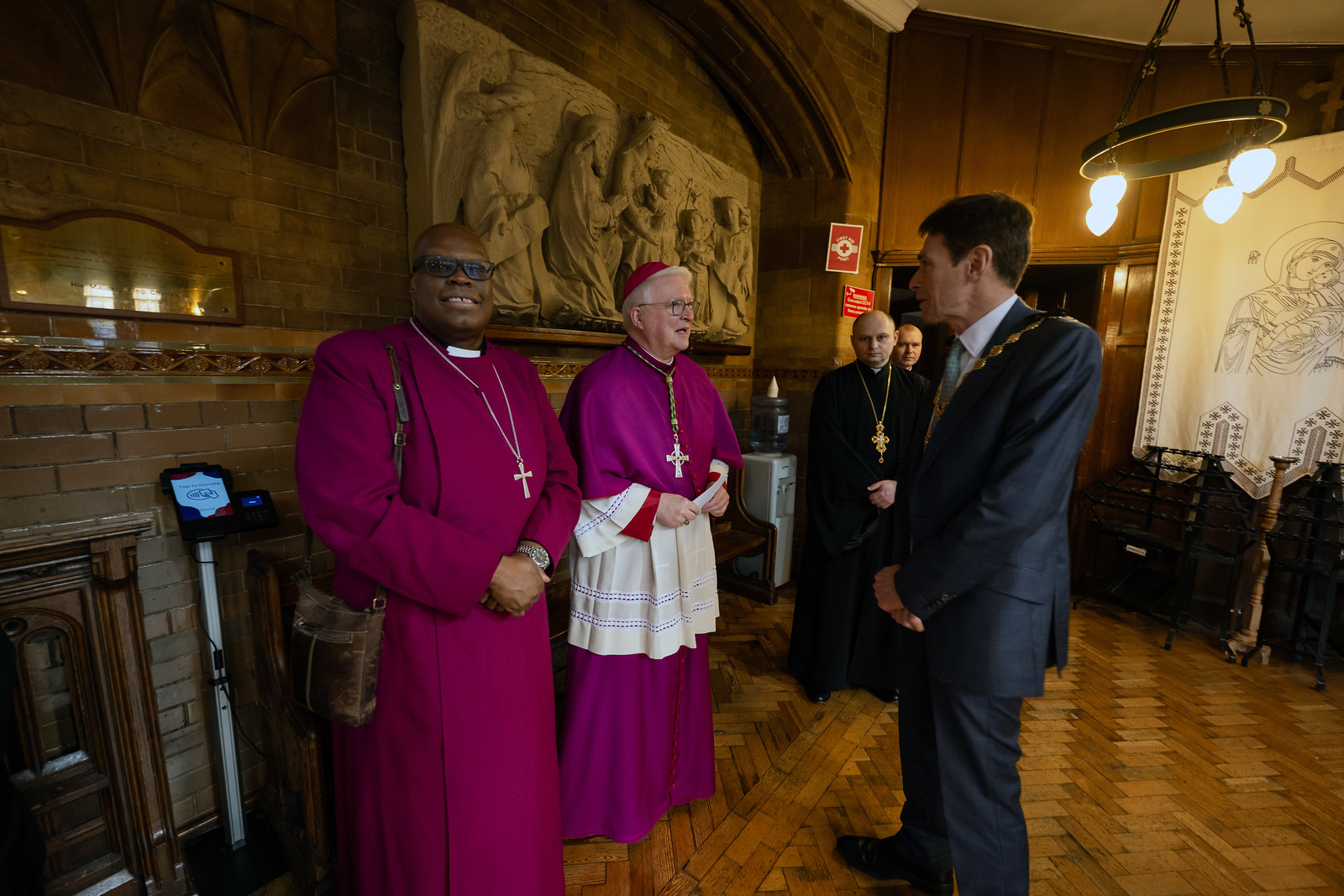
Bishop James Curry (centre) greets Mayor of Westminster Cllr Robert Rigby at the Ukrainian Catholic Cathedral. Fr Dominic Robinson SJ (Chair) and Colette Joyce (Co-ordinator) were also in the congregation to represent Westminster Justice and Peace Commission. Photo: CBCEW
A moving Interfaith Prayer Service for Peace in Ukraine took place yesterday at the Ukrainian Catholic Cathedral in London, to commemorate the third anniversary of Russia’s brutal invasion of Ukraine. The cathedral was decked out in sunflowers – Ukraine’s national flower. Many members of the congregation wore sunflower badges, while some were draped in the yellow and blue flag.
The packed service began with a procession of workers and volunteers from the Ukrainian Welcome Centre who lit three remembrance candles in front of the altar, while the cathedral choir sang the hymn Under Your Grace. Among the congregation was Shadow Foreign Secretary, Dame Priti Patel, Migration and Citizenship minister Seema Malhotra and the Mayor of Westminster Cllr Robert Rigby.
St Mary’s Ukrainian school choir sang the hymn ‘Peace is What We Want’ and Bishop Jim Curry, auxiliary bishop of Westminster was among those offering prayers for peace… continue reading on Independent Catholic News
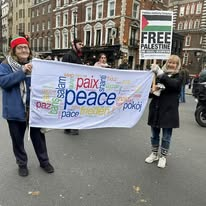
More than 175,000 people of all faiths and none took part in the 24th March for Palestine in London on Saturday, 15 February.
The Christian Bloc gathered for prayers at St Matthew’s Church Westminster, before joining the main body of the march in Parliament Square to walk to the US Embassy.
The short service of hymns, readings and prayers opened with a call to worship written by Palestinian women for the World Day of Prayer 2024: “Let us praise God who brings us together to worship in love and unity – Unity in the Triune God, transcending difference in views and theological interpretations. Let us remember these essential qualities of people of faith: humility gentlest ness , patience and love.”
Another prayer written by Palestinian Christians was an appeal:
“God of Compassion, for nearly 80 years Palestinian people have endured dispossession and loss. From Gaza to the West Bank the weight of impression continues to bear down on our hearts.. We grieve the pain of those who have lived through generations of injustice …. Grant peace to the afflicted, comfort the grieving and strength to the oppressed. Embolden the world to put an end to the cycle of violence and injustice.”
After singing the final hymn: – ‘We Are Marching’ – participants began to file out with banners including: ‘Quakers For Peace’, ‘Christians For Palestine’ ‘Palestinian Lives Matter – Break the Chains of Injustice.’
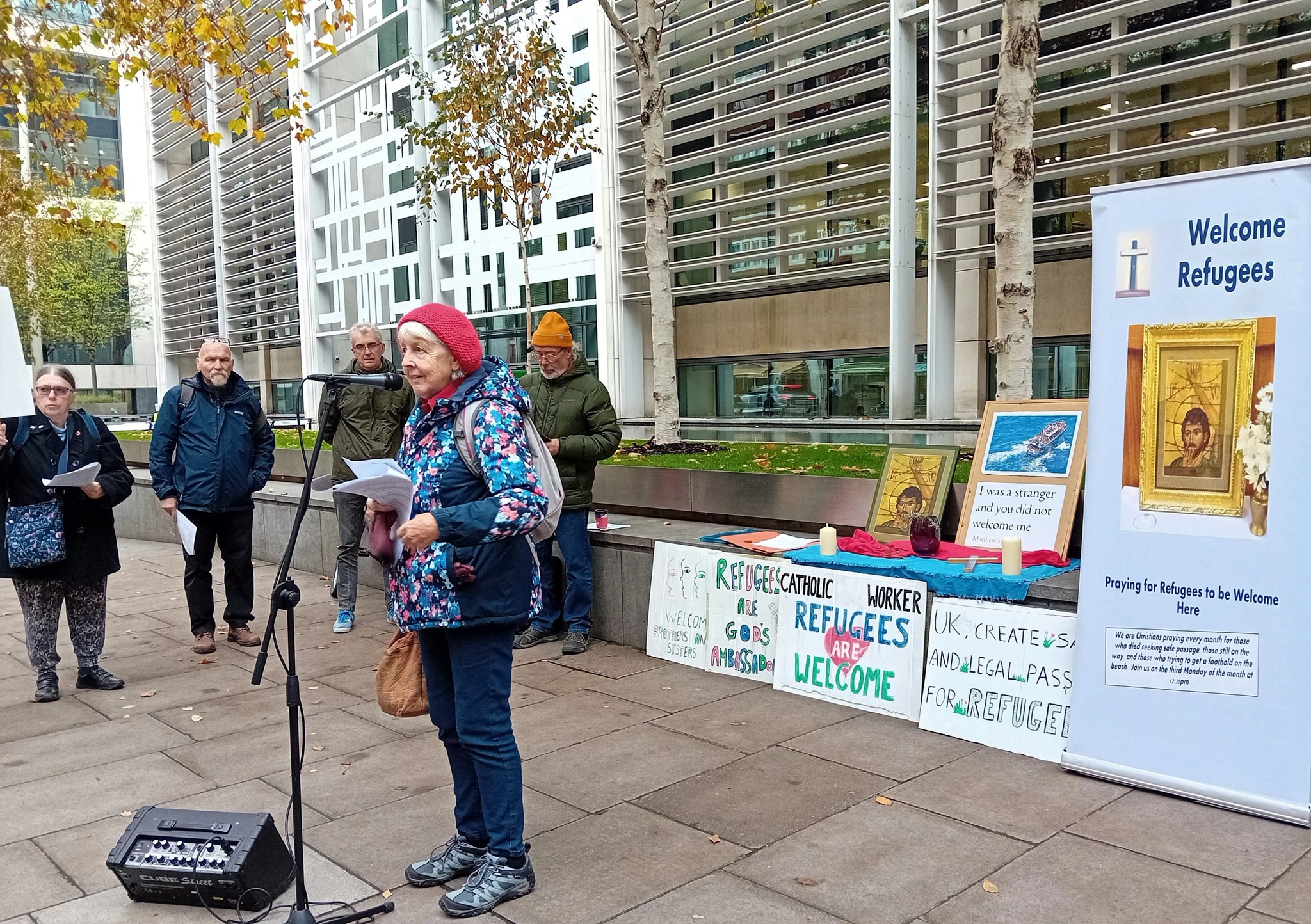
Monthly Prayer Vigil outside the Home Office – next Vigil 17 March 2025
Source: Ben Bano and Phil Kerton
According to the Pas-de-Calais prefecture, “in 2024, 77 people died trying to reach Great Britain aboard a small boat”, a record since the start in 2018 of the use of this means of crossing the Channel. According to British authorities, in 2024, 36,816 migrants managed to cross the Channel on boats, 25% more than in 2023.
According to the count of migrant aid associations, which also includes deaths on land, 89 exiles died on the coast of northern France in 2024. Support groups and political parties organised a march “for justice and dignity” in Calais recently to draw attention to these figures.
First deaths of 2025
The body of Abdul Raheem, a Yemeni aged around 24, was discovered on the morning of 22 January on the sand of Salines beach at Sangatte, facing England, where illegal boats regularly depart.
On the night of Friday to Saturday, 11 January, Suleiman, a Syrian migrant in his early twenties, died at Sangatte during an attempt to cross the Channel. He was one of about 60 people who left on a small boat, only to return very soon, soaked to the skin, leaving the victim on the floor of the boat in a state of cardio-respiratory arrest, probably crushed by the others.
In the early hours of 4 February, a Portuguese driver found the body of a migrant at the side of the A16 motorway near Calais. He was of Eritrean origin and had been hit by a truck.
The prefecture states that two people have been arrested as part of an investigation opened by the Boulogne public prosecutor’s office and entrusted to the office for combating illicit migrant trafficking.
Small boats
According to a 2024 report from the Global Initiative Against Transnational Organized Crime, there has been the rise in the use of ‘small hands’ – migrants who recruit others for the smuggling gangs, helping them to fill their boats. They recruit migrants of their own nationality or ethnicity and know the embarkation points from the beaches, working in groups to prepare and launch boats.
These middle men in the supply chain may charge for their service – a fee of between €1,000 and €1,500 for each boat that leaves the French shore. With up to four hands working on a boat, this is an additional cost for the smuggler of up to €6,000 (on condition that if the boat is intercepted no payment is made). The hands sometimes recruit a third person to act as ‘security’, for which they are paid €200 to €500, or a free passage on a boat after they have worked some shifts. The hands can make some extra cash by adding their own clients to the boats, increasing the overcrowding.
Some smugglers have developed low-cost options for poorer clients (for example, Sudanese and Eritreans), who are offered passage for around €1000. To make up the margins, smugglers may load the boats with more low-paying customers.
Allegedly, for those migrants, generally from sub-Saharan Africa, who cannot afford the crossing, even at a low fee, there is still hope in the shape of what are known in local jargon as ‘zig-zag’ brokers. For a fee of €100 to €400, these brokers take a migrant to a point on the coast where a boat is being prepared for launch, so that the migrant can attempt to board it, by force if necessary, without paying the fare. The migrants already on board often have little option but to comply.
The Vietnamese phenomenon
In recent months, more Vietnamese nationals have attempted to cross the Channel in small boats than any other nationality. Many wonder why so many risk their lives trying to reach Britain. On one hand, Vietnam is a rapidly growing economy, often referred to as “mini-China”. Over the past two decades, per capita income has increased eightfold and the country boasts beautiful landscapes and a vibrant culture, attracting tourists from around the world. Yet, despite these advancements, many Vietnamese feel a sense of “relative deprivation.”
The country is a one-party Communist state, where political dissent is not tolerated. While most Vietnamese have learned to navigate this system, the lack of political freedom and economic disparity between urban and rural areas drives many to seek opportunities abroad. Average wages remain low, especially in rural areas, where many workers lack job security.
The desire to migrate is deeply rooted in Vietnam’s history. In the 1970s and 1980s, many fled the country due to economic hardships and political repression. The shift in the economy in 1986, which opened Vietnam to global markets, fuelled a new wave of migration. The narrative of “catching up and getting rich” became prevalent, leading many to believe that success lay beyond their borders. Families pool resources to finance the migration of one member, hoping they will send money back home to improve living standards. This cycle perpetuates the desire to leave, even as the risks grow.
Events in Calais
Despite the hardcore survival conditions with storms and negative temperatures, the ‘Severe Cold Plan’ hangar was only open to take in people from the street for 15 nights. Furthermore, they have to take a bus to get there and must be gone by 9am sharp the next morning. When it is unoccupied (i.e. almost the rest of the year) the hangar is closed and monitored.
Harassment and evictions remain the norm. Every 48 hours, four to seven living spaces are cleared without a legal framework. People are arrested and tents, tarpaulins and personal belongings regularly stolen.
The ‘BMX Site’ near the Town Hall has been fenced off and cleared by order of the town council which has also requested the “evacuation” of migrants surviving under two bridges and on two quays. Likewise, the ‘Fontinettes’ camp has been cleared and fenced off to prevent people from resettling. Witnesses say that police turn up every morning in Black Mercedes, using batons to wake up and arrest people in tents.
Vocabulary in the UK
The word “illegal” has been one of the terms most strongly associated with migrants in UK parliamentary debates over the past 25 years, research by the Runnymede Trust has found.
After Theresa May’s 2012 pledge to “create a hostile environment for illegal immigrants”, media coverage containing hostile rhetoric around migration and migrants more than doubled (a 137% increase) compared with the two years before.
It seems plausible that the acceptance of such language may have supported growth in racial unrest, especially given a scarcity of well-presented factual media accounts that speak well of migrants.
Ben Bano writes:
The demonisation continues …
Have we lost all sense of proportion? Have we been infected by ‘Trumpism’? Across Europe migrants and refugees are seen as a threat to civil order and anyone who does not have a white skin is suspect. The narrative fostered by Angela Merkel has given way to something much more sinister which conflates migration with a threat to our society – never mind the fact that our care homes and farms would be severely affected by reductions in migration. We need to put a halt to the point scoring between the two major parties on who can do better on halting migration.
And can we find ways of being prophets of hope in responding to these events, as major parts of the world are affected by climate change, war, and much else? Those of us who are activists need to continue to speak out about the tragic effects of climate change which is an existential threat to so many, particularly in Africa. A recent estimate by the UN suggested that 420 million people are affected by climate change, drought, and war. The latest news from Goma in the Democratic Republic of Congo suggests that another tide of displaced people is very possible, adding to the millions who are seeking refuge from Syria, Sudan, and other war zones and areas of unrest.
We need to talk about global citizenship and our responsibilities to help those around us, not least to our MPs. In terms of awareness raising of the issues I fear that we are going backwards at a time when Trumpism and allied ideologies are making too much headway.
A Vigil sponsored by Westminster Justice and Peace, London Catholic Worker and the London Churches Refugee Fund, is held outside the Home Office from 12.30pm-1.30pm, 2 Marsham St SW1, on the third Monday of each month to pray for migrants who have died attempting to reach England. The next one will be on 17 March 2025.
Join us for an afternoon of panel discussions and workshops, spiritual connection, music, dance and poetry, creative work, and stalls showcasing the work that faiths are doing for the planet. Hosted by Faith for the Climate, Christian Climate Action and Quakers in Britain.
The event is free, and the venue is accessible for wheelchair users and people with other mobility issues. If there will be other barriers to you joining us (e.g. travel costs or travel schedules for your journey or being responsible for children), please email mobilise@faithfortheclimate.org.uk.
We want to learn so that we can improve the events that we organise. If you could please answer the monitoring questions when you sign-up that would be really appreciated!
Breakouts
There will be an opportunity to choose from 4 breakout sessions to take part in:
1) Healing Ourselves During Challenging Times (a series of activities you can do at your own pace) – nurturing your existing spiritual resources and learning from other traditions.
2) Bridging the Divide: How Faiths Can Come Together (panel and discussion) – building new, and refreshing existing, faith connections.
3) Starting With Our Local Environment (panel and discussion) – hear from groups already taking local action about their projects and how faith values connect with this.
4) National and International campaigns (panel and discussion) – learning about campaigns that are focused on justice-based action on climate.
You will be able to indicate which stream you would like to take part in when you register.
As we approach the third anniversary of the full-scale invasion of Ukraine by Russia, London’s Ukrainian Catholic Cathedral of the Holy Family have announced that they are planning to hold an interfaith prayer service on on Monday, 24 February at 11 o’clock.
The organisers say: “It is with deep sadness that we will be commemorating this date. Whilst we have witnessed horrors, we have also seen much goodness through the unwavering support offered for the people of Ukraine since the 24 February 2022.
“Three years on, and we continue to be buoyed by the generosity expressed through every spectrum of UK society as people continue to ‘Stand with Ukraine’ not only in words but in deeds too.
“During this service, we will hear the testimony of chaplains from Ukraine who have been providing pastoral care to families who have lost their sons and daughters because of the war.
“Please join us in this commemoration and help us to spread the word.”
The service takes place on Monday 24 February 2025, from 11 – 12 noon, at the Ukrainian Catholic Cathedral in Duke Street, London, W1K 5BQ.
Following the second reading of the Border Security, Asylum and Immigration Bill on Tuesday, 11 February, Bishop Paul McAleenan urged the government to address the root causes that force many to make dangerous journeys in search of safety.
The new law would put new crimes on the books and grant harsh counter-terror-style powers to tackle people smugglers bringing migrants across the the English Channel from France.
Bishop McAleenan, Lead Bishop for Migrants and Refugees, said: “Sadly, this government’s approach to immigration and asylum seems very similar to that of the previous one. As before, this bill seems to favour criminalisation over compassion and protection.
“We know of the fragile state of the world today; wars, conflicts and other factors which motivate or force people to flee their homeland are not decreasing. In the absence of safe and legal routes, as has been said many times before, the afflicted and persecuted are left with no choice other than to risk dangerous journeys.
“The new government has done little to address the lack of safe and legal routes – genuine alternatives remain unavailable. Instead, the government has proposed even harsher measures, such as expansion of detention powers and reduced protection for survivors of trafficking and modern slavery.”
Bishop McAleenan continued: “While the ambition to combat exploitative gangs and human trafficking is certainly welcome, it is difficult to see how measures that criminalise asylum seekers will achieve these aims. A distinction must be made between victims and those who profit from their vulnerability.
“Some of the proposed measures will increase the hardship of those who have been exploited. Relief, not presenting further difficulties, should be the government’s priority. With this bill, will refugees ever have the opportunity to find safety? We must resist closing the door of hope on asylum seekers and refugees.
Bishop McAleenan concluded: “I urge the government to reconsider its approach and instead focus on addressing the real drivers of forced migration, ensuring access to safe routes and upholding the fundamental principles of compassion.
“The words of Pope Francis are perpetual: ‘Every migrant has a name, a face and a story.'”






 Diocese of Westminster Justice and Peace Commission