‘Coming Home’ – the annual Service of Commemoration for people who have been homeless, who have died in London in the past year, took place at a packed St Martin in the Fields, Trafalgar Square on Thursday. In this very touching service, the names of 129 people were carefully read out – another 64 people who died were not named. The congregation included friends and relatives of the deceased as well staff and volunteers of the various homeless charities.
Organised by St Martin in the Fields, The Connection at St Martin’s, Housing Justice and the Museum of Homelessness, the service began with Simon and Garfunkel’s song ‘Homeward Bound, played by Alistair Murray, John Deacon and Chris Bluemel.
In his introduction, Rev Richard Carter pointed out that these people were originally not homeless. “They came to London looking for a home” he said…
Cardinal Vincent Nichols and the other bishops of England and Wales are encouraging all to join them as they pause for an hour in the middle of their autumn plenary meeting, at 5.30pm on Wednesday, 13 November, to kneel in front of the Blessed Sacrament to pray for the dignity of human life and to uphold a culture of life in our countries.
They will gather in the Chapel of the Holy Family at Hinsley Hall, Leeds, to unite in compassionate action in light of the bill passing through parliament that seeks to legalise assisted suicide. The holy hour will end with Evening Prayer before a concluding Benediction.
Cardinal Vincent said: “We offer our prayers this holy hour for the dignity of human life. In particular our focus is on the end of life and praying together in front of the Blessed Sacrament that assisted suicide will not become law in our lands. This would greatly diminish the importance and innate value of every human person, akin to saying that our life is not a gift of God. Instead we would be asserting that life is our own possession to do with as we choose. But we are far more important than that. We are a gift of God – a gift that is freely given. Then, when God is ready, we are called back to him.
“During this holy hour, we pray that many minds and hearts will be open to this beautiful and great truth about the value, importance, and beauty of every human person. We pray passionately that we will not take a step in legislation that promotes a so-called ‘right to die’, that will quite likely become a duty to die and place pressure on doctors and medical staff to help take life rather than to care, protect, and heal.
“When you are praying, please remember those who offer such care and accompaniment to people facing their last days and hours. Especially pray for those who work in palliative care – nurses, doctors, people who are home visitors. They do a wonderful job with care and compassion, but they need more resources. That is what we should be investing in, not a piece of legislation that leaves us vulnerable and under pressure to seek an end to our life.
“This is an important moment in our history. Please write to your MP and express your view to that member of Parliament. Many have not yet made up their minds how to vote.
“May God bless us all, bless our countries, and bless those who make our laws with courage to embrace and uphold a culture of life.”
On Friday, 29 November, the House of Commons will hear the Second Reading of a new bill on assisted suicide tabled by Labour MP Kim Leadbeater. This is another attempt to legalise assisted suicide and we need you to contact your MP to voice your opposition.
Please visit the Bishops’ Conference resources on assisted suicide. Here you will find content that explains why we oppose assisted suicide, provides answers to FAQs, helps Catholics to quickly and easily contact their MP, provides further information on hospice care, and more.
Here you can download a simple two-page A4 PDF with suggested readings, intercessions and reflections to accompany your time of prayer, whether this is in church in front of the Blessed Sacrament, or in your own home.
There will be a Holy Hour at Farm Street Church, on Wednesday 13 November 2024, 5.00-6.00pm, with Exposition of the Blessed Sacrament and prayers for the dignity of human life at 5.30pm.
Members of the Westminster Justice and Peace network are particularly welcome to join us for this time of prayer, either in person or on the parish livestream.
Christians gathered for ecumenical prayers in St Matthews Church, Westminster, on Saturday, before joining the Christian Bloc on the latest National March for Palestine.
After a welcome by the Rector of St Matthews, Fr Philip Chester, this gathering statement was read, reminding all that it was All Souls Day when the Church comes together to remember all who have died:
“This day also marks the 107th anniversary of the Balfour Declaration… which was instrumental in the creation of the state of Israel, the dispossession of the Palestinian people and many decades of oppression and violence.
“With lament we recall the role played by Christian Zionist theology in this dark history. This same theology continues to be employed today as a pretext for ongoing ethnic cleansing, apartheid and genocide.
As we gather for prayers on this All Souls Day – mourning every life taken in Gaza, in the West Bank, in Lebanon and across the Middle East – we refuse to let our faith be used to justify so many atrocities. We are united in our belief in a gospel of liberation. None of us are free until all are free.”
After the service ended, participants from many denominations, including Anglicans, Catholics, Methodists, Quakers (and two dogs) processed out to join the main march to the American Embassy, led by a drummer.
One of the marchers, Jenny Rossiter from Kentish Town told ICN: “I had to join the service on All Souls Day to remember all those lives that have been cut short by this hideous conflict.”
Faith leaders hold vigil outside Foreign Office, calling on government to show leadership on climate justice
Source: Quakers in Britain
At a vigil outside the Foreign Office on Tuesday, Christian, Muslim, Hindu, Jewish, Sikh, and Buddhist representatives handed in a letter to Foreign Secretary David Lammy. Catholic signatories included Bishop John Arnold (Salford), spokesman on the environment for the Catholic Bishops Conference of England and Wales, and Colette Joyce, the Westminster Justice and Peace Co-ordinator.
The letter asks the foreign secretary to take the initiative at upcoming COP29 by contributing new funding to the International Loss and Damage Fund.
It’s time for the UK – and its wealthiest polluters – to pay our fair share- faith leaders
It must do this in the form of grants not loans and by taxing pollution and wealth, rather than repurposing official development assistance, the letter, co-ordinated by Quakers in Britain and the Faith for the Climate network, says.
The 21 signatories call on the UK government to champion a new “collective quantified goal” for climate finance for developing countries, including sufficient funding to respond to loss and damage.
“Our call to Make Polluters Pay is partly about our history,” the letter says. “When we factor in Britain’s colonial past, the UK is the fourth largest contributor to climate change.”
It is also about our present, faith leaders including Paul Parker, recording clerk of Quakers in Britain, write.
Two fossil fuel giants, Shell and BP, are based here, enjoying record-breaking profits.
“Meanwhile, many British households are struggling to heat their homes. At the same time, communities all around the world are being devastated by extreme weather events, such as flooding, super storms and forest fires.
“These inequalities need to be redressed, to acknowledge the intrinsic value of every living being on our precious and finite earth.”
The faith leaders conclude, “It’s time for the UK – and its wealthiest polluters – to pay our fair share.”
Dr Timothy Howles, the Associate director Laudato Si’ Research Institute (LRSI) at Campion Hall, Oxford, addressed the most recent meeting of the Southern Dioceses Environment Network on 14 October 2024.
Tim told us that the LRSI is a Catholic institute, set up by the Jesuits, but he is an ordained Anglican priest, and happy to be working in this project in an ecumenical way.
His slides covered the integral ecology paradigm which is increasingly used in Higher Education but with the theological basis found in Pope Francis’ 2015 encyclical, Laudato Si’.
Laudato Si’ stresses the need for an ecological conversion for all of us (LS 217) and invites us to care for those who are on the margins (LS62). Scientists are frustrated that their data is being ignored so as Prof Chris Rapley says, “We have to change who people are, we have to give them epiphanies”.
LS25 focuses on the idea of interconnectedness, that “we ourselves are part of nature,” and so have responsibility for the delicate equilibria of the world.
The Institute produces resources and books such “Faith-based participation in natural resource governance”, “Integral ecology approaches to the new science of gene drives”, “Endangered languages in North East India”.
They also host talks such as the upcoming lecture by Dr Vijay d’Souza SJ, who will be in Oxford for a lecture on 13 November, 5.30 – 6.30pm, which is both in-person and on livestream.
Future Meetings
Next month, we are pleased to welcome back Dr Emma Gardner, Head of Environment for the Diocese of Salford, who will tell us a little more about the work she does at the Laudato Si’ Centre, the beautiful project at Wardley Hall, near Manchester. For more details visits:
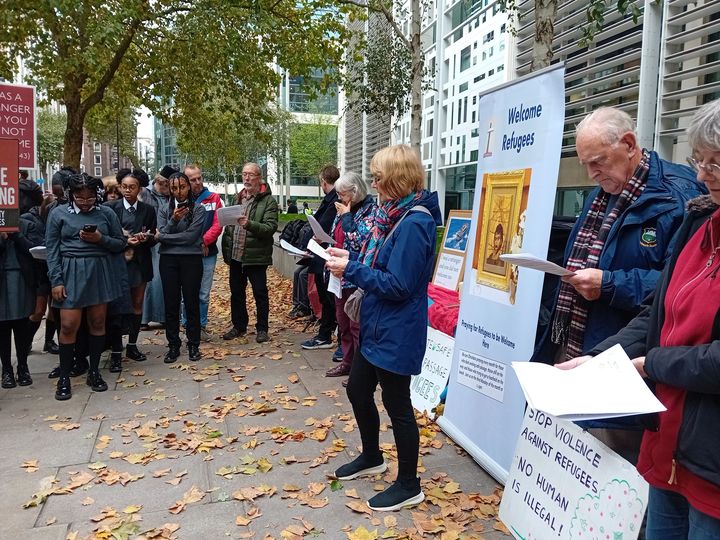
October 2024 Vigil outside the Home Office. Photo: Pat Gaffney
By Abi Yendole
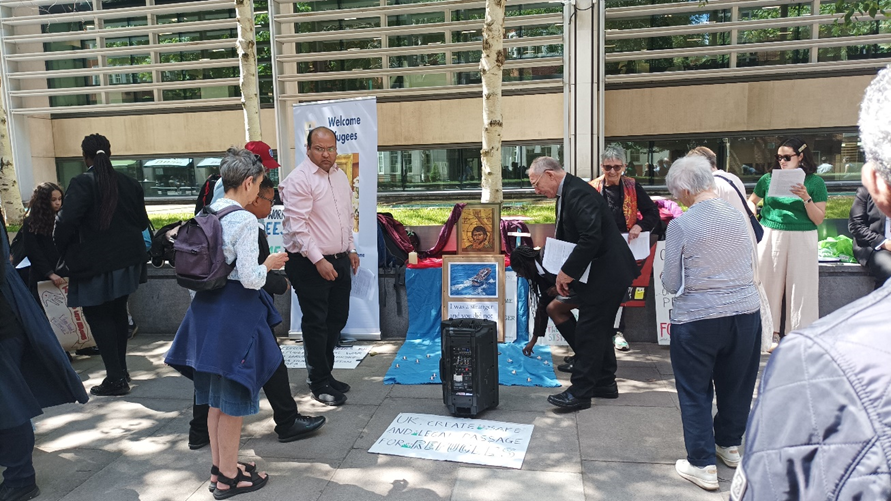
This month’s Migrants Vigil at the government’s Home Office in London marked three years of monthly prayers there for people who have died trying to reach the UK and for the UK to be a more welcoming nation. An organiser, Barbara Kentish, said. “If only we could say things were better, but alas, we need to pray harder than ever.” The one-hour vigils are co-sponsored by Westminster Justice and Peace Commission, London Catholic Worker and London Churches Refugee Fund.
Brother Johannes Maertens of the London Catholic Worker gave a reflection on his visits to Calais and the work of an arts refugee project that uses maps and art to encourage refugees to tell their stories. He commented that some of the young men he met had been on the road for six years.
The names of people who died a year ago – in October 2023 – trying to enter Europe or the UK were read out and a prayer of repentance said afterwards: “You told us to welcome strangers in our land, but we have hated, humiliated, imprisoned, and killed those who have asked for our hospitality. Forgive us and help us to change.”
Around 30 people attended the latest vigil on Monday 21 October. James Trewby (Columban Justice, Justice, Peace and Ecology coordinator) and Abi Yendole (Columban Faith in Action Volunteer) accompanied the Justice and Peace Committee of 16 Year 10 students and one teacher from St George’s School in Maida Vale to the vigil.
One student said afterwards: “Hearing all the names and stories of those who have died meant I was able to personify every victim; give every victim a face; it was powerful.” Pope Francis has said something similar, captured on the refugee memorial in Dover, that, “every migrant has a name, a face and a story.” Another student said: “As a member of the justice and peace group, going to the Home office to pray for refugees has been a profound and humbling experience. Standing in solidarity praying for those seeking safety and refuge, I felt the weight of their struggles and the urgency of advocating for justice. In the quiet moment of prayer, we offered up hope for a system that could see beyond the borders to the humanity of those in need. It was both a spiritual act of compassion and a call for action, reminding me of the power of community and faith in pursuing change.”
Also present on Monday were representatives from churches around London, Jesuit Refugee Service, London Catholic Worker, Pax Christi England and Wales and Seeking Sanctuary.
Intercessions included the prayer: “We pray for the end of the hostile environment, and the creation of safe, legal routes to claim asylum in this country.”
A monthly Memorial Prayer Vigil for refugees and asylum-seekers takes place on the 3rd Monday of every month outside the Home Office, SW1P 4DF, 12:30pm to 1:30pm.
Laudato Si’ Animators with Bishop John Arnold during visit to the Laudato Si’ Centre
A group of 24 Laudato Si’ Animators from around England, including some from the Diocese of Westminster, visited the Diocese of Salford’s Laudato Si’ Centre during the Season of Creation. They have undertaken to write to their bishops and push for a similar centre in other dioceses.
Laudato Si’ Animators are members of the Laudato Si Movement, a global community of prayer and action. They work to bring Pope Francis’s Encyclical Laudato Si’ to life. They are trained by the Laudato Si’ Movement to get the message of Pope Francis into the parishes. Most attend bi-monthly zoom meetings and take part in prayer vigils and marches about the climate and biodiversity.
Members of the Laudato Si’ Movement support local parishes and communities to engage in ecological spirituality, sustainable lifestyles and advocacy for climate and ecological justice.
On 29 September, a group of animators met with Bishop John Arnold of Salford, the bishops’ environmental lead in England and Wales.
Their visit to Salford’s Laudato Si’ Centre began with a tour of the Centre given by Emily Cahill, the Centre’s environmental and learning officer. She stressed that Bishop John Arnold’s vision for the Wardley Hall Centre was that it would be used by everyone as a centre for learning, spirituality and wellbeing.
In four years, a lawn has been converted into a thriving garden and a woodland area is ideal for groups. Over 3,000 people have visited the centre, especially school and parish groups.
The group was given leaves from various plants to attach to sheets on which they wrote what inspired them to be animators and what hopes they had for the future. After a simple vegan lunch when they were joined by the director of the centre, Emma Gardner, they split into groups and noted down responses. The rain brought them back into the outdoor classroom where Bishop John Arnold greeted the group and a photo was taken.
Sr Joan Kerley then gave an inspiring talk about St Hildegard of Bingen and St Kateri and the Haudenosaunee (Iroquois) Creation story. They sang two songs about creation and then started to answer the seven questions that Laudato Si’ Movement had suggested. They ended with prayers from the Haudenosaunee (Iroquois) Greetings to the Natural World.
If a diocese was to set up its own Laudato Si’ Centre it would need land owned by the Diocese, preferably with woodland and near to public transport. Trained staff would be needed to run the centre supported by volunteers. Disabled access and safeguarding are important. In terms of buildings, the outdoor classrooms and portaloos were perfectly adequate. But it was felt the most important needs would be for prayer and vision. It was felt that centres like the one in Salford would be wonderful for getting the message of Pope Francis out to clergy and laity?
A place like this in every diocese would help towards the UK Government’s commitment to rewild 30% of the nation’s land and sea by 2030, and would be a centre for peace, reconciliation and evangelisation.
Animator John Woodhouse said: “We all responded to the inspiring experience of being in creation. How many children never experience this? So many spend their lives glued to their phones and live in a virtual world. So many have mental health issues. Laudato Si’ needs to be seen as a spiritual and evangelical document. Our young people are pushing us to do so much more and they respond very positively to the message of Pope Francis.”
Fr Hugh Mackenzie shares a couple of angles upon why the Church opposes legalising assisted suicide or euthanasia, inspired by some philosophy and some deathbed ministry at St John’s Hospice.
Human beings are good beings. This is true even if they do bad actions, but especially if they have bad suffering. To be alive is to have an importance. This basic value is not earnt but received along with life itself. Love of someone affirms that importance. Denying the importance of someone’s life is not true love.
The basic concepts of good and bad, right and wrong, compassion and trust, emerge from this intrinsic value of the human. Goodness is ultimately about fostering the human person. To set criteria by which the importance of someone staying alive can be evaluated, undermines their basic value and the very basis of morality and civilisation.
You don’t need to believe in God to understand this, but it does complete the picture. In the light of faith, we believe that life is a gift of God and that every human being has an eternal dignity. The basic value and vocation of human life is not earnt but given, by God.
This all means that St Paul was right, the way we live and die affects everyone else (Rom 14:7). No one is an island. It is wrong to argue as some do that euthanasia is a matter of personal choice.
Legalising euthanasia would profoundly change the relationship between medical professionals and patients in hospitals and care homes. It would also damage trust within families. The sick and elderly often worry that they are a burden on others and could easily feel pressurised into asking for help to end their lives. In countries where euthanasia is legal, resources for hospices and funding for research into better end-of-life treatments have been tragically reduced.
Far from life becoming pointless in the face of terminal illness, such moments can be occasions of amazing grace, as I and many hospital chaplains can attest. Loving when carrying a cross saves the world.
The end of life’s journey can present serious physical and mental challenges, yet pain is always easier to bear when we are at peace. Research shows that persistent requests for assisted suicide are rare when people’s spiritual needs are adequately met. Our ‘quality of life’ is not just about physical health and autonomy, but about our spiritual well-being. Human dignity is sustained by the love we receive and the love we give and ultimately, real peace comes from living, and dying, in the love of God.
This is why we should surround the dying not just with the best physical care but with constant prayer, like Our Lady at the foot of the cross. This is the true meaning of ‘assisted dying’.
A special Mass and prayer vigil to mark the one-year anniversary of the hijacking of the Galaxy Leader will take place in London on Tuesday, 19th November.
On this day last year, Houthi rebels seized the car carrier in the Red Sea, taking its 25 crew members hostage. Their whereabouts is not publicly known.
Stella Maris will be holding this service to stand in solidarity with the seafarers from the Galaxy Leader and their families, offering comfort and support as they continue to endure captivity. We will also pray for all seafarers who have faced threats and attacks while carrying out their vital work, as well as for peace and stability in the region.
This is an opportunity for the community to come together in reflection and prayer, remembering those who remain in danger and praying for their safe release.
The Mass and prayer vigil will take place on 19 November, 7pm in the Church of St Anselm and St Cecilia, Kingsway, London WC2A 3JA





 Diocese of Westminster Justice and Peace Commission