NJPN Conference 2025: Report by Therese Xu

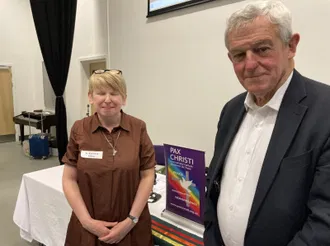
Speakers Sr MaryAnne Francalanza FCJ and Sr Katrina Alton CSJP

A little over a month ago, representatives from the Westminster Justice and Peace Commission attended the annual National Justice and Peace Network (NJPN) Conference, 25-27 July 2025, at The Hayes, Conference Centre, Swanwick, Derbyshire. Two young adults from the Diocese received sponsored places to attend the Conference and recorded their impressions of the event.

The second report is by Therese (Xinnan) Xu, a postgraduate student at Imperial College, London

Peace-building Among People Like You and Me — A Narrative from the 47th Annual NJPN Conference

The 47th Annual Conference of the National Justice and Peace Network successfully commenced from Friday 25 July to Sunday 27 July 2025 at the scenic Hayes Christian Conference Centre in Swanwick, Derbyshire. Exciting discussions on contemporary topics of peace-building and conflict resolution took place, with more than 20 Christian and Catholic organisations such as Caritas, CAFOD, CHIPS, and Pax Christi participating alongside approximately 160 attendees from political, non-governmental, and charity backgrounds.

What is peacebuilding in a world that is becoming increasingly polarised, where national security is measured by war-readiness and military forces, and what is the responsibility of us Catholics? Sister MaryAnne from the FCJ Sisters in London and Sr Katrina Alton of the Congregation of the Sisters of St Joseph of Peace shared insights on gospel nonviolence in the opening talk on Friday, 25 July 2025.

Remembering childhood experiences of being normalised to body searches when entering public spaces in Northern Ireland, Sr Katrina reminded the audience that Jesus offers a third way where violence has become the “daily bread” for many communities. To truly see and respect someone in the likeness and image of God means abandoning military force — to “put down your sword.” She further emphasised the position of many non-violent church workers as “swimming against the waves” and opposed the contemporary governmental claim to “prepare for war, pray for peace.” She explained that in order to consciously reject violence and injustice, and to truly establish God’s kingdom on earth, community and prayer are two essential elements. “Whatever is breaking your heart is breaking God’s heart also.” She encouraged the audience to ask themselves what breaks their hearts, further emphasising the importance of community: “Connect to others—it doesn’t just depend on you.”

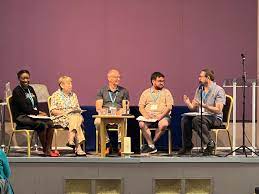
On Saturday 26 July 2025, workshops on climate justice, community-building, poverty, nuclear morality, LGBT+ issues, and non-violence commenced after an engaging morning panel discussion. The panel featured James Trewby, the Columban’s Justice, Peace and Ecology Coordinator and Education Worker; Andrew Jackson, Chief Executive of Pax Christi; George White, a transgender Catholic Religious Education teacher; Bokani Tshidzu, Artist and Creative Director of ART BY BOKANI LIMITED and Campaign Officer at Operation Noah; as well as Sister Katrina.

Bokani shared her story of immigrating from Zimbabwe to Britain after surviving AIDS, receiving “freedom, but not full freedom” as she saw more clearly following George Floyd’s death in 2020 and the Black Lives Matter movement. In many ways people received political freedom, but ecologically, the rights of the next generation of Britons remain largely constrained. Now, as a London-based multimedia artist and activist at Operation Noah working on climate action, she proclaimed that it’s important to understand “we’re the ones we’ve been waiting for” to take proactive steps toward change.

Concerning LGBT+ non-violence and inclusion, George gave a graceful response to James’ account of not walking away from hateful speech against the community at an event. He explained that silent opposition such as walking out of a conference may not have an effective impact on the speaker or audience when one disagrees with their views. Active change can only be demonstrated through dialogue and consistent conversation. When asked how to make peace with a church that rejects him, George answered, “Forgiveness. We need to understand that people don’t always make the right choices.” He encouraged people within the LGBT+ community to embrace their identities as beloved individuals of God: “You don’t have to worship where you are not wanted,” he declared. “We need processes for dialogue.”

Joanna Frew, Outreach Coordinator for the Rethinking Security Network, concluded the conference on 27 July 2025 by redefining national security. She highlighted England’s unique challenges in achieving just national security due to its imperial legacy, arms industry and military sales, possession of nuclear weapons, political interventionism following US examples, network of tax havens, and high carbon emissions. She also challenged the audience with difficult questions about what truly guarantees our security, and whether security can be found in power projection and dominance.

Imperialism may have shaped an unjust world system in which many of us live and from which we benefit. After the pandemic in 2020, the global situation has become turbulent, triggered by local unrest and conflicts including Russia-Ukraine and Israel-Palestine, and peace — among the dealings of great powers and the miscellany of global organisations — seems to have been reduced to a concept used as slogan and propaganda. It is therefore increasingly important, especially for those living in the global north who potentially profit from the pain and suffering of other regions, to consciously object to injustices within the system and to constantly “choose inclusion over isolation”. “Seek ye first his kingdom, and the rest will be given to you.” The peace-building faith-based organisations, strongly supported by faithful members and volunteers, are making changes to each individual starfish on the immense sandy beach.

Amidst vast pain and injustice, much that breaks human hearts — whether climate change, people losing their homes, drug abuse, war, and violence, there seems to be very little we can do. But just like all the organisations present at the conference, and like little people, each of us who survive and thrive in this global village, we are allowed to be afraid and encouraged to be hopeful. Perhaps the best question to ask ourselves now is: what breaks your heart?

Therese (Xinnan) Xu
National Justice and Peace Network

NJPN Conference 2025: Report by Alannah Travers

Panel with Bokani Tzidzu, Sr Katrina Alton CSJP, Andrew Jackson, George White and James Trewby

A little over a month ago, representatives from the Westminster Justice and Peace Commission attended the annual National Justice and Peace Network (NJPN) Conference, 25-27 July 2025, at The Hayes Conference Centre, Swanwick, Derbyshire. Two young adults from the Diocese received sponsored places to attend the Conference and recorded their impressions of the event.

The first report is by Alannah Travers, a postgraduate student at SOAS University

NJPN Conference 2025: Towards a Just Peace and challenging the inevitability of violence

   I was delighted to attend the 2025 National Justice and Peace Network (NJPN) Conference, held from 25–27 July at The Hayes Conference Centre, Derbyshire. This year’s theme, “Towards a Just Peace: Challenging the Inevitability of Violence”, deeply connected with my own postgraduate research at SOAS University of London, where I study international humanitarian and human rights law with a focus on justice and accountability in post-conflict societies.

   My place at the conference was generously funded through the Westminster Justice and Peace Commission’s initiative offering free places to young adults aged 18–35. I learned about the opportunity from Father Oscar Ardila, Catholic Chaplain at SOAS, whose encouragement I remain grateful for. As someone long interested in the intersection of peace, justice, and international law – especially in contexts such as Iraq – I was drawn to the conference’s commitment to confronting structures of violence and reimagining what peace might look like.

   Throughout the weekend, I joined over 160 participants, including representatives from 17 dioceses, religious orders, Catholic agencies, and peace organisations, engaged in dialogue, worship, workshops, and collective action. Saturday’s powerful panel chaired by James Trewby (Columbans), with speakers including Andrew Jackson (Pax Christi) and Bokani Tshidzu (Operation Noah) challenged us to link spiritual non-violence to climate justice and community activism. The call to confront racialised climate injustice stood out as particularly urgent.

   Another highlight was the contribution of Dr Joanna Frew from Rethinking Security, whom I have had the privilege of learning from in the past. I was grateful to attend her workshop, “A Just Peace After Empire?” held in a personal capacity. On Sunday she spoke on redefining “security” through cooperation, sustainability, and care, insisting that there is no security without a viable planet. As a Genocide is being committed in Gaza, Dr Frew’s call to move away from militarised logics of safety towards Gospel-rooted visions of peace felt especially timely this weekend.

   The collective action component of the conference was also appreciated. Participants gathered for a symbolic “Red Line for Gaza” protest, condemning the systematic targeting and starvation of Palestinian civilians and calling on world leaders to uphold international law and human dignity. The visual display of solidarity, alongside prayers, petitions, and personal testimonies, demonstrated many participants’ holistic and spiritual approach to peace-making.

   The weekend ended with an invitation to live out this year’s Jubilee theme as “pilgrims of hope.” I left feeling spiritually and intellectually renewed, grateful for the community of justice-seekers and the opportunity to reflect deeply on how I might integrate these values into both my academic work and wider life. I want to extend my sincere thanks to the Westminster Justice and Peace Commission, the NJPN team, and Father Oscar for supporting my participation. 

Alannah Travers

Remember Hiroshima and Nagasaki – Marking 80th Anniversary on 6 & 9 August 2025

This August it will be 80 years since the atom bombs were dropped on the Japanese cities of Hiroshima and Nagaski, killing as many as 200,000 people instantly and leaving many others to suffer from radiation sickness and forms of cancer for years afterwards.

The threat that these weapons will one day be used again still hangs over the world today. Catholic international peace charity, Pax Christi, organises prayers and vigils every year to recall the suffering of survivors and those who died and to work towards a world where these weapons are no longer necessary.

Pax Christi Vigils outside Westminster Cathedral

6 August, 11.00am-1.00pm: 80th Anniversary of the Bombing of Hiroshima

9 August, 11.00am-1.00pm: 80th Anniversary of the Bombing of Nagasaki

Blessed Franz Jägerstätter Service

9 August, 5.00-6.00pm: Pax Christi Franz Jägerstätter Service – Westminster Cathedral Crypt

Remembering the witness of Austrian farmer and conscientious objector, Blessed Franz Jägerstätter, who refused to serve in the in the Nazi army and was executed on 9 August 1943. https://paxchristi.org.uk/resources/peace-people-2/blessed-franz-jagerstatter/

Hiroshima and Nagasaki Memorial Service at Battersea Peace Pagoda

This service on 9th August is followed by an Interfaith Walk to Battersea Peace Pagoda for the annual Hiroshima and Nagasaki Memorial Service.

All are welcome to join us on the walk or at the Pagoda.

For more details visit https://paxchristi.org.uk/calendar/

Holy Family Church Gaza: Solidarity messages from Pax Christi

Fr Romanelli (centre) on a visit to London last year with Bishop Nicholas Hudson (l). Photo: ICN

Pax Christi England and Wales

Pax Christi England and Wales and Pax Christi International have issued the following statements in response to the deadly attack on the Holy Family Church in Gaza yesterday.

This morning’s horrific news that the Israel Defence Forces (IDF) struck the Holy Family Church in Gaza is both shocking and shameful. We know that at least six people are injured, including Fr Romanelli, and that two people have been killed. Lord have mercy.

If we are ever to overcome the myth of redemptive violence, then our response is never revenge.

Our response is never apathy. Our response is never neutrality. Instead, we dare to proclaim the revolutionary power of Jesus’ way of nonviolence. The way of the cross, the way of redemptive suffering, that ultimately leads to joy, hope, peace and resurrection.

Today it might seem that we are in the darkness of the tomb. Yet even inside the tomb something is happening. Young people in Tel Aviv are burning their draft cards and refusing to fight for the IDF. Across the world people are non-violently resisting the sale of arms to Israel. Acts of solidarity, prayer and fasting are the tools by which we bring about a revolution of the heart – one person at a time.

Let us never forget the power we each have to make a difference. The works of war destroy lives, land, and futures. The works of mercy support life and bring hope. Let’s commit ourselves afresh to pray and act in every way possible to make real our solidarity with the suffering people of Gaza and bring an end to this genocide in which the UK government is complicit.

Pax Christi International

Pax Christi International supports the Latin Patriarchate in Jerusalem and strongly condemns today’s Israeli military strike on Holy Family Catholic Church in Gaza, a place of sanctuary for displaced civilians.

We stand in solidarity and prayer with all those Christians and Muslims sheltering in the parish compound.

We mourn those who have died, Mr Saad Salameh, Mrs Fumayya Ayaad and Najwa Abu Daoud. We pray that they will rest in peace and send our deepest condolences to their families and friends. We hope for a good recovery for Fr Gabriel and all those injured in the attack.

We echo Pope Leo XIV and the Latin Patriarchate in calling for an immediate and permanent ceasefire in Gaza.

As the Patriarch has said, ‘The time has come for leaders to raise their voices and to do all that is necessary in order to stop this tragedy, which is humanly and morally unjustified.’

Pax Christi calls on the international community, political and religious, to raise their voices and take urgent action to protect all civilians and humanitarian spaces to enable:

– An immediate and permanent ceasefire and immediate access to humanitarian aid for everyone in Gaza, to be distributed through UNWRA and other experienced NGOs;
-The release of all hostages, Israeli and Palestinian;
-A complete arms embargo on Israel;
-An end to all trade with illegal Israeli settlements;
-An end to the Israeli siege on Gaza and the occupation of the West Bank.

Join Christians for Palestine at the National Rally on 19th July 2025

Join Westminster Justice & Peace and others for a Gaza Memorial Vigil 28th July 2025

28 July 2025, 12.30pm: Westminster Justice and Peace to join Christian Service for Remembrance for the Gazan Dead

A Christian service of remembrance for those who have died during the war in Gaza will be held at the Foreign Office in King Charles Street, London, SW1A 2AH, on Monday, 28 July, from 12.30pm -1.30pm

During our prayer, we will read out some of the names from a list of 50,000 people who are known to have died so far in Gaza, (many thousands more are missing under the rubble) – a name for each 28th day of the month since the war started.

The killings of so many are not just statistics. They are individuals with faces and names. The families of many have not been able to honour their dead with dignity. In a token way, through this short service, we try to honour them by telling some of their stories.

Organisations coming together to pray include the following: Westminster Justice and Peace, The London Catholic Worker, Pax Christi.

For further information contact Barbara Kentish homeofficevigil@gmail.com

Two Free Places at the NJPN Conference, 25-27 July 2025, for Young Adults (18-35)

Westminster Justice & Peace has two fully-funded free places to offer to young adults (18-35) at the forthcoming National Justice and Peace Network Conference, 25-27 July 2025.

In return, we invite you to help as a volunteer at the event with tasks such as running our stall at the Just Fair, stewarding or helping with music and liturgy.

The Conference is being held at the beautiful Hayes Conference Centre, Swanwick, Derbyshire, DE55 1AU

All expenses will be covered including conference fees, accommodation, meals and travel.

Applicants must live, work or worship within the Diocese of Westminster.

To apply – please send a short message to the Co-ordinator, Colette Joyce, giving your name, address, phone number and email address and a brief description of why you are interested in this opportunity. Short-listed applicants will be invited to an online interview. Email: colettejoyce@rcdow.org.uk

Closing Date: 2 July 2025

CONFERENCE INFORMATION

“War is a defeat for everyone” – Words of Pope Francis, quoted by Cardinal Giovanni Battista Re at His Holiness’ Requiem Mass on 26 April 2025.

“Peace be with all of you!” – The first words of Pope Leo XIV as he appeared on the balcony of St Peter’s in Rome having been just elected by the Conclave on 8 May 2025.

In this Jubilee Year, at a time of transition for the global Catholic community and great upheaval for the world, the National Justice and Peace Network invites you to our annual conference: ‘Towards a Just Peace – Challenging the Inevitability of Violence’

The weekend provides opportunities for networking and prayer with Catholics and others from across the country who share an interest in world peace and the promotion of social justice. There will be talks, workshops, prayer, a Just Fair with stalls from many different charities and organisations, and time for socialising.

Speakers this year include Dr Rowan Williams, former Archbishop of Canterbury, who will address the theme, and Dr Joanna Frew of Rethinking Security, who will explore what real security looks like today.

Workshop contributors include Richard Solly of Jesuit Missions and Ellen Teague of the Columban Justice, Peace and Ecology Team who will explore links between violence and environmental problems. Another workshop will listen to the voices of bereaved Israelis and Palestinians who are committed to working together for a Just Peace. Bokani Tshidzu of Operation Noah will explore ‘Investing in Peace through Climate Action.’ Quakers in Britain will look at how local interfaith and intercommunal relations in Britain are impacted by international conflicts.

NJPN says: “Journey with us this jubilee year as we open the doors to a just peace for current and future generations. Join us as we commit to taking restorative action to bring about peace and justice for migrants, or people living in poverty and inequality and for a world in climate crisis. We owe it to future generations to make this Jubilee permanent”.

National Justice and Peace Network

Venue

The Hayes Conference Centre, Swanwick, Derbyshire, DE55 1AU

Bishop Curry says that when Christians pray for peace in the Holy Land, it can be both supplication and a cry of protest

Photo: CBCEW

Bishop Jim Curry is an auxiliary bishop in the Diocese of Westminster

Bishop Jim Curry, the Lead Bishop for the Holy Land for the Bishops’ Conference, has joined our former Middle East North Africa consultant, Dr Harry Hagopian, as a special guest on his monthly Middle East Analysis podcast. Contributing to a discussion on Gaza, the West Bank and the wider region of the Holy Land, Bishop Curry said that when Christians pray for peace, it can be both supplication and a cry of protest.

“Obviously, the Christian always wants to pray, and we can’t just dismiss prayer as fanciful. Prayer is a cry of protest as well as supplication,” says Bishop Curry. “The fact that we can pray in our churches publicly for the situation in Palestine and Gaza, in the West Bank, that we remember our Christian brothers and sisters and the wider community is important. So we can’t ever dismiss it.”

Bishop Curry also spoke about the Christian presence in the Holy Land as foundational and a vital part of the rich tapestry of the region:

“One of our fundamental tenets is to go on pilgrimage, because these lands are holy to us, they are holy to the Jews, and to Muslims. Christians have been part of the mosaic of those lands for over 2,000 years, they belong there. They’re not interlopers. They’ve built schools, they’ve built churches, they’ve built communities. So going to visit them is important for us. When we last visited [for the Holy Land Coordination], we were able to visit Bethlehem, Beit Jala, where the Latin Patriarch has a seminary, Aboud, and Taybeh. We were able to show that they are not forgotten. But I’m always conscious that afterwards, we walk away. We walk away and leave communities to struggle with lack of access to jobs, to security, to freedom of movement.”

The Bishop also shared his first impressions of the Palestinian city Ramallah, the administrative capital, that he visited in January 2025 as part of the Holy Land Coordination meeting, organised by the Bishops’ Conference:

“I’d never been to Ramallah, and as I looked around as we entered the city I saw a peaceful, busy, bustling city with cafes and buses, restaurants and shops, and people about their business.

“It was a warm day, with a blue sky, and I thought ‘that’s what normality looks like’. People don’t run away from normality. We were asking ourselves, ‘what would normality look like?’ And there we saw it. Someone whispered into my ear, ‘You should have seen Gaza. It was bigger and more well-organised’. Now all we see are these images of rubble and people being displaced – hungry and frightened. I’d seen a different reality in Ramallah, a place that worked. I’m sure people complain about the services there, but I saw something different and it stayed with me.”

In the face of conflict, death, destruction and extreme hardship, Bishop Curry offers a suggestion to enable us to cling to a shard of hope:

“What can we do? We can go on advocating that normality is possible, that people can live well together. People want to live well together… Everywhere we went, we heard this plea, ‘We just want to live normal lives. We want jobs, we want our kids to go to school, we want them to be able to play their part in this land when they come back after university’. It still comes back to me, that image of what normality is. People don’t run away from normality.”

He reserved special praise and heart-felt prayers for the small Catholic community of the Church of the Holy Family in Gaza:

“They are giving a witness to the possibility that our despair can’t be the final word about the human situation. That little community there, the Holy Family in Gaza, they are a living sign that human beings can live together, and they can work together for each other’s good.”

Listen

You can listen to the full June 2025 episode of Middle East Analysis on the Catholic Bishops’ website or on Soundcloud.

Bishop Hudson says peacebuilding is a vital aspect of international security

Source: CBCEW

Bishop Nicholas has responsibility for Justice & Peace in the Diocese of Westminster

In response to the government’s recently announced Strategic Defence Review, Bishop Nicholas Hudson, Chair of the International Affairs Department at CBCEW, expressed the strong hope that the government will not neglect international peacebuilding efforts.  

Bishop Hudson said: “I understand that the government has a very difficult decision to make given the current fiscal position and international environment.” 

“However, if defence spending is to increase, it should not be at the expense of other ways of promoting peace and justice. Peacebuilding is a vital aspect of international security that must not be sacrificed to an increased emphasis on defence.” 

Earlier this month the government announced the review, with wide-ranging measures, including building 12 attack submarines and a commitment to raise defence spending to 2.5% by 2027-28 with the aim of 3% by the next parliament. 

Bishop Hudson added: “It is important to ensure that the expansion of military funding does not result in the diversion of resources away from foreign aid and support for the world’s poorest people. Without a balanced investment in diplomacy, multilateralism, and assistance to the poor as vital means of securing peace, we risk deepening the very crises we seek to prevent. 

“I also hope that the UK approaches the development of autonomous weapon systems with great caution, always upholding the principle that machines must never replace human moral judgment or responsibility in matters of life and death.

“I urge our government leaders to remember that true security comes not only from strength, but also from compassion and active peacebuilding.” 

Read the Catholic Bishops’ document on disarmament and the ethical use of weapons:

 ‘Called to Be Peacemakers’

Report on Pax Christi AGM: “The world is looking for prophets of peace”

Sr Katrina Alton and Oliver McTernan

Source: Ellen Teague / Independent Catholic News

“The old rules of war have gone, and this is something to which we should give full attention.” Oliver McTernan, the Co-Founder and Director of Forward Thinking, was guest speaker on Saturday at the Annual General Meeting of Pax Christi England and Wales in London. The experienced mediator in conflict situations called for Pax Christi and other peace groups to highlight the moral and ethical issues in modern warfare. “We are not impotent,” he said, “we have the power to challenge.”

The theme of his talk was ‘Prophets for Peace in a Changing World’. The Chair of Pax Christi England and Wales, from Pax Christi Merseyside, Kathryn Lydon, told around 60 in-person participants and 20 online, that “the world is looking for prophets of peace.”

Dioceses represented included Birmingham, Hallam, Leeds, Liverpool, Middlesbrough, Southwark and Westminster. Groups represented included the Archbishop Romero Trust, Columbans and the National Justice and Peace Network of England and Wales.

Devoting much of his talk to the Gaza conflict, McTernan deplored Israel’s use of powerful Artificial Intelligence (AI) systems to identify targets in Gaza…

Continue reading on Independent Catholic News

Names released of over 50,000 people killed in Gaza

Prayer for a Ceasefire in Gaza in Mount Street Gardens

Source: Independent Catholic News

The names and ID numbers of more than 50,000 people killed by Israel in Gaza in the last 18 months have been published by Iraq Body Count (IBC) a database of official statistics complied from hospital, morgue, NGO and other official records. (It does not count many thousands more people reported missing whose remains are under the rubble.)

The 981 page list makes chilling reading. One researcher said: “Reading out of names of the Gaza dead is a very spiritual ritual. Though at 10 names per minute it would take 83 hours non stop to read them all out. Even just reading out the 876 names of babies killed under the age of one would take 90 minutes.”

John Sloboda, a Roman Catholic who is a member of the Westminster Justice and Peace Holy Land Roundtable and a co-founder of Iraq Body Count, told ICN:

“Naming those killed is the most basic way of recognising and honouring their dignity as individuals. Contemplating unimaginably large numbers can freeze us into helpless immobility, or lock us into abstractions…” Continue reading on ICN

The next meeting of the Westminster Holy Land Roundtable takes place on Saturday 5th April, 4-6pm, at Farm Street Church, 114 Mount Street, London, W1K 3AH and is facilitated by Colette Joyce, the Westminster Justice and Peace Co-ordinator.

Westminster Holy Land Roundtable, 5th April, 4-6pm: Register with Eventbrite

Read the list here: www.iraqbodycount.org/pal/moh_2025-03-23.pdf