6 August 2023, Memorial Service for Hiroshima and Nagasaki in St Alban’s, Hertfordshire
On 6 and 9 August 1945, the United States detonated two atomic bombs over the Japanese cities of Hiroshima and then Nagasaki. On Sunday afternoon, Sunday 6 August 2023, some of the Cathedral congregation gathered alongside members of other local churches, including St Bartholomew’s and St Alban and St Stephen’s Catholic Churches, at the Peace Pillar to remember those affected by those bombings and to pray for world peace.
The Peace Pillar stands at the entrance to Sumpter Yard and was given by the people of Japan in gratitude that the Dean at that time, Cuthbert Thicknesse, refused for the Cathedral bells to be rung with other bells in the city to mark Victory in Japan because it had come at such a cost in terms of destruction and loss of life.
The Cathedral would now like to move the Peace obelisk, now very obscured by the tree and hedge (barely discernible in the picture above, behind the woman in red on the right), to a more prominent location.
We continue to pray for all who strive for peace in our own day.
Video from the Catholic Bishop’s Conference of Scotland addressing Peace and Disarmament (2022)
In 1982, the Scottish bishops released a landmark statement on nuclear weapons. In this letter they challenged not just the use of nuclear weapons, something the church has always condemned, but they challenged also the very notion of deterrence and the morality of deterrence.
Last year, 40 years on – with the help of schools – bishops and anti-nuclear activists made a video version to endorse the words of the statement. The school pupils also call for peace education in the classroom as a right.
The Bishops have re-shared the video to mark Hiroshima Day, 6 August 2023.
Pax Christi vigil outside Westminster Cathedral, 9th August 2022
The nuclear bombs dropped on Hiroshima (6 August 1945) and Nagasaki (9 August 1945) killed hundreds of thousands of people and left countless others living with the effects, many of which continue today. Those who survived the bombings, known as Hibakusha, have been leading campaigners for nuclear disarmament for nearly eight decades.
This year the Christian Campaign for Nuclear Disarmament and the Anglican Pacifist Fellowship will come together on the evening of Sunday 6 August, 8.00pm, for an Online Vigil – ‘Reflections for Peace’ -including prayers, reflections and songs. While the evening will include prayers for the victims and survivors, it will also look forward with hope towards a world without nuclear weapons.
In London, there will be also be a Pax Christi vigil and stall outside Westminster Cathedral from 11.00am to 1.00pm on both Sunday 6 and Wednesday 9 August.
On Wednesday 9 August there is a Service to Commemorate Blessed Franz Jägerstätter (1907-1943) on the 80th anniversary of his death at 6.30pm in the Crypt of Westminster Cathedral, which is followed by a walk to the London Peace Pagoda in Battersea to join an interfaith gathering to remember the Hiroshima and Nagasaki bombings and pray for a world free from nuclear weapons.
In Hertfordshire, on Sunday 6th August, 3.00 pm, the Justice Peace and Integrity of Creation Group from Ss Alban and Stephen Catholic Church in St Albans mark the event with a short service on the theme ‘Against Nuclear Proliferation’ at the Abbey Peace Pillar in Sumpter Yard, Holywell Hill, St Albans, AL1 1BY.
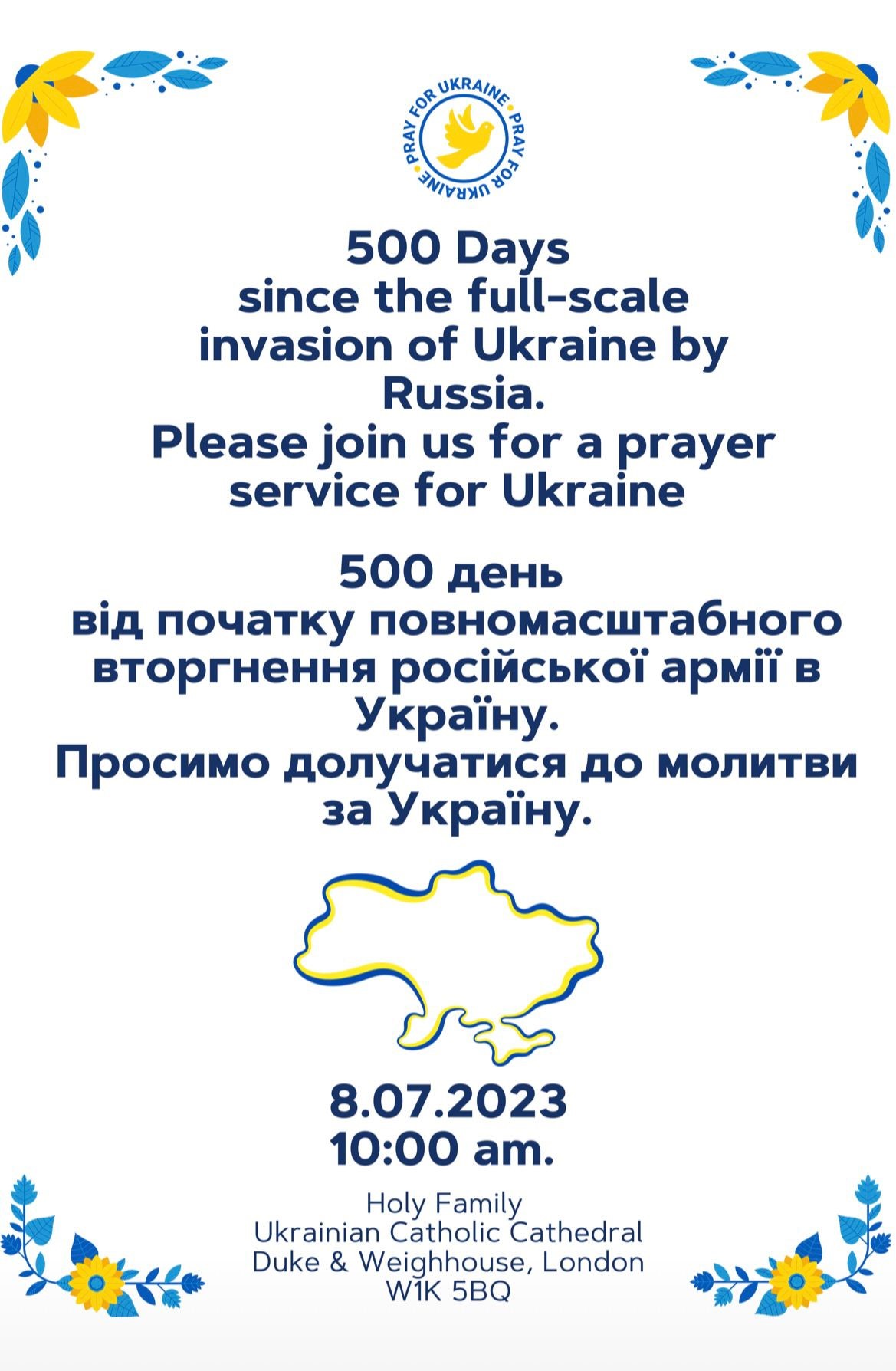
All are welcome to join the congregation of the Ukrainian Catholic Cathedral to mark 500 days since the Russian invasion of Ukraine. The service will be in English with music in Ukrainian.
The service will include thanksgiving for the help and welcome given to thousands of Ukrainian refugees in the UK.
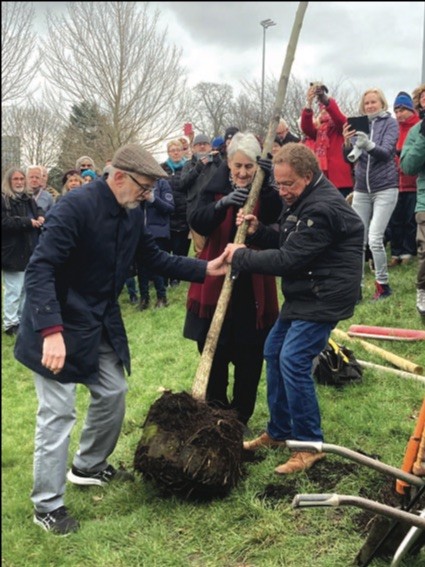
Saturday 4th March saw about 150/200 people gathered on the north side of the Finsbury Park athletics track to plant a walnut tree in memory of Bruce Kent. In the spirit of Bruce himself it was a joyful if somewhat chaotic event bringing together numerous strands of his most varied life.
Kate Hudson there on behalf of CND head office, accompanied by Jeremy Corbyn. Bruce’s widow, Valerie Flessati, spoke on behalf of the Movement for Abolition of War along with a Keith from the Friends of Finsbury Park. Like Bruce himself they all managed to bring humour into the serious topics they were talking about. Pax Christi, London Catholic Worker and the London Peace Pagoda, the United Nations Association were but five organisations I recognised as being present after a quick survey of the crowd. The Diocese of Westminster Justice & Peace Commission was also represented. Mereid Hopwood, a Welsh language poet came all the way from her home country to deliver a poem she had composed just for the occasion.
That said it would perhaps be incorrect to describe it as a crowd as there was no ‘them and us’ as everyone was chatting as friends and all were invited to add soil as a collective team effort to plant the tree.
Initially it had been announced that the tree to be planted would be grown by Jeremy Corbyn. Unfortunately, when pruning his olive tree Jeremy damaged the hornbeam he was growing for the purpose so, once that has recovered, it will be planted elsewhere in Finsbury Park. It seems somewhat ironic that the tree being grown to commemorate such a commensurate peace campaigner should be damaged by an olive branch! Bruce would have seen the funny side.
On the first anniversary of the start of the war in Ukraine, Cardinal Nichols has called for continued support and prayer.
Calling this day a ‘solemn and distressing moment’, he appealed for ‘an unceasing prayer for peace’.
In his message, he writes: ‘This first anniversary of the invasion of Ukraine is a solemn and distressing moment. The people of Ukraine continue to suffer. We must all continue our support, both in practical ways and in an unceasing prayer for peace.’
An Ecumenical Prayer Service for Peace in Ukraine will take place at the Ukrainian Catholic Cathedral of the Holy Family in Exile in Duke Street, Westminster, London W1 5BQ at 9am on Friday, 24 February 2023, marking the first anniversary of the Russian invasion.
The service will be led by Rt Rev Kenneth Nowakowski, Bishop of the Ukrainian Catholic Eparchy of the Holy Family of London.
At 4pm there will be an Ecumenical Memorial Service at the Statue of St Volodymyr the Great on the corner of Holland Park and Holland Park Avenue.
Pope Francis Message for Peace: “No one can be saved alone.” Photo: Marcin Mazur
1 January 2023
No one can be saved alone. Combatting Covid-19 together, embarking together on paths of peace
“Now concerning the times and the seasons, brothers and sisters, you do not need to have anything written to you. For you yourselves know very well that the day of the Lord will come like a thief in the night” (First Letter of Saint Paul to the Thessalonians, 5:1-2).
1. With these words, the Apostle Paul encouraged the Thessalonian community to remain steadfast, their hearts and feet firmly planted and their gaze fixed on the world around them and the events of history, even as they awaited the Lord’s return. When tragic events seem to overwhelm our lives, and we feel plunged into a dark and difficult maelstrom of injustice and suffering, we are likewise called to keep our hearts open to hope and to trust in God, who makes himself present, accompanies us with tenderness, sustains us in our weariness and, above all, guides our path. For this reason, Saint Paul constantly exhorts the community to be vigilant, seeking goodness, justice and truth: “So then, let us not fall asleep as others do, but let us keep awake and be sober” (5:6). His words are an invitation to remain alert and not to withdraw into fear, sorrow or resignation, or to yield to distraction or discouragement. Instead, we should be like sentinels keeping watch and ready to glimpse the first light of dawn, even at the darkest hour.
2. Covid-19 plunged us into a dark night. It destabilized our daily lives, upset our plans and routines, and disrupted the apparent tranquillity of even the most affluent societies. It generated disorientation and suffering and caused the death of great numbers of our brothers and sisters.
Amid a whirlwind of unexpected challenges and facing a situation confusing even from a scientific standpoint, the world’s healthcare workers mobilized to relieve immense suffering and to seek possible remedies. At the same time, political authorities had to take measures to organize and manage efforts to respond to the emergency.
In addition to its physical aspects, Covid-19 led to a general malaise in many individuals and families; the long periods of isolation and the various restrictions on freedom contributed to this malaise, with significant long-term effects.
Nor can we overlook the fractures in our social and economic order that the pandemic exposed, and the contradictions and inequalities that it brought to the fore. It threatened the job security of many individuals and aggravated the ever-increasing problem of loneliness in our societies, particularly on the part of the poor and those in need. We need but think of the millions of informal workers in many parts of the world left without a job and without any support during the time of the lockdown.
Only rarely do individuals and societies achieve progress in conditions that generate such feelings of despondency and bitterness, which weaken efforts to ensure peace while provoking social conflict, frustration and various forms of violence. Indeed, the pandemic seems to have upset even the most peaceful parts of our world, and exposed any number of forms of fragility.
3. Three years later, the time is right to question, learn, grow and allow ourselves to be transformed as individuals and as communities; this is a privileged moment to prepare for “the day of the Lord”. I have already observed on a number of occasions that we never emerge the same from times of crisis: we emerge either better or worse. Today we are being asked: What did we learn from the pandemic? What new paths should we follow to cast off the shackles of our old habits, to be better prepared, to dare new things? What signs of life and hope can we see, to help us move forward and try to make our world a better place?
Certainly, after directly experiencing the fragility of our own lives and the world around us, we can say that the greatest lesson we learned from Covid-19 was the realization that we all need one another. That our greatest and yet most fragile treasure is our shared humanity as brothers and sisters, children of God. And that none of us can be saved alone. Consequently, we urgently need to join together in seeking and promoting the universal values that can guide the growth of this human fraternity. We also learned that the trust we put in progress, technology and the effects of globalization was not only excessive, but turned into an individualistic and idolatrous intoxication, compromising the very promise of justice, harmony and peace that we so ardently sought. In our fast-paced world, the widespread problems of inequality, injustice, poverty and marginalization continue to fuel unrest and conflict, and generate violence and even wars.
The pandemic brought all this to the fore, yet it also had its positive effects. These include a chastened return to humility, a rethinking of certain consumeristic excesses, and a renewed sense of solidarity that has made us more sensitive to the suffering of others and more responsive to their needs. We can also think of the efforts, which in some cases proved truly heroic, made by all those people who worked tirelessly to help everyone emerge from the crisis and its turmoil as best they could.
This experience has made us all the more aware of the need for everyone, including peoples and nations, to restore the word “together” to a central place. For it is together, in fraternity and solidarity, that we build peace, ensure justice and emerge from the greatest disasters. Indeed, the most effective responses to the pandemic came from social groups, public and private institutions, and international organizations that put aside their particular interests and joined forces to meet the challenges. Only the peace that comes from a fraternal and disinterested love can help us overcome personal, societal and global crises.
4. Even so, at the very moment when we dared to hope that the darkest hours of the Covid-19 pandemic were over, a terrible new disaster befell humanity. We witnessed the onslaught of another scourge: another war, to some extent like that of Covid-19, but driven by culpable human decisions. The war in Ukraine is reaping innocent victims and spreading insecurity, not only among those directly affected, but in a widespread and indiscriminate way for everyone, also for those who, even thousands of kilometres away, suffer its collateral effects – we need but think of grain shortages and fuel prices.
Clearly, this is not the post-Covid era we had hoped for or expected. This war, together with all the other conflicts around the globe, represents a setback for the whole of humanity and not merely for the parties directly involved. While a vaccine has been found for Covid-19, suitable solutions have not yet been found for the war. Certainly, the virus of war is more difficult to overcome than the viruses that compromise our bodies, because it comes, not from outside of us, but from within the human heart corrupted by sin (cf. Gospel of Mark 7:17-23).
5. What then is being asked of us? First of all, to let our hearts be changed by our experience of the crisis, to let God, at this time in history, transform our customary criteria for viewing the world around us. We can no longer think exclusively of carving out space for our personal or national interests; instead, we must think in terms of the common good, recognizing that we belong to a greater community, and opening our minds and hearts to universal human fraternity. We cannot continue to focus simply on preserving ourselves; rather, the time has come for all of us to endeavour to heal our society and our planet, to lay the foundations for a more just and peaceful world, and to commit ourselves seriously to pursuing a good that is truly common.
In order to do this, and to live better lives after the Covid-19 emergency, we cannot ignore one fundamental fact, namely that the many moral, social, political and economic crises we are experiencing are all interconnected, and what we see as isolated problems are actually causes and effects of one another. Consequently, we are called to confront the challenges of our world in a spirit of responsibility and compassion. We must revisit the issue of ensuring public health for all. We must promote actions that enhance peace and put an end to the conflicts and wars that continue to spawn poverty and death. We urgently need to join in caring for our common home and in implementing clear and effective measures to combat climate change. We need to battle the virus of inequality and to ensure food and dignified labour for all, supporting those who lack even a minimum wage and find themselves in great difficulty. The scandal of entire peoples starving remains an open wound. We also need to develop suitable policies for welcoming and integrating migrants and those whom our societies discard. Only by responding generously to these situations, with an altruism inspired by God’s infinite and merciful love, will we be able to build a new world and contribute to the extension of his kingdom, which is a kingdom of love, justice and peace.
In sharing these reflections, it is my hope that in the coming New Year we can journey together, valuing the lessons that history has to teach us. I offer my best wishes to Heads of State and Government, to Heads of International Organizations, and to the leaders of the different religions. To all men and women of good will I express my prayerful trust that, as artisans of peace, they may work, day by day, to make this a good year! May Mary Immaculate, Mother of Jesus and Queen of Peace, intercede for us and for the whole world.
“We are waging war on nature. This Conference is about the urgent task of making peace.”
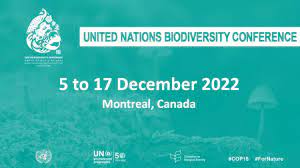
UN Secretary-General António Guterres gave the following address at the opening of UN Biodiversity Conference COP15 in Montreal, Canada, on 6 December. He is a practicing Catholic.
Nature is humanity’s best friend.
Without nature, we have nothing.
Without nature, we are nothing.
Nature is our life-support system.
It is the source and sustainer of the air we breathe, the food we eat, the energy we use, the jobs and economic activity we count on, the species that enrich human life, and the landscapes and waterscapes we call home.
And yet humanity seems hellbent on destruction.
We are waging war on nature.
This Conference is about the urgent task of making peace.
Because today, we are out of harmony with nature.
In fact, we are playing an entirely different song.
Around the world, for hundreds of years, we have conducted a cacophony of chaos, played with instruments of destruction.
Deforestation and desertification are creating wastelands of once-thriving ecosystems.
Our land, water and air are poisoned by chemicals and pesticides, and choked with plastics.
Our addiction to fossil fuels has thrown our climate into chaos – from heatwaves and forest fires to communities parched by heat and drought, or inundated and destroyed by terrifying floods.
Unsustainable production and consumption are sending emissions skyrocketing, and degrading our land, sea and air.
Today, one-third of all land is degraded, making it harder to feed growing populations.
Plants, mammals, birds, reptiles, amphibians, fish and invertebrates are all at risk.
A million species teeter on the brink.
Ocean degradation is accelerating the destruction of life-sustaining coral reefs and other marine ecosystems, and directly affecting those communities that depend on the oceans for their livelihoods.
Multinational corporations are filling their bank accounts while emptying our world of its natural gifts. Ecosystems have become playthings of profit.
With our bottomless appetite for unchecked and unequal economic growth, humanity has become a weapon of mass extinction.
We are treating nature like a toilet.
And ultimately, we are committing suicide by proxy.
The loss of nature and biodiversity comes with a steep human cost.
A cost we measure in lost jobs, hunger, diseases and deaths.
A cost we measure in the estimated US$3 trillion in annual losses by 2030 from ecosystem degradation.
A cost we measure in higher prices for water, food and energy.
And a cost we measure in the deeply unjust and incalculable losses to the poorest countries, Indigenous populations, women and young people.
Those least responsible for this destruction are always the first to feel the impacts.
But they are never the last.
Dear friends,
This Conference is our chance to stop this orgy of destruction.
To move from discord to harmony.
And to apply the ambition and action the challenge demands.
We need nothing less from this meeting than a bold post-2020 Global Biodiversity Framework:
One that beats back the biodiversity apocalypse by urgently tackling its drivers – land and sea-use change, over exploitation of species, climate change, pollution and invasive non-native species.
One that addresses the root causes of this destruction – harmful subsidies, misdirected investment, unsustainable food systems, and wider patterns of consumption and production.
One that supports other global agreements aiming at protecting our planet – from the Paris Agreement on climate, to agreements on land degradation, forests, oceans, chemicals and pollution that can bring us closer to achieving the Sustainable Development Goals.
And one with clear targets, benchmarks and accountability.
No excuses.
No delays.
Promises made must be promises kept.
It’s time to forge a peace pact with nature.
This requires three concrete actions.
First – Governments must develop bold national action plans across all ministries, from finance and food to energy and infrastructure.
Plans that re-purpose subsidies and tax breaks away from nature-destroying activities towards green solutions like renewable energy, plastic reduction, nature-friendly food production and sustainable resource extraction.
Plans that recognise and protect the rights of Indigenous peoples and local communities, who have always been the most effective guardians of biodiversity.
And National Biodiversity Finance Plans to help close the finance gap.
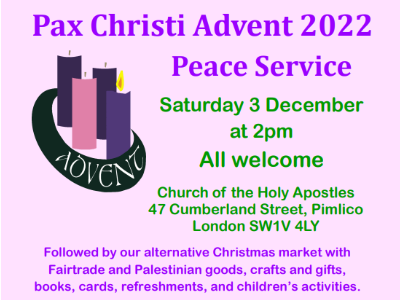
This year’s Pax Christi Advent Service will be held at the Church of the Holy Apostles, 47 Cumberland Street, Pimlico, London SW1V 4LY.
The music will be led by Julie McCann and singers and instrumentalists will gather to rehearse at 10am in the church. See Julie’s call for musicians here: https://www.indcatholicnews.com/news/45851
The service will be followed by an Alternative Christmas Market with Fairtrade and Palestinian goods, crafts and gifts, books, cards, refreshments and children’s activities.





 Diocese of Westminster Justice and Peace Commission