Caritas Westminster has announced the publication of their Annual Review for 2024, showcasing their areas of service and achievements from the previous year.
Richard Harries, Director of Caritas Westminster, commented: “2024 marked my first full year as the new Director of Caritas Westminster, and it gives me great pleasure to share with you the many milestones we achieved together over the course of the year.
“The Annual Review offers an overview of our efforts to serve the most vulnerable and empower charity in our communities. It brings together the many strands of our work, which ranges from direct services to enabling social action in diocesan parishes and schools. It also includes compelling stories from the people and communities supported, as well as significant events and highlights from 2024.
“Caritas Westminster’s direct services include a safe house for survivors of trafficking and exploitation, support for the Deaf Community and those with intellectual disabilities, a start-up hub for social impact entrepreneurs, financial aid, and resources to tackle domestic abuse.
“Caritas Westminster also strives to be the ‘voice of charity’ within the Roman Catholic Diocese of Westminster, facilitating voluntary service and social action. The Caritas Community Development team offers expertise, network links and project management support to help parishes and schools start or grow charitable initiatives that address the needs of their local communities.”
Highlights from the Annual Review include:
– 47,500 people supported by social action projects run by diocesan parishes and schools – Recognising outstanding volunteers at the ‘Love in Action’ Volunteering Awards – 2,964 miles travelled by the Caritas Deaf Service team for liturgies and events in British Sign Language – Celebrating ‘Achievement Day’ at Caritas St Joseph’s – 128 therapists and counselling professionals trained by Safe in Faith – 50 businesses supported by Seeds Hub – 30 women passed through the doors of Caritas Bakhita House
Bishop Paul McAleenan, Chair of Caritas Westminster, said: “This Annual Review recounts the activities of Caritas Westminster; may it also inspire us in our journey of faith and service as we read of Christ’s work being carried out in our midst.”
Since our last statement on the cost-of-living crisis, issued by our Department for Social Justice, some aspects of the crisis have eased while other problems have emerged. The persistence of social and economic difficulties for many has led us to issue a new public statement.
We understand the complex challenges facing Government as a result of war, an ageing population and the fracturing of families. However, the ‘preferential option for the poor’ must be at the forefront of the Government’s priorities. This principle requires that social and economic policies are scrutinised for their impact on the poor: “Whoever oppresses the poor shows contempt for their Maker, but whoever is kind to the needy honours God” (Proverbs 14:31).
Recent events have further exposed the fact that too many people live in a position where they lack financial security and risk falling into a spiral of poverty and debt. Ahead of the Government’s 2023 Autumn Statement, the Department for Social Justice urges the Government to consider seriously policies to address these problems, whilst not neglecting our obligations to aid poorer countries or to reduce carbon emissions.
The Catholic Church recognises that the promotion of the common good is the responsibility of all individuals and institutions in society. We commend the wonderful work of Catholic schools and charities that have responded to the cost-of-living crisis. Schools and charities have supported families, welcomed migrants and extended solidarity to our brothers and sisters in faraway countries who are similarly suffering at the present time. We also applaud the work of parish communities which, in a spirit of solidarity and true to the mission of the Church, must always be open to those who are in particular need of social, material and spiritual support at this time. Those in need of our support can, in turn, enrich the community with their own special gifts.
We offer our prayers for all who are struggling with the cost-of-living crisis and for those with the opportunity and responsibility to help them.
In this statement, we recognise that the cost-of-living crisis is multi-faceted and requires actions at a range of levels, including Government, civil society and the Church. However, with the Government’s Autumn Statement imminent, we are making the following specific requests of the Government:
The taxation system should treat justly those with family, child-rearing and other caring responsibilities.
The Government should examine with urgency and seriousness how policies relating to the provision of housing can reduce costs for families and ensure that families can have a stable and decent home. Housing costs today are at their highest levels relative to incomes since the 1870s.
The Government should not neglect the need for a just transition to greener energy but should also consider carefully how different sections of society bear the costs.
The world’s poorest people should not be further victims of the cost-of-living crisis in our own country. The Government should return to spending 0.7 per cent of national income on foreign aid.
Welfare benefits should be fully uprated to reflect increases in the cost of living, with priority being given to families with children.
The two-child cap on universal credit payments should be removed or, at the very least, suspended pending a review of its impact.
Bishop Richard Moth
Chair, Department for Social Justice Catholic Bishops’ Conference of England and Wales
CAFOD staff and volunteers deliver ‘Salina’s Letter’ to the World Bank HQ in London
Catholic aid agency CAFOD has handed over a letter to the World Bank calling on it to help fix the broken global food system by upholding the rights of farmers to use their own seeds. The letter was signed by 18 Catholic Bishops and over 70,000 Catholics from 750 parishes across England and Wales.
43 Westminster parishes, plus the curial staff at Vaughan House, were among the contributors signing ‘Salina’s letter’ to the World Bank. This represents around 8,180 signaturesfrom our diocese.
The letter from Salina, a farmer in Bangladesh, calls for the protection of the fundamental rights of small farmers like herself to use their own varieties of seeds – a right that is increasingly under threat as big seed companies have come to dominate the global seed market. Her letter – signed in solidarity by over 70,000 Catholics – was handed over to World Bank staff in London and at the annual World Bank meetings taking place this week in Marrakech, Morocco.
‘Fix the Food System’, CAFOD’s food campaign, is urging the UK government and institutions including the World Bank to protect the right of farmers around the world to save, use, exchange and sell their own seeds. In some countries, new seed laws have been insisted on by the World Bank in exchange for financial support, yet these laws prevent farmers from sharing seeds as they have done for generations and instead force them to buy seeds from big agribusinesses.
CAFOD’s Campaigns and Outreach Manager, Helen Moseley, said: “We would like to say a huge thank you to everyone who signed Salina’s letter. Her message to the World Bank has been heard loud and clear: unfair rules putting pressure on small farmers to buy commercial seeds aren’t acceptable. They can push farmers and the communities they feed into poverty, food insecurity and reduce their resilience to climate change.”
CAFOD campaigners handing in Salina’s letter on 11th October 2023 were received by senior World Bank staff who agreed to meet and discuss the issue.
“It was a very cordial meeting and we explained how much support our campaign has received across the country from ordinary parishioners,” said Father Rob Esdaile, who handed over the letter to World Bank staff and whose own parish, St Dunstan’s in Woking, was one of the 750 parishes who supported the campaign.
Bishop Tom Neylon from Liverpool Archdiocese said: “I support CAFOD’s Fix the Food System campaign because it’s highlighting the situation that small-scale farmers around the world are increasingly finding themselves in. Caught in a huge power imbalance with large agribusiness, even their rights to their own seeds passed down from generation to generation are being threatened.”
Last Thursday 17 November, the Chancellor of the Exchequer, the Rt Hon Jeremy Hunt MP, presented his Autumn Statement to Parliament. This came just under two months after the government’s disastrous mini budget on 23 September, which caused market turmoil with a plan to redistribute wealth to the already wealthy at a time when many were being dragged into poverty by a cost-of-living crisis.
The Autumn Statement is more responsible and measured, with a fairer approach to redistribution, but raises profound questions about the quality of life in the UK and the state of our public services for years to come. Extra funding for health and education is welcome, although it is modest. The most concerning aspect of the approach to public spending is that the most difficult decisions regarding cuts have been put off until 2025, after the next election.
The uprating of benefits in line with inflation, which we called for in our cost-of-living campaign is welcome. However, this uprating is not timely, coming into effect in April 2023. In the meantime, many people relying on benefits will struggle this winter to bridge the gap between their needs and what they receive, with inflation at a 40-year high and energy prices rising steeply. We call on the government to increase benefits in line with inflation immediately.
We are disappointed that no consideration was given to the removal of the two-child cap on universal credit payments, one of the ‘asks’ of the Bishops’ Conference’s Department for Social Justice briefing paper and the CSAN cost-of-living campaign. This is unfair on larger families and should be removed, or at the very least suspended pending a review of its impact.
We are also deeply concerned that the long-awaited social care reforms, a 2019 Conservative Manifesto pledge, will not now be implemented next year as planned.
Andrew Dilnot, who drew up the plans for reform, commented: “Without these reforms, individuals and families facing the possibility of long social care journeys are left entirely on their own, with the state only helping once their assets – including their homes – have dwindled down to the threshold”. We call on the government to honour their pledge to “fix social care” without delay.
The extent of the poverty in our country remains a scandal. In a recent report, the Trussell Trust revealed that 1300 foodbanks across the UK had given out 1.3 million emergency food parcels between 1 April and 30 September this year, an increase of 50% on pre-pandemic levels. This “tsunami of need” as they describe it has put charities at breaking point as they try to respond with diminishing resources.
Patrick O’Dowd, the Director of Caritas Salford, said recently: “Research from the University of Loughborough highlighted that about 228,000 children, we believe, living in Salford diocese are living in poverty. And that’s as high as about 42% of children in Manchester, one of the biggest, most populated areas in the city”. Patrick highlighted how Caritas Salford was working with other Catholic charities and CSAN members, such as the SVP and Out There, to meet the extraordinary level of need.
The economic outlook is bleak. Paul Johnson, the Director of the Institute for Fiscal Studies, said: “The truth is we just got a lot poorer. We are in for a long, hard, unpleasant journey; a journey that has been made more arduous than it might have been by a series of economic own goals”.
The fifty-four member charities of Caritas Social Action Network stand in solidarity with those who experience various forms of poverty which prevent human flourishing. We are inspired by our Gospel mandate to proclaim good news to the poor and to build up God’s kingdom of justice, peace and love. We are committed not only to meeting the humanitarian needs of the present time but also, as Pope Francis said, (in Evangelii Gaudium, 188) “to eliminate the structural causes of poverty and to promote the integral development of the poor”.
We call upon the Catholic community to write to their MP to amplify our ‘asks’ of the government, revised in the light of the Autumn Statement, to describe the reality of poverty in their community and to share the good news of what the Catholic community is doing to meet this urgent need.
Raymond Friel is the CEO of Caritas Social Action Network
Pat Fernandes (Advice for Renters) with Elroy and Laura from White City Parish, where a Community Hub has already been set up to promote social and economic inclusion
On Saturday, 12 November, 56 people from 38 parishes and schools across London and Herts came together to learn more about how they can support their communities in the current Cost of Living Crisis.
The conference was organised by Caritas Westminster alongside Advice for Renters as part of our response to the financial difficulties that are hitting many people in the Diocese at this time.
Sr Silvana Dallanegra, Financial Resilience Lead for Caritas Westminster, was one of the main organisers, with Pat Fernandes from Advice 4 Renters Money. She says: “Our aim wasn’t to tell people how grim things are – they know that already. Our aim was to equip and strengthen them with knowledge and resources around the solutions that are out there, and the organisations that can help. We also wanted to give them more confidence around how to have conversations with people who might be struggling, and how to support them in accessing the help and advice they need. And we also hoped everyone would get the chance to network, and begin learning from each other – which, judging by the buzz during group discussions and breaks, certainly happened!”
Attendees were able to attend a variety of workshops to learn more about debt, loan sharks, credit unions, saving energy and other solutions, in order to better support people in their communities. They were also told about Firm Foundations, our bespoke training programme for Money Champions, which we are planning to run again in 2023. Many of those who came are already helping people as members of the Society of St Vincent de Paul (SVP), and through provision of food, distribution of supermarket vouchers or other social outreach projects. Everyone said how informative, useful and eye-opening all the sessions had been.
Nicholas O’Donnell from Knebworth SVP said: “This was my first time at this type of event, and I loved the whole day. I have made some useful contacts and learned so many things which will help me in my work. I also benefitted from having Bishop Paul share some of his experience.”
Anne Lamont, from West Green parish told us that the day contained “An excellent range of information, plus the opportunity to network and share ideas – I only wish we could have had longer! I felt we were given practical ideas for action, and for living out Catholic Social Teaching. I’m taking all these ideas back to my parish’s Live Simply group, so that we can consider what practical support and advice we can offer to parishioners in need.”
Workshops were delivered by experts from Advice for Renters Money, Green Doctors, Illegal Money Lending Team, Community Money Advice, London Capital Credit Union and Acts 435, and attendees also had a chance to meet each other and share ideas. Caritas Westminster would also like to thank Andrew O’Neill and his staff at the conference venue: All Saints Catholic College in Ladbroke Grove.
Bishop Paul McAleenan, Chair of Caritas, was present throughout the day. Summing up at the end he commented on how he had been struck that the emphasis throughout – in the presentations and the discussions – was less on the issue or problem, and much more on the person at the heart of the matter. This, he felt, was a clear emphasis on each one’s God-given dignity and worth.
The conference took place on the eve of the World Day of the Poor – a day for to renewing commitment to solidarity with those in our community who are struggling or marginalised. This can be hard when we are all beginning to feel the pinch, but the Pope, in his message for World Day of the Poor 2022 says: “This is the moment for us not to lose heart but to renew our initial motivation. The work we have begun needs to be brought to completion with the same sense of responsibility.”
The conference on Saturday aimed to enable volunteers in social outreach projects to go beyond providing emergency support, to walking alongside people as they find ways to solve problems and reach their potential.
As the Pope also said in his message: “Where the poor are concerned, it is not talk that matters; what matters is rolling up our sleeves and putting our faith into practice through a direct involvement, one that cannot be delegated.”
In a statement marking the announcement of a new Prime Minister today, Cardinal Vincent Nichols assures PM Liz Truss of his prayerful support and stresses that the needs of the poorest in society must be given urgent attention.
As President of the Catholic Bishops’ Conference of England and Wales, I offer my congratulations to Liz Truss on her election as leader of the Conservative Party and her consequent appointment as Prime Minister. I wish to assure the Prime Minister of my prayerful support.
Her appointment comes at a time when many crises have to be faced, at home and across the world. Prominent among them is the crisis in the cost of living.
Catholics are present in every local community, seeking to contribute constantly to the support of those in need. So we are well aware of the dramatic impact this crisis is having, with many people knowing they face choices between ‘heating or eating’, especially as winter approaches. The affluence to which our society has become accustomed seems to be seeping away.
I, and my fellow bishops, recognise the complexity of the causes, both short and long-term, that bring about the crisis now affecting so many. There are many Catholics in public life and in the charitable sector who are engaging in trying to produce long-term solutions to these political and economic challenges.
Catholic Social Teaching
Catholic Social Teaching indicates key principles which help to fashion just solutions to urgent and dire need.
The principle of serving the common good means that the needs of the poorest in society must be given urgent attention. The time for giving priority to factional interests has passed. Today our focus should be on the elderly, families who have the care of children, and all those least able to absorb the huge increases in the cost of living that we face. This means giving immediate attention to issues such as the level of welfare benefits and the impact of the two-child cap on universal credit payments, among other possible actions. Businesses too, especially small businesses, are facing acute challenges and will need help to survive. Their support for employment and family income is crucial.
Similarly, the principle of subsidiarity can be applied to our centralised system of welfare and public services to make delivery more effective and more efficient. This principle, long part of the social teaching of the Catholic Church, seeks “the active participation of private individuals and civil society” through which “it is actually possible to improve social services and welfare programmes, and at the same time save resources” (Pope Benedict XVI, Caritas in Veritate 60).
Parishes and Charities
The work of our local parishes, and of Catholic charitable agencies, is based on the firm conviction of the inherent dignity of every person. No one is to be cast aside or ‘discounted’. I am confident that throughout this crisis, the Catholic community will do all we can to act on this conviction and promote this principle.
I know that parishes will continue to do everything possible, including innovative ways of providing further material help and pastoral support. I also urge all Catholics to give whatever time and financial resources they can to charitable endeavours that support those who are affected by the current crisis. The work of Catholic schools, that have long been supportive of, and responsive to, children whose parents might be struggling financially or in other ways, is to be strongly applauded and encouraged.
The spiritual needs of the poor and their special gifts should never be forgotten. As Pope Francis wrote:
“The great majority of the poor have a special openness to the faith; they need God and we must not fail to offer them his friendship, his blessing, his word, the celebration of the sacraments and a journey of growth and maturity in the faith” (Evangelii Gaudium – The Joy of the Gospel – 200).
I trust that our parish communities will always be open to those suffering from hardship and in particular need of companionship and spiritual support at this time. They can help us to understand the humility we must have before God.
Finally, I ask that we all offer our prayers for those who are suffering from the cost of living crisis. I pray that all in our society will work together to find ways, both short and long term, to alleviate this crisis which threatens the well-being of so many people.
St. Thomas More, pray for all who serve in political and public life.
St. Bernadette, pray for the poor.
Cardinal Vincent Nichols President, Catholic Bishops’ Conference of England and Wales
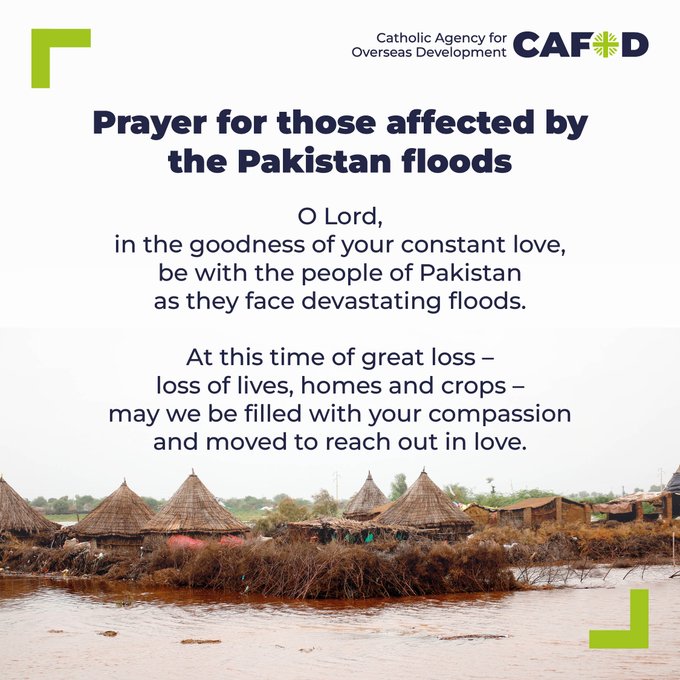
30 million people have been affected. A third of the country is underwater. Lives, homes, and livelihoods have been lost. Today, the DEC is launching the #PakistanFloodsAppeal. Please donate if you can to help save lives.
Former Prime Minister Gordon Brown has joined with 56 faith groups, charities and politicians to call on the government to take urgent action to bridge the cost of living gap faced by the lowest income families.
The call responds to a report written by poverty expert and Loughborough University Professor Donald Hirsch which reveals the gap between the support the government is currently offering to households and the anticipated rise in living costs.
The report concludes that the current flat-rate payments offered by the government will fall at least £1,600 short of making up for recent changes to living costs and benefits faced by a couple with two children.
The report assesses the extent to which cost of living measures announced in May will compensate for three blows experienced by millions of low-income families: cuts in Universal Credit, inadequate uprating of benefits with accelerating inflation in April and the further rise in the energy cap anticipated in October.
It shows that the package of support measures falls well short of making up for these losses, even with the October increase in the cap.
The groups, supported by Gordon Brown, are urging the Government to consider appropriate measures to bridge the shortfall in family finances, which is only anticipated to rise into the winter months.
Some charities are calling for benefits to be uprated in line with inflation, and for debt deductions from Universal Credit to be paused.
The report is endorsed by 56 charities, faith groups and politicians, many of whom are providing front-line support for families hit by rising costs, including Archbishop Leo William Cushley, Archbishop of St Andrews and Edinburgh, representatives of Caritas, Paul Southgate, Chair, National J&P Network and Fr Dominic Robinson SJ, Chair, Westminster J&P Commission.
It has also been endorsed by the Trussell Trust, the Joseph Rowntree Foundation, the Child Poverty Action Group as well as the Methodist Church, the Bishop of Durham, the Hindu Council UK and the Muslim Council of Britain, Welsh First Minister Mark Drakeford, Metro Mayors, Tracy Brabin of West Yorkshire, Andy Burnham of Greater Manchester, Jamie Driscoll of North Tyne Combined Authority, Sadiq Khan of Greater London, Dan Norris of West of England, Steve Rotheram of Liverpool City Region and Mayor of Bristol Marvin Rees.
The report contains stories of first-hand experience of the impact of the rise in the cost of living. Lowri receives Universal Credit and cares for her father and daughter.
Her food and fuel bills have doubled, and she’s had to sell her daughter’s bike to make ends meet: “I have spent the last 5 years living in survival mode, just about surviving each day, worrying about money constantly.
“I am emotionally and mentally exhausted living like this. It is not living, merely existing. There is just no way people can manage to pay all their bills, and all we are doing is existing to pay bills. Terrified is an understatement.”
Prof Hirsch said: “The shortfall families are facing between skyrocketing costs and the support government have offered continues to grow. Families were falling behind with the anticipated rise in costs even when the measures were announced, and since then the food and energy costs forecast for this winter have continued to rise sharply.
“The flat rate emergency payments announced so far leave families with children particularly far behind, because they are not sensitive to the extra costs that children bring.
“A new package needs to address the fact that by the autumn, living costs could have risen by as much as 14% for low-income families, who have received only a 3% increase in benefits.
“An additional across-the-board uprating to Universal Credit and other benefits would address family need far more effectively than further flat rate payments.”
The former Prime Minister Gordon Brown commissioned the report, after facing the realities of rising costs alongside churches and charities in the UK
He said: “This is a crisis that Britain hasn’t seen in decades. The most urgent and immediate challenge for the incoming Prime Minister is to ensure that families with children and disabled people aren’t neglected to struggle through the challenges ahead.
“We need targeted support for families on the lowest incomes, not just cuts in taxes or flat rate payments which don’t account for the specific needs of people on the brink of poverty.
“There should be no argument that a permanent increase in Universal Credit is the only way to take a sure step towards a solution.
“This crisis goes far beyond politics; this is a moral issue – our responsibilities to our neighbours and in particular to those who have the least and whose needs are the greatest.
“The incoming Prime Minister has a moral responsibility to ensure that everyone has enough to live on, through this crisis and beyond. We cannot be at ease when millions are ill at ease and cannot rest content as long as there is so much discontent.
“Our society will be stronger when we help the weak and will be richer when we help the poor.”
Revd Graham Thompson, President of the Methodist Church in Britain, who have endorsed the report, said: “Churches and other faith groups are on the front line of offering support to families who are already being swept under by rising costs. We know that millions of families aren’t simply making hard choices between heating and eating, but are having to go without both completely.
“If people aren’t given enough support to live, we don’t dare to imagine what will happen this winter. The government now have a duty to step up and take firm and long-lasting action to ensure not only that this crisis doesn’t deepen, but that it doesn’t happen again.”
As members of the Together With Refugees coalition, Westminster Justice & Peace and Caritas Westminster invite you to join us at Saturday’s demonstration ‘We Demand Better’ organised by the TUC.
Coalition member, Care for Calais, along with Stand Up To Racism, are leading a refugee bloc in the TUC demo about the Cost-of-Living Crisis in London, on Saturday 18 June 2022.
When there are social problems in the UK refugees and migrants are often blamed. As the Cost of Living Crisis worsens the government is using racism as way to divide and rule people. We say #AllRefugeesWelcome – we won’t let racism divide us. We need unity in the face of the Cost of Living Crisis. The TUC’s demo offers a great opportunity to show solidarity and unity and promote the rights of refugees.
Let us know if you would like to join us in the ‘Stop the Rwanda plan – All Refugees Welcome’ bloc by emailing Colette Joyce at colettejoyce@rcdow.org.uk or call 07593 434905.
Gather at 10.30am, Portland Place, London, W1B 1, United Kingdom
Refugee Week is a UK-wide festival celebrating the contributions, creativity and resilience of refugees and people seeking sanctuary. This annual event founded in 1998 is held every year around the UN World Refugee Day on 20th June and is a growing global movement.
It will involve a dynamic programme of arts, culture, sports, educational, media and creative campaigns. Refugee Week aims for UK refugees from different backgrounds to connect and share their experiences, perspectives and creative work. Hopefully this will encourage understanding of why people are displaced and the challenges they face when seeking safety. Refugee Week’s vision is for refugees and asylum seekers to be able to live safely within inclusive and resilient communities, where they can continue to make a valuable contribution. This reflects our values that everyone has a right to be safe, and treated fairly with respect and kindness.
Refugee Week is an umbrella festival, and anyone can get involved by holding or joining an event or activity. The events will happen in a variety of spaces ranging from arts festivals, exhibitions and film screenings and museum tours to football tournaments, public talks and activities in schools.
Christian events in London include:
20th June, 12.30-1.30pm: Prayer Vigil outside the Home Office with Westminster Justice & Peace and London Catholic Worker to pray for migrants seeking safe passage to the UK. Contact Barbara Kentish (J & P) barbarakentish@talktalk.net
20th June, 7pm: London Churches Refugee Fund Annual Speaker Meeting. Revd Dr Sam Wells ‘So Many Kinds of Wrong: A Theological Response to the Rwanda Asylum Initiative‘ – St Martin-in-the-Fields, Trafalgar Square, WC2N 4JH. Further details www.lcrf.org.uk Email info@lcrf.org.uk
20th June 2022, 6-8pm: Stories of Welcome. Farm Street Church (‘Arrupe Hall’), 114 Mount Street, London, W1K 3AH. Share and celebrate the stories of how our London churches and parishes are welcoming asylum seekers, migrants and refugees from Syria, Afghanistan, Iraq, Eritrea, Ukraine, Hong Kong and so many other countries.
Speakers will include:
The Right Revd Paul McAleenan (Diocese of Westminster and Lead Bishop for Migrants and Refugees)
The Right Revd Joanne Grenfell (Bishop of Stepney, Diocese of London)
The Bishop of Southwark, The Rt Revd Christopher Chessun
This event is hosted jointly by the Compassionate Communities Team (Diocese of London), the Diocese of Southwark and Caritas Westminster.






 Diocese of Westminster Justice and Peace Commission