The Catholic Association for Racial Justice (CARJ) Annual General Meeting will take place on Saturday 16 November 2024 at 11.00am at St Thomas More Church, 9 Henry Rd, London N4 2LH. The theme is: ‘Practical steps for achieving the Racial Justice Agenda’. The event is open to all members and friends of CARJ
Papers for the AGM (including the Annual Report, the Accounts, papers relating to the Election of Trustees, membership forms etc) here – please notify CARJ if you would want hard copies of the papers sent to you.
Please keep an eye on the CARJ website over the coming weeks (here) for the names of nominated Trustees. There is also a form for you to nominate a trustee to CARJ.
Arrival and registration starts from 10.30am. The business meeting commences promptly at 11am followed by Mass, lunch, and an afternoon of talks and discussion relating to practical step for achieving Racial Justice.
Food and drink will be available across the day.
It is helpful, for catering purposes, to know in advance who is coming. If possible, please contact CARJ by phone- 020 8802 8080 or email- info@carj.org.uk beforehand. However, please feel free to turn up on the day even if you have not booked.
Directions: St Thomas More Church is a short walk from Manor House Underground Station. Anyone who is driving has to enter the complex of streets around Henry Rd by turning off Green Lanes into Gloucester Drive.
To join CARJ or renew your membership, please email info@carj.org.uk for membership form.
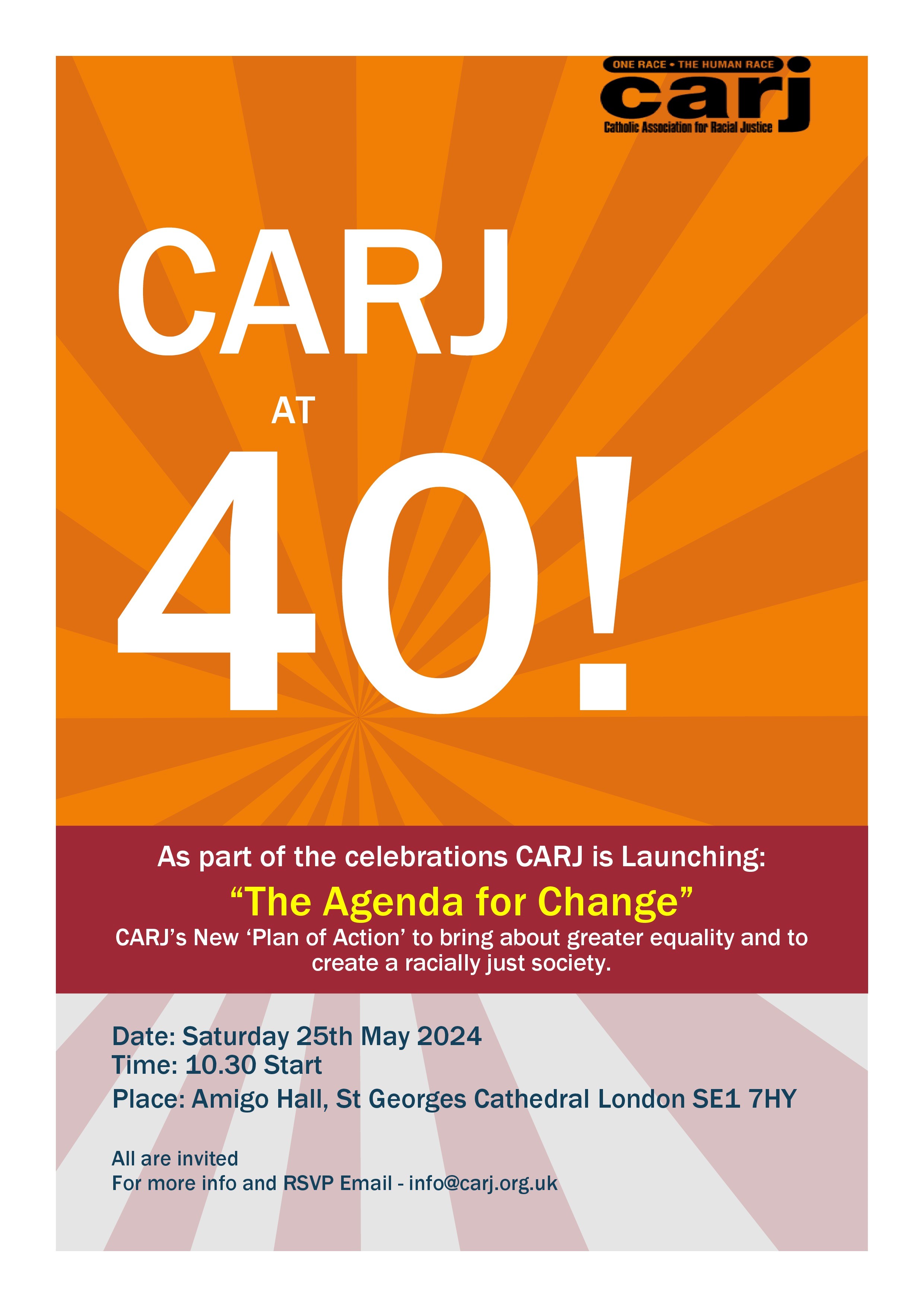
25 May, 10.30am-3.00pm: CARJ 40th Anniversary Event Amigo Hall at St George’s Cathedral London SE1 7H.CARJ was established 40 years ago on 16 June 1984 at a meeting of approximately 25 ‘founding members’ from a variety of ethnic backgrounds. To mark this important anniversary, CARJ are launching a new ‘Racial Justice Agenda for Change.’ Open to all and free to attend, with lunch served and a Sung Mass to end the day at 3.00pm. Email your interest to info@carj.org.ukhttps://www.carj.org.uk/
25 May, 3.00pm: CARJ 40th Anniversary Mass St George’s Cathedral Southwark, Westminster Bridge Road, SE1 7HY. https://www.carj.org.uk/
CARJ was established 40 years ago on 16 June 1984 at a meeting of approximately 25 ‘founding members’ from a variety of ethnic backgrounds.
From the beginning, CARJ was seen as a black-led, independent organisation where ethnic minorities could find support and a voice, and where people of all backgrounds could work together for racial justice.
Despite challenging times in society and in the church, CARJ secured remarkable achievements along the way including:
Hosting the first National Congress for Black Catholics -1990
Holding the National Racial Justice Congress -2003
Since 2006 CARJ has worked in schools, delivering workshops on racial justice, training youth ambassadors and supporting the general educational attainment of black and minority ethnic young people
CARJ has setup and has run networks and support groups, including the Urban Network and Travellers and Gypsy working group
On Saturday 25th of May in London, CARJ launches a new ‘Racial Justice Agenda for Change’, which will be the vision for the work of CARJ into the future. The Agenda for Change builds on the experiences and learning of the past 40 years and puts forward a strategy for bringing about greater equality and creating a racially just church and society, a goal which continues to elude us in the 21st century.
Date Saturday 25th May 2024
Venue: Amigo Hall at St George’s Cathedral London SE1 7HY
The Struggle for Racial Justice: Recalling the past and discerning the future. A CARJ series of webinars will take place from May to August 2023. The aim of these webinars is to reflect on the history of the past 75 years and attempt to discern the best ways forward for society and for the Church in the effort to bring about a more just, more equal and more cooperative society.
The Webinars will take place on Thursday evenings and Saturday mornings. Each Webinar will last for an hour and a half. There will be two speakers and ample time for discussion. Yogi Sutton will Chair the Webinars. The Webinars are free. To register for one or more webinars or if you need further information, please contact the CARJ Administrator at info@carj.org.uk A link will be sent to all who register. The Webinars will be recorded and will be available on the CARJ website until the end of August 2023.
The Changing Face of Britain – A Brief History 1947-2023 – Saturday 27 May (10 – 11.30am)
Persistent inequality and Racism over the past 75 years – Thursday 15 June (7 – 8.30pm)
Combatting Racism – different approaches over the past 75 years – Thursday 29 June (7 – 8.30pm)
The Churches role in combatting racism over the past 75 years – Thursday 6 July (7 – 8.30pm)
Combatting racism – An Agenda for the Future for Britain – Saturday 29 July (10 – 11.30am)
The Church’s role in the struggle for Racial Justice in the future – Thursday 3 August (7 – 8.30pm)
These Webinars are a preparation for CARJ’s 40th Anniversary in 2024.
Nalini Nathan, General Secretary of the Conference of Religious and a trustee of CARJ, the Catholic Association for Racial Justice, offers three thoughts to help us focus on ‘Working Together’ for racial justice.
On 5 February, the Catholic Church in England and Wales celebrates Racial Justice Sunday. It’s the day the Church focuses on the need to oppose racism and pursue racial justice with renewed vigour.
The theme for 2023 is “All are included in the mission of Christ and His Church. Let us walk together, pray together and work together.”
This reflection, from Nalini Nathan, General Secretary of the Conference of Religious and a trustee of CARJ, focuses on ‘Working Together’ for racial justice.
+++
My name is Nalini, and I am the General Secretary for the Conference of Religious in England and Wales. I am also a member of the Christian Network Against Caste Discrimination and a trustee for a number of charities including CARJ, the Catholic Association for Racial Justice and the Margaret Clitherow Trust which supports Traveller, Gypsy and Roma communities.
In the next few minutes, I’ll be sharing three ponderings I have about working together if every race and ethnicity are to be included in the mission of Christ and His Church.
Firstly, our unique ancestries are a gift. The world has been blessed with such a broad diversity of cultures and therefore perspectives, knowledge, skills and experiences. Working with different people to ourselves should, I think feel like being in a sweet shop. I want mine and all cultures to be seen for what they are, a gift from God!
I should be so grateful that God has blessed me with chocolate brown skin that protects me from harmful rays, from cancer, even from wrinkles! I save so much money not needing to use sunbeds or fake tan. But more seriously, so often in life, my skin colour has been a hindrance. There’s the avoidance, that change in tone when someone speaks to you, the ignorant mistaken or at times deliberate aggressive comments, the being overlooked for promotion when you’re the most qualified or experienced person for the job. There’s the scapegoating, the stepping on, the passive-aggressive behaviours and the trauma of healing from ignorant comments, isolation and oppression. As a Catholic, I find this at odds with my faith. I was taught that like everyone, that I am made not just good but very good, that we are all made very good, each called to be a jewel in God’s crown.
Secondly, I want to mention privilege. I come from more than one culture. That’s my privilege, that’s one of my blessings. I humbly embrace my cultural privilege. It helps me be a better Christian, a better Catholic as it increases me empathy, compassion and communication skills to relate to the stranger, to relate to the outsider, to relate to the person who is being treated as invisible.
Privilege has become the dirty word of our post-covid society. There is absolutely nothing wrong with being given privilege. It’s your talent, it’s your gift. There’s nothing wrong with having privilege if you are a Catholic as long as you are using it for the glory of God and as long as you are not stealing it from someone else.
I wonder, are we aware of our privileges, if so, how are we using them to work with and support others? How are we using them to help others flourish?
Finally, I want to reflect on how we might look at each other through the eyes of God. The first thing we are told in the bible is that God is a creator. ‘In the beginning he created…’ I look at the diversity of what he has created, the diversity of plants and wildlife. God is clearly a creator of diversity. We are taught that we are the Body of Christ. Are our cultures also different parts of this Body, which are meant to work together to build up the kingdom of God? If we oppress one part of the body, one culture, are we damaging ourselves?
Like those of different cultures who face rejection in their workplaces, parishes and schools, Jesus too felt rejection throughout His life, even before He was born, when there was not place at the inn. It is a natural human behaviour to feel the need to surround ourselves with people who are similar to ourselves. We want to fit in, we want to feel validated and sometimes there are opportunities to preserve things by working with people similar to ourselves. But as Catholics, like the early Christians, we are called to sometimes put away our own insecurities and need to fit it, to instead look outwards. I wonder, way back when God chose the Israelites, did he consider that the land of Christ’s birth would be the place that united the known world of that time? Israel, a land that links Africa, Asia and Europe. Quietly, Christ was born at a place that brought together the continents, and then 33 years later, again, he reached out his hands to the world.
So the three things I just reflected on were that if we wish to work together it might be helpful to remember that:
Each and every culture is a gift from God that is needed for working to build up His kingdom.
Own your privilege -it is a gift to be used to help others step forward, it can be used to help others participate and share their talents.
Look outwards, that’s a part of the mission and calling of each of us who make up the Body of Christ and His Church.
Every culture is a gift, own your privilege, look outwards.
God of our past, present and future, you created each one of us in your image and likeness, help us to recognise you in each person.
As we pray for end to suffering caused by racism lead us this day to walk with one another, pray with one another and work together, so that we create a future based on justice and healing, where all can fulfil the hope you have for all peoples.
The theme for this year’s Racial Justice Sunday is:
‘All are included in the mission of Christ and his Church. Let us walk together, pray together and work together.’
It reflects the role each of us must play in promoting the mission of Christ and His Church. This was inspired by conversations around last year’s Racial Justice Sunday and Pope Francis’ visit to Canada in July 2022 when he spoke about looking towards a future of ‘Justice, healing and reconciliation’.
There are new resources for 2023 on the Catholic Bishops Conference of England and Wales website and we are also invited to return to the images produced last on ‘Made in the Image God’ for deeper reflection.
Gallery of Saints – Chosen by parishioners and especially commissioned for Our Lady of Fatima Catholic Parish, White City, in West London. Photo @ Fr Richard Nesbitt
Prayer
God of our past, present and future, you created each one of us in your image and likeness, help us to recognise you in each person.
As we pray for end to suffering caused by racism lead us this day to walk with one another, pray with one another and work together, so that we create a future based on justice and healing, where all can fulfil the hope you have for all peoples.
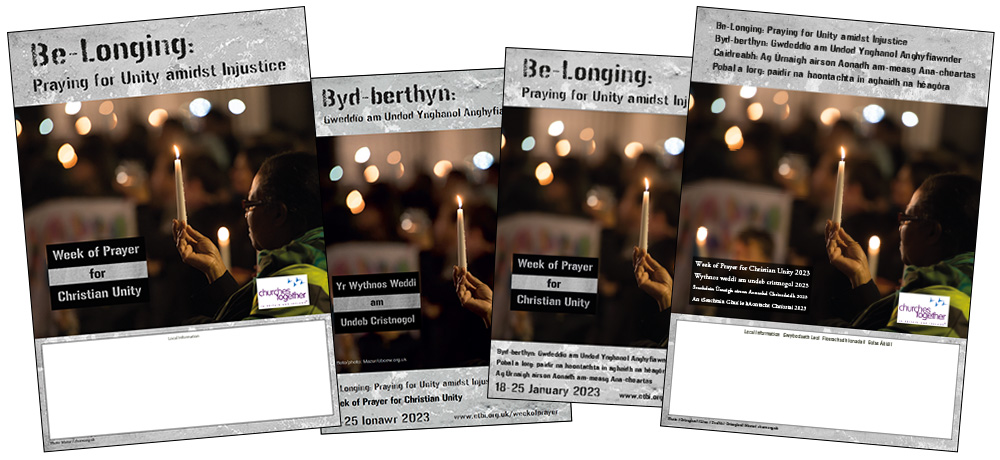
The Week of Prayer for Christian Unity is traditionally observed from the 18th to the 25th January – the octave of St. Peter and St. Paul.
For this week we are guided by the churches of Minneapolis as we seek to explore how the work of Christian unity can contribute to the promotion of racial justice across all levels of society.
Through this resource, the ecumenical Churches Together in Britain and Ireland (CTBI) writers’ group has chosen to focus our attention in the UK on the 30th anniversary of the murder of Stephen Lawrence, which we mark in 2023.
Prayer
You made us, God, in your own image, and then became one of us, proud of those you have made. Make us proud of being part of that worldwide family, and eager to discover and celebrate your image in every person, every culture, every nation that we are privileged to encounter.
This Saturday, November 5th 2022, The Catholic Association for Racial Justice (CARJ) will have its AGM with the Business meeting at 11-12 noon.
Chine McDonald was born in Nigeria and moved to the UK when she was four years old. She read Theology at Cambridge University before training as a newspaper journalist. She was also head of ‘public engagement’ at Christian Aid, and is a regular contributor to BBC Religion and Ethics programmes, including Thought for the Day, the Daily Service and Prayer for the Day. Her first book was titled “Am I beautiful”. She sits on the boards of several charities including Greenbelt Festival, Christians in Media, and Christians Against Poverty. She is also the Director of Theos, the religion and society think tank. Her second book, “God is not a white man” was published last year.
At 1pm after Lunch there will be a talk given by the author of ”God is not a White Man,” Chine McDonald, on the topic “God, race and the imago Dei: black women in the Church”.
Venue: St Thomas More Church Hall, 9 Henry Road, London N4 2LH
There is an option for Participation by Zoom. Please email info@carj.org.uk for information.
Other Details for the AGM Extraordinary General Meeting 10.00-10.45am AGM Business Meeting 11:00am – 12.00pm
Lunch, AGM Talk and Activities from 1pm
Further information and booking: It is helpful, for catering purposes, to know in advance who is coming. Please contact: Catholic Association for Racial Justice (CARJ), 9 Henry Road, London N4 2LH (020 8802 8080), info@carj.org.uk
Directions: St Thomas More Church is a short walk from Manor House Underground Station. Leave the Station via Exit 5; and walk along Seven Sisters Road toward Finsbury Park Station. Take the first turning on the left (Portland Rise) and then the second turning on the right (Henry Road). Anyone who is driving has to enter the complex of streets around Henry Rd by turning off Green Lanes into Gloucester Drive.
The national Synthesis developed by the Catholic Bishops Conference of England and Wales (CBCEW) is a marvel of lucidity, and one which tackled a series of difficult, and potentially controversial, issues in a thoughtful and sensitive manner. It constitutes an incredible contribution to the global debate about how the People of God should journey together to live out our Gospel values.
There is so much in it to be welcomed that it seems petty to focus on a serious weakness, rather than proceed to embed this model of a listening church into our faith lives in our homes, our parishes, our places of work etc. Still, this moment should not be let pass, without some recognition of the blindness that the Synthesis seems to show with regard to the issue of racism.
There is a paragraph devoted in the ‘marginalised groups’ section to “People of Colour” (paragraph 71), which might be considered an improvement on some of the diocesan reports which did not allude to this issue at all. However, the paragraph is, in my view, very wrong headed. The national Synthesis notes that there are few references in the diocesan reports to ‘people of colour’ being excluded (the word racism still does not appear anywhere), but this silence is ‘explained away’ on the grounds that our congregations are often so ethnically diverse. The impression is given either that racism is not a problem within our church, since people of colour themselves did not raise it in the diocesan reports; or, alternatively, racism cannot be a problem experienced in our church because we have such ethnically diverse congregations. Neither interpretation is credible.
The commitment to addressing the need for more diversity in leadership roles is important but insufficient.
Talking with others, they confirmed my view that the final Synthesis seems “totally blind to the issue of racism” and some felt “let down” by its silence on the topic. I accept that the diocesan submissions might not have addressed the issue of racism explicitly but surely our duty as a church is to listen to what the Holy Spirit is saying in the silences too? Were ‘people of colour’ engaged in the process in proportionate numbers (I was a parish synodal rep and noted in our written report that no non-white people engaged in our process)? If they did engage, were they comfortable in raising sensitive issues such as their treatment within broader society, and maybe also the treatment received from fellow parishioners? Maybe it is worse still if people of colour engaged in their parish or synodal processes but did not raise any concerns about exclusion because they did not feel that their experiences of racism had anything much to do with their faith journeys? There is plenty of documentation to show that racism is a problem that needs to be addressed from a faith perspective – just read the ground-breaking Rooting Out Racism report carried out by White City parish in Westminster diocese; or the submission to the national synodal process by the Catholic Association for Racial Justice (CARJ).
The Bishops will present this national Synthesis to the global church and (rightly) alluding to the fact that “the racial and cultural diversity of Catholics is seen as one of the great gifts of the Church in England and Wales”. However, I think that they must also be willing to see that racism is experienced by many in our society, and even in our pews. We, the People of God, need support in celebrating our diversity but also in recognising that many of the people we are journeying with experience racism. Absent this support, many faithful Catholics will remain blind to racism and, even perhaps quite unthinkingly, engage in it.





 Diocese of Westminster Justice and Peace Commission