Laudato Si’ Animators with Bishop John Arnold during visit to the Laudato Si’ Centre
A group of 24 Laudato Si’ Animators from around England, including some from the Diocese of Westminster, visited the Diocese of Salford’s Laudato Si’ Centre during the Season of Creation. They have undertaken to write to their bishops and push for a similar centre in other dioceses.
Laudato Si’ Animators are members of the Laudato Si Movement, a global community of prayer and action. They work to bring Pope Francis’s Encyclical Laudato Si’ to life. They are trained by the Laudato Si’ Movement to get the message of Pope Francis into the parishes. Most attend bi-monthly zoom meetings and take part in prayer vigils and marches about the climate and biodiversity.
Members of the Laudato Si’ Movement support local parishes and communities to engage in ecological spirituality, sustainable lifestyles and advocacy for climate and ecological justice.
On 29 September, a group of animators met with Bishop John Arnold of Salford, the bishops’ environmental lead in England and Wales.
Their visit to Salford’s Laudato Si’ Centre began with a tour of the Centre given by Emily Cahill, the Centre’s environmental and learning officer. She stressed that Bishop John Arnold’s vision for the Wardley Hall Centre was that it would be used by everyone as a centre for learning, spirituality and wellbeing.
In four years, a lawn has been converted into a thriving garden and a woodland area is ideal for groups. Over 3,000 people have visited the centre, especially school and parish groups.
The group was given leaves from various plants to attach to sheets on which they wrote what inspired them to be animators and what hopes they had for the future. After a simple vegan lunch when they were joined by the director of the centre, Emma Gardner, they split into groups and noted down responses. The rain brought them back into the outdoor classroom where Bishop John Arnold greeted the group and a photo was taken.
Sr Joan Kerley then gave an inspiring talk about St Hildegard of Bingen and St Kateri and the Haudenosaunee (Iroquois) Creation story. They sang two songs about creation and then started to answer the seven questions that Laudato Si’ Movement had suggested. They ended with prayers from the Haudenosaunee (Iroquois) Greetings to the Natural World.
If a diocese was to set up its own Laudato Si’ Centre it would need land owned by the Diocese, preferably with woodland and near to public transport. Trained staff would be needed to run the centre supported by volunteers. Disabled access and safeguarding are important. In terms of buildings, the outdoor classrooms and portaloos were perfectly adequate. But it was felt the most important needs would be for prayer and vision. It was felt that centres like the one in Salford would be wonderful for getting the message of Pope Francis out to clergy and laity?
A place like this in every diocese would help towards the UK Government’s commitment to rewild 30% of the nation’s land and sea by 2030, and would be a centre for peace, reconciliation and evangelisation.
Animator John Woodhouse said: “We all responded to the inspiring experience of being in creation. How many children never experience this? So many spend their lives glued to their phones and live in a virtual world. So many have mental health issues. Laudato Si’ needs to be seen as a spiritual and evangelical document. Our young people are pushing us to do so much more and they respond very positively to the message of Pope Francis.”
As the Season of Creation (1 September – 4 October) draws to close, Maria Carvalho reflects on why it is important to dedicate time to praying for creation. While this special season is ending for another year, our prayer continues!Maria sits on the Parish Pastoral Council at Farm Street Church, Central London.
In 2016, Professor Lord Nicholas Stern was invited by the LSE Catholic Society to reflect on his time advising Pope Francis when Laudato Si’ was being written. Lord Stern said, “My heritage is Jewish, but I am a confirmed atheist. And my father would be rolling in his grave if he ever heard me say, ‘This is my favourite Pope.’”
Why? “This Pope is able to take complex ideas and make it simple, real and meaningful to people.”
This is high praise from the man who ten years earlier launched The Economics of Climate ChangeReport (aka Stern Review). I had the privilege of witnessing its launch in 2006 as a Master’s student at LSE, and have been working on climate policy in both academia and the private sector ever since.
Having witnessed the evolution of climate action in the past 18 years, why does Laudato Si and the Pope’s launch of the “World Day of Prayer for the Care of Creation” this September matter?
The truth is – it is a mind-boggling challenge to even think of reforming a global economy to stay within planetary boundaries. And we are already in overshoot with some of these boundaries and are witnessing the reckonings of it around the world. In some places it is more severe storms and floods, and in other places it is more severe heatwaves, droughts, and fires. In several places around the world – including Britain – we are only a few harvest cycles away before putting more artificial fertiliser in the soil will no longer grow any food. Eradicating the natural ecosystems that put nutrients into soil means our soil has become dust. We will have to artificially pollinate due to the loss of natural pollinators.
Knowing that it will only get worse if we don’t fundamentally change the technological, social and political institutions that currently drive our economy is difficult to contemplate.
There is a reason why climate anxiety is a real psychological phenomenon that is on the rise. This anxiety is not restricted just to sustainability professionals, but also to young people who will have to face the consequences of our current economic system.
My atheist colleague and I both agree that to do this kind of work, you need to go through a process of facing the challenge, and even going through a period of grief when contemplating the consequences. But being stuck in despair is not an option – it just doesn’t help to be stuck. You need a way to come out to the other side – to have the courage to face the challenge with equanimity, constructivism, and determined passion.
We both agree that the process to come out the other side is deeply spiritual. His spiritual practice is meditating and running. My spiritual practice is contemplative prayer and walking in nature. Our practices are similar in terms of moving from frustration towards interior acceptance.
I would say that the key difference in our spiritual approach is that I always start and end my prayer with a focus on God. I breathe, knowing that I am deeply loved by God, and that I deeply love Him. In my mind, I think about Lake Moraine, an aquamarine gem surrounded by the majesty of the Canadian Rockies. I think of this lake as God’s cathedral – it never fails to take my breath away, and I praise God for His sheer artistry.
Lake Moraine reminds me that God has created a stunningly beautiful planet that He has entrusted to us to be our Common Home. Original sin points to the brokenness that exists within us and our institutions to explain why instead of caring for our Common Home, we move towards exploiting it. God’s story of redemption through Jesus and His followers shows how grace can work within us to heal and redeem. To refocus on what truly matters, and with Christ’s love within us, act.
Prayer never fails in helping me gain perspective when I face setbacks. Prayer leads me to a space of humility: to accept that fighting this cause does not solely rest on my shoulders. Prayer is about giving Him space to work through me. And I trust Him in guiding us to Care for Creation. Our Common Home.
The familiar blue and green logo, the registered Fairtrade Mark, appeared on the first UK product in 1994. The Mark is licensed by the Fairtrade Foundation, which was set up in 1992 by CAFOD, Christian Aid, Oxfam, Traidcraft, the World Development Movement and the National Federation of Women’s Institutes. Fairtrade seeks to achieve economic, social, and environmental sustainability for farmers and workers in less developed countries. It helps to achieve the UN Sustainable Development Goals and supports farmers to mitigate and adapt to climate change.
2024 is the 30th anniversary of the FAIRTRADE Mark in the UK, and the Fairtrade Foundation
Fairtrade Fortnight is the annual celebration of all things Fairtrade, raising awareness for the need for fairer trade to support farmers in low-income countries. Celebrating the 30th anniversary of the Fairtrade Mark, which lets people know what products are in line with the movement’s ethical and sustainably.
Fairtrade now works with more than 2 million farmers and workers around the world. Between 1994 and 2022, farmers and producers have shared an estimated £1.7 billion in Fairtrade Premium payments. But with the world facing major challenges, now is the time to redouble our efforts to do more. Many of the farmers overseas who produce the goods we rely on in the UK are facing the impacts of both climate change and poverty.
Many small-scale farmers and workers in countries most affected by climate change are often experts in adapting to climate change. But unfair trade means they don’t have the money to invest in sustainable farming techniques that can secure a fairer, greener future for people, planet and the world’s food supply.
Fairtrade are working to grow fair pay for farmers, so they have the resources and financial stability to protect the environment and adapt to the risks of climate change. Farmers are at the heart of the climate crisis; they face the worst effects of climate change and are bearing the costs to combat it. Ask the UK government to support the farmers taking on deforestation, by delivering on promised funding and making sure deforestation law gives a fair deal to farmers. Stand with farmers taking on climate change and building a sustainable future. We must act at pace in a world in which the climate crisis, global conflicts, and the pandemic have heightened threats to farmers’ livelihoods and exposed the fragility of our shared food system. Growing Our Movement for Change Report
Every time we buy an item with the Fairtrade Mark, we are part of this movement which works in partnership with producers and workers, so that they can afford to feed their families, send their children to school, cover their farming costs, adapt to climate change and have a brighter future. We are also calling upon changemakers to promote fair trade to help producers and farmers tackle poverty and climate change, and build a sustainable trade system for all. Be the Change
Fairtrade is a worldwide movement for change and trade justice.
Transform Trade supports producers around the world. Together, we fight for a fairer trade system. we can change the way we trade – in partnership with the world’s producers – we can solve big problems. trade should support humanity – and the planet we all live on. Be part of the transformation
Everyday, inspirational producer collectives and social enterprises around the world are finding new and innovative ways to tackle global challenges. They’re showing a better way of doing trade isn’t just possible – it’s already happening.
Transform Trade partner with these groups to build a brighter future for their communities and spread their influence around the world. Invest in the farmers, workers and artisans who are changing the world of trade from the ground up.
During March 2021, at the Fairtrade Fortnight celebrations, the Diocese of Westminster celebrated being recognised as the first Catholic Fairtrade Diocese.
There are lots of ways to support Fairtrade, but just two core requirements to be awarded Fairtrade Place of Worship status:
Use Fairtrade products wherever possible (at least tea, coffee and sugar) and share this information with the wider congregation.
Integrate Fairtrade into the life of your place of worship, at Fairtrade Fortnight or other times of the year e.g. events, stalls and worship.
There is a brand-new online commitment process that’s easy to complete whether you have applied for Fairtrade status before, or not, and new certificates, posters and materials available to celebrate and showcase your Fairtrade commitment.
Thank you for being part of the Fairtrade movement and for celebrating this 30th anniversary with us. Fairtrade would not be what it is today, without your support.
Fifty-five Laudato Si’ Animators, representing all parts of the United Kingdom, have written an open letter to the Prime Minister Sir Keir Starmer, and the ministers responsible Steve Reed and Ed Milliband. They call on the government to:
1. Introduce the Climate and Nature Bill which 60,000 marched for at Restore Nature Now rally on 22 June 2024. This bill would address many issues of concern e.g. reducing greenhouse gases, ending fossil fuel extraction, restoring ecosystems.
2. Commit to a transition from animal agriculture to organic, arable agriculture. Animal agriculture is a leading cause of many present world crises – climate change; antibiotic resistance; waste of resources and global hunger (food, land, water and energy are wasted in growing food for animals to eat).
3. Commit to the signing of the Fossil Fuel Non-Proliferation Treaty (FFNPT), a proposed international agreement that aims to control fossil fuel production and infrastructure expansion, and phase out fossil fuel use in a fair and equitable way. The treaty would also accelerate the transition to clean energy and economic diversification away from fossil fuels. In 2023 Pope Francis called for “the elimination of fossil fuels, and education in lifestyles that are less dependant”.
4. Support rewilding and in particular the Rewilding manifesto.
5. Ensure businesses pay for their pollution, and transition to non-polluting practices and products.
They state: “We believe that climate change is now such a threat to humanity that it should not be the subject of policies of individual political parties, but that all the parties should work together to find solutions to the problem for the common good and for the sake of our children’s children.
“Pope Francis issued a papal document Laudate Deum in October 2023 which gives a clear warning about what needs to be done urgently.
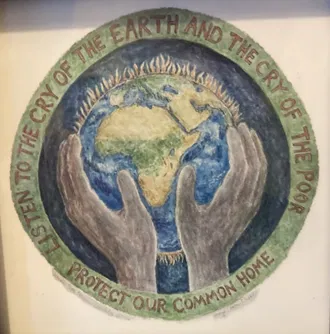
“We are sending you a photo from the march in June and a copy of a special painting by professional artist Helen Elwes who is one of the Animators which we hope you will put on your desk as a reminder that we all need to think and act to care for our common home.”
Show the film ‘The Letter’ which tells the story of Pope Francis and the encyclical letter ‘Laudato Si’: On the Care of Our Common Home’. Free to download https://theletterfilm.org/
Produce a Season of Creation noticeboard display, banners or booklets for the Parish.
Invite local people to speak.
Plant a tree.
Look after land around the church to encourage wildlife.
Arrange a parish walk in nature, finishing with a picnic.
Celebrate the Season of Creation with a parish vegetarian meal.
Implement a carbon reduction programme for your Parish. Contact Westminster Diocese Property Services or Westminster Justice & Peace for assistance.
Hold an exhibition for the Season of Creation in collaboration with a local school or art group.
Hold a concert with music inspired by creation or as a fundraiser for local nature projects.
Book a ‘Tree Walk’ with Colette Joyce, the Justice and Peace Co-ordinator, to explore the fascinating trees to be found around Westminster Cathedral. Email: colettejoyce@rcdow.org.uk
Promote the Southern Dioceses Environment Network Meetings. A home for all Catholics interested in getting more support for their environment activity within the Church or in society. Over 100 people on the mailing list. New participants welcome!
Make plans to continue your Care for Creation throughout the year.
Let the Justice & Peace office know about your activities so that we can share the good news with the rest of the Diocese!! Email: justiceandpeace@rcdow.org.uk
“Hope and Act with Creation” is the theme of the World Day of Prayer for the Care of Creation, to be held on 1 September 2024. The theme is drawn from Saint Paul’s Letter to the Romans (8: 19-25), where the Apostle explains what it means for us to live according to the Spirit and focuses on the sure hope of salvation that is born of faith, namely, newness of life in Christ.
Let us begin with a question, one perhaps without an immediately obvious answer. If we are truly believers, how did we come to have faith? It is not simply because we believe in something transcendent, beyond the power of reason, the unattainable mystery of a distant and remote God, invisible and unnameable. Rather, as Saint Paul tells us, it is because the Holy Spirit dwells within us. We are believers because the very love of God “has been poured into our hearts” ( Rom 5:5) and the Spirit is now truly “the pledge of our inheritance” ( Eph 1 :14), constantly prompting us to strive for eternal goods, according to the fullness of Jesus’ authentic humanity.
The Spirit enables believers to be creative and pro-active in charity. He sends us forth on a great journey of spiritual freedom, yet one that does not eliminate the tension between the Spirit’s way of thinking and that of the world, whose fruits are opposed to each other (cf. Gal 5:16-17). We know that the first fruit of the Spirit, which sums up all the others, is love. Led by the Holy Spirit, believers are children of God and can turn to him with the words “Abba, Father” ( Rom 8:15), just as Jesus did. Moreover, they can do so with the freedom of those who no longer fall back into the fear of death, for Jesus has risen from the dead. This is our great hope: God’s love has triumphed and continues to triumph over everything. Indeed, even in the face of physical death, future glory is already assured for those who live the new life of the Spirit. Nor does this hope disappoint, as was affirmed in the recent Bull of lndiction of the forthcoming Jubilee. [1]
The life of a Christian, then, is one of faith, active in charity and abounding in hope, as we await the Lord’s return in glory. We are not troubled by the “delay” of the Parousia, Christ’s second coming; for us the important question is whether, “when the Son of man comes, he will find faith on earth” (Lk 18:8). Faith is a gift, the fruit of the Spirit’s presence in us, but it is also a task to be undertaken freely, in obedience to Jesus’ commandment of love. Such is the blessed hope to which we must bear witness. Yet where, when, and how are we to bear that witness? Surely by caring for the flesh of suffering humanity. As people who dare to dream, we must dream with our eyes wide open, impelled by a desire for love, fraternity, friendship and justice for all. Christian salvation enters into the depths of the world’s suffering, which embraces not only humanity but also the entire universe, nature itself, and the oikos, the home and living environment of humanity. Salvation embraces creation as an “earthly paradise,” mother earth, which is meant to be a place of joy and a promise of happiness for all. Our Christian optimism is founded on a living hope: it realizes that everything is ordered to the glory of God, to final consummation in his peace and to bodily resurrection in righteousness, as we pass “from glory to glory.” Nonetheless, in the passage of time we are not exempt from pain and suffering: the whole creation groans (cf. Rom 8:19-22), we Christians groan (cf. vv. 23-25) and the Spirit himself groans (cf. vv. 26-27). This groaning expresses apprehension and suffering, together with longing and desire. It gives voice to our trust in God and our reliance on his loving yet demanding presence in our midst, as we look forward to the fulfilment of his plan, which is joy, love and peace in the Holy Spirit.
The whole of creation is caught up in this process of new birth and, in groaning, looks forward to its liberation. This entails an unseen and imperceptible process of growth, like that of “a mustard seed that becomes a great tree” or “leaven in the dough” (cf. Mt 13:31-33). The beginnings are tiny, but the expected results can prove to be infinite in their beauty. Similar to the anticipation of a birth – the revelation of the children of God – hope can be seen as the possibility of remaining steadfast amid adversity, of not losing heart in times of tribulation or in the face of human evil. Christian hope does not disappoint, nor does it deceive. The groaning of creation, of Christians and of the Spirit is the anticipation and expectation of a salvation already at work; all the same, we continue to find ourselves enduring what Saint Paul describes as “tribulation, distress, persecution, famine, nakedness, peril, sword” ( Rom 8:35). Hope, then, is an alternative reading of history and human affairs. It is not illusory, but realistic, with the realism of a faith that sees what is unseen. This hope is patient expectation, like that of Abraham. I think of that great visionary believer, Joachim of Fiore, the Calabrian abbot who, in the words of Dante Alighieri, “was endowed with a spirit of prophecy”.[2] At a time of violent conflicts between the Papacy and the Empire, the Crusades, the outbreak of heresies and growing worldliness in the Church, Joachim was able to propose the ideal of a new spirit of coexistence among people, based on universal fraternity and Christian peace, the fruit of a life lived in the spirit of the Gospel. I spoke of this spirit of social friendship and universal fraternity in Fratelli Tutti, but this harmony among men and women should also be extended to creation, in a “situated anthropocentrism” (Laudate Deum, 67) and in a sense of responsibility for a humane and integral ecology, the path to salvation for our common home and for us who inhabit it.
Why is there so much evil in the world? Why so much injustice, so many fratricidal wars that kill children, destroy cities, pollute the Environment and leave mother earth violated and devastated? Implicitly evoking the sin of Adam, Saint Paul states: “We know that the whole creation has been groaning in labour pains until now” (Rom 8:22). The moral struggles of Christians are linked to the “groaning” of creation, ever since the latter “was subjected to futility” (v. 20). The entire universe and every creature therein groans and yearns “impatiently” for its present condition to be overcome and its original state to be restored. Our liberation thus includes that of all other creatures who, in solidarity with the human condition, were placed under the yoke of slavery. Creation itself, like humanity, was enslaved, albeit through no fault of its own, and finds itself unable to fulfil the lasting meaning and purpose for which it was designed. It is subject to dissolution and death, aggravated by the human abuse of nature. At the same time, the salvation of humanity in Christ is a sure hope also for creation, for, “the creation itself will be set free from its bondage to decay and obtain the glorious liberty of the children of God” (Rom 8:21). Consequently, thanks to Christ’s redemption, it is possible to contemplate in hope the bond of solidarity between human beings and all other creatures.
In our hopeful and persevering expectation of the glorious return of Jesus, the Holy Spirit keeps us, the community of believers, vigilant; he continually guides us and calls us to conversion, to a change in lifestyle in order to resist the degradation of our environment and to engagement in that social critique which is above all a witness to the real possibility of change. This conversion entails leaving behind the arrogance of those who want to exercise dominion over others and nature itself, reducing the latter to an object to be manipulated, and instead embracing the humility of those who care for others and for all of creation. “When human beings claim to take God’s place, they become their own worst enemies” (Laudate Deum, 73), for Adam’s sin has tainted our fundamental relationships, namely with God, with ourselves, with one another and with the universe. All these relationships need to be integrally restored, saved and “put right”. None of them can be overlooked, for if even one is lacking, everything else fails.
To hope and act with creation, then, means above all to join forces and to walk together with all men and women of good will. In this way, we can help to rethink, “among other things, the question of human power, its meaning and its limits. Our power has frenetically increased in a few decades. We have made impressive and awesome technological advances, yet we have not realized that at the same time we have turned into highly dangerous beings, capable of threatening the lives of many beings and our own survival” (Laudate Deum, 28). Unchecked power creates monsters and then turns against us. Today, then, there is an urgent need to set ethical limits on the development of artificial intelligence, since its capacity for calculation and simulation could be used for domination over humanity and nature, instead of being harnessed for the service of peace and integral development (cf. Message for the World Day of Peace 2024).
“The Holy Spirit accompanies us at every moment of our lives”. This was clearly understood by the boys and girls assembled in Saint Peter’s Square for the first World Day of Children, which was held on Trinity Sunday. God is not an abstract notion of infinity, but the loving Father, the Son who is the friend and redeemer of every person, and the Holy Spirit who guides our steps on the path of charity. Obedience to the Spirit of love radically changes the way we think from “predators”, we become “tillers” of the garden. The earth is entrusted to our care, yet continues to belong to God (cf. Lev 25:23). This is the “theological anthropocentrism” that marks the JudeaChristian tradition. To claim the right to possess and dominate nature, manipulating it at will, thus represents a form of idolatry, a Promethean version of man who, intoxicated by his technocratic power, arrogantly places the earth in a “dis-graced” condition, deprived of God’s grace. Indeed, if the grace of God is Jesus, who died and rose again, then the words of Benedict XVI certainly ring true: “It is not science that redeems man: man is redeemed by love” (Spe Salvi, 26), the love of God in Christ, from which nothing and no one can ever separate us (cf. Rom 8:38-39). Creation, then, is not static or closed in on itself, but is continuously drawn towards its future. Today, thanks to the discoveries of contemporary physics, the link between matter and spirit presents itself in an ever more intriguing way to our understanding.
The protection of creation, then, is not only an ethical issue, but one that is eminently theological, for it is the point where the mystery of man and the mystery of God intersect. This intersection can be called “creative”, since it originates in the act of love by which God created human beings in Christ. That creative act of God enables and grounds the freedom and morality of all human activity. We are free precisely because we were created in the image of God who is Jesus Christ, and, as a result, are “representatives” of creation in Christ himself. A transcendent (theological-ethical) motivation commits Christians to promoting justice and peace in the world, not least through the universal destination of goods. It is a matter of the revelation of the children of God that creation awaits, groaning as in the pangs of childbirth. At stake is not only our earthly life in history, but also, and above all, our future in eternity, the eschaton of our blessedness, the paradise of our peace, in Christ, the Lord of the cosmos, crucified and risen out of love.
To hope and act with creation, then, means to live an incarnational faith, one that can enter into the suffering and hope-filled “flesh” of others, by sharing in the expectation of the bodily resurrection to which believers are predestined in Christ the Lord. In Jesus, the eternal Son who took on human flesh, we are truly children of the Father. Through faith and baptism, our life in the Spirit begins (cf. Rom 8:2), a holy life, lived as children of the Father, like Jesus (cf. Rom 8:14-17), since by the power of the Holy Spirit, Christ lives in us (cf. Ga/ 2:20). In this way, our lives can become a song of love for God, for humanity, with and for creation, and find their fullness in holiness.[3]
[1] Cf. Bull of lndiction of the Ordinary Jubilee of the Year 2025 Spes Non Confundit (9 May 2024).
[2] The Divine Comedy, Paradiso, Canto XII, 141
[3] The Rosminian priest Clemente Rebora expressed this poetically: “As creation ascends in Christ to the Father, all in a mysterious way become the travail of birth. How much dying is required if life is to be born! Yet from one Mother alone, who is divine, we come happily into the light. We are born to a life that love brings forth in tears. Its yearning, here below, is poetry; butholiness alone can finish the song” ( Curriculum vitae, “Poesia e santita”: Poesie, prose e traduzioni, Milan 2015, p. 297).
Southern Dioceses Environment Network – Join us for the next Southern Dioceses Environment Network meeting on 9 September 2024, when we will be exploring Pilgrimages and the Holy Year 2025, in the light of our commitment to care for creation.
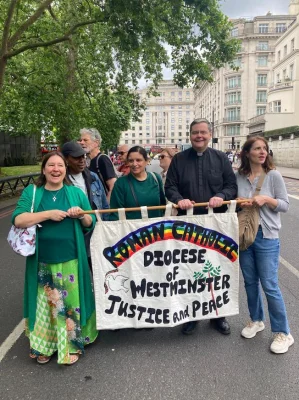
Colette Joyce (l) and Fr Dominic Robinson SJ from Westminster J&P with campaigners about to join the march.
Source: Jo Siedlecka, ICN / Westminster Justice & Peace
People of all faiths and none were out in force at the Restore Nature Now march in London last Saturday. Billed as the “largest-ever environmental march”, an estimated nearly 100,000 people from more than 350 organisations took part – ranging from long established wildlife organisations to climate change activists and faith groups.
Led by naturalist and television presenter Chris Packham with actors Emma Thompson and Judi Dench, Megan McCubbin, Steve Backshall, singer Feargal Sharkey, speakers at the rally urged stronger political action to tackle the nature and climate crisis based on five demands: Giving a pay-rise for nature. Making polluters pay. Delivering more space for nature. Putting a right to a healthy environment in law. Ensuring fair and effective climate action.
Christian campaigners gathered before the march at packed service at Farm Street Church in Mayfair, hosted by A Rocha, the Salvation Army, Christian Climate Action, Operation Noah and Green Christian. Rev Helen Burnett, Vicar of St Peter & Paul Chandon, Diocese of Southwark and Fr Dominic Robinson SJ, Parish Priest and Chair of Westminster Justice & Peace, led the prayers. A separate Forest Church gathering for children took place in the church grounds.
Participants then joined the march through central London, to the rally in Parliament Square.
Colette Joyce from Westminster Diocese Justice and Peace told ICN: “Pope Francis has urged us all to hear the cry of the earth and the cry of the poor and to respond. The UK is one of the most nature-depleted countries in the world so we need to act fast now, not only to protect what we have left, but to restore what we have lost. When we help nature we also help ourselves, creating better physical and mental health for ourselves and for future generations. The aims of this rally chime with those expressed in Laudato Si’, and so many Catholics have come out to support it. We know that we need to be in this for the long haul, but we are not doing it alone. The care of our common home is a cause that can unite people like no other. As one slogan said ‘No nature, no us’!”
Tim Cooper, co-founder and Trustee of Green Christian, said: “It was hugely inspiring to see so many Christians demonstrating their love of God’s creation by joining the march. The event should serve as a wake-up call to Christians everywhere. When we voice praise to God for the glory of His creation, we are simultaneously called to address the severe harm being caused to nature by our current lifestyles and priorities.”
Speaking at the rally, Emma Thompson said: “We cannot take any more oil out of the ground. I mean, there’s much argument about it. I know there’s a lot of very complicated economic arguments about it. … we have to leave all the resources in the ground, we cannot bring them out of the ground.”
Chris Packham, who proposed the march and led the coalition of green charities taking part, said political parties’ lack of “substantial promises” in the election campaign to tackle the destruction of the planet was “reckless”.
“I’m devastated by the lack of foresight, intelligence, commitment, understanding and determination to do anything about the single biggest issue in our species’ history,” he said. “At a time when we need bold and brave leadership, we’re not seeing any sign from any of the manifestos that that might materialise.”
Packham said it would be “a bold ask” to expect the march – to put the biodiversity crisis on the political agenda given that it has had “next to no mention at all” in the election campaign so far.
But he said he hoped the day of songs, speeches and slogans for wildlife would show there was a growing coalition determined to force the next government to properly fund nature recovery, with further protests a possibility.
“What the march should do is send a very clear signal to all candidates that an enormous breadth of society is exhibiting a real concern for nature restoration,” he said. “Don’t think we’re going to go away because we will be banging on the door of No 10 on 5 July saying now is the time for action.”
Mary Andrews, Green Christian member and volunteer, said: “Brilliant to be united with thousands upon thousands of nature lovers, to call for its restoration now, at this amazing, family friendly march!”
The weekend of 22/23 June 2024 is a busy one for Westminster Justice and Peace.
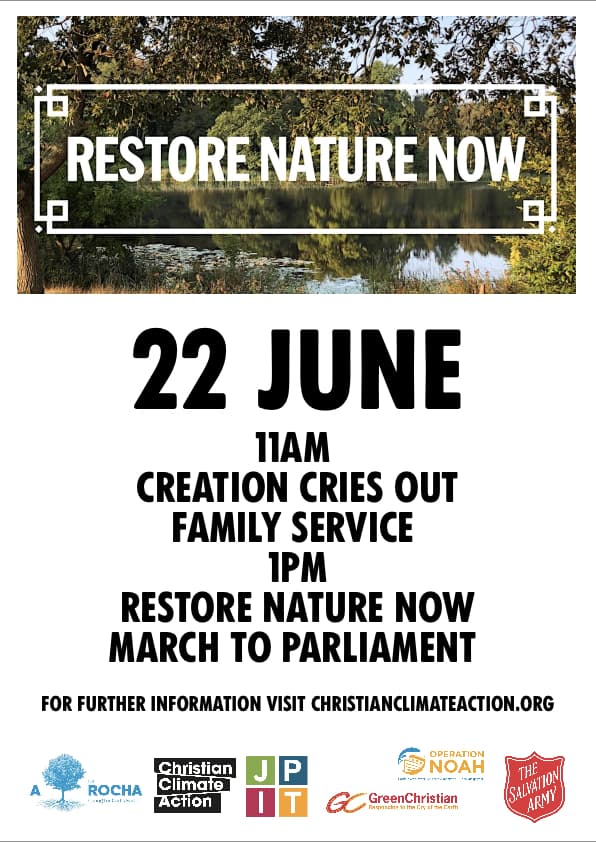
On Saturday, 22 June, we will be participating in the ‘Restore Nature Now’ rally, alongside Chris Packham and thousands of other people from organisations that care for and protect our natural world. Before the rally, we are hosting an Ecumenical Service – ‘Creation Cries Out’ – at Farm Street Church at 11.00am, with participation from a wide range of Christian charities and activists. Please come along and join us! Nature Rally
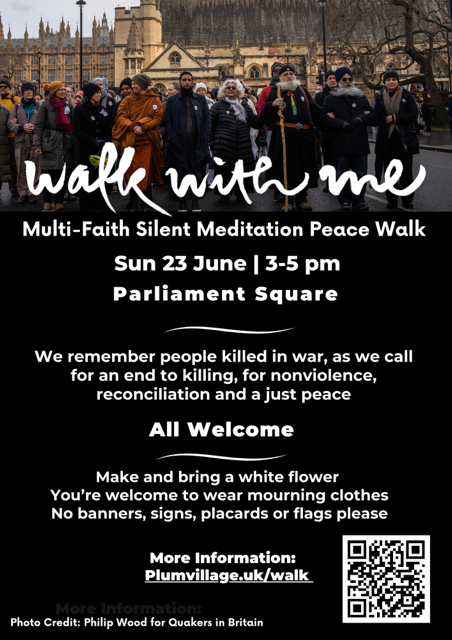
On Sunday, 23 June, we are joining a Multi-Faith Silent Meditation Walk for Peace. Every day on our screens we see reports of the horrors of war. We want to show our commitment to a more peaceful world by uniting in this visible coming together of people from many different faith communities. Join us in Parliament Square and be part of a multi-faith movement. Peace Walk
This weekend also sees the conclusion to Refugee Week, 17-23 June 2024. This is an important time for showing our solidarity with all those who come to the UK seeking sanctuary from war and violence. Refugee Week
Creation Cries Out – Ecumenical Service: 11am, Catholic Church of the Immaculate Conception (Farm Street Church), 114 Mount St, Mayfair, London, W1K 3AH. Includes children’s outdoor nature-based church.
You are invited to join us for the biggest ever march to protect the natural world and tackle the climate emergency. Westminster Justice & Peace will be gathering with thousands of others in London for a family-friendly, legal march to demand that UK politicians show strong domestic and global nature and climate leadership.
Why are we marching?
Creation is in crisis. Nature in the UK is in long-term decline and without radical change we’re set to lose even more precious habitats and species. That is why we’re joining a coalition of nature and climate organisations at a mass demonstration calling on politicians from all parties to act now for nature, people and climate.
The vision is for a huge creative, family-friendly and legal mass gathering with Chris Packham and other nature defenders in a united call to protect and restore our natural world.
It is an opportunity for some creative campaigning with speeches from activists and conservationists, as well as entertainers and performance artists, all highlighting the beauty of UK wildlife and the need to protect it.
Creation Cries Out Service
We’ll be meeting at 11am for a ecumenical service with nature-based messy church for children at the Catholic Church of the Immaculate Conception, 114 Mount St, Mayfair, London W1K 3AH before leaving together to join the main march at noon. The Creation Cries Out service is a collaboration between A Rocha UK, Green Christian, Christian Climate Action, and Operation Noah and other groups.
Join us to add your voice to the call to halt biodiversity decline and stabilise our climate for the benefit of all future generations.
Restore Nature Now March and Rally
After the service we will join the Restore Nature Now mass demonstration.
Through Restore Nature Now a wide-range of dozens of nature, wildlife and climate groups from the RSPB to Butterfly Conservation and Woodland Trust are joining together, united in calls for politicians to support action to restore nature by:
Providing more funding to ensure a nature-friendly farming approach
Making polluters pay for the damage they do to the environment
Creating more space for nature by expanding and improving protected areas and public land
Putting a legal right to a healthy environment in law – clean air and water and access to nature for all communities
Delivering fair and effective climate action that means we at least halve UK emissions by 2030.
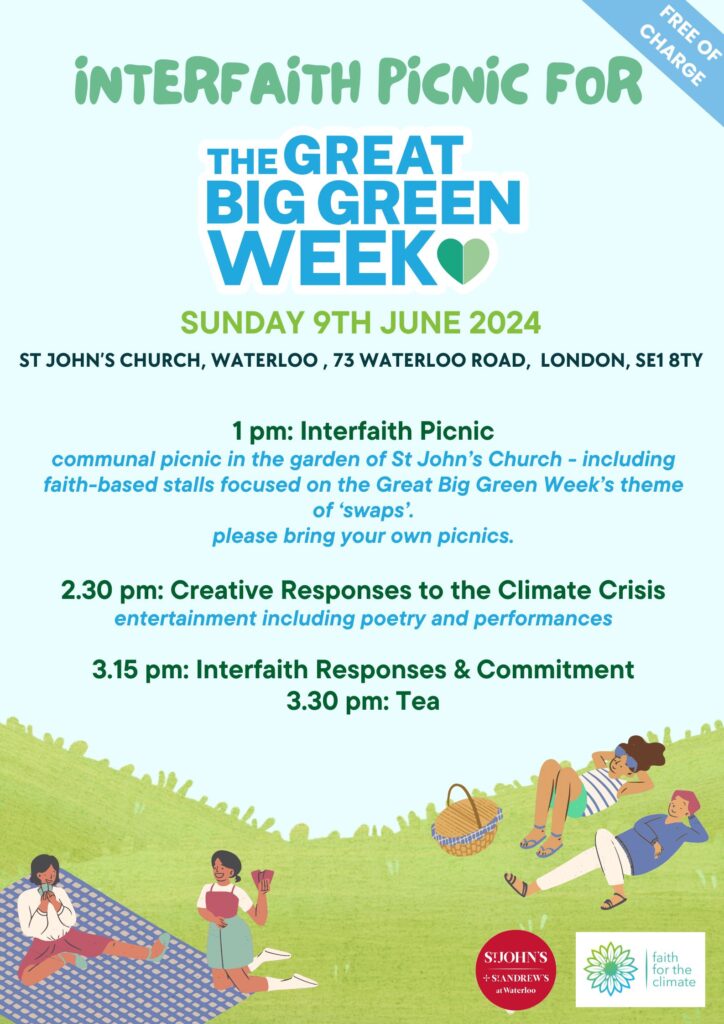
Join us on Sunday, 9 June, at St John’s in Waterloo, London, from 1 pm – 4 pm, to kick off the Great Big Green Week. Featuring face-painting, a treasure hunt, recycling rounders, a butterfly puzzle, clothes & toy swap stalls, music, dance, a photo exhibition, and more. Bring a plant-based picnic to share!
Do you want to know what “climate justice” means? Are you keen to find out how a justice-centered approach addresses the climate crisis? Are you looking for a welcoming space where you can bring your unique spiritual and/or religious motivations to tackle the climate emergency? If you’re based in the UK, these workshops are designed to help you address these questions and be part of a community of action.





 Diocese of Westminster Justice and Peace Commission