NJPN Conference 2025: Report by Therese Xu

Speakers Sr MaryAnne Francalanza FCJ and Sr Katrina Alton CSJP

A little over a month ago, representatives from the Westminster Justice and Peace Commission attended the annual National Justice and Peace Network (NJPN) Conference, 25-27 July 2025, at The Hayes, Conference Centre, Swanwick, Derbyshire. Two young adults from the Diocese received sponsored places to attend the Conference and recorded their impressions of the event.

The second report is by Therese (Xinnan) Xu, a postgraduate student at Imperial College, London

Peace-building Among People Like You and Me — A Narrative from the 47th Annual NJPN Conference

The 47th Annual Conference of the National Justice and Peace Network successfully commenced from Friday 25 July to Sunday 27 July 2025 at the scenic Hayes Christian Conference Centre in Swanwick, Derbyshire. Exciting discussions on contemporary topics of peace-building and conflict resolution took place, with more than 20 Christian and Catholic organisations such as Caritas, CAFOD, CHIPS, and Pax Christi participating alongside approximately 160 attendees from political, non-governmental, and charity backgrounds.

What is peacebuilding in a world that is becoming increasingly polarised, where national security is measured by war-readiness and military forces, and what is the responsibility of us Catholics? Sister MaryAnne from the FCJ Sisters in London and Sr Katrina Alton of the Congregation of the Sisters of St Joseph of Peace shared insights on gospel nonviolence in the opening talk on Friday, 25 July 2025.

Remembering childhood experiences of being normalised to body searches when entering public spaces in Northern Ireland, Sr Katrina reminded the audience that Jesus offers a third way where violence has become the “daily bread” for many communities. To truly see and respect someone in the likeness and image of God means abandoning military force — to “put down your sword.” She further emphasised the position of many non-violent church workers as “swimming against the waves” and opposed the contemporary governmental claim to “prepare for war, pray for peace.” She explained that in order to consciously reject violence and injustice, and to truly establish God’s kingdom on earth, community and prayer are two essential elements. “Whatever is breaking your heart is breaking God’s heart also.” She encouraged the audience to ask themselves what breaks their hearts, further emphasising the importance of community: “Connect to others—it doesn’t just depend on you.”

On Saturday 26 July 2025, workshops on climate justice, community-building, poverty, nuclear morality, LGBT+ issues, and non-violence commenced after an engaging morning panel discussion. The panel featured James Trewby, the Columban’s Justice, Peace and Ecology Coordinator and Education Worker; Andrew Jackson, Chief Executive of Pax Christi; George White, a transgender Catholic Religious Education teacher; Bokani Tshidzu, Artist and Creative Director of ART BY BOKANI LIMITED and Campaign Officer at Operation Noah; as well as Sister Katrina.

Bokani shared her story of immigrating from Zimbabwe to Britain after surviving AIDS, receiving “freedom, but not full freedom” as she saw more clearly following George Floyd’s death in 2020 and the Black Lives Matter movement. In many ways people received political freedom, but ecologically, the rights of the next generation of Britons remain largely constrained. Now, as a London-based multimedia artist and activist at Operation Noah working on climate action, she proclaimed that it’s important to understand “we’re the ones we’ve been waiting for” to take proactive steps toward change.

Concerning LGBT+ non-violence and inclusion, George gave a graceful response to James’ account of not walking away from hateful speech against the community at an event. He explained that silent opposition such as walking out of a conference may not have an effective impact on the speaker or audience when one disagrees with their views. Active change can only be demonstrated through dialogue and consistent conversation. When asked how to make peace with a church that rejects him, George answered, “Forgiveness. We need to understand that people don’t always make the right choices.” He encouraged people within the LGBT+ community to embrace their identities as beloved individuals of God: “You don’t have to worship where you are not wanted,” he declared. “We need processes for dialogue.”

Joanna Frew, Outreach Coordinator for the Rethinking Security Network, concluded the conference on 27 July 2025 by redefining national security. She highlighted England’s unique challenges in achieving just national security due to its imperial legacy, arms industry and military sales, possession of nuclear weapons, political interventionism following US examples, network of tax havens, and high carbon emissions. She also challenged the audience with difficult questions about what truly guarantees our security, and whether security can be found in power projection and dominance.

Imperialism may have shaped an unjust world system in which many of us live and from which we benefit. After the pandemic in 2020, the global situation has become turbulent, triggered by local unrest and conflicts including Russia-Ukraine and Israel-Palestine, and peace — among the dealings of great powers and the miscellany of global organisations — seems to have been reduced to a concept used as slogan and propaganda. It is therefore increasingly important, especially for those living in the global north who potentially profit from the pain and suffering of other regions, to consciously object to injustices within the system and to constantly “choose inclusion over isolation”. “Seek ye first his kingdom, and the rest will be given to you.” The peace-building faith-based organisations, strongly supported by faithful members and volunteers, are making changes to each individual starfish on the immense sandy beach.

Amidst vast pain and injustice, much that breaks human hearts — whether climate change, people losing their homes, drug abuse, war, and violence, there seems to be very little we can do. But just like all the organisations present at the conference, and like little people, each of us who survive and thrive in this global village, we are allowed to be afraid and encouraged to be hopeful. Perhaps the best question to ask ourselves now is: what breaks your heart?

Therese (Xinnan) Xu
National Justice and Peace Network

NJPN Conference 2025: Report by Alannah Travers

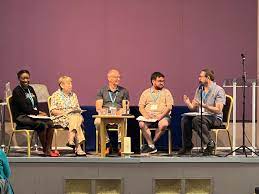
Panel with Bokani Tzidzu, Sr Katrina Alton CSJP, Andrew Jackson, George White and James Trewby

A little over a month ago, representatives from the Westminster Justice and Peace Commission attended the annual National Justice and Peace Network (NJPN) Conference, 25-27 July 2025, at The Hayes Conference Centre, Swanwick, Derbyshire. Two young adults from the Diocese received sponsored places to attend the Conference and recorded their impressions of the event.

The first report is by Alannah Travers, a postgraduate student at SOAS University

NJPN Conference 2025: Towards a Just Peace and challenging the inevitability of violence

   I was delighted to attend the 2025 National Justice and Peace Network (NJPN) Conference, held from 25–27 July at The Hayes Conference Centre, Derbyshire. This year’s theme, “Towards a Just Peace: Challenging the Inevitability of Violence”, deeply connected with my own postgraduate research at SOAS University of London, where I study international humanitarian and human rights law with a focus on justice and accountability in post-conflict societies.

   My place at the conference was generously funded through the Westminster Justice and Peace Commission’s initiative offering free places to young adults aged 18–35. I learned about the opportunity from Father Oscar Ardila, Catholic Chaplain at SOAS, whose encouragement I remain grateful for. As someone long interested in the intersection of peace, justice, and international law – especially in contexts such as Iraq – I was drawn to the conference’s commitment to confronting structures of violence and reimagining what peace might look like.

   Throughout the weekend, I joined over 160 participants, including representatives from 17 dioceses, religious orders, Catholic agencies, and peace organisations, engaged in dialogue, worship, workshops, and collective action. Saturday’s powerful panel chaired by James Trewby (Columbans), with speakers including Andrew Jackson (Pax Christi) and Bokani Tshidzu (Operation Noah) challenged us to link spiritual non-violence to climate justice and community activism. The call to confront racialised climate injustice stood out as particularly urgent.

   Another highlight was the contribution of Dr Joanna Frew from Rethinking Security, whom I have had the privilege of learning from in the past. I was grateful to attend her workshop, “A Just Peace After Empire?” held in a personal capacity. On Sunday she spoke on redefining “security” through cooperation, sustainability, and care, insisting that there is no security without a viable planet. As a Genocide is being committed in Gaza, Dr Frew’s call to move away from militarised logics of safety towards Gospel-rooted visions of peace felt especially timely this weekend.

   The collective action component of the conference was also appreciated. Participants gathered for a symbolic “Red Line for Gaza” protest, condemning the systematic targeting and starvation of Palestinian civilians and calling on world leaders to uphold international law and human dignity. The visual display of solidarity, alongside prayers, petitions, and personal testimonies, demonstrated many participants’ holistic and spiritual approach to peace-making.

   The weekend ended with an invitation to live out this year’s Jubilee theme as “pilgrims of hope.” I left feeling spiritually and intellectually renewed, grateful for the community of justice-seekers and the opportunity to reflect deeply on how I might integrate these values into both my academic work and wider life. I want to extend my sincere thanks to the Westminster Justice and Peace Commission, the NJPN team, and Father Oscar for supporting my participation. 

Alannah Travers

Jubilee of Justice 20 September 2025 – Join the Westminster Justice and Peace Delegation in Rome

Would you like to join the Westminster Justice and Peace Pilgrimage to Rome from 19-22 September?

We are taking a small delegation of 10 people to Rome to take part in the Jubilee of Justice on Saturday 20 September 2025. There are a few places still available.

We will be staying at Villa Lante Center, a property belonging to the Sacred Heart Sisters and located in the heart of Trastevere, near the Vatican City. Activities will include a Pilgrimage to the Holy Door, Catechesis with Pope Leo XIV and meeting other Jubilee of Justice participants from around the world.

The cost for 3 nights bed & breakfast is £220

Participants are invited to make their own travel arrangements but we can give you advice on travelling together with other pilgrims.

Please contact Fr Dominic Robinson dominicrobinson@rcdow.org.uk if you are interested in joining us.

This pilgrimage may be of particular interest to anyone working in a legal profession, social justice charities or parish volunteers with a heart for justice. People from other Dioceses are welcome to join us!

Jubilee of Justice

Remember Hiroshima and Nagasaki – Marking 80th Anniversary on 6 & 9 August 2025

This August it will be 80 years since the atom bombs were dropped on the Japanese cities of Hiroshima and Nagaski, killing as many as 200,000 people instantly and leaving many others to suffer from radiation sickness and forms of cancer for years afterwards.

The threat that these weapons will one day be used again still hangs over the world today. Catholic international peace charity, Pax Christi, organises prayers and vigils every year to recall the suffering of survivors and those who died and to work towards a world where these weapons are no longer necessary.

Pax Christi Vigils outside Westminster Cathedral

6 August, 11.00am-1.00pm: 80th Anniversary of the Bombing of Hiroshima

9 August, 11.00am-1.00pm: 80th Anniversary of the Bombing of Nagasaki

Blessed Franz Jägerstätter Service

9 August, 5.00-6.00pm: Pax Christi Franz Jägerstätter Service – Westminster Cathedral Crypt

Remembering the witness of Austrian farmer and conscientious objector, Blessed Franz Jägerstätter, who refused to serve in the in the Nazi army and was executed on 9 August 1943. https://paxchristi.org.uk/resources/peace-people-2/blessed-franz-jagerstatter/

Hiroshima and Nagasaki Memorial Service at Battersea Peace Pagoda

This service on 9th August is followed by an Interfaith Walk to Battersea Peace Pagoda for the annual Hiroshima and Nagasaki Memorial Service.

All are welcome to join us on the walk or at the Pagoda.

For more details visit https://paxchristi.org.uk/calendar/

Brother Johannes Maertens – Reflection at the Home Office Vigil, Monday 21st July 2025

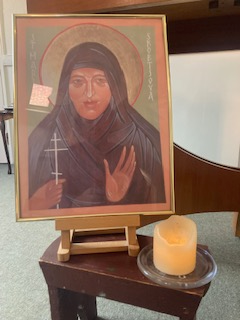
Mother Maria Skobtsova

Brother Johannes Maertens gave the following reflection at the Vigil for Migrants outside the Home Office on 21 July 2025:

Reading: Luke 10:25–37 The Parable of the Good Samaritan

This year marks 80 years since the death of Mother Maria Skobtsova. The Church Times recently referred to her as an “eccentric, chain-smoking poet, monastic, and martyr” “whose theology—grounded in the dual command to love both God and neighbour”—remains startlingly relevant. And perhaps more urgently needed than ever.

In recent years, certain voices—some from pulpits, some from platforms of global influence—have begun to portray empathy as a liability. In 2018, an American pastor published a book titled The Sin of Empathy, describing compassion as potentially morally dangerous. Others have called mercy weak. More recently, tech billionaire Elon Musk described empathy as the “fundamental weakness of Western civilisation,” even criticising Germany’s funding of refugee rescue efforts in the Mediterranean. In response, Germany’s Foreign Office simply said: “Yes. And it’s called saving lives.”

Compassion, empathy… What most of us would consider a fundamental strength—a binding force in our cultures—is now labeled a threat by those in power. And these are not random comments. They are part of a wider push to redefine the moral imagination of society.

But contrast that with the Gospel— and our Gospel reading today —and the very life of Mother Maria Skobtsova.

The parable of the Good Samaritan reframes what it means to be a neighbour—not by nationality, proximity, or religious allegiance, but by mercy. “Who was neighbour to the man?” Jesus asks. And the answer is clear: “The one who showed him compassion.” Jesus, doesn’t answer the question “Who is your neighbour” – he tells you more how you would hope your neighbour is – and then Jesus says: “Go and do likewise.”

This command sits at the heart of Mother Maria Skobtsova’s radical theology. What she called “the sacrament of the brother.” She wrote: “Give from the heart, since each person is the very icon of God incarnate in the world.”

Let that sink in. Every human being—no matter how broken or marginalised—is an icon of Christ. For Mother Skobtsova, every encounter with another person becomes a kind of opportunity to be liturgy. She imagined the whole world as one altar. And to this altar, we offer not only bread and wine, but our hearts—so that they might be transformed into Christ’s love. A “kenotic love”—a love that empties itself.

In this vision, compassion is not weakness. It is sacrament.
Mercy is not naive. It is resurrection.

She didn’t separate the altar from the street, the Eucharist from the soup kitchen, or the refugee-boats from the chalice. She saw Christ there—broken, waiting—and she responded.

When the Nazis invaded Paris, Mother Maria didn’t ask whether hiding Jewish children was politically wise. She saw the face of Christ and acted. And it cost her everything, she died in the Ravenbrouck concentration camp, where she was gazed to death around Easter 1945.

So we must ask: what do we see today?

Across the Mediterranean, in the English Channel, across borders, people are crossing treacherous waters in small inflatable boats. Fleeing war, persecution, and poverty. They too lie wounded along the road to Jericho. And we—we are the passers-by. The priests. The Levites.

We scroll past their faces. Hear their statistics. Debate their fate. But the Gospel doesn’t ask who deserves to be saved.
It asks: Who will show compassion?

To offer mercy is to meet Christ.
To bind a wound is to celebrate Eucharist.
To open a door is to open heaven.
This is not sentimental. It is spiritual courage.

So when we see a migrant in crisis, a stranger at the door, an outcast in pain—we must not pass by. We must be moved with compassion. Not because it’s trendy, or convenient. But because Christ is there.

Broken. Waiting.

And that is why we stand here today.
In prayer. In solidarity.
And in hope—for a more compassionate future, together.

Amen.

“But if at the center of the Church’s life there is this self-giving Eucharistic love, then where are the Church’s boundaries, where is the periphery of this center? Here it is possible to speak of the whole of Christianity as an eternal offering of a Divine Liturgy beyond church walls … It means that we must offer the bloodless sacrifice, the sacrifice of self-surrendering love not only in a specific place, upon the altar of a particular temple; the whole world becomes the single altar of a single temple, and for this universal liturgy we must offer our hearts, like bread and wine, in order that they may be transformed into Christ’s love, that he may be born in them, that they may become “God-manly” hearts, and that He may give these hearts of ours as food for the world…” ” (Mother Maria Skobtsova, Selected Writings, ed. Jim Forest, Chapter on Types of Monasticism, page 185)

Service Sheet

9 July 2025 – Report from the Mass Lobby of Parliament for the Climate

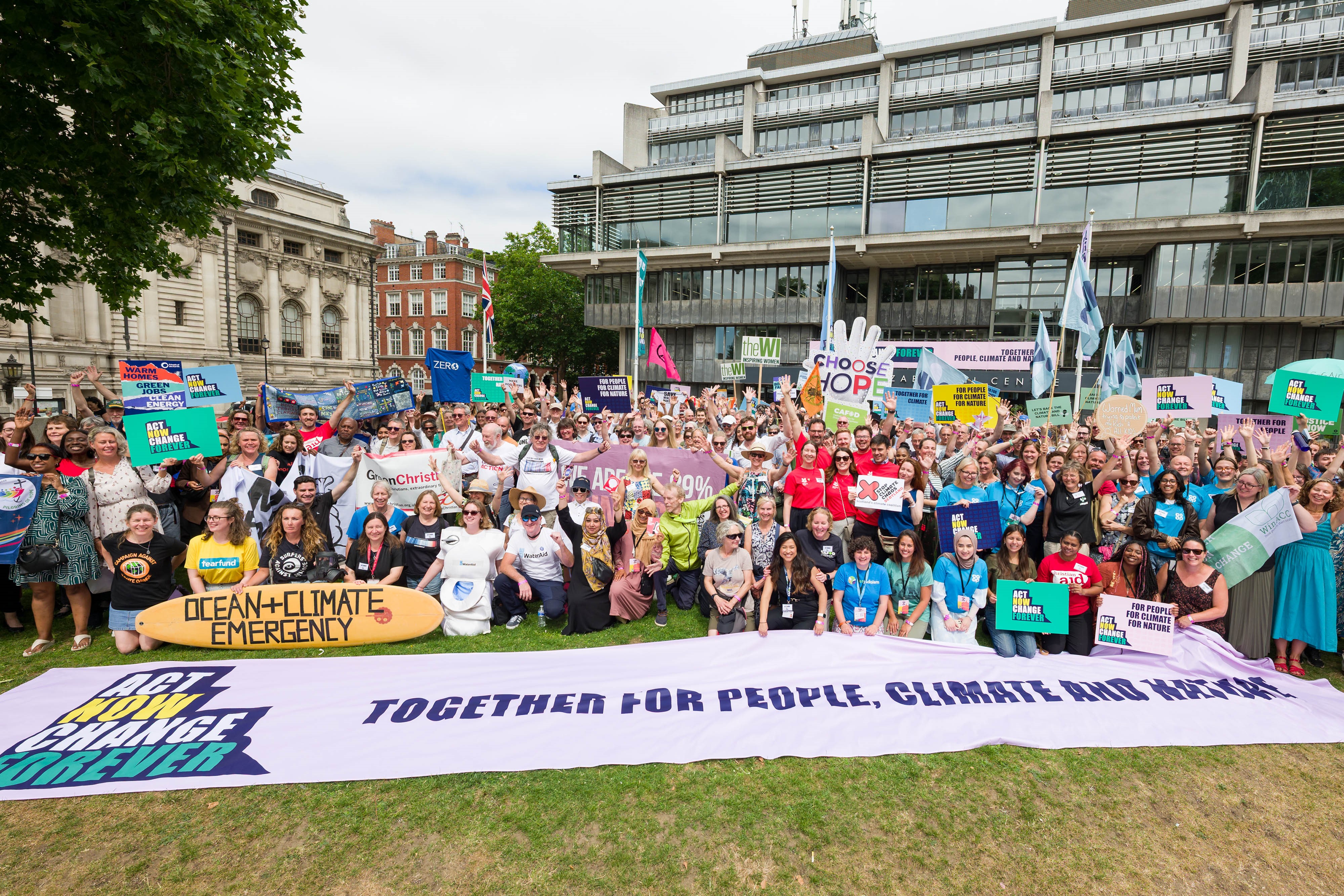
Mass Lobby of Parliament participants outside the QEII Centre, London

On Wednesday 9 July 2025, around 5,000 people came together in Westminster for the Act Now, Change Forever Mass Lobby. We called on MPs to act now for a healthier, fairer, safer future, in one of the biggest moments for climate and nature this year, and the largest mass lobby of the decade. 

People from across the UK travelled, far and wide to speak directly to their MPs. From schoolchildren to surfers, parents to pensioners, campaigners to conservationists, the diversity and strength of the movement was impossible to ignore.

For the Catholic community, CAFOD supporters were present in great numbers. Colette Joyce, the Westminster Justice and Peace Co-ordinator, spent the day on the Faith for the Climate stall in the QEII Centre.

“There was a constant stream of visitors to the stall all day,” she said. “It was fantastic to meet people from all over the country, of all faiths and none, who were glad to see us there and keen to find out how faith groups are contributing to the climate, nature and debt movements.”

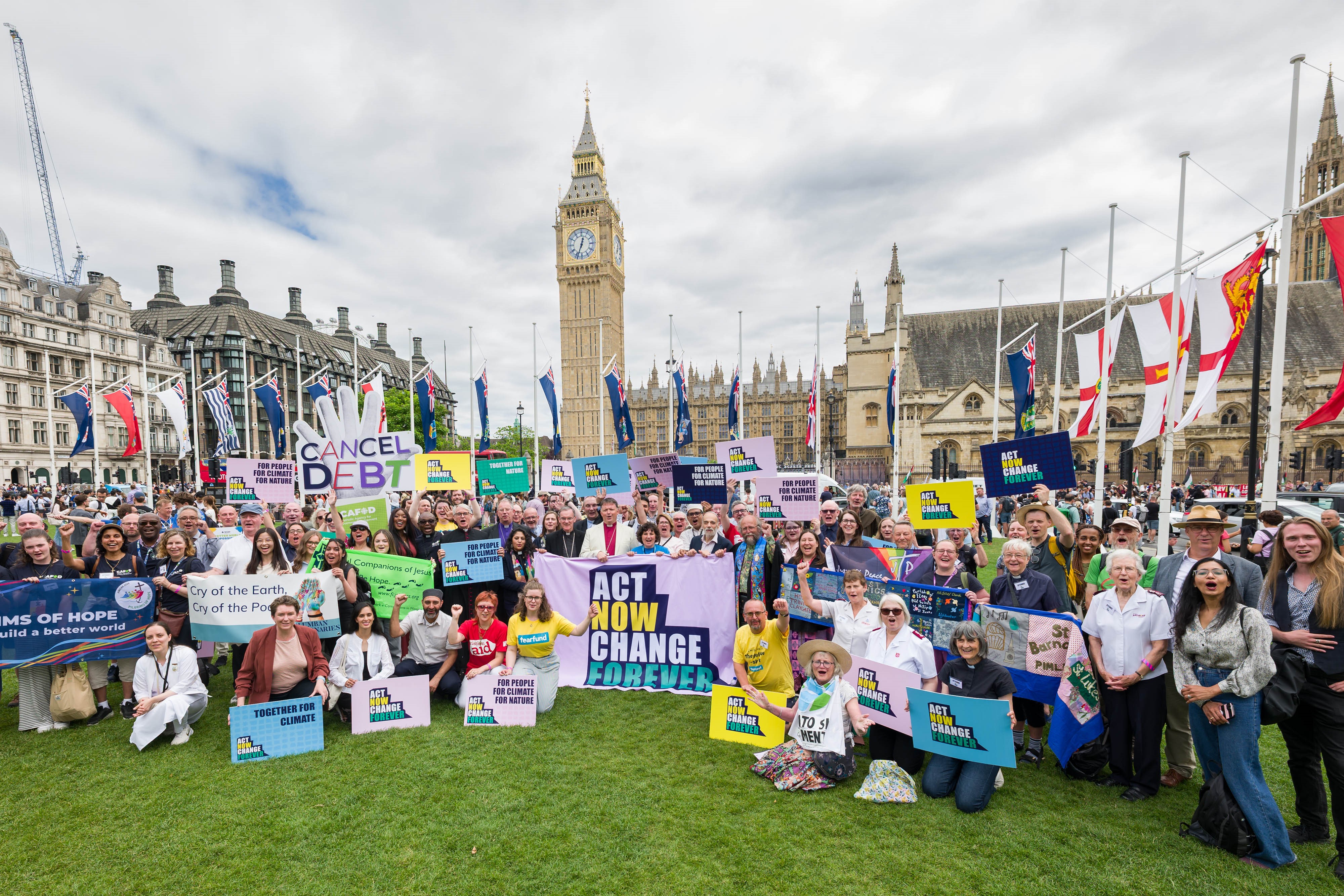
A photo of faith groups was taken in Parliament Square

Mass Lobby of Parliament 9 July 2025 – Faith Groups in Parliament Square

The Mass Lobby with its Act Now, Change Forever message was a powerful reminder of what’s possible when we show up – together, side by side – to demonstrate the overwhelming public support for action on climate and nature.

Together, we brought our MPs an unmissable message: communities across the UK are ready for bold, practical action on climate and nature – and we won’t stop here. We’re just getting started.

The Climate Coalition

Faith for the Climate – Report and pictures from the day by Jon Chew

CAFOD Campaigns – Includes text of talk by Fr Charlie Chilufya SJ 

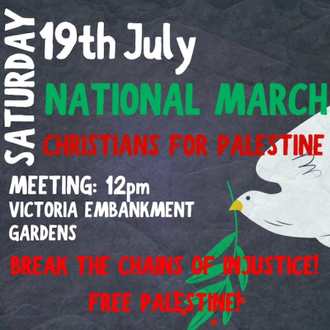
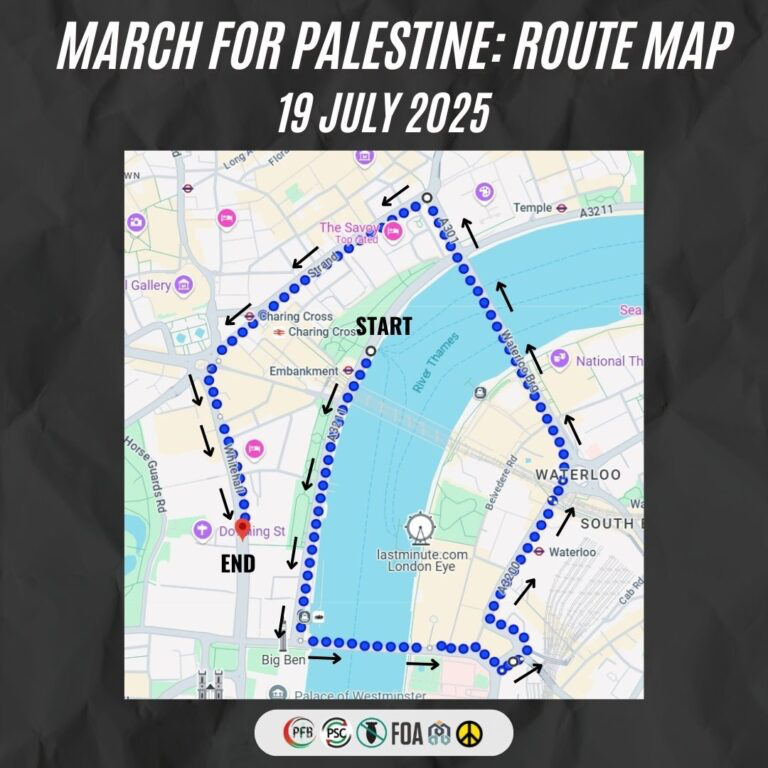
19 July 2025, 12.00 noon, Join Christians for Palestine at the National March

Westminster Justice and Peace will be among Christians from many different churches gathering at 12pm this Saturday, 19th July 2025, at Victoria Embankment Gardens to join the latest National March for Palestine in London.

Contact Colette Joyce, Westminster Justice and Peace Co-ordinator if you are interested in joining her –

Email: colettejoyce@rcdow.org.uk / Mobile: 07593 434905

More than 84,000 people are known to have died in Gaza since October 2023. Thousands more are missing under the rubble. There are tens of thousands of child amputees. Meanwhile on the West Bank there have been more and violent attacks by illegal Israel settlers on peaceful Palestinian communities – with over a thousand deaths.

Christians For Palestine say: “Speak out for those who cannot speak, for the rights of all the destitute” (Proverbs 31:8). Break the chains of injustice! End the Apartheid! Free Palestine!”

Pax Christi are joining the National March for Palestine as it passes through Waterloo. Meet outside St. John’s Church, 73 Waterloo Road, London, SE1 8TY if you would like to join at this point. Contact info@paxchristi.org.uk

LINKS

To receive future updates on all actions with Christians for Palestine join their mailing list
email: ChristiansForPalestineUK@gmail.com

Christians for Palestine Facebook Page: www.facebook.com/profile.php?id=61555041637853

Pax Christi England and Wales: https://paxchristi.org.uk

Jesuit Missions hold vigil for Fr Stan Swamy SJ outside Indian High Commission

The campaign to clear the name of the late Jesuit priest Fr Stan Swamy continued with a vigil outside the Indian High Commission in London. Peaceful protestors gathered in front of India House, in Aldwych, on Friday, 11 July 2025, where they stood silently with placards calling for Fr Stan to be exonerated.

Fr Stan spent most of his life defending the rights of vulnerable communities in India, including Adivasi (indigenous tribal) and Dalit (low caste) people.

He was arrested by Indian authorities in October 2020 under controversial anti-terror laws for his alleged involvement in violence surrounding protests in 2018 in the village of Bhima Koregaon.

Suffering from Parkinson’s disease, he was kept in appalling conditions in prison and died as a result in July 2021, aged 84.

The demonstration, which was arranged by international development organisation Jesuit Missions, included prayers and readings on the theme of justice.

Paul Chitnis, Director of Jesuit Missions, attempted to hand over a box of cards signed in memory of Fr Stan at the end of the vigil, but this was refused by the High Commission staff.

Speaking at the vigil, Mr Chitnis said: “We continue to voice our call for Fr Stan’s name to be cleared, refusing to forget him and his legacy of working for the marginalised. Jesuits across the world and their supporters want the Indian Government to officially declare his innocence. We are also calling for due process for others arrested on similar charges, some of whom have been in pre-trial detention for years.”

In December 2022, Massachusetts-based digital forensics firm Arsenal Consulting reported the results of its investigation into the evidence which had led to Fr Swamy’s arrest and imprisonment. The report concluded that Fr Stan was systematically targeted in a cyber campaign over a four-year period during which time falsified evidence was planted on his computer.

LINK

Jesuit Missions: https://jesuitmissions.org.uk/

12 July 2025 – Memorial Service for Victims of Knife Crime at Tollington Park

Outside St Mellitus, Tollington Park

By Valerie Flessati

Victims of knife crime in London were remembered at a memorial event held at St Mellitus Church, Tollington Park, in north London on Saturday 12 July. Fifty names were read out, and candles lit in memory of those young people: all under 30, many of them teens, of all ethnicities, and all leaving grief-stricken family and friends to cope with such devastating and senseless violence. Fifty, representing hundreds across London, murdered in recent years.

Parishioners of St Mellitus church, including some bereaved parents, were joined by leaders of the Finsbury Park Mosque, and Wightman Road Mosque, politicians, and partner organisations such as Caritas Westminster.

Sandra Campbell, CEO of Word 4 Weapons, described being a parent as ‘the hardest job in the world’, and identified with the difficulty of making choices which would best protect their children. Her charity installed (and empties regularly) a weapons disposal bin on the forecourt at St Mellitus. Word 4 Weapons has helped to remove tens of thousands of weapons from circulation, and is receiving an unprecedented number of new requests for bins from all over the country.

Speakers focussed on practical responses to knife crime, honouring the victims’ memory ‘not just with silence, but with purpose’ – as Islington Councillor Anjna Khurana put it. Islington Council ‘has been involved in the introduction of knife bins, “No Knife Shops” policies, and trauma-informed approaches to prevention and rehabilitation’. The Council supports local initiatives like the Targeted Youth Support service, parenting programmes, and the Ben Kinsella Trust, which offer young people positive alternatives and hope.

‘There’s lots for me to do as Member of Parliament, and there’s lots for us to do as a community,’ said Catherine West, MP for Hornsey and Friern Barnet. At a recent meeting with knife crime specialists from the Metropolitan Police, her team had learned details about the glamorisation of knives online, how knives are sourced through online platforms, and about illegal knives getting into the UK through false shipping declarations.

A previous commitment kept Jeremy Corbyn, MP for Islington North, from attending the commemoration, but he sent a strong message to the gathering. ‘Essentially, we can only defeat knife crime through education, understanding, and a sense of community that makes sure that all young people have purposeful activities and options available to them in the crucial hours after school each day and during their free time.’

All the guest speakers concurred. Tackling knife crime requires a multi-faceted approach, including remedial actions, legislation and policing, but fundamentally a shift away from our violent culture. ‘As a community, we all must play our part to foster a culture of respect and nonviolence,’ said Councillor Khurana.

In this process the Church has deep truths to offer, as outlined during the Mass celebrated earlier for all victims of violence in London. ‘Anything that happens to any of us affects all of us… How do I live, in the world, that interconnectedness?’ asked Spiritan Father Pascal, as he viewed the day’s ceremony in the context of opposing all forms of violence and choosing life. ‘We all stand for life; we stand in solidarity with one another with an act of respect to human life and dignity. That is the cry, the longing and hope of our shared humanity.’

LINKS

Caritas Westminster – www.caritaswestminster.org.uk/

Word4Weapons – www.word4weapons.co.uk/

28 July 2025, 12.30pm: Westminster Justice and Peace to join Christian Service for Remembrance for the Gazan Dead

A Christian service of remembrance for those who have died during the war in Gaza will be held at the Foreign Office in King Charles Street, London, SW1A 2AH, on Monday, 28 July, from 12.30pm -1.30pm

During our prayer, we will read out some of the names from a list of 50,000 people who are known to have died so far in Gaza, (many thousands more are missing under the rubble) – a name for each 28th day of the month since the war started.

The killings of so many are not just statistics. They are individuals with faces and names. The families of many have not been able to honour their dead with dignity. In a token way, through this short service, we try to honour them by telling some of their stories.

Organisations coming together to pray include the following: Westminster Justice and Peace, The London Catholic Worker, Pax Christi.

For further information contact Barbara Kentish homeofficevigil@gmail.com