NJPN Conference 2025: Report by Therese Xu

Speakers Sr MaryAnne Francalanza FCJ and Sr Katrina Alton CSJP

A little over a month ago, representatives from the Westminster Justice and Peace Commission attended the annual National Justice and Peace Network (NJPN) Conference, 25-27 July 2025, at The Hayes, Conference Centre, Swanwick, Derbyshire. Two young adults from the Diocese received sponsored places to attend the Conference and recorded their impressions of the event.

The second report is by Therese (Xinnan) Xu, a postgraduate student at Imperial College, London

Peace-building Among People Like You and Me — A Narrative from the 47th Annual NJPN Conference

The 47th Annual Conference of the National Justice and Peace Network successfully commenced from Friday 25 July to Sunday 27 July 2025 at the scenic Hayes Christian Conference Centre in Swanwick, Derbyshire. Exciting discussions on contemporary topics of peace-building and conflict resolution took place, with more than 20 Christian and Catholic organisations such as Caritas, CAFOD, CHIPS, and Pax Christi participating alongside approximately 160 attendees from political, non-governmental, and charity backgrounds.

What is peacebuilding in a world that is becoming increasingly polarised, where national security is measured by war-readiness and military forces, and what is the responsibility of us Catholics? Sister MaryAnne from the FCJ Sisters in London and Sr Katrina Alton of the Congregation of the Sisters of St Joseph of Peace shared insights on gospel nonviolence in the opening talk on Friday, 25 July 2025.

Remembering childhood experiences of being normalised to body searches when entering public spaces in Northern Ireland, Sr Katrina reminded the audience that Jesus offers a third way where violence has become the “daily bread” for many communities. To truly see and respect someone in the likeness and image of God means abandoning military force — to “put down your sword.” She further emphasised the position of many non-violent church workers as “swimming against the waves” and opposed the contemporary governmental claim to “prepare for war, pray for peace.” She explained that in order to consciously reject violence and injustice, and to truly establish God’s kingdom on earth, community and prayer are two essential elements. “Whatever is breaking your heart is breaking God’s heart also.” She encouraged the audience to ask themselves what breaks their hearts, further emphasising the importance of community: “Connect to others—it doesn’t just depend on you.”

On Saturday 26 July 2025, workshops on climate justice, community-building, poverty, nuclear morality, LGBT+ issues, and non-violence commenced after an engaging morning panel discussion. The panel featured James Trewby, the Columban’s Justice, Peace and Ecology Coordinator and Education Worker; Andrew Jackson, Chief Executive of Pax Christi; George White, a transgender Catholic Religious Education teacher; Bokani Tshidzu, Artist and Creative Director of ART BY BOKANI LIMITED and Campaign Officer at Operation Noah; as well as Sister Katrina.

Bokani shared her story of immigrating from Zimbabwe to Britain after surviving AIDS, receiving “freedom, but not full freedom” as she saw more clearly following George Floyd’s death in 2020 and the Black Lives Matter movement. In many ways people received political freedom, but ecologically, the rights of the next generation of Britons remain largely constrained. Now, as a London-based multimedia artist and activist at Operation Noah working on climate action, she proclaimed that it’s important to understand “we’re the ones we’ve been waiting for” to take proactive steps toward change.

Concerning LGBT+ non-violence and inclusion, George gave a graceful response to James’ account of not walking away from hateful speech against the community at an event. He explained that silent opposition such as walking out of a conference may not have an effective impact on the speaker or audience when one disagrees with their views. Active change can only be demonstrated through dialogue and consistent conversation. When asked how to make peace with a church that rejects him, George answered, “Forgiveness. We need to understand that people don’t always make the right choices.” He encouraged people within the LGBT+ community to embrace their identities as beloved individuals of God: “You don’t have to worship where you are not wanted,” he declared. “We need processes for dialogue.”

Joanna Frew, Outreach Coordinator for the Rethinking Security Network, concluded the conference on 27 July 2025 by redefining national security. She highlighted England’s unique challenges in achieving just national security due to its imperial legacy, arms industry and military sales, possession of nuclear weapons, political interventionism following US examples, network of tax havens, and high carbon emissions. She also challenged the audience with difficult questions about what truly guarantees our security, and whether security can be found in power projection and dominance.

Imperialism may have shaped an unjust world system in which many of us live and from which we benefit. After the pandemic in 2020, the global situation has become turbulent, triggered by local unrest and conflicts including Russia-Ukraine and Israel-Palestine, and peace — among the dealings of great powers and the miscellany of global organisations — seems to have been reduced to a concept used as slogan and propaganda. It is therefore increasingly important, especially for those living in the global north who potentially profit from the pain and suffering of other regions, to consciously object to injustices within the system and to constantly “choose inclusion over isolation”. “Seek ye first his kingdom, and the rest will be given to you.” The peace-building faith-based organisations, strongly supported by faithful members and volunteers, are making changes to each individual starfish on the immense sandy beach.

Amidst vast pain and injustice, much that breaks human hearts — whether climate change, people losing their homes, drug abuse, war, and violence, there seems to be very little we can do. But just like all the organisations present at the conference, and like little people, each of us who survive and thrive in this global village, we are allowed to be afraid and encouraged to be hopeful. Perhaps the best question to ask ourselves now is: what breaks your heart?

Therese (Xinnan) Xu
National Justice and Peace Network

NJPN Conference 2025: Report by Alannah Travers

Panel with Bokani Tzidzu, Sr Katrina Alton CSJP, Andrew Jackson, George White and James Trewby

A little over a month ago, representatives from the Westminster Justice and Peace Commission attended the annual National Justice and Peace Network (NJPN) Conference, 25-27 July 2025, at The Hayes Conference Centre, Swanwick, Derbyshire. Two young adults from the Diocese received sponsored places to attend the Conference and recorded their impressions of the event.

The first report is by Alannah Travers, a postgraduate student at SOAS University

NJPN Conference 2025: Towards a Just Peace and challenging the inevitability of violence

   I was delighted to attend the 2025 National Justice and Peace Network (NJPN) Conference, held from 25–27 July at The Hayes Conference Centre, Derbyshire. This year’s theme, “Towards a Just Peace: Challenging the Inevitability of Violence”, deeply connected with my own postgraduate research at SOAS University of London, where I study international humanitarian and human rights law with a focus on justice and accountability in post-conflict societies.

   My place at the conference was generously funded through the Westminster Justice and Peace Commission’s initiative offering free places to young adults aged 18–35. I learned about the opportunity from Father Oscar Ardila, Catholic Chaplain at SOAS, whose encouragement I remain grateful for. As someone long interested in the intersection of peace, justice, and international law – especially in contexts such as Iraq – I was drawn to the conference’s commitment to confronting structures of violence and reimagining what peace might look like.

   Throughout the weekend, I joined over 160 participants, including representatives from 17 dioceses, religious orders, Catholic agencies, and peace organisations, engaged in dialogue, worship, workshops, and collective action. Saturday’s powerful panel chaired by James Trewby (Columbans), with speakers including Andrew Jackson (Pax Christi) and Bokani Tshidzu (Operation Noah) challenged us to link spiritual non-violence to climate justice and community activism. The call to confront racialised climate injustice stood out as particularly urgent.

   Another highlight was the contribution of Dr Joanna Frew from Rethinking Security, whom I have had the privilege of learning from in the past. I was grateful to attend her workshop, “A Just Peace After Empire?” held in a personal capacity. On Sunday she spoke on redefining “security” through cooperation, sustainability, and care, insisting that there is no security without a viable planet. As a Genocide is being committed in Gaza, Dr Frew’s call to move away from militarised logics of safety towards Gospel-rooted visions of peace felt especially timely this weekend.

   The collective action component of the conference was also appreciated. Participants gathered for a symbolic “Red Line for Gaza” protest, condemning the systematic targeting and starvation of Palestinian civilians and calling on world leaders to uphold international law and human dignity. The visual display of solidarity, alongside prayers, petitions, and personal testimonies, demonstrated many participants’ holistic and spiritual approach to peace-making.

   The weekend ended with an invitation to live out this year’s Jubilee theme as “pilgrims of hope.” I left feeling spiritually and intellectually renewed, grateful for the community of justice-seekers and the opportunity to reflect deeply on how I might integrate these values into both my academic work and wider life. I want to extend my sincere thanks to the Westminster Justice and Peace Commission, the NJPN team, and Father Oscar for supporting my participation. 

Alannah Travers

Brother Johannes Maertens – Reflection at the Home Office Vigil, Monday 21st July 2025

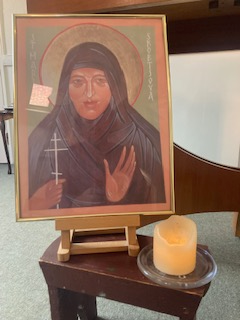
Mother Maria Skobtsova

Brother Johannes Maertens gave the following reflection at the Vigil for Migrants outside the Home Office on 21 July 2025:

Reading: Luke 10:25–37 The Parable of the Good Samaritan

This year marks 80 years since the death of Mother Maria Skobtsova. The Church Times recently referred to her as an “eccentric, chain-smoking poet, monastic, and martyr” “whose theology—grounded in the dual command to love both God and neighbour”—remains startlingly relevant. And perhaps more urgently needed than ever.

In recent years, certain voices—some from pulpits, some from platforms of global influence—have begun to portray empathy as a liability. In 2018, an American pastor published a book titled The Sin of Empathy, describing compassion as potentially morally dangerous. Others have called mercy weak. More recently, tech billionaire Elon Musk described empathy as the “fundamental weakness of Western civilisation,” even criticising Germany’s funding of refugee rescue efforts in the Mediterranean. In response, Germany’s Foreign Office simply said: “Yes. And it’s called saving lives.”

Compassion, empathy… What most of us would consider a fundamental strength—a binding force in our cultures—is now labeled a threat by those in power. And these are not random comments. They are part of a wider push to redefine the moral imagination of society.

But contrast that with the Gospel— and our Gospel reading today —and the very life of Mother Maria Skobtsova.

The parable of the Good Samaritan reframes what it means to be a neighbour—not by nationality, proximity, or religious allegiance, but by mercy. “Who was neighbour to the man?” Jesus asks. And the answer is clear: “The one who showed him compassion.” Jesus, doesn’t answer the question “Who is your neighbour” – he tells you more how you would hope your neighbour is – and then Jesus says: “Go and do likewise.”

This command sits at the heart of Mother Maria Skobtsova’s radical theology. What she called “the sacrament of the brother.” She wrote: “Give from the heart, since each person is the very icon of God incarnate in the world.”

Let that sink in. Every human being—no matter how broken or marginalised—is an icon of Christ. For Mother Skobtsova, every encounter with another person becomes a kind of opportunity to be liturgy. She imagined the whole world as one altar. And to this altar, we offer not only bread and wine, but our hearts—so that they might be transformed into Christ’s love. A “kenotic love”—a love that empties itself.

In this vision, compassion is not weakness. It is sacrament.
Mercy is not naive. It is resurrection.

She didn’t separate the altar from the street, the Eucharist from the soup kitchen, or the refugee-boats from the chalice. She saw Christ there—broken, waiting—and she responded.

When the Nazis invaded Paris, Mother Maria didn’t ask whether hiding Jewish children was politically wise. She saw the face of Christ and acted. And it cost her everything, she died in the Ravenbrouck concentration camp, where she was gazed to death around Easter 1945.

So we must ask: what do we see today?

Across the Mediterranean, in the English Channel, across borders, people are crossing treacherous waters in small inflatable boats. Fleeing war, persecution, and poverty. They too lie wounded along the road to Jericho. And we—we are the passers-by. The priests. The Levites.

We scroll past their faces. Hear their statistics. Debate their fate. But the Gospel doesn’t ask who deserves to be saved.
It asks: Who will show compassion?

To offer mercy is to meet Christ.
To bind a wound is to celebrate Eucharist.
To open a door is to open heaven.
This is not sentimental. It is spiritual courage.

So when we see a migrant in crisis, a stranger at the door, an outcast in pain—we must not pass by. We must be moved with compassion. Not because it’s trendy, or convenient. But because Christ is there.

Broken. Waiting.

And that is why we stand here today.
In prayer. In solidarity.
And in hope—for a more compassionate future, together.

Amen.

“But if at the center of the Church’s life there is this self-giving Eucharistic love, then where are the Church’s boundaries, where is the periphery of this center? Here it is possible to speak of the whole of Christianity as an eternal offering of a Divine Liturgy beyond church walls … It means that we must offer the bloodless sacrifice, the sacrifice of self-surrendering love not only in a specific place, upon the altar of a particular temple; the whole world becomes the single altar of a single temple, and for this universal liturgy we must offer our hearts, like bread and wine, in order that they may be transformed into Christ’s love, that he may be born in them, that they may become “God-manly” hearts, and that He may give these hearts of ours as food for the world…” ” (Mother Maria Skobtsova, Selected Writings, ed. Jim Forest, Chapter on Types of Monasticism, page 185)

Service Sheet

9 July 2025 – Report from the Mass Lobby of Parliament for the Climate

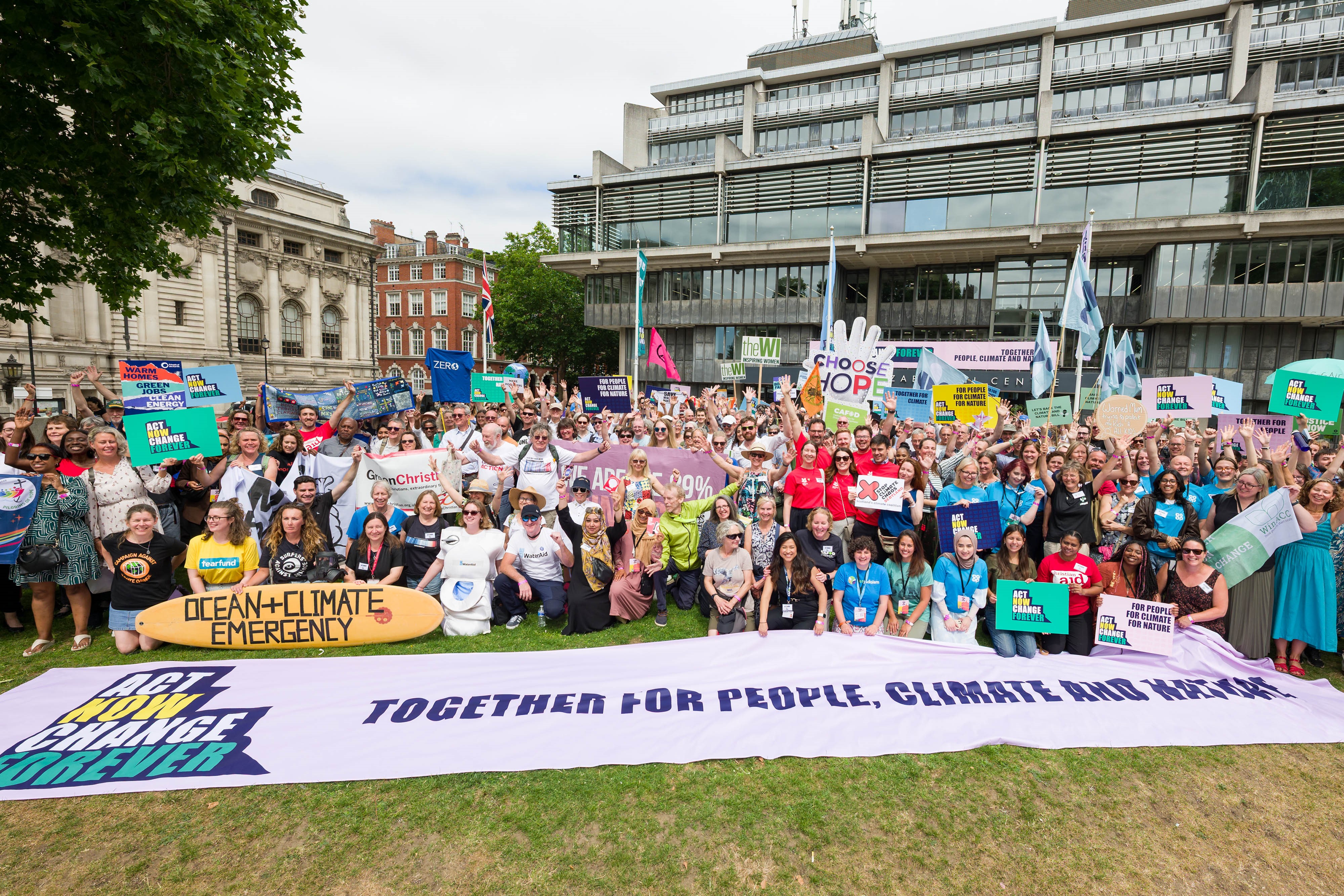
Mass Lobby of Parliament participants outside the QEII Centre, London

On Wednesday 9 July 2025, around 5,000 people came together in Westminster for the Act Now, Change Forever Mass Lobby. We called on MPs to act now for a healthier, fairer, safer future, in one of the biggest moments for climate and nature this year, and the largest mass lobby of the decade. 

People from across the UK travelled, far and wide to speak directly to their MPs. From schoolchildren to surfers, parents to pensioners, campaigners to conservationists, the diversity and strength of the movement was impossible to ignore.

For the Catholic community, CAFOD supporters were present in great numbers. Colette Joyce, the Westminster Justice and Peace Co-ordinator, spent the day on the Faith for the Climate stall in the QEII Centre.

“There was a constant stream of visitors to the stall all day,” she said. “It was fantastic to meet people from all over the country, of all faiths and none, who were glad to see us there and keen to find out how faith groups are contributing to the climate, nature and debt movements.”

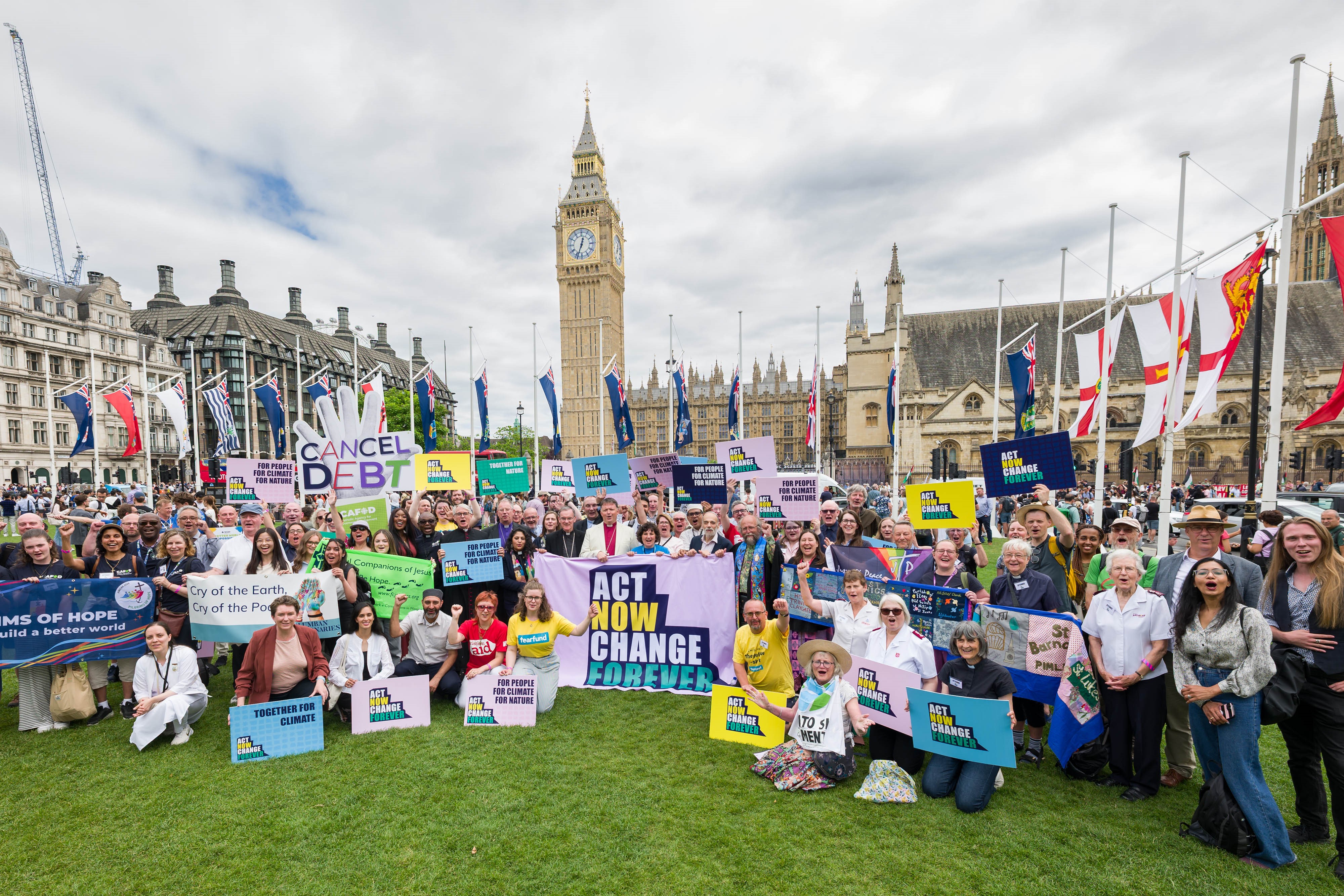
A photo of faith groups was taken in Parliament Square

Mass Lobby of Parliament 9 July 2025 – Faith Groups in Parliament Square

The Mass Lobby with its Act Now, Change Forever message was a powerful reminder of what’s possible when we show up – together, side by side – to demonstrate the overwhelming public support for action on climate and nature.

Together, we brought our MPs an unmissable message: communities across the UK are ready for bold, practical action on climate and nature – and we won’t stop here. We’re just getting started.

The Climate Coalition

Faith for the Climate – Report and pictures from the day by Jon Chew

CAFOD Campaigns – Includes text of talk by Fr Charlie Chilufya SJ 

Jesuit Missions hold vigil for Fr Stan Swamy SJ outside Indian High Commission

The campaign to clear the name of the late Jesuit priest Fr Stan Swamy continued with a vigil outside the Indian High Commission in London. Peaceful protestors gathered in front of India House, in Aldwych, on Friday, 11 July 2025, where they stood silently with placards calling for Fr Stan to be exonerated.

Fr Stan spent most of his life defending the rights of vulnerable communities in India, including Adivasi (indigenous tribal) and Dalit (low caste) people.

He was arrested by Indian authorities in October 2020 under controversial anti-terror laws for his alleged involvement in violence surrounding protests in 2018 in the village of Bhima Koregaon.

Suffering from Parkinson’s disease, he was kept in appalling conditions in prison and died as a result in July 2021, aged 84.

The demonstration, which was arranged by international development organisation Jesuit Missions, included prayers and readings on the theme of justice.

Paul Chitnis, Director of Jesuit Missions, attempted to hand over a box of cards signed in memory of Fr Stan at the end of the vigil, but this was refused by the High Commission staff.

Speaking at the vigil, Mr Chitnis said: “We continue to voice our call for Fr Stan’s name to be cleared, refusing to forget him and his legacy of working for the marginalised. Jesuits across the world and their supporters want the Indian Government to officially declare his innocence. We are also calling for due process for others arrested on similar charges, some of whom have been in pre-trial detention for years.”

In December 2022, Massachusetts-based digital forensics firm Arsenal Consulting reported the results of its investigation into the evidence which had led to Fr Swamy’s arrest and imprisonment. The report concluded that Fr Stan was systematically targeted in a cyber campaign over a four-year period during which time falsified evidence was planted on his computer.

LINK

Jesuit Missions: https://jesuitmissions.org.uk/

12 July 2025 – Memorial Service for Victims of Knife Crime at Tollington Park

Outside St Mellitus, Tollington Park

By Valerie Flessati

Victims of knife crime in London were remembered at a memorial event held at St Mellitus Church, Tollington Park, in north London on Saturday 12 July. Fifty names were read out, and candles lit in memory of those young people: all under 30, many of them teens, of all ethnicities, and all leaving grief-stricken family and friends to cope with such devastating and senseless violence. Fifty, representing hundreds across London, murdered in recent years.

Parishioners of St Mellitus church, including some bereaved parents, were joined by leaders of the Finsbury Park Mosque, and Wightman Road Mosque, politicians, and partner organisations such as Caritas Westminster.

Sandra Campbell, CEO of Word 4 Weapons, described being a parent as ‘the hardest job in the world’, and identified with the difficulty of making choices which would best protect their children. Her charity installed (and empties regularly) a weapons disposal bin on the forecourt at St Mellitus. Word 4 Weapons has helped to remove tens of thousands of weapons from circulation, and is receiving an unprecedented number of new requests for bins from all over the country.

Speakers focussed on practical responses to knife crime, honouring the victims’ memory ‘not just with silence, but with purpose’ – as Islington Councillor Anjna Khurana put it. Islington Council ‘has been involved in the introduction of knife bins, “No Knife Shops” policies, and trauma-informed approaches to prevention and rehabilitation’. The Council supports local initiatives like the Targeted Youth Support service, parenting programmes, and the Ben Kinsella Trust, which offer young people positive alternatives and hope.

‘There’s lots for me to do as Member of Parliament, and there’s lots for us to do as a community,’ said Catherine West, MP for Hornsey and Friern Barnet. At a recent meeting with knife crime specialists from the Metropolitan Police, her team had learned details about the glamorisation of knives online, how knives are sourced through online platforms, and about illegal knives getting into the UK through false shipping declarations.

A previous commitment kept Jeremy Corbyn, MP for Islington North, from attending the commemoration, but he sent a strong message to the gathering. ‘Essentially, we can only defeat knife crime through education, understanding, and a sense of community that makes sure that all young people have purposeful activities and options available to them in the crucial hours after school each day and during their free time.’

All the guest speakers concurred. Tackling knife crime requires a multi-faceted approach, including remedial actions, legislation and policing, but fundamentally a shift away from our violent culture. ‘As a community, we all must play our part to foster a culture of respect and nonviolence,’ said Councillor Khurana.

In this process the Church has deep truths to offer, as outlined during the Mass celebrated earlier for all victims of violence in London. ‘Anything that happens to any of us affects all of us… How do I live, in the world, that interconnectedness?’ asked Spiritan Father Pascal, as he viewed the day’s ceremony in the context of opposing all forms of violence and choosing life. ‘We all stand for life; we stand in solidarity with one another with an act of respect to human life and dignity. That is the cry, the longing and hope of our shared humanity.’

LINKS

Caritas Westminster – www.caritaswestminster.org.uk/

Word4Weapons – www.word4weapons.co.uk/

Westminster Schools – Jubilee Festival of Hope Report

On Tuesday 24 June, Westminster Cathedral welcomed pupils from 130 schools across the Diocese of Westminster for a Jubilee Festival of Hope, presided over by Cardinal Vincent Nichols.

The festival began with students exploring a range of stalls and workshops set up in the Cathedral’s chapels. Each explored a different theme of the Jubilee Year. CAFOD focused on ‘Managing Debt’, Caritas Westminster on ‘Food Poverty’ and ‘Modern Slavery’, Westminster Justice and Peace on ‘Care of Creation’, Pax Christi on ‘Peace’, the Agency for Evangelisation on ‘Forgiveness’ and the Youth Service on ‘Rest and Worship’. These activities offered pupils an opportunity to engage with the Church’s social mission and deepen their understanding of faith in action.

During the liturgy, students presented their Jubilee pledges to the Cardinal, outlining commitments inspired by their reflections ahead of the festival. St Thomas More Language College also performed their drama piece, The Temptations – Unstoppable, which was originally showcased at the Flame Festival.

The service concluded with a time of Adoration and Benediction of the Blessed Sacrament, bringing the day to a prayerful close.

In his message to staff and pupils in the order of service, Canon Michael Dunne, Chair of the Education Commission, said:

‘Congratulations to all pupils and schools who, responding to the call of Jesus, have discerned together what pledges they can commit to on this festival day, and so receive from today the grace to live what has been pledged.

‘I want to thank very much those who have worked so hard to bring us this Festival of Hope, often in their volunteering beyond work commitments.”

Westminster Justice and Peace in St Andrew’s Chapel, Westminster Cathedral

Refugee Week Home Office Vigil Report – Reflection by Bishop Paul McAleenan

Refugee Week Prayer Vigil 2025
Bishop Paul McAleenan (l) and Br Johannes Maertens at the microphone

Source: Barbara Kentish

The list of names heard at the vigil on 16 June outside the Home Office were numerous and distressing. They were a selection of people who died trying to reach Europe over the year from June 2023 to May 2024. 

The list was followed by a two minute silence to let the tragedies sink in, and then we heard a reflection from Bishop Paul McAleenan, spokesperson on migration for the Catholic Bishops’ conference. 

Attended by over 40 people, the ecumenical vigil follows the Christian imperative to mourn the tragic and horrifying deaths happening daily on Europe’s borders.

Bishop Paul, referring to the scripture account of the Flight into Egypt, said: ‘ Rachel mourned for the children killed as Jesus escaped with his family to Egypt. You are all ‘Rachel, mourning for her children, as you lament so many people fleeing persecution and war.’

This is an ecumenical vigil, on the third Monday of the month at 12.30pm. All are welcome.

Next Home Office Vigil: Monday, 21st July, 12.30pm.

There will be a further vigil on 28th July 2025, from the same co-ordinating group and co-sponsored by Westminster Justice and Peace Commission, for those who have died in Gaza over the last year. This will take place at the Foreign and Commonwealth Office off Whitehall, also at 12.30pm.

For information contact barbarakentish11@gmail.com or johanmaertens@hotmail.com

Bishop Paul McAleenan’s Reflection

To understand a person you have to know them. Knowledge of others is a necessary step towards understanding them. Often when migrants and displaced persons are spoken of what rises to the surface is statistics. Statistics reveal the extent and depth of affliction suffered by so many, but we must never forget that migration is about real people. When we encounter them, we know them as they really are and come to understand them.

Today we begin Refugee Week, the theme, ‘Community as a Super Power’. We salute the communities who this week through events and campaigns and initiatives are making a special effort to educate themselves and understand the realities behind migration. We honour the communities and individuals whose language and outlook is not, ‘we must protect ourselves’ but ‘we must listen and understand’. In listening we learn that migration for those without documents and status is not the result of a free decision. Within the term ‘enforced migration’ falls well known reasons, war, persecution, climate emergency, famine.

What about those whose details have been supplied to us whose names are contained within these the handouts we have received? Here we read of the man who left his home in Pakistan to earn money to repay his debts and support his family, of another who left home to earn money to support his disabled brother, and again of the one whose desire was to work so that he could build a roof for his family home.

To have to leave your country so that your family can have decent life is also enforced migration. The resources of our planet as we know are not for the benefit of a few. The principle of Catholic Social Teaching ‘The Universal Destination of Goods’ meaning the earth’s resources must be shared is not a principle for academia and debate but one which must have practical application. In other words people have right to leave their country to seek better opportunities for themselves and their families, they may not want to but they have to.

When migration is not the result of a free decision there is an even greater need to support that migrant, to accompany them, building bridges not walls, to expand channels for safe and regular migration, as Pope Francis, to whom we are so greatly indebted for his leadership on this matter said.

A community ready to welcome, protect, promote and integrate the newly arrived immigrant is essential.

Unfortunately there is not always a welcoming community. We are aware of the events in Northern Ireland last week. Incidents that the PSNI denounced as ‘racist thuggery’.

As we stand outside this building today conscious of the plight of refugees we think also of recently issued White Paper on Immigration We counter the introductory remarks on the White Paper with the reminder that essential work carried out every day by people in low paid, low skilled roles must be recognised and valued. For many migrants such jobs are the first step to becoming fully integrated. Without their contribution, dedication and hard work our hospitals, schools and care homes might not function. Their lives have enriched ours.

As we begin this year’s Refugee Week we implore all those involved in migration issues, be cautious in your words, let them be devoid of attempts to gain party political advantage; have listening and understanding as an essential component in your dealings with compassion in your decisions.

Despite our concerns there is room for hope. Today we express our support and admiration for those communities in our country who in this Refugee Week are implementing initiatives which reach out to migrants, refugees and asylum seekers offering them a welcome.

Revisiting Laudato Si’ – Report 7 June 2025

Watch the 60 seconds highlight video!

The Diocese of Westminster marked the 10th Anniversary of Pope Francis’ encyclical ‘Laudato Si’ – On the Care of our Common Home’ with an afternoon of celebration held at the FCJ Centre for Spirituality and EcoJustice in Somerston, Euston, on Saturday 7th June 2025.

Fr Richard Nesbitt and John Paul de Quay were our guest speakers, as we also enjoyed prayer, workshops and home-made soda-bread! 

Watch the 60 seconds highlight video above!

The event was organised by Westminster Justice and Peace Commission in collaboration with the Westminster Laudato Si’ Animators and the FCJ Sisters.

FCJ Centre for Spirituality and EcoJustice

Laudato Si’ Animators UK – Facebook Page

Southern Dioceses Environment Network

4 June 2025: Austen Ivereigh Speaks to the Northern and Southern Catholic Environment Groups

A very special combined event was hosted by the Southern Dioceses Environment Network and the Northern Dioceses Environment Group on 4th June 2025 to mark the tenth anniversary of Pope Francis Papal Encyclical ‘Laudato Si’ – On the Care of Our Common Home (2015).

Colette Joyce (Westminster) and Mark Wiggin (Salford) facilitated the meeting, with prayers led by Bernadette Jordan (Salford) and Siân Thomas-Cullinan (Brentwood).

We calculated that approximately 115 people registered for the event and we estimate 95 attended.

Our guest speaker, Austen Ivereigh, is a well-known Catholic journalist, writer and commentator with a special relationship with Pope Francis.

Austen helped us to reflect on where we have come in the last ten years and what we are being called to do in the next ten.

The publication of the papal encyclical Laudato Si‘ in 2015 galvanised Catholics around the world and in every country to unite with those of all other faiths and none in the common cause of caring for our home planet and all the people on it. Pope Francis urged us to integrate questions of justice into our debates on the environment, ‘so as to hear both the cry of the earth and the cry of the poor’ – for they are one and the same thing. (LS, 49). 

Austen deepened our reflection on the method that Pope Francis adopts to respond to the cry of the earth and the cry of the poor, using a broad SEE-JUDGE-ACT model. The first stage is to enter the crisis and open our eyes to places where there is pain and suffering. What is happening to our Earth? The second task is discernment: finding where God’s action can be seen and what frustrates God’s action. The third was to move to proposals for action in line with the Kingdom, confident that what is aligned with the arc of the Kingdom is never wasted.

He suggested that the Laudato Si’ apostolate can be considered as enabling these three tasks: (a) helping people to see what is happening to our Earth and to help people experience grief and the desire to repent; (b) helping people enter into an understanding of what is happening (as does Laudato Si’ in chapters three and four); and (c) enabling processes of synodal discernment that move through these two stages into concrete actions.

A full report by Ellen Teague can be found here on Independent Catholic News

Supplementary Reading

AI – Artificial Intelligence and the Church https://www.vatican.va/roman_curia/congregations/cfaith/documents/rc_ddf_doc_20250128_antiqua-et-nova_en.html

Synodality – The Vatican’s Final Document on the recent world-wide process: https://www.synod.va/content/dam/synod/news/2024-10-26_final-document/ENG—Documento-finale.pdf 

Austen Ivereigh’s Publications Include:

  • The Great Reformer- Francis and the Making of a Radical Pope (2014). Biography of Pope Francis.
  • Let Us Dream (2020). Pope Francis reflection on what we learnt during the Covid pandemic.
  • First Belong to God: On Retreat with Pope Francis (2024). An eight-day Ignatian retreat drawing on the wisdom of Pope Francis and the spiritual Exercises of St. Ignatius of Loyola. Pope Francis and St Ignatius encourage us recognise our triple belonging: to God, to Creation and one another.

LINKS

Austen Ivereigh Website

Southern Dioceses Environment Network

Northern Dioceses Environment Group

Opening prayer: Bernadette Jordan (Diocese of Salford)

Adapted from a prayer by David Kossoff in ‘You have a minute, Lord?’ 1977

Lord, a word.
It’s about the world.
Your world that you made in six days,
Resting on the seventh and being pleased with your work.
And rightly so Lord.
It is a beautiful world you made.
Beautiful.
Well, Lord, it’s getting dirty.
We’re dirtying it, Lord.
You made the seas and the creatures therein, Lord.
And we are choking the creatures
with filth and oil, Lord.
You made all the creatures that
fly and swim and live on land.
And you looked on them and said, ‘Good.’
Well Lord, there’s quite a few
You wouldn’t be able to find.
Extinctions have happened and are happening right now.
We try to improve on your work, Lord.
We make a lot of noise and a lot of smoke.
And a lot of what are called waste-products.
Pollutants, Lord. Effluents and such.
Wonderful gifts you have given us, Lord.
Riches beyond imagination
Now we have the fastest roads and
The fastest cars and the fastest planes.
But sometimes we don’t stop to see the wonders
that are with us every day.
Every Spring you make it all new again, Lord,
Every summer it all grows.
Every autumn you show us colours to
Catch the breath, to swell the heart.
Every winter you remind us of your presence.
We need reminding, Lord.
We litter the place.
We clash with the colours.
And worse, to be quite honest, Lord,
A lot of us don’t notice.

Reflection from Bernadette
Pope Francis raised our awareness in his encyclical Laudato Si’ and coming together in celebration gives us hope. The natural world springs back new each year on Earth’s untrodden ground. This fills me with gratitude and thanksgiving. We are called to Hope that is linked to love and to a sense of responsibility for those who come after us. Lord, let us tread lightly on the Earth by reducing our demands and living simply.

Closing Prayer: Siân Thomas-Cullinan (Brentwood Diocese)

Loving God, as we close this time together,
we pause to recognise Your presence among us.

In our conversations, in our questions, and in our
shared commitment to care for this beautiful, fragile world
we carry with us the vision of Laudato Si’
A vision of a world
where the earth is treated not as a resource to be used,
but as a gift to be cherished.

A world where the dignity of every person is honoured,
where the vulnerable are protected,
and where justice and sustainability walk hand in hand.

Together, we hold onto the hope of a world that is fairer,
greener, and more deeply connected, where communities flourish,
creation is respected, and future generations can live with joy and peace.

As we step back into our daily lives, give us the imagination to dream big,
the courage to act boldly, and the grace to stay rooted in love for You,
for each other, and for our common home. Amen