Chris Carling gave this reflection during the Young Christian Climate Network relay walkers service in Westminster Cathedral on Friday:
Daniel 3:57-81, 88-89
Song of the Three Young Men in the Furnace
That Canticle from Daniel sums up how God calls us to cooperate with creation to bless the Lord, to give glory and eternal praise to him. This is what God meant when in Genesis he gave dominion over the earth – not that we dominate or destroy the planet but that we care for creation, we till this earth.
However, humanity has sinned, we have turned away from God and we need conversion; ecological conversion. Like our constant spiritual conversion, this is a process not an event, it will last a lifetime. And it is always the work of the Holy Spirit.
In Romans 5:20 we are told ‘where sin increased, grace overflowed all the more’. Right now humanity’s sin against creation and against our creator is indeed increasing. The canticle proclaims ‘Ice and Snow, bless the Lord’ yet we are melting the ice caps and the glaciers retreat. ‘Seas and Rivers, bless the Lord’, yet we fill the waters with plastic. ‘Everything that grows on earth, bless the Lord’ and we cut down the rainforests. Our sin is increasing, but we do not despair because we are Christian and we have hope. We know that grace will overflow.
Grace is indeed already overflowing in this relay and in the YCCN. Young people filled with the Holy Spirit coming together at this ‘decade defining’ moment to share the call to care for creation. Already 300 miles in, they have touched hundreds of communities by their presence, and countless more by their prayer. Grace is overflowing.
That same grace is overflowing in the young Catholics represented here from CAFOD, CARITAS, Jesuit Missions and others. Knowing, like the YCCN, that climate change affects the world’s poorest, they are helping those most affected by the current crisis to take action. CAFOD are doing excellent work lobbying parliament: already 100 MPs have met with Catholic parishes and Christian groups through their ‘parliament in your parish’ initiative. They are also running key petitions to our Prime Minister and Chancellor. Jesuit Missions are taking practical action such as by supporting reforestation efforts by communities in Madagascar. The Holy Spirit is moving in these groups as they respond to the call for ecological conversion.
Our Pope, at 84 may not be young, but he is a wise prophet on this question. This man filled with the Holy Spirit is reaching millions. His encyclical, Laudato Si’ – Praise Be – a letter to the whole world, written six years ago, is becoming ever more relevant by the day. This Diocese of Westminster has heard his call and has just committed to seeking carbon neutrality by 2030. We know the Pope’s voice matters: at COP 21 his words moved nations and were key to the agreement there. We pray, his health permitting, he can come to Glasgow and move nations again.
Because this call to ecological conversion needs to spread. Thinking of our government, it is perhaps easy to despair; new oil fields being considered off the Shetlands, a second private jet for ministers. Yet there is hope, hope in this conference in Glasgow, hope that grace will overflow. Our government, our Prime Minister -married in this very chapel a few months ago- the delegates, we pray they are filled with the Holy Spirit at COP and hear the call to ecological conversion.
Conversion too is a theme on this great Feast of the Transfiguration. I resonate especially with St Peter who, on seeing our Lord transfigured ‘brilliantly white’ before him on the mountain turned to Jesus and said: ‘Rabbi … it is wonderful for us to be here; so let us make three tents, one for you, one for Moses, one for Elijah’. It seems he wanted to stay in the presence of our transfigured Lord.
It too is wonderful for us to see the Lord transfigured on this relay. To see him transfigured in each other, hope transfigured in young Christians responding to the call for ecological conversion. For those lucky enough to have taken this relay into the city or who will take it out again, it is wonderful to see our Lord transfigured in creation. I think of the beauty of Devon and Cornwall and the walkers who will cross the Pennines before eventually reaching the Northumberland Coast. It is indeed wonderful to be here with our transfigured Lord.
However like St Peter, we too must come down from the mountain. He went on to experience his own journey of conversion. Denying our Lord three times during the passion, before experiencing the grace and mercy of the resurrection. He lived his vocation taking the Gospel, the Good news, the message of conversion to the ends of his world, to Antioch and Rome.
As we come away from this relay, how will we respond to the call to spread the message of ecological conversion? How will we cooperate with creation to give glory and eternal praise to God? As humanity’s sin against creation and against our creator increases, how will grace overflow in us?
Chris Carling is a Communications Volunteer with Westminster Justice and Peace Commission. He has recently completed a European Social and Political Studies BA at University College London.
Members of the Young Christian Climate Network (YCCN), on pilgrimage from June’s G7 in Cornwall to November’s COP26 in Glasgow, had a great welcome from churches in and around London while passing through these past few days. Services and meetings at St Paul’s Cathedral – where they were greeted by Anglican Bishop John Sentamu – St John’s Waterloo, Lambeth Palace, Wesley’s Chapel, St Martin in the Fields and St James Piccadilly included a gathering for action, prayer, and reflection in Westminster Cathedral.
As around 100 people gathered in the piazza of Westminster Cathedral on Friday afternoon, waiting to go in, the line ups for photos demonstrated both Catholic and ecumenical support for the pilgrimage. Four Westminster Diocesan priests attended, including the current Chair of Westminster Justice and Peace, Fr Dominic Robinson SJ, and former one, Fr Joe Ryan. Alongside the YCCN banners there was Westminster Justice and Peace, CAFOD, Caritas, Pax Christi, Jesuit Mission, Columban JPIC, and ARocha. “What do we want? Climate justice!” echoed round Victoria.
When we walked down to the Lady Chapel we saw that the YCCN boat had been set up on the altar. The relay is accompanied along the whole route by this boat whose sail bears fabrics from climate threatened places – pointing to the hundreds of millions of people whose lives are threatened by sea level rise, cyclones, and other climate related disasters. It sat well alongside the chapel’s decoration where above the altar is the Tree of Life (the Cross) and from it gushes fountains of living water; its branches produce vines and refuge for birds and other living creatures.
Colette Joyce of Westminster Justice and Peace welcomed the congregation, followed by testimonies from Florence, Sophie and Naomi, three of the walkers. They explained the reasons for the relay. Pilgrims are calling on the government to meet and exceed their own climate finance commitments, reinstate the original aid budget and to cancel the debts of poor countries. The pilgrims also seek to raise awareness of COP26 and urged participants to spread the word “to look out for us and we would like as many people to join us as possible”. They were clapped as they stepped down amidst an animated and joyful spirit in the very chapel where Prime Minister Boris Johnson – the primary target for climate lobbying – was married at the end of May.
After a prayer of thanks, taken from the song of the three young men in the furnace in the Book of Daniel, a reflection on “ecological conversion” was given by Chris Carling, a student and Westminster Justice and Peace volunteer. He felt the ecological conversion called for in Laudati Si’ is a process that lasts a lifetime. Despite such challenges as the melting ice caps and polluting the oceans with plastic, “grace will overflow with YCCN”. Then a reflection from Pope Francis calling on each person to “be a guardian of our common home,” and protect all God’s creation, including other species.
We said together the final prayer from CAFOD:
“Inspire us to care for the environment:
to help rebuild lives and communities;
to share in the griefs and anxieties, joys and hopes of all your people,
so that all your creation may flourish. Amen.
The pilgrimage has been very successful in drawing attention to God’s presence in the world, particularly to people and places which are the first victims of the climate crisis. Anglican ordinand Hannah Malcom based her Saturday morning Radio 4 Thought for the Day reflection on it.
The young people have travelled through Truro, Exeter, Bristol, Reading and London, being received enthusiastically and offered hospitality by churches of all denominations, and are now heading north towards Glasgow.
Colette Joyce rounded off the service by telling the pilgrims, “you are doing a tremendous job and we will follow you all the way.” More clapping!
Around 100 Young Christian Climate Network relay walkers arrived in London last Wednesday on their way from Cornwall to Glasgow for COP26. They were welcomed by faith communities – and accompanied on their trek – as they stopped for ecumenical services and actions across the capital.
Their first service of prayer for climate justice was held at the Silver Eco Church, St Paul’s Clapham, and included a talk from a local YCCN member; followed by a meal and celebration in the churchyard.
Next morning they walked to Lambeth Palace where they stopped for refreshments and a tour of the gardens. From there they went on to St Paul’s Cathedral, where they were welcomed by Archbishop John Sentamu and took part in a vigil and photo call with Christian Aid.
On Friday they gathered in Arrupe Hall in Farm Street Church for lunch and then prayers and a blessing from parish priest Fr Dominican Robinson SJ in the church, before they set off through the parks for a picture op with CAFOD partners outside Buckingham Palace.
From here they walked to Westminster Cathedral where they were welcomed and joined by more supporters, for an Ecumenical service in the Lady Chapel. Among the congregation, were Pax Christi members who had been holding a Hiroshima Day vigil in the Piazza earlier in the day.
That evening the YCCN walkers went to St Andrew’s Church Short Street London SE1 where they from Hannah Eves about YCCN’s plans for COP26 and their work on climate justice, and from Canon Giles Goddard.
On Saturday morning the group attended Morning Prayer in Wesley’s Chapel and Leysian Mission in City Road followed by tea and cakes – Watch the service here: www.youtube.com/watch?v=Z1J5sqrtTK
On Sunday morning the walkers attended a climate-themed service at St Martin-in-the-Fields, in Trafalgar Square. Lunch was a picnic at St James’ Church Piccadilly.
The new week begins on Monday with 9am prayers at All Hallows by the Tower Church, Byward Street. All are welcome to joined the walkers as they pray for a good outcome to the talks in Glasgow, and for urgent action to combat climate change and safeguard the earth.
St James, Muswell Hill will be the last stop in London for the YCCN team before they set off for Oxford. All are welcome to join them for a climate themed service at 6pm with Wave Church. Wave Church is an inclusive space where people with and without learning disabilities can worship together. It will be inclusive informal and creative. Expect singing with Makaton signing and Bible teaching using pictures and games.
Hundreds of young people are joining the YCCN relay walk to Glasgow – either for a single leg or for a few days. If you’d like to get involved or follow them as they continue their trek to Glasgow for COP26, visit their website here: www.yccn.uk
The chant: “We come together for our common home”, ran through the liturgies at this year’s annual conference of the National Justice and Peace Network of England and Wales (NJPN). It attracted 200 participants to Derbyshire for the first face to face meeting of Justice and Peace activists from every diocese since the pandemic started. The line came from a new hymn written by liturgical musician Marty Haugen especially for the conference, which took the theme, ‘2021: Moment of Truth – Action for Life on Earth’.
A music group led by Colette Joyce, Justice and Peace Co-ordinator in Westminster Diocese, and including pianist Christine Allen Director of CAFOD and Columban co-worker James Trewby on the clarinet, reflected the broad range of participants seeking to mobilise for the November COP26 climate talks in Glasgow. Also, to promote ecological conversion and action in the Church and wider society, all inspired by the papal encyclical Laudato Si’.
Conference chair Christine Allen reminded the gathering that there are now 100 days to COP26 and CAFOD is working with the Global Catholic Climate Movement (GCCM) and faith leaders to lobby for global warming to be kept below 1.5 degrees. She reported that CAFOD, “amplifies voices around the world in climate vulnerable situations”. Bishop John Arnold of Salford, lead bishop on the environment for England and Wales, said Churches and faiths are making clear they want action. He has been in zooms with COP26 president Alok Sharma MP, “trying to speak loudly to politicians”. He thanked NJPN “for who you are, what you stand for and what you want, and for keeping Pope Francis as an inspiration in our lives and actions.” “It is important to acknowledge the truth of the crisis of our common home,” he said.
Fr P Joshtrom Isaac Kureethadam SDB, Coordinator of the ‘Ecology and Creation’ sector of the Vatican Dicastery for Promoting Integral Human Development, told the conference in a video message: “the planet is crying out and the poor are crying out; we need to open our ears and hear these painful cries.” He felt there is hope and that “this could be a watershed, a moment of change.” He told NJPN that, “you can count on the support of our Dicastery as we work together under the inspiration of the Holy Spirit as families, parishes, communities, institutions, to heal and protect mother Earth.”
Keynote speaker Lorna Gold, Chair of the Board of the GCCM and author of ‘Climate Generation: Awakening to Our Children’s Future’, highlighted the “vibrant network of networks sustaining and nurturing ecological conversion right across the world” and turning Laudato Si’ “into a lived reality.” She applauded the role young people have played in stimulating climate action. “Young people have done more in two years than the rest of us have done over three decades” she said. Lorna felt the pandemic is teaching us that we are all connected to each other and to nature and what it means to act together to face a common threat. She felt Pope Francis’ vision of ecological conversion refers to “community conversion” and asked: “What if that process of community ecological conversion was to extend to the entire world of faith communities that still encompass 80% of the world’s population?”
Andy Atkins, head of Arocha UK, underlined how far Churches have come with programmes such as Live Simply, Eco Church, Eco Congregation, Climate Sunday and Fossil Fuel Divestment with Operation Noah. In fact, more than 5000 churches across the denominations are registered with green schemes which “was unimaginable 30 years ago” but “we need to speed up.” He deplored the UK government’s loss of credibility to deal with the crises facing us. “At a time when the government says it is leading the world it has cut its aid budget and has opened the door to fossil fuel development,” he lamented; “we should be saying No More Fossil Fuel Exploitation in This Country!” Lorna felt the 20 October announcement of fossil fuel divestment should include the 18 Catholic dioceses on England and Wales that have not yet announced divestment.
Speaker Mark Rotherham, of the Northern Diocese Environmental Group, felt it essential we transform our current economic system so that it promotes both social equality and environmental protection. “A good life sustaining economy is about slowly down and recognising planetary boundaries” he said. He described the arms industry as “a huge shadow over our nation” and felt that we need to withdraw legitimacy from this draw on global resources and energy.
There was so much more, from Fr Eamonn Mulcahy CSSp developing a critique of anthropocentrism and the technocratic paradigm, taken from Laudato Si’, to NJPN Chair Paul Southgate teaching the conference a Navajo hymn of praise! Young university and school students told the conference they would like “less of fossil fuel companies pretending to care and schools accepting money from them”. They called for Catholics “to challenge the increasingly hostile policy towards refugees”, many of whom are victims of our actions in arms trading and raising global temperatures. One highlighted “the detachment of our education system from real life” and the attitude that “the more money we have the more successful we are.”
An action planning session at the end included dioceses forming Laudato Si’ Action Platform groups, organising Climate Sunday Masses, promoting the Live Simply programme in parishes and schools, and urging divestment from fossil fuels. Columbans and Salesians are among those arranging a 24-hour prayer vigil on 5 November that parishes can join, with intentions fed in from around the world. Many dioceses plan to connect with the Young Christian Climate Network (YCCN) pilgrimage to Glasgow and the Camino to COP26, setting off in September.
There were more than 20 stalls in the ‘Just Fair’ and around 15 workshops on such topics as: ‘Sustainable Development Goals,’ ‘Conflict and Environment,’ and a ‘Nature Explorer Walk’ with a botanist. Justice and Peace Scotland gave a briefing around ‘Attendance at COP26 – real or virtual’.
Since 2005, NJPN has regularly taken an environmental theme for the national conference and its Environment Working Group, formed that year, helped plan the 2021 conference.
Father Tom O’Brien, Parish Priest of Our Lady Immaculate and St Andrew, Hitchin, and member of Westminster Justice and Peace Commission, gave the following address at the online interfaith service to mark the start of London Climate Action Week “Take Care for our common home” on 27th June 2021.
Coming together as we are today, united in a passionate concern for our common home and sharing our insights and beliefs, is precisely what Pope Francis wanted to happen when, in 2015, he wrote a letter to everyone in the world called Laudato Si or Praise be to you. Recognising that we face a catastrophic crisis, Pope Francis publicly proclaimed and clarified our deep concern for the destruction happening to our planet. He also recognised that this crisis can only be addressed together and globally. Whatever our differences of faith or of non-faith, we are all united in our growing concern for the future of our planet. The letter spells out the challenges we face clearly and succinctly and also recognises that we need to act now before it’s too late.
We believe that God called us to be stewards of creation which Pope Francis summarises as cultivating, ploughing, working, as well as caring, protecting, overseeing and preserving the natural world. This implies a relationship of mutual responsibility between human beings and nature. Each community can take from the bounty of the earth whatever it needs for subsistence, but it also has the duty to protect the earth and to ensure its fruitfulness for coming generations. It is a call to work with a creation that is only too willing to work with us.
The letter recognises that: “We urgently need a humanism capable of bringing together the different fields of knowledge, including economics, in the service of a more integral and integrating vision. Today, the analysis of environmental problems cannot be separated from the analysis of human, family, work related and urban contexts, nor from how individuals relate to themselves, which leads in turn to how they relate to others and to the environment” (#141).
Throughout the letter care for the earth is conjoined with care for the poor. They are indispensably connected. Laudato Si: “The human environment and the natural environment deteriorate together; we cannot adequately combat environmental degradation unless we attend to causes related to human and social degradation. In fact, the deterioration of the environment and of society affects the most vulnerable people on the planet: ‘Both everyday experience and scientific research show that the gravest effects of all attacks on the environment are suffered by the poorest'” (#48).
Our exploitation and abuse of the resources of the earth have led to increased Tsunamis, a continuing global rise in temperature that affects climate in a way that the poor, who depend on the land for sustenance, face long term droughts leading to a lack of clean water and starvation (25,000 a day, UN). Seeking survival leads them into underpaid jobs in which they are exploited, their basic rights are ignored and their freedom denied, so that we can have cheaper food and cheaper clothes to which they have no access. Laudato Si states There can be no renewal of our relationship with nature without a renewal of humanity itself. There can be no ecology without an adequate anthropology” (#118).
We are called to an inner conversion to a radical change in lifestyle, to living more simply, being less wasteful, to recycle and re-use, to be more generous to those in need. We must urgently lobby the government not to decrease our overseas support aid and even increase it.
Some of the fastest growing businesses in America are in energy efficiency and renewable energy helping produce the same output for half the energy.”
Businesses, who promote sustainability through the supply chain, have reduced their costs. They see pollution as a form of waste.
An organization that doesn’t waste anything is proved to be more efficient and more profitable.
Young people, led by the likes of Greta Thunberg, are calling for and fighting for a radical reduction in Co2 emissions. The recent G7 meeting has committed to fading out the use of fossil fuels and investing in renewable energy.
Being positive and hopeful is actually an important way to combat climate change. “We must look toward our positive shared future. The more we articulate the ability to get to that place, the more likely we are to get there.”
Expression of Hope;
Encouragingly, in Laudato Si, Pope Francis adds:
“Yet all is not lost. Human beings, while capable of the worst, are also capable of rising above themselves, choosing what is good, and making a new start, whatever their mental and social conditioning. We are able to take an honest look at ourselves, to acknowledge our deep dissatisfaction, and to embark on new paths. No system can completely suppress our openness to what is good, true and beautiful. I appeal to everyone throughout the world not to forget this dignity which is ours. No one has the right to take it from us. (#205)”
This was the first time London Climate action week had held an interfaith service and it was organised by South London interfaith group and Faiths Forum for London. Among the wide range of speakers there was humanist Richard Norman and pagan Robin Horne. Dr Ruth Valerio of Tearfund, Rabbi Jonathan Wittenberg, Zahra Kanani from Streatham mosque, Zoroastrian Vista Khosravi, Robert Harrap General director of SGI-UK, Sikh Balbir Singh Bakshi and Jain Varsha Dodhia all spoke about what there faith teaches about Creation and some of the practical actions their communities have undertaken. Bishop Karowei Dorgu, Anglican Bishop of Woolwich spoke about Southwark as an eco-diocese and what parishes are doing.
How often do we notice the trees in places familiar to us?..
Why is it important to do so?..
And what does care of trees have to do with our faith?..
On Sunday 27 June, I joined a group finding out about trees in the vicinity of Westminster Cathedral. I’ve visited the area many times since childhood, but hardly noticed them before now.
This was an event as part of London Climate Action Week. The experience, organised by Westminster Justice and Peace, was special because it seems to be the first time that valuing trees was firmly on the agenda of a diocesan body.
It seemed strange to be gathering outside the Cathedral under a banner, ‘Tree Walk from Westminster Cathedral,’ but it shouldn’t have been. Care of Creation is an element of Catholic Social Teaching, all underlined by the 2015 Encyclical, Laudato Si’.
Colette Joyce, Westminster Justice & Peace Co-ordinator, led the two-hour walk. She reflected on the importance of trees within Christian tradition and invited contemplation of some of the many beautiful trees within easy walking distance of Westminster Cathedral.
As we strolled, we were encouraged to think about the nature and purpose of trees, especially their role in maintaining a stable climate that enables all life Earth to exist and thrive. Trees bind soil, remove carbon dioxide from the air and release oxygen, as well as providing a home for many species of birds and insects. Along the way we considered, too, the significance we attach to trees – from the solemn prayer before the wood of the Cross to the celebratory decoration of Christmas trees.
When we met outside Westminster Cathedral’s West Door we were immediately invited to admire the two mature London Plane trees in the piazza. Plane was widely planted as a street tree during the 18th and 19th centuries, being sturdy and suitable for city life for many reasons. It requires little root space and can survive in most soils and a wide range of temperatures. One of these two trees provided welcome shade for my son James who spent a number of hours standing with young people from dioceses around England and Wales waiting to see Pope Benedict during his visit in 2010. The Westminster youth contingent was under the Plane tree nearest the West Door, and he was very grateful.
We learnt that more than half of London’s eight million trees are Planes and they provide the important service of removing pollution from the atmosphere. The mottled olive, brown and grey bark breaks away in large flakes to reveal new cream-coloured bark underneath, a process which cleanses the tree of pollution stored in the outer bark. Each year London’s trees remove 2,241 tonnes of pollution which is a major contribution to public health.
When we moved off down Morpeth Terrace we passed rows of Plane trees and stopped at the end under a statue of St Francis of Assisi for a short reflection and prayer. Then there was Willow Place, named after Willow trees that were formerly common here. And Ginkgo in Rochester Road, a tree which survived the dinosaurs and the ice age, and, Colette told us, was the first tree to recover in Hiroshima after the city was destroyed by a nuclear bomb in August 1945. Then we walked around Vincent Square, a 13-acre green space lined with mature trees including London Plane. In Rutherford Street we admired the Silver Birches, whose white bark reflects heat and whose tolerance to pollution makes them a common sight in urban landscapes. Silver Birches also provides food and habitat to more than 300 insect species.
By gardens near the Cardinal Hume Centre we heard the tenth century, ‘The Dream of the Rood’ and heard how trees are mentioned in the Bible more than any living thing other than God and people. 56 Bible verses talk about trees.
We crossed Victoria Street and sat down in a grassy area for a short reflection on what trees mean to us. “Daily walks in the trees of Dulwich Wood got me though Covid” said one person. “This walk is a spiritual journey, about making a connection with trees,” said another.
“They’re the lungs of the world,” and “we must learn to keep the mature trees, not just plant new ones,” seemed to be common concerns about global deforestation and the HS2 project in particular in Britain. One member of the group lamented the disruption around Euston Station where she lives and has seen several public gardens destroyed and trees axed. We considered the quote from JRR Tolkien on our flier: ‘Every tree has its enemy, few have an advocate. In all my works I take the part of trees against all their enemies.’
Of course, London used to be covered in forest. This is reflected in the fact that so many parts of London are named after trees and woods. There’s the three Oaks (Burnt, Gospel and Honor), Nine Elms, Royal Oak Station, Wood Green, Forest Hill and Forest Gate.
Our final stop was St James’ Park, a green gem of 57 acres and we stopped to admire a Black Mulberry, Weeping Beech and a Caucasian Wingnut! There are around 1,250 individual trees in St James’s Park from around 35 species. The two islands in the lake, with their secluded woodlands and shrubberies, serve as nesting sites and refuges for birds. As we watched the ducks and geese waddling between the trees we thanked Colette profusely for this beautiful experience.
The walk was so successful that she has organised another one on 5 September! Several people have booked in already.
Dr David Ko and Richard Busellato presented a King’s College webinar on investments and sustainability on 16th June 2021. Their book on the ethics of sustainability is due to be published by Panoma Press in November. Both David and Richard are participants in the London & South-East Care of Creation Monday Lunchtime Briefings hosted by Westminster Justice and Peace. Dr David Ko is the Justice and Peace Parish Contact for Our Lady of Victories, Kensington.
What is going on with sustainability? Why do we keep damaging the environment? What is really driving the problems? Is it the fault of the big businesses and the economy? Or, is it actually all on us? A case of “Lord make me pure, but just not yet”.
With three decades of investment experience working with pensions and savings institutions, Dr David Ko and Richard Busellato explored the ways in which we are all pushing the world beyond its limits. Our investments are draining the world of its resources just so we can hoard money for our individual futures – our retirement. If we are going to be sustainable, forget retiring – it is the ethical thing to do. If we can’t retire, what are we working for? If investing is unsustainable, should we save at all?
Speakers Dr David Ko and Richard Busellato are authors of a book on the sustainability issues of investments. After three decades in the industry, even as seasoned professionals they somewhat ashamedly admit to only recognizing recently the extent of the problems. We save to protect our own future, but the savings need to grow by so much that they destroy the future. The problem is our economy is not designed for a world with finite limits; an economic model for this needs to be centred on ethics and purpose. Having worked at renowned hedge funds such as LTCM and Millennium, and investment companies such as Henderson and Bank of America, they have recently left the industry so they may speak more freely.
The Webinar was hosted by King’s College Fellow, Dr Kamiar Mohaddes.
Watch interfaith messages to G7 leaders from an Interfaith Event organised by CAFOD at Truro Cathedral on the eve of the G7 Leaders meeting in Cornwall, Thursday 10th June 2021.
Truro Cathedral hosted an online ‘act of witness’ this evening, on the eve of the G7 summit. Participants sent messages to world leaders of Canada, France, Germany, Italy, Japan, the United Kingdom and the United States that people of faith in the UK and internationally expect the leaders at their summit in Cornwall to put in place plans for a global green recovery from Covid-19 and other crises.
The event was organised by CAFOD, Christian Aid, Tearfund, World Vision, Islamic Relief and Faith for the Climate Network. Speakers were from faith groups and from communities affected by the coronavirus, climate, and debt crises globally. Young campaigners who had travelled to Cornwall for the G7 summit were among around 80 people in the Cathedral but more than 1,000 joined online. Afterwards, CAFOD provided an online message board where anybody could send a message online to the leaders.
Ruth Valerio, Canon Theologian of Rochester Cathedral, welcomed everybody and homed in on the issues of vaccines, debt cancellation and climate action. She felt the G7 and COP26 in Glasgow in November provide, “huge opportunities for us to leave the damaging track we have been on.” Some hands of the ‘waves of hope’ initiative were waved in the cathedral.
Fr Augusto Zampini of the Vatican Covid-19 Commission called for better international access to vaccines and the suspension of intellectual property rights, which have held up vaccine distribution. He urged the cancellation of the debts of poor countries and called on G7 leaders, “to take seriously the commitment to care for our common home and implement the Paris Agreement of 2015”. He felt, we must “use creativity to improve our relationship with ecosystems” and “do our best to change this course of ecological destruction.”
Rt Rev Nicholas Holtam of Salisbury urged for political leaders “to put aside selfish concerns and work for the world’s common good.” He wanted the UK government to reinstate the full foreign aid budget which was reduced last year. His focus was a call for spiritual change and to rebuild human relationship with creation and the creator. “We cannot depend on techno-optimism” he suggested. Bishop Mark O’Toole of Plymouth received a clap when, quoting from Laudato Si’, he said the Catholic Church stood alongside other denominations and faiths in listening “to the cry of the Earth and the cry of the poor.” He urged a reduction in consumption, work for change in the direction of justice, and community conversion to act for the common good. And he touched on the need for structural change, particularly re-evaluating the current model of economic growth which promotes inequality and commodification of the environment.
Rabbi Jonathan Wittenberg and a young Muslim, Sikh, Hindu and Buddhist called for moves towards a more sustainable relationship with nature. Andy Norfolk, Pagan representative from the Cornwall Faiths Forum, said faiths, “should find it easy to find a vision for a better world” and urged G7 leaders to look beyond short-termism and urgently address long term challenges. Davina Bacon of the Young Christian Climate Network spoke of the young people’s relay walk to Glasgow, starting on Sunday, recalling that “the tradition of pilgrimage is strong in many faiths.” She also highlighted that near the affluent G7 conference centre and local holiday homes around St Ives live many people on low incomes. She told the G7, “when you are making decisions – remember those made poor by systemic injustice; they don’t have a seat at your table.”
Maggie Beirne is a member of the Diocese of Westminster Justice & Peace Commission and co-ordinates the West London NetworkforJustice and Peace
The topic of “work” seems to be fashionable currently – with books and seminars on different aspects of the theme. This is at least in part due to covid 19 and the belief that attitudes to, and experience of, work has changed dramatically in recent years. But will this re-thinking of the world of work be of short or long-term duration; and what do Catholics have to offer to the debate?
This latter question was addressed recently both by way of an international academic conference hosted by St Mary’s University, Twickenham, discussing the theme of “Rerum Novarum 130 years on: the future of the world of work” and a meeting of the Westminster Diocesan Forum on Social Justice & Peace, held on 22nd May 2021, exploring what our faith says today about what needs to happen practically on the ground.
Rerum Novarum dating from 1891 and issued by Leo XIII speaks to a different era but is regarded as the first of the social encyclicals upon which later Catholic Social Teaching builds. People of faith were told that: “the Church commits itself to the reform of society, for society can only be healed by Christian life and teaching”. Employers are exhorted to render what is ‘just’ to their workforces; workers should create workers’ associations consistent with Christian principles to improve the condition of the poor; and the state should intervene to prevent strikes by removing the causes of conflict, in particular by improving the conditions of labour.
Whilst many of the St Mary’s conference speakers built extensively on the theological basis for the principles set out in Rerum Novarum, it was interesting also to hear similar concepts being explored by those speaking from a secular perspective. Matthew Taylor spoke to his report entitled “Good Work” citing “all work in the UK economy should be fair and decent with realistic scope for development and fulfilment”. He argued that this principle was true in terms of social justice but also because it ensured people’s health, productivity, and the creation of an active engaged civil society. Will Hutton built on the concept of ‘good’ work by quoting Aristotle to the effect that we are happy – and will lead the good life – if we accept that we have a purpose in life. Christians believe that they have a definite purpose in life – to quote John Henry Newman “God has created me to do Him some definite service; He has committed some work to me which He has not committed to another; I have my mission”.
It was this mission that was explored at the Westminster Social Justice and Peace Forum – participants looked to the learning from covid about the world of work. Covid taught many of us that we have sometimes placed an economic rather than a social value on the work that people do. We pay corporate bankers very well, but it was NHS workers, bus drivers, carers, and refuse collectors whose work we really valued in the last year. So, how do we use this time of reflection to re-focus on the purpose of work, giving people more control over their work and recognising that work of the ‘heart’ is as important (and often more important) than the work of the ‘brain’ which society tends to privilege in terms of respect and monetary reward.
The Forum explored questions such as: if work is meant to give us a sense of purpose, identity and meaning, how can we reflect that in terms of everyone’s right to dignity, to just wages, and to fair conditions of work. Our Catholic Social Teaching says that work shapes us as moral persons, so why is it that so many of us think of work only in terms of paid work? What respect should be accorded to the work done in the home, as a carer, as a campaigner for the care of creation, as a person volunteering in the political or civic realm? Work is good for us – making us more fully human and allowing us to become part of God’s redemptive plan for the world. But how do we bring this faith perspective into the world of work? Speakers and participants had lots of practical ideas.
These ideas can be grouped, as is the practice at previous Forums, according to what could be done by people as individuals, as active members of parishes, and at a diocesan level.
As individuals: until the 20th century, Catholics were very active in social movements, but this seems to be less true these days? Could I be doing more – in my workplace, in the home, in my local area, in my lobbying of my local MP etc – to challenge poor working conditions, to respect other workers, to promote efforts which will assure the fair treatment of all workers? Covid reminded us of the importance of appreciating all those frontline workers (bus drivers, corner shop workers, etc) for their important contributions to the common good – will I maintain this post-covid, or will they become ‘invisible’ for me again? Do I respect the God-given talents of all those around me? Do I use my weekly shop to reward good employers and penalise bad ones and do I inform myself so as to know the difference? Do I buy Fairtrade where possible and if I personally face unemployment or under-employment have I turned to my church for moral and practical support?
As parishes: What is my parish doing about issues of employment/unemployment/under-employment/poor pay/bad working conditions for its parishioners and our immediate neighbours? Does the parish even know the conditions people are working in locally? If the parish already has a Foodbank/advice service/benefits signposting effort, does it need more volunteers; does it report regularly on this work to the whole parish so that it becomes a community endeavour? If the parish has no such project underway, are there other neighbouring ecumenical or secular efforts that they could work alongside to promote social justice? What is being done internationally about the right to work and the dignity of labour – if you are not a Fairtrade parish, ask why not? Is the parish helping out with offering shelter to refugees/asylum seekers and/or campaigning for better treatment? Is the parish listening to all its congregation in all its diversity (age, gender, ethnicity, disabilities), and to all its different experiences of the world of work?
As a diocese: is our church leadership vocal enough on these issues? Does the Catholic church speak out regularly when it sees policies being introduced which undermine the dignity of work? As we come out of the pandemic, what will it say about the moral imperative of addressing the economic and racial inequalities highlighted and exacerbated by covid? What is being done to train our priests and catechists, and use our liturgical opportunities (Sunday Mass, 1st Communion, Confirmation events) to alert the faithful to the duty of all to speak for the voiceless? Does it provide practical resources to be used at local level; does it regularly assess its own employment and procurement practices; do the church’s investments reflect our Catholic social teaching? Very practically, the Pope has talked positively about a Universal Basic Income – this is a new concept for many; should we have a period of discernment about it?
Many emphasised the importance of Catholics developing a vision of work which could inform our day-to-day activities and our advocacy efforts, noting that this duty is not ours alone, but one due to future generations. It is today’s youth especially which needs to be able to believe in the dignity and meaning of work, and in this way determine for themselves their own God-given mission in life.
The next meeting of the West London Justice & Peace Network takes place on Saturday 5th June, 10am-12noon on Zoom and will include a discussion of the recent Forum on The Catholic Vision of Work, as well as sharing on other current issues of interest to West London parishes.
To join the mailing list and receive details of West London Justice and Peace meetings, please contact Maggie on maggiebeirne@googlemail.com
The Deaneries in West London are: Brent, Ealing, Harrow, Hillingdon, Hounslow and Upper Thames.
Rerum Novarum, nearly a century and a half later, remains as pertinent as ever – some of its calls have been enculturated into working practices, whilst other gloomier portents have become even more acute. The gathering provided a space for people across the archdiocese to look at the contemporary reality of work and how the Catholic vision of work can interact with and transform that reality.
Rosa Lewis
The gathering (chaired by Fr Dominic Robinson SJ) was led in prayer by the Diocesan Evangelisation Team, and opened by Bishop Nicholas Hudson. Dr Pat Jones, Vincent Fernandes, Kathy Margerison, and Fr Chris Vipers shared their perspectives on the topic before the plenary took place. Daisy Srblin summarised before the event was closed by Bishop Paul McAleenan.
So what is the Catholic vision of work? This question first requires us to question our assumptions of what work is and what it looks like, perhaps even reflect upon what our past experiences of work have been like. Has work been an experience of injustice, enjoyment or perhaps both? The Catholic vision of work might require us to change our working practices and habits of consumption – this is a necessary challenge.
Work, by its nature, is solid; even if sometimes it seems ephemeral or non-tangible – the act of making, doing and influencing change the reality around us. As such, the Catholic vision of work requires us to be creative and dare to imagine the kind of world we would like to see. It becomes incumbent on us to be discerning and responsible co-creators, who in so doing create the conditions in which others can flourish. “I found the input from speakers and attendees alike so inspiring with each contribution shedding new light on the function and meaning of work. It is conversations like these that will shape the future of work and influence the trajectory for the 140th anniversary of Rerum Novarum ten years from now!”
Introductory Remarks from Bishop Nicholas Hudson lead bishop for Justice and Peace:
It’s my privilege and pleasure to welcome you all to this Social Justice & Peace Forum, in which we’re going to be exploring ‘The Catholic Vision of Work’. It’s a very logical follow-on from the last Forum, in which we asked what the pandemic was teaching us about the call to Justice & Peace.
That question seems more urgent than ever as society gets back to work; because the pandemic has opened our eyes to see the sheer scale of poverty and inequality in the United Kingdom; just how many are falling through the social safety net; how the poor are getting poorer – especially those who have no work. Society is waking up to the fact that it’s going to get worse, not better: inflation is already upon us, unemployment and homelessness are bound to increase. The Catholic vision of unemployment is unequivocal: unemployment is a “real social disaster”. Resort to a gig economy, with zero-hours contracts, is leaving increasing numbers of families still with too little income to put food on the table.
Into this reality the Catholic Vision of Work needs to speak ever more urgently.
The right to a just wage and the right to rest are central to it – as is the right, as Pope St John Paul II put it in ‘Laborem Exercens’, “the right to a working environment and to manufacturing processes which are not harmful to the workers’ physical health or to their moral integrity.” Of course, Catholic Social teaching doesn’t mention working from home as such: we’ve only now woken up to all the issues around that – because the pandemic forced us to.
But human flourishing has long been at the heart of a Catholic Vision of Work; and work environments which foster human flourishing after the pandemic are surely going to be part of our discussion today.
As is the impact on the environment itself. It was St Irenaeus who said, in the early Middle Ages, “By his work … man (man and woman) … makes (make) creation more beautiful.” By their work, man and woman make creation more beautiful. That’s a statement which speaks even more deeply to us now, I think, than it did even 14 months ago – because we’ve become sensitised, through reflection, observation and discussion, to the impact on creation of all our different ways of working.
How the air and our children’s lungs were spared by our not driving cars into work or flying across continents for meetings was brought home to us by the bright, bright blue skies of April and May last year!
“Just look at that sky!” I remember one homeless man telling another in Leicester Square.
The vital impact on family life of the way we work has become all the more apparent too: we see all the more clearly the prophetic wisdom of the Holy See’s Charter on the Rights of the Family, when it said, “Travelling great distances to the workplace, working two jobs, physical and psychological fatigue all reduce the time devoted to the family.”
“Life to the full” was Jesus’s message and hope. But what are we going see as the net outcome of this pandemic? Life fuller or life reduced? Some re-skilled, others de-skilled; some with priorities reordered towards a better quality of life, others left with the sense of a life diminished. If some do emerge stronger for work, others will find the decline of their physical and mental health, the stress of strained relationships at home, months of isolation leaves them frighteningly incapable. Loneliness, economic uncertainty, changed work-conditions will all have taken their toll.
All of this goes to make up the altered geography and landscape we find ourselves inhabiting as the world returns to work – or doesn’t! And I’m looking forward to each of us helping the other to deepen our perspective on it for a few hours today.
Presentation: Dr Pat Jones – The toad and the altar
So; take a moment to reflect on what work has meant in your life: it probably takes up more time than anything else except family life; certainly more time than Church activities. Has it made you feel valuable, or given you a sense of meaning? Has it been a crucial part of your identity? Or the opposite? Philip Larkin’s famous poem begins ‘Why should I let this toad work sit on my life?’
Well, the Catholic vision of work isn’t about toads. Rather, it proposes that work is part of what gives our lives meaning and purpose; part of what it means to be a human person. In CST, work shapes us as moral persons.
To put this in practical terms, think about nurses and other medical staff in the pandemic. Rachel Clarke wrote recently about their determination to sit with people who were dying alone, to hold Ipads and read letters from loved ones. Did they do that because they were already compassionate before they became nurses? Or did the work to which they were committed draw that out from them?
Let’s also put two other examples on the table, before we move to CST principles, two stories recently in the media.
The first is the British Gas workers who fought back against the company’s decision to fire and rehire a large proportion of its workforce of engineers, compelling them to accept new contracts with longer hours for the same pay, removing extra pay for working week-ends or bank holidays. Around 3-400 would not accept and lost their jobs, many of them lifetime British Gas workers.
The second is Deliveroo, a prime example of the gig economy, precarious work, paid by the number of deliveries, with no guaranteed hours or rights to holiday pay or sick pay. How many of our young adults have been pushed into such work in the last year? This was in a way a good news story; the stock market flotation of Deliveroo flopped, because investors thought that its policy on workers’ employment status and wages was likely to run into trouble.
The crucial point in both these examples is that the worker matters; indeed, the worker is more important than the product, or the profit, even than the company. What was at stake in for the British Gas workers was not just an extra 3 hours a week, but the whole structure of family life, care tasks and community belonging that each worker builds around their job. Deliveroo also seems indifferent to that, viewing its couriers only as replaceable economic units.
So what does CST offer us? There are 2 basic ideas.
And just to be clear; work in the CST vision is not just paid employment; it’s also all the other ways we labour; work done in the home, work that is part of the unpaid care economy; work that is care for creation or voluntary community or public life.
The first principle is that work expresses our dignity as human persons; it is part of the goodness of our human condition; it is good for us to work. It gives us purpose and enables us to explore our potential and reach for our fulfilment. Pope Francis expressed this beautifully in a letter for the feast of St Joseph:
‘Work is fundamental to the dignity of a person. Work anoints us with dignity, fills us with dignity, makes us similar to God, who has worked and still works, who always acts.’
This means that work should be worthy of human persons; and that those with the economic power to structure work have a moral duty to ensure this, that jobs provide what we might call decent work; in which workers have a say in how it is organised and structured; where there is fairness in what they are paid; and security when they are ill or in need.
That is the ideal, the mark of a good society, But when we look around at how work is organised in our society, it’s not always the case that jobs are worthy of human persons. Some work is degrading; some is exploitative, failing to recognise people’s dignity or rights, or treating them as commodities. Yet research shows that most people would rather work than not, even in what are called ‘bullshit’ jobs.
The second is that work in the CST vision has two dimensions, the subjective and the objective.
The subjective dimension is where I began: that work makes us more fully human. It shapes who we are; it has a formative moral effect. It is not just a practical necessity, nor is it a burden, a punishment or a toad; back to the nurses, care workers, paramedics, the restauranteurs who turned to feeding homeless people and many others. And that formative effect works too when work is exploitative; moral senses are blurred or lost.
The objective dimension is that through work, we play a part in the creative and redemptive activity of God; we collaborate with the divine purpose which is still unfolding in our history. Our work is part of ordering created reality in the interests of the vision of the Kingdom which we receive from the Gospel.
I’ve recently been doing some research into the YCW, Young Christian Workers, a movement which started in Belgium in the 1920s and spread worldwide, but is now much smaller. The founder, Joseph Cardijn, made a cardinal in his 80s, had a prophetic vision of the task of young workers. Each young worker, he said, is more precious than all the gold in the world. He spoke often of how ‘your workbench is your altar’. In the workplace, he said, you are made lay priests, you are Christ in the workplace. He saw a parallel between the ordained priest who places the host on the paten, and the worker who places ‘the host of work’ on the workbench. He was talking of factories and workshops, offices and shops, rather than laptops and courier bikes, but the principle and the theology stand. He wanted to give dignity to young people and equip them to be activists.
Years ago when I worked in adult formation, I was trying to explain in a parish group the idea that in baptism we become part of a priesthood, and our task is to consecrate the world around us to God. A man sitting at the back looked up and said to me, ‘what I do is, I shovel up shit on Blackpool beach. That’s my job. Are you telling me that’s consecrating the world to God?’. And the answer is yes. The world of dirty work, like care work, needs re-valuing.
So those are the core principles; the rest is implications; which is where our social mission starts.
CST has covered many of them: papal texts are strongly in favour of worker solidarity, worker movements and trade unions, and on worker rights; they are also keen on worker involvement in shared ownership of companies (and I note in passing that there’s a movement of 67 worker owned co-operatives courier food delivery companies spreading across Europe; that Deliveroo gave up in Germany because they were required to give workers proper contracts and benefits). CST texts have spoken out about just wages, what we now recognise as a living wage. Our own Bishops in their 1996 statement, The Common Good, cautiously endorsed the policy of a minimum wage (before we had one), one of the few practical conclusions they drew. CST has also set out a critique of economic structures and of various political ideologies, but that’s another topic.
But we have to receive and test and enact the principles; first, do they ring true? Do they resonate with our instincts? And then, if they do, we have to examine what’s happening around us that contradicts this vision, and what we can do to change it.
The pandemic has sharpened our sight. We can see that care work is under-valued and under-paid; that gig work means people live in radical insecurity so they can’t stop work when they need to self-isolate, and so infection rates go up; that people in many other jobs, in supermarkets and transport, are key workers.
On Thursday I listened to Jon Cruddas speaking in a CSAN seminar outlining his vision of how a renewed sense of the dignity of work and its intrinsic value in people’s lives could and should become the organizing principle for a new kind of politics. He could hardly have been closer to Pope John Paul’s conviction that work is ‘the essential key’ to the social question, how we organise society, and integral also to social peace and development. Cruddas’ new book, The Dignity of Work, outlines the practical ways we can do this, paying particular attention to what we have learned in the pandemic.
And here’s the rub. For much of the 20th century, this was a crucial area of Catholic social mission; Catholics were involved in labour movements. Bishops spoke out; on Merseyside, Catholic and Anglican bishops, Derek Worlock and David Sheppard led protest marches when factories were threatened, and fought to save jobs and to face the new realities of technological change. Today, I worry that we seem to have withdrawn from this field; yet for us, the baptised, our workplace is the frontline of our mission. One of my dreams for the post-pandemic church would be that in every parish we begin to talk about our workbench, whatever it is; that we re-engage in shaping the future of work; that we agitate so that our young people have work worthy of their dignity.
Presentation: Kathy Margerison – Me and SEIDs – overview of our programmes
Kathy Margerison, Head of Programmes, Social Enterprise Ideas Development (SEIDs)
I’m the head of programmes at SEIDs. We’re a charity and we were set up by Caritas. Our mission is to create decent and dignified work opportunities through self employment and living wage jobs. We’re a relatively new addition to the Caritas family having officially opened in January 2019.
I’m going to talk about what we do and then I’m talk about what we’ve learned about decent work over the past couple of years.
The work I do as head of programmes is specifically focused on working with people who are unemployed or on a low income and who want to start either a business or a social enterprise (which is a business with a social purpose)
What this looks like in practice is a 12 month cohort based learning programme, for 20 participants who fulfil that eligibility criteria of being unemployed or on a low income and who want to start their own business. They move through a programme that is curated by SEIDs – and it’d made up of workshops, 121 mentoring, £500 of funding and access to a desk in the SEIDs coworking space.
The workshops are on things like business planning, finance, branding, marketing and social media. But also soft skills like confidence and mental health and are hosted by a new expert facilitator every week. What’s also really important is that we’ve created opportunities for participants on previous cohorts to deliver paid workshops as part of the programme.
In addition to what we created on paper when we set up the programme, almost the strongest and most beneficial part of it is that it has created an opportunity and space for people who are often in similar circumstances to talk, gain peer to peer support and collaborate on their business ideas.
The programme overall was really helpful. Being able to talk to people at the same stage of setting uptheir own business was invaluable – so many fresh pairs of eyes! The workshops were useful and theygot better over time – I found the finance workshop especially beneficial. Being able to speak to theprogramme manager about my business was great. Before lockdown, I really loved coming to the SEIDsbuilding – actually getting out of the house and having a place to work was fantastic. The £500 of fundinghelped support the development of my business – and helped pay for my website update, flyers, acourse on memoir writing, life coaching sessions and advice from an accountant.
Anita Kelly, participant on the first SEIDs start up business programme
Holistic approach
A lot of the people we work with experience multiple disadvantages, it’s very rare that the only difficulty they are facing is a lack of work. They also often have, housing issues, mental health issues personal relationship issues, the refugees that we work with often have PTSD.
Sometimes I think there’s a tendency was the DWP staff to think that all someone needs is a job and they’ll be ok – but actually if that job it’s zero ours minimum wage with no benefits, there’s a chance this kind of work could exacerbate any existing mental health issues and leave the person in a worse state than when they were unemployed. So it’s about looking at everything that’s going on in someone’s life and thinking about the kind of work that will promote a sustainable livelihood as opposed to just any job because it’s a job.
I think key to making this holistic approach work is partnership work. I think there is a tendency for third sector organisations to duplicate the work that they do instead of collaborating with others. I think it’s about thinking what is your organisation best placed to do – if you’re not a grass roots organisation don’t try to be one. Instead find out what your local grassroots organisation is doing and ask them how you can add value to what they’re already offering. And that way you work more intensively with people across multiple issues rather than just 10 organisations running the same CV session.
Advocacy strategy around decent work
We’re in the very early stages of developing an advocacy strategy for SEIDs, one of the things we’ve been thinking about is the idea of a decent work accreditation that would use a number of metrics to assess work – and part of this would involve doing research with low paid workers around what is most important to them –so for example hourly rate, maternity pay, sick leave, holiday allowance, in work progression. This thinking comes out of the idea that we know there are organisations, that do really well focusing on one thing, but sometimes focusing on just one metric means other things get sacrificed – so for example when Sainsbury’s upped their basic rate of pay for all 130,00 staff form £8 per hour to £9.20 per hour in 2018 (which still isn’t living wage of course) they slashed paid breaks and premium pay for unsocial working hours.
I think linked to this is the idea of Underemployment, especially as regards to some of the refugees we’ve worked with..
Just to finish – I want to talk about funding for our work and also looking to the future.
Funding
How do we get funding to do this work?
Not just relying on grants from trusts and foundations or local authority funding but
Leveraging the support that we can get from corporates, universities and local and central government – 10% of all 100k bids to brent council have to factor in social value. This is true of other LA as well as central government.
What are we thinking about in the future? Young people and innovative programming
i) Young people: offered university or apprenticeship or a job – but what about starting their own business?
ii) Thinking about how we can be innovative – preparing people for jobs that will exist in ten years.
iii) Tech – coding for refugee women – what jobs will exist in 20 years
Reflection: Fr Chris Vipers – St Joseph the Worker
St Joseph the Worker, Our Lady of Fatima Parish, White City, West London
Those who know me know that I love to travel, and I can’t wait to do it again. And one place I need to re-visit is the Holy Land, so much on our TV screens and on our hearts at the moment. If you’ve been there you’ll know that every stop – and sometimes every whistle-stop – can become like a prayer station. From renewing marriage vows at Cana, and praying for the sick at the church of St Ann in the Old City of Jerusalem, just by the Pool of Siloam, to praying for mothers-to-be at the Basilica of the Annunciation in Nazareth. And in Nazareth, a short walk from the Basilica, is another church, the church of St Joseph, built over Joseph’s house and workshop, the home of the Holy Family. It’s a beautiful church but I think the house that Joseph built would be more beautiful still. Whenever I’ve taken pilgrim groups we’ve always paused to pray there, and to reflect on the work we’re each of us called to do, and I’ve spoken of the creativity and craftsmanship that’s written into us, into our God-given nature. Be that a child’s picture of Mummy pinned to the fridge, a student’s nard-worked on assignment, a musician’s magnum opus, a beautiful window box to brighten up your flats, or an ambulance crew at the end of a busy shift, saying “great work team!”. For a Scripture reading there I’ve always used that powerful passage from the Book of Genesis, that poetic telling of God’s masterplan, of his purpose and his design at the beginning and birth of everything, where God sees all that he has made and declares it “very good”. Joseph’s workshop, and the home he and Mary made for the Lord, is a good place to hear that.
Naming and confessing our God as Creator, and then discovering the awesome truth that we, women and men, are created in his image and likeness, means that creativity is at the heart of who we are – creativity and craftsmanship, work and workmanship. As St Paul reminds us in Ephesians 2, “we are God’s work of art”, his mirror-image. So don’t let your gifts and talents surprise you. God made you for a reason. As our newest City-Saint, John Henry Newman, would say: “God has created me to do him some definite service. He has entrusted some work to me which he has given to no-one else”. I used that quote once in a meeting with the board of a hospital trust when I was part of the chaplaincy team there, and then I asked them who was the most important person in that hospital – chief exec, ward manager, surgeon, anaesthetist, doctor, nurse, physiotherapist, porter, cook, cleaner, receptionist, even patient! The answer being, of course, that they are all as important as each other. Each, in their own unique, God-shaped way, a work of art. I suppose that’s what we mean by the “common good”.
Theologically speaking, we are made for work because we are living, breathing, making, mending working-models of our creator, our creating, and ever-creative God.
As a model for this, and as an inspiration to discover the creativity we are made for, the Church paints us the picture of a human life, of Joseph, who she honours under the title of “the Worker” – or at least we have since Pope Pius XII gave us this Feast in 1956. Now it’s true that in imagery and iconography you are more likely to see St Joseph holding a lily (for purity, as a sign of the “spouse most chaste”), a lily rather than a lathe, a hammer or a saw. But Joseph would have known those tools – they were his tools in his creative hands. I love that throw-away line in the Gospel, that attempted put-down of Jesus, “this is the carpenter’s son, surely”. Well, all I can say is don’t knock carpenters – they’ve got nails!
We pray don’t we, in Psalm 89, “give success to the work of our hands, give success to the work of our hands”. We need to say, and we need to sing it loudly –particularly in this time of change in working patterns, in employment prospects, in the despair of redundancy or in the surprise of early retirement, in neighbourhood volunteering and in charitable service, in quiet and loving local heroism, in simple caritas, in education and in the nurturing of our young, in families and in the communities in which we are planted and in which we grow, we need to say that our working lives don’t stop until the day we die. As Cardinal Newman would pray, “and our work is done”. And that everything we do can be a work of art, even if we’re tempted not to see it that way. That meaningful work is work that means something to someone, even if it’s just me. That we could never ever be redundant. That, as Cardinal Newman puts it, “I can never be thrown away”.
In giving us this Year of St Joseph, Pope Francis accompanied his gift with a letter, Patris Corde, With a Father’s Heart. And in that letter he gives societies and governments a challenge. In the Pope’s words:
In our own day, when employment has once more become a burning social issue, and unemployment at times reaches record levels even in nations that for decades have enjoyed
a certain degree of prosperity, there is a renewed need to appreciate the importance of dignified work, of which Saint Joseph is an exemplary patron.
Work is a means of participating in the work of salvation, an opportunity to hasten the coming of the Kingdom, to develop our talents and abilities, and to put them at the service of society and fraternal communion. It becomes an opportunity for the fulfilment not only of oneself, but also of that primary cell of society which is the family. A family without work is particularly vulnerable to difficulties, tensions, estrangement and even break-up. How can we speak of human dignity without working to ensure that everyone is able to earn a decent living?
Working persons, whatever their job may be, are cooperating with God himself, and in some way become creators of the world around us. The crisis of our time, which is economic, social, cultural and spiritual, can serve as a summons for all of us to rediscover the value, the importance and necessity of work for bringing about a new “normal” from which no one is excluded. Saint Joseph’s work reminds us that God himself, in becoming man, did not disdain work. The loss of employment that affects so many of our brothers and sisters, and has increased as a result of the Covid-19 pandemic, should serve as a summons to review our priorities. Let us implore Saint Joseph the Worker to help us find ways to express our firm conviction that no young person, no person at all, no family should be without work!
And then, in the fruit of his reflections compiled by Austin Ivereigh, ‘Let Us Dream’, Pope Francis invites the world to reflect on this – how can we, how will we, build back better, to bring about that “new normal from which no one is excluded”? If you and I knew all the answers to this, how it would look not just here in our London and across our UK, but in every village and town and city in every continent across the face of the earth, we would be the miracle makers!
As the Church gathered here, we are called simply to look and see, and to see deeply, to judge, and to judge wisely and well, and to act with what Francis calls “creative courage”. In Patris Corde he writes, “God always finds a way to save us, provided we show the same creative courage as the carpenter of Nazareth, who was able to turn a problem into a possibility by trusting in divine providence”. We need to pray this into action!
We’re called to be dreamers, young and old to see visions and to dream dreams, to dream prophetically, to be dreamers of divine human possibilities, to dream big and to dream daringly. Joseph dreamt dreams before us, which is why we’re here today, listening to and learning from the carpenter’s son, the Saviour of the World.
I love this little reflection, and I’m going to end with it. It’s simply called ‘God’s Dream’:
I myself will dream a dream within you – Good dreams come from me you know… My dreams seem impossible, not too practical, not for the cautious – a little risky sometimes, a trifle brash perhaps… Some of my friends prefer to rest more comfortably, in sounder sleep, with visionless eyes. But for those who share my dreams I ask a little patience, a little humour, some small courage, and a listening heart. I will do the rest. Then they will risk and wonder at their daring… Run – and marvel at their speed… Build – and stand in awe at the beauty of their building… You will meet me often as you work – in your companions, who share the risk… in your friends who believe in you enough to lend their own dreams, their own hands their own hearts, to your building… in the people who will stand in your doorway, stay awhile, and walk away knowing that they, too, can find a dream. There will be sun-filled days and sometimes it will rain – a little variety – both come from me. So come now, be content. It is my dream you dream… my house you build… my caring you witness… my love you share…
Daisy Srblin is the Director of Million Minutes, a charity dedicated to youth social action and advocacy.
INTRODUCTION
Well, that was a really rich conversation, exploring the Catholic Vision of Work, and its different dimensions, especially given the way that the pandemic has shifted experiences of work significantly (and the indignity of unemployment and under-employment.) My job is to try and summarise a two-hour conversation in 15 minutes (I’ve taken 3000 words of notes)! Inevitably there’ll be bits I miss in this summary, so I’m just going to draw on some of the key themes I’ve heard coming out of the discussion, and some questions for reflection we could take away with us.
Bishop Nicholas – Kicked us off with a question:Post-pandemic, will we see lives more fulfilled or more diminished?
KEY THEMES OF SPEAKERS
Dr PatJones – Explored the theology behind the principle of dignity of work.
She reminded us that we are all experts by experience – and invited us to reflect on the importance of work in our own lives. She also summarised some of the key points of around the Catholic vision of work – that it should: give our lives meaning and purpose; shape us as moral people, provides us with community and solidarity – and that in this vision, the worker matters, and worker is more important than product or profit or company – workers are more than replaceable units of productivity.
Dr Pat reminded us of the importance of revaluing work in society, not just care work, but also unpaid labour and work, the work done especially by women, that society depends on. She reflected on the Catholic Church’s role in social movements in history – and posed the question of whether we might see such activist engagement in 21st Century.
In every parish, we need to talk about our ‘workbench as our altar’ in the words of Joseph Cardijn – and explore these realities in our own communities.
Fr Chris Vipers – Developed and embedded these ideas, with the underlying theme that sometimes in society we fall into the trap of thinking that others skills are more important than our own.
He reminds us that creativity and craftsmanship that’s written into us in our God given nature – whatever our talents and skills. Jesus as carpenter’s son and St Joseph as a manual worker! Work as a means to participate in salvation – to put our talents in the service of society and community – and our working lives don’t stop until our dying day. God made us for a reason. Let’s not underestimate our skills and talents – unique to us and no one else – let us never underestimate how special our skills and talents are. We are all a work of art – Vincent’s ‘bee hive’ model of society.
Meaningful work is work that means something to someone – even if it’s just to me. I can never actually be ‘redundant’ – I can never be thrown away. Let us dream – how can we, how will we build back better / different, where no one is excluded, in every village and town and city, across the world?
Kathy Margerison – explored lessons learned from Social Enterprise Ideas Development (SEIDS) Caritas project in Wembley. Training and mentoring, particularly women and women of colour, either employed or on a low income to create their own business / social enterprise.
Challenged us to think bigger than the metric of unemployment – exploitative employment, undignified employment, underemployment (jobs below your skill levels) unsustainable livelihoods, longevity of employment beyond the next year or two – beyond per hour wages, the other metrics e.g. maternity policies.
From the work with SEIDs, she shared with us some lessons:
Need to understand the nature of multiple disadvantage and holistic approaches. Not just about employment, but the right employment, longevity, development, good standard of living, PTSD of refugees
We can’t do everything and there’s no benefit in duplicating efforts. So can we explore, what are we, and our communities, best placed to do? Can we collaborate better? How can we add value to their expertise? Partnership work is v important. How can parishes collaborate across communities?
We as employers need to have our house in order – how generous are our maternity policies, sick pay, policies, progression in work?
She challenged us to think more about young people 18-25: those who have left school – starting your own business seen as something for older people and how can we prepare for future of employment, which will look different to today.
Vincent Fernandes – Gave us an on the ground perspective of how the pandemic is hitting the residents of Hounslow, and how the parish of St Michael and St Martin is responding.
In London – a capital city with so much wealth, but so much poverty. Vincent explained the fact that in West London the families suffering are people of colour, esp South Indian, blue collar workers, reliant on manual jobs. Vincent also explained to us how it is predominantly women of colour coming forward to accessing services. And, like Kathy, he showed us how there are all sorts of interrelated issues around dignity of work – benefits access, unemployment, decent work, mental health, domestic violence and sexual abuse, employment agencies exploiting vulnerable workers – all because of loss of jobs.
Vincent also explained how the social enterprise of Bee Hive has had to step in in absence of Council responses. Stressed the importance of parish priest participation, and service of local community. Imagine if we had that sort of social enterprise in every parish! Would be truly ground breaking – the Church making such a positive difference. Church sharing its love and resources.
Families = inter-community, from various parishes, some Catholics, some not, different races and cultures. Serving them all!
THEMES FROM PLENARY
Pandemic didn’t create inequalities – they just exacerbated and brought them to light
Power of testimony, of hearing the experiences of those on the ground – CST in practice
How well is the value of dignity of labour known in church spaces?
Sow seeds for young people who are inheriting unprecedented economic situation
Not everyone shares our views of work and justice in society and in the world
Employment of women and people of colour in the Church – putting our own house in order
QUESTIONS THAT EMERGE FROM THESE
What are our God-given gifts?
What are the skills that we have that are unique to us?
What does meaningful work mean to us?
Do we find dignity, moral formation, in our work?
What’s around us that contradicts this vision, and what can we do to change it?
And those we see around us? Do we truly see all those around us, all those we interact with, as also participating in God’s creation?
When we think of the dignity of Labour, do we just reflect on employment / unemployment, or are we appreciative of multiple disadvantage and complexities of such issues in present day?
What can the Church be saying, doing in terms of national advocacy, inspired by Let Us Dream?
Whatever the national advocacy / policies etc (not just UBI, but reinstating much of the benefits that have been lost over the years…) how can our local communities emulate the sort of lessons that Vincent and Kathy talked about?
What can we do NOW? e.g. research, understand needs, understand its beyond parishes. Vincent and Kathy show us that there’s so much that we can do. How can our parish priests take a lead? How can we support our communities, facing unemployment, underemployment and insecurity and more – how can we live out CST principles?
Let’s not worry about taking care only of our ‘own’ people.
So, a great number of challenges, ideas, and really inspiring stories.


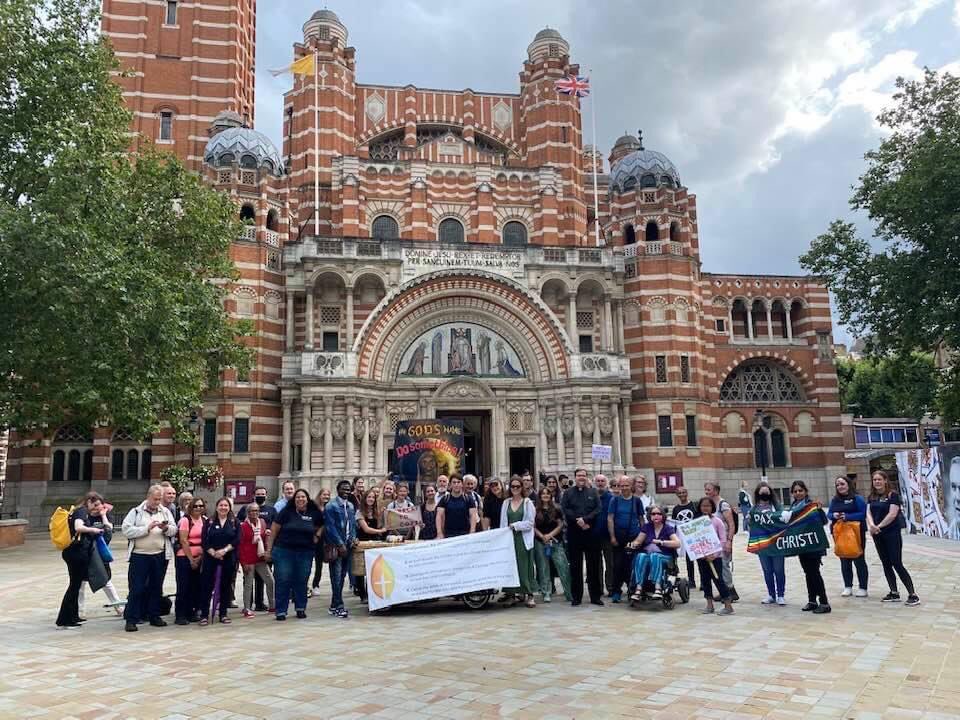
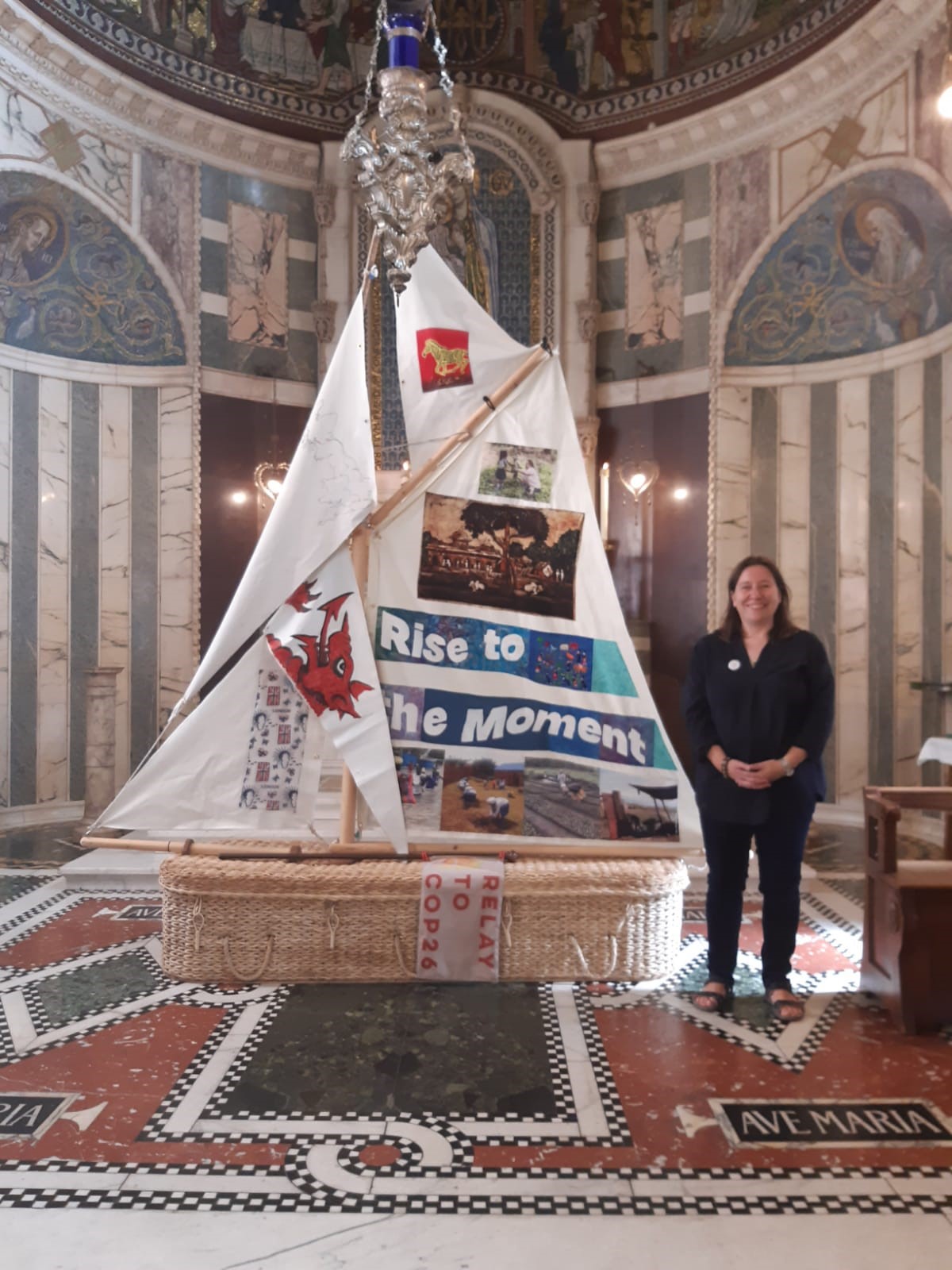
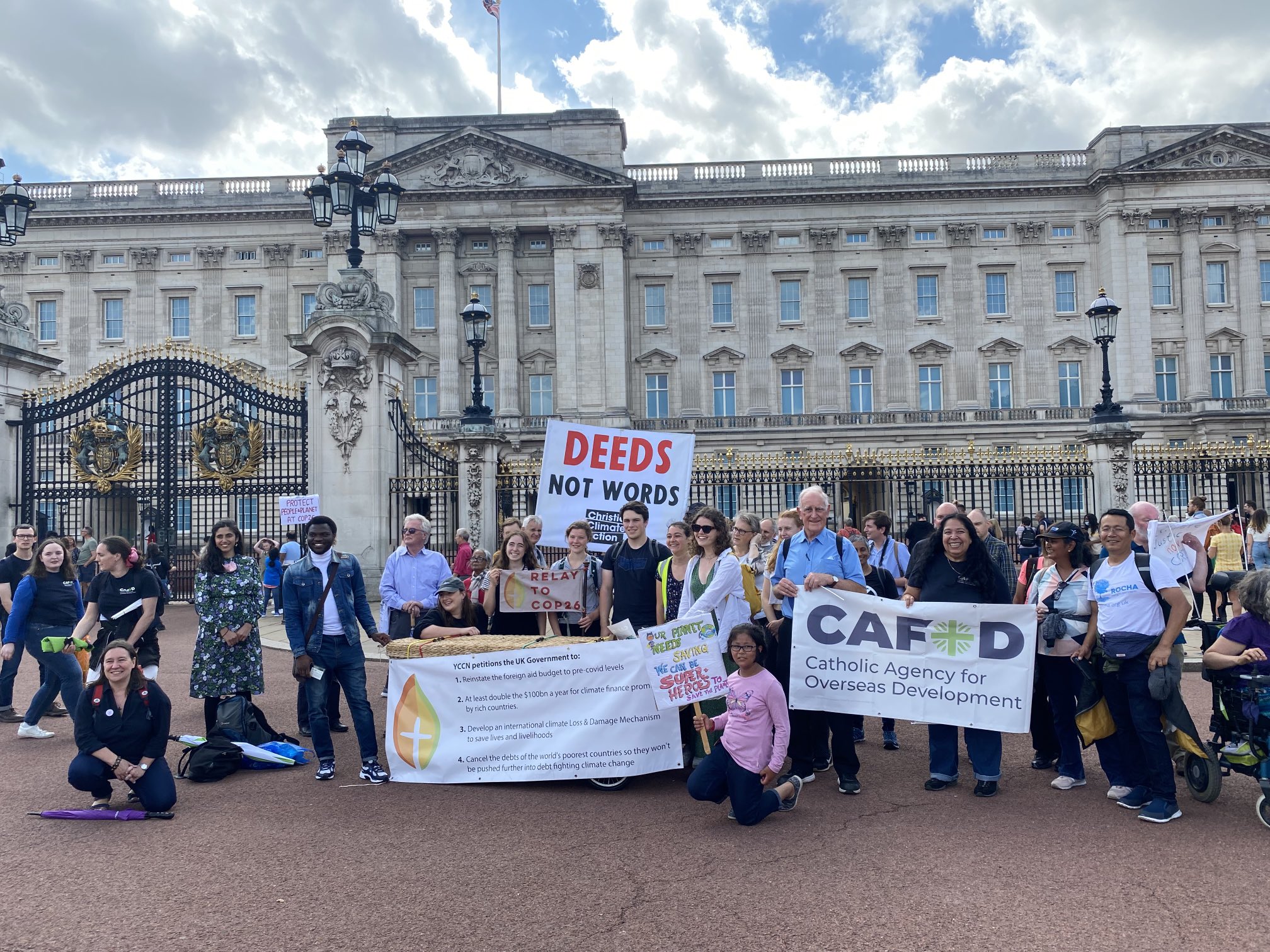

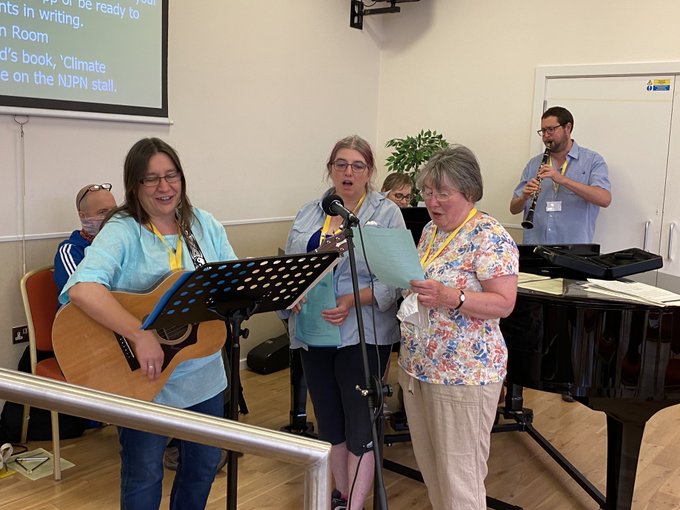



 Diocese of Westminster Justice and Peace Commission