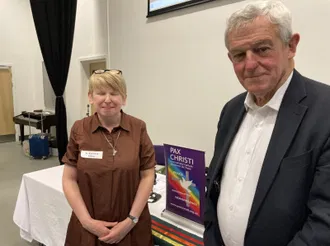
“The old rules of war have gone, and this is something to which we should give full attention.” Oliver McTernan, the Co-Founder and Director of Forward Thinking, was guest speaker on Saturday at the Annual General Meeting of Pax Christi England and Wales in London. The experienced mediator in conflict situations called for Pax Christi and other peace groups to highlight the moral and ethical issues in modern warfare. “We are not impotent,” he said, “we have the power to challenge.”
The theme of his talk was ‘Prophets for Peace in a Changing World’. The Chair of Pax Christi England and Wales, from Pax Christi Merseyside, Kathryn Lydon, told around 60 in-person participants and 20 online, that “the world is looking for prophets of peace.”
Dioceses represented included Birmingham, Hallam, Leeds, Liverpool, Middlesbrough, Southwark and Westminster. Groups represented included the Archbishop Romero Trust, Columbans and the National Justice and Peace Network of England and Wales.
Devoting much of his talk to the Gaza conflict, McTernan deplored Israel’s use of powerful Artificial Intelligence (AI) systems to identify targets in Gaza…
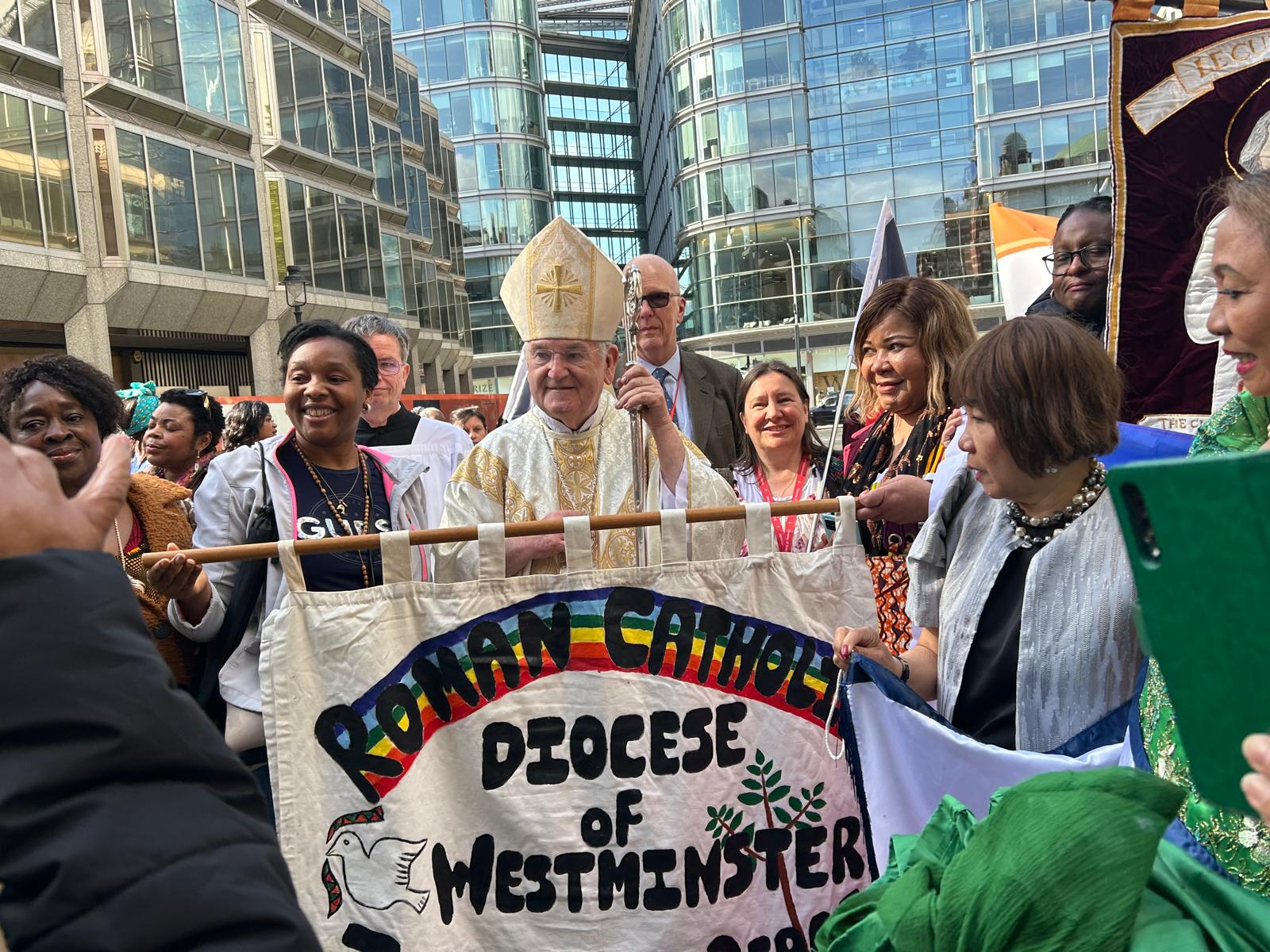
Westminster Justice and Peace Pilgrims arriving at Westminster Cathedral. Photo: RCDOW
“Pilgrimage is of course a fundamental element of every Jubilee event. Setting out on a journey is traditionally associated with our human quest for meaning in life. A pilgrimage on foot is a great aid for rediscovering the value of silence, effort and simplicity of life. In the coming year, pilgrims of hope will surely travel the ancient and more modern routes in order to experience the Jubilee to the full.” (Spes Non Confundit, 5)
A group from Westminster Justice and Peace completed the Westminster Way Pilgrimage for the Holy Year on Thursday 29th May 2025, the Feast of the Ascension.
Setting out from English Martyrs Roman Catholic Church, 30 Prescot Street, London, E1 8BB, at 11.00am, the pilgrims visited five other churches along the way, finishing with Westminster Cathedral at around 4.15pm.
At each station we heard reflected on saints connected to London and the inspiration they continue to be for us today – St John Houghton and The Carthusian Martyrs of the Reformation, the missionary St Augustine of Canterbury, St Anne Line who sheltered priests and held secret Masses in her home during the Elizabethan persecution, St Erconwald, St Ethelburga and St Etheldreda, the scholars of the 7th Century who brought learning and education to both men and women, and St John Henry Newman whose own spiritual journey of conversion and prophetic sense of the nature of the Church had a profound influence on the 20th century leading up to the Second Vatican Council.
We also passed by the Tower of London and stood sombrely on the site of the scaffold where St John Fisher and St Thomas More were executed, among others.
As we were walking during Laudato Si’ Week, pilgrim leader Colette Joyce also invited pilgrims to reflect on the flora and fauna of London as we went along. London is a surprisingly green city, blessed with around twenty percent tree coverage – which makes it technically a forest! We are especially grateful to the Victorians who planted the ubiquitous London Plane trees which can be found in streets and parks all over the city, while there are over 400 other species of tree to discover.
“The entire material universe speaks of God’s love, his boundless affection for us. Soil, water, mountains: everything is, as it were, a caress of God… contemplation of creation allows us to discover in each thing a teaching which God wishes to hand on to us.” (Laudato Si’, 84-85)
On arrival at the Cathedral, the weary walkers were greeted by the Cathedral Dean, Fr Slawomir Witoń. We ended our pilgrimage with prayers in the Martyrs Chapel and a reflection from Fr Slawomir on the life and witness of St John Southworth, patron saint of clergy in the Diocese of Westminster.
The pilgrims received the final stamp in their Pilgrim Passports and a blessing before returning home.
l-r: Fr Michael Baggot, Jen Copestake, Fr Dominic Robinson, Dr Karen Singarayer, Matthew Sanders. Image: Diocese of Westminster
Dr Philip Crispin
From the outset of his pontificate, Pope Leo XIV has explained how the development of Artificial Intelligence (AI) inspired the choice of his papal name.
Speaking to the College of Cardinals after his election, he said: “I chose to take the name Leo XIV. There are different reasons for this, but mainly because Pope Leo XIII in his historic encyclical Rerum Novarum addressed the social question in the context of the first great industrial revolution.”
“In our own day, the Church offers to everyone the treasury of her social teaching in response to another industrial revolution and to developments in the field of artificial intelligence that pose new challenges for the defence of human dignity, justice, and labour.”
With serendipitous timing, the Catholic Union, in collaboration with Farm Street Church, Mayfair, hosted a panel discussion last Sunday 18th May entitled ‘AI, Faith and Ethics at a Crossroads: Discerning the Way Forward’ which explored the moral and spiritual challenges in this time of technological transformation. The event was convened and chaired by Farm Street Parish Priest, Fr Dominic Robinson SJ.
In her opening remarks, Dr Karen Singarayer, Vice-Chair of the Catholic Union of Great Britain, highlighted the opportunities and risks of the development of AI. She said: “The artificial intelligence revolution holds both promise and peril. The AI revolution seems to be impacting not only manual labourers but also professionals. The written word, once the exclusive realm of the human mind, is now increasingly the domain of machines. Video and audio too are more and more frequently AI-generated. Professions that long commanded social respect as learned or creative vocations now seem vulnerable in the face of the machine.”
She added: “These developments prompt us to ask difficult questions – what does it mean to be truly present to another human being? How are relationships, education, healthcare, and even evangelisation being reshaped by the advent of AI?”
Dr Singarayer paid tribute to the late Pope Francis as the leading moral voice regarding AI. He was ever mindful of the common good she said and noted his warning about the catastrophic consequences of allowing instruments of war to develop way beyond human oversight.
Jen Copestake, Correspondent at China Global Television Network Europe, said: “AI is no longer a matter of speculation; it is deeply embedded in all of our lives. We stand at a crossroads-not just technological, but moral and philosophical. As AI becomes more capable, present and even humanlike, the question is not just what it can do, but what should we do.”
She pointed to the pitfalls of AI which was not always programmed to embrace human diversity and posed the question whether soul-less machines with no human history could replicate human empathy and dignity.
Ms Copestake cited a prediction that, by 2030, 375 million workers globally would be forced to migrate or ‘transition’ and recollected that in Laudato Si Pope Francis had insisted that technological change should never render a person obsolete.
She spoke of the “seismic effect” of a predicted 70 per cent of jobs being transformed by AI and the imperative of protecting workers and the meaning behind the work they did which might, as Pope Francis had pondered, necessitate the move to introducing a universal basic income in order to preserve human dignity.
Furthermore, she continued, it was necessary to work upon improving the ecological impact of AI which was dependent on massive energy consumption. According to Catholic social teaching on ethical stewardship, harnessing the world’s resources should be sustainable not extractive.
Speaking on AI’s use in Evangelisation, Matthew Harvey Sanders, CEO of Longbeard, Creator of Magisterium AI, said: “What we found is that there’s a lot of people out there who aren’t ready to step into a church and talk to a priest or share their concerns, but they are ready to test their problem, their query out on a chatbot. . . . This isn’t a question of trying to replace the priest at all. It’s just recognizing where people are at. . . . We’ve seen testimonials of people who started a journey to the church or had misconceptions clarified. It’s been a beautiful project.”
He hailed the accelerated polyglot digitization of the Church’s library holdings and the World’s first Catholic language AI model Ephrem designed to offer deep insights into the teachings of the Church.
Fr Michael Baggot, Professor of Theology at Pontifical University of St Thomas Aquinas, Rome, spoke about how the Church is founded upon relationship, with God and each other. He said: “We are masters of communion. We are masters of relationship. We follow a God of relationship, not a solitary God, but a God who is eternal exchange of interpersonal love. If we’re made in the image of that God, we are called into being by a God of communion for communion-with that God and with the other persons made in the image of that God. We were made for interpersonal communion.”
The Church, he said, is “expert in humanity'” adding “I hope we know how to accompany people and their most profound needs.”
He warned against the abuses of AI’s virtual world, seductive and damaging as it moved from an attention economy to an affection economy but was lacking in compassion and an interior life.
Fr Baggot warned, too, against the possibility of “outsourcing” moral agency. While AI worked with data and statistical patterns it should never replace human responsibility. The Church insisted on equity, sexual and racial, he said.
Responding to audience questions, the panel hoped that greater efficiency through AI could liberate from certain forms of toil but feared that job losses could lead to social unrest and scapegoating. They feared, too, information overdrive and saturation.
AI should never replace the gift of humanity and personhood, underscored by the fundamental truth of the incarnational God, who took on our human flesh and blood, and served ‘fleshly’ human beings. Rather AI should be based upon human wisdom. Now was the time for discernment.
Colette Joyce, our Co-ordinator, attended this Service on behalf of Westminster Justice and Peace.
The Temple Church in London and Co-Cathedral of the Most Holy Name of Jesus in Jerusalem were the settings for an historic simultaneous ecumenical service on Tuesday 20th May 2025, marking the 1,700th anniversary of the Council of Nicaea. The event featured a livestream broadcast from the two churches and shown on screens.
At the Council of Nicaea, in the year 325, church leaders formally assembled to agree on Christian doctrine and endorse the Nicene Creed.
The choice of the Temple Church for this event was particularly significant. It was built in 1162 to recreate the Rotunda of the Holy Sepulchre, or Anastasis, in Jerusalem, commissioned by Constantine soon after the Council of Niceae.
Organisers at the Temple church said yesterday’s service was planned “to bring us all together in unity to pray for peace in the midst of the current troubles in the Holy Land and in our shared concern for the founding communities of our faith.”
As the clergy processed into both churches the Temple Singers led the hymn: Jerusalem the Golden.
In London, Cardinal Vincent Nichols welcomed those present with a blessing. He then delivered a message prepared for the occasion by the late Pope Francis in which he prayed for peace in the Holy Land and prayed this “commendable initiative” which he said “bears eloquent witness to the rich religious tapestry that characterises the land of Our Saviour’s birth and calls attention too the enduring desire for peace held dear by its citizen’s today.”
In Jerusalem Cardinal Pizzabella welcomed everyone in the first words of Pope Leo XIV as Pope:
“Peace be with all of you!”
He said: “Dearest brothers and sisters, this is the first greeting of the Risen Christ, the good shepherd who gave his life for God’s flock . I too would like this greeting of peace to enter your hearts, to reach your families, and all people whoever they are, all of the people all over the earth.
This is the peace of the Risen Christ, an unarmed peace and a disarming peace, humble and persevering .It comes from God. God, God who loves us all unconditionally . We still have in our ears that weak , but always courageous voice off Pope Francis as he blessed Rome!
The Pope who blessed Rome gave his blessing to the world that Easter morning. Allow me to follow up on that same blessing.: God loves us. God loves you all, and evil will not prevail.
We are all in the hands of God. Therefore without fear, united hand in hand with God and among ourselves we move forward. We are disciples of Christ.
Christ preceded us. The world needs his light. Humanity needs him as the bridge to allow it to be reached by God and his light.”
Bokani Tshidzu (Operation Noah)and James Buchanan (Laudato Si’ Movement)
Source: Ellen Teague
Justice and Peace contacts from dioceses around England and Wales gathered on Saturday 10th May 2025 for a networking day on ‘Opening doors to a sustainable world for future generations’. It was the third meeting in the series of events for this Jubilee Year of Hope organised by the National Justice and Peace Network (NJPN).
Held at CAFOD’s office in South London, it brought together around 40 participants from Arundel and Brighton, Birmingham, Brentwood, Cardiff/Menevia, Clifton, Hallam, Leeds, Liverpool, Nottingham, Portsmouth, Southwark and Westminster. They were joined by representatives of CAFOD, Religious Links, FCJ Sisters, Jesuit Missions, Columbans, Journey to 2030 and Laudato Si’ Animators.
The day opened with reflective prayer and singing of the hymn, ‘O Word of God come into this place,’ by Ricky Manalo, led by Sr MaryAnne Francalanza, Director of the London FCJ Centre for Spirituality and EcoJustice, and Colette Joyce, Westminster Justice & Peace Co-ordinator.
The first speakers were Mary and Peter Johnson of the Livesimply parish of St Teresa of Lisieux Parish at Lexden in Brentwood Diocese, whose projects include creating a prayer garden, producing sustainable lifestyle ideas and creation-centred prayers of intercession, and making Laudato Si’ better known. They are trained Laudato Si animators and are active with social projects of Caritas Brentwood and have helped organise the installation of 24 solar panels on their church roof. “The Season of Creation is now embedded in our parish,” they said. There were plenty of ideas for other parish groups.
Mary Finnerty, Lead Economist at CAFOD, and Andrea Speranza of CAFOD campaigns talked on ‘Tackling debt and the climate crisis in this Jubilee Year.’ The meeting was urged to support and bring to Catholic parishes a Caritas Internationalis petition calling for debt cancellation for the world’s poorest countries. It aims to reach 10 million signatures. CAFOD is also calling for a Debt Justice Law in the UK and a new comprehensive debt framework. Some in the room had been involved in Jubilee 2000 – which prompted the cancellation of $130 billion of debt 25 years ago – and endorsed a focus on structural change to try and prevent poor country indebtedness building up again. “There are structural issues keeping countries in debt that have never been addressed,” said Andrea. Maria pointed out that there are particular opportunities for campaigning in the UK because 98% of the loans of poor countries are governed by English Law.”
All were urged to attend and promotes a lobby of parliament on 9 July, which includes Christian development agencies and civil society networks, and will urge MPs to work towards the UK becoming a global leader in tackling climate change and restoring nature by 2030. “Faith groups have an important role to play,” said Andrea. And then there will be a build up to campaigning for significant climate action at the UN’s COP30 climate conference in Brazil in November.
James Buchanan of the Laudato Si Movement and Bokani Tshidzu of Operation Noah spoke to ‘Greening Church Investments: fossil fuel divestment and investment in climate solutions.’ Participants were urged to join the ‘Big Bank Switch’ and ‘Share Action.’ Bishop Gerardo Alimane Alminaza of San Carlos in the Philippines sent a video message challenging extractive industries which harm the environment and urged ethical investment. He was particularly concerned about HSBC and Standard Chartered’s financing of liquefied natural gas terminals and fossil gas power plants in the Verde Island Passage: Everyone clapped as he concluded with, “we hope we can count on you to join and support us.”
The Muslim Director of Faith for the Climate, Dr Shanon Shah, led group work on creation-centred theology – taken from ‘Laudato Si’, ‘Laudato Deum’ and the Muslim document ‘Al-Mizan: A Covenant with the Earth.’ Participants undertook to network more ecumenically and interfaith on justice, peace and ecology issues. Interfaith collaboration was also mentioned in a message from Bishop John Arnold, Lead Bishop for the Environment in England and Wales. He welcomed initiatives in parishes and schools to care for the environment over the 10 years since the publication of Laudato Si’. And he added that, “internationally, there has also been good news, especially with the impact of the Islamic document ‘Al-Mizan’ which so closely mirrors the contents of Laudato Si’.”
In the feedback at the end one participant reflected, “this is a great network of individuals, groups and organisations and we are strong when we work together.” Inspired by the day, actions suggested for building a sustainable world included promoting CAFOD’s Livesimply programme in parishes and schools and lobbying dioceses to have paid staff offering expertise on renewable energy projects and fossil-free banking. Creation-care should be embedded in Church liturgies and sacramental preparation. Church monies should be used ethically.
The next major NJPN event will be the annual national conference at the Hayes Conference Centre in Swanwick, Derbyshire, on 25-27 July 2025. The theme will be: ‘Towards a Just Peace – Challenging the Inevitability of Violence.’ Keynote speakers will be Dr Rowan Williams, former Archbishop of Canterbury and Dr Joanna Frew of Rethinking Security. All are welcome.
The world came to Westminster Cathedral on Bank Holiday Monday, 5th May 2025, as the three London Dioceses of Brentwood, Southwark and Westminster gathered for a special Jubilee edition of the annual Feast of St Joseph the Worker Mass, celebrating the contributions made to the life, work and faith in the UK by all those who come from other countries to make a home here.
Organised by the Justice & Peace Commissions, Caritas and Ethnic Chaplaincies of the three Dioceses, in spite of grey skies and rainy weather there was a party atmosphere in the Cathedral Hall, as participants prepared for the procession down Ambrosden Avenue into the Piazza – many wearing their national dress, singing, dancing, and carrying banners and flags. People walking down Victoria Street stopped to watch as the colourful parade filled the Piazza and entered the Cathedral.
The Chief Celebrant was Archbishop George Stack. (Cardinal Vincent Nichols and Cardinal Michael Fitzgerald, would have taken part – but they were at the Conclave in Rome.)
The Deacons were Rev Eze Uguola from Nigeria and Rev Eric Chelvarayan from Sri Lanka.
Musicians Giovanni Marseglia and Liz Simpson who accompany the Westminster Lourdes pilgrimage, led the Mass parts and – together with the Cathedral Organist.
Colette Joyce, Justice and Peace Co-ordinator with Westminster Diocese gave a warm welcome – “especially to all the members of the ethnic chaplaincies represented here today and to the parishioners of all three dioceses who have come along to celebrate their commitment to our multi-racial and multi-ethnic community.”
Among VIP attending was Gopaljeet Singh Bhachu, Ambassador of City Sikhs, Mr Ruzbeh Hodiwala and Mr Shiruy Billimoria from the Zoroastrians; Christine Allen, Director of CAFOD, and members of her team; Naoise Grenham, Catholic Bishops of England and Wales policy team for migration and racial justice, Robina Rafferty from London Churches Refugee Fund; James Holland, Westminster Interfaith Co-ordinator, Gopaljeet Singh Bhachu, Ambassador of City Sikhs, Siobhan Garibaldi, president of the Catholic Women’s League and representatives from: Caritas Westminster, Southwark and Brentwood, Catholic Association for Racial Justice, Jesuit Refugee Service, Union of Catholic Mothers and representatives of London Citizens.
Fr Dominic Robinson SJ Chair of Westminster Justice and Peace gave the homily, in which he reflected on the question ‘Where are you from?’ He concluded: “Where are we from? We are all from here, rooted now in where we live and work, and walking together in hope in the Christ who calls us all to build up his Kingdom here and now.”
The Offertory Procession was brought up by representative from several chaplaincies.
The beautiful Offertory song was sung by the Nigerian Chaplaincy Choir. After Communion there were hymns sung by the Goan Chaplaincy and the Tamil Chaplaincy.
Post-Communion reflections were given by representatives from Citizens UK. Nori and Joan described the difficulties they had as migrants in this country and the support they’ve received from their churches and London Citizens. Joan is now training to be a teacher and works with London Citizens helping other migrants and refugees. She said: “A report by the Bishops Conference in England and Wales, called Love The Stranger, says: ‘We call upon all Catholics to help ensure that their Members of Parliament and local authorities are aware of their responsibilities towards migrants and refugees.’ If you or your parish would like to explore working with us, please come speak to us after the service.”
After words of thanks and final blessing, the congregation processed out into the Piazza, where the sun was now shining and many people stopped to chat and pose for pictures under a blue sky.
Video credit: Jo Siedlecka, Independent Catholic News
Bishop William Shomali (l) with Bishop Jim Curry. Photo: ICN
Source: Jo Siedlecka, ICN
Bishop William Shomali, Patriarchal Vicar for Jerusalem and Palestine, gave a moving account on the situation of Christians in the Holy Land at Bloomsbury Baptist Church in London on Monday. The ecumenical event was attended by representatives from many denominations, including Bishop Jim Curry from RC Diocese of Westminster and Bishop Mike Royal, General Secretary of Churches Together.
Bishop Shomali began with a summary of the history of the Holy Land, which he said has been suffering from a “devastating conflict for the past hundred years.” While the Jewish people, based on their interpretation of the Bible claim the land is theirs given to Abraham and his descendants by God, the Palestinians assert that their roots date back to the Canaanites who lived there 3000 years BC. Thus he said: “There are two narratives, two claims and two perspectives on the history and geography of the land.”
“My intention is not to advocate for one side against the other or to discuss the injustices and crimes committed in this land called Holy” Bishop Shomali said. “Instead I aim to present the situation from a humanitarian perspective and delve into the condition of the Christian community which has lived there for 2000 years without interruption…”
Fr Dominic Robinson SJ (Chair) and Colette Joyce (Co-ordinator) also attended the event on behalf of Westminster Justice and Peace.
The Westminster Holy Land Roundtable is an open discussion forum where anyone with a connection to the Diocese can come and share news, events and ideas to help formulate a common response to the war in Gaza. The next meeting takes place Saturday 5 April 2025, 4-6pm, at Farm Street Arrupe Hall. Bishop Jim Curry will be speaking about his recent visit to the Holy Land. New participants welcome
Cardinal Fitzgerald with Colette Joyce from Westminster J&P. Image ICN/JS
Cardinal Michael Fitzgerald M.Afr. gave the following talk on the Day of Martyrdom of Archbishop Oscar Romero, Saturday, 22 March, 2025, at St Martin in the Fields, Trafalgar Square.
All my hope on God is founded. On this day when we are celebrating the anniversary of the martyrdom of Archbishop Romero, which falls actually on Monday 24 March, we are concentrating on HOPE, because we badly need Hope in our world today and Archbishop Romero is a figure of hope.
We have heard a reading from St Paul to the Romans about Abraham who believed though it would seem that there was no room left for hope or belief. He was old, and his wife was old too, and yet he believed that she would bear him a child, since God had promised this.
We have heard recited a poem by a Palestinian about the people of Gaza:
My God is courage, patience, justice, the sumoud of a people.
We adore the same one God, though we understand this God differently.
Muslims say that God is al-samad, which could be translated “rock-like”; God is an all-encompassing refuge for us.
In the midst of this world, with all its difficulties, we are encouraged to take refuge in God.
As Christians, we say that this God has become one with us in Jesus Christ
So, we can truly say that our God is a stubborn refugee girl, her heart still yearning for the place she calls her own.
We can say that our God is a Gaza refugee wishing to share freedom with all of us.
We are called to believe like Abraham, our father; we are called to believe in life as Archbishop Romero did, hoping against hope that conditions will revive, conditions in Gaza, in Israel and Palestine, in Tigray in the North of Ethiopia, in Sudan and Eastern Congo, in Myanmar and Yemen conditions in El Salvador, conditions all around the world where there is conflict. We are encouraged to continue praying for the people in these areas of conflict, following the example of Pope Francis who, every Sunday, at the mid-day prayer, mentions these places and prays for their inhabitants.
We are called not only to pray, but to work for a renewal of life, as the Qur’an reminds us:
Have you considered the one who denies the Judgement? that is the one
who pushes aside the orphan and does not urge others to feed the needy
So woe to those who pray but are heedless of their prayer; those who are all show and forbid common kindnesses.
( Qur’an 107)
Many of us are familiar with the words of the Gospel:
Come… take for your heritage the kingdom prepared for you…: For I was hungry and you gave me food; I was thirsty and you gave me drink; I was a stranger and you made me welcome; naked and you clothed me; sick and you visited me, in prison, and you came to see me; I tell you solemnly, in so far as you did this to one of the least of these brothers [or sisters] of mine, you did it to me.
( Gospel according to Matthew, 25: 34-42)
This year, Ramadan and Lent fall together in the same period. We can remember that their contents are similar: fasting, prayer and alms-giving, but the reasons for engaging in these practices are different.
To fast every day during the month of Ramadan, to abstain during the hours of day-light from every intake of food or drink or of any substance is very demanding. The Christian is not asked to observe this. The Christian would be expected to forego some food or drink during the 40 days of Lent; avoiding alcohol, which is allowed at other times; avoiding chocolate or sweets; having a simple meal such as spaghetti and cheese and being able to share the amount saved with people who are in need.
There are other ways of fasting that can be chosen: avoiding watching television, curbing one’s use of social media.
All this is voluntary, by way of free choice. Whereas I understand that Ramadan is observed as an act of obedience to God: “You who believe, fasting is prescribed for you… so that you may be mindful of God (Q 2: 183).”
Ramadan is practised more collectively; families gather together to break the fast.
Lent is a more individual practice.
Lent is really a way of preparing for the celebration of the greatest feast of the Christian year, Easter, the commemoration of the Passion of Jesus, of his death on the Cross, his burial, and his rising to New Life.
Nevertheless, there are common prayers in both religious traditions. Special prayers are recited in the mosque, the tarâwîh, after the last prayer of the day.
Christians have a custom of gathering in church on Friday afternoons or evenings for what we call the Way of the Cross, recalling the different ways Jesus suffered for us.
At this time when Ramadan and Lent unite us, I should like to let the voice of Archbishop Romero resound again:
As long as there are mothers who are crying about the disappearance of their sons and daughters, as long as there are tortures in the headquarters of our security forces, as long as there is horrible disorder… there cannot be peace. We need to be rational and listen to the voice of God, to organize a more just society once more according to God’s heart.
(Through the Year with Oscar Romero, Daily Meditations CAFOD, D.L.T. Christian Aid 2006 p.14).
To return to our theme of Hope, we who believe in Hope, whether we are Christians or Muslims, or whatever religion we belong to, we pray earnestly to God for this gift of Hope, true hope which will generate justice-seeking solidarity, hope which may presage true peace.
In this way we shall be true to ourselves, true to our religions and true to Oscar Romero who has given us such a good example.
London Catholic Worker members at the 17 March 2025 Home Office Vigil. Photo: LCW
The regular monthly Home Office Vigil was held on 17 March 2025, to commemorate the thousands of refugees who have died, trying to reach a place of safety in Europe.
Barbara Kentish writes:
We heard today from a brother who simply asks the international community for a humanitarian system, a recognition that ordinary people are destroyed in the current world order. And we heard from the gospel reading Jesus’s simple message – Be compassionate, as your heavenly Father is compassionate. Give and it will be given back to you.
How do we keep on being compassionate, calling for compassion, giving compassion in this broken world? I want to share an experience I had recently which struck a chord, and showed me one or two ways we manage to keep on feeling and showing this compassion.
A week ago we celebrated International Women’s Day, and I was asked to talk about our Home Office Vigil from a women’s perspective, which I found difficult, as the people we commemorate are women and men, probably more of the latter. And the people who come to pray are women and men. Reading through the months of stories for inspiration, however, I did come across stories such as this one that we read a few months ago, which seems very immediate, because it is one woman, and she is named, as is her child:
A mother and baby from Senegal, both called Touré, died on a boat adrift for over a week in the Mediterranean. A bag containing the baby’s food fell into the sea, and he starved to death. His mother died from exhaustion and grief. Their bodies were thrown into the sea. What an agony for that mother.
There seem to be more women recorded amongst the deaths of those travelling from Senegal via the Canary islands. Maybe this is a recent trend. Women travelling are nearly always more vulnerable than the men. Such desperation, to make them take to the boats. But to think of one example, one woman, one baby, brings home an immediacy that numbers can blunt. A name, a person.
In my Women’s day celebrations I met women involved in craft work, whether art, knitting or weaving. This resonated with me, as I love making things: I do lots of crochet work, making jumpers or cardigans. Creative work really restores the soul in some way, even though most of the finished products will never be seen in any art galleries. It’s our need to contribute something to the world, to celebrate the beauty around us. How do we create beauty in this broken asylum system, where so many lives are ground down or simply damaged? We create together, we cook together, we sing together. We make beauty. And that is where God gives back, a hundredfold, pressed down and running over.
I am going to read a poem by a Lutheran minister that was read at my gathering on International Women’s Day. It’s called ……
To Weavers Everywhere
God sits weeping The beautiful creation tapestry She wove with such joy Is mutilated, torn into shreds, Reduced to rags, Its beauty fragmented by force.
God sits weeping. But look! She is gathering up the shreds To weave something new.
She gathers The rags of hard work Attempts at advocacy, Initiatives for peace, Protests against injustice, All the seemingly little and weak Words and deeds offered Sacrificially In hope, in faith, in love.
And look! She is weaving them all With golden threads of Jubilation Into a new tapestry, A creation richer, more beautiful Than the old one was!
God sits weaving Patiently, persistently, With a smile that Radiates like a rainbow On her tear-streaked face.
And She invites us Not on1y to keep offering her the Shreds and rags of our suffering And our work,
But even more – To take our place beside Her At the Jubilee Loom, And weave with her The tapestry of the New Creation.
Marchiena Rienstra (Presbyterian minister and poet)
More Information
Monthly Memorial Prayer Vigil for Refugees and Asylum-Seekers On the 3rd Monday of every month outside the Home Office, SW1P 4DF, 12:30pm to 1:30pm
Interim communications officer, Jon Chew, reflects on the recent multi-faith eco-summit on 23 February, 2025.
Colette Joyce (Westminster Justice and Peace Co-ordinator and Trustee of Faith for the Climate) and Fr Dominic Robinson SJ (Justice and Peace Chair) were in attendance on behalf of the Diocese.
“Out beyond ideas of wrongdoingand rightdoing there is a field. I’ll meet you there. When the soul lies down in that grass, the world is too full to talk about.” – Jalaluddin Rumi
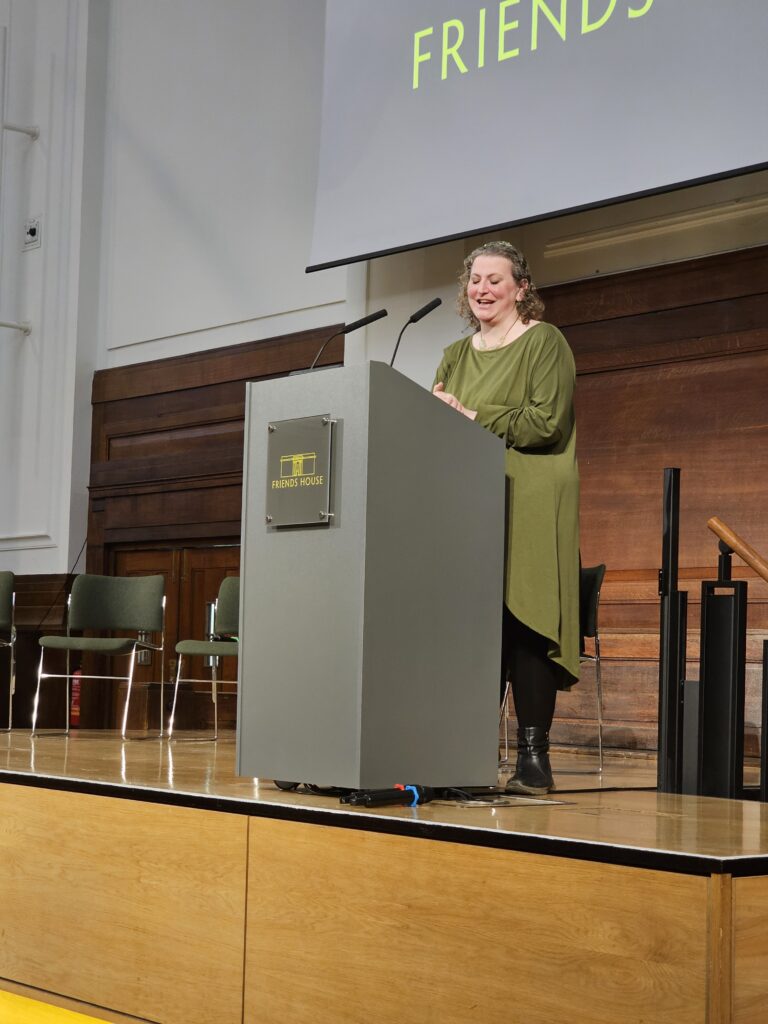
Rabbi Debbie Young-Somers, trustee of Faith for the Climate. Photo by Jon Chew
As Rabbi Debbie Young-Somers, a trustee of Faith for the Climate, led us in ‘Hinei Ma Tov’ – a Jewish hymn sung at Shabbat feasts – I was reminded of the field the Sufi poet Rumi speaks of. While evocative, this translation by Coleman Barks has been accused of de-Islamifying Rumi a bit too much.
There is another translation by the British scholar A.J. Arberry that is closer to the original meaning of the Persian:
“Beyond Islam and unbelief there is a ‘desert plain.’ For us, there is a ‘passion’ in the midst of that expanse. The knower [of God] who reaches there will prostrate [in prayer], (for) there is neither Islam nor unbelief, nor any ‘where’ (in) that place.”
In this rendering, the middle ground between belief and unbelief feels like a blank canvas, a place that may be too scary for some to enter. But here, a worshipper of God finds a unique passion, where your heart and devotion to truth and healing fills the expanse. A passion that is no less devoted, that causes us to prostrate in prayer, but maybe, a place where fellow pilgrims are feasting with each other. A place where we are bound not by the ferocity of our arguments, but by our need to find kinship.
Hinei mah tov umah na’im / Shevet achim gam yachad. Behold how good and pleasing it is, for people to sit together in unity.
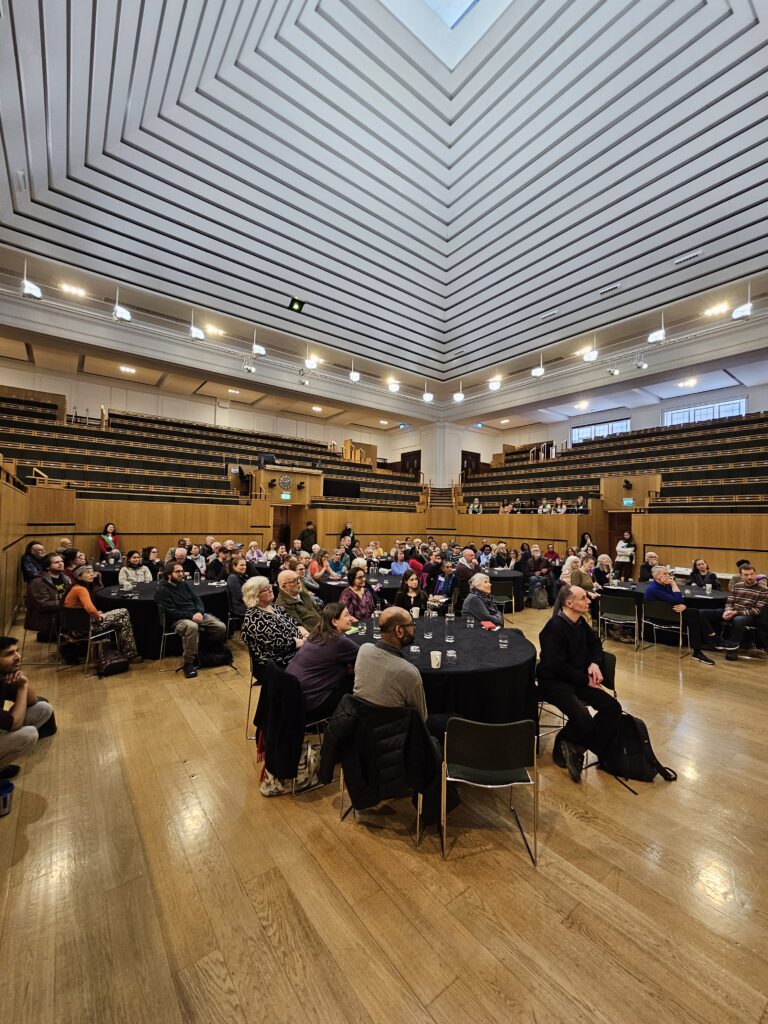
An act of gathering can be a provocation for our times, because these are the times we live in. On February 23, around 150 of us spent an afternoon at Friends House in London for our ‘Healing the Earth, Healing Ourselves’ summit. Co-organised with Christian Climate Action and Quakers in Britain, we came together in The Light Auditorium, where a vaulted roof stretched with holy hands to the skylight above, almost in recognition that the sacred provides safety for the extra-ordinary.
Event attendees gathering inside The Light Auditorium. Photo by Jon Chew





 Diocese of Westminster Justice and Peace Commission