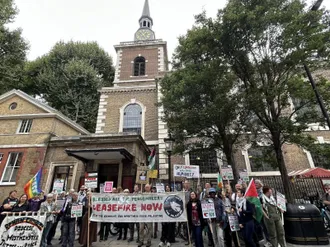
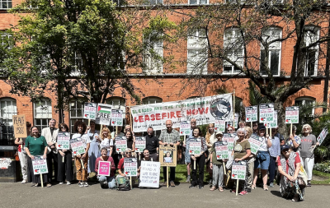
A record number of Christians from different denominations – clergy, religious and laypeople – gathered for prayers at St Anselm & St Cecilia’s Catholic church in Holborn on Saturday 5th October 2024, before joining the 20th National March, from Russell Square to Whitehall, to appeal to the government to stop arming Israel and demand a permanent ceasefire in Gaza, Lebanon, Yemen, Israel and Iran.
The prayers were led by Revd Sam Fletcher, an Anglican priest from Exeter, and Colette Joyce, Westminster Justice and Peace Coo-ordinator.
The Jewish Bloc was also the largest ever.
Organisers say more than 300,000 people took part in the demonstration.
John Sloboda, academic, musician, and co-founder of Iraq Body Count , told ICN: “As a British Catholic I consider that participating in these marches and rallies is an important act of witness that I can offer, in the face of the ongoing decimation of the Palestinian people.
“What our taxes are paying for goes against everything I hold dear as a Christian. Marching together with fellow Christians jointly asserting “not in our name” brings some relief and encouragement, in the face what would otherwise be an overwhelming sense of despair about our country and the ultra-timid role our church leaders are playing at this potentially apocalyptic juncture in world history…” More
Colette Joyce, Justice and Peace Co-ordinator with Westminster Diocese is currently on a pilgrimage to Jordan with Friends of the Holy Land. The visit has been hosted by the Jordanian Tourist Board who are keen to show that Jordan is still a country of peace and safety, despite the regional conflicts raging all around its borders.
Colette writes:
If there is one word that springs to mind after my first few days in the country it is ‘hospitable’. Every where we go people call out, ‘Where you from?’ ‘London, UK.’ Ah, welcome to Jordan!’ We have been extraordinarily well looked after by the hotel, restaurants, shops and site staff who want to show us the best that Jordan has to offer.
As we travel, we can see a country just getting on with life. It is hard to believe, at times, that there is so much turmoil just a few miles from here. While we’ve been here there have been attacks in Lebanon with pagers and walkie-talkies connected to Hezbollah exploding in streets and homes, killing dozens and injuring thousands more. Rockets have been fired at Israel, bombings continue in Gaza, arbitrary arrests take place in the West Bank and hostages from Israel still languish in Palestinian bunkers. Peace negotiations have faltered, as the risk of escalation rises, and it is hard to know how peace can possibly be restored.
For me, a strong motivation for making the trip was to show solidarity with the people of Jordan who are suffering from the effects of conflict in the region and also with all those in the Holy Land who are desperate to see an end to the fighting. Now that I am here, it is clear that they need that solidarity more than ever.
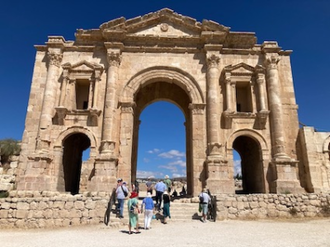
Before 7th October, Jordan would receive 7,000-8,000 tourists a day to its historic sites at Jerash and Petra. The sites are still open in all their glory but the visitors can now be counted in dozens. I have been stunned by their historic significance and beauty and hope very much to return to spend longer learning about them, hopefully with others, in the near future.
For Christians there is the added significance that these are Biblical lands and we have visited sites connected to Moses, Elijah and Jesus. Most deeply moving of all is the Baptism site, where Jesus was baptised by John the Baptist ‘on the far side of the Jordan’ which was only identified in 1995 when excavations became possible following reduced military operations. It has been endorsed by Pope John Paul II and visited by Pope Francis in 2016.
Here, between the river and the desert, I felt for myself a deep sense of connection to what our guide, Bashar, called ‘the sunrise of Christianity.’ Here is located the origin of Christian baptism that I experienced at six weeks old and which I have witnessed many hundreds of times since, most recently at Farm Street Church last Sunday. Priests from the new Catholic church rising above the shores of the Jordan poured water over our heads from a font beside the river to ‘Remember your baptism in the name of the Father, Son and Holy Spirit.’ From the actions of John and Jesus sprang a faith tradition that now connects two billion people around the world and across two thousand years of time.
For Rustom Mkhjian, the Armenian Christian Director of the Baptism Site Commission who showed us round, one of the most remarkable aspects of the restoration of the Baptism Site is that it has been sponsored by the Muslim royal family who deeply understand the significance of the site for Christians and why they should protect it and make it accessible to pilgrims. “This,” he said, “is how it should be everywhere in the world.” Relations between Christians and Muslims are good here and there are deep lessons for peace to be learnt from the Jordanian approach to welcome and hospitality.
St James’ Piccadilly, was the gathering place for the Christian Bloc taking part in the 18th national march for Palestine in London on Saturday. Some participants, from churches of different denominations, came from as far away as Hertfordshire, Surrey and Sussex. After prayers together they joined the main march in Regent Street, walking alongside Jewish, Muslim and secular campaign groups, passing Hyde Park before ending near the Israeli embassy on Kensington Road. Organisers say more than 100,000 people took part.
Speaking from a stage, broadcast on screens, a series of speakers described the catastrophic humanitarian situation in Gaza and the West Bank and appealed for the British government to stop arming Israel.
Daniel Kebede from the National Education Union said: “Across the UK and in many parts of the world thousands of children are returning to school. But for the children of Gaza there is no such respite from the relentless war that has blighted their young lives for almost a year now. Palestinians place a high value on the education of their children and young people. 625,000 in Gaza have been denied the inalienable right to education since October 7 last year.
“Now we are in a second school year which there is no prospect for returning to school. No respite from the relentless bombardment that is terrorising their young lives. Scholasticide is taking place in Gaza. The destruction of all education infrastructure with the deliberate targeting of schools and universities and the indiscriminate killing of children and their teachers. Almost 10,000 schoolchildren have been killed along with over 400 of their teachers.
“According to NGOs working in Gaza, 93 per cent of their schools which have specific protection under international law have sustained major damage. 156 UNRWA schools have been hit directly, despite the fact that many are providing refuge for displaced people.
“All twelve of Gaza’s universities have been bombed, leaving 88,000 students unable to continue their education. 90 percent of the Palestinian population has been displaced. Over 40,000 killed. 94,000 injured. Many more missing beneath the rubble.
“How long must this be allowed to continue? We need a ceasefire now. The ICJ has ruled that there is a credible case that Israel is committing genocide against the Palestinian people. The UK must now ban all arms sales to Israel. My union, the National Education Union will continue to stand up for the Palestinian people. We will continue to stand up for the rights of children to have an education.”
Sophie Bolt, CND Vice Chair questioned why the UK government has no money for pensioners’ cold weather payment; no money for families with more than two children – yet they have money to supply weapons to Israel.
Dr Ismail Patel from Friends of Al Aqsa expressed his grief at the barbaric behaviour of Israeli forces towards prisoners, and Palestinian civilians. By acting like this “Israel dehumanizes itself” he said.
Husam Zomlot, Palestinian Ambassador to the United Kingdom gave a heartfelt speech in which he said: “Israel has failed for 76 years to erase the Palestinian people and it will continue to fail. It must leave occupied territory now and third parties must end their support for Israel’s unlawful occupation.”
See his full address here:
Saturday’s march was organised by a coalition of organisations, including the Palestine Solidarity Campaign, Friends of Al Aqsa, the Muslim Association of Britain, the Stop the War Coalition and the Palestine Forum in Britain. The Christian Bloc included Catholic, Anglican and Methodist clergy and religious, representatives from the London Catholic Worker, Pax Christi, Christian CND and Westminster Diocese Justice and Peace.
One Christian campaigner, a retired schoolteacher, told ICN: “These marches are tiring, but they are nothing compared to the hardships experienced by people in Gaza. I can’t imagine how they survive, sleeping in makeshift tents with severe shortages of food and water. This is the least we can do.”
Parishioners from Ss Alban and Stephen Church held a joint service with the St Albans’ Abbey community, and representatives of other churches and of Pax Christi, in Sumpter Yard at St Albans Abbey (Cathedral) on Sunday 4 August 2024.
This is an annual event which takes place on the Sunday closest to 6 August, when the first atom bomb was dropped on Hiroshima in 1945. 6 August is also the Feast of the Transfiguration.
This year the Pillar was relocated to a new site at the Abbey and to mark this change, the service started with a blessing of the Pillar in it’s new site.
Pupils from Loreto College produced Origami Peace Cranes which were distributed at all Masses in Ss Alban and Stephen Church at the weekend and were also distributed to those attending the service.
The vigil is always conducted at the Peace Pillar which is a gift from the people of Japan to the Cathedral.
It was given in 1982 to commemorate the decision of Dean Cuthbert Thicknesse to refuse to allow the Abbey bells to be rung to celebrate the end of the War in the East. At the time the Guardian reported the Dean’s decision, as explained at a council meeting on 14th August 1945, as follows:
“After the dean, who is the mayor’s chaplain, had opened the council meeting with prayer, he made a statement to the council. “Let it not be supposed,” he said, “that any of us withhold our due sense of gratitude for the mighty deliverance. The events of the last ten days had given cause for deep searchings of heart to many people. “The decision to use the atomic bomb was made by the leaders of the democratic nations. We are all, therefore, though without our consent, implicated in that act. I do not hold a service of thanksgiving in St. Albans because I cannot honestly give thanks to God for an event brought about by a wrong use of force, by an act of wholesale, indiscriminate massacre which is different in kind from all the acts of open warfare hitherto, however brutal and hideous.”
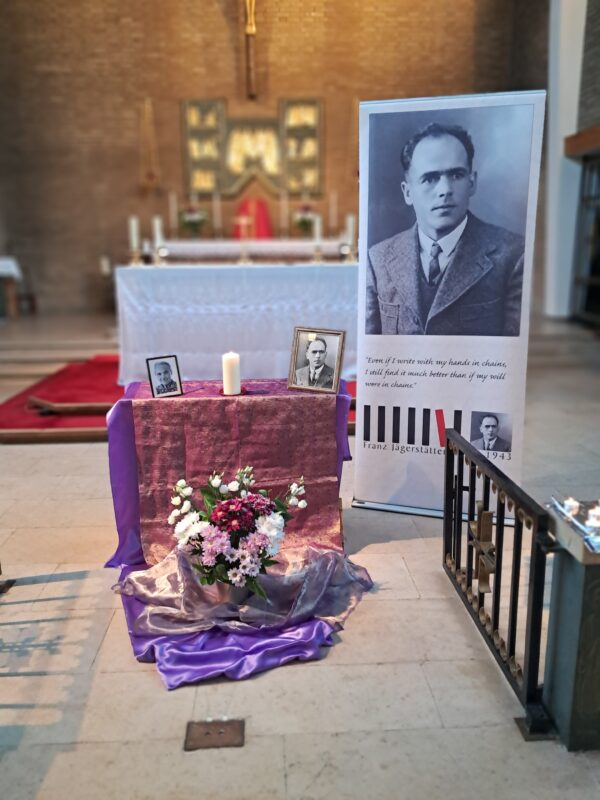
An interfaith congregation gathered at Holy Apostles church, Pimlico, on Friday, 9 August, the 81st anniversary of Bl Franz Jagerstatter’s martyrdom and Nagasaki Day, to give thanks for peacemakers and to pray for peace.
Jagerstatter was executed for refusing to serve in Hitler’s army. The congregation prayed: “Let us be encouraged and inspired as we reflect on his witness. We pray for the strength to be peacemakers in our troubled world.”
Music was led by Ellen and Gerry Teague. As the congregation filed in, they sang Peace Will Come by Tom Paxton, and the Taize chant The Lord is my Light. All those gathered then joined in a prayer saying “We pray to be peacemakers in our troubled world.’ This was followed by a reading of the words of Franz Jagerstatter written in a notebook 1942, in which he stressed the need for Christians to take a stand against injustice.
Andrew Jackson, CEO of Pax Christi then gave a reflection on the life of Bl Franz Jagerstatter. He said: “This wasn’t some blind, simplistic black and white fundamentalism – despite all the accusations that he had become extreme in his Catholicism. No – he saw the principality, the power and he named it and resisted it. What about us ?
We will say, of course, that we are not leaders, that we don’t have the voice or the profile to have any impact. But then neither did Franz. Outside of a very local community in 1943, no one knew who he was or the stand he was taking. He didn’t have a platform or a position that gave him a voice. He was an ordinary person just like us. But as he told us in our reading from his writings – we are just the people the world is looking for… Words teach, but personal example shows their meaning.”
A litany of names and groups was read out (after every one came the response: ‘We remember you’): Franz Jagerstatter; Josef Mayr Nusser; Franz Reinisch; Max Josef Metzger; Otto Schimek; all other conscientious objectors, (COs) from World War One and World War Two; All COs since 1945; members of the Society of Friends; Followers of the Anabaptist tradition; the COs of Israel and Palestine; The COs of Ukraine and Russia; The COs of the wars with Iraq, Afghanistan, and those of other countries in conflict.
The congregation was then invited to name other ‘war resisters’. People recalled: St Oscar Romero, Blessed Julia Rodzinska, Steve Biko, Desmond Tutu, Mahatma Gandhi, Edith Cavell, Dorothy Day, Martin Luther King, Bruce Kent and many more
Candles were lit in prayer, ‘a sign of hope against the darkness of war and violence.’
One prayer asked for the intercession of Blessed Franz Jagerstatter: ‘We give thanks for the witness of Franz Jagerstatter who has been beatified and recognised by the Church was a martyrs for peace. We pray that people through out the world will be inspired to followed their conscience . To go against the stream and stand up for peace.”
The final song was ‘Will you come and follow me’ and those present left the church and gathered outside to walk in the interfaith procession, led by Buddhist Rev Gyoro Nagase to the London Peace Pagoda in Battersea Park for the Nagasaki Commemoration Ceremony there.
The 79th anniversary of the atomic bomb on Nagasaki was commemorated in London on 9 August 2024, with a procession from Holy Apostles Catholic Church, Pimlico – following the memorial service for Blessed Franz Jagerstatter – to the Peace Pagoda in Battersea Park, led by Buddhist monk the Rev Gyoro Nagase with several monks and a nun from the Nipponzan Myohoji Buddhist Order.
They were accompanied by representatives from several London churches, Pax Christi, Westminster Justice and Peace, CND and other peace campaigners.
Arriving at the Peace Pagoda they were welcomed by Mr Shigeo Kobayashi from Japan Against Nuclear UK (JAN). After a water sprinkling and blessing by Rev Nagase Shonin, participants chanted chapter 16 from the Lotus Sutra. This was followed by Christian prayers for peace by Catholic Deacon Rev Jon Dal Din, from Southwark Diocese, Unitarian Pastor Rev Fergus O’Connor and Quaker David Stephenson.
All participants then were invited to come forward to offer incense and flowers.
Mr Shigeo Kobayashi then gave a brief address, reflecting on the horrors of war in an atomic age, and calling for prayers for peace and harmony between all peoples and nations. He said that more than 74,000 people had died in Nagasaki, in 1945 but people there now still suffer the consequences of the bombing. He noted that for the first time the ambassadors of the UK and other countries had declined to attend the memorial service in Nagasaki, because the ambassador of Israel had not been invited. ( The Mayor of Nagasaki Shiro Suzuki, said that the reason for not inviting Israel was not political. Commentators suggested it was rather for security reasons.)
The last speaker was Ms Carol Turner, chair of London CND. In her address she warned that we are living in a very dangerous time, particularly with events in the Middle East, bringing us closer to nuclear war than we have ever been since 1945.
As an orange sunset began filled the London sky, the colourful lanterns on the steps of the pagoda, represented souls of the 74,000 people who perished in the bombing in 1945, started to glow.
Singer Brigette Bennett gave a beautiful acapella performance of ‘Song for Peace’ as the crowd slowly dispersed into the night.
Next year will be the 80th anniversary of the Hiroshima and Nagasaki bombings and Westminster Justice & Peace aim to mark the occasion with some special events to inspire future peace-makers. Mark 6th and 9th August 2025 in your diaries now!
More than 100,000 people took part in last Saturday’s National March for Palestine in London.
The Christian Bloc gathered in Mount Street Gardens next to Farm Street Church for ecumenical prayers, Taize chants and intercessions written by Palestinian Christians, before setting out to Park Lane to join the march through London to Parliament.
The group included Catholic, Anglican and Methodist clergy and religious, members of the London Catholic Worker, Pax Christi, Christian CND and Westminster Diocese Justice and Peace.
Weaving their way through the heart of London towards parliament, the Christians marched alongside the Muslim and Jewish bloc, calling for: Ceasefire now; End to the occupation; End to the Apartheid; End to arms sales to Israel; Boycott, divestment and sanctions and Support the ICJ rulings.
A small counter-protest known as ‘Enough is Enough’ took place at Piccadilly Circus, with protesters waving Israeli flags and holding placards of Israeli hostages.
A group of Holocaust survivors sat at the side of the protest with placards in support of the Palestinian protesters reading: “Holocaust survivor descendants against Gaza genocide.”
At the end of the march, various speakers, including former Labour and now Independent MP Apsana Begum and the chair of Young Labour, Jess Barnard, addressed the crowds from a stage outside Parliament.
Ms Begum said: “For ourselves, for each other, for our diverse communities across the UK and for the men, women and children of Gaza and all those facing oppression all around the world, solidarity.”
Ms Barnard said: “Starmer we don’t want excuses, we don’t want delay, we don’t want you to say you’re different from the Tories, we want you to smash the Tory legacy of complicity in Israeli war crimes. We want action. No more delay, no more excuses.”
Four arrests were made during the march. The Metropolitan Police said one arrest was made for directing a Nazi salute towards a counter-protester. A second was made for a placard suspected of supporting a proscribed organisation. Two further arrests were made for having an offensive placard.
John Sloboda, from Christians for Palestine told ICN: “It was really noticeable how peaceful the march and rally was, with lots of song and comradeship. The ‘confrontation’ with a small group of Israeli flag-wavers was marked simply by people singing even louder.
“It was also noticeable how low-key the policing was, and how the marchers were enabled to mingle with tourists and passers by. The police know that these marches are exactly what they claim to be: demonstrations of peaceful solidarity with the Palestinian people, attended by people representing the full diversity of our society in age, ethnicity, and religion.”
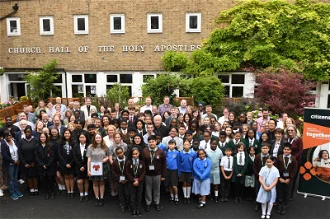
On Tuesday 2nd July, more than 200 young people, teachers and school leaders from all over England and Wales gathered in the parish hall of the church of the Holy Apostles, Pimlico. The event was arranged by a team of teachers and chaplains who work in Catholic schools and are engaged with Citizens UK.
Fr Dominic Robinson SJ, Chair of Westminster Justice & Peace Commission, and Colette Joyce, the Co-ordinator, were both present to learn more from the young people and other leaders about the work of community organising in schools around the country.
We gathered to celebrate the existing Community Organising work taking place in our schools, and inspire others to get involved. The event also served to launch a new ‘Catholic Social Teaching and Community Organising toolkit for schools and colleges’.
Cardinal Vincent Nichols opened the event with a discussion of his previous work with Citizens UK and reminded everyone that we are all on a “journey guided by our faith, strengthened by hope, and led by our desire for charity and justice.” Following this, he offered his prayers and blessing for Citizens UK’s organising work in Catholic schools and colleges, including the new toolkit, and agreed to share our work with Pope Francis on his next visit to Rome. There is a hope that a delegation can visit the Vatican to share this work in person.
Raymond Friel OBE, chief executive of Caritas Social Action Network (CSAN), reminded everyone of the upcoming year of jubilee and how schools can be ready to make pledges which links to their work with organising. He explained the connection between love and justice, and reminded everyone of Pope Benedict XVI’s call to have a “heart that sees”.
Anita Motha, chief executive of Million Minutes, celebrated the work of the different campaigns that young people had been involved in as well as reminding the young people that they are the “living catalysts for change”. “You are inspiring!” she told the audience which contained over 100 young people.
Schools and colleges that were featured in the toolkit celebrated and shared some of their work during the afternoon, where they have been living out the principles of Catholic Social Teaching through the model of Community Organising. Andy Lewis, Deputy Headteacher at St Bonaventure’s, East London, said, “It was a real coming together of so much great work – the achievements of these young people are incredible – securing the Living Wage at large companies, reduced bus fares for a whole region, ensuring greater funding for mental health support in schools. However it felt like only the beginning – we will now be working out next steps with the support of key Catholic organisations, and with the blessing of Cardinal Nichols, and look forward, in great hope, to sharing and celebrating this work with the Holy Father in Rome.”
Young people from our Catholic schools, confidently co-chaired the event and conducted a panel discussion with other young people engaged in Community Organising within Citizens UK chapters. One said: “Power can feel limited in this country, especially as we cannot vote, but when we work together we can be powerful,” while another said, “With our energy as young people, there can be a tsunami of change.” One student pointed out that young people are ready to “demolish the divides of our society and rebuild stronger.” and that, “Every win is a win, big or small, persist, try, try, try and try again.”
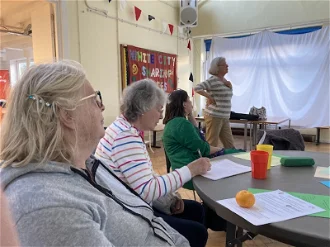
Fourteen Justice and Peace contacts from 10 parishes in Westminster met on Tuesday, 2 July, at Our Lady of Fatima Parish in White City, west London, to feedback on election activity in their churches. They were from White City, Isleworth, Hanwell, Ruislip, Feltham, Enfield, Ponders End, Wealdstone and St Albans. Participants included Fr Dominic Robinson SJ, parish priest of Farm Street and Chair of the Westminster Diocese Justice and Peace Commission, and Colette Joyce, the Westminster Justice and Peace Coordinator.
The evening started with an opening liturgy and a tour of the parish, led by Parish Priest Fr Richard Nesbitt and Hilda McCafferty, who coordinates justice, peace and ecology work. The group was impressed with the multiple initiatives for social justice and care of God’s creation. Even space around the church, once fairly bare, has been transformed into a green oasis promoting biodiversity and composting. Inside the church doors was a display of the parish’s LiveSimply Award, ‘Love in Action’ programme, and Fairtrade project. Around the church, stained-glass windows, created by London artist Mark Cazalet, contained images which reflected the multi-cultural nature of the parish and background outlines of the White City landscape. In two collages, saints of colour – such as Josephine Bakhita, Martin de Porres and Andrew Kim Taegon – were honoured alongside Bernadette of Lourdes and Maximilian Kolbe.
The parish centre is a community hub and it houses a ‘Reduce, Reuse and Recycle’ upcycling centre and a foodbank. Single use plastic is banned. On Saturdays it hosts a weekly vegetarian meal, open to the local community.
After shared refreshments, a presentation in the hall was given by Hilda and Fr Richard, highlighting parish advocacy work for Justice and Peace. In 2021, during the UN’s COP26 on Climate in Glasgow, a ‘Parliament in the Parish’ was organised involving local MP Andy Slaughter. He was there again more recently on 17 June for hustings of the Hammersmith and Chiswick Constituency and hosted by Hilda. Around 80 people attended, and issues raised included Cost of living, Disability, and Assisted Dying.
This was followed by feedback from other parish contacts and discussion on engagement with the 2024 General Election. This ranged between encouraging Catholics to attend hustings hosted by Anglican parishes – including St Alban’s Abbey – advertising election materials offered by the Bishops’ Conference and others, to items in parish newsletters and bidding prayers. A few parishes had scant engagement. “The parish team seems to feel it is not appropriate to push a certain agenda,” reported one participant, despite issues highlighted being rooted in Catholic Social Teaching. Cardinal Vincent Nichols’ video encouraging participation in the General Election was valued.
There was a recommendation that J&P people make a note of commitments from candidates on issues of concern to Catholics so that they can be reminded about them after the election. The new government must be held to account.
Colette reported that Westminster J&P will be at the National Justice and Peace Network Annual Conference in July, which will focus on ‘Just Politics’. Next year, that conference will focus on Politics and Peace. In the current tragic circumstances of the Holy Land, Westminster’s Commission is discerning how to make their witness for peace more effective? There will also be work on the 2025 Holy Year and it was noted that CAFOD and CSAN are currently working on resources. For the coming academic year, the Commission’s focus is likely to be on ‘Formation’ and the growth in Justice and Peace Groups.
Fr Richard led a final prayer, “for a new kind of politics which serves the common good.”
Fr Dominic Robinson SJ (Chair), Colette Joyce (Co-ordinator) and Ann Milner (Hitchin) from the Justice and Peace Commission represented the Diocese of Westminster at an Interfaith Peace Walk in Central London on Sunday 23rd June 2024. We joined Christians from several denominations and members of other faith communities to walk in solidarity in a silent, yet powerful, call for peace. In the face of escalating violence and loss of life in over 100 wars and armed conflicts worldwide, including in Palestine and Israel, Sudan, Ukraine, and Myanmar, around 500 people of all faiths joined the vigil.
Facilitated by Plum Village UK and Quakers in Britain, this second peace walk, held by popular request, reflected a groundswell of calls for peace in London and inspired events in Washington, Los Angeles and France on the same day.
The walk commemorated people killed in war, alongside a call for the cessation of killing and reflected a shared commitment to nonviolence, reconciliation and a just peace.
Muslims, Jews, Christians, Buddhists and many more faiths joined the walk from Parliament Square to Trafalgar Square and back, weaving a narrative of peace between the city’s key political landmarks.
Without flags, placards, slogans or chants, participants dressed in mourning to remember the loss of life through war.
They carried hand-made white flowers as a reminder that everyone has a role to play in cultivating a more peaceful world.
Prayers were offered by a diverse group of grassroots faith representatives: Lakshmi Vyas (Hindu), Shahin Bekhradni (Zoroastrianism), Maureen Goodman (Brahma Kumaris), Islam, Rabbi Rebecca Birk (Judaism), Rev Sarah Farrow (Christian), Jinali Meisheri (Jain), Sr Dao Nghiem (Buddhist), Cristina De Rossi (Pagan, Wiccan, Druidry), and Koje Freemantle (Baha’i).
Plum Village Buddhist monastics from France attended the walk, which was supported by key aid organisations Christian Aid and the Salvation Army.
Rehena Harilall, co-organiser from Plum Village UK, said: “There are simply no more words left to convey our anger and grief.”
Judith Baker, co-organiser from Quakers in Britain, said: “We walk together because we share a deep love for creation and a common universal language of peace. We share horror at the desecration of creation that war brings. War is failure to love our neighbours as ourselves; failure to seek peace and pursue it; failure of dialogue and diplomacy; failure to uphold the basic principles of international law and ethical norms. But the possibility of peace is always with us.”





 Diocese of Westminster Justice and Peace Commission