On Thursday 17 November, the Diocese of Westminster presented awards to eleven volunteers or groups of volunteers for their work in responding to needs in their parishes and communities. During the evening special mention was made of two individuals who had committed their lives to volunteering, and improving the lives of those around them. Bruce Kent, well known activist and campaigner for peace, and Libby Biberian, a volunteer at Caritas St Joseph’s.
Fr Joe Ryan, former Chair of Westminster Justice and Peace, gave this tribute to Bruce’s life and work:
“I have known Bruce Kent for over 50 years, firstly as a fellow-priest of the Archdiocese of Westminster. He was Secretary to Cardinal Hennan. As University Chaplain, he secured the premises at Gower Street and in priestly ministry I had always found him inspiring, encouraging and totally dedicated in his love of God and his fellow human beings.
One can only stand in awe at the breadth and depth of his varied concerns for others.
His vision was local but also there were no limits to his horizons.
In five minutes how could anyone deal adequately with his involvement and leadership in the Campaign for Nuclear Disarmament (CND): Abolition of War; Amnesty International; Pax Christi; Social Justice; Human Rights; Geneva Conventions; Rights of Prisoners; His extensive Letter Writing and Prompting notes to Leaders; Ethical Investments; Parish involvement….. and much more
All this involvement done with sincerity, clarity and a sense of humour.
Whether you were rich or poor; powerful or less-so; Bruce treated each person with the same dignity and respect.
He was a gifted speaker with natural authority. He had a razor-sharp intellect always able to get to the kernel of his topic in the minimum of words. His clarity of thought and his Christian faith brought light and direction to many of us struggling with complex arguments around subjects like war and peace and the care of our planet.
He was all the time probing as to the underlying causes of injustices and human tragedies. This was where many people saw him as a threat. It was like Archbishop Helder Camera who once said:
“When I feed the hungry, they call a saint, but when I ask why the poor are hungry, they call me a communist”
When I replaced Bruce as parish priest in St Aloysius, Somers Town (Euston), our friendship entered a new phase. I had seen the work he had done in the parish and beyond and found it all so inspirational and uplifting. Personally, I am very much in debt to Bruce also for his encouragement during me thirteen years as Chair of the Westminster Justice and Peace Commission.
And a new image of Bruce! I could see him as God’s ventriloquist or the ventriloquist of the Holy Spirit! One who spoke on behalf of others who had no voice of their own. Jesus needs our hands, our hearts and our voices today to proclaim the Gospel message with clarity and conviction. Bruce did this with distinction!
As we celebrate this award, given posthumously, and accepted by Valerie, his wife, there are a few important items for us all. The best way to pay tribute to Bruce is to take up maybe just one of the many concerns he had in his life. His tireless concern for the poor, the marginalised, those in whatever need they find themselves, the asking of relevant questions – these are the ways we can keep Bruce’s memories alive”.
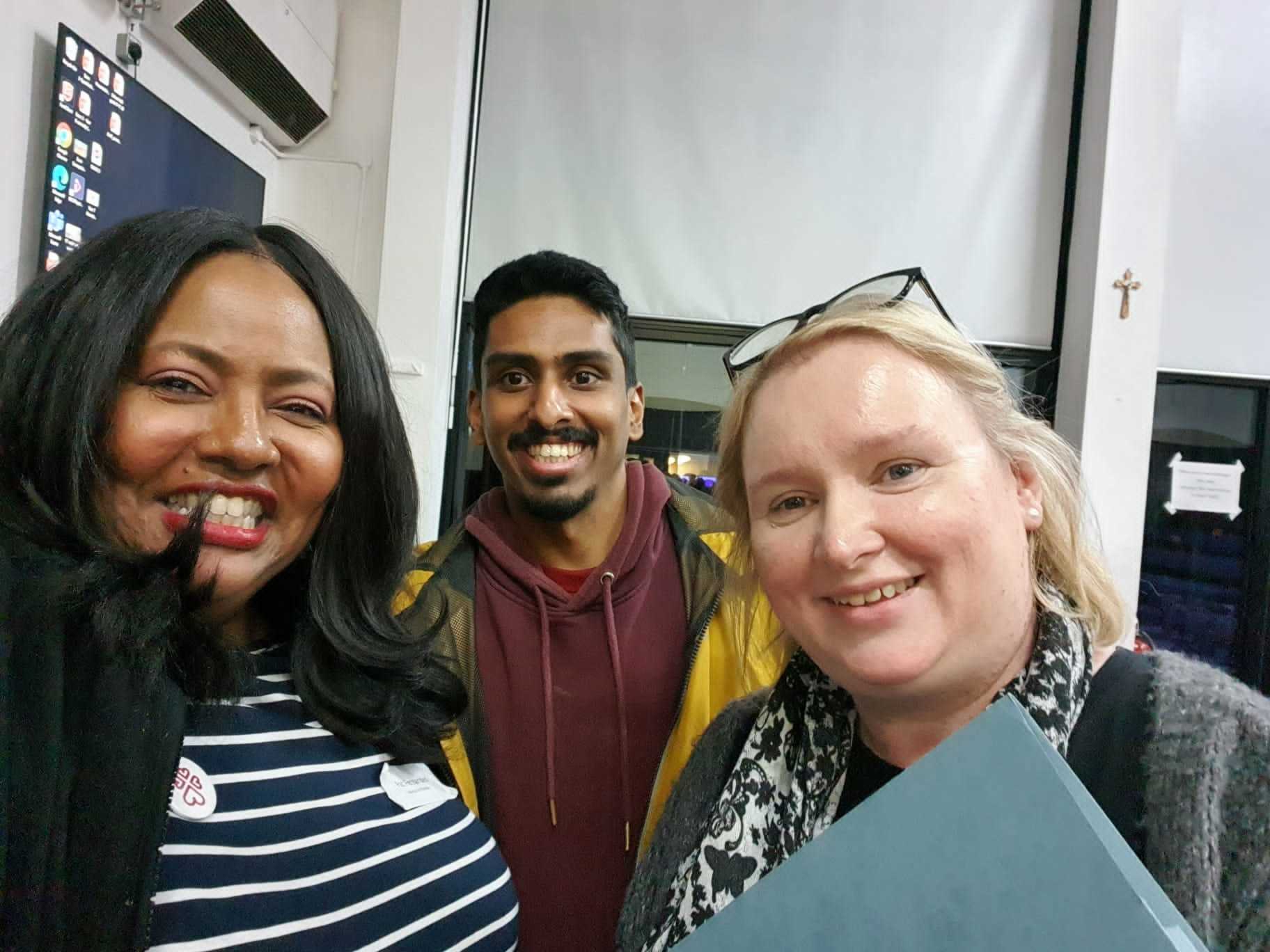
Pat Fernandes (Advice for Renters) with Elroy and Laura from White City Parish, where a Community Hub has already been set up to promote social and economic inclusion
On Saturday, 12 November, 56 people from 38 parishes and schools across London and Herts came together to learn more about how they can support their communities in the current Cost of Living Crisis.
The conference was organised by Caritas Westminster alongside Advice for Renters as part of our response to the financial difficulties that are hitting many people in the Diocese at this time.
Sr Silvana Dallanegra, Financial Resilience Lead for Caritas Westminster, was one of the main organisers, with Pat Fernandes from Advice 4 Renters Money. She says: “Our aim wasn’t to tell people how grim things are – they know that already. Our aim was to equip and strengthen them with knowledge and resources around the solutions that are out there, and the organisations that can help. We also wanted to give them more confidence around how to have conversations with people who might be struggling, and how to support them in accessing the help and advice they need. And we also hoped everyone would get the chance to network, and begin learning from each other – which, judging by the buzz during group discussions and breaks, certainly happened!”
Attendees were able to attend a variety of workshops to learn more about debt, loan sharks, credit unions, saving energy and other solutions, in order to better support people in their communities. They were also told about Firm Foundations, our bespoke training programme for Money Champions, which we are planning to run again in 2023. Many of those who came are already helping people as members of the Society of St Vincent de Paul (SVP), and through provision of food, distribution of supermarket vouchers or other social outreach projects. Everyone said how informative, useful and eye-opening all the sessions had been.
Nicholas O’Donnell from Knebworth SVP said: “This was my first time at this type of event, and I loved the whole day. I have made some useful contacts and learned so many things which will help me in my work. I also benefitted from having Bishop Paul share some of his experience.”
Anne Lamont, from West Green parish told us that the day contained “An excellent range of information, plus the opportunity to network and share ideas – I only wish we could have had longer! I felt we were given practical ideas for action, and for living out Catholic Social Teaching. I’m taking all these ideas back to my parish’s Live Simply group, so that we can consider what practical support and advice we can offer to parishioners in need.”
Workshops were delivered by experts from Advice for Renters Money, Green Doctors, Illegal Money Lending Team, Community Money Advice, London Capital Credit Union and Acts 435, and attendees also had a chance to meet each other and share ideas. Caritas Westminster would also like to thank Andrew O’Neill and his staff at the conference venue: All Saints Catholic College in Ladbroke Grove.
Bishop Paul McAleenan, Chair of Caritas, was present throughout the day. Summing up at the end he commented on how he had been struck that the emphasis throughout – in the presentations and the discussions – was less on the issue or problem, and much more on the person at the heart of the matter. This, he felt, was a clear emphasis on each one’s God-given dignity and worth.
The conference took place on the eve of the World Day of the Poor – a day for to renewing commitment to solidarity with those in our community who are struggling or marginalised. This can be hard when we are all beginning to feel the pinch, but the Pope, in his message for World Day of the Poor 2022 says: “This is the moment for us not to lose heart but to renew our initial motivation. The work we have begun needs to be brought to completion with the same sense of responsibility.”
The conference on Saturday aimed to enable volunteers in social outreach projects to go beyond providing emergency support, to walking alongside people as they find ways to solve problems and reach their potential.
As the Pope also said in his message: “Where the poor are concerned, it is not talk that matters; what matters is rolling up our sleeves and putting our faith into practice through a direct involvement, one that cannot be delegated.”
Westminster Justice and Peace at the Global Day of Action, The Strand, London for COP27, 12th November 2022
COP27 GLOBAL DAY OF ACTION MOBILISATION, SATURDAY 12TH NOVEMBER, 11.30AM, LONDON
Westminster Justice & Peace joined CAFOD, the Southern Dioceses Environment Network, Christian Climate Action, Christian Aid, Tearfund, Quakers, Buddhists, Faith for the Climate and many other civic groups on Saturday 12th November for the Global Day of Action rally in Central London on the middle Saturday of COP27, the UN Climate Conference.
The faith bloc gathered at St John’s Church Waterloo, where they were welcomed by Rev Canon Giles Goddard and prayers were said in the garden, before moving to join a larger crowd outside the head office of oil giant Shell building on the Southbank.
Among these were health workers, scientists and campaigners highlighting the plight of climate refugees. Eco-Sikh called for a ‘Loss and Damage Fund Now’. Then thousands marched to Trafalgar Square for a rally.
Colette Joyce, coordinator of Westminster Justice & Peace Commission, who led the Westminster Justice & Peace group on the march said: “The urgency is growing with each year that passes, and so we can and must keep the pressure on to demand tangible results this time.”
Banners carried by pupils from St George’s Catholic Secondary School, Maida Vale
Our first speaker wasPaul Chitnis, Director of Jesuit Missions
Jesuit Missions is the Mission and Development Office of the Jesuits in Britain.
Based in Wimbledon.
Work in countries in Southern Africa, parts of India and Guyana.
Paul was previously Director of SCIAF, the development agency in Scotland, sister agency to CAFOD.
He was present at COP26, along with his colleague Colm Fahey.
He is not attending this year.
COP27 (6-18 November 2022) is taking place on the African continent for the first time.
One of the main drivers of hunger in Africa is climate change.
Seeing the impact of climate change everywhere, floods in Pakistan, droughts in Africa, fires in Australia.
The political context this year is significant. Attention of the world has been diverted by the war in Ukraine. The bandwidth of our political leaders for climate change has been reduced.
On the agenda for COP27 – as usual ‘adaptation’ and ‘mitigation’ measures.
There will also be an emphasis this year on’ loss and damage’ – compensation for losses due to climate change for which adaption is not possible.
World leaders were in attendance at COP26 which had an impact on the country negotiators and the civic society activists present. There are likely to be fewer world leaders present this time.
Finance will be key. The conference will succeed or fail depending on funding. ‘Follow the money’ – that is where the answer will be.
Has to work quite hard personally to remain optimistic after many years working for climate change. Only have to watch ‘Frozen Planet’ on a Sunday night to see the impacts. Faith communities have a role to play because they offer hope and he is hopeful.
Final question: What happens if we do not meet these targets from the Paris Agreement?
Paul’s presentation was complemented by a presentation fromBishop John Arnold, Bishop of Salford
Evidence is overwhelming in terms of the climate damage that is happening.
Great damage being reported today from storms in Venezuela.
In September a climate disaster seemed to be reported every day.
Good news from some governments speaking up in the last few months Australia, New Zealand, US (although not consistently), Denmark, Singapore.
Encouraging because governments have to take the lead, industry has a part to play, and each of us individually must do our part.
Pope Francis is consistently encouraging.
Our government has not been helpful. During process of whittling down candidates for conservative party leader from 11 to 2 there was one mention of the environment by one candidate. Obsession with growth for the economy is misplaced. Helps neither the poor nor the environment. Hopefully restarting fracking will not happen. Local resistance in Lancashire.
First activity in Glasgow last year was a multi-faith prayer service in George Square. Each of 9 major faiths, including Pagans, led a prayer and he couldn’t disagree with any of it. All major faiths have a concern for the world in which we live.
85% of the world population adhere to one of those faiths. Presents a real opportunity for faith leaders to conjure more enthusiasm.
Young people are so much more enthusiastic and learned. Schools love visiting the Laudato Si’ Centre in Salford. Over 100,000 turned up for the young people’s rally in Glasgow.
Deforestation Agreement was good but even as Brazil was signing the promise it was increasing deforestation of the Amazon by 15%.
Loss and Damage – $100 million sounds a lot but it is not. It is vital life-saving money. Up to 1 billion people might migrate by 2050 because of the loss of agricultural land and heading to the places that are able to produce food. Very short-sighted not to care for people already affected by climate change.
Disappointed that the Prime Minister has told King Charles not to go to COP-27. His long-standing commitment and experience would be helpful.
Haven’t seen much evidence that best intentions have been implemented. IPCC say at the moment we are heading for 3.2 degrees increase.
Good things – increasing understanding of the environment. More and more groups are aligning. Pope Francis film ‘The Letter’ gives a very clear appeal and should be recommended far and wide.
‘We are jogging along but we need to be sprinting.’
Small Group Discussions…
We considered the question:
Sam Baker’s Walk2COP27 has started. It is a journey to gather people for a common cause. What would you talk about with a stranger to bring people together?
The Letter: Laudato Si’ Film Released 4th October 2022
The West London Justice and Peace Network meets three times a year, bringing J&P activists together from a dozen or more parishes across West London. On Saturday 8 October, it was delighted to hear Nigel Parker – Director of the Catholic Union of Great Britain – talk about its work.
Established in 1870, only a few decades after Catholic Emancipation, when anti-Catholic discrimination was high, the Catholic Union was a voluntary organisation aimed at influencing public policies of interest to Catholics. At the outset, it probably consisted only of the ‘great and the good’ but it now has 1,300 members and it is open to all lay Catholics.
Nigel explained that it is non-party political and that its officers are elected to reflect all political parties. The current president is Sir Edward Leigh (a Conservative) who succeeded a Labour peer. Its website reports that it is “a membership organisation dedicated to the defence of Catholic values in parliament and public life, and the promotion of the common good”.
In practical terms, the Catholic Union makes submissions to parliament and government; it comments on current events; it meets with ministers and special advisers etc. It has a broad range of interests ranging from beginning to end of life issues to social justice, human rights, religious freedom issues. The staff team is small and the Union therefore makes a very conscious effort not to duplicate the work of other groups such as CSAN/CAFOD/ACN/PACT/SVP etc. but instead tries to add value to their efforts.
There is a particular emphasis on religious freedom and freedom of conscience, and it works via a mixture of education, public lectures, webinar events. In the fairly recent past, it has addressed issues such as: covid and the closure of churches; the murder of David Amess and the importance of access to last rites even (or especially) at crime scenes; hate speech legislation; Public Space Protection Orders (and protests outside abortion centres); freedom of conscience for pharmacists; the Bill of Rights Bill and other foreign and defence policies. The Catholic Union works alongside many other groups and tries to represent the many issues of concern to the 4.5m Catholics in the country.
Members of the Network were interested in how strategies and priorities are set by the Union; how at the parish level we can effectively lobby our public representatives; and more information about the Union’s work across the gamut of justice and peace issues. Nigel explained that membership gives access to a weekly parliamentary briefing; encourages active engagement via committees and monthly briefings; and includes an invitation to an annual summer gathering. Though they have consultative status with the Bishops’ Conference, and work closely with the bishops, they are a lay organisation and set their priorities according to the concerns of the Catholic laity across Great Britain.
Their website also carries detailed practical advice for those people wanting to lobby their local MP on concerns around refugees, climate justice, poverty, prisoners, racism or other J&P issues. Members of the West London J&P network reported on their efforts to influence local elected politicians on a broad array of social justice and peace issues, and how useful it was to learn how they might best cooperate with the Catholic Union, which is doing the same at the national level.
Central London Catholic Churches guest, Richard Jackson, talks to Jon Kuhrt (left) and Mick Clarke (right) at the Homeless Panel at Farm Street Church on 28th March 2022
In March 2022, Westminster Justice & Peace together with Central London Catholic Churches hosted a panel discussion at Farm Street Church entitled ‘Homelessness and the Pandemic: what have we learnt?’
Six months on, we invited our speakers from that panel to record their thoughts on where we are at now, especially with respect to homelessness in London. Listen to the podcast here.
Listen to the podcast, recorded for World Homeless Day 2022
Watch Bishop Paul McAleenan’s Summary of the ‘To Accompany Refugees’ Forum meeting
On Saturday, 17th September people from around the Diocese of Westminster joined Bishop Nicholas Hudson and Bishop Paul McAleenan for the Westminster Social Justice and Peace Forum on Zoom.
The theme of the forum was ‘To Accompany Refugees’, and took place on the weekend proceeding World Day of Migrants and Refugees.
The forum was chaired by Bishop Nicholas Hudson who underlined that this was an opportunity to explore what the response in the ecclesial community in Westminster has been.
Megan Knowles, Communications and Development Manager for JRS UK, spoke about the experience of accompanying refugees in an increasingly hostile world. She spoke about the primary work of JRS being accompaniment, and specifically the accompaniment of people experiencing destitution as a result of being given no recourse to public funds. This looks like ‘being with, rather than doing for’. She spoke about how people at this point in the asylum system are in a ‘legal-limbo’, isolated with significantly reduced access to healthcare during a prolonged and anxiety inducing time. JRS supports in a variety of ways, including having a hosting scheme, a pantry and befriending.
Pattie Gercke is the Development Worker for Compassionate Communities, which is the social action arm of the Diocese of London. Pattie presented from the ecumenical perspective and how churches in the Diocese of London are engaged in the welcome of people seeking sanctuary. Ecumenism was a strong theme of the forum. Pattie shared that church response looked like practical support such as access to work, ESOL provision, hosting, education, healthcare, digital access, provision of food, clothing as well as legal and rights-based support. The value, however, of non-material forms of support was highlighted; for instance the importance of relationship, sitting, sharing space, listening and providing spaces of welcome. Further, it was highlighted that churches are repositories of social capital and that this social capital can be used to support integration. The importance of enabling a wider audience to hear the stories and theologies of people in the asylum system was discussed.
The forum then heard from Danny Coyle who presented the school experience, specifically the transformation of Newman Catholic College in Brent when they became a school of sanctuary. There had been an immediate positive effect of welcoming and integration sanctuary seeking pupils and their parents in the school. They developed a unique and bespoke curriculum to meet the needs of those coming from overseas from conflict zones. There was a particular focus on language which enables pupils to unlock other parts of the curriculum, which pupils were keen to embrace. The academic needs of pupils are placed alongside their emotional needs, and pupils are entered onto different pathways. The school has a Refugee Coordinator. Support of Caritas Westminster for the school’s annual Syria Summer Camp, where pupils take part in varied and enriching activities. These camps have gone from strength to strength with volunteers from a sanctuary seeking background being involved. The key takeaway was that if correct structures are put in place, refugee students and their families can flourish.
The final presentation came from Teresa Clarke who is a parishioner at St Bartholemew’s Parish in St Albans who is directly involved in refugee accompaniment through the Church’s conversation group. Teresa shared how ecumenical work, as well as responsiveness to the needs of the asylum seekers that they are supporting has transformed the project. The group provides emotional and practical support to asylum seeking men at a local hotel and works with 10% of residents. The value of engagement with local MPs was underlined, with the group having strong connections with Daisy Cooper MP. The group is part of a network with other churches in the area providing support. The group hold forums to hold the hotel to account with regards to need for good food and appropriate clothing for the guests. Alongside this the group held a refugees Information Exchange where asylum seekers shared experiences and information, offering help and support. There is a significant challenge of transport, where the location of Noake hotel is a barrier to asylum seekers making connections in the city. This lead to an initiative whereby spare bikes were donated, and so far, the project has received 55 bikes which are fully serviced by a bike mechanic. Herts County Council are offering Bike Ability training while the conversation group support as they gain confidence in these sessions.
After the presentations, attendees went into breakout rooms with each of the speakers to discuss questions relating to the topics that had been presented. These were:
What are the most effective ways to assist refugee and migrant groups, what are the challenges and what else can we do?
It was an opportunity for discussion before joining back with the main group to share experiences, observations and questions.
Plenary Feedback
How to balance being with and doing with. Context of the whole person. How to accompany people who have and are experiencing trauma.
Partner with expert services.
How to support people, especially women facing domestic violence.
Ecumenical working and that how could operate
Joined up working between churches, looking at modeling St Albans, not working elsewhere necessarily.
Working alongside interfaith groups
Joined up working
Campaigning and advocacy more difficult, fundamental systems change – HO not listening.
Range of needs for refugees and asylum seekers, different circumstances and needs.
Challenges because of the cost of living. Need of financial assistance, winter, facing difficulties.
Challenges getting churches to communicate.
What else can we do – sharing information, what is going on where.
Need for greater awareness of what is going on for asylum seekers.
Hard to balance the media portrayal of refugee help as a very hard thing;
How to keep people compassionate enough to help?
Keep learning from other people and always try to be flexible;
The best answer to the question is to share experiences.
How to stop the work of helping people from being overwhelming?
Think of how we speak about these matters language wise.
The Forum was summed up by Bishop Paul McAleenan, lead bishop for Migrant Issues, saying ‘Refugees are not statistics, but heart and flesh, human beings who must be helped.’
Westminster Caritas Refugees and Migrants Mailing List
Rosa Lewis, the Caritas Westminster Lead for Refugees and Migrants, convenes a quarterly meeting for everyone in the Diocese of Westminster concerned about refugees and migrants. To be added to her mailing list please email rosalewis@rcdow.org.uk
Home Office Prayer Vigils
You are warmly invited to join Barbara Kentish (Westminster Justice & Peace), Br Johannes Maertens (London Catholic Worker) and others to participate at the vigils outside the Home Office or to pray along at home on the third Monday of every month, 12.30-1.30pm.
Next Vigil: Monday 17th October 2022, 12.30-1.30pm
Southern Dioceses Environment Network 12th September 2022: Presentation by Shanon Shah, Director, Faith for the Climate
We were delighted to welcome Shanon Shah, the Director of Faith for the Climate, as our guest speaker for the first meeting this term of the Southern Dioceses Environment Network.
Faith for the Climate is a network that aims to equip, inspire, and encourage faith inspired action on issues of climate change across the UK. All faiths and spiritualities are welcome.
Shanon Shah is a Malaysian Muslim who came to the UK in 2010. He joined the team at Faith for the Climate in 2020.
The organisation aims to unite those of faith together in the environmental justice space and to encourage learning from the different faith traditions. It was a way to target the UK government and show solidarity with those who suffer the worse impact of climate change despite doing the least to contribute.
The group meet regularly online with two priorities in the lead up to COP-26: new and additional money for loss and damage, ending fossil fuel subsidies. The UK government has made some progress with the second focus, therefore, most energy was focused on loss and damage.
Loss and Damage is part of the architecture of the Paris Agreement which includes three main pillars of climate action; mitigation of climate emissions, adaption to live with the impact of climate change, loss and damage. Loss and damage is when the impact of climate change is so severe that adaption/mitigation is not possible e.g. as a result of sea level rises, extreme weather events.
The UK government has historically blocked negotiations on loss and damage.
At COP-19, in 2013, the Warsaw international mechanism for Loss and damage was established in response to the typhoon Haiyan in the Philippines. At COP-25 in Madrid, the Santiago network on loss and damage was established to implement the Warsaw mechanism. It called for richer countries to offer compensation. At COP-26, there was a push for clarity on how the Santiago network would be implemented.
The Glasgow Dialogue on Loss and Damage was established post COP-26. Many questions on how to address the issue are undecided, but it is climbing the agenda with the first awareness day last year. This is largely due to the efforts of faith communities.
The UK has faced financial difficulty this year due to the war in Ukraine, cost of living crisis etc. which has made it more difficult to talk about loss and damage. Despite our own issues we must not forget countries such as Pakistan which is now 1/3 under water with the displacement of 50 million people and 10 billion US dollars’ worth of damage. These poorer countries are suffering the worst effects of climate change despite contributing the least. The impacts of extreme weather events are far greater for them and they are still struggling with debt.
It seems only fair that the big polluters have the most responsibility to pay compensation for loss and damage. It is a moral issue that lies at the centre of many faiths; we are all interconnected.
The next Loss and Damage Awareness Day will be on the 22nd September; including a walk of witness to Parliament Square via the Shell headquarters. Gathering at St. John’s Church, Waterloo, 10.30am. It will join those doing an interfaith fast for loss and damage.
22 September – Loss and Damage Awareness Day 10.30am Meet at St John’s Waterloo, 73 Waterloo Rd, London SE1 8TY 11.30am Walk to the Shell headquarters for a vigil 12.00pm Walk to Parliament Square Loss and Damage Day of Action London
We then broke into small groups to consider the question: “In what ways does the topic of Loss and Damage resonate with this year’s theme for the Season of Creation – Listen to the Voice of Creation?”
Hiroshima Day, 6th August 2022, Outside Westminster Cathedral
Westminster Justice & Peace joined Pax Christi, London Catholic Worker and other peace campaigners to remember the devastation caused by the atomic bombs dropped on the Japanese cities of Hiroshima and Nagasaki on 6th and 9th August 1945.
We mourned for those who lost their lives, prayed for an end to nuclear weapons and handed out leaflets to visitors to the Cathedral.
On 9th August, the 77th anniversary of the atomic bombing of Nagasaki, we also joined a procession from Westminster Cathedral – following the memorial service for Blessed Franz Jagerstatter – to the Peace Pagoda by the Thames in Battersea Park, led by Buddhist monk the Rev Gyoro Nagase with several monks and a nun from the Nipponzan Myohoji Buddhist Order.
Arriving at the Peace Pagoda, we were welcomed by Mr Shigeo Kobayashi from Japan Against Nuclear (JAN).
Colourful lanterns on the steps of the pagoda represented souls of the 74,000 people who perished in the bombing in 1945.
The monks led prayers and ceremonies with incense and chanting for all victims in Nagasaki and offered prayers for peace in the world.
Fr Alan Gadd, from the South London Interfaith group, offered a Christian prayer. Hannah Kemp-Welch, CND co-chair, gave a brief address in which she voiced fears over the increasing tensions in the world where so many countries have nuclear weapons.
Shigeo Kobayashi spoke about the urgent necessity of implementing promises made in the nuclear non-proliferation treaty and hopes for the tenth Review Conference of Parties to the treaty (#NPTRevCon) which is currently taking place at the UN in New York. He said the danger of a catastrophic accident has never been greater – pointing out that the bomb on Nagasaki was actually an accident – the original intention was to drop it somewhere else but plans were changed because of the weather.
The Peace Pagoda was presented to London in 1984 by the Venerable Nichidatsu Fuji, founder of the Japanese Buddhist movement, Nipponzan Myohoji. Following the atomic bombing of Hiroshima and Nagasaki, he pledged to build pagodas worldwide as shrines to peace. Altogether, there are now 80 peace pagodas worldwide.
“Civilisation is not to kill human beings, not to destroy things, nor make war; civilisation is to hold mutual affection and to respect one another.”
Rev Fuji
All are invited to join us next year to mark the 78th anniversary of the bombings and to continue, in the meantime, to work for an end to these weapons so that all may live without fear of them ever being used again.
The use of #NuclearWeapons, as well as their mere possession, is immoral. Trying to defend and ensure stability and peace through a false sense of security and a “balance of terror” ends up poisoning relationships between peoples and obstructs real dialogue. #NPTRevCon
About 160 people gathered from across the country for the 44th Annual Conference of the National Justice and Peace Network at the Hayes Conference Centre in Swanwick, Derbyshire. There were 12 representatives from the Diocese of Westminster. Particular thanks go to Assumption Volunteers Angel, Chris, Amy and Tra-My who ran the Just Fair stall for Westminster Justice and Peace this year. Over the course of the weekend they collected answers to synod-style questions on the environment and racial justice (two priority areas for Westminster Justice and Peace) which we hope to collate and publish soon.
Keynote speakers throughout the weekend explored the conference theme of ‘Hope’.
Irish diplomat Philip McDonagh explored the meaning of hope, drawing on Pope Benedict’s encyclical Spe Salvi, especially the statement that “all serious and upright conduct is hope in action.” He felt “we should ‘image’ or visualise peace as the rightful possession of the human community as a whole,” despite current global conflicts. He felt that, “through developing a culture of dialogue or encounter in national, regional, and global politics we can transform our understanding of effective action and create the conditions for a different kind of civilisation.” He felt, “the National Peace and Justice Network is living proof that individual interventions in the name of justice and mercy reinforce one another and can support wider social objectives as well.” He pointed to the United Nations Sustainable Development Goals (SDGs) as already providing a medium-term common plan for humanity and called for consultative processes to include representatives of religion to underpin their implementation. “In this moment of fractured politics and dissolving ethics, renewed attention to religion as a source of unity is a bold and much-needed initiative,” he suggested.
Rev Dr Patrick Devine SMA spoke of his peace-building work in East Africa as chairman of the Shalom Center for Conflict Resolution and Reconciliation. Shalom seeks to identify, understand and address the underlying causes of conflict rather than just address the symptoms. Fr Devine spoke of dramatic, life-changing results in the areas of conflict transformation, peace education and poverty alleviation. Shalom researches root causes of inter-ethnic conflicts, trains local peace-builders, organises workshops to facilitate resolution and reconciliation processes between factions, and develops inter-ethnic and inter-religious schools. “Theory without practice is empty and practice without theory is blind,” he said.
‘Getting beyond Optimism to Hope: demonstrating or building the Kingdom in the world of politics,’ was the title of a presentation by Andy Flanagan of Christians in Politics and a singer-songwriter. He spoke of leading parliamentarians in singing about integrity, truth and justice at a parliamentary prayer breakfast in early July and a spate of government ministerial resignations which took place hours later! Christians believe that, “integrity is leadership is really important.” A firm believer in tackling the causes of injustice, he praised NJPN for its campaigning work over the years to promote justice and compassion. His music provided the Saturday evening entertainment.
Liturgies were organised by the Lay Community of St Benedict and both Catholic and ecumenical worship was offered. Conference planning partners included ACTA, Christians Aware, Joint Public Issues Team, and Stella Maris. Rev Ruth Gee, a Methodist pastor and patron of NJPN who led a service on Saturday afternoon, spoke of “being united by concern and passion for justice and peace and by a shared faith.”
Workshops included issues of domestic poverty and universal credit, Salford’s ‘Guardians of Creation’ project, restoring dignity to prisoners and their families, Church Action for Tax Justice and Interfaith work on Justice and Peace.
A preview of the film, ‘Finite: The Climate of Change’, which looks at non-violent direct action in Germany and UK to protect ancient forests from coal mines, attracted an audience of 60. https://www.finite-film.com/
A Just Fair hosted 25 stalls, including Together for the Common Good, Green Christian, Christian Climate Action, Columbans, Missio, World Community for Christian Meditation, Fairtrade, Palestinian Goods and Global Justice Now.
Food at the conference was guided by LOAF principles (Local, Organic, Animal Friendly, Fairly Traded).






 Diocese of Westminster Justice and Peace Commission