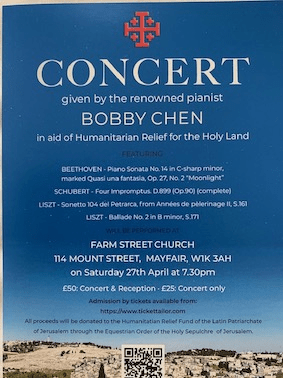
There is a chance to hear the renowned pianist Bobby Chen on Saturday, 27 April, when he gives a special concert in aid of humanitarian relief for the Holy Land at Farm Street Church, Mayfair, London. A reception will follow the concert.
All proceeds will be donated through the Humanitarian Relief Fund of the Latin Patriarchate of Jerusalem through the Equestrian Order of the Holy Sepulchre of Jerusalem.
Bobby Chen will play
Beethoven’s – Piano Sonata No. 14 in C-sharp minor, marked Quasi una fantasia, Op. 27, No. 2 Moonlight
Schubert’s Four Impromptus. D.899 (Op.90) (complete)
Liszt – Sonetto 104 del Petrarca, from Annes de pèlerinage II, S.161
Mist – Ballade No. 2 in B minor, S.171
The concert takes place on Saturday, 27 April 2024 at 7.30pm.
Farm Street Church, 114 Mount Street, Mayfair, W1K 3AH
Tickets are £50 for the concert and reception – £25 concert only.
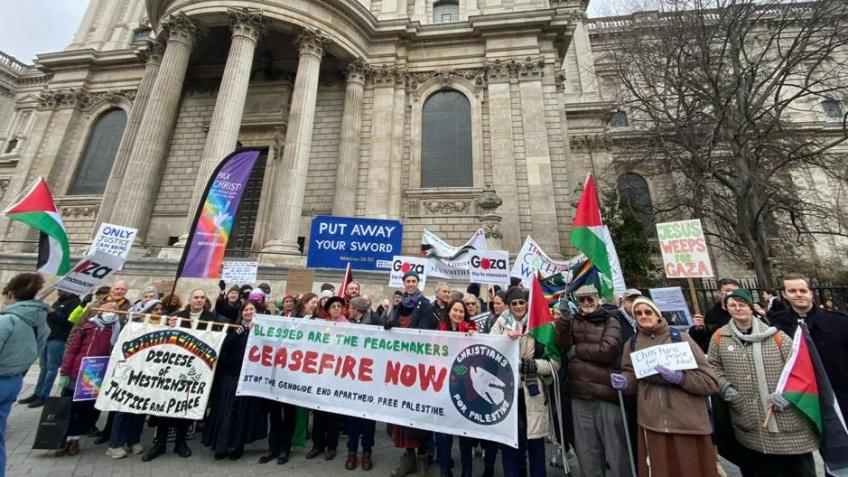
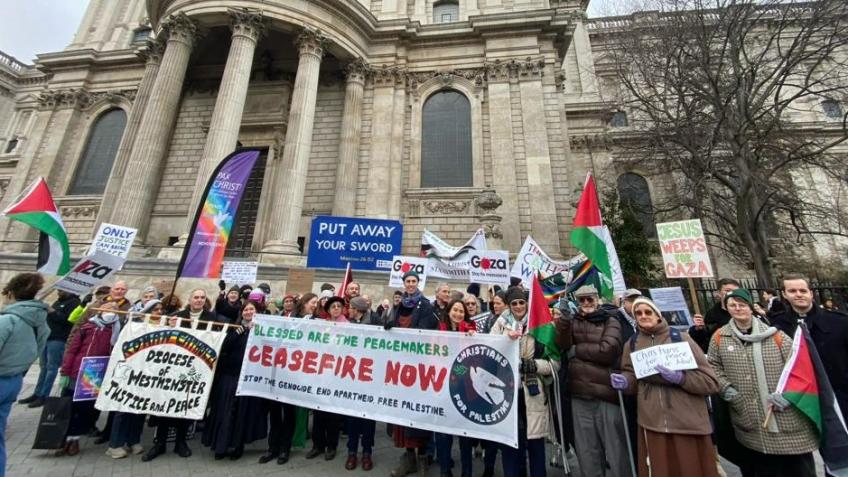
Christians for Palestine outside St Paul’s Cathedral, January 2024
Date: 9 May 2024 Time: 7:00pm – 8:30pm Venue: Our Lady of Victories, Kensington, 235a Kensington High St, London W8 6SF, UK
Westminster Justice and Peace began the Holy Land Roundtables in response to the horrendous series of events unfolding in our news bulletins since 7th October 2023, with first the massacre of over 1,200 people in Israel by Hamas and the taking of around 240 hostages, then full-scale retaliatory military action by the Israeli government across the whole of Gaza.
Six months later, the conflict continues to escalate, with homes and infrastructure destroyed, the entire population of Gaza facing famine, and more than 100 men, women and children still being held hostage. Now, there is an increasing threat of escalation of the conflict to other countries in the Middle East.
This Roundtable aims to gather together Catholics from across the Diocese with an interest in exploring our collective response as a community and asking what more we could do?
All are welcome to join us for our third meeting at Our Lady of Victories Parish Centre, 235a Kensington High Street.
We are currently setting up a working party to be responsible for the Roundtable and facilitating a Justice & Peace response in the diocese in five main areas:
1) Muslim, Christian & Jewish relations in Westminster Diocese. 2) Supporting local parish responses to the conflict. 3) Promoting prayer and liturgy for peace. 4) Assisting Christians and other communities in the Holy Land. 5) Campaigning for a ceasefire and ending weapons sales.
Please do come along to find out more or get in touch with the Westminster Justice and Peace Co-ordinator, Colette Joyce, on 07593 434 905 colettejoyce@rcdow.org.uk
The National Justice & Peace Network of England and Wales Annual Conference will take place at The Hayes Conference Centre, Swanwick, Derbyshire on 19-21July 2024.
The theme for the weekend is ‘Just Politics’ and the aim is to explore the need for truth and integrity in public life.
The conference welcomes Justice and Peace representatives from the Catholic dioceses of England and Wales and representatives of agencies with a focus on social justice.
As people of faith, and in an election year, how are we called to work towards honest dialogue and respectful listening in political and social engagement and seek good governance in all seats of power; local, national, and global? What is our gut response when we hear, via our news channels, that the forthcoming election will be full of ‘dirty tricks and muckraking’? How should we respond to such a depressing and alarming prediction? Is this the level of public discourse that we must accept?
During the weekend we will hear from Keynote speakers, take part in workshops, find resources and information in the ‘Just Fair’ and listen to the voices of young adults as they share their hopes and concerns for the future of our world.
Chair:
Sir John Battle will chair the conference, bringing his vast knowledge and experience of Catholic Social Teaching in action both in the political sphere and in community engagement.
Speakers:
Dr Guli Francis-Dehqani, Anglican Bishop of Chelmsford, will explore some of the dynamics of public discourse, the implications for individuals and society, some possible solutions and opportunities for Christians and the Church to play a positive role.
Molly Scott Cato, Former Green MEP and currently Finance and Economy Spokesperson for the Green Party, will speak about how untruth is undermining democracy.
Steve Whiting, former manager of the Quaker Turning the Tide Programme, will start to pull together what we have learned from speakers and workshops and help us identify common themes.
Colette Joyce of Westminster Justice and Peace Commission will facilitate the session with young people speaking about their concerns, what action they can take and what they look for from others.
The final part of the conference be facilitated by Fr Chris Hughes and Sara Bryson who will share and describe how they have used community organising in campaigns with Tyne and Wear Citizens. They will focus on how participants accept the challenges raised during the weekend and how we move forward in our action for peace and social justice.
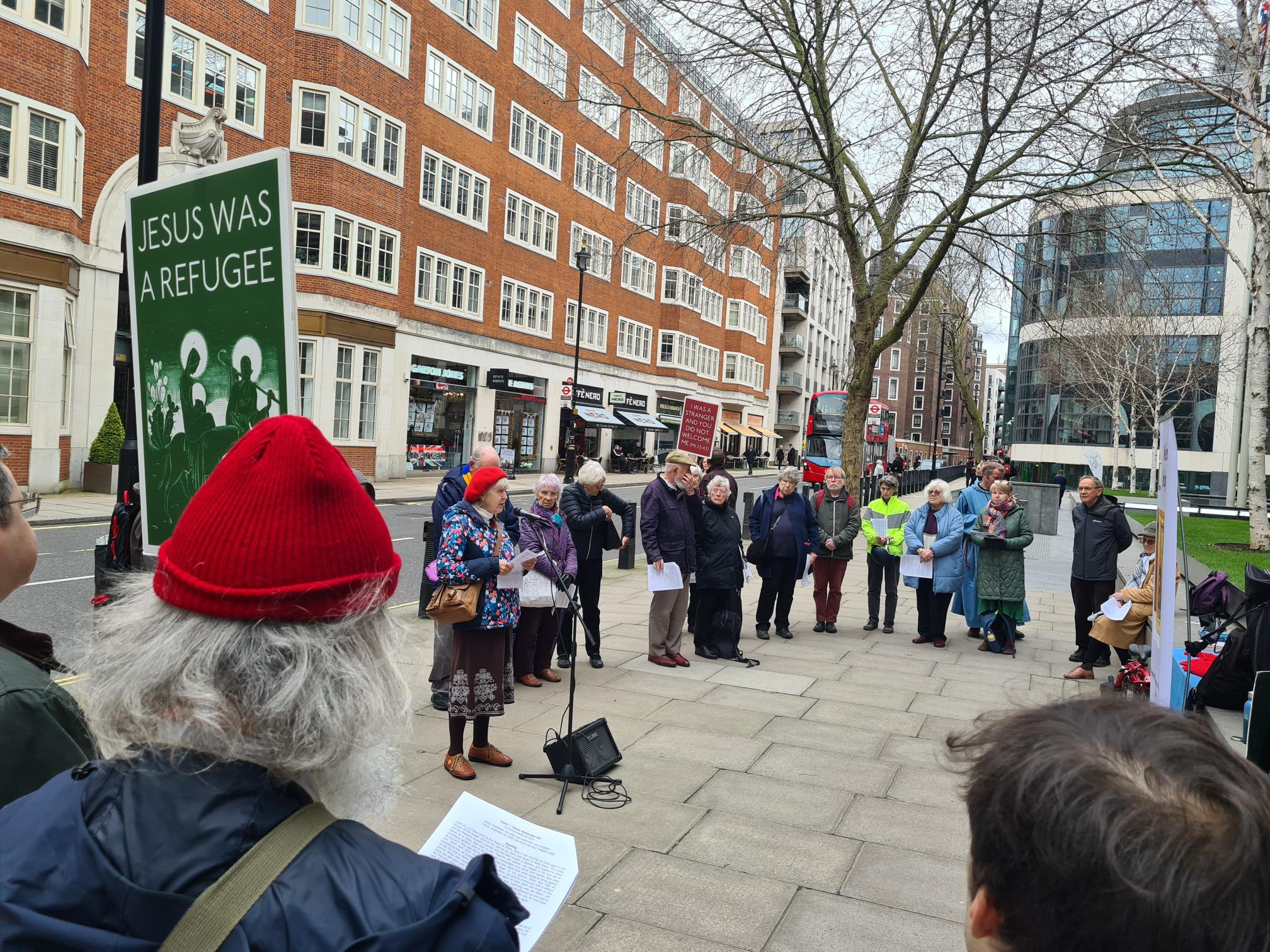
Barbara Kentish gives the reflection outside the Home Office
Not casting stones
We come here month after month, to pray for asylum seekers and to mark the deaths of those whom the system has failed. We pray, like the importunate widow, each time, for justice for refugees, for a welcome for these strangers. What more can we be doing that we are not already doing?
I thought about today’s reading, and the woman who apparently deserved stoning, and Jesus’s reluctant conclusion: ‘Let he who is without sin cast the first stone.’
I wonder if there is a danger that we can look as though we are blaming government for all the ills of the asylum and immigration system. Yet we have a tiny part to play.
We are here as Christians, but also as citizens, who have a degree of freedom of speech, the right to assemble, the right to share our views, although we know that all of these cannot be taken for granted. And a vote. We have an election coming up, probably in the Autumn.
Our message, month after month, is surely that a politics of compassion must be applied to the whole asylum system. This system is national, European and global, and the crisis of people on the move needs to be seen as a huge humanitarian crisis. This was done after the Second World War, but also after the Vietnam war, when more than 1.3 million people were resettled.
I looked up some suggestions for policy, and found on Amnesty International site the following eight pointers:
Safe routes to sanctuary 2) Resettle most vulnerable 3) Save lives 4) Crossing borders: allow people to cross borders without papers, as they flee from danger. 5) Stop trafficking 6) Stop blaming refugees for domestic problems Governments need to stop blaming refugees and migrants for economic and social problems, and instead combat all kinds of xenophobia and racial discrimination. 7) Start funding an impoverished UN, which has not even enough money to deal with the famine crisis in the Sudan for instance. 8) Asylum is a human right The world has a very short memory. In the aftermath of World War II, most countries agreed to protect refugees through the 1951 Refugee Convention, and through UN agencies like the UNHCR.
Barbed wire fences and chronic underfunding have left that vision of a better world in tatters. By ignoring the warning signs, world leaders have allowed a huge, global humanitarian crisis to unfold. Ultimately, it will be resolved by ending the conflicts and persecution that forced people to flee in the first place.
But no one knows when that will be. Meanwhile, we need radical solutions, visionary leadership and global co-operation on a scale not seen for 70 years. That involves setting up strong refugee systems: allowing people to apply for asylum, treating their refugee claims fairly, resettling the most vulnerable of all, and providing basics like education and healthcare.
None of these eight solutions are impossible to achieve, if politicians listen to the millions of people saying “refugees welcome”, and put solidarity and compassion above petty wrangling over who should host a few thousand refugees’.
My own thoughts on the local domestic level are obvious:
– stop throwing money at walls and fences and spend it instead on improving the claims system, using the money to enable the – Home Office to deal with the huge backlog of applications. – Stop putting people in detention for indefinite periods, treating them like prisoners, and instead let them go out to work, including while they await a hearing of their applications.
As Simon Jenkins of the Guardian says:
‘Our plight is rich in absurdity. The UK needs new workers and people want to come here. The real problem is populist politics’.
In other words, the fears planted in people about invasion by strangers is simply a tool of a party faction using biased media, and should be dealt with as such.
But overall, as Clive Myrie, of the BBC says: ‘we need international cooperation to solve a global crisis’.
Which brings me to the central idea behind all of these measures: Compassion and humanity. The theme for Refugee Week this year is Compassion.
What we are doing here in Marsham Street is praying for an international politics of compassion. And whatever we are getting involved in, whether hospitality, campaigning, accompaniment or befriending, we are praying that the umbrella idea over all of it, is compassion, not numbers, not expediency, identity politics or anything else. The alternative is the deaths we have just heard read out. It does not have to be like this.
With a general election coming up, might we think of doing our part, and coming up with a sort of Charter of Compassion for refugees, Might we do our own writing on the ground, as to what to put forward on how we might address this global crisis, and not be accused of simply casting stones at the Government?
The things we pray for, Lord, give us the grace to labour for!
List of the Dead, March 2023
At the Vigil we prayed for all those who died in the month of March 2023 while trying to seek sanctuary in Europe. Please remember them also in your prayers. You might like to download or print this sheet for your own daily memorials.
Father Fadi Diab, Rector of the Anglican Parish in Ramallah, received a warm welcome when he visited the parish of Our Lady Help of Christians in Kentish Town, North London, on Saturday. Fr Fadi is currently on a visit to the UK hosted by Friends of the Holy Land.
Fr Fadi will be joining Westminster Justice and Peace for the Westminster Holy Land Roundtable on Saturday 23rd March, 4-6pm, at Farm Street. More details
Born and educated in the West Bank, Fr Fadi is a founder of the Youth Connection for Peace Programme, a member of the Palestine-Israeli Theologians Forum and the Palestine Advisory Council of the Episcopal Peace Fellowship, co-author of Kairos Palestine document and board member on Kairos-Palestine. He has presented workshops at the World Council of Churches on the theological understanding of the Palestine Israeli conflict.
Fr Fadi began by thanking everyone present for their support. “It means a lot to know to know you care, Its means a lot to know we are not abandoned. We are all part of the Body of Christ. People who care.”
The situation in the last few months has been “heartbreaking, devastating” for the people of Gaza and the West Bank, he said. But he pointed out: “This situation didn’t start on October 7. The settler colonial project began more than 75 years ago. “Israel wants to take all the land and get rid of the people of the land…”
“In Gaza it is not a war against Hamas,” he said. “Its a war against all Palestinians.” In the West Bank (which is not run by Hamas) since October around 500 people, including many children have been killed in attacks by settlers and the Israeli army. 50 houses have been demolished.
Gaza at the present time “is another story” he said. “It is beyond imagination! More than 33,000 killed. 13,000 children. 7,000 women. Thousands more are missing under the rubble. Schools, hospitals, mosques, churches, universities, and most homes all destroyed.” The population is now facing starvation.
“We believe human being were created in the image of God – to kill one person is to kill humanity.”
Fr Fadi said there is an urgent need for “awakening” in churches abroad. “They are so often silent, shy or complicit.” He said he is often surprised at how little many Christians know about the Holy Land.
But he was encouraged to see so many demonstrations taking place in the UK. “Its a process” he said. “It is our mission to challenge structures of injustice. God’s plan is for every person to be treated equally. No one should be left out.”
Fr Fadi went on to describe the desperate plight of Christians in the Holy Land. “We are facing an existential crisis – the decline of Christians in Holy Land. The place God chose to send the Messiah… This is the community that traces its roots back to the first Christians. They have been there for two millennium witnessing to the message of Jesus Christ – looking after pilgrims – but now most of them have left.”
“In 1917 they were 17- 20% of the population. Today Christians are less than 2 per cent. 90% of Christians from Ramallah now live in US. There are less than 50,000 Christians in West Bank. All 900 Christians in Gaza have filed immigration applications.”
80% of Christians in Bethlehem rely on tourism. For two years during the pandemic there were no pilgrims and people faced real difficulties. Now things are much worse. 100,000 Palestinians from the West Bank used to go to Israel to work. But since October they have had their work permits revoked. Now Israel is bringing in people from India and other countries to do their jobs, Fr Fadi said.
“The challenge for Christians is huge. Young people are fed up. They have lost hope… The Church, together with the UN and government provide all the education, health and social social care. To lose that would be really frightening. To think of the Holy Land without Christians is frightening.”
Fr Fadi is Chair of the Holy Land Committee of Friends of the Holy Land, an ecumenical, non-political charity with a mission, together with other Christian charities is to secure a resilient and enduring Christian community in the West Bank, Gaza, Israel and Jordan – transforming lives through education, scholarships, medical and social care for the young and old, as well as food these days. Since the latest crisis, Fr Fadi said many people are on the “edge of collapse,” suffering from depression and anxiety, and so Friends of the Holy Land has introduced trauma counselling programs.
“We feel this is a Kairos moment – to respond to the situation in every way we can – offering support and promoting peace and justice” Fr Fadi said.
During the Q& A afterwards Fr Fadi was asked what he would like to see UK churches do. He responded by saying that the UK is responsible for what has happened in the Holy Land on many levels, and so we should have a role in restoring justice. “The Church needs to put pressure on the government” he said. “The Church should be crystal clear about that… the. UK should not be providing weapons to Israel” he said.
Churches in the UK need to educate people more, Fr Fadi said. “I’m surprised at how little people know. This should be a central component in UK churches and all over the world.
Fr Fadi said we need to question where we invest our money. “There is no limit to educating people about ethical questions.” And he pointed out the need for constant prayers. Three faiths have lived in the Holy Land for so many centuries, it can accommodate them peacefully, he said.
At the end of the talk, Brendan Metcalfe, director of Friends of the Holy Land reminded everyone that the FHL website has a section for prayers, as well as a news page “so we know what we’re praying for.” See: www.friendsoftheholyland.org.uk/
He also had a meeting with Bishop Nicholas Hudson.
On Sunday, he preached at the 9am & 11am services at Southwark Anglican Cathedral and had a Q&A with the congregation. Watch the service here: www.youtube.com/watch?v=HTh7qHWPpJc&t=6s
Dr Raymond Perrier, Director of the Denis Hurley Centre in Durban, South Africa, gave the following address during the Ecumenical Service to mark the 44th anniversary of the martyrdom of St Oscar Romero at St Martin in the Fields, Trafalgar Sqhaere, London on Saturday, 16 March 2024.
Prayerful and Prophetic Resilience in the Face of Injustice
We have, in the figures of St Oscar Romero of El Salvador and Denis Hurley of Durban, South Africa, two ‘golden arches’. Two men who used their position as archbishops in the Catholic church to be ‘a voice for the voiceless’. They operated on different sides of the planet; while Hurley was a leading figure in the Second Vatican Council in the 1960s, Romero was relatively unknown outside his home country until his death; and while Romero was an archbishop for under three years, Hurley was a bishop for almost 60 years. Yet there are some remarkable similarities between their lives.
Being of similar age, they both studied for the priesthood in Rome in the 1930s. Frustratingly we cannot prove that they ever met, though Hurley in his memoirs assumes that they must have attended the same lectures. What we do know is that they had a shared experience of seeing the rise of fascism in Italy and then the conflicted response of the Church in the face of political intimidation. They both spent part of their lives training future priests – really quite bookish men who were unlikely revolutionaries. The appointment of each of them to high office in the Church was surprising, though for different reasons: Romero was chosen because he was the quiet man who had been a rural bishop and, it was thought, would not rock the boat; Hurley, when he was appointed in 1947, was absurdly young: in fact at 31 he was the youngest bishop in the entire Catholic world.
But once they were in charge of dioceses, both had the experience of being conscientised by their own people and most especially by the poor and marginalised. Romero broke the conventions of the strictly classist Salvadoran society by mixing with peasants and listening to their experiences. There are moving photos on the Romero Trust website of him walking the streets, or sharing a meal with ordinary families, to connect with the lives of his people. Hurley broke the even stricter laws of Apartheid South Africa by reaching out to citizens of all colours and hearing at first hand what injustices and daily humiliations they faced. Hurley also broke the equally strict conventions of his Church at the time by listening to and empowering lay people, women, Christians of other denominations and people of other faiths.
By walking alongside their people, these bishops learnt about the exclusions, oppression and violence that was happening in their countries and that so many other leaders – political and religious – chose to ignore. They thus both became icons in the struggle against injustice having the courage to use the platform they had to speak out in a divided society. And what they said was often not what people wanted to hear. Of course, that deafness is still true today and we just sang Hurley’s own words in the hymn: “We humbly ask your pardon, Lord: the ones who hear are all too few.”
For their stand against injustice, both archbishops faced intimidation and vilification, a cool reception from members of their church, from their fellow bishops and even from Rome, and warnings from their governments of legal actions and death threats. Romero of course did not survive these. He was assassinated while saying Mass almost exactly 44 years ago on 24 March 1980 – the blood of the chalice mixing with his own blood in the supreme image of martyrdom. Hurley was spared such violence and lived to see the transition to a democratic South Africa; he died 20 years ago, in his 90th year.
In both these men we see a prophetic stance but importantly it is a prophetic stance that is rooted in prayer and in Scripture. There is a lovely story told of a group of young revolutionary-minded trainee priests in San Salvador, creeping out of the seminary to campaign on the streets, and passing an old priest who was on his knees praying in the chapel. They mocked him wondering why he could not be more like their great hero the activist Archbishop Romero. And then the old priest stood up and turned around and it was indeed Archbishop Romero.
Through all their actions, Romero and Hurley were doing no more – and no less – than Jesus proclaims in his first public sermon as recounted in Luke chapter 4. Jesus enters the synagogue in Nazareth, takes out the scroll and reads from the prophet Isaiah: “The Spirit of the Lord is upon me; he has anointed me.” Hurley chose as his episcopal motto a phrase from 2 Corinthians which we have just heard read: “Where the Spirit is, there is Freedom”. And it is in the power of that anointing by the Spirit that Hurley and Romero find freedom and were able to show others the way to freedom. It is the freedom to preach good news to the poor, to liberate captives, to open the eyes of the blind, to bind up the broken hearted.
Both Hurley and Romero used their pulpits, and used the media available to them, to preach good news to the people of their own countries. Both men also benefited hugely in their ministry from the support of CAFOD and Christian Aid to make sure that the truth of what was happening was heard further afield. As we heard from Romero’s words earlier:
“It is not enough to demand justice. The civilisation of love also demands truth…and truth is what is lacking in our situation…When the truth is spoken it gives offence, and the voices that speak the truth are silenced.”
Romero was silenced by his assassination but, as he had predicted: “they may kill an archbishop, but I will rise again in the Salvadoran people”. Hurley was also fearless in witnessing to the truth, often standing on his own outside Durban City Hall holding a placard and daring the authorities to arrest him. He was also supremely creative in how he could use the power of religious symbols to tell the truth to the world. Let me give one example.
At the height of the state of emergency, in March 1985, a group of anti-Apartheid activists had been detained without charge in the central prison in Durban and Hurley wanted to show solidarity with them. Strictly speaking it was illegal for him even to mention that they were detained, let alone organise any kind of public demonstration. His great lieutenant, a lay man called Paddy Kearney, came to Hurley with an idea. “Is it not, your Grace, an ancient tradition of the church that a bishop should be able to visit his congregants on Good Friday?”. “Is it?” asked Hurley; “well,” Paddy replied, “it is an ancient tradition: who knows?”
So Hurley went to the Chief of Police and explained this ancient tradition to him and the Chief of Police, a loyal member of the Dutch Reformed Church, felt he could not refuse. But then Hurley explained that, since not all the detainees were Catholic, the Anglican bishop and the Methodist and the rest should also be allowed to visit the prison. And so, at dawn on Good Friday, Hurley led a group of fellow Christian leaders into the jail so that they could pray with the detainees; meanwhile a group of other Christians who had by coincidence turned up at the same time stood in a circle around the prison and sang hymns so the prisoners would know they were not forgotten. And then they all walked away in complete silence, so they did not break the rules on public protests.
This was not a protest but a prayer service – a prayerful and prophetic witness – that comforted the afflicted inside the prison and afflicted the comfortable forces of the Apartheid regime. That tradition of a silent ecumenical walk of witness at dawn on Good Friday continues to this day and we will be marking it in central Durban in two weeks’ time.
The ecumenical nature of that event is worth noting in this wonderful ecumenical service. We should remember that Romero was honoured by Westminster Abbey many years before he was canonised by Rome. Long before it was encouraged, or even allowed, for Catholics to mix with ‘our separated brothers and sisters’, Hurley was reaching out to Christians of other denominations and indeed to people of other faiths since Durban has sizeable Muslim and Hindu communities. One of his great collaborators was Ela Gandhi, grand-daughter of the Mahatma. I am proud to say that the Denis Hurley Centre in Durban is located between the Catholic Cathedral, the largest mosque and the site of Mahatma Gandhi’s law office. We are, as far we know, the only building in the world named after a Catholic archbishop which houses a halal kitchen so we can work together with all faiths to feed the poor.
If Isaiah calls us to bind up the broken-hearted, then every act of ecumenical or interfaith collaboration is an opportunity to bind up the broken heart of the one God who created us all.
Romero did not live to see liberation in El Salvador – it came after his death. But he also did not live to see how that liberation would later be squandered by politicians who once fought for the poor and now ignore their plight and feather their own nests. Hurley did live to see liberation with South Africa’s first democratic elections 30 years ago in 1994 – that was a moment celebrated especially here in Trafalgar Square where for so many years there had been a valiant protest outside South Africa House next door to us. But Hurley died before the pot of gold in the rainbow nation was found to be empty – stolen by members of a party that claimed to be the liberators or sold by businesses and political leaders to the highest bidder.
Romero and Hurley might have hoped that their successors as religious leaders in El Salvador or South Africa (or even here in Britain) would have continued the fight against injustice with the same vigour. And some of them do; but by no means all. Can we put our hands on our hearts and say that we have – to use Hurley’s words from 1960 – ‘a true social apostolate, a systematic effort to concentrate the energies of divine light and life on the failings of human conduct’?
Because, of course, the anointing that Jesus mentions in Luke 4 is and not for just for him or for Romero and Hurley. Each one of us by our baptism has been anointed; the Spirit of the Lord is on each one of us and the manifesto of Isaiah should be the manifesto of all our lives. So what does this mean for us sitting here today?
We heard Hurley’s words from 64 years ago reminding the Church that in a bitterly divided community, its mission is one of salvation. And that while we can hope to draw on the strength of God, we have to constantly be aware of – and challenge – the weakness of humans, starting with our own frailty.
In El Salvador and in South Africa today the work of bringing good news to the poor is far from over. I would suggest that the same is true of the bitterly divided nation which looks to this square as the epicentre for celebration and for protest. The over-riding need for that good news is something I see every day in central Durban at the Denis Hurley Centre. It is a place where people of all faiths come together to serve the homeless, refugees, drug users, the unemployed – the captives of our economic system who are looking to be liberated. So many wonderful parallels to the work of St Martin in the Fields. Occasionally, especially when there is an election coming up, government with its massive resources does remember that these are the poor and marginalised whom Hurley and others fought valiantly to liberate from Apartheid. But more often than not, the poor are forgotten by the South African government because (to use Hurley’s words) of “the slowness or the failure or the refusal of humans to respond to the call of God.”
In the face of increasing injustice and indifference – in El Salvador, in South Africa or here in Britain – one temptation for people of faith is to retreat. But as Romero put it: “To pray and wait for God to do something is not holiness, it is laziness.” We are all anointed and called to constantly find ways, small and large, to bring good news to the poor, to bind up the broken hearted and to open the eyes of the blind – starting with opening our own eyes and then encouraging others to see what they would rather ignore.
Another temptation is to be committed to act but then to wait for the perfect moment. In Luke 4 we are told of the year of the Lord’s favour – that sounds like a great time to act and until then we should just wait, shouldn’t we? Clearly, Romero did not live to see the year of the Lord’s favour: but he did what he could when he could and entrusted the rest to God: accepting that he was a worker not the master builder. In South Africa with the elections 30 years ago it looked as if we had reached that Kairos moment – the year of the Lord’s favour. But of course 1994 was just the start of another mountain and at the Denis Hurley Centre we are very aware that we still have a long way to climb. The example of the lives of Romero and Hurley remind of what Jesus tells us in Luke 4: there is no excuse for waiting: for now is the acceptable time, now is the day of the Lord’s salvation.
Christians for Palestine bloc outside St Paul’s Cathedral
The next Westminster Holy Land Roundtable, hosted by the Westminster Justice and Peace Commission, will take place on Saturday, 23 March, from 4-6pm, at the Catholic Church of the Immaculate Conception, Mayfair, 114 Mount Street, London, W1K 3AH, to share and discuss the response of the Catholic community in the Diocese of Westminster to war and conflict in the Holy Land.
The horrendous series of events unfolding in our news bulletins since the 7th October attack by Hamas in which 1,200 were killed and over 250 were taken hostage, and the subsequent retaliation by Israel in which over 30,000 people have been killed – most of them women and children, where over 1.8 million people have seen their homes destroyed and are now facing a major famine – has increased the concern of people everywhere for the Holy Land.
Following the first Roundtable on 20th February, we are hoping to gather Catholics in the Diocese with an interest in exploring our collective response to strife in the Holy Land and asking what more we could do as a community?
We hope to set up a Working Party to cover the following areas:
· Christian, Muslim and Jewish relations in the Diocese. · The ‘Ceasefire Now!’ rallies and liaising with the ‘Christians for Palestine’ group. . Liaising with Catholic parishes and other organisations. · Prayer and Liturgy. · Support for Catholics and other Christians in the Holy Land.
If you are interested in helping in any of these areas, but are unable to attend the meeting on 23rd March, please contact Colette Joyce directly on colettejoyce@rcdow.org.uk for further details or a chat.
It is not necessary to register, but it will be helpful for us to gauge numbers if you do. Many thanks.
A monthly Memorial Prayer Vigil for refugees and asylum-seekers takes place on the 3rd Monday of every month outside the Home Office, SW1P 4DF, 12:30pm to 1:30pm.
Praying for
Those who died trying to reach the UK
Victims of current wars
Those in detention and who are homeless
The UK to be a more welcoming nation
Sign up to receive email news & alerts of changes orcancellation at: homeofficevigil@gmail.com
Co-sponsored by Westminster Justice and Peace Commission London Catholic Worker and London Churches Refugee Fund
All are welcome to join Westminster Justice and Peace and many other Christian social justice organisations at this ecumenical service at St Martins-in-the-Fields Church on Saturday 16th March 2024 at 11.00am.
The annual Romero Mass will take place at 12.30pm at St George’s Cathedral, Southwark with Archbishop John Wilson presiding, and will include a presentation to schools who have achieved the Romero Award.
St Oscar Romero is the patron saint of the National Justice and Peace Network in England and Wales.
Father Fadi Diab, Rector of the Anglican Parish in Ramallah, is coming speak in the Parish Centre of Our Lady Help of Christians in Kentish Town on Saturday, 16 March, about the present situation in the Holy Land and its effect on Christian communities, and take questions. The event will last from 2-4pm. Light refreshments will be available.
Born and educated in the West Bank, Fr Fadi is the Rector St Andrew’s Episcopal Church, Ramallah and St Peter’s, Birzeit. Fr Fadi’s ministry includes midweek youth service, Bible study, Women’s group, Youth group, Sunday school, an Acolyte programme, a new choir and a Celebrating Family program. Fr Fadi provides leadership and pastoral support for St Andrew’s school, the Episcopal Vocation and Training Centre and his sister Parish in Birzeit with a developing elderly home project, St Peter’s.
His vision includes supporting the Christian community spiritually and socially, strengthening Christians in the Holy Land to enabling them to stay in the area and to continue witness to the Gospel of Christ. Fr Fadi is a Founder of the Youth Connection for Peace Programme, a member of the Palestine-Israeli Theologians Forum, a member of the Palestine Advisory Council of the Episcopal Peace Fellowship and co-author of Kairos Palestine document and board member on Kairos-Palestine. He has presented workshops at the World Council of Churches on the theological understanding of the Palestine Israeli conflict and spoken widely at churches in the USA. He visits parishes in the UK regularly during non-Covid times.





 Diocese of Westminster Justice and Peace Commission