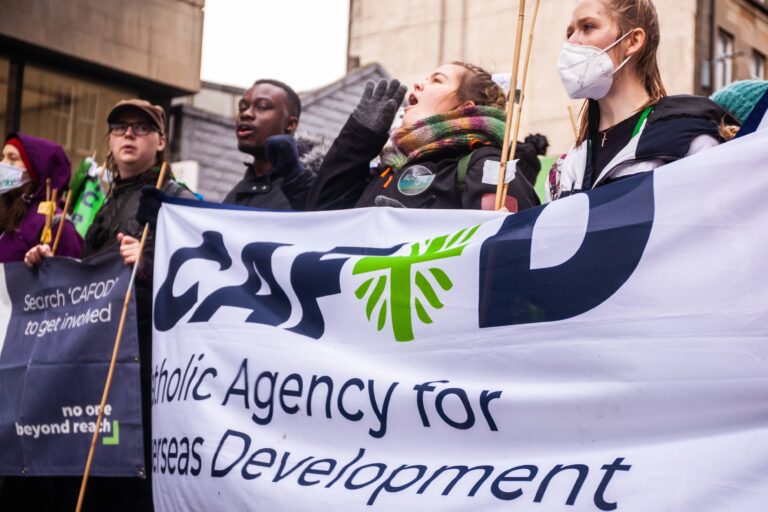
CAFOD Supporters at the Global Day of Action for the Climate, Glasgow, 2021, COP26
Join CAFOD, Westminster Justice & Peace, the Southern Dioceses Environment Network and other Catholic groups in the Faith Bloc for this Global Day of Action rally in Central London on the middle Saturday of COP27, the UN Climate Conference, on 12th November 2022.
Location
Starting Location: Shell Centre, Belvedere Road, London, SE1 7NA
22 September – 7 November: Walk2COP27 – Virtual walk from Glasgow to Sharm el-Sheikh organised by Sam Baker. Participants include the Laudato Si’ Animators. Download the App and log your steps in solidarity with others around the world! A virtual townhall meeting takes place in each of the 12 countries en route: Scotland, England, France, Belgium, Germany, Austria, Hungary, Bulgaria, Turkey, Lebanon, Jordan and Egypt. https://www.walk2cop27.com/
25 October, 7.30-9.30pm: Catholic People’s Weeks Annual Autumn Online Lecture with Dr Carmody Grey – Living in a Time of Crisis: Christianity and Ecological Catastrophe. Dr Grey is Assistant Professor of Catholic Theology at Durham University and a visiting research fellow at Laudato Si Institute, Oxford. https://catholicpeoplesweeks.org/events/annual-autumn-lecture-2022
29 October, 11am-2.30pm: CAFOD Faith in Action – Online event. Includes updates on transforming our food system campaign and finding out more about COP27. Register in advance
Our first speaker wasPaul Chitnis, Director of Jesuit Missions
Jesuit Missions is the Mission and Development Office of the Jesuits in Britain.
Based in Wimbledon.
Work in countries in Southern Africa, parts of India and Guyana.
Paul was previously Director of SCIAF, the development agency in Scotland, sister agency to CAFOD.
He was present at COP26, along with his colleague Colm Fahey.
He is not attending this year.
COP27 (6-18 November 2022) is taking place on the African continent for the first time.
One of the main drivers of hunger in Africa is climate change.
Seeing the impact of climate change everywhere, floods in Pakistan, droughts in Africa, fires in Australia.
The political context this year is significant. Attention of the world has been diverted by the war in Ukraine. The bandwidth of our political leaders for climate change has been reduced.
On the agenda for COP27 – as usual ‘adaptation’ and ‘mitigation’ measures.
There will also be an emphasis this year on’ loss and damage’ – compensation for losses due to climate change for which adaption is not possible.
World leaders were in attendance at COP26 which had an impact on the country negotiators and the civic society activists present. There are likely to be fewer world leaders present this time.
Finance will be key. The conference will succeed or fail depending on funding. ‘Follow the money’ – that is where the answer will be.
Has to work quite hard personally to remain optimistic after many years working for climate change. Only have to watch ‘Frozen Planet’ on a Sunday night to see the impacts. Faith communities have a role to play because they offer hope and he is hopeful.
Final question: What happens if we do not meet these targets from the Paris Agreement?
Paul’s presentation was complemented by a presentation fromBishop John Arnold, Bishop of Salford
Evidence is overwhelming in terms of the climate damage that is happening.
Great damage being reported today from storms in Venezuela.
In September a climate disaster seemed to be reported every day.
Good news from some governments speaking up in the last few months Australia, New Zealand, US (although not consistently), Denmark, Singapore.
Encouraging because governments have to take the lead, industry has a part to play, and each of us individually must do our part.
Pope Francis is consistently encouraging.
Our government has not been helpful. During process of whittling down candidates for conservative party leader from 11 to 2 there was one mention of the environment by one candidate. Obsession with growth for the economy is misplaced. Helps neither the poor nor the environment. Hopefully restarting fracking will not happen. Local resistance in Lancashire.
First activity in Glasgow last year was a multi-faith prayer service in George Square. Each of 9 major faiths, including Pagans, led a prayer and he couldn’t disagree with any of it. All major faiths have a concern for the world in which we live.
85% of the world population adhere to one of those faiths. Presents a real opportunity for faith leaders to conjure more enthusiasm.
Young people are so much more enthusiastic and learned. Schools love visiting the Laudato Si’ Centre in Salford. Over 100,000 turned up for the young people’s rally in Glasgow.
Deforestation Agreement was good but even as Brazil was signing the promise it was increasing deforestation of the Amazon by 15%.
Loss and Damage – $100 million sounds a lot but it is not. It is vital life-saving money. Up to 1 billion people might migrate by 2050 because of the loss of agricultural land and heading to the places that are able to produce food. Very short-sighted not to care for people already affected by climate change.
Disappointed that the Prime Minister has told King Charles not to go to COP-27. His long-standing commitment and experience would be helpful.
Haven’t seen much evidence that best intentions have been implemented. IPCC say at the moment we are heading for 3.2 degrees increase.
Good things – increasing understanding of the environment. More and more groups are aligning. Pope Francis film ‘The Letter’ gives a very clear appeal and should be recommended far and wide.
‘We are jogging along but we need to be sprinting.’
Small Group Discussions…
We considered the question:
Sam Baker’s Walk2COP27 has started. It is a journey to gather people for a common cause. What would you talk about with a stranger to bring people together?
The Letter: Laudato Si’ Film Released 4th October 2022
The West London Justice and Peace Network meets three times a year, bringing J&P activists together from a dozen or more parishes across West London. On Saturday 8 October, it was delighted to hear Nigel Parker – Director of the Catholic Union of Great Britain – talk about its work.
Established in 1870, only a few decades after Catholic Emancipation, when anti-Catholic discrimination was high, the Catholic Union was a voluntary organisation aimed at influencing public policies of interest to Catholics. At the outset, it probably consisted only of the ‘great and the good’ but it now has 1,300 members and it is open to all lay Catholics.
Nigel explained that it is non-party political and that its officers are elected to reflect all political parties. The current president is Sir Edward Leigh (a Conservative) who succeeded a Labour peer. Its website reports that it is “a membership organisation dedicated to the defence of Catholic values in parliament and public life, and the promotion of the common good”.
In practical terms, the Catholic Union makes submissions to parliament and government; it comments on current events; it meets with ministers and special advisers etc. It has a broad range of interests ranging from beginning to end of life issues to social justice, human rights, religious freedom issues. The staff team is small and the Union therefore makes a very conscious effort not to duplicate the work of other groups such as CSAN/CAFOD/ACN/PACT/SVP etc. but instead tries to add value to their efforts.
There is a particular emphasis on religious freedom and freedom of conscience, and it works via a mixture of education, public lectures, webinar events. In the fairly recent past, it has addressed issues such as: covid and the closure of churches; the murder of David Amess and the importance of access to last rites even (or especially) at crime scenes; hate speech legislation; Public Space Protection Orders (and protests outside abortion centres); freedom of conscience for pharmacists; the Bill of Rights Bill and other foreign and defence policies. The Catholic Union works alongside many other groups and tries to represent the many issues of concern to the 4.5m Catholics in the country.
Members of the Network were interested in how strategies and priorities are set by the Union; how at the parish level we can effectively lobby our public representatives; and more information about the Union’s work across the gamut of justice and peace issues. Nigel explained that membership gives access to a weekly parliamentary briefing; encourages active engagement via committees and monthly briefings; and includes an invitation to an annual summer gathering. Though they have consultative status with the Bishops’ Conference, and work closely with the bishops, they are a lay organisation and set their priorities according to the concerns of the Catholic laity across Great Britain.
Their website also carries detailed practical advice for those people wanting to lobby their local MP on concerns around refugees, climate justice, poverty, prisoners, racism or other J&P issues. Members of the West London J&P network reported on their efforts to influence local elected politicians on a broad array of social justice and peace issues, and how useful it was to learn how they might best cooperate with the Catholic Union, which is doing the same at the national level.
Central London Catholic Churches guest, Richard Jackson, talks to Jon Kuhrt (left) and Mick Clarke (right) at the Homeless Panel at Farm Street Church on 28th March 2022
In March 2022, Westminster Justice & Peace together with Central London Catholic Churches hosted a panel discussion at Farm Street Church entitled ‘Homelessness and the Pandemic: what have we learnt?’
Six months on, we invited our speakers from that panel to record their thoughts on where we are at now, especially with respect to homelessness in London. Listen to the podcast here.
Listen to the podcast, recorded for World Homeless Day 2022
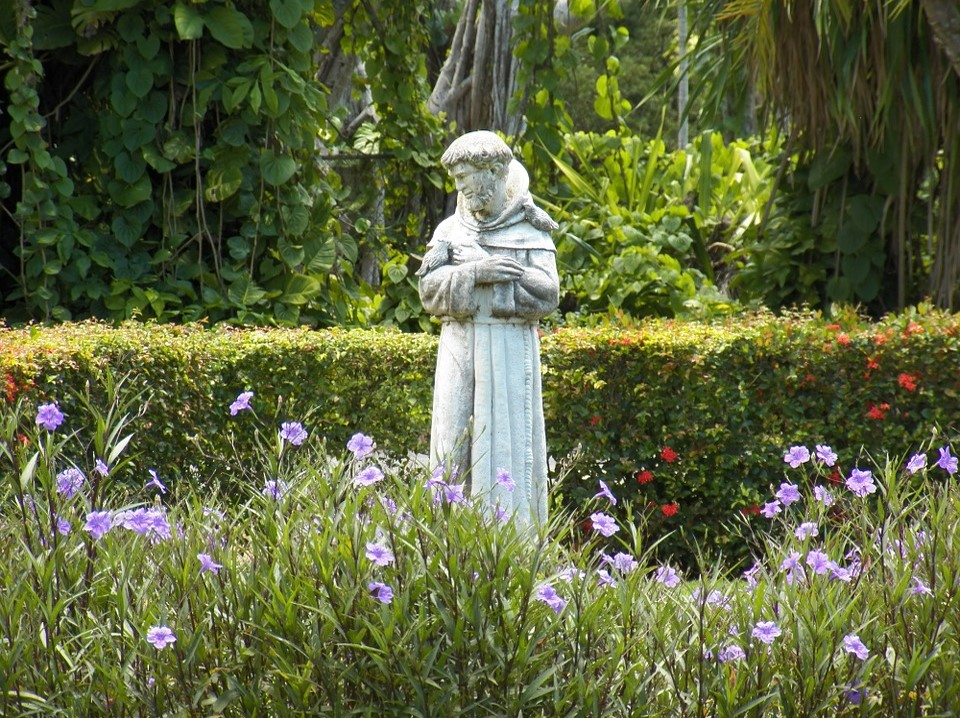
I hope you have enjoyed celebrating nature this month, even as we become ever more aware of the efforts we must make to protect our common home. There is still the Feast of St Francis to come on Tuesday, 4th October, to close the season, as we seek his intercession and inspiration in our care for the environment for rest of the year.
Our E-Bulletin this month contains a report from our most recent Westminster Social Justice and Peace Forum on Saturday, 17th September, when people from around the Diocese joined Bishop Nicholas Hudson and Bishop Paul McAleenan on Zoom. The theme of the Forum was ‘To Accompany Refugees’, and it took place on the weekend preceding the World Day of Migrants and Refugees (25th September). The Forum was chaired by Bishop Nicholas Hudson, who underlined that this was an opportunity to explore what the response in the ecclesial community in Westminster has been… Read the full report on our website
Welcome to New Commission Member
Fr Dominic writes:
A warm welcome to Sr Carolyn Morrison ra, University Chaplain based at Newman House, to the Westminster Justice and Peace Commission. We look forward to benefiting from Sr Carolyn’s skills and experience. We hope to recruit more new members to the Commission in due course.
The current Commission members are: Fr Dominic Robinson SJ (Chair), Colette Joyce (Co-ordinator), Tony Sheen (CAFOD), John Coleby (Caritas), Sr Carolyn Morrison ra
Parish Contacts
Thank you to everyone who has volunteered to serve as a Parish Contact for Justice & Peace in 2023. The current list can be found here:
Finally, in this month which includes Homeless Sunday and Challenge Poverty Week, we continue to consider how best we might help our communities rise to meet the current cost-of-living challenges. There are many links and events in the Diary pages to inform our response, including a one-day Conference with Caritas Westminster on 12th November at All Saints Catholic College, 75 Saint Charles Square, London, W10 6EL, which will bring together a number of different organisations offering assistance, with people from schools, parishes and projects across the Diocese.
Watch Bishop Paul McAleenan’s Summary of the ‘To Accompany Refugees’ Forum meeting
On Saturday, 17th September people from around the Diocese of Westminster joined Bishop Nicholas Hudson and Bishop Paul McAleenan for the Westminster Social Justice and Peace Forum on Zoom.
The theme of the forum was ‘To Accompany Refugees’, and took place on the weekend proceeding World Day of Migrants and Refugees.
The forum was chaired by Bishop Nicholas Hudson who underlined that this was an opportunity to explore what the response in the ecclesial community in Westminster has been.
Megan Knowles, Communications and Development Manager for JRS UK, spoke about the experience of accompanying refugees in an increasingly hostile world. She spoke about the primary work of JRS being accompaniment, and specifically the accompaniment of people experiencing destitution as a result of being given no recourse to public funds. This looks like ‘being with, rather than doing for’. She spoke about how people at this point in the asylum system are in a ‘legal-limbo’, isolated with significantly reduced access to healthcare during a prolonged and anxiety inducing time. JRS supports in a variety of ways, including having a hosting scheme, a pantry and befriending.
Pattie Gercke is the Development Worker for Compassionate Communities, which is the social action arm of the Diocese of London. Pattie presented from the ecumenical perspective and how churches in the Diocese of London are engaged in the welcome of people seeking sanctuary. Ecumenism was a strong theme of the forum. Pattie shared that church response looked like practical support such as access to work, ESOL provision, hosting, education, healthcare, digital access, provision of food, clothing as well as legal and rights-based support. The value, however, of non-material forms of support was highlighted; for instance the importance of relationship, sitting, sharing space, listening and providing spaces of welcome. Further, it was highlighted that churches are repositories of social capital and that this social capital can be used to support integration. The importance of enabling a wider audience to hear the stories and theologies of people in the asylum system was discussed.
The forum then heard from Danny Coyle who presented the school experience, specifically the transformation of Newman Catholic College in Brent when they became a school of sanctuary. There had been an immediate positive effect of welcoming and integration sanctuary seeking pupils and their parents in the school. They developed a unique and bespoke curriculum to meet the needs of those coming from overseas from conflict zones. There was a particular focus on language which enables pupils to unlock other parts of the curriculum, which pupils were keen to embrace. The academic needs of pupils are placed alongside their emotional needs, and pupils are entered onto different pathways. The school has a Refugee Coordinator. Support of Caritas Westminster for the school’s annual Syria Summer Camp, where pupils take part in varied and enriching activities. These camps have gone from strength to strength with volunteers from a sanctuary seeking background being involved. The key takeaway was that if correct structures are put in place, refugee students and their families can flourish.
The final presentation came from Teresa Clarke who is a parishioner at St Bartholemew’s Parish in St Albans who is directly involved in refugee accompaniment through the Church’s conversation group. Teresa shared how ecumenical work, as well as responsiveness to the needs of the asylum seekers that they are supporting has transformed the project. The group provides emotional and practical support to asylum seeking men at a local hotel and works with 10% of residents. The value of engagement with local MPs was underlined, with the group having strong connections with Daisy Cooper MP. The group is part of a network with other churches in the area providing support. The group hold forums to hold the hotel to account with regards to need for good food and appropriate clothing for the guests. Alongside this the group held a refugees Information Exchange where asylum seekers shared experiences and information, offering help and support. There is a significant challenge of transport, where the location of Noake hotel is a barrier to asylum seekers making connections in the city. This lead to an initiative whereby spare bikes were donated, and so far, the project has received 55 bikes which are fully serviced by a bike mechanic. Herts County Council are offering Bike Ability training while the conversation group support as they gain confidence in these sessions.
After the presentations, attendees went into breakout rooms with each of the speakers to discuss questions relating to the topics that had been presented. These were:
What are the most effective ways to assist refugee and migrant groups, what are the challenges and what else can we do?
It was an opportunity for discussion before joining back with the main group to share experiences, observations and questions.
Plenary Feedback
How to balance being with and doing with. Context of the whole person. How to accompany people who have and are experiencing trauma.
Partner with expert services.
How to support people, especially women facing domestic violence.
Ecumenical working and that how could operate
Joined up working between churches, looking at modeling St Albans, not working elsewhere necessarily.
Working alongside interfaith groups
Joined up working
Campaigning and advocacy more difficult, fundamental systems change – HO not listening.
Range of needs for refugees and asylum seekers, different circumstances and needs.
Challenges because of the cost of living. Need of financial assistance, winter, facing difficulties.
Challenges getting churches to communicate.
What else can we do – sharing information, what is going on where.
Need for greater awareness of what is going on for asylum seekers.
Hard to balance the media portrayal of refugee help as a very hard thing;
How to keep people compassionate enough to help?
Keep learning from other people and always try to be flexible;
The best answer to the question is to share experiences.
How to stop the work of helping people from being overwhelming?
Think of how we speak about these matters language wise.
The Forum was summed up by Bishop Paul McAleenan, lead bishop for Migrant Issues, saying ‘Refugees are not statistics, but heart and flesh, human beings who must be helped.’
Westminster Caritas Refugees and Migrants Mailing List
Rosa Lewis, the Caritas Westminster Lead for Refugees and Migrants, convenes a quarterly meeting for everyone in the Diocese of Westminster concerned about refugees and migrants. To be added to her mailing list please email rosalewis@rcdow.org.uk
Home Office Prayer Vigils
You are warmly invited to join Barbara Kentish (Westminster Justice & Peace), Br Johannes Maertens (London Catholic Worker) and others to participate at the vigils outside the Home Office or to pray along at home on the third Monday of every month, 12.30-1.30pm.
Next Vigil: Monday 17th October 2022, 12.30-1.30pm
The World Day of Migrants and Refugees is celebrated in Catholic parishes on Sunday, 25th September 2022.
Sunday – An International Mass to mark the day will be celebrated in Westminster Cathedral on 25th September at 5.30pm by Cardinal Vincent Nichols.
Monday – Home Office Vigil. Westminster Justice and Peace will again join London Catholic Worker and others outside the Home Office, 2 Marsham Street, London, SW1P 4DF, on Monday 26th September (postponed from 19th September, owing to the funeral of Queen Elizabeth II) from 12.30-1.30pm for a vigil to remember all those who have died seeking sanctuary in Europe and to pray for justice for all migrants and refugees in the UK. All are welcome to join us.
Bishop Paul McAleenan, Auxiliary Bishop in Westminster and Lead Bishop for Migrants and Refugees for the Bishops’ Conference of England and Wales, has recorded the following message for the World Day of Migrants and Refugees:
Transcription
Hello and greetings to everyone.
I am Bishop Paul McAleenan, the Lead Bishop for Migrants and Refugees at the Bishops’ Conference of England and Wales.
Every year, the Church throughout the world devotes a day to migrants and refugees. This year, 2022, the day will be celebrated on Sunday, 25 September. You may think that this day, WDMR, as it’s called, World Day of Migrants and Refugees, is in response to the coverage of new arrivals to our country and migration. In fact, the World Day of Migrants and Refugees has been held annually since 1914, an indication that displacement from one’s homeland has long been a feature of life for many people.
This day is an opportunity for Catholics throughout the world to remember and pray for those who are displaced through war, poverty and persecution, and also to raise awareness of the fact that migration offers opportunity to many people. It benefits many.
In 2020, Pope Francis, in his message, said, if we wish to promote those whom we wish to assist, then we must involve them and make them agents of their own redemption. In his message for this year, 2022, the Holy Father expands on those words by choosing the theme ‘Building the Future with Migrants and Refugees’.
In our parishes and in our neighbourhoods, we can see that migration is a reality. There are many people from other countries. Pope Francis appeals to us to adopt an attitude of welcome to those who live among us, reminding us that they can revitalise our communities and enliven celebrations in our parishes. Their presence is a witness to the Catholicity of God’s people. Without undermining or devaluing our own culture and values, we are asked to be open to the treasure and the variety of gifts that migrants and refugees bring to our communities.
It is edifying that many parishes are reaching out to migrants and refugees. I know of one group who, motivated by their faith and working ecumenically, invite migrants and refugees to English language conversation classes. That is an example of how Pope Francis’s call to build the future together is being lived out.
Two other events have taken place which portray the Church’s commitment to migrants and refugees. In March of this year, the Papal Nuncio, that is the Pope’s representative to Great Britain, visited Napier Barracks in Folkestone, where a number of people are housed. He spent time with them. He conveyed to them both the concern and the best wishes of Pope Francis. He returned at a later date to present a Papal Blessing personally signed by the Holy Father.
In October 2021, a 3.5-metre high puppet called Amal was welcomed in Westminster Cathedral to music and dance and a great atmosphere of prayer.
In cathedrals and parish halls and holding centres, the love of God has been extended to those who are marginalised, to those who are poor, and in need, and I thank everyone involved in this wonderful work.
We are also grateful to those who, using their professional expertise advocate the cause of migrants and refugees, in weighty matters and in smaller but essential ways.
The love of God has been extended and migrants and refugees are receiving a welcome from God’s people and encouragement, which is much needed. It is work that must increase and must continue.
I ask you to pray and to remember migrants, refugees, displaced persons: through war, persecution, climate change and all those on the move seeking a better life.
On Sunday, 25 September, the World Day of Migrants and Refugees, may God give us all of the grace to work together with migrants and refugees to build a better future.
Prayer
A prayer that we will build the future together with migrants and refugees…
Lord, make us bearers of hope, so that where there is darkness, Your light may shine. And where there is discouragement, confidence in the future may be reborn.
Lord, make us instruments of Your justice, so that where there is exclusion, fraternity may flourish and where there is greed, a spirit of sharing may grow.
Lord, make us builders of Your kingdom together with migrants and refugees and with all who dwell on the peripheries.
Lord, let us learn how beautiful it is to live together as brothers and sisters.
Amen.
Message from Pope Francis for the World Day of Migrants and Refugees 2022
Southern Dioceses Environment Network 12th September 2022: Presentation by Shanon Shah, Director, Faith for the Climate
We were delighted to welcome Shanon Shah, the Director of Faith for the Climate, as our guest speaker for the first meeting this term of the Southern Dioceses Environment Network.
Faith for the Climate is a network that aims to equip, inspire, and encourage faith inspired action on issues of climate change across the UK. All faiths and spiritualities are welcome.
Shanon Shah is a Malaysian Muslim who came to the UK in 2010. He joined the team at Faith for the Climate in 2020.
The organisation aims to unite those of faith together in the environmental justice space and to encourage learning from the different faith traditions. It was a way to target the UK government and show solidarity with those who suffer the worse impact of climate change despite doing the least to contribute.
The group meet regularly online with two priorities in the lead up to COP-26: new and additional money for loss and damage, ending fossil fuel subsidies. The UK government has made some progress with the second focus, therefore, most energy was focused on loss and damage.
Loss and Damage is part of the architecture of the Paris Agreement which includes three main pillars of climate action; mitigation of climate emissions, adaption to live with the impact of climate change, loss and damage. Loss and damage is when the impact of climate change is so severe that adaption/mitigation is not possible e.g. as a result of sea level rises, extreme weather events.
The UK government has historically blocked negotiations on loss and damage.
At COP-19, in 2013, the Warsaw international mechanism for Loss and damage was established in response to the typhoon Haiyan in the Philippines. At COP-25 in Madrid, the Santiago network on loss and damage was established to implement the Warsaw mechanism. It called for richer countries to offer compensation. At COP-26, there was a push for clarity on how the Santiago network would be implemented.
The Glasgow Dialogue on Loss and Damage was established post COP-26. Many questions on how to address the issue are undecided, but it is climbing the agenda with the first awareness day last year. This is largely due to the efforts of faith communities.
The UK has faced financial difficulty this year due to the war in Ukraine, cost of living crisis etc. which has made it more difficult to talk about loss and damage. Despite our own issues we must not forget countries such as Pakistan which is now 1/3 under water with the displacement of 50 million people and 10 billion US dollars’ worth of damage. These poorer countries are suffering the worst effects of climate change despite contributing the least. The impacts of extreme weather events are far greater for them and they are still struggling with debt.
It seems only fair that the big polluters have the most responsibility to pay compensation for loss and damage. It is a moral issue that lies at the centre of many faiths; we are all interconnected.
The next Loss and Damage Awareness Day will be on the 22nd September; including a walk of witness to Parliament Square via the Shell headquarters. Gathering at St. John’s Church, Waterloo, 10.30am. It will join those doing an interfaith fast for loss and damage.
22 September – Loss and Damage Awareness Day 10.30am Meet at St John’s Waterloo, 73 Waterloo Rd, London SE1 8TY 11.30am Walk to the Shell headquarters for a vigil 12.00pm Walk to Parliament Square Loss and Damage Day of Action London
We then broke into small groups to consider the question: “In what ways does the topic of Loss and Damage resonate with this year’s theme for the Season of Creation – Listen to the Voice of Creation?”
Monday 19th September is a bank holiday for the funeral of the Queen. RIP. There will be no workers in offices, reduced travel services (as on normal bank holidays perhaps), and many will be watching events on TV. It seems sensible therefore to hold our Vigil for migrants and asylum seekers on Monday 26th September at 12.30pm, outside the Home Office, 2 Marsham St, London SW1P 4DF.
This has the advantage of being the day after the Vatican World Day of Refugees, whose theme is, ‘Building the Future with Migrants and Refugees.’






 Diocese of Westminster Justice and Peace Commission