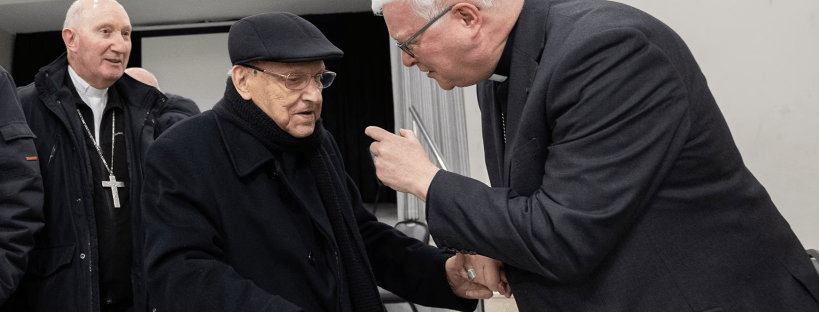
Bishop Jim Curry, Lead Bishop for the Holy Land for the Bishops’ Conference, has offered his reflections as the Holy Land Co-ordination pilgrimage passes its halfway point.
The Bishop delegates have learned of the struggles of Bedouin tribes in the West Bank and have celebrated Mass with the local Christians in Palestine’s only fully Christian town – Taybeh. They have listened to Jewish perspectives from groups like Rabbis for Human Rights and the Rossing Centre that advocates for interreligious peacebuilding. The group has also spent time with Hebrew-speaking Catholics at the Vicariate of St James in Jerusalem.
Many perspectives have been heard, and many experiences shared.
In a short video reflection, Bishop Curry processes what he’s heard over the past two days:
‘What we’re discovering is that Israel and Palestine – because of the 7 October attack, the war in Gaza, and the encroachment in the West Bank – are in a state of absolute shock and trauma. Communities have been paralysed. Conversations have stopped. And yet there are still small seeds of hope because communities and individuals are trying to reach out to each other, to re-engage with each other, to begin a process of healing – not ignoring what’s happened, seeking just solutions, seeking to embody the legitimate rights, both of Israel to security and safety, but also security and safety for the Palestinian people.
‘Because if those two peoples don’t have a mutual assurance of safety and respect, then the imbalance between them seems to promise yet more unease, more destructive behaviour, more a deterioration in the civic structure of this promised land.’
Solutions are in short supply, positions are entrenched, but Bishop Curry does recognise what true hope looks like:
‘The people we’ve met have shown a bravery, a faithfulness, a commitment to peace that is humbling. And the challenge they’ve given us is how can we be part of that peace? Hope is how we live. Hope is the choices we make. Hope is the way we treat each other. Hope is how we refrain from mistreating each other. Hope is who we are. And this land of promise is full of hope, but it’s a hope and a potential yet to be fully realised.’
Speakers Sr MaryAnne Francalanza FCJ and Sr Katrina Alton CSJP
A little over a month ago, representatives from the Westminster Justice and Peace Commission attended the annual National Justice and Peace Network (NJPN) Conference, 25-27 July 2025, at The Hayes, Conference Centre, Swanwick, Derbyshire. Two young adults from the Diocese received sponsored places to attend the Conference and recorded their impressions of the event.
The second report is by Therese (Xinnan) Xu, a postgraduate studentat Imperial College, London
Peace-building Among People Like You and Me — A Narrative from the 47th Annual NJPN Conference
The 47th Annual Conference of the National Justice and Peace Network successfully commenced from Friday 25 July to Sunday 27 July 2025 at the scenic Hayes Christian Conference Centre in Swanwick, Derbyshire. Exciting discussions on contemporary topics of peace-building and conflict resolution took place, with more than 20 Christian and Catholic organisations such as Caritas, CAFOD, CHIPS, and Pax Christi participating alongside approximately 160 attendees from political, non-governmental, and charity backgrounds.
What is peacebuilding in a world that is becoming increasingly polarised, where national security is measured by war-readiness and military forces, and what is the responsibility of us Catholics? Sister MaryAnne from the FCJ Sisters in London and Sr Katrina Alton of the Congregation of the Sisters of St Joseph of Peace shared insights on gospel nonviolence in the opening talk on Friday, 25 July 2025.
Remembering childhood experiences of being normalised to body searches when entering public spaces in Northern Ireland, Sr Katrina reminded the audience that Jesus offers a third way where violence has become the “daily bread” for many communities. To truly see and respect someone in the likeness and image of God means abandoning military force — to “put down your sword.” She further emphasised the position of many non-violent church workers as “swimming against the waves” and opposed the contemporary governmental claim to “prepare for war, pray for peace.” She explained that in order to consciously reject violence and injustice, and to truly establish God’s kingdom on earth, community and prayer are two essential elements. “Whatever is breaking your heart is breaking God’s heart also.” She encouraged the audience to ask themselves what breaks their hearts, further emphasising the importance of community: “Connect to others—it doesn’t just depend on you.”
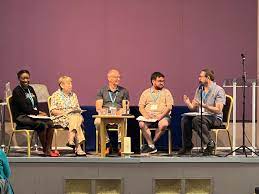
On Saturday 26 July 2025, workshops on climate justice, community-building, poverty, nuclear morality, LGBT+ issues, and non-violence commenced after an engaging morning panel discussion. The panel featured James Trewby, the Columban’s Justice, Peace and Ecology Coordinator and Education Worker; Andrew Jackson, Chief Executive of Pax Christi; George White, a transgender Catholic Religious Education teacher; Bokani Tshidzu, Artist and Creative Director of ART BY BOKANI LIMITED and Campaign Officer at Operation Noah; as well as Sister Katrina.
Bokani shared her story of immigrating from Zimbabwe to Britain after surviving AIDS, receiving “freedom, but not full freedom” as she saw more clearly following George Floyd’s death in 2020 and the Black Lives Matter movement. In many ways people received political freedom, but ecologically, the rights of the next generation of Britons remain largely constrained. Now, as a London-based multimedia artist and activist at Operation Noah working on climate action, she proclaimed that it’s important to understand “we’re the ones we’ve been waiting for” to take proactive steps toward change.
Concerning LGBT+ non-violence and inclusion, George gave a graceful response to James’ account of not walking away from hateful speech against the community at an event. He explained that silent opposition such as walking out of a conference may not have an effective impact on the speaker or audience when one disagrees with their views. Active change can only be demonstrated through dialogue and consistent conversation. When asked how to make peace with a church that rejects him, George answered, “Forgiveness. We need to understand that people don’t always make the right choices.” He encouraged people within the LGBT+ community to embrace their identities as beloved individuals of God: “You don’t have to worship where you are not wanted,” he declared. “We need processes for dialogue.”
Joanna Frew, Outreach Coordinator for the Rethinking Security Network, concluded the conference on 27 July 2025 by redefining national security. She highlighted England’s unique challenges in achieving just national security due to its imperial legacy, arms industry and military sales, possession of nuclear weapons, political interventionism following US examples, network of tax havens, and high carbon emissions. She also challenged the audience with difficult questions about what truly guarantees our security, and whether security can be found in power projection and dominance.
Imperialism may have shaped an unjust world system in which many of us live and from which we benefit. After the pandemic in 2020, the global situation has become turbulent, triggered by local unrest and conflicts including Russia-Ukraine and Israel-Palestine, and peace — among the dealings of great powers and the miscellany of global organisations — seems to have been reduced to a concept used as slogan and propaganda. It is therefore increasingly important, especially for those living in the global north who potentially profit from the pain and suffering of other regions, to consciously object to injustices within the system and to constantly “choose inclusion over isolation”. “Seek ye first his kingdom, and the rest will be given to you.” The peace-building faith-based organisations, strongly supported by faithful members and volunteers, are making changes to each individual starfish on the immense sandy beach.
Amidst vast pain and injustice, much that breaks human hearts — whether climate change, people losing their homes, drug abuse, war, and violence, there seems to be very little we can do. But just like all the organisations present at the conference, and like little people, each of us who survive and thrive in this global village, we are allowed to be afraid and encouraged to be hopeful. Perhaps the best question to ask ourselves now is: what breaks your heart?
Panel with Bokani Tzidzu, Sr Katrina Alton CSJP, Andrew Jackson, George White and James Trewby
A little over a month ago, representatives from the Westminster Justice and Peace Commission attended the annual National Justice and Peace Network (NJPN) Conference, 25-27 July 2025, at The Hayes Conference Centre, Swanwick, Derbyshire. Two young adults from the Diocese received sponsored places to attend the Conference and recorded their impressions of the event.
The first report is by Alannah Travers, a postgraduate student at SOAS University
NJPN Conference 2025: Towards a Just Peace and challenging the inevitability of violence
I was delighted to attend the 2025 National Justice and Peace Network (NJPN) Conference, held from 25–27 July at The Hayes Conference Centre, Derbyshire. This year’s theme, “Towards a Just Peace: Challenging the Inevitability of Violence”, deeply connected with my own postgraduate research at SOAS University of London, where I study international humanitarian and human rights law with a focus on justice and accountability in post-conflict societies.
My place at the conference was generously funded through the Westminster Justice and Peace Commission’s initiative offering free places to young adults aged 18–35. I learned about the opportunity from Father Oscar Ardila, Catholic Chaplain at SOAS, whose encouragement I remain grateful for. As someone long interested in the intersection of peace, justice, and international law – especially in contexts such as Iraq – I was drawn to the conference’s commitment to confronting structures of violence and reimagining what peace might look like.
Throughout the weekend, I joined over 160 participants, including representatives from 17 dioceses, religious orders, Catholic agencies, and peace organisations, engaged in dialogue, worship, workshops, and collective action. Saturday’s powerful panel chaired by James Trewby (Columbans), with speakers including Andrew Jackson (Pax Christi) and Bokani Tshidzu (Operation Noah) challenged us to link spiritual non-violence to climate justice and community activism. The call to confront racialised climate injustice stood out as particularly urgent.
Another highlight was the contribution of Dr Joanna Frew from Rethinking Security, whom I have had the privilege of learning from in the past. I was grateful to attend her workshop, “A Just Peace After Empire?” held in a personal capacity. On Sunday she spoke on redefining “security” through cooperation, sustainability, and care, insisting that there is no security without a viable planet. As a Genocide is being committed in Gaza, Dr Frew’s call to move away from militarised logics of safety towards Gospel-rooted visions of peace felt especially timely this weekend.
The collective action component of the conference was also appreciated. Participants gathered for a symbolic “Red Line for Gaza” protest, condemning the systematic targeting and starvation of Palestinian civilians and calling on world leaders to uphold international law and human dignity. The visual display of solidarity, alongside prayers, petitions, and personal testimonies, demonstrated many participants’ holistic and spiritual approach to peace-making.
The weekend ended with an invitation to live out this year’s Jubilee theme as “pilgrims of hope.” I left feeling spiritually and intellectually renewed, grateful for the community of justice-seekers and the opportunity to reflect deeply on how I might integrate these values into both my academic work and wider life. I want to extend my sincere thanks to the Westminster Justice and Peace Commission, the NJPN team, and Father Oscar for supporting my participation.
Would you like to join the Westminster Justice and Peace Pilgrimage to Rome from 19-22 September?
We are taking a small delegation of 10 people to Rome to take part in the Jubilee of Justice on Saturday 20 September 2025. There are a few places still available.
We will be staying at Villa Lante Center, a property belonging to the Sacred Heart Sisters and located in the heart of Trastevere, near the Vatican City. Activities will include a Pilgrimage to the Holy Door, Catechesis with Pope Leo XIV and meeting other Jubilee of Justice participants from around the world.
The cost for 3 nights bed & breakfast is £220
Participants are invited to make their own travel arrangements but we can give you advice on travelling together with other pilgrims.
This pilgrimage may be of particular interest to anyone working in a legal profession, social justice charities or parish volunteers with a heart for justice. People from other Dioceses are welcome to join us!
This August it will be 80 years since the atom bombs were dropped on the Japanese cities of Hiroshima and Nagaski, killing as many as 200,000 people instantly and leaving many others to suffer from radiation sickness and forms of cancer for years afterwards.
The threat that these weapons will one day be used again still hangs over the world today. Catholic international peace charity, Pax Christi, organises prayers and vigils every year to recall the suffering of survivors and those who died and to work towards a world where these weapons are no longer necessary.
Pax Christi Vigils outside Westminster Cathedral
6 August, 11.00am-1.00pm: 80th Anniversary of the Bombing of Hiroshima
9 August, 11.00am-1.00pm: 80th Anniversary of the Bombing of Nagasaki
Blessed Franz Jägerstätter Service
9 August, 5.00-6.00pm: Pax Christi Franz Jägerstätter Service – Westminster Cathedral Crypt
In the 21st century, humanity’s second largest threat is ecological overshoot, our persistent overuse of our planet’s resources. The greatest threat is not responding to it.
Today is Earth Overshoot Day 2025, the date when humanity will have used up nature’s entire annual budget of ecological resources and services, according to Global Footprint Network, the international sustainability organization that pioneered the Ecological Footprint, and York University, which now produces the National Footprint and Biocapacity Accounts under the governance of FoDaFo.
Currently, humanity is using nature 80% faster than Earth’s ecosystems can regenerate, meaning this overshoot is equivalent to using 1.8 Earths. This level of overuse is possible by depleting natural capital, which compromises long-term resource security. The consequences are visible in deforestation, soil erosion, biodiversity loss, and the accumulation of CO₂ in the atmosphere, contributing to more frequent extreme weather events and declining food production.
UN agencies and affiliated bodies, which provide all the input data for our accounts, regularly revise their data sets, which can lead to updates in historical Ecological Footprint and biocapacity calculations. One major revision this year was a downward adjustment of the ocean’s carbon sequestration capacity. This, along with a slightly higher per capita Footprint and slightly lower per capita biocapacity, shifted Earth Overshoot Day eight days earlier than in 2024. Seven of these eight days are due to the data revisions…
Brother Johannes Maertens gave the following reflection at the Vigil for Migrants outside the Home Office on 21 July 2025:
Reading: Luke 10:25–37 – The Parable of the Good Samaritan
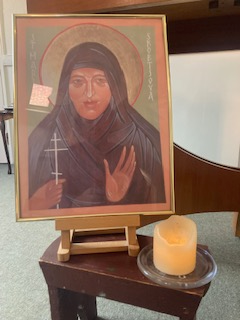
This year marks 80 years since the death of Mother Maria Skobtsova. The Church Times recently referred to her as an “eccentric, chain-smoking poet, monastic, and martyr” “whose theology—grounded in the dual command to love both God and neighbour”—remains startlingly relevant. And perhaps more urgently needed than ever.
In recent years, certain voices—some from pulpits, some from platforms of global influence—have begun to portray empathy as a liability. In 2018, an American pastor published a book titled The Sin of Empathy, describing compassion as potentially morally dangerous. Others have called mercy weak. More recently, tech billionaire Elon Musk described empathy as the “fundamental weakness of Western civilisation,” even criticising Germany’s funding of refugee rescue efforts in the Mediterranean. In response, Germany’s Foreign Office simply said: “Yes. And it’s called saving lives.”
Compassion, empathy… What most of us would consider a fundamental strength—a binding force in our cultures—is now labeled a threat by those in power. And these are not random comments. They are part of a wider push to redefine the moral imagination of society.
But contrast that with the Gospel— and our Gospel reading today —and the very life of Mother Maria Skobtsova.
The parable of the Good Samaritan reframes what it means to be a neighbour—not by nationality, proximity, or religious allegiance, but by mercy. “Who was neighbour to the man?” Jesus asks. And the answer is clear: “The one who showed him compassion.” Jesus, doesn’t answer the question “Who is your neighbour” – he tells you more how you would hope your neighbour is – and then Jesus says: “Go and do likewise.”
This command sits at the heart of Mother Maria Skobtsova’s radical theology. What she called “the sacrament of the brother.” She wrote: “Give from the heart, since each person is the very icon of God incarnate in the world.”
Let that sink in. Every human being—no matter how broken or marginalised—is an icon of Christ. For Mother Skobtsova, every encounter with another person becomes a kind of opportunity to be liturgy. She imagined the whole world as one altar. And to this altar, we offer not only bread and wine, but our hearts—so that they might be transformed into Christ’s love. A “kenotic love”—a love that empties itself.
In this vision, compassion is not weakness. It is sacrament. Mercy is not naive. It is resurrection.
She didn’t separate the altar from the street, the Eucharist from the soup kitchen, or the refugee-boats from the chalice. She saw Christ there—broken, waiting—and she responded.
When the Nazis invaded Paris, Mother Maria didn’t ask whether hiding Jewish children was politically wise. She saw the face of Christ and acted. And it cost her everything, she died in the Ravenbrouck concentration camp, where she was gazed to death around Easter 1945.
So we must ask: what do we see today?
Across the Mediterranean, in the English Channel, across borders, people are crossing treacherous waters in small inflatable boats. Fleeing war, persecution, and poverty. They too lie wounded along the road to Jericho. And we—we are the passers-by. The priests. The Levites.
We scroll past their faces. Hear their statistics. Debate their fate. But the Gospel doesn’t ask who deserves to be saved. It asks: Who will show compassion?
To offer mercy is to meet Christ. To bind a wound is to celebrate Eucharist. To open a door is to open heaven. This is not sentimental. It is spiritual courage.
So when we see a migrant in crisis, a stranger at the door, an outcast in pain—we must not pass by. We must be moved with compassion. Not because it’s trendy, or convenient. But because Christ is there.
Broken. Waiting.
And that is why we stand here today. In prayer. In solidarity. And in hope—for a more compassionate future, together.
Amen.
“But if at the center of the Church’s life there is this self-giving Eucharistic love, then where are the Church’s boundaries, where is the periphery of this center? Here it is possible to speak of the whole of Christianity as an eternal offering of a Divine Liturgy beyond church walls … It means that we must offer the bloodless sacrifice, the sacrifice of self-surrendering love not only in a specific place, upon the altar of a particular temple; the whole world becomes the single altar of a single temple, and for this universal liturgy we must offer our hearts, like bread and wine, in order that they may be transformed into Christ’s love, that he may be born in them, that they may become “God-manly” hearts, and that He may give these hearts of ours as food for the world…” ” (Mother Maria Skobtsova, Selected Writings, ed. Jim Forest, Chapter on Types of Monasticism, page 185)
At a press conference following their pastoral visit to Gaza, the Greek Orthodox and Latin Patriarchs of Jerusalem issue a joint appeal to world leaders and decision makers, calling for “an end to the war, the release of detainees, and the beginning of a true healing process that restores life and dignity to Gaza and the entire Holy Land”.
“Christ is not absent from Gaza,” Cardinal Pierbattista Pizzaballa said on Tuesday. “He is there—crucified in the wounded, buried under rubble, and yet present in every act of mercy, every candle in the darkness, every hand extended to the suffering.”
The Latin Patriarch of Jerusalem was speaking at a press conference with Eastern Orthodox Patriarch Theophilos III, following the prelates’ recent pastoral visit to Gaza. In his opening remarks, Cardinal Pizzaballa insisted that the two patriarchs had travelled to the war-torn Palestinian territory not as politicians or diplomats, but as pastors. He insisted that the Church will never abandon the people of Gaza, emphasizing that their mission was not to a specific group, but to all: “Christians, Muslims, believers, doubters, refugees, children.”
‘Servants of the suffering Body of Christ’
His sentiments were echoed by Patriarch Theophilos, who said they had gone to Gaza “as servants of the suffering Body of Christ, walking among the wounded, the bereaved, the displaced, and the faithful, whose dignity remains unbroken despite their agony.” In Gaza, he said, “we encountered a people crushed by the weight of war, yet carrying within them the image of God.”
The Orthodox Patriarch explained that “the Church’s mission in times of devastation is rooted in the ministry of presence, of standing with those who mourn, of defending the sacredness of life, and of witnessing to the light that no darkness can extinguish.”
Fr Romanelli (centre) on a visit to London last year with Bishop Nicholas Hudson (l). Photo: ICN
Pax Christi England and Wales
Pax Christi England and Wales and Pax Christi International have issued the following statements in response to the deadly attack on the Holy Family Church in Gaza yesterday.
This morning’s horrific news that the Israel Defence Forces (IDF) struck the Holy Family Church in Gaza is both shocking and shameful. We know that at least six people are injured, including Fr Romanelli, and that two people have been killed. Lord have mercy.
If we are ever to overcome the myth of redemptive violence, then our response is never revenge.
Our response is never apathy. Our response is never neutrality. Instead, we dare to proclaim the revolutionary power of Jesus’ way of nonviolence. The way of the cross, the way of redemptive suffering, that ultimately leads to joy, hope, peace and resurrection.
Today it might seem that we are in the darkness of the tomb. Yet even inside the tomb something is happening. Young people in Tel Aviv are burning their draft cards and refusing to fight for the IDF. Across the world people are non-violently resisting the sale of arms to Israel. Acts of solidarity, prayer and fasting are the tools by which we bring about a revolution of the heart – one person at a time.
Let us never forget the power we each have to make a difference. The works of war destroy lives, land, and futures. The works of mercy support life and bring hope. Let’s commit ourselves afresh to pray and act in every way possible to make real our solidarity with the suffering people of Gaza and bring an end to this genocide in which the UK government is complicit.
Pax Christi International
Pax Christi International supports the Latin Patriarchate in Jerusalem and strongly condemns today’s Israeli military strike on Holy Family Catholic Church in Gaza, a place of sanctuary for displaced civilians.
We stand in solidarity and prayer with all those Christians and Muslims sheltering in the parish compound.
We mourn those who have died, Mr Saad Salameh, Mrs Fumayya Ayaad and Najwa Abu Daoud. We pray that they will rest in peace and send our deepest condolences to their families and friends. We hope for a good recovery for Fr Gabriel and all those injured in the attack.
We echo Pope Leo XIV and the Latin Patriarchate in calling for an immediate and permanent ceasefire in Gaza.
As the Patriarch has said, ‘The time has come for leaders to raise their voices and to do all that is necessary in order to stop this tragedy, which is humanly and morally unjustified.’
Pax Christi calls on the international community, political and religious, to raise their voices and take urgent action to protect all civilians and humanitarian spaces to enable:
– An immediate and permanent ceasefire and immediate access to humanitarian aid for everyone in Gaza, to be distributed through UNWRA and other experienced NGOs; -The release of all hostages, Israeli and Palestinian; -A complete arms embargo on Israel; -An end to all trade with illegal Israeli settlements; -An end to the Israeli siege on Gaza and the occupation of the West Bank.
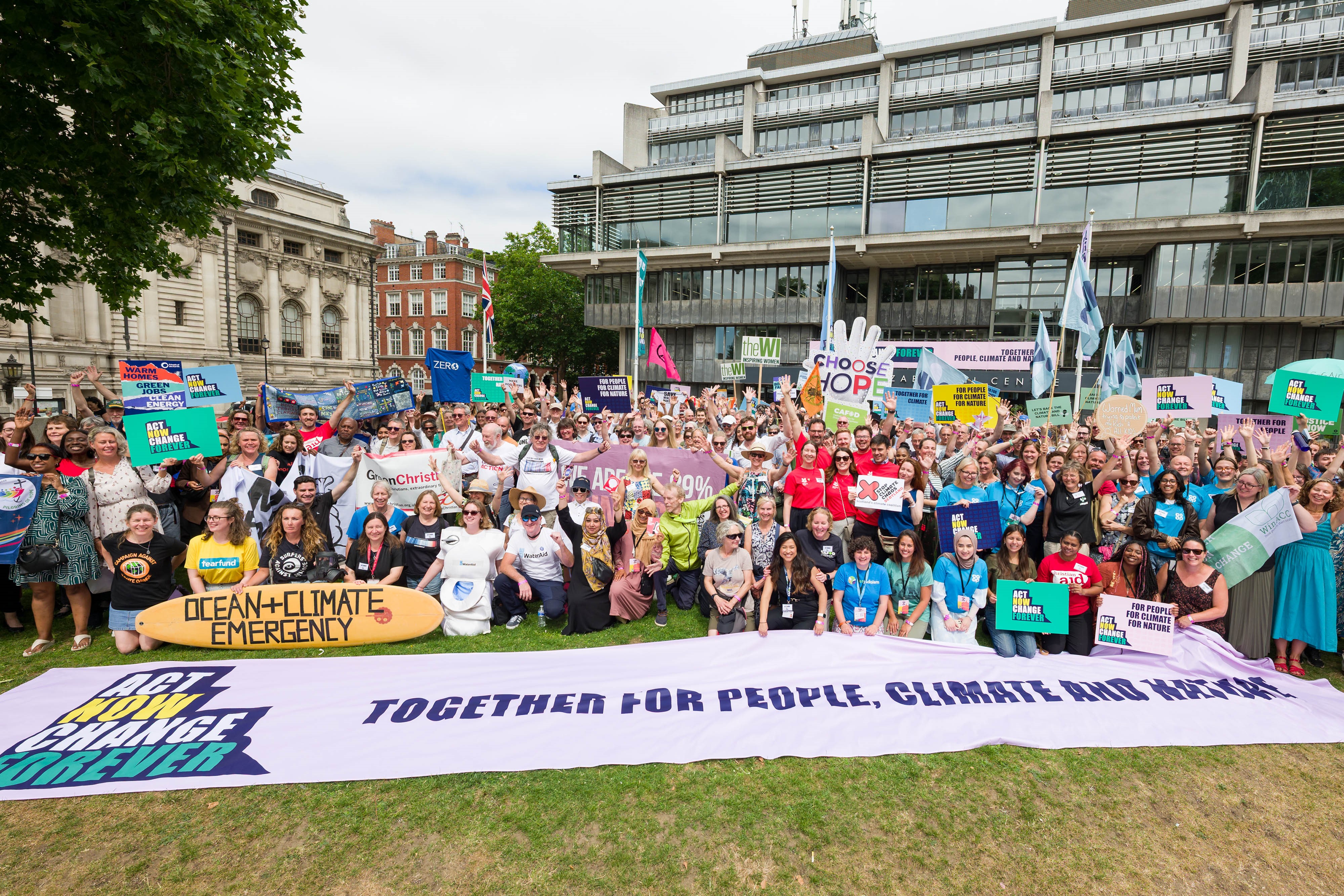
Mass Lobby of Parliament participants outside the QEII Centre, London
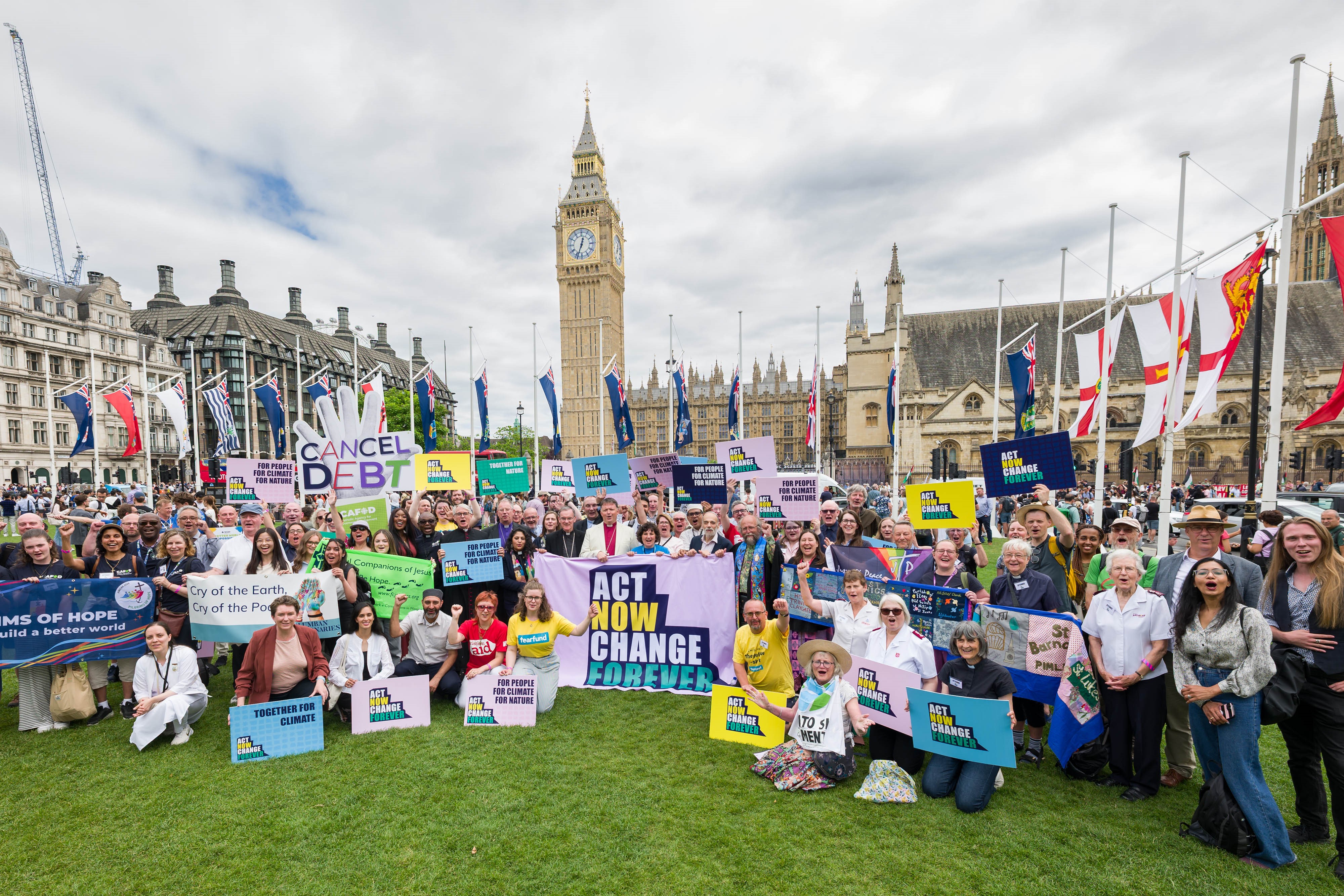
On Wednesday 9 July 2025, around 5,000 people came together in Westminster for the Act Now, Change Forever Mass Lobby. We called on MPs to act now for a healthier, fairer, safer future, in one of the biggest moments for climate and nature this year, and the largest mass lobby of the decade.
People from across the UK travelled, far and wide to speak directly to their MPs. From schoolchildren to surfers, parents to pensioners, campaigners to conservationists, the diversity and strength of the movement was impossible to ignore.
For the Catholic community, CAFOD supporters were present in great numbers. Colette Joyce, the Westminster Justice and Peace Co-ordinator, spent the day on the Faith for the Climate stall in the QEII Centre.
“There was a constant stream of visitors to the stall all day,” she said. “It was fantastic to meet people from all over the country, of all faiths and none, who were glad to see us there and keen to find out how faith groups are contributing to the climate, nature and debt movements.”
A photo of faith groups was taken in Parliament Square
Mass Lobby of Parliament 9 July 2025 – Faith Groups in Parliament Square
The Mass Lobby with its Act Now, Change Forever message was a powerful reminder of what’s possible when we show up – together, side by side – to demonstrate the overwhelming public support for action on climate and nature.
Together, we brought our MPs an unmissable message: communities across the UK are ready for bold, practical action on climate and nature – and we won’t stop here. We’re just getting started.






 Diocese of Westminster Justice and Peace Commission