To mark this year’s Education Sunday on 8 September 2024, Sr Silvana Dallanegra, one of the Caritas Westminster Development Team and Lead for Catholic Social Teaching, reflects on the impact of CST and the Caritas Ambassadors programme on schools across the diocese.
I thank you, Father, Lord of heaven and earth, that you have hidden these things from the wise and understanding and revealed them to little children(Matthew 11: 25)
Catholic Social Teaching (CST), for too long known as the Church’s ‘best-kept secret’, is now being thoroughly revealed to children, thanks to its growing popularity and new prominence in the Religious Education Directory. A thorough grounding in CST enables children to understand the values and attitudes which must underpin their choices and activities; how to treat other people, especially those who have less than them, and how to treat all of God’s gift of creation.
Caritas Westminster is committed to supporting schools in deepening and developing their Catholic life, particularly through CST. One way is via our Caritas Ambassadors programme, currently being used by over 35 schools across the Diocese of Westminster. This aims to equip pupils with a strong understanding of CST and how they can put it into action in their daily lives: it deepens their understanding of six key themes, helping them to think about social justice issues in their local community before taking them through developing and running their own social action project.
In the five years since we started piloting it, Caritas Ambassadors have led their schools in numerous initiatives, including reaching out to those who are isolated, supporting local homeless projects and food banks, and caring for the environment. They have also led their schools in prayer and campaigning, and in some cases, invited the wider parish community to get involved.
Miss Bessant from St Peter & St Paul Primary in Clerkenwell, recently told us:
This is the second year that we have taken part in Caritas Ambassadors. The children have embraced the different aspects of Catholic Social Teaching and have worked together to identify the needs of their community. As a result, they have built relationships with some of the elderly in the community that attend The Peel Centre. It has been a real honour watching the children grow in love as they embraced their role as a Caritas Ambassador.
Speaking of their collaboration with The Peel Centre, her pupils added:
At our age, we cannot give money or physical gifts, but we can give the gift of our love and time; to let others know that in an age where many things are online, there are still people that care. We are all God’s children, and as Ms Peters, our head teacher always says, Jesus is the tree and we are branches… ready to reach out and share our fruits.
A pupil from St Joseph’s Primary in Chelsea said of their social action initiative:
Looking back, our project was more than just supporting charities; it was a testament to the power of community and participation, and we really showed our ‘love in action.’
A few months ago, we hosted our second Caritas Ambassadors Festival at Westminster Cathedral. In a liturgy led by Bishop Paul McAleenan, Chair of the Caritas Board, almost 400 students came together to present examples of their work and receive certificates for their schools.
Many children spoke of their pride at being able to represent their school, and noted the inspiring effect of hearing and learning from other students.
Mrs Kelliher from The Rosary in Heston said:
the Festival has been a standout moment for us this half term! The testimonials shared by the other schools were inspiring, and our Ambassadors have already been discussing their next ideas.’
Indeed, a student from St Joseph’s, Harrow, poignantly noted:
Through his ministry, Jesus taught us how to serve others. Being a part of the festival made me really reflect on what we have already achieved but it also made me think about what else we could do.
We were all in awe as we listened to the Ambassadors sharing not only what they do, but why they do it. It’s so lovely to see children who are not only enthused by social action, but able to understand and demonstrate the underlying principles so well. In the years to come, I hope they will remember this experience, and that they will always be Caritas Ambassadors, called to step forward in love and service wherever they may be.
On this Education Sunday, and as we begin a new academic year, we invite you to pray with us for all the pupils and staff in our schools, as they seek to live their call to follow Jesus, our original Love in Action. Please join us in saying this prayer, written by a Caritas Ambassador from The Rosary Primary School, Heston, and pray especially for all the children who will be taking part in the programme this year:
We pray for all our schools and their Caritas Ambassadors who are leading Faith in Action through their service and care. May our school communities be in unity and solidarity, and may kindness and compassion fill the hearts of those we help. May the Lord’s healing hands touch those who are unfortunate to have to struggle in their lives.
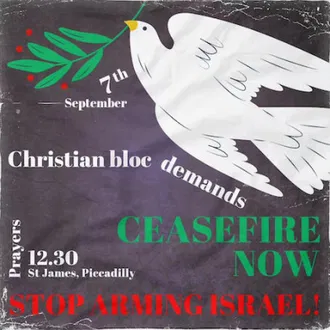
Once again this Saturday, 7 September, Westminster Justice and Peace will be joining the Christian bloc at the Ceasefire Now! rally in Central London to pray and march for peace and justice for Palestine.
The UK government has finally acknowledged that weapons made in this country are being used to commit war crimes in Palestine, but has suspended only 30 of its 350 arms contracts with Israel. Nothing short of a full arms embargo will do. The UK must stop arming Israel immediately.
Schedule
12.15 – Meet outside St James, Piccadilly, W1J 9LL 12.30 – Pray together 13.00 – Join the march
Brendan Metcalfe, CEO at the charity Friends of the Holy Land, will be speaking at St Thomas More RC Church, 9 Henry Road, London N4 2LH on Friday 13th September at 7pm, followed by a Q&A session.
Brendan’s talk will include an update on how Friends in the Holy Land are supporting Christians in the current crisis. This is a great opportunity to learn more about the Holy Land, especially as Brendan recently visited Jordan and the West Bank.
Admission free, refreshments will be served. Donations welcome.
All are very welcome to join Westminster Justice and Peace and parishioners from surrounding parishes at this talk.
Fifty-five Laudato Si’ Animators, representing all parts of the United Kingdom, have written an open letter to the Prime Minister Sir Keir Starmer, and the ministers responsible Steve Reed and Ed Milliband. They call on the government to:
1. Introduce the Climate and Nature Bill which 60,000 marched for at Restore Nature Now rally on 22 June 2024. This bill would address many issues of concern e.g. reducing greenhouse gases, ending fossil fuel extraction, restoring ecosystems.
2. Commit to a transition from animal agriculture to organic, arable agriculture. Animal agriculture is a leading cause of many present world crises – climate change; antibiotic resistance; waste of resources and global hunger (food, land, water and energy are wasted in growing food for animals to eat).
3. Commit to the signing of the Fossil Fuel Non-Proliferation Treaty (FFNPT), a proposed international agreement that aims to control fossil fuel production and infrastructure expansion, and phase out fossil fuel use in a fair and equitable way. The treaty would also accelerate the transition to clean energy and economic diversification away from fossil fuels. In 2023 Pope Francis called for “the elimination of fossil fuels, and education in lifestyles that are less dependant”.
4. Support rewilding and in particular the Rewilding manifesto.
5. Ensure businesses pay for their pollution, and transition to non-polluting practices and products.
They state: “We believe that climate change is now such a threat to humanity that it should not be the subject of policies of individual political parties, but that all the parties should work together to find solutions to the problem for the common good and for the sake of our children’s children.
“Pope Francis issued a papal document Laudate Deum in October 2023 which gives a clear warning about what needs to be done urgently.
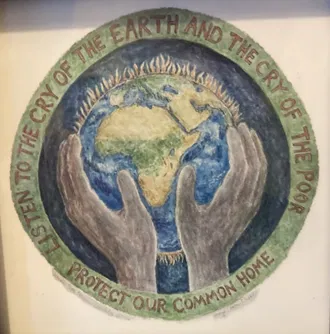
“We are sending you a photo from the march in June and a copy of a special painting by professional artist Helen Elwes who is one of the Animators which we hope you will put on your desk as a reminder that we all need to think and act to care for our common home.”
A big concern on our hearts at the moment is the need for peace in the world as we approach nearly a year of war in Gaza, as well as remembering the on-going conflicts in Ukraine and Russia, Sudan, the Democratic Republic of Congo, Yemen and elsewhere.
The guest speaker at our Inaugural Justice and Peace Lecture at Farm Street on 1 September is Baroness Scotland, Commonwealth Secretary General, who will address the theme of ‘Delivering Peace in a Multi Polar World’.
Join us to reflect deeply on how we might contribute to building a culture of peace and not war.
There are so many different ways to joyfully celebrate the Season of Creation! Create a display, pray for the care of creation, spend time in nature on a walk or picnic, plant a tree or a ‘fruits of hope’ garden, hold a blessing of pets, host a screening of the film ‘The Letter’ about Pope Francis’ encyclical Laudate Si’, sign up for the CAFOD Live Simply Award and so much more…
Show the film ‘The Letter’ which tells the story of Pope Francis and the encyclical letter ‘Laudato Si’: On the Care of Our Common Home’. Free to download https://theletterfilm.org/
Produce a Season of Creation noticeboard display, banners or booklets for the Parish.
Invite local people to speak.
Plant a tree.
Look after land around the church to encourage wildlife.
Arrange a parish walk in nature, finishing with a picnic.
Celebrate the Season of Creation with a parish vegetarian meal.
Implement a carbon reduction programme for your Parish. Contact Westminster Diocese Property Services or Westminster Justice & Peace for assistance.
Hold an exhibition for the Season of Creation in collaboration with a local school or art group.
Hold a concert with music inspired by creation or as a fundraiser for local nature projects.
Book a ‘Tree Walk’ with Colette Joyce, the Justice and Peace Co-ordinator, to explore the fascinating trees to be found around Westminster Cathedral. Email: colettejoyce@rcdow.org.uk
Promote the Southern Dioceses Environment Network Meetings. A home for all Catholics interested in getting more support for their environment activity within the Church or in society. Over 100 people on the mailing list. New participants welcome!
Make plans to continue your Care for Creation throughout the year.
Let the Justice & Peace office know about your activities so that we can share the good news with the rest of the Diocese!! Email: justiceandpeace@rcdow.org.uk
“Hope and Act with Creation” is the theme of the World Day of Prayer for the Care of Creation, to be held on 1 September 2024. The theme is drawn from Saint Paul’s Letter to the Romans (8: 19-25), where the Apostle explains what it means for us to live according to the Spirit and focuses on the sure hope of salvation that is born of faith, namely, newness of life in Christ.
Let us begin with a question, one perhaps without an immediately obvious answer. If we are truly believers, how did we come to have faith? It is not simply because we believe in something transcendent, beyond the power of reason, the unattainable mystery of a distant and remote God, invisible and unnameable. Rather, as Saint Paul tells us, it is because the Holy Spirit dwells within us. We are believers because the very love of God “has been poured into our hearts” ( Rom 5:5) and the Spirit is now truly “the pledge of our inheritance” ( Eph 1 :14), constantly prompting us to strive for eternal goods, according to the fullness of Jesus’ authentic humanity.
The Spirit enables believers to be creative and pro-active in charity. He sends us forth on a great journey of spiritual freedom, yet one that does not eliminate the tension between the Spirit’s way of thinking and that of the world, whose fruits are opposed to each other (cf. Gal 5:16-17). We know that the first fruit of the Spirit, which sums up all the others, is love. Led by the Holy Spirit, believers are children of God and can turn to him with the words “Abba, Father” ( Rom 8:15), just as Jesus did. Moreover, they can do so with the freedom of those who no longer fall back into the fear of death, for Jesus has risen from the dead. This is our great hope: God’s love has triumphed and continues to triumph over everything. Indeed, even in the face of physical death, future glory is already assured for those who live the new life of the Spirit. Nor does this hope disappoint, as was affirmed in the recent Bull of lndiction of the forthcoming Jubilee. [1]
The life of a Christian, then, is one of faith, active in charity and abounding in hope, as we await the Lord’s return in glory. We are not troubled by the “delay” of the Parousia, Christ’s second coming; for us the important question is whether, “when the Son of man comes, he will find faith on earth” (Lk 18:8). Faith is a gift, the fruit of the Spirit’s presence in us, but it is also a task to be undertaken freely, in obedience to Jesus’ commandment of love. Such is the blessed hope to which we must bear witness. Yet where, when, and how are we to bear that witness? Surely by caring for the flesh of suffering humanity. As people who dare to dream, we must dream with our eyes wide open, impelled by a desire for love, fraternity, friendship and justice for all. Christian salvation enters into the depths of the world’s suffering, which embraces not only humanity but also the entire universe, nature itself, and the oikos, the home and living environment of humanity. Salvation embraces creation as an “earthly paradise,” mother earth, which is meant to be a place of joy and a promise of happiness for all. Our Christian optimism is founded on a living hope: it realizes that everything is ordered to the glory of God, to final consummation in his peace and to bodily resurrection in righteousness, as we pass “from glory to glory.” Nonetheless, in the passage of time we are not exempt from pain and suffering: the whole creation groans (cf. Rom 8:19-22), we Christians groan (cf. vv. 23-25) and the Spirit himself groans (cf. vv. 26-27). This groaning expresses apprehension and suffering, together with longing and desire. It gives voice to our trust in God and our reliance on his loving yet demanding presence in our midst, as we look forward to the fulfilment of his plan, which is joy, love and peace in the Holy Spirit.
The whole of creation is caught up in this process of new birth and, in groaning, looks forward to its liberation. This entails an unseen and imperceptible process of growth, like that of “a mustard seed that becomes a great tree” or “leaven in the dough” (cf. Mt 13:31-33). The beginnings are tiny, but the expected results can prove to be infinite in their beauty. Similar to the anticipation of a birth – the revelation of the children of God – hope can be seen as the possibility of remaining steadfast amid adversity, of not losing heart in times of tribulation or in the face of human evil. Christian hope does not disappoint, nor does it deceive. The groaning of creation, of Christians and of the Spirit is the anticipation and expectation of a salvation already at work; all the same, we continue to find ourselves enduring what Saint Paul describes as “tribulation, distress, persecution, famine, nakedness, peril, sword” ( Rom 8:35). Hope, then, is an alternative reading of history and human affairs. It is not illusory, but realistic, with the realism of a faith that sees what is unseen. This hope is patient expectation, like that of Abraham. I think of that great visionary believer, Joachim of Fiore, the Calabrian abbot who, in the words of Dante Alighieri, “was endowed with a spirit of prophecy”.[2] At a time of violent conflicts between the Papacy and the Empire, the Crusades, the outbreak of heresies and growing worldliness in the Church, Joachim was able to propose the ideal of a new spirit of coexistence among people, based on universal fraternity and Christian peace, the fruit of a life lived in the spirit of the Gospel. I spoke of this spirit of social friendship and universal fraternity in Fratelli Tutti, but this harmony among men and women should also be extended to creation, in a “situated anthropocentrism” (Laudate Deum, 67) and in a sense of responsibility for a humane and integral ecology, the path to salvation for our common home and for us who inhabit it.
Why is there so much evil in the world? Why so much injustice, so many fratricidal wars that kill children, destroy cities, pollute the Environment and leave mother earth violated and devastated? Implicitly evoking the sin of Adam, Saint Paul states: “We know that the whole creation has been groaning in labour pains until now” (Rom 8:22). The moral struggles of Christians are linked to the “groaning” of creation, ever since the latter “was subjected to futility” (v. 20). The entire universe and every creature therein groans and yearns “impatiently” for its present condition to be overcome and its original state to be restored. Our liberation thus includes that of all other creatures who, in solidarity with the human condition, were placed under the yoke of slavery. Creation itself, like humanity, was enslaved, albeit through no fault of its own, and finds itself unable to fulfil the lasting meaning and purpose for which it was designed. It is subject to dissolution and death, aggravated by the human abuse of nature. At the same time, the salvation of humanity in Christ is a sure hope also for creation, for, “the creation itself will be set free from its bondage to decay and obtain the glorious liberty of the children of God” (Rom 8:21). Consequently, thanks to Christ’s redemption, it is possible to contemplate in hope the bond of solidarity between human beings and all other creatures.
In our hopeful and persevering expectation of the glorious return of Jesus, the Holy Spirit keeps us, the community of believers, vigilant; he continually guides us and calls us to conversion, to a change in lifestyle in order to resist the degradation of our environment and to engagement in that social critique which is above all a witness to the real possibility of change. This conversion entails leaving behind the arrogance of those who want to exercise dominion over others and nature itself, reducing the latter to an object to be manipulated, and instead embracing the humility of those who care for others and for all of creation. “When human beings claim to take God’s place, they become their own worst enemies” (Laudate Deum, 73), for Adam’s sin has tainted our fundamental relationships, namely with God, with ourselves, with one another and with the universe. All these relationships need to be integrally restored, saved and “put right”. None of them can be overlooked, for if even one is lacking, everything else fails.
To hope and act with creation, then, means above all to join forces and to walk together with all men and women of good will. In this way, we can help to rethink, “among other things, the question of human power, its meaning and its limits. Our power has frenetically increased in a few decades. We have made impressive and awesome technological advances, yet we have not realized that at the same time we have turned into highly dangerous beings, capable of threatening the lives of many beings and our own survival” (Laudate Deum, 28). Unchecked power creates monsters and then turns against us. Today, then, there is an urgent need to set ethical limits on the development of artificial intelligence, since its capacity for calculation and simulation could be used for domination over humanity and nature, instead of being harnessed for the service of peace and integral development (cf. Message for the World Day of Peace 2024).
“The Holy Spirit accompanies us at every moment of our lives”. This was clearly understood by the boys and girls assembled in Saint Peter’s Square for the first World Day of Children, which was held on Trinity Sunday. God is not an abstract notion of infinity, but the loving Father, the Son who is the friend and redeemer of every person, and the Holy Spirit who guides our steps on the path of charity. Obedience to the Spirit of love radically changes the way we think from “predators”, we become “tillers” of the garden. The earth is entrusted to our care, yet continues to belong to God (cf. Lev 25:23). This is the “theological anthropocentrism” that marks the JudeaChristian tradition. To claim the right to possess and dominate nature, manipulating it at will, thus represents a form of idolatry, a Promethean version of man who, intoxicated by his technocratic power, arrogantly places the earth in a “dis-graced” condition, deprived of God’s grace. Indeed, if the grace of God is Jesus, who died and rose again, then the words of Benedict XVI certainly ring true: “It is not science that redeems man: man is redeemed by love” (Spe Salvi, 26), the love of God in Christ, from which nothing and no one can ever separate us (cf. Rom 8:38-39). Creation, then, is not static or closed in on itself, but is continuously drawn towards its future. Today, thanks to the discoveries of contemporary physics, the link between matter and spirit presents itself in an ever more intriguing way to our understanding.
The protection of creation, then, is not only an ethical issue, but one that is eminently theological, for it is the point where the mystery of man and the mystery of God intersect. This intersection can be called “creative”, since it originates in the act of love by which God created human beings in Christ. That creative act of God enables and grounds the freedom and morality of all human activity. We are free precisely because we were created in the image of God who is Jesus Christ, and, as a result, are “representatives” of creation in Christ himself. A transcendent (theological-ethical) motivation commits Christians to promoting justice and peace in the world, not least through the universal destination of goods. It is a matter of the revelation of the children of God that creation awaits, groaning as in the pangs of childbirth. At stake is not only our earthly life in history, but also, and above all, our future in eternity, the eschaton of our blessedness, the paradise of our peace, in Christ, the Lord of the cosmos, crucified and risen out of love.
To hope and act with creation, then, means to live an incarnational faith, one that can enter into the suffering and hope-filled “flesh” of others, by sharing in the expectation of the bodily resurrection to which believers are predestined in Christ the Lord. In Jesus, the eternal Son who took on human flesh, we are truly children of the Father. Through faith and baptism, our life in the Spirit begins (cf. Rom 8:2), a holy life, lived as children of the Father, like Jesus (cf. Rom 8:14-17), since by the power of the Holy Spirit, Christ lives in us (cf. Ga/ 2:20). In this way, our lives can become a song of love for God, for humanity, with and for creation, and find their fullness in holiness.[3]
[1] Cf. Bull of lndiction of the Ordinary Jubilee of the Year 2025 Spes Non Confundit (9 May 2024).
[2] The Divine Comedy, Paradiso, Canto XII, 141
[3] The Rosminian priest Clemente Rebora expressed this poetically: “As creation ascends in Christ to the Father, all in a mysterious way become the travail of birth. How much dying is required if life is to be born! Yet from one Mother alone, who is divine, we come happily into the light. We are born to a life that love brings forth in tears. Its yearning, here below, is poetry; butholiness alone can finish the song” ( Curriculum vitae, “Poesia e santita”: Poesie, prose e traduzioni, Milan 2015, p. 297).
Southern Dioceses Environment Network – Join us for the next Southern Dioceses Environment Network meeting on 9 September 2024, when we will be exploring Pilgrimages and the Holy Year 2025, in the light of our commitment to care for creation.
Hundreds of people have been arriving at the Greenbelt Festival at Boughton House, near Kettering. The weekend will be full of music, worship, comedy, craft, theatre, dance, food, spirituality, talks and more. Partner organisations include Christian Aid, Iona Community, Trussell Trust and Embrace the Middle East.
Those who can’t make it can sign up to take part in the Festival’s free livestreaming of some of the sessions. It starts on Friday morning.
Key livestreams are:
Brooke Prentis, an Aboriginal Christian leader will speak about the 250-year history of struggling for justice at 10.30am on Friday.
Richard Rohr, speaking at 5pm on Saturday. He will explore how walking the path of the prophets – from anger to sadness to love – can help sustain us in times of cultural exhaustion.
Vanessa Nakate, a climate activist from Uganda, will be speaking about how faith can sustain action for climate justice at 13.30pm on Sunday.
The Greenbelt Festival is nearly here. The weekend of music, comedy, craft, theatre, dance, food, spirituality, talks, provocation and more takes place from Thursday 22 – Sun 25 August 2024 at Boughton House, near Kettering.
Christian Aid has been a partner in the event for 31 years and this year is unveiling a new venue – the No Fly Zone. With a packed programme of speakers, films, information and the chance to meet Christian Aid staff and volunteers, this is the place to visit to find out more about global justice.
Pete Moorey, Head of Community and Church Fundraising and Engagement, explained: “We’re really excited to launch this amazing space at Greenbelt and provide festivalgoers with the opportunity to hear from activists, partners and communities. Each day will focus on different aspects of our work on racial justice, economic justice and climate justice.
“Thanks to a live digital link-up as well as pre-recorded films and content, we’ll be able to bring speakers from outside the UK to the festival to connect with supporters and offer a variety of perspectives, particularly through a faith lens.”
The programme includes keynote speaker, Catholic Father Richard Rohr, an American Franciscan friar and ecumenical teacher, who will be speaking about spirituality and Christian mysticism; a showing of The Tinderbox – a documentary from Gillian Moseley about Israel and the occupied Palestinian territory; Daoud Nasser from the Tent of Nations near Bethlehem. Anglican Father Azariah France-Williams will be chatting to some of the poets, singers, comedians and other contributors at Greenbelt.
There will be daily prayers with The Iona Community – an ecumenical Christian movement working for justice and peace, the rebuilding of community and the renewal of worship; panel sessions; and films. On Sunday Fr Martin Poulsom SDB will celebrate a Catholic Mass with music and liturgy led by members of https://pilgrimcross.org.uk/
Music will include: Ooberfuse, Bailla La Cumbia, Akram Abdulfattah, Boom Boom Racoon and many more.
If you’re unable to come in person, join the festival in the field of streams instead. Register HERE to join us for free livestreams during the festival weekend.
Independent Catholic News will be reporting from Greenbelt all weekend – watch this space!
Westminster Justice and Peace Co-ordinator, Colette Joyce, will also be in attendance at the festival.





 Diocese of Westminster Justice and Peace Commission