Westminster Justice and Peace are members of The Climate Coalition, which since 2015, has used the power of green hearts on Valentine’s Day to send a message to those in power that we want to see a safer, greener future for generations to come.
Watch some of the highlights from eight years of Show The Love
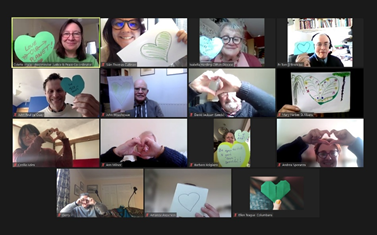
On Monday 12th February, everyone is invited to join the Southern Dioceses Environment Network on Zoom for deeper reflection on the theme of ‘Show The Love’ in our parishes and Catholic communities as we also make our preparations for Lent. If you would like to join us, make or bring a green heart to the meeting and wear something green!
Cardinal Vincent Nichols and Bishop Nicholas Hudson have written to all the priests of the Diocese with an invitation to arrange two parish meetings before the next Deans meeting on 6th March to reflect on two themes of the Synod: Co-responsibility and Formation.
The time is short but materials are available to help and will be published on the Diocesan website shortly here https://rcdow.org.uk/synod/ .
The Cardinal writes: “It will be a moment for us to pause and consider how we are, in fact, keeping this mission before our eyes and in doing so striving to act in a participative manner.”
PREPARING FOR LENT
2024 is to be a Year of Prayer, leading up to the next Jubilee Holy Year in 2025. We are invited to delve deeply into the Lord’s Prayer at this time, reflecting on it deeply, line by line.
A Diocesan booklet ‘We Dare to Say’ is available with 5 Lenten sessions for small groups and the Westminster Deaf Service is encouraging us to learn to pray the Our Father in sign language. Please give it a go!
Watch some of the highlights from eight years of Show The Love
THE POWER OF GREEN HEARTS
Since 2015, The Climate Coalition have used the power of green hearts on Valentine’s Day to send a message to those in power that we want to see a safer, greener future for generations to come.
On Monday 12th February, we will join other participants in the Southern Dioceses Environment Network for deeper reflection on the theme of ‘Show The Love’ in our parishes and Catholic communities as we also make our preparations for Lent.
If you would like to join us, make or bring a green heart to the meeting and wear something green!
l-r: Hilda McCafferty, Colette Joyce and Father Richard Nesbitt in West London Parish, Our Lady of Fatima, White City
ByMaggie Beirne
Sixteen people from 12 parishes in West London met online on 27 January to feedback on their local outreach work. Parishes included White City, Ealing Abbey, Hanwell, Feltham and Pinner. Participants included Colette Joyce, the Westminster Justice and Peace Coordinator, and Sr Silvana Dallangra of Caritas Westminster.
The West London Justice and Peace Network held its first meeting of 2024 on a very appropriate weekend. All parishes were expected to mark both Holocaust Memorial Day (27 January) and Racial Justice Sunday (28 January).
The participants shared information about the efforts undertaken to mark both of these events at parish level – with Bidding Prayers, items in parish newsletters, and more active efforts to improve the diversity of the imagery in their churches and so on. Concern was however expressed at the lack of advance planning so that resources for Racial Justice Sunday arrived too late for parishes to be very active in using them.
Opposition to racism, anti-Semitism and Islamophobia is our duty as Catholics but how do we best do this? We can examine our own consciences, and we can pray, but in the current tragic circumstances of the Holy Land, what action should we be taking to make their witness more effective?
Some parishes have raised money; others have introduced special prayer events; and the network talked of additional measures to be pursued. We could, for example, be protesting the UK’s involvement in arms sales, drawing attention to the recent ruling of the International Court of Justice, and building stronger alliances with other Christians, Jews and Muslims in calling for peace throughout the region. It was pointed out that there has been a Christian presence at each ‘Ceasefore Now’ London protest march since last October.
And, if we cannot do everything, let’s at least start to do something. The great quote from St Oscar Romero comes to mind when motivating ourselves to act when everything looks bleak: “We plant the seeds that one day will grow. We water seeds already planted, knowing that they hold future promise. We lay foundations that will need further development. We provide yeast that produces far beyond our capabilities”.
As ever, the network meeting had lots to report about parish activities relating to poverty in our own communities; promoting environmental justice; and the importance of addressing long term development. Thus, the network heard from parishes from across west London that are building community at local level – with their work with night shelters, foodbanks, and warm hubs; their activism around the Big Garden Birdwatch, Laudato Si events, climate justice campaigns; and their sustained work on international development (thanks to CAFOD). Following up the synodal process at parish level is also a priority and will take up some of their efforts in coming weeks and months.
At all of these gatherings, the network explores how to make justice and peace an activity for the whole parish (rather than a few campaigners) – how do we build it into our liturgy (with Holy Hours, prayer cards distribution etc) and use parish newsletters more effectively to communicate J&P news. How do we communicate most effectively with all our parishioners and engage them in the work and how do we involve our young people more consistently in promoting the ‘best hidden secret’ of Catholic Social Teaching.
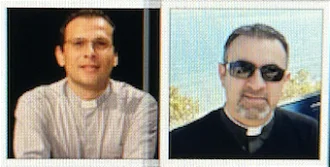
Rev Dr Munther Isaac and Rev Dr Fadi Diab – Voices from the frontline
Revd Dr Munther Isaac, Senior Pastor of the Evangelical Lutheran Christmas Church, Bethlehem – the first to put the Baby Jesus in the ‘rubble’ of his Christmas crib and Revd Dr Fadi Diab, Rector of St Andrew’s Episcopal Church, Ramallah and St Peter’s Episcopal Church in Birzeit will be speaking this Thursday in a symposium hosted by Friends of the Holy Land.
Questions they will be discussing include: How have they and their community coped with the terrible war? Where can they find resilience this Lent? What do they ask of the UK Church and their Christian brothers and sisters? And What are their hopes for the future?
Revd Dr Munther Isaac is an ordained minister of the Lutheran Church and is passionate about issues related to the Palestinian theology. He speaks locally and internationally and has published numerous articles on issues related to the theology of the land, Palestinian Christians and Palestinian theology, holistic mission and reconciliation. He is the author of “The Other Side of the Wall”, “From Land to Lands, from Eden to the Renewed Earth
Revd Dr Fadi Diab is a well-respected theologian in the Palestinian community and a prophetic voice for justice and peace. Fadi provides leadership and pastoral support for St Andrew’s school. He is the current Chairman of the Friends of the Holy Land Volunteer Committee based in country.
Although both are used to living in crisis, the war which has continued since October is the longest and most shocking in its intensity that they have ever experienced. The sheer scale of the numbers killed and the disruption to daily life is new.
Christians in the Holy Land – Finding hope and resilience for the future takes place on Thursday, 1st February at 2pm. Hear their views from the frontline and join in the conversation.
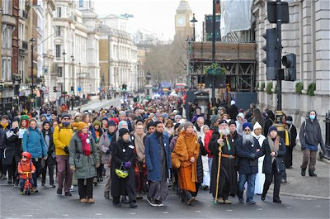
Last Sunday, around 1,000 people attended a multifaith peace walk in Central London, ‘Peace in every step’. Jews, Muslims, Christians, Hindus, Buddhists and others participated. One Christian walker was Sr Elizabeth O’Donohoe, a Sister of the Holy Crossand former member of the Westminster Justice and Peace Commission.
Sr Elizabeth writes: Since October 7th there have been many ways of demonstrating the desire to find a path to Peace for the Middle East: last Sunday we did it in silence.
Hot foot from morning Mass, we arrived in Trafalgar Square to find that Prayers from the Faiths represented were already being offered. In this Vigil, beautifully organised by the Buddhists of Ticht nacht han’s Plum Village and the Quakers, the Walk was preceded by short prayer contributions by each Faith, after which there was a respectful pause and the gong of the Prayer bowl.
Other than religious dress, we had all been asked not to bring any flags or slogans, but instead to wear a white flower – many had made their own or bought fresh ones.
Led by the Faith representatives, we set off in silence down Whitehall. Traffic police cleared the way for us and vehicles were very patient. There really was nothing to disturb our contemplative walk: past Downing Street, round the Cenotaph and back to the Square.
Personally, I found a mantra coming to me – in fact from the music we had sung at Mass earlier: ‘Have mercy, have mercy, have mercy, Lord. Have mercy, have mercy have mercy, Lord.’ It seemed just right for this occasion.
Nearly an hour later, we were back in the Square.
A short thank you from Rabena Harilall and Judith Baker who had worked so hard to make this all-faiths vigil become a reality, and an invitation, in a gesture of common endeavour, to share our white flower with someone nearby. As can happen on such occasions, I gave mine to someone who recognised me from 30 years ago!
This weekend, campaigners will be holding local demonstrations in more than 50 locations around the country. For details click here or visit the ICN Listings page.
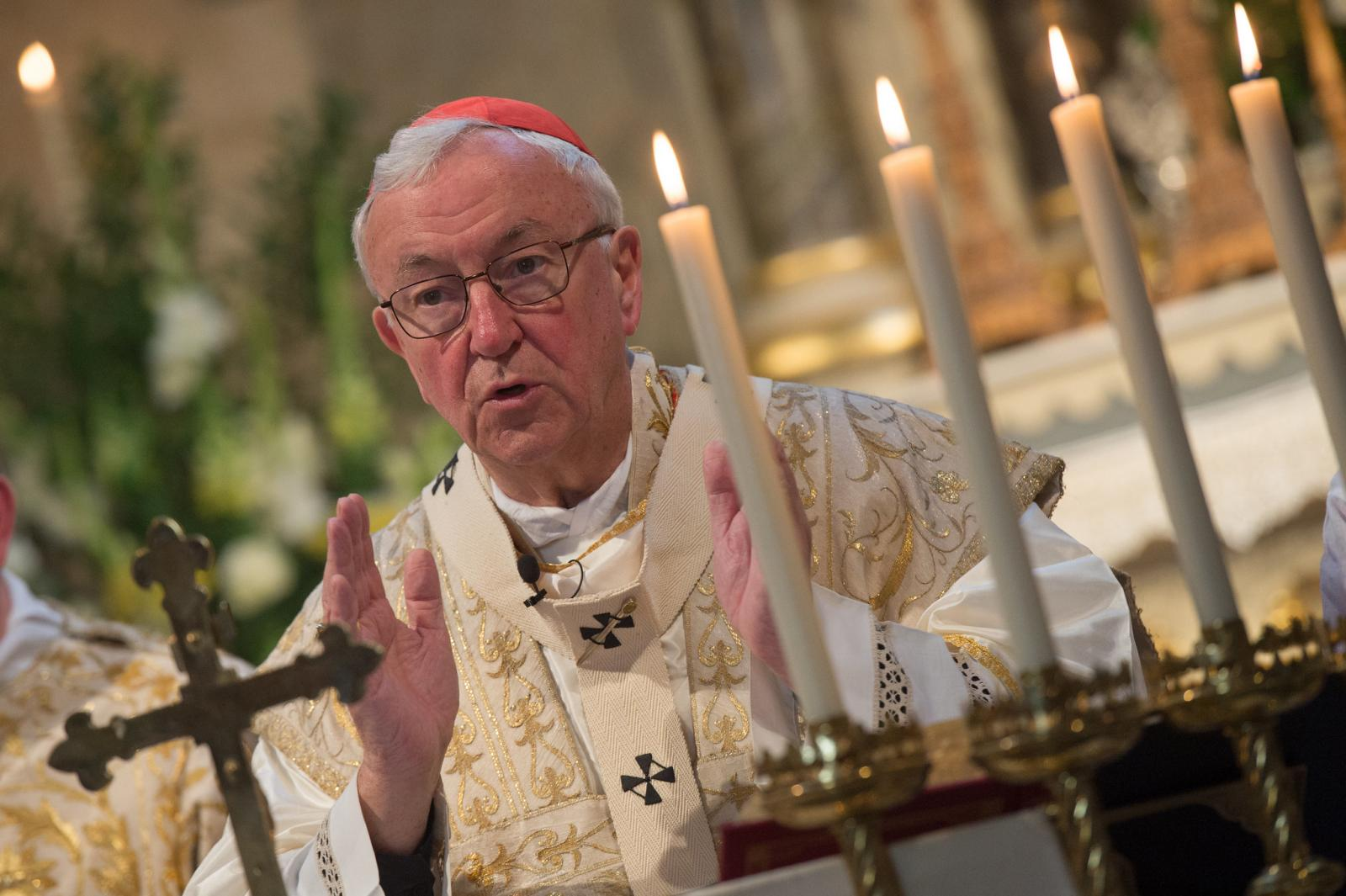
Cardinal Vincent Nichols has stressed that prayers must continue after more than 100 days of fighting in the Gaza Israel war:
‘The 100 days of warfare in Gaza and Israel illustrate, yet again, the horrors of war and the reinforcing of the barriers of hatred that it creates.
‘Our 100 days of prayer are not futile and our prayer must continue, not only for peace in the wider Middle East but also in Ukraine and all other areas riven by conflict.
‘The local Church tells us that the parish of the Holy Family in Gaza continues to be a place of safety for over 600 people, including over 50 severely disabled and very vulnerable children. They need our prayers and practical help financially.
‘So, too, we pray for all those involved in current negotiations to bring additional humanitarian aid to the beleaguered people of Gaza and medical aid to the hostages. Tireless efforts in negotiations are essential. This war and violence against the innocent must end. The hostages must be released. People must be able to live in peace. The long, slow work of reconstruction has to begin, sooner or later, on the ruined foundations of life in Gaza and in Israel. The challenges are immense and the dangers facing the world immediate and deeply troubling.’
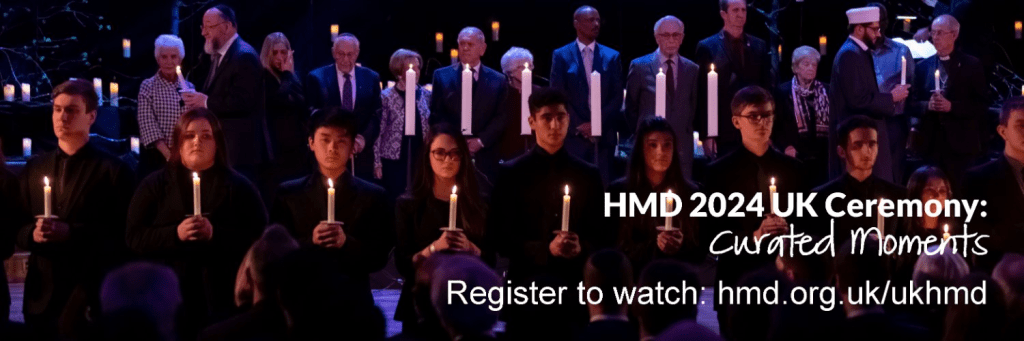
Join the nation on Saturday 27 January at 8pm to watch the ‘HMD 2024 UK Ceremony: Curated Moments’.
‘Curated Moments‘ is taken from the UK Holocaust Memorial Day Ceremony earlier in the week. It is vital that the entire nation can come together to commemorate Holocaust Memorial Day and to learn from genocide and build a better, safer future together.
Directly after the Curated Moments have finished at 8pm, people are asked to display lit candles safely in their windows to Light the Darkness to remember those who were murdered for who they were and to stand against prejudice and identity-based persecution in the world today.
About Holocaust Memorial Day
Holocaust Memorial Day (HMD) takes place on 27 January each year and is a time to remember the millions of people murdered during the Holocaust, under Nazi Persecution and in the genocides which followed in Cambodia, Rwanda, Bosnia and Darfur.
Holocaust Memorial Day is a time when we seek to learn the lessons of the past and recognise that genocide does not just take place on its own – it’s a steady process which can begin if discrimination, racism and hatred are not checked and prevented. We’re fortunate here in the UK; we are not at immediate risk of genocide. However, discrimination has not ended, nor has the use of the language of hatred or exclusion. There is still much to do to create a safer future and HMD is an opportunity to start this process.
To find out more about Holocaust Memorial Day visit:
Presentation by Neil Thorns, CAFOD Director of Advocacy – ‘Feedback from COP28‘
Neil Thorns, the Director of Advocacy for CAFOD, was the guest speaker at the Southern Dioceses Environment Network on Monday 15th January, 12.45-2.00pm, to give feedback to participants on the UN Climate Conference (COP28) held from 1-12 December 2023 .
Neil was present at COP28 in Dubai and has attended a number of previous COPs as a member of the Vatican delegation
For his presentation, Neil identified four headline outcomes from COP28:
Agreement on a Loss and Damage Fund
The UAE Consensus: Transition away from fossil fuels
Dubai – Baku – Belem Roadmap
Recognition of Food
He reported on each issue in more detail, explaining the significance of each and what it means for Catholics in the UK going forward.
Agreement on a Loss and Damage Fund
‘Loss and Damage’ is when poor communities overseas can no longer adapt to the effects of climate change but need to be able to respond when disasters occur. How do they get the resources they need?Developed countries who have done the most to cause the climate crisis have a responsibility towards these communities. ‘Loss and Damage’ has been kicking around for a long time in climate circles and in climate negotiations and a fund was finally agreed in principle Sharm El-Sheikh last year at COP27.
Operating the Fund was agreed on the first day of COP28 and money was put into it. Not enough money was put in, but what was important was that all the major countries contributed. For example, the US paid around $27 million which is just peanuts! The UK, in comparison has paid $45 million and the UAE $100 million. How that money is spent is going to be really important. It is also significant that ‘Loss and Damage’ will now be included for the first time in the Global Stock Take Process.
The Vatican is very interested in ‘Loss and Damage’ and especially non-economic ‘Loss and Damage’ – e.g. spiritual, cultural sites, language etc. The Vatican strongly supports ‘Integral Human Development’ so will continue to take a major interest in this aspect.
Neil said that people often ask, ‘Why do COPs have to happen annually? There have been 28 of them, are they achieving anything?’ His answer is ‘Yes!’ The pace may be slow, but the important thing is that we keep moving forward each year. The Global Stock Take Process is an important part of this. It is important to get things into the negotiations because then they get monitored and countries are accountable going forward. This was one of the biggest things to come out of COP28 and a big win for the first day.
2. UAE Consensus
Host countries like to get agreements named after themselves and so now we have the UAE Consensus arising as an outcome. COP28 was focused on the Global Stock Take that was agreed in Paris at COP21 in 2015 and came into force in 2020 whereby countries have to submit reports on how far they are doing to meet the principles of the Paris Agreement to keep global warming temperatures below 1.5C by 2050. All eyes were on COP28 to see if an end to Fossil Fuels would be included in the next Global Stock Take. Making a ‘transition away from fossil fuels’ was eventually included in the final agreement. It may not have been expressed in the strongest language – and was not what the Pope called for – but it was the first mention of an end to fossil fuels in a COP agreement. It is true there were a lot of caveats! For example, it didn’t call for taking away subsidies from fossil fuels, but we can start chipping away from this base.
3. Dubai – Baku – Belem Roadmap
COP29 will be in BAKU, Azerbaijan, in 2024 which is another oil state and will feature another COP president with oil company links.
COP30 will be in BELEM, Brazil in 2025 – a city in the Amazon rainforest.
These next two COPs are expected to be about finance. As Neil said, ‘Money makes the world go round!’ and at these next COPs progress of the Climate Fund will be closely scrutinised. A Climate Fund to enable developing countries to make adaptations was agreed in 2009 and set at $100bn per year. This target was meant to be reached by 2020 but is still only partially met. A ‘New Collective Quantified Goal’ has to be agreed this year in Baku to ensure that money gets to those countries for adaptation and loss and damage. Currently we using existing money to meet these commitments. For example, the UK is using part of the Overseas Aid Budget. This is essentially robbing Peter to pay Paul so we need innovative ideas on finance, such as a tax on international shipping. Levels of debt will be have to be addressed and debt cancellation considered as international finance architecture currently makes it difficult for developing countries to get loans, creating debt cycles that prevent spending on climate adaptation. The UK currently borrows money at 1 or 2%, while for Bangladesh it is 7 or 8%. There will also be questions about who pays? Should it be the historic big emitters? Or more recent emitters like Saudi Arabia, who don’t currently have any obligations to pay. A France-Kenya initiative to explore these options will report back to COP30 in Brazil.
4. Recognition of Food
A third of greenhouse gas emissions comes from our food and food systems. Food now needs to be considered in national plans. We can now include it in the whole aspect of deforestation. 150 countries are now pledged to include Food in their climate plans.
What Next?
The Vatican played an important role by talking about ending fossil fuels and talking about food and is in a position to ask for an ambitious Global Stock Take in these areas. The BBC reported on the Pope’s talk, read by Cardinal Parolin as the Pope himself was unable to attend due to illness. Media reports – especially the BBC which has a global reach – have an impact in COP spaces.
The rate of action is accelerating as we head towards 2025. The UK is heading into an election year and we can use this to promote improvements to our Nationally Determined Contribution (NDC). We need to let our elected representatives know what we want in terms of climate ambition.
Q & A with Neil
Q. How useful is a focus new tech e.g. solar panels? There are always side things happening alongside COP. More renewable energy deals were done at COP28 than ever before, which is a good thing. People at COP were talking about ‘carbon capture and storage’ but experts say it has very little impact so we can’t rely on it. Solar energy is making a huge difference. Especially in the US Joe Biden’s Inflation Reduction Bill has had a huge impact in creating green jobs. Tech linked to jobs makes for social change.
Q. What about the Vatican follow-up? Loss and Damage is a priority as I said earlier and talking about ending fossil fuels. The Catholic Church celebrates a Jubilee Year in 2025 and the Vatican is looking into how this can be linked to Brazil 2025 and COP30. Pope Francis said during the Covid pandemic that we don’t come out of a crisis the same. We come out either better or worse. Can we ensure that we come out better, with a better economics and better outcomes for the poorest?
Q. Can we push the CAFOD Fix the Food System even more? The Pope said in Laudato Si’ that ‘everything is connected.’ We have to link food with everything else and seeds is a big part in that. As CAFOD we can make some progress making sure that seeds find a place in the food plans for individual countries.
We then split into small breakout groups to discuss the questions: 1) What is your response to the outcomes of COP28? 2)What will you be focusing on for the environment in 2024?
Members of the Network were encouraged by the positive messaging from Neil. Participants asked how they might encourage people to be hopeful but at the same time make things like taking multiple flights socially unacceptable and wanted to be more confident in speaking up for the climate with family and friends. Members are focused on taking local actions, with several planning to taking part in the Christian Climate Action 10-Day Vigil in Lent. Some are involved with Greenpeace.
Participants also agreed that, while we are glad to hear that progress is being made, we need to make it known that progress needs to be faster, especially in this election year. CAFOD and SVP are working together on election material that will encourage Catholics to push for climate action this year.
Colette Joyce, Westminster Justice and Peace Co-ordinator, who convenes the Network said: “We are really grateful to Neil for representing us at COP28 and for his comprehensive reporting and analysis. Knowing that we can have an impact on the international processes helps motivate us to keep going with climate action on a local and parish basis.”
TheSouthern Dioceses Environment Networkis a network for all Catholics and our friends who careabout creation and meets monthly online on the second Monday of the month. It also organises other events online and in-person when this is possible. Some events take place jointly with the Northern Dioceses Environment Group, as we all work together to animate the Catholiccommunity in the long-term task of stabilising our climate and protecting our common home.We are inspired by the principles of Catholic Social Teaching, especially as set out by Pope Francis in the encyclical Laudato Si’, and the teachings on caring for the earth and one another found in Scripture.
Participants include CAFOD and Diocesan staff and volunteers, Laudato Si’ Animators, Journey to 2030, parishioners, clergy, religious and activists. You are welcome to attend as a one-off or to participate regularly.The Southern Dioceses are: Arundel & Brighton, Brentwood, Clifton, East Anglia, Plymouth, Portsmouth, Southwark and Westminster.
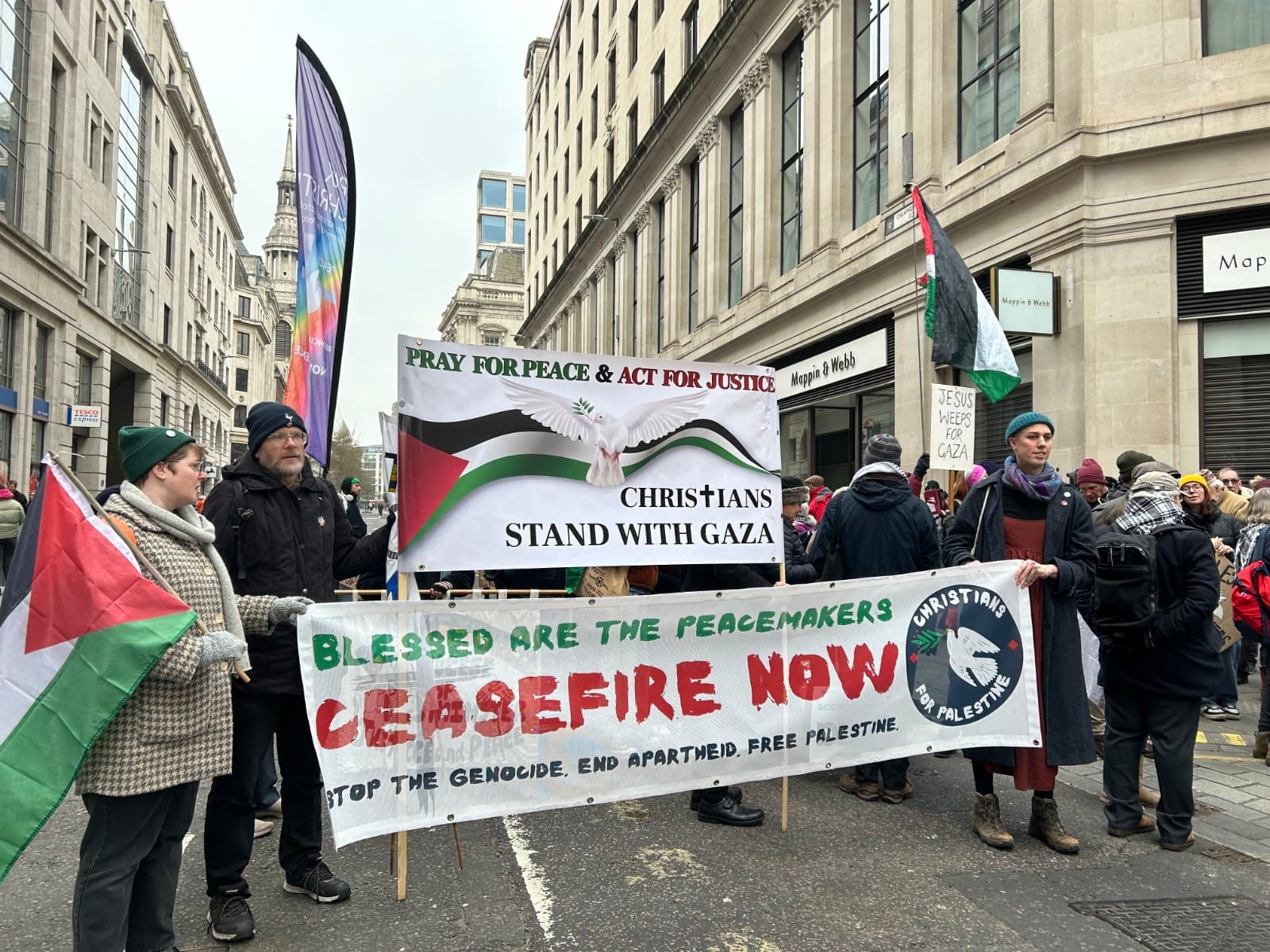
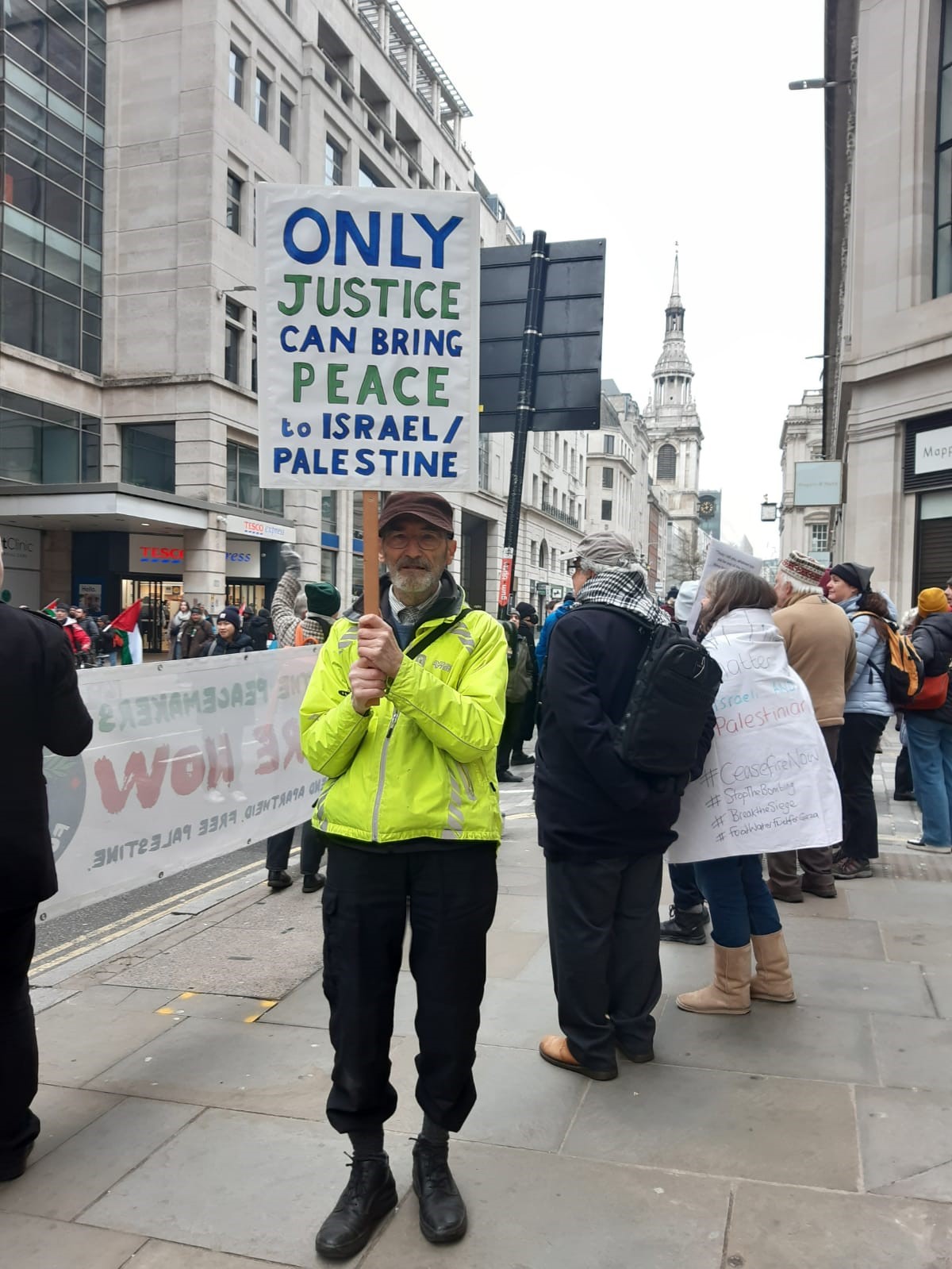
Up to half a million campaigners of all faiths and beliefs, marched through London on Saturday, from the Bank along Fleet Street towards Trafalgar Square down Whitehall to the Houses of Parliament, appealing for peace in Gaza and the West Bank.
Westminster Justice and Peace joined the Christian bloc, co-ordinated by Christians For Palestine, which included banners from Pax Christi, the Church of England, Quakers, the Columbans, London Catholic Worker, Passionists, Holy Land Trust, Fellowship of Reconciliation, Anglican Pacifist Fellowship, Sisters of St, Joseph of Peace and many more. We walked next to the Jewish bloc, which included hundreds of individuals and members of Na’Amod, International Anti-Zionist Network, Jews for Palestine, Torah Jews, JVL and other Jewish peace groups.
Columban Sisters Kate Midgley and Young Mi helped carry one of the Christian banners. Sr Mi said: “The reason I joined the demo is only a little gesture to show my solidarity towards suffering Palestinians. Because what is going on in Gaza and what Palestinians have to go through at this time is a total distortion of humanity.”
Little Amal – the 3.5 metre tall puppet of a nine-year-old Syrian refugee girl, who made the 8,000 km journey from the Syrian border to Manchester, in 2021, to highlight the plight of child refugees, led the front of the march, accompanied by a group of Palestinian children.
Speaking in Parliament Square, the Palestinian ambassador to the UK, Husam Zomlot, accused the British government of “complicity” with Israel. He said: “I stand before you with a broken heart but not a broken spirit.” He congratulated South Africa for bringing a genocide case against Israel at the UN’s international court of justice.
Sinn Féin’s president, Mary Lou McDonald, told the crowd that Palestinian freedom is possible. She said: “When I say this, standing in London, in common cause with you, having walked our own journey out of conflict, building peace for 25 years, this can happen. “This must happen and we will ensure that it does.”
Former Labour leader Jeremy Corbyn thanked South Africa for their bravery bring their case to the ICJ. He pointed out that the weapons used in the onslaught on Gaza are provided by the United States and the UK. Corbyn thanked everyone around the world and especially those campaigners in Israel who are speaking up for peace, justice and hope.
This was the seventh National March for Palestine in London organised by the Palestine Solidarity Campaign since October.
Protests took place in 120 cities around the world on Saturday, including Dublin, Edinburgh, Washington DC, Johannesburg, Kuala Lumpur, Paris, Rome and Milan.
On Peace Sunday, 14th January 2024, Pope Francis made a heartfelt appeal for an end to armed conflicts and a firm condemnation of war as “a crime against humanity.”
“War itself is a crime against humanity. People need peace. The world needs peace,” said the Pope at the Sunday Angelus prayer.
He also mentioned a program he had seen on an Italian TV channel just minutes before, in which the Vicar of the Custody of the Holy Land had spoken. Fr Ibrahim Faltas said: “we need to learn from John the Baptist how to cry out and show the path to follow.” Jesus, he added, is “the way. He is forgiveness, justice, love, and peace.”
“If we follow Jesus, we will truly have peace and there will be no war,” said Fr Faltas.
He noted that there are over 60 ongoing wars in the world, calling the global situation “utter confusion.” “We want to live in peace,” concluded Fr Faltas. “We want to follow Jesus, so we will have peace throughout the world.”




 Diocese of Westminster Justice and Peace Commission