

Home Office Vigil for Refugees – Monday 28th April 12.30-1.30pm

Source: Independent Catholic News
They are known as some of London’s most elite venues with a string of VIP guests going through their doors.
But Annabel’s, George, Harry’s Bar and Mark’s Club are also helping to feed the homeless at a West End church thanks to a service set up by a group of churches during the pandemic.
On 16th April the Lord Mayor of Westminster, Cllr Robert Rigby, visited the project and helped serve lunch to around 75 people on a visit to the Central London Catholic Churches Homeless lunch service run from Farm Street Church. Dario Mazzzolli, Dimitris Panopoulos and Camllia Fabbio, deputy director and managers at Annabel’s, who had provided the day’s food, also came to lend a hand.
Set up in 2020 at the start of the coronavirus pandemic and supported by Westminster City Council, the service offers lunch twice a week in a large dining room. It is already supported with donations of food from five-star hotels including the Connaught, Claridges and the Mandarin Oriental.
The addition of the private members’ clubs will mean the service can continue to serve around 140 people per week.
Volunteers led by Father Dominic Robinson, parish priest of Mount Street Jesuit Centre at Farm Street, refer to the homeless diners as guests and serve them sitting at tables – making the point that those sleeping rough are deserving of dignity and respect.
Continue reading on Independent Catholic News

Source: CBCEW
Ahead of the Sacred Triduum, when we contemplate Christ’s passion, death and resurrection, Bishop Nicholas Hudson, Chair of the International Affairs department of the Catholic Bishops’ Conference of England and Wales, offers this reflection on the Holy Land.
In this holiest of weeks, our hearts turn naturally to the Holy Land, the land in which Christ died and rose for the redemption of humankind. Our hearts are deeply saddened to witness the immense suffering borne still by so many of its inhabitants.
Of the 251 Israelis taken hostage in the 7 October Hamas attack, 59 remain unaccounted for. Of these, just 24 are believed to be alive. We hold firmly in our prayers their relatives and all who mourn these dead hostages. We hold just as firmly in our prayers the families of the tens of thousands of Palestinians – countless women and children among them – killed by the ensuing disproportionate bombardment. It is with profound distress that we witness the continuing suffering of countless innocent civilians. We pray the Spirit released by Christ on the evening that he rose from the dead (cf. John 20, 22) might be released anew in these lands to bestow on them the just peace for which so many of its inhabitants yearn.
We are profoundly concerned that, despite extensive multilateral efforts to secure a lasting ceasefire and bring an end to hostilities, there remains no sign of peace. Pope Francis constantly reminds us: “War is a human defeat. War does not solve problems; war is evil; war destroys.” (Pope Francis, General Audience, 4 December 2024) Peace benefits all; it is a sign of God’s kingdom on earth and enables us all to flourish.
We call on the international community to recognise that all the people of these lands have the right to live in safety and peace. These are not mere aspirations – they are inalienable rights grounded in the dignity of every person; rights that must be upheld. We particularly pray for the West Bank Christians and their neighbours, where many are deeply fearful for their future, as they see their homes encircled by new and rapidly expanding settlements and their freedom of movement drastically restricted.
In his Lenten message, Cardinal Pizzaballa, the Latin Patriarch of Jerusalem, reminds us that hope is the daughter of faith. It is with hope in our hearts that we sing at our Easter Vigil, “at night there are tears but joy comes with dawn” (Psalm 30): as Christ’s body is laid in the earth, we await with hope his Resurrection from the dead. Our heartfelt prayer this Holy Week is that there rise up in these lands a renewed desire and yearning on all sides for the cessation of hostilities and the finding of ways to a just peace which honours the humanity redeemed by Christ.

Source: Ann Farr, Pax Christi
In Holy Week our thoughts and prayers are very much on the Holy Land and particularly on the last days of Jesus, as he approached Jerusalem.
In an act of deep symbolism and solidarity a number of Catholic and Anglican Dioceses have again chosen Palestinian Olive Oil as the base for their Holy Oils. These include the Catholic Dioceses of Arundel and Brighton, Birmingham, Liverpool, Nottingham, Southwark and Westminster and the Anglican Dioceses of Coventry, Leicester, Rochester, Sheffield and Southwark.
Each year, during the Chrism Mass, the local bishop blesses new oils for the diocese. The holy oils are then taken to each parish, where they are used for Sacramental anointing throughout the year.
This year we are again deeply shocked and saddened by all we see and hear from our friends and partners living in the Holy Land.
Palestinians are living in vastly increased poverty as unemployment rises to unprecedented levels and freedom of movement is denied throughout the occupied West Bank. As well as Palestinian olive trees being burst, cut down or uprooted throughout the year, gathering the harvest last Autumn proved to be a greater challenge than normal with extreme violence from the Israeli Military and Israeli settlers. Many families were refused access to their lands and their olives were stolen. We received terrible stories were during this time and sadly one woman farmer, Hanan Abu Salameh, was shot by an Israeli soldier while harvesting olives in Faqua, near Jenin.
Never has our solidarity and support for the Holy Land been needed more and this Easter it’s good to know that we are linked in such a special way to the Palestinian families who have produced the oil that will be used throughout the year in the Sacraments of the Sick, Baptism and Holy Orders and in the anointing of new bishops.
Canon Rob Esdaile, a priest of Arundel & Brighton Diocese, who has long been active in work for peace and justice, says: “The olive tree has long been a symbol of the heritage of the inhabitants of the Holy Land.
“Psalm 133 uses the vivid image of olive oil running down a man’s beard as a symbol of peace in the community and of ‘brothers dwelling in unity’, while the same oil was used by Samuel to anoint both King Saul and King David.
“It is beyond tragic that Zionist settlers systematically and deliberately destroy Palestinian olive groves, while the annual olive harvest (always a communal effort in Palestinian settlements) in the face of military blockades and the theft of land has become a symbol of resistance and hope. Our liturgical use of Palestinian olive oil is both an act of solidarity and a very physical prayer for the peace of Jerusalem and of the whole Holy Land.”
While we take part in the services of Holy Week, we remember that many Palestinians have been refused permits from the Israeli Authorities to enable them to worship in Jerusalem. We are asked to keep them in our prayers as we hope for a Just Peace for all in the Holy Land.
Find out more about Palestinian Olive Oil at https://zaytoun.uk
Ann Farr is a member of the Pax Christi International Working Group for a Just Peace in Palestine and Israel
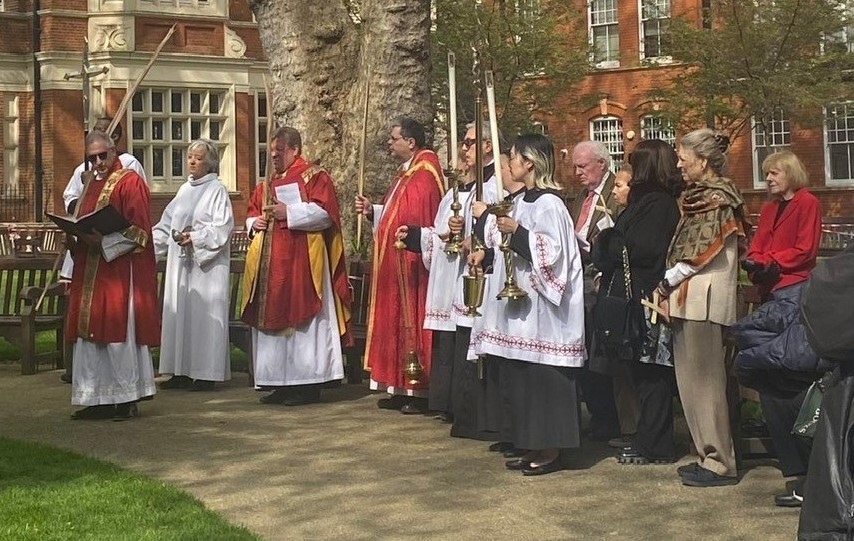
Fr Dominic Robinson, Chair of Westminster Justice and Peace Commission, delivered this homily at the Church of the Immaculate Conception, Farm Street, Mayfair on Palm Sunday:
Hosanna… the Messiah has arrived to save us, but come Wednesday the fear, doubt, betrayal… condemnation… death on a cross… we turn on our saviour and crucify him.
Where are we in this crowd?
Maybe take that away with us this weekend – what is my reaction as the baying crowd hails the King’s entry into the city and then turns on him?
Where am I in any crowd?
I find myself asking that question often and regularly. In a world where we’re expected to believe that some things cannot change, where the injustice of abject poverty amid outrageous wealth is just taken as an economic necessity, where I sit on my hands at the suggestion I can do something to save our planet from disaster, when I shrug my shoulders and say I’ve done all I can to write to my MP to plead for more time and discernment on assisted suicide, when I say I don’t understand the conflict in the Middle East and leave it to the experts, when I say let’s continue to pray for vocations to ministry and they will come, when I say the Churches are really united in a diversity that’s actually good, when I say the abuse crisis in the Church has nothing to do with me.
Being in the crowd means responsibility. The crowd lulls us into a herd mentality to go with whatever the person next to me is saying or thinking. And Christ ends up crucified because good people were complicit in bad deeds.
The Church, that is all of us wanting to walk together as pilgrims towards the heavenly city again in this Jubilee Year, embarks on this painful journey again, accompanying each other, striving yet again to listen better to the signs of our times, to discern the way forward. At our heart are the poorest, the weakest, those without a voice, loved especially by the God who embraces death all the way to the tomb.
Hosanna to this Messiah is our anthem this morning. Only the passage of time will lead us to what that Hosanna really means.
LINK
Farm Street Church: www.farmstreet.org.uk/

Source – Theos
Religious think-tank, Theos, has published an open letter signed by over 100 women from different faith traditions voicing significant concerns over the current proposed legislation for Assisted Dying.
We believe that the Terminally Ill Adults Bill has insufficient safeguards to protect some of the most vulnerable in society, particularly women subject to gender-based violence.
Colette Joyce, Justice and Peace Co-ordinator for the Diocese of Westminster, and Nikki Dhillon-Keane, Head of Safe in Faith for Caritas Westminster, are among the signatories.
Our open letter was reported on in The Guardian and the Church Times.
The full text is below:
We write as a group of women of faith from different traditions and backgrounds passionate about care for people in vulnerable situations, many of whom have dedicated our professional lives to preventing male violence against women and girls.
We hold a variety of views on the principle of legalising assisted dying. However, we are all clear that the current legislation – The Terminally Ill Adults Bill – progressing through parliament, has insufficient safeguards to protect some of the most marginalised in society, particularly women subjected to gender–based violence, and abuse by a partner, who also experience intersecting barriers to a full and safe life.
We are concerned that the proposed legislation could create a new tool to harm vulnerable women, particularly those being subjected to domestic abuse and coercive control, by helping them to end their lives.
A report out last month showed that the number of domestic abuse victims who died by suicide in England and Wales was higher than the number of people killed by their abusive partner, for the second year running.
We know too that domestic abuse victims who are also women of faith can face a particular form of abuse[1] at the hands of their perpetrators, who may weaponise theologies and culture to harm and control their victims. We are concerned that the assisted dying legislation, as it stands, fails to take account of how faith and its role at the end of life, as well as its use by both perpetrators and the women they abuse, create complex dynamics that can lead to vulnerable women, who may also hold strong religious beliefs, seeing no way out but death.
We know that poverty and other inequalities increase the risk of women and girls being subjected to violence, ill health and the quality of care and support they receive from statutory institutions and civil society. We know too that in a society riven with inequalities, women who are from Black and minoritised communities, disabled women, migrant women and working–class women, struggle to be heard. Their voices are absent from conversations about this bill, and so too are those subjective to coercive control or violence. It is unclear to us how the legislation and its consultative process has taken account of the multiplicity of faiths, cultures, socio–economic and health backgrounds of our citizens and women who make up our country.
Much of the debate inside and outside parliament has been conducted by those empowered to speak of the importance of personal choice, without consideration of those who struggle to be heard in the public square. It is the voices of the unheard, ignored, and marginalised that we are compelled by our faith traditions and scriptures to listen and draw attention to, in the pursuit of good law–making for the common good – legislation that considers and protects the most vulnerable, not just those who speak loudest.
Having followed the progress of the bill through parliament, we are particularly concerned about:
If assisted dying is seen as a response to alleviate suffering, without addressing the underlying structural issues that make life difficult and safeguard against harm, it could put undue pressure on vulnerable women to choose death over inadequate care.
This is no way to legislate, especially not on matters of life and death. We have serious concerns about the bill and its lack of safeguards. The bill has too much potential to hurt vulnerable people and so we are uniting as women from across faith traditions to speak up for vulnerable women, including victims of violence against women and girls, and disabled women, and raise our concerns publicly.
Signatories:
This initiative follows a meeting organised in partnership with the Faith and Violence Against Women and Girls Coalition, and Restored, facilitated by Jewish Women’s Aid, and brought together by Theos.
For more information, see:
Addressing Spiritual Abuse in Ending Violence Against Women – Faith & VAWG Coalition
The Meaning of Dignity: What’s beneath the assisted dying debate? – Theos

A group of West End Christian church leaders from different denominations have written a letter to the government and Mayor of London expressing their grave concerns over the violent police raid on the Westminster Quaker Meeting House. The full text of their letter follows:
Rachel Blake MP
Sir Keir Starmer, MP
Yvette Cooper MP, Home Secretary
Mayor of London Sadiq Khan
As Christian clergy responsible for parishes and churches in the West End of London, we are writing to you as our two constituency members of Parliament, Home Secretary and Mayor to express our deep concerns about the police raid at the Westminster Quaker Meeting House on 27 March.
We lead work in buildings that, like the Quaker Meeting House, include a variety of activities: worship, meals for those in need, mental health counselling, classes, community group meetings, 12-step programmes, rehearsals, private staff residences, and commercial hires. We also host, whether as a part of our expression of faith or an act of hospitality, conversations and meetings on issues of social justice and global concerns.
The actions of the police at the Quaker Meeting House on 27 March could have happened to any of us.
Without knocking or ringing the bell, the police forced entry into the Meeting House, causing property damage to a historic building. Into a community space deeply committed to non-violence and pacificism, officers armed with tasers entered to control and intimidate. After showing unnecessary force toward a meet-up for people exploring non-violent social action, police then intruded upon and disrupted other events happening simultaneously at the Meeting House, including a life-drawing class, therapy sessions and staff working and living on site, seizing property such as phones and computers.
This incident has caused great fear and alarm in the Quaker community, who have historically represented a voice for peace and compassion for all. We stand with them in their sense of shock and violation. We share their distress, knowing that the same force could be directed against our own ministries and the community groups hosted in our buildings.
This is not an acceptable police response to a peaceable assembly of any kind, whether in church, mosque, synagogue or community centre.
We ask you to clearly condemn the police actions on 27 March, and reassure us that clear measures will be taken to ensure there are no future incidents of disproportionate and inappropriate police responses in places of worship and community centres.
Faithfully,
Rev Simon Buckley, Rector, St Anne’s Church Soho
and Area Dean of Westminster (St Margaret’s) Deanery
Rev Jared Jaggers, Associate Minister,
American International Church
Rev Jennifer Mills-Knutsen, Senior Minister,
American International Church
Fr Dominic Robinson SJ, Parish Priest,
Farm Street Church of the Immaculate Conception.
Rev Dr Simon Woodman, Minister,
Bloomsbury Baptist Church
Source: CBCEW
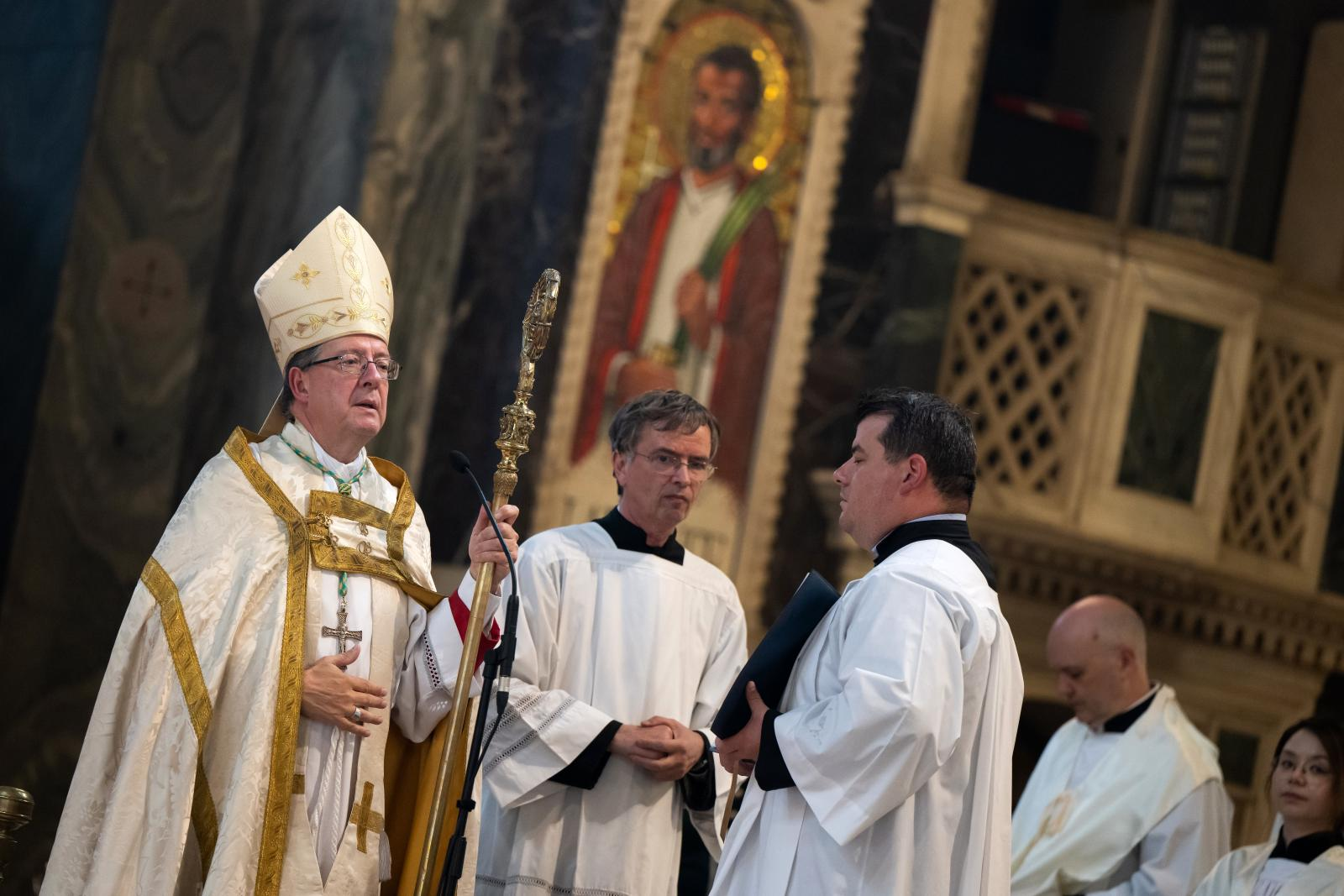
His Holiness Pope Francis has appointed Bishop John Sherrington as Archbishop of Liverpool.
Ordained as a priest for the Diocese of Nottingham on 13 June 1987, Bishop Sherrington has been an Auxiliary Bishop of Westminster and Titular Bishop of Hilta since 14 September 2011.
Archbishop-elect Sherrington will become the tenth Archbishop of Liverpool in succession to Archbishop Malcolm McMahon OP, who has been Archbishop of Liverpool since 2014.
His Installation will take place in the Metropolitan Cathedral of Christ the King on Tuesday, 27 May at 12 noon.
Archbishop Malcolm McMahon OP said: “I am grateful to God and to the Holy Father, Pope Francis, for appointing a bishop to serve this local church, the Archdiocese of Liverpool. We are receiving a new Archbishop with considerable gifts, talents and skills, but most of all we are receiving a man of deep prayer who loves the Lord Jesus and who loves His Church. I have had the pleasure to serve with Archbishop-elect Sherrington in the Diocese of Nottingham and in the Catholic Bishops’ Conference of England and Wales and I am delighted to welcome him today.”
On hearing of his appointment, Archbishop-elect Sherrington said: “I thank Pope Francis for his trust in me on my appointment as Archbishop of Liverpool which I accept with humility and joy. We pray for our Holy Father at this time of sickness as he recuperates and prepares for Holy Week and Easter.
“I look forward to serving as shepherd of the historic and faith-filled Church in the Archdiocese of Liverpool which is rich in its heritage of the English martyrs, Irish immigration, and now looks to the future.
“Archbishop Malcolm McMahon OP has served Liverpool Archdiocese with love and generosity, and I am honoured to succeed him… I look forward to building on the foundations already laid in the synodal pastoral plan ‘Together on the Road’ to serve the Church and bring the hope and joy of Jesus Christ to all people.
“In this Jubilee Year, we are a people living the hope of Christ who has loved us, saved us and walks with us. We share this hope with other Christians and people of all faiths and good will. I welcome meeting and building friendships with leaders, both Christian and of other faiths, which has always been a strong dimension of the Church here.
“May we receive the fire of the Holy Spirit into our hearts to bring Christ to others.”
Cardinal Vincent Nichols, said about the appointment: “Those who have been following reports on the health of the Holy Father and keeping him in their prayers will know that he has continued his work, including the appointment of bishops.
“I am so pleased that he has appointed our Bishop John Sherrington to be the next Archbishop of Liverpool. Liverpool is, of course, my home diocese and I am delighted that it is to be led by Bishop John.
“In Westminster we know his gifts, dedication and utter generosity only too well. We will miss him greatly. Archbishop Malcolm will welcome him with great joy as, I’m sure, will everyone across the extensive Archdiocese of Liverpool.
“Today we offer our profound thanks to Bishop John for all that he has given to us over these last fourteen years, and we assure him, wholeheartedly, of our prayers and constant support.
“And, of course, we continue to hold Pope Francis very much in our prayers, too.”
Bishop John Sherrington was born in Leicester on 5 January 1958. Before entering the seminary, he graduated with a BA in mathematics from Queens’ College, Cambridge, where St John Fisher was once President. Upon graduation, he worked for a short period in management consultancy. Having been ordained a priest for the Diocese of Nottingham in 1987, and after a short period in a parish, he then completed an STL in Moral Theology at the Gregorian University, Rome.
He lectured in moral theology at All Hallows College, Dublin and St John’s Seminary, Wonersh where he was also a member of the formation staff, before serving as a parish priest from 2004-2011.
Bishop Sherrington was ordained as an Auxiliary Bishop of Westminster and Titular Bishop of Hilta on 14 September 2011 by the then-Archbishop Vincent Nichols, the co-consecrators being Cardinal Cormac Murphy-O’Connor and the then-Bishop Malcolm McMahon of Nottingham.
He has responsibility for the pastoral care of the parishes and deaneries of North London and is Moderator of the Curia and a Trustee of the Diocese. He is Chair of the Governing Body of Mater Ecclesiae College.
He served on the Methodist Roman Catholic International Commission (MERCIC) for ten years and was Co-Chair for five years. He was also, for some years, a Trustee of CAFOD which gave him further insight into the international mission of the Church.
Within the Catholic Bishops’ Conference of England and Wales, he is a member of the Department for Social Justice with responsibility for life issues since 2014, and a member of the Education Department since 2022. He is a member of the governing body of the Anscombe Centre, Oxford, and a Trustee of the Hospital of St John and St Elizabeth.
Internationally, he is a member of the Overseas Seminary Committee. He is also a Trustee of the Pontifical Beda College and Venerable English College in Rome, and a Trustee of the Royal English College in Valladolid, Spain.
Reflection on the Ministry of Archbishop Elect John Sherrington

In this special Jubilee Year, you are warmly invited to join the three ‘London’ Dioceses of Brentwood, Southwark and Westminster for the annual Mass for Migrants on Bank Holiday Monday, 5th May 2025 at Westminster Cathedral, starting at 2.00pm with a procession of banners.
This year the Mass is hosted by the Diocese of Westminster at Westminster Cathedral.
The Mass for the Feast of St Joseph the Worker is prepared by the Justice & Peace Commissions, Caritas and Ethnic Chaplaincies of the three Dioceses and celebrates the contributions made to faith, life and work in the UK by all those who come from other countries to make a home here.
Music will be provided by musicians from the Lourdes Mass and a variety of Ethnic Chaplaincy choirs. We will also be joined by community organisers from London Citizens
Our celebrant and preacher this year is Cardinal Michael Fitzgerald MAfr OBE. Cardinal Fitzgerald is a British Cardinal who headed the Pontifical Council for Interreligious Dialogue from 2002 to 2006. He has held the rank of archbishop since 2002 and was apostolic nuncio to Egypt and delegate to the Arab League, prior to his retirement in 2012. Pope Francis raised him to the rank of cardinal on 5 October 2019. He is one of the leading experts on Islam, Christian–Muslim relations and interreligious dialogue in the international Catholic Church. He is fluent in Arabic.
Parishes and Catholic organisations are welcome to bring banners for the procession. Everyone is invited to wear national dress. Those taking part in the procession are invited to arrive from 1.30pm where light refreshments will be provided and a locked space in which to leave possessions during the Mass.
Do come along and bring the family, whether you are from a migrant background or not! It is always a colourful and a lively occasion.
Fr Dominic Robinson SJ, Chair of the Westminster Justice and Peace Commission, writes:
“We truly hope that you can join us and we can fill the Cathedral on this day when we give thanks to God for the universal gift of work and for the huge contribution of migrants to our city. This annual event is such an important one in our Churches’ calendar as it represents the presence and involvement of so many Catholics from diverse ethnic communities, a mark of our true catholicity.
And at a time when we see a reluctance or hostility to truly welcome the stranger in our midst, this gathering takes on a prophetic role too as we are called to celebrate with great enthusiasm our diverse musical gifts, national dress, our cultural diversity in all its richness, and so witness to the dignity of every human person and the dignity of fulfilling work as a gift from God for all”.

Source: Jo Siedlecka, ICN
Bishop William Shomali, Patriarchal Vicar for Jerusalem and Palestine, gave a moving account on the situation of Christians in the Holy Land at Bloomsbury Baptist Church in London on Monday. The ecumenical event was attended by representatives from many denominations, including Bishop Jim Curry from RC Diocese of Westminster and Bishop Mike Royal, General Secretary of Churches Together.
Bishop Shomali began with a summary of the history of the Holy Land, which he said has been suffering from a “devastating conflict for the past hundred years.” While the Jewish people, based on their interpretation of the Bible claim the land is theirs given to Abraham and his descendants by God, the Palestinians assert that their roots date back to the Canaanites who lived there 3000 years BC. Thus he said: “There are two narratives, two claims and two perspectives on the history and geography of the land.”
“My intention is not to advocate for one side against the other or to discuss the injustices and crimes committed in this land called Holy” Bishop Shomali said. “Instead I aim to present the situation from a humanitarian perspective and delve into the condition of the Christian community which has lived there for 2000 years without interruption…”
Fr Dominic Robinson SJ (Chair) and Colette Joyce (Co-ordinator) also attended the event on behalf of Westminster Justice and Peace.
Continue reading on Independent Catholic News
The Westminster Holy Land Roundtable is an open discussion forum where anyone with a connection to the Diocese can come and share news, events and ideas to help formulate a common response to the war in Gaza. The next meeting takes place Saturday 5 April 2025, 4-6pm, at Farm Street Arrupe Hall. Bishop Jim Curry will be speaking about his recent visit to the Holy Land. New participants welcome
 Diocese of Westminster Justice and Peace Commission