In this special Jubilee Year, you are warmly invited to join the three ‘London’ Dioceses of Brentwood, Southwark and Westminster on Bank Holiday Monday, 5th May 2025, 2.00pm, for the annual Mass for Migrants which celebrates the contribution made to the life, work and faith of the UK by all those who come from other countries to make a home here.
This Mass for St Joseph the Worker is prepared by the Justice & Peace Commissions, Caritas and Ethnic Chaplaincies of the three Dioceses.
This year the Mass is hosted by the Diocese of Westminster at Westminster Cathedral.
Do come along and bring the family, whether you are from a migrant background or not! It is always a colourful and a lively occasion. Parishes and Catholic organisations are welcome to bring banners for the procession. Gather from 1.30pm.
Everyone is invited to wear national dress.
We will also be joined by community organisers from London Citizens.
Celebrant: Cardinal Michael Fitzgerald.
Please read our E-Bulletin to discover many other ways to participate in the Jubilee celebrations and work towards peace and justice in this Holy Year.
The names and ID numbers of more than 50,000 people killed by Israel in Gaza in the last 18 months have been published by Iraq Body Count (IBC) a database of official statistics complied from hospital, morgue, NGO and other official records. (It does not count many thousands more people reported missing whose remains are under the rubble.)
The 981 page list makes chilling reading. One researcher said: “Reading out of names of the Gaza dead is a very spiritual ritual. Though at 10 names per minute it would take 83 hours non stop to read them all out. Even just reading out the 876 names of babies killed under the age of one would take 90 minutes.”
John Sloboda, a Roman Catholic who is a member of the Westminster Justice and Peace Holy Land Roundtable and a co-founder of Iraq Body Count, told ICN:
“Naming those killed is the most basic way of recognising and honouring their dignity as individuals. Contemplating unimaginably large numbers can freeze us into helpless immobility, or lock us into abstractions…” Continue reading on ICN
The next meeting of the Westminster Holy Land Roundtable takes place on Saturday 5th April, 4-6pm, at Farm Street Church, 114 Mount Street, London, W1K 3AH and is facilitated by Colette Joyce, the Westminster Justice and Peace Co-ordinator.
Cardinal Fitzgerald with Colette Joyce from Westminster J&P. Image ICN/JS
Cardinal Michael Fitzgerald M.Afr. gave the following talk on the Day of Martyrdom of Archbishop Oscar Romero, Saturday, 22 March, 2025, at St Martin in the Fields, Trafalgar Square.
All my hope on God is founded. On this day when we are celebrating the anniversary of the martyrdom of Archbishop Romero, which falls actually on Monday 24 March, we are concentrating on HOPE, because we badly need Hope in our world today and Archbishop Romero is a figure of hope.
We have heard a reading from St Paul to the Romans about Abraham who believed though it would seem that there was no room left for hope or belief. He was old, and his wife was old too, and yet he believed that she would bear him a child, since God had promised this.
We have heard recited a poem by a Palestinian about the people of Gaza:
My God is courage, patience, justice, the sumoud of a people.
We adore the same one God, though we understand this God differently.
Muslims say that God is al-samad, which could be translated “rock-like”; God is an all-encompassing refuge for us.
In the midst of this world, with all its difficulties, we are encouraged to take refuge in God.
As Christians, we say that this God has become one with us in Jesus Christ
So, we can truly say that our God is a stubborn refugee girl, her heart still yearning for the place she calls her own.
We can say that our God is a Gaza refugee wishing to share freedom with all of us.
We are called to believe like Abraham, our father; we are called to believe in life as Archbishop Romero did, hoping against hope that conditions will revive, conditions in Gaza, in Israel and Palestine, in Tigray in the North of Ethiopia, in Sudan and Eastern Congo, in Myanmar and Yemen conditions in El Salvador, conditions all around the world where there is conflict. We are encouraged to continue praying for the people in these areas of conflict, following the example of Pope Francis who, every Sunday, at the mid-day prayer, mentions these places and prays for their inhabitants.
We are called not only to pray, but to work for a renewal of life, as the Qur’an reminds us:
Have you considered the one who denies the Judgement? that is the one
who pushes aside the orphan and does not urge others to feed the needy
So woe to those who pray but are heedless of their prayer; those who are all show and forbid common kindnesses.
( Qur’an 107)
Many of us are familiar with the words of the Gospel:
Come… take for your heritage the kingdom prepared for you…: For I was hungry and you gave me food; I was thirsty and you gave me drink; I was a stranger and you made me welcome; naked and you clothed me; sick and you visited me, in prison, and you came to see me; I tell you solemnly, in so far as you did this to one of the least of these brothers [or sisters] of mine, you did it to me.
( Gospel according to Matthew, 25: 34-42)
This year, Ramadan and Lent fall together in the same period. We can remember that their contents are similar: fasting, prayer and alms-giving, but the reasons for engaging in these practices are different.
To fast every day during the month of Ramadan, to abstain during the hours of day-light from every intake of food or drink or of any substance is very demanding. The Christian is not asked to observe this. The Christian would be expected to forego some food or drink during the 40 days of Lent; avoiding alcohol, which is allowed at other times; avoiding chocolate or sweets; having a simple meal such as spaghetti and cheese and being able to share the amount saved with people who are in need.
There are other ways of fasting that can be chosen: avoiding watching television, curbing one’s use of social media.
All this is voluntary, by way of free choice. Whereas I understand that Ramadan is observed as an act of obedience to God: “You who believe, fasting is prescribed for you… so that you may be mindful of God (Q 2: 183).”
Ramadan is practised more collectively; families gather together to break the fast.
Lent is a more individual practice.
Lent is really a way of preparing for the celebration of the greatest feast of the Christian year, Easter, the commemoration of the Passion of Jesus, of his death on the Cross, his burial, and his rising to New Life.
Nevertheless, there are common prayers in both religious traditions. Special prayers are recited in the mosque, the tarâwîh, after the last prayer of the day.
Christians have a custom of gathering in church on Friday afternoons or evenings for what we call the Way of the Cross, recalling the different ways Jesus suffered for us.
At this time when Ramadan and Lent unite us, I should like to let the voice of Archbishop Romero resound again:
As long as there are mothers who are crying about the disappearance of their sons and daughters, as long as there are tortures in the headquarters of our security forces, as long as there is horrible disorder… there cannot be peace. We need to be rational and listen to the voice of God, to organize a more just society once more according to God’s heart.
(Through the Year with Oscar Romero, Daily Meditations CAFOD, D.L.T. Christian Aid 2006 p.14).
To return to our theme of Hope, we who believe in Hope, whether we are Christians or Muslims, or whatever religion we belong to, we pray earnestly to God for this gift of Hope, true hope which will generate justice-seeking solidarity, hope which may presage true peace.
In this way we shall be true to ourselves, true to our religions and true to Oscar Romero who has given us such a good example.
A simple and accessible ‘take-outs’ resource has been published by the Diocese of Westminster to help Catholics engage with the Synod on Synodality’s Final Document.
The resource is particularly useful ahead of the ‘Implementation Phase’ that Pope Francis has recently commissioned the Church to move into as we journey to the celebration of an ecclesial assembly in the Vatican in October 2028.
The resource is titled: How to be a Synodal Church in Mission. Take-outs from the Final Document: ‘An Informal Reaping of the Fruits’.
Each section of the Final Document (FD) is numbered, and this ‘take-outs’ resource takes a particular topic or key point and explores it with reference to the FD’s more in-depth text.
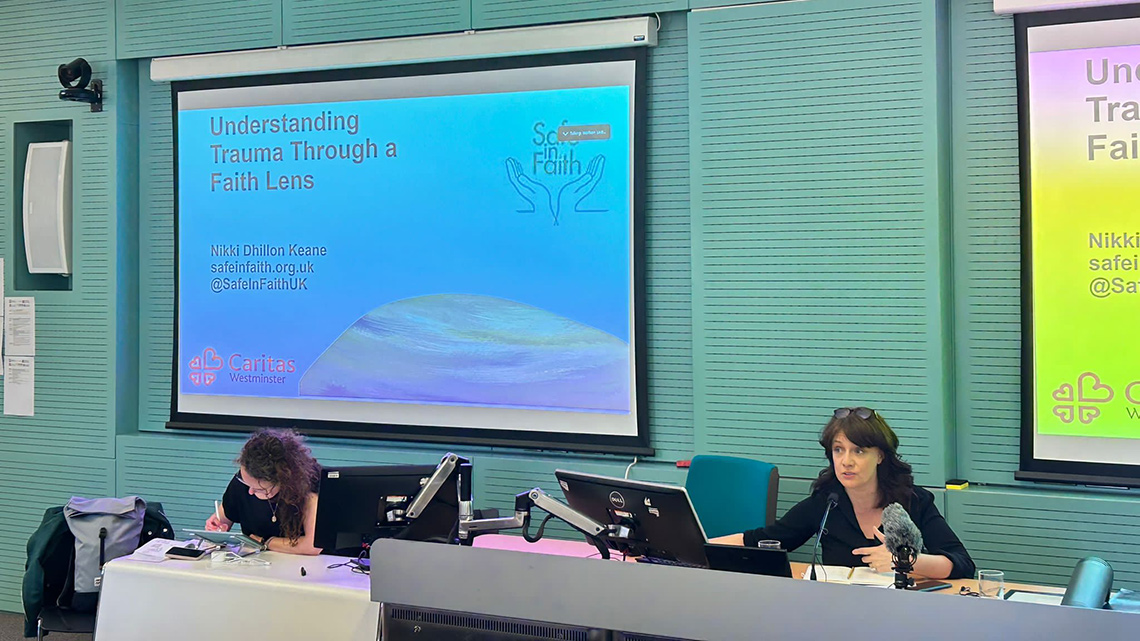
Nikki Dhillon Keane, founder of Safe in Faith UK, is a therapist who helps survivors of abuse and Head of Service at Caritas Safe in Faith on domestic abuse and assisted suicide.
‘The criminal justice system is just acknowledging the scale of possible criminal culpability in domestic abuse and suicide, while at the same time, a bunch of MPs seek to make it non-criminal.’
The questions raised by the proposed Terminally Ill Adults (End of Life) Bill are highly complex. It is difficult to imagine the deeply personal experience of terminal illness, for patients and their families. Raising questions about the safety of proposed legislation should in no way be viewed as a lack of compassion for people nearing the end of their lives; rather as an attempt to ensure that all people affected by this legislation, particularly the most vulnerable, are safe from harm.
There is one particularly vulnerable group for whom this legislation could significantly increase risk: victim/survivors of domestic abuse. Often invisible, they have, until very recently, been all but totally absent from the debate around assisted suicide. For many people being subjected to domestic abuse, however, this danger is all too evident.
Shortly after the evidence session of the Committee stage of the bill began. I found myself listening to Helena (not her real name), who was telling me why she was so worried about the bill: “It’s not for the same reason that other people have a problem with it,” she tells me.
Helena is a domestic abuse survivor, who used to live with her former husband in a country with legalised assisted dying. She explained her fear: “It is when your spouse wants to kill you, and the state gives them a totally legal way to do it…”
As a disabled woman, Helena had a higher risk of domestic abuse. In the UK, one in two deaf and disabled women experience domestic abuse during their lifetime. Helena continued: “My husband used to threaten to euthanise me if he got fed up with being my carer.” She tells me that legislation had expanded there to include chronic, not just terminal, illness – the all-too-familiar slippery slope.
For almost 20 years, Helena was subjected to coercive control by her then husband. Recognised in the UK as a criminal offence under the serious crimes act 2015, coercive control is the umbrella under which all the other forms of domestic abuse are perpetrated. Threats and isolation are common tactics, as is weaponising whatever is available for the perpetrator to gain and maintain control. If a victim has a disability or chronic illness, it is very common for that to be used by the perpetrator as part of the abuse, restricting access to medication, or aids such as wheelchairs or hearing aids. If the perpetrator also has the role of carer, escape – or even a chance to safely disclose abuse – can be almost impossible. Disability or illness can leave domestic abuse victims completely trapped with their abuser.
I have spent most of the last quarter century working with victim/survivors of domestic abuse. Coercive control, which tends to escalate slowly and subtly over time, can be extremely hard to recognise, even for those being subjected to it. It is even harder to prove. Any signs of physical harm are probably well hidden, or more often not present at all. Sometimes the first act of physical violence is the fatal one. More often, however, when domestic abuse becomes fatal, it is through suicide. An estimated three women take their life every week as a direct result of domestic abuse. A further 30 female domestic abuse survivors contemplate suicide every day. Recognition of the causal link between domestic abuse and suicide is a very recent development in British law. Domestic Abuse Related Death Reviews (which unlike Domestic Homicide Reviews, investigate domestic abuse related suicide) were only introduced in May 2024. While this development is welcome, most health and social work professionals receive little or no training in coercive control, missing opportunities to prevent further deaths.
Proposed amendments to the assisted suicide bill would require mandatory training for professionals to help them spot coercion. Most likely, this is intended as an important protection against relatives, motivated perhaps by thoughts of a dwindling inheritance, gently pressuring a terminally ill relative to consider the option of a swift assisted death, rather than expensive palliative care. However, training to help professionals recognise a terminally ill person wishing for death as the only escape from the torment of abuse is a more complex matter.
Macmillan Cancer Support has released a toolkit for professionals working with cancer patients to help them recognise domestic abuse. Just as they do with disabilities, domestic abuse perpetrators tend to weaponise critical or terminal illness as part of their abuse. Domestic abuse victims and perpetrators can be any age. Sometimes perpetrators abuse their spouse for decades. We need to be aware that there is a very real possibility that someone nearing the end of their life may also be a victim of domestic abuse, and that this is likely to affect decisions about assisted suicide.
Given the high levels of suicidality among victims, and the control that abusers have over them, it is easy to see how assisted suicide legislation could be twisted into a method for perpetrators to kill their spouse with impunity. Prof Jane Monkton-Smith, a specialist in fatal coercive control, has shared her fears about the bill on social media: “The CJS [criminal justice system] is just acknowledging the scale of possible criminal culpability in domestic abuse and suicide, whilst at the same time, a bunch of MPs seek to make it non-criminal.”
Currently, in the UK, a woman is murdered by her partner or former partner every five days. In countries where assisted suicide is legalised there is (perhaps unsurprisingly) a significant lack of research into any potential links between legally assisted suicides and domestic abuse. However, there is information from the UK regarding so-called “mercy killings”. This is a term used to describe someone being killed illegally but with the claimed intent to relieve suffering. A disturbing review of over 100 UK mercy killings by the research centre The Other Half found that “mercy killings are not the wanted, hastened deaths that need assisted dying. They are overwhelmingly violent domestic homicides of women by men”.
Whatever views people may have about what it means to die with dignity, it is clear that there are serious risks which would arise from passing the assisted suicide bill into legislation. As Helena put it: “I just don’t want anyone living with the fear and threats that I had. Whatever we do, we need to make sure that we don’t open the door to another way for men to harm women and get away with it.”
London Catholic Worker members at the 17 March 2025 Home Office Vigil. Photo: LCW
The regular monthly Home Office Vigil was held on 17 March 2025, to commemorate the thousands of refugees who have died, trying to reach a place of safety in Europe.
Barbara Kentish writes:
We heard today from a brother who simply asks the international community for a humanitarian system, a recognition that ordinary people are destroyed in the current world order. And we heard from the gospel reading Jesus’s simple message – Be compassionate, as your heavenly Father is compassionate. Give and it will be given back to you.
How do we keep on being compassionate, calling for compassion, giving compassion in this broken world? I want to share an experience I had recently which struck a chord, and showed me one or two ways we manage to keep on feeling and showing this compassion.
A week ago we celebrated International Women’s Day, and I was asked to talk about our Home Office Vigil from a women’s perspective, which I found difficult, as the people we commemorate are women and men, probably more of the latter. And the people who come to pray are women and men. Reading through the months of stories for inspiration, however, I did come across stories such as this one that we read a few months ago, which seems very immediate, because it is one woman, and she is named, as is her child:
A mother and baby from Senegal, both called Touré, died on a boat adrift for over a week in the Mediterranean. A bag containing the baby’s food fell into the sea, and he starved to death. His mother died from exhaustion and grief. Their bodies were thrown into the sea. What an agony for that mother.
There seem to be more women recorded amongst the deaths of those travelling from Senegal via the Canary islands. Maybe this is a recent trend. Women travelling are nearly always more vulnerable than the men. Such desperation, to make them take to the boats. But to think of one example, one woman, one baby, brings home an immediacy that numbers can blunt. A name, a person.
In my Women’s day celebrations I met women involved in craft work, whether art, knitting or weaving. This resonated with me, as I love making things: I do lots of crochet work, making jumpers or cardigans. Creative work really restores the soul in some way, even though most of the finished products will never be seen in any art galleries. It’s our need to contribute something to the world, to celebrate the beauty around us. How do we create beauty in this broken asylum system, where so many lives are ground down or simply damaged? We create together, we cook together, we sing together. We make beauty. And that is where God gives back, a hundredfold, pressed down and running over.
I am going to read a poem by a Lutheran minister that was read at my gathering on International Women’s Day. It’s called ……
To Weavers Everywhere
God sits weeping The beautiful creation tapestry She wove with such joy Is mutilated, torn into shreds, Reduced to rags, Its beauty fragmented by force.
God sits weeping. But look! She is gathering up the shreds To weave something new.
She gathers The rags of hard work Attempts at advocacy, Initiatives for peace, Protests against injustice, All the seemingly little and weak Words and deeds offered Sacrificially In hope, in faith, in love.
And look! She is weaving them all With golden threads of Jubilation Into a new tapestry, A creation richer, more beautiful Than the old one was!
God sits weaving Patiently, persistently, With a smile that Radiates like a rainbow On her tear-streaked face.
And She invites us Not on1y to keep offering her the Shreds and rags of our suffering And our work,
But even more – To take our place beside Her At the Jubilee Loom, And weave with her The tapestry of the New Creation.
Marchiena Rienstra (Presbyterian minister and poet)
More Information
Monthly Memorial Prayer Vigil for Refugees and Asylum-Seekers On the 3rd Monday of every month outside the Home Office, SW1P 4DF, 12:30pm to 1:30pm
In the context of increasing complexity and geopolitical uncertainty surrounding peace in Ukraine, the Presidency of the Commission of the Bishops’ Conferences of the European Union (COMECE) issued a statement on Tuesday, 4 March 2025, expressing strong support for Ukraine.
“Ukraine’s struggle for peace will also be decisive for the fate of Europe and the world.” COMECE
The statement emphasises that “Ukraine’s struggle for peace and the defence of its territorial integrity is not only a fight for its own future. Its outcome will also be decisive for the fate of the entire European continent and of a free and democratic world.”
In a geopolitical landscape that the EU bishops describe as “complex” and marked by “the unpredictability of actions taken by some members of the international community”, the Presidency of COMECE calls on the European Union and its Member States to remain united in their commitment to supporting Ukraine and its people.
“Russia’s invasion of Ukraine is a blatant violation of international law. The use of force to alter national borders and the atrocious acts committed against the civilian population are not only unjustifiable but demand a consequent pursuit of justice and accountability,” the statement reads.
The EU bishops affirm that a comprehensive, just, and lasting peace in Ukraine can only be achieved through negotiations, which should be backed by strong transatlantic and global solidarity and must involve Ukraine. “In order to be sustainable and just – state the EU bishops – a future peace accord must fully respect international law and be underpinned by effective security guarantees to prevent the conflict from re-erupting.”
Furthermore, COMECE urges the international community to “continue to assist Ukraine in the reconstruction of the destroyed infrastructure” and specifies that Russia “must adequately participate in this effort.” The Presidency of COMECE emphasises that Ukraine is the victim in this war and Russia the aggressor, stressing that any attempts to distort the reality of this aggression must be firmly rejected.
Regarding Ukraine’s request to join the European Union and the internal reforms undertaken to achieve this goal, the EU bishops call on the EU “to advance with the enlargement process in a timely and fair manner alongside other candidate countries.”
The statement concludes by expressing hope that the European Union “will remain faithful to its vocation to be a promise of peace and an anchor of stability to its neighbourhood and to the world”, particularly at a time when the contours of a new global security architecture are being redrawn.
The declaration follows the recent interview (read the interview: EN – IT) with H.E. Mgr. Mariano Crociata, released last week to mark the third anniversary of Russia’s invasion of Ukraine. In the interview, the President of COMECE not only underscored the need for a just and lasting peace in Ukraine but also warned against “a disgraceful spectacle” that falsely portrays the victim as the aggressor.
Interim communications officer, Jon Chew, reflects on the recent multi-faith eco-summit on 23 February, 2025.
Colette Joyce (Westminster Justice and Peace Co-ordinator and Trustee of Faith for the Climate) and Fr Dominic Robinson SJ (Justice and Peace Chair) were in attendance on behalf of the Diocese.
“Out beyond ideas of wrongdoingand rightdoing there is a field. I’ll meet you there. When the soul lies down in that grass, the world is too full to talk about.” – Jalaluddin Rumi
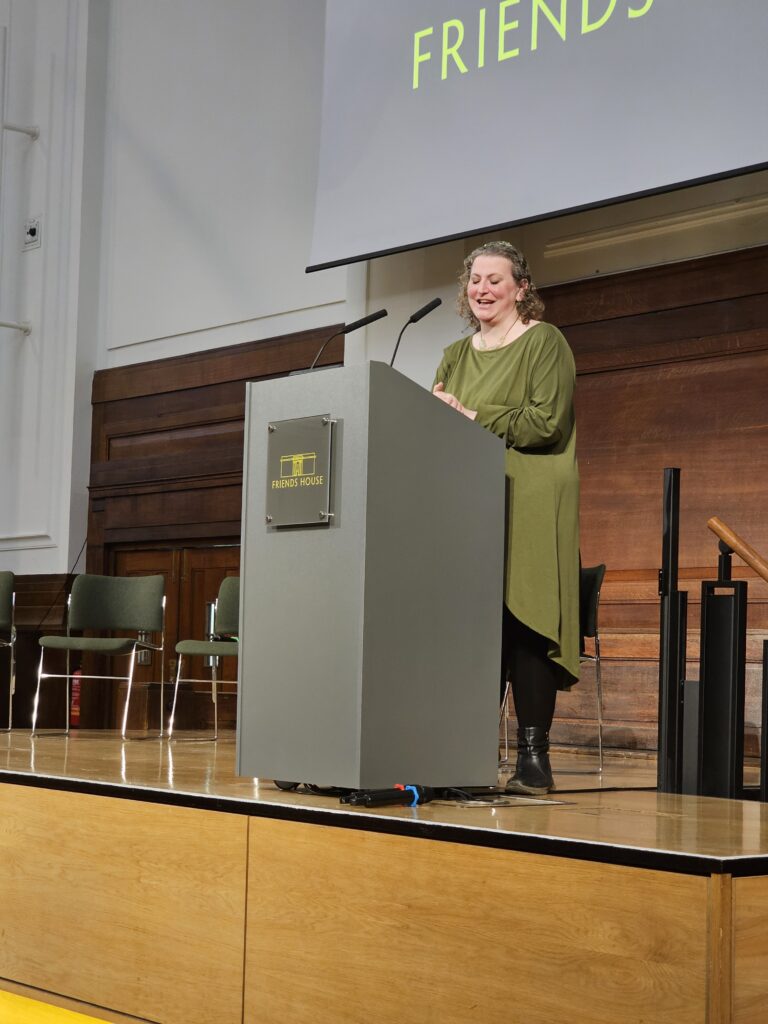
Rabbi Debbie Young-Somers, trustee of Faith for the Climate. Photo by Jon Chew
As Rabbi Debbie Young-Somers, a trustee of Faith for the Climate, led us in ‘Hinei Ma Tov’ – a Jewish hymn sung at Shabbat feasts – I was reminded of the field the Sufi poet Rumi speaks of. While evocative, this translation by Coleman Barks has been accused of de-Islamifying Rumi a bit too much.
There is another translation by the British scholar A.J. Arberry that is closer to the original meaning of the Persian:
“Beyond Islam and unbelief there is a ‘desert plain.’ For us, there is a ‘passion’ in the midst of that expanse. The knower [of God] who reaches there will prostrate [in prayer], (for) there is neither Islam nor unbelief, nor any ‘where’ (in) that place.”
In this rendering, the middle ground between belief and unbelief feels like a blank canvas, a place that may be too scary for some to enter. But here, a worshipper of God finds a unique passion, where your heart and devotion to truth and healing fills the expanse. A passion that is no less devoted, that causes us to prostrate in prayer, but maybe, a place where fellow pilgrims are feasting with each other. A place where we are bound not by the ferocity of our arguments, but by our need to find kinship.
Hinei mah tov umah na’im / Shevet achim gam yachad. Behold how good and pleasing it is, for people to sit together in unity.
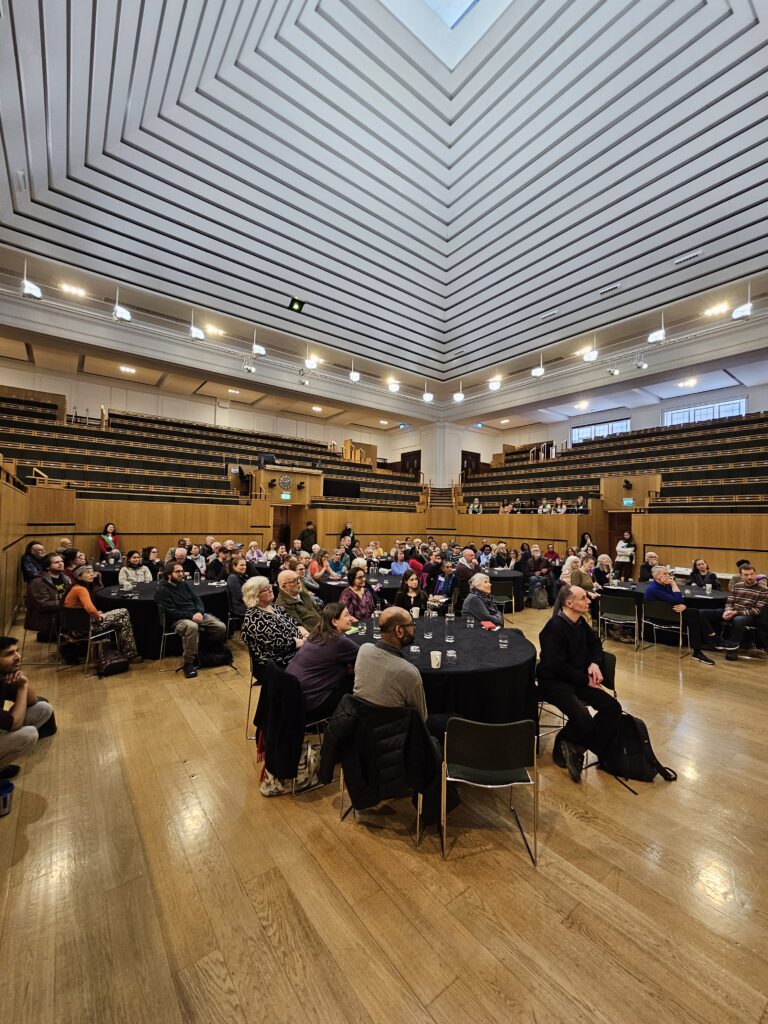
An act of gathering can be a provocation for our times, because these are the times we live in. On February 23, around 150 of us spent an afternoon at Friends House in London for our ‘Healing the Earth, Healing Ourselves’ summit. Co-organised with Christian Climate Action and Quakers in Britain, we came together in The Light Auditorium, where a vaulted roof stretched with holy hands to the skylight above, almost in recognition that the sacred provides safety for the extra-ordinary.
Event attendees gathering inside The Light Auditorium. Photo by Jon Chew
We are asking people to send a pre-prepared email to UK Prime Minister Keir Starmer calling for debt cancellation.
By sending the emails on the same day we hope to have greater impact. Please go to our Debt Campaign webpage and follow the instructions to take part in this simple action. It only takes a couple of minutes. You’ll also find more information about why debt cancellation is vital.
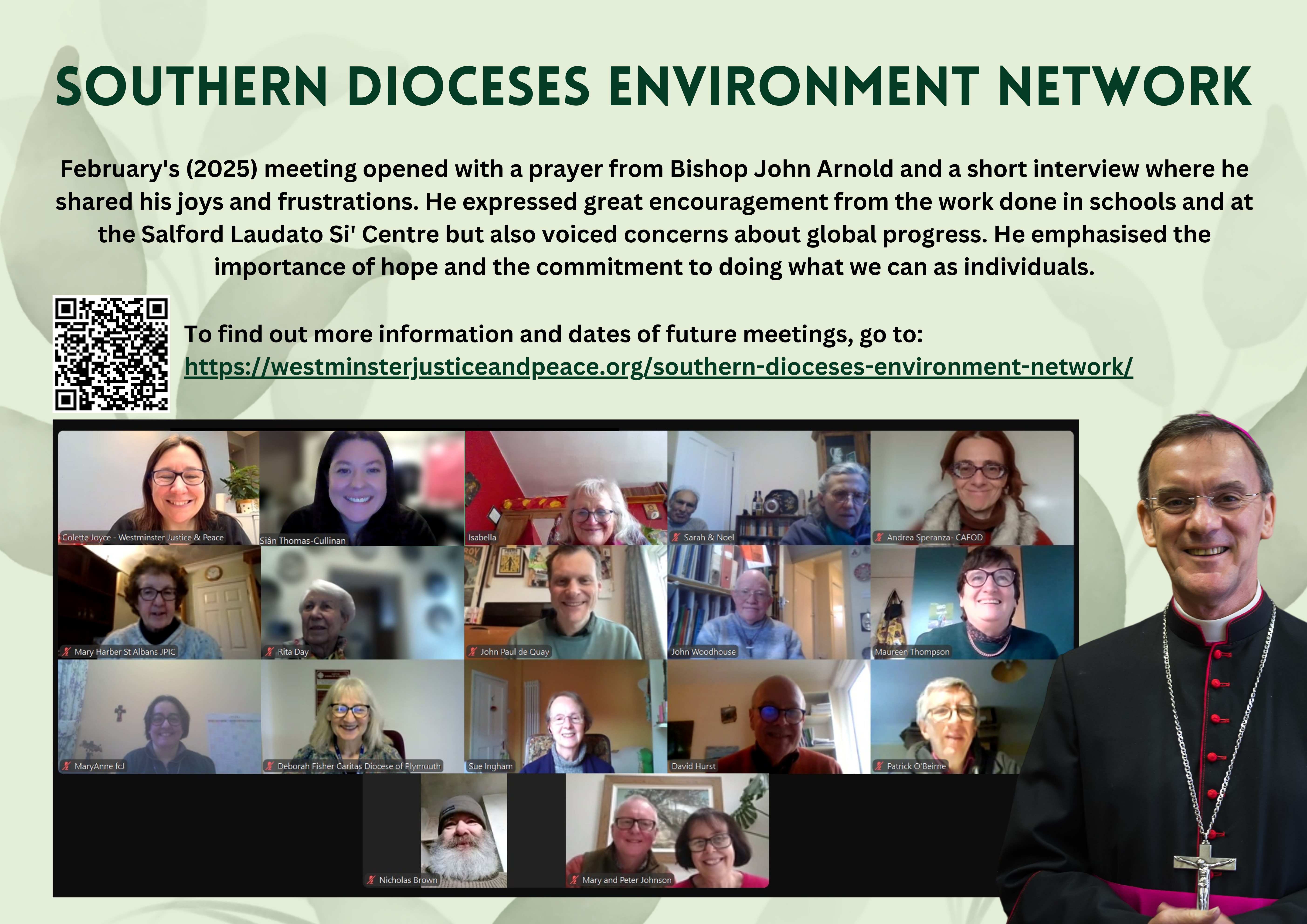
Now in its fifth year, this monthly Zoom meeting is a valuable space for sharing and learning about the many significant initiatives across the Southern Dioceses focused on our care for creation. It also serves as a source of support as we navigate various challenges together. This month’s meeting was a review of the past year, reflecting on the inspiring talks we’ve had. All of these sessions are available for viewing on the current page:
February’s (2025) meeting opened with a prayer from Bishop John Arnold and a short interview where he shared his joys and frustrations. He expressed great encouragement from the work done in schools and at the Salford Laudato Si’ Centre but also voiced concerns about global progress. He emphasised the importance of hope and the commitment to doing what we can as individuals.
To stimulate discussion, John Paul from Journey 2030 and Maureen, a parishioner from Portsmouth Diocese, shared practical and spiritual reflections, along with resources for action linked to the Jubilee Year and the 800th anniversary of the Canticle of Creation. They also posed an important question: how might we continue our journey beyond this Jubilee year, looking ahead to Jubilee 2033?
These open meetings provide a valuable space for diocesan staff, charities, and parish supporters to unite in small groups, fostering collaboration and generating ideas for future meetings. This format offers an excellent opportunity to stay informed, exchange ideas, and support one another in our shared mission.
We are always looking to welcome new voices and hear about the progress in caring for our common home. Please join us on the second Monday of each month!
Additionally, a sister group with the Northern Dioceses is actively collaborating, and we are planning a special event to mark 10 years of Laudato Si’ Week, featuring Austin Ivereigh as a keynote speaker. Keep a look out for further information!
With blessings from the Southern Dioceses,
Arundel and Brighton, Brentwood, Clifton, East Anglia, Portsmouth, Plymouth, Southwark and Westminster.






 Diocese of Westminster Justice and Peace Commission