Calais camp – a Franco British dilemma

I have just received and am passing on  guidance on how to offer practical help in Calais, from that excellent organisation, Seeking Sanctuary – see the link,

http://www.indcatholicnews.com/news.php?viewStory=30016

HowevIMG_20150919_145501937er,  I would  argue that we should, as well as showing compassion and welcome, also speak up about the injustice and inhumanity of treating thousands of refugees coming from the Middle East and Africa in the way we do.  One of the  allegories  we often use to explain what Justice and Peace is about is about ‘The babies in the stream’: Seeing babies floating down the river a horrified community jumps in to save them.  They keep coming and the community keeps jumping in. Finally one citizen suggests going upstream to find out what is going on, so as to prevent this horrible phenomenon.  That response is  ‘justice and peace’.

I never thought we would actually see this situation happen, but day after day we hear about worse phenomena than those allegorical babies, as drowning continues on a shocking scale in the Mediterranean.    In the European context, the refugee situation – I prefer to call it a ‘political’ problem not a ‘refugee’ problem, since it seems obvious that a unit of 500 million

IMG_20150919_143736852

Rally for refugee rights in Calais September 2015

people should be able to absorb 1 million incomers – is caused by the failure of rich countries to coordinate a response .  War and instability in the Middle East,  and failing states in Africa need foreign policy responses, but also a coordinated humanitarian response.  We are closing our eyes if we think these issues will go away tomorrow.

The UK have contributed  around £80m on security and  fencing around Calais (you will see it still going up as  Eurostar pulls away from Calais-Fréthun station), and the French government have provided only for  those applying for asylum in France.  With no policing inside the camp, and no medical or education services  this seems to me to be pretending that there is no problem, that the camp is full of non-persons.  Compare that with the generosity of people we read about in Lesbos and Lampedusa, and Europe presents a very uncoordinated picture.

A Europe-wide policy is needed.   Thirteen aid agencies, including CAFOD, published in early April an excellent, detailed analysis of what needs to happen on  a UK and a Europe-wide level, called SAFE HAVENS.   It remains to be seen whether these measures can be achieved in or out of the EU.   We have a duty to inform ourselves and to vote in solidarity with the poorest, for the Common Good, and for peace.


Migrants Mass at Westminster Cathedral

From Independent Catholic News:

More than 2,000 Catholic migrants living and working in London brought colour and international music to a special Mass for Migrants at Westminster Cathedral on Monday 2 May. The principal celebrant this year was Cardinal Vincent Nichols, Archbishop of Westminster.

In his homily Cardinal Nichols deplored “reports of sadness, dismay, frustration, anger, rejection and humiliation from Iraq and Jordan, to Libya and Calais.” He felt it was important to speak out when vulnerable children “are perishing at sea or at risk in hostile camps”, and to act with “compassion and justice.”

He said, it is vital to acknowledge the hard work of refugees and migrants in Britain, “who have arrived in this country, in this city, and who work hard not only to survive and to support their loved ones, but also to make their contribution to the well-being of others”. He called for “a change of heart in our society, so that we begin by appreciating the great contribution made by so many migrant communities, without whom this city would not function.”

The Cardinal went on to urge more responsible leadership “from those who deal in creating fear of migrant people and who seek to profit from that fear, whether financially or politically”. He concluded by saying: “We pray earnestly for those who are in positions of authority and leadership that they will find the courage and imagination to respond more generously to those in need, speeding up our own resettlement programme and looking to see how other avenues of rescue and support can be provided.”

Alongside Cardinal Nichols at the Mass were bishops representing Westminster, Brentwood, and Southwark dioceses, and more than 40 priests from ethnic chaplaincies and missionary societies, including the Superior General of the Columban Missionaries, Australian Fr Kevin O’Neill. The Mass was organised by the Justice and Peace commissions of Westminster and Southwark and Citizens UK, in dialogue with Bishop Paul McAleenan, auxiliary in Westminster. Among those handing out Mass brochures to the congregation were Barbara Kentish of Westminster Justice and Peace, Phil Kerton of Seeking Sanctuary (a charity which supports refugees in Calais) and Alison Gelder of Housing Justice.

A procession before Mass, led by the Brazilian chaplaincy, reflected the diversity of London’s Catholic community, as various communities made their way up the aisle, singing, drumming and dancing to their traditional music. Particularly appreciated was an accompaniment of the Offertory by London’s Vietnamese Catholic community, involving the dancing of garlanded young people and the singing of a Vietnamese choir.

Biddings prayers at the Mass were spoken in a variety of languages, including Mandarin, Yoruba and Portuguese, by students of Our Lady’s Convent High School in Hackney. They remembered refugees who have died crossing seas and borders to escape wars and persecution, and victims of human trafficking. The well-being of migrants working in London was recalled with, “may we live together in harmony and may our employment policies enable all to be treated justly”.

Banners heading up the aisle at the end of the Mass included the Ethiopian chaplaincy, the London Chinese Catholic Association, Syro-Malabar churches of India, Catholic Nigerian and Ghanaian chaplaincies, the London Catholic Worker and ‘Justice for Domestic Workers’ (J4DW). They rubbed shoulders with Julian Filochowski of the Archbishop Romero Trust, Maria Elena Arana of CAFOD and representatives of Catholic organisations and religious sisters.

In recent years, Catholic Churches in London have seen a growing number of parishioners from Africa and Asia, from Eastern and Western Europe, from the islands of the Caribbean and more recently from South America. This annual Mass is a visible sign of the Catholic Church’s desire to celebrate this rich diversity which enhances parish life, and to underline the church’s pastoral care for migrants and their families. It has been celebrated on the first Monday in May (Bank Holiday Monday) since 2006.

Read the full text of Cardinal Nichol’s homily here

Update on Refugees and Asylum Seekers

As we read and see daily news about the refugee crisis, we can feel powerless in the face of such a huge movement of suffering people. We must just begin where we can. Here are some things we can do:

1 Caritas Westminster is coordinating diocesan volunteering, and can signpost us to various types of practical help: see their website, http://rcdow.org.uk/caritas/news/the-refugee-crisis-we-need-your-help/

2 Pray and vigil with the London Catholic Worker as follows:
First and third Tuesday of the month at 12.30 PM:
One-hour prayer vigil in solidarity with migrants and refugees who make their way to Europe across the Mediterranean Sea. As part of the liturgy, we read the names and stories of people who have died attempting this dangerous crossing and call on our government to support search and rescue missions. The first Tuesday in front of the Foreign Office and the third Tuesday in front of the Home Office.

3 Support the Calais Migrants through the Kent charity, Seeking Sanctuary: Seeking Sanctuary are urgently looking for goods and cash for the people scattered by police in the last few days. www.seekingsanctuary.weebly.com

4 Find out whether our local boroughs are accepting Syrian refugees, and whether we can be part of the support offer

5 Consider and discuss with our local and national leaders the future of a Europe closed to refugees.

Lord Stern on Climate Change and Laudato Si’ at LSE

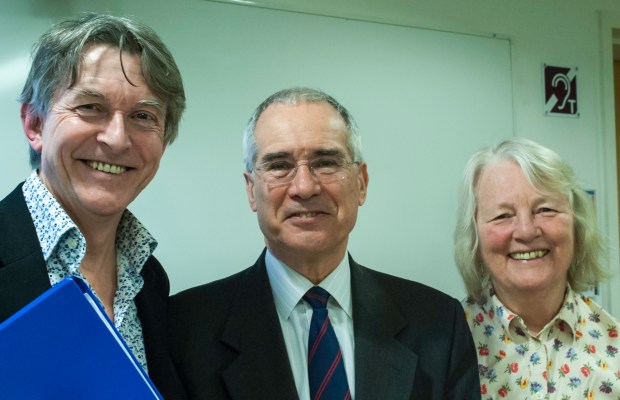
Conor Gearty, Lord Stern & Anne Power, 10th March 2016.jpg
The LSE Student Catholic Society and the Department of Housing and Communities held an exciting discussion on Thursday March 10th, with renowned environmental economist Lord Nicholas Stern, and Human Rights professor Conor Gearty, who is also a Catholic. The dialogue between these two was chaired by Catholic Anne Power, professor of Social Policy and head of LSE Housing and Communities department. The discussion was attended by a packed audience of around 135 people in a hall designed for 120, and was a mix of academics and church climate activists. Lord Stern endorsed many of the points made by Pope Francis, on the need for solidarity between rich and poor worlds, and the necessity of a carbon tax in order to support sustainable development in poorer countries. He highlighted the success of the Paris Climate Talks, where 195 nations had agreed on a global strategy on climate change, without minimising the fragility and difficulties of such an agreement. When asked about the Pope’s denial that population increase was contributing to the problem, he answered that while he felt that this was an issue, he agreed with Pope Francis that it was not the main one, and that population was in any case decreasing for a number of reasons, separately from the climate issue. Lord Stern thought that action could take place on several levels, but that acting in community with others we could encourage and be encouraged by change. One of the factors which had altered the thinking of governments since the Copenhagen talks was seeing the many alternatives possible to our carbon emitting economies. We could continue to work with communities but also to lobby our political leaders to focus on reducing our use of fossil fuels according to the targets we set ourselves in Paris.

The event was supported and publicised by Westminster Justice and Peace. LSE is producing a transcript of the discussion which will be available shortly.

Upcoming event: Climate Change and Laudato Si’: the relevance of Pope Francis’ call to save “our common home”

London School of Economics Housing and Communities in association with LSESU Catholic Society will be hosting a public discussion entitled Climate Change and Laudato Si’: the relevance of Pope Francis’ call to save “our common home”.

Date: Thursday 10 March 2016
Time: 4.15-6pm
Venue:  Wolfson Theatre, New Academic Building, London School of Economics
Speaker:  Professor Lord Nicholas Stern
Chair:  Professor Conor Gearty

A call for ecological conversion, the Laudato Si’ by Pope Francis examines environmental issues in the light of faith. The Pope argues that social justice and climate protection are intertwined and must be tackled together. However, how relevant is his call to the need for profit maximisation and business efficiency?

Nicholas Stern is the Head of the Government Review on the Economics of Climate Change 2003-6, author of Why Are We Waiting? The Logic, Urgency and Promise of Tackling Climate Change (2015) and Chair of the Grantham Research Institute since it was founded in 2008.

Conor Gearty is a professor of human rights law, a founding member of the Matrix chamber and Director of LSE’s Institute of Public Affairs.

This event is free and open to but pre-registration is required. Places are limited, please R.S.V.P. by emailing J.Rowan1@lse.ac.uk. For any queries email s.n.menggu@lse.ac.uk.

More details can be found here.

Archbishop Oscar Romero Service 2016

This year Jesuit Fr Francisco de Roux will be the guest speaker for the commemorations of Blessed Oscar Romero’s martyrdom. 

Since the 1980s Fr de Roux has been a leading voice in the efforts to seek a negotiated settlement to Colombia’s decades-long armed conflict. He has received numerous awards recognising his contribution to human rights and peace-building: among them the French Légion d’Honneur, Colombia’s National Peace Prize and the Chirac Foundation’s 2012 prize for Peace and Conflict Prevention.

Fr de Roux is speaking about ‘The Violence of Peacemaking: Archbishop Romero and the Search for Peace’, and will be the preacher at the annual ecumenical service in St Martin-in-the-Fields, London to mark Romero’s martyrdom, this year taking place at 11am on Saturday, 19 March. Details of the services, as well as anniversary Masses taking part across the UK, can be found below where you can also download a poster to advertise the ecumenical service.

Saturday, 19 March at 11am, St Martin-in-the-Fields, Trafalgar Square

Download a poster here

A World Free from Nuclear Weapons, or renewal of Trident?

The statement below expresses our view on the Trident nuclear weapons system. The climate good we are trying to work for is not helped in any way by renewing this weapon which, when used, is so pervasively destructive of humanity and the environment. We add our voices to all those who campaign for an end to our nuclear deterrent. We think Trident should be scrapped. Our statement explains why.

As Labour attempt to resolve their defence policy in relation to nuclear weapons, we look at the arguments for and against retaining the UK Trident system in the light of our Faith, and call for an unequivocal refusal to renew Trident, this costly and deadly weapons system. Pope Francis called for an end to nuclear weapons in October last year, saying:  ‘There is an urgent need to work for a world free from nuclear weapons, in full application of the Non-Proliferation Treaty in letter and spirit with a goal of a complete prohibition of these weapons’.   How is this to be achieved? There are vital questions of security, economics and the very purpose of nuclear weapons to be considered.

How did it start?          Some remember the devastating destruction caused by the bombs dropped on Hiroshima and Nagasaki and were horrified to read and see, soon after,  pictures of a bomb that could vaporise human flesh for a half mile radius and burn thousands of men, women and children, who were miles away from the epicentre. Perhaps we were made aware of the horrors through the Campaign for Nuclear Disarmament founded in the 1950s, and Ban the Bomb marches to Aldermaston, which went on for decades.   Yet, not only do the tragic consequences continue 70 years later, but there are now 9 countries in possession of nuclear weapons, some  not even signed up to nuclear armaments limitation treaties (Israel denied it had them) –  hardly a sign that the issue has ‘gone off the boil’.

The UK’s nuclear capacity today
“The UK’s nuclear deterrent force currently consists of an operational system known as Trident:  four Vanguard-class submarines each capable of carrying up to 1611 D-5 ballistic nuclear missiles.  At least one submarine constantly is on patrol, while one undergoes maintenance; and the other two carry out manoeuvres” Wikipedia

This is operated by the Royal Navy and based at Clyde Naval Base on Scotland’s West Coast – Faslane and Coulport are the two key locations.  Each of the submarines can be armed with eight missiles and 40 warheads: so a total of 160 warheads.  Frighteningly, each of the 160 warheads has eight times the explosive power of the bomb that destroyed the Japanese city of Hiroshima in 1945.  It is very hard to contemplate the capability of destroying over 1,200 Hiroshimas!  It is estimated that 75,000 people died in that blast; another 140,000 died some days/weeks later.  The death toll reached 200,000 by the end of 1950.  There are still health problems for the people of Hiroshima today.

The Modern Potential of Nuclear Weapons
Most of us have no idea of the tragedy, suffering and devastation caused by a nuclear bomb; Trident replacement is discussed like a play-station game.  The consequences of using these weapons would far outstrip those of the World War II bombs.   One image of the stupidity and insanity of even a single warhead, for instance, is, two men in a large tank of petrol up to their shoulders; one has a lighter which he is threatening to strike to destroy his enemy!  The fact  is, both will be incinerated by the strike!

The arguments

1          Deter or Use   Politicians frequently argue that atomic weapons are a deterrent never to be used.  But this had been argued right up to when politicians and generals had them dropped on Japan in 1945, almost as soon as they were available.  Ever since, there have been plans for nuclear wars.  US bombers planned for and practised small and large scale nuclear bombing runs against North Korea with live nuclear bombs in the early 1950s.  President Eisenhower also threatened China with nuclear bombs, saying “I see no reason why they shouldn’t be used just exactly as you would use a bullet or anything else”.  The threat of a nuclear war between the US and Soviet Union escalated in the 1960s.  The Soviet Union put medium range nuclear missiles on Cuba, from where they could reach the US West Coast within minutes.  The US had placed similar missiles in Turkey.  Fear spread across the globe as it became clear that a false alarm could trigger a missile attack.  Generals now discussed a “first strike” policy.  Rather than risk missiles being destroyed before hitting their targets, they prepared to hit first and discussed ways to “win” a nuclear war.  To these ends, the US first put nuclear bomber planes on permanent flight.  By the 1980s, following a near-disastrous crash, both NATO and the Eastern Bloc began siting short range missiles across Europe.  US President Ronald Regan even talked of a “limited nuclear war” in Germany.  After the fall of the Soviet Union these dangers began to feel like ancient history.
Current tensions   But tensions between superpowers are rising again.  NATO ally Turkey shot down a Russian jet bombing Syria last November.  There are regular standoffs between the US, its allies and China over control of the South China Sea.  The only way to make sure nuclear bombs are never fired is surely to get rid of them.  The danger is exacerbated by the number of countries which possess nuclear weapons and yet are not signed up to nuclear armaments limitation treaties. Israel denied it even had them – it took Mordechai Vanunu to expose them. He served 18 years in an Israeli jail and was released in 2004.  He is still victimised for the stand he took.

2          Shield or Target?       Supporters of Trident and nuclear weapons generally try to convince us that having atomic weapons will keep us safe and deter wars.  Britain has had nuclear armed submarines on patrol since the 1960s.  Yet, they did not deter war, conflict or terrorists.  ISIS gunmen or any other terrorist will not be prevented from launching an attack on Britain because the state has nuclear weapons.  The many attacks or atrocities or suicide bombers and so on, in recent years, have not been resolved by possessing nuclear weapons.

3          Job losses or new opportunities?                    In the nuclear debate, the idea of job losses is thrown in as a final salvo.  Surely £160 billion could be put to better use – to save lives; to fight diseases; to educate our young people, to develop renewable energy.

Spend on Peace, not War      If some of the hundreds of billions of pounds due to be spent on quickly out-of-date nuclear weapons, were directed, along with humanity’s energy, skills, wisdom, cash, and peace negotiating abilities, towards work for peace, then we might succeed. Yesterday’s enemies can become today’s friends.  Many peace workers, such as Mordechai Vanunu, have struggled and suffered to rid the world of these weapons of mass destruction.  We should not let their stand be in vain.

A Will for Peace            As individuals, groups and nations, we need a new ‘way of thinking’ about how nations should relate to one another.   We endorse the Pax Christi vision on nuclear weapons:

‘Integrity will bring peace, justice give everlasting security’ (Is 32:17)
The peace we seek cannot come from weaponry, but from a commitment to justice and nonviolent actions which recognise the dignity of every human person and all creation. We reject models of security that rely on fear, the demonisation of others or on the strength of arms – conventional and nuclear.

We need to support and listen to those who have been on the Peace Trail for years and years.  We need to believe that international peace is possible.  We need work for peace and to dialogue with our so-called enemies.  We need to scrap Trident.
It is ridiculous to make efforts to save our planet on the one hand, and to build up nuclear weapon systems on the other.  Our world is too small and precious to have it destroyed.
Westminster Commission for Justice and Peace
February 2016

Sudbury and Fulham Confirmation Groups celebrate Fairtrade Fortnight

Fairtrade workshop (2)

Justice and Peace held a Fairtrade workshop on Saturday to mark the annual Fairtrade Fortnight. Volunteer Anne Lamont and new Justice and Peace youth worker Edmund Dean led an afternoon exploring the reasons Fairtrade is important. Whether it’s tea plantations in Malawi or bananas in the Windward Islands, the young people understood what a difference their choices make in the supermarket. Solving poverty is not just a question of handing money over as charity. It’s paying a fair price for someone else’s hard work. Anne pointed out that supermarkets only stock what we ask for. We need to ask for Fairtrade in our supermarkets.