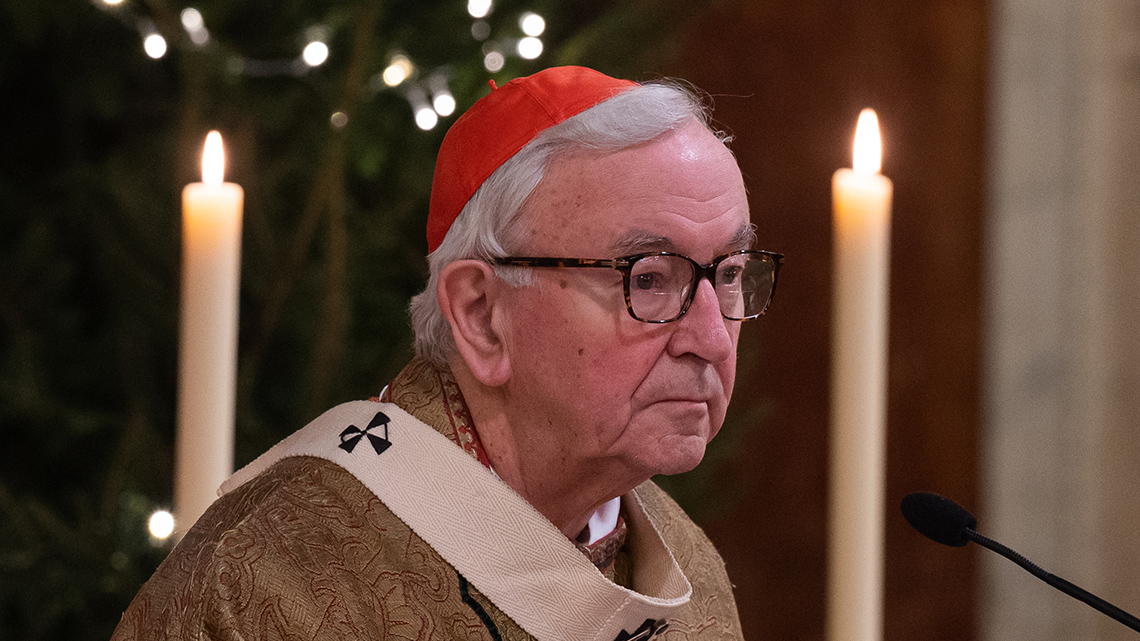
Cardinal Nichols has called the way in which the assisted suicide bill is being handled ‘deeply irresponsible’ and a ‘shambles’.
Speaking to Christian Fellowship, a group at News UK, the Cardinal expressed serious concern that MPs had only spent a few hours debating assisted suicide when they spent more than a hundred times longer debating banning fox hunting in 2004.
He said:
‘I believe it is deeply irresponsible of any government to allow a change of this magnitude to be carried out without due, proper, government-supported parliamentary process’.
‘I think what’s happening, if it came to pass, would be the biggest change that this country has seen for many, many decades at least, probably more. On the back of what – five, six, seven hours’ debate?
‘I was told that the fox hunting bill [in 2004] endured 700 hours of debate.’
Despite these concerns, he hoped that the bill could still be defeated as it makes it way through the Houses of Parliament: ‘I don’t think that story’s over yet.’
The Hunting Act 2004 passed after 700 hours of parliamentary debate and a government inquiry – the Terminally Ill Adults (End of Life) bill, passed on November 29 by 330 to 275 last year after five hours of debate.
Cardinal Nichols added that there was ‘something deeply lacking in a government that isn’t prepared to guide and sponsor,if it wants to, this process of legal change’.
In October last year, Cardinal Nichols issued a pastoral letter to his diocese, encouraging Catholics to contact their MPs ahead of the debate.
In it, he raised concerns: ‘the right to die can become a duty to die’.
He said:
‘Once assisted suicide is approved by the law, a key protection of human life falls away. Pressure mounts on those who are nearing death, from others or even from themselves, to end their life in order to take away a perceived burden of care from their family, for the avoidance of pain, or for the sake of an inheritance.’
‘The radical change in the law now being proposed risks bringing about for all medical professionals a slow change from a duty to care to a duty to kill.’
At this webinar, participants will learn a little more about the insidious issue of Human Trafficking and Modern Slavery in the UK and importantly what we can do as ‘Pilgrims of Hope’ during this Jubilee Year to help victims of Human Trafficking as we shine a light on this important issue.
Brian O’ Toole, who is a member of the National Justice and Peace Network (NJPN), Act to Prevent Trafficking (APT Ireland) and the Religious in Europe Networking Against Trafficking in Europe (RENATE) and Talitha Kum will be hosting this webinar entitled: Open the Doors to Freedom from Trafficking and Exploitation on Thursday 6 February 2025 at 7pm.
St James’s Chamber Orchestra present a concert of Baroque Music by Candlelight – with pieces by Vivaldi, Handel, Albinoni, Bach and Purcell – at the Ukrainian Holy Family Cathedral, Duke Street, London W1K 5BQ on Sunday, 9 February at 7.30pm.
This is a major fundraising drive in aid of assisting displaced Ukrainian nationals and families supported by the Ukrainian Eparchy and its Welcome Centre.
Monday 27th January 2025 marked 80 years since the liberation of Nazi concentration and death camp, Auschwitz-Birkenau.
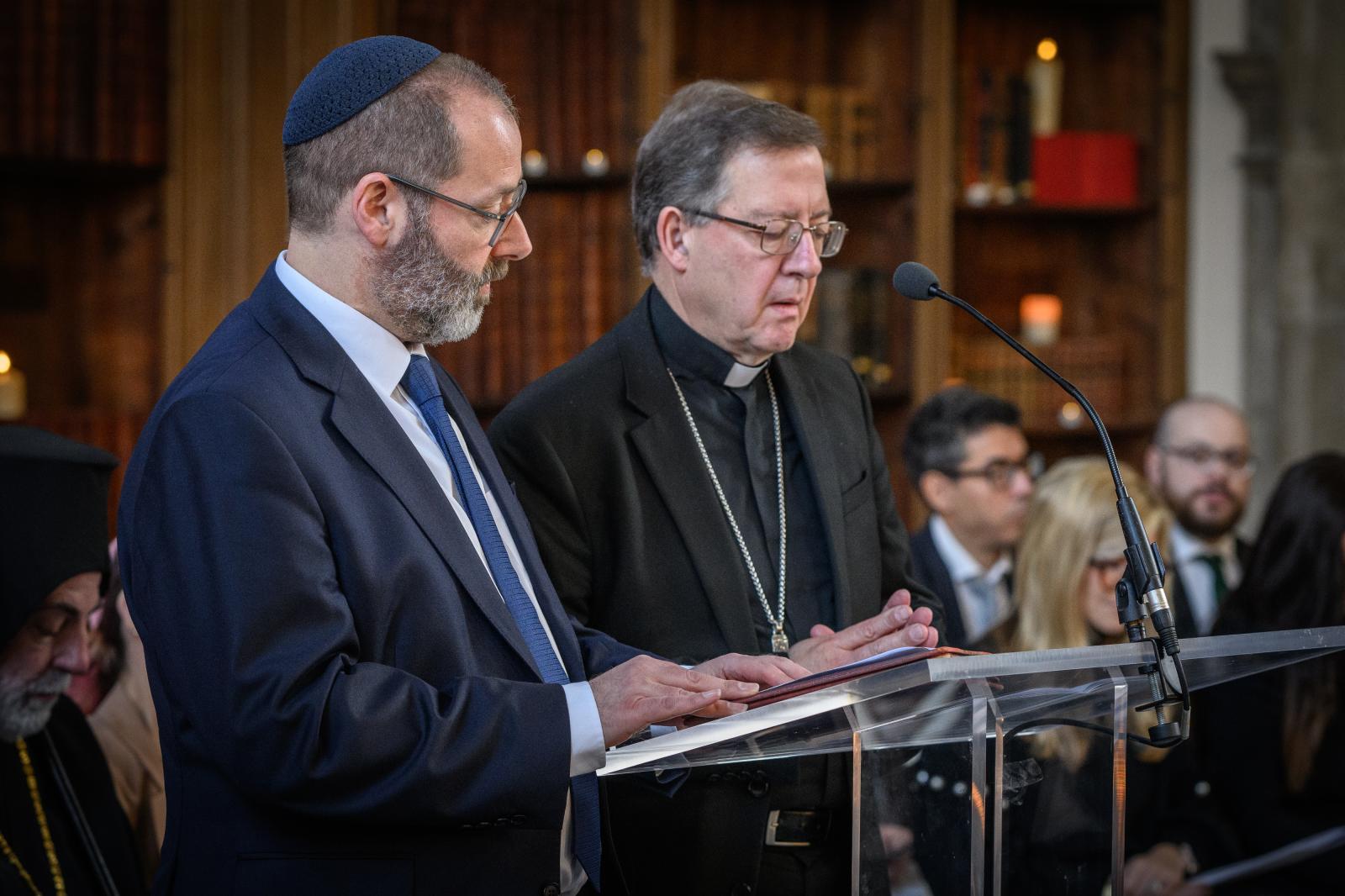
Bishop John Sherrington, Auxiliary Bishop of Westminster, and James Holland, Coordinator of Westminster Interfaith, were among the guests invited to a Holocaust Memorial Day commemoration in Lambeth Palace, organised by the Council of Christians and Jews.
After an introduction from the Lord Archbishop of York, those gathered listened to the survivor testimony of Martin Stern MBE, who was just two years old when the Nazis invaded the Netherlands. Having been successfully hidden for a few years, by a Christian family, Martin eventually found himself in Theresienstadt, a concentration camp north of Prague.
Here, he and his sister, aged just one-year-old, was cared for by a Catholic prisoner, who was transported to the camp for being married to a Jewish man. In 1945, the camp was liberated by the Soviet army and Martin is counted among a small group of people who survived the Holocaust. He has dedicated his life to sharing his story and, for all those gathered, it was an honour to listen to his testimony.
There was also the testimony of a second-generation Roma survivor, whose story was a reminder that the Nazis sought to exterminate not just Jewish people, but Sinti and Roma people too, amongst many others. Daniela Abraham, founder of the Sinti Roma Holocaust Memorial Trust, spoke about the trauma her family members endured during Nazi occupation.
Throughout the commemoration, scripture was shared in both Hebrew and English, recognising the role sacred scripture played, and continues to play, in the lives of Christians and Jews. Alongside Rabbi Josh Levy, Co-Lead of Progressive Judaism, Bishop John Sherrington read Psalm 23, The Lord is My Shepherd.
James Holland, Coordinator of Westminster Interfaith, said:
‘It was a great honour to be present at this commemoration, and yet, listening to the stories of survivors is harrowing. It is a hideous reminder of the evil humankind is capable of. For all participating in Holocaust Memorial Day, it reinforces what we all know – that the future is far from certain. Each of us must recommit ourselves to building a better future together and working for a peaceful world for all.’
A consortium of charities are today warning that that high debt servicing costs are preventing Global South governments from spending on vital public services such as education and health and making investments to limit the impact of the climate emergency. Thirty-two African countries spend more on paying external debts than they do on healthcare.
UK charities including CAFOD, Christian Aid, Save the Children, Debt Justice and the international development network, Bond, are gathering outside the UK Treasury to launch a campaign calling for a debt cancellation initiative in the Jubilee year of 2025.
Debt payments for lower-income countries are at the highest level in 30 years. Private lenders are the largest group of creditors, with many based in the UK, and 90% of their contracts are governed by English law.
The campaign is calling on the UK government to champion major improvements to the debt cancellation process for lower-income countries, including legislating to ensure banks, hedge funds and oil traders participate.
In a joint statement, the charities say:
“We welcome the fact the UK government has made “tackling unsustainable debt” a major priority. However, this will not happen through business as usual but requires a complete change in the UK approach.”
The campaign calls on the UK government to:
“Champion a debt cancellation scheme that brings debt payments down to a genuinely sustainable level” and to “Pass legislation to ensure all private lenders participate in debt cancellation and suspend repayments to private lenders during debt cancellation negotiations.”
The South African government has made tackling the unsustainable debt crisis a key priority for its presidency of the G20 in 2025. 2025 is a Jubilee year in the Catholic Church, and Pope Francis has made achieving debt cancellation one of his key priorities for the year. World Bank Chief Economist Indermit Gill recently said:
“It’s time to face the reality: the poorest countries facing debt distress need debt relief if they are to have a shot at lasting prosperity… Sovereign borrowers deserve at least some of the protections that are routinely afforded to debt-strapped businesses and individuals under national bankruptcy laws. Private creditors that make risky, high-interest loans to poor countries ought to bear a fair share of the cost when the bet goes bad.”
Catholic development agencies CAFOD, SCIAF, and Caritas’ new report, Jubilee 2025: The New Global Debt Crisis and its Solutions, outlines the causes of cyclical global debt crises, the inadequacies in current global debt structures, and sets out six policies to build a fair and functional debt system.
LINKS
Debt Justice (formerly Jubilee Debt Campaign) is a UK charity working to end poverty caused by unjust debt through education, research and campaigning: https://debtjustice.org.uk/
Having touched down in the Holy Land to the news that a ceasefire had been brokered between Hamas and Israel in Gaza to come into effect from Sunday, 19 January, Bishop Nicholas Hudson greeted the news with cautious optimism.
On his first day in the Holy Land, Bishop Hudson, moderator of the annual Holy Land Co-ordination meeting, brought his prayers for a lasting and sustained peace to the Church of the Nativity in Bethlehem.
“It was a sad privilege, in a way, to go down into the grotto where Christ came into the world over 2,000 years ago, but it offered the consolation that we were able to pray deeply.
“I prayed there for peace, and as I knelt before the star – the star of hope that marks the place of Jesus’s birth – I prayed so deeply to the Prince of Peace that He might help this ceasefire to hold… I prayed as well for the families on either side that they might be reunited. I prayed that aid might now be allowed to flow into Gaza – poor, beleaguered Gaza – and that people on both sides of the conflict might now be able to rebuild their lives.”
The Holy Land Coordination, organised by the Catholic Bishops’ Conference of England and Wales through its Department for International Affairs, is an annual meeting of bishops from around the world that is defined by four Ps – presence, prayer, pilgrimage, and pressure. Bishop James Curry, an auxiliary Bishop of Westminster, is joining the group for the first time. The Co-ordination runs from 18-23 January.
On Thursday, Bishop Hudson and Bishop Curry alongside staff from the Bishops’ Conference, visited two projects in Bethlehem. The first stop was St Martha’s House, a day-care centre for elderly Christian ladies, mostly widows, who enjoy companionship and therapies provided by specialist staff and volunteers, including healthcare checks, haircare, podiatry, arts and crafts, and more. The group were the first visitors since October 2023 and there were smiles, tears and even dancing – almost a distraction from the suffering and difficulties that had come before.
Bishop Hudson led a small group to visit the Bethlehem Care and Hospice Trust, a Catholic charity registered in England and Wales, and Scotland, set up to bring compassionate care to those with life-limiting illness in the West Bank.
“The Bethlehem Care and Hospice Trust is a wonderful Christian initiative, with a number of Muslim volunteers and staff coming alongside them in their care for those who have terminal illnesses. It’s a model of palliative care, which I describe a bit like ‘hospice at home’, because it’s our hospice model from Western Europe adapted to a Middle East conviction that people who have terminal illnesses should be able to be looked after at home right until they die.
“We met the palliative team and went out with them to two different families to visit two elderly people who were dying, and I was able to bless them.”
Bishop Hudson’s final observation focussed on the obvious lack of pilgrims on the streets of both Jerusalem and Bethlehem:
“It brought home to me how hard it has been for places like Bethlehem these last 15 months, to not have pilgrims come to be with them, to not be able to support them economically – whether in cafés or shops – or to support St Martha’s House, or the hospice team. They were all saying the same thing, ‘You’re the first people who have come for such a long time. Thank you for coming. We need you to come more often.’ In a sense, it touched on one of our other Ps, the ‘P’ of pilgrimage, which we’ll be talking about more often during this Holy Land Co-ordination. We need to find ways of coming to be ‘present’ on pilgrimage now in the Holy Land – especially now that the ceasefire has been signed.”
Join us for an afternoon of panel discussions and workshops, spiritual connection, music, dance and poetry, creative work, and stalls showcasing the work that faiths are doing for the planet. Hosted by Faith for the Climate, Christian Climate Action and Quakers in Britain.
The event is free, and the venue is accessible for wheelchair users and people with other mobility issues. If there will be other barriers to you joining us (e.g. travel costs or travel schedules for your journey or being responsible for children), please email mobilise@faithfortheclimate.org.uk.
We want to learn so that we can improve the events that we organise. If you could please answer the monitoring questions when you sign-up that would be really appreciated!
Breakouts
There will be an opportunity to choose from 4 breakout sessions to take part in:
1) Healing Ourselves During Challenging Times (a series of activities you can do at your own pace) – nurturing your existing spiritual resources and learning from other traditions.
2) Bridging the Divide: How Faiths Can Come Together (panel and discussion) – building new, and refreshing existing, faith connections.
3) Starting With Our Local Environment (panel and discussion) – hear from groups already taking local action about their projects and how faith values connect with this.
4) National and International campaigns (panel and discussion) – learning about campaigns that are focused on justice-based action on climate.
You will be able to indicate which stream you would like to take part in when you register.
Cardinal Vincent Nichols, Archbishop of Westminster, has co-signed a multi-faith letter ahead of the assisted suicide vote in parliament on Friday:
As leaders of faith communities we wish to express our concern at the Terminally Ill Adults (End of Life) bill, which will be debated by MPs on 29th November. We are aware of how complex and weighty this topic is. There are many dimensions to the bill, all of them of great ethical and practical importance. We hold in prayer all those across our country who may be personally affected, and our representatives in Parliament with profound decisions before them.
Part of the role of faith leaders in communities is to provide spiritual and pastoral care for the sick and for the dying. We hold the hands of loved ones in their final days, we pray with families both before and after death. It is to this vocation that we have been called, and it is from this vocation that we write.
Our pastoral roles make us deeply concerned about the impact the bill would have on the most vulnerable, opening up the possibility of life-threating abuse and coercion. This is a concern we know is shared by many people, with and without faith.
In the UK, it is estimated that 2.7 million older people have been subjected to abuse; many of these may also be vulnerable to pressure to end their lives prematurely. Disability campaigners and those working with women in abusive relationships have also highlighted the danger of unintended consequences should the law be changed. The experience of jurisdictions which have introduced similar legislation, such as Oregon and Canada, demonstrate how tragic these unintended consequences can be. Promised safeguards have not always protected the vulnerable and marginalised.
Even when surrounded by loving family and friends, people towards the end of their life can still feel like a burden. This is especially the case while adult social care remains underfunded. In this environment, it is easy to see how a ‘right to die’ could all too easily end in feeling you have a duty to die.
We are convinced that the current law provides much greater security for those who are vulnerable than the bill before Parliament. A bill which MPs will have had only three weeks to scrutinise before they vote on it. The most effective safeguard against life-threatening coercion or abuse is to keep the law as it is.
In supporting the state of the current law, we do not deny that some people experience a painful death, though we welcome the fact that these deaths are far less common than they used to be due to advances in palliative care.
Over decades we have witnessed how compassionate care, along with the natural processes of dying, allow those at the end of their life to experience important moments. We have seen relationships repair and families reconcile. We have seen lives end in love. Much can be lost by cutting these processes short.
We believe that a truly compassionate response to the end of life lies in the provision of high-quality palliative care services to all who need them. While there are many examples of excellent palliative care in this country, it remains worryingly underfunded. Investment in palliative care is the policy of a truly compassionate nation. It is the way to ensure that everyone in society, including the most vulnerable, receive the care they deserve at the end of life.
Sarah Mullally, Bishop of London and former Chief Nursing Officer; Cardinal Vincent Nichols Archbishop of Westminster; Ephraim Mirvis, Chief Rabbi of the United Hebrew Congregations of the Commonwealth. Sayed Abdul Saheb Al-Khoei, Secretary General of Al-Khoei Foundation; Archbishop Angaelos, Coptic Orthodox Church; Imam Qari Asim, Chair of MINAB (Mosques and Imams Advisory Board); Glyn Barrett, National Leader Assemblies of God; Anil Bhanot, Managing Trustee of the Hindu Council UK; Gavin Calver, CEO of Evangelical Alliance; Malcolm Deboo, President, Zoroastrian Trust Funds of Europe; Joseph Dweck, Senior Rabbi of the Spanish & Portuguese Sephardi Community; Pinchas Hackenbroch, Chair of the Rabbinical Council; Ross Hendry, CEO of CARE (Christian Action, Research and Education); Trevor Howard, Executive Vice-Chair of the Board, Churches in Communities International; Andrew John, Archbishop of Church in Wales; Nikitas Lulias, Archbishop of Great Britain, Greek Orthodox Church; Paul Main and Jenine Main, Territorial Leaders of The Salvation Army in the United Kingdom and Ireland; Patrick McKinney, Bishop of Nottingham, Roman Catholic Church; Zara Mohammed, Secretary General of the Muslim Council of Britain; Bhai Sahib Mohinder Singh Ahluwalia, Spiritual Leader & Chair, Guru Nanak Nishkam Sewak Jatha; Trupti Patel, President of the Hindu Forum of Britain; Mark Pugh, General Superintendent of Elim Pentecostal Churches; Mehool Sanghrajka, Chair of the Institute of Jainology; Venerable Bogoda Seelawimala, President of Sri Lankan Sangha Sabha of GB; Lord Singh of Wimbledon, Director of the Network of Sikh Organisations UK; Jonathan Wittenberg, Senior Rabbi of Masorti Judaism; Mar Awraham Youkhanis, Bishop of London, Assyrian Church of the East.
The president of the Catholic Medical Association, Dr Mike Delany has appealed to Members of Parliament to oppose legislation to bring in assisted suicide when the Terminally Ill Adults (End of Life) Bill is given its second reading on 29 November.
Dr Delany commented that assisting a person to end their own life is contrary to the Christian understanding of the sanctity of life and the role of medical practitioners and that it is also contrary to our understanding of the meaning of compassion. Compassion means to “suffer with” another person. It involves accompanying people, especially during sickness, disability and old age when we know that people are frail and vulnerable. Such accompaniment is the responsibility of all those who care for those who are suffering, including medical practitioners.
We believe it is wrong for doctors to help somebody to deliberately kill themselves and that such actions have no place in a compassionate society.
In common with many others, we see the dangers of the legalisation of assisted suicide for the future of palliative care and we also fear the progressive relaxation of the proposed safeguards. However, there are particular concerns for the medical profession.
This legislation has the potential to fundamentally change the relationship between doctor and patient. Doctors will be allowed to initiate a conversation about assisting patients to commit suicide if they meet the criteria. No doctor should be allowed to initiate a conversation that leads to him or her offering to help a patient kill themselves.
We reject entirely the language of the proponents of the bill who have suggested that assisted dying “does not shorten life, it shortens death.” This changes fundamentally how we think about people in the later stages of life who are very much alive and have a right to the care they need to live in dignity.
The conscientious objection clause proposed in the bill is very weak. Any doctor who refuses to participate in discussions about assisted suicide will be required to refer the patient to another doctor who will. This means that any doctor, upon qualification, will be required by law to co-operate in the deliberate taking of the life of another human being: if not in person, by referral to another doctor. No Catholic doctor could do that in good conscience.
We are concerned too for the Catholic hospices and care homes in which we work. It would seem likely that, if the bill becomes law, they will be required to co-operate with assisted suicide. This would create major problems for our Catholic care sector, which has genuine compassion at its heart, and it would undermine further the provision of palliative care in this country.
On these grounds, and on many others, I ask all Catholic healthcare workers to write to their MPs to oppose this bill.
Contact your MP
There is a simple online mechanism to contact your MP. It takes little more than a few minutes to input your postcode, make sure the suggested text suits your viewpoint and submit your message to ask your MP to stop assisted suicide being rushed into law.
Click here to contact your MP via the Right to Life UK website.







 Diocese of Westminster Justice and Peace Commission