Peace Icon Completes Tour of Westminster

Fr Joe Ryan welcomes the Peace Icon to St John Vianney's to a trumpet fanfare

Fr Joe Ryan welcomes the Peace Icon to St John Vianney’s to a trumpet fanfare

The Pax Christi Icon has been travelling in relay between five Westminster parishes in the last month as part of the 100 Days of Peace initiative.

The Icon was welcomed first to St Patrick’s, Wapping, on 8th June 2012, 50 Days before the start of the Olympic Games, where visitors included clients from the Jesuit Refugee Service.

St John Vianney’s held a week of parish Mission to mark the visit of the Icon evening service was held every day during the week, focusing on one of the Icon images. Speakers included Bruce Kent on St Boris and St Gleb, and Ann Farr on Abraham and Sarah. Talks and times of meditation were held at Our Lady’s, St John’s Wood, and St Joseph’s, Bishop’s Stortford. A full programme of events at Welwyn Garden City included the opening of a Peace Garden at the parish church of Our Lady, Queen of the Apostles, and singing to early morning commuters at Welwyn Garden station.

The purpose of the Peace Icon relay is to create a ‘ring of prayer’ around the capital to pray for a peaceful Games. The Icon is currently at Brentwood Cathedral and will travel to parishes in Brentwood and Southwark Dioceses until 50 days after the end of the Paralympic Games, finishing at Southwark Cathedral.

A final Mass will be held at St George’s Cathedral, Southwark, on 28th October 2012, 3.00pm, to give thanks for all that has taken place during the 100 Days of Peace and to ensure that our efforts to build peace during the Olympic period do not end there.

Symbols of the Peace Legacy will be handed over to the Brazilian Catholic Chaplaincy as Brazil takes up the challenge of hosting the next Olympic Games in Rio in 2016. Brazil, too, wants peace and people of all nations are invited to help bring the world closer to it over the next four years.
Peace Garden Opened at Welwyn Garden City

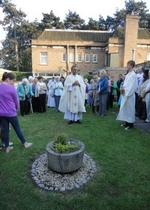
Fr Norbert Fernandes blesses the Peace Garden

Fr Norbert Fernandes blesses the Peace Garden

A beautiful Peace Garden was opened at Our Lady Queen of Apostles on 6th July 2012 following a Mass to mark the start of a week of prayer for peace. Parishioners attended from all three Catholic parishes in Welwyn Garden City as well as guests from other churches and peace organisations.

The garden has been carefully designed to include a host of peace symbols, including a flower bed planted in the colours of the rainbow, an olive tree and a fountain. This tranquil space will provide a haven of peace and reflection for parishioners for many years to come.

The parishes also welcomed the Pax Christi Peace Icon for a week as part of the 100 Days of Peace initiative in preparation for the Olympic and Paralympic Games. The Icon is travelling in relay to 16 parishes in the three ‘Olympic’ dioceses of Westminster, Southwark and Brentwood, with the aim of creating of ‘ring of peace’ around the capital.

Other activities took place throughout the week, including a talk on Icons at Our Lady’s by a Coptic Orthodox bishop and singing songs of peace to early morning commuters at Welwyn Garden City station.

100 Days of Peace Underway

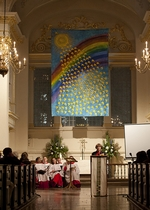
Barbara Kentish speaks at St Martin-in-the-Fields beneath the 100 Days of Peace banner

Barbara Kentish speaks at St Martin-in-the-Fields beneath the 100 Days of Peace banner

The 100 Days of Peace iniative began on 8 June 2012 and will continue until 28th October 2012. This marks the time 50 days before the Opening Ceremony of the Olympic Games on 27 July 2012, the Games themselves, and 50 more days from the Closing Ceremony of the Paralympic Games on 9th September 2012. 

During this period we are called on to undertake a time of active peace-making wherever we find ourselves – at home, at school, at work and in society. It will also be a time of urgent and persistent prayer for all the nations sending athletes and spectators to the Games, particularly those countries currently experiencing conflict and war. We are also praying for peace on our streets in this country before, during and after the Games.

The 100 Days of Peace is a partnership of many groups, involving the three Catholic ‘Olympic’ Dioceses of Brentwood, Southwark and Westminster, Pax Christi, London Citizens, the Jimmy Mizen Foundation, More Than Gold, CAFOD and the Catholic Bishops Conference of England and Wales.

It is supported by Boris Johnson and Sebastion Coe. British Peer Lord Michael Bates, who walked from Olympia to London to highlight the need for the British Government to take the Olympic Truce seriously, has also given his support and attended the Peace Vigil.

We are now asking everyone to commit to prayer and an action for peace every day during the Olympic Truce period until 28th October 2012. Not much to ask!


100 Days of Peace Website

27th Multi-faith Pilgrimage for Peace

Saturday 26th May 2012 saw the 27th Annual London Multi-Faith Pilgrimage for Peace in the East End of London. It was the second occasion on which I had been able to join this inspiring walk. I was only one of over 100 pilgrims from a wide range of beliefs, who were able to bear witness to their faiths.

All religions were represented, either in the groups of pilgrims or in the places of worship we visited. We were guests of the Forest Gate Faithful Friends, which is an organisation started as a pro-ject in 2007, with the aim of bringing local people of different faiths together so as to learn from each other and develop a friendship together. They visit each other’s places of worship, celebrate major reli-gious festivals and organise other events together.

The meeting point and first place of worship was St Ethelburga’s Centre. In 1993 the Church was de-stroyed by an IRA bomb and since then the centre has grown, phoenix like, from the devastation to become a place of reconciliation and interreligious dialogue. A talk explaining the history and work of St Ethelburga’s was followed by a visit to the ‘tent’ and after refreshments, we assembled to go in pro-cession with banners flying and led by a Japanese Buddhist monk with a hand drum. Thus we pro-gressed to Liverpool Street station in order to take a train to Manor Park for our next stop.

The Sri Muragan Temple is a fine example of a South Indian Hindu Temple. It was built in 1983 by skilled craftsmen and sculptors from Tamil Nadu and serves the community of worshipers in that part of East London in addition to many visitors from both England and overseas. We were made most welcome and several additional pilgrims joined us at this point. These included a fellow Heythrop alumnus who had been with me on my BA course. We were given great hospitality but did not overin-dulge as lunch was to be provided at our next desti-nation.

This was St Michael’s/Froud Centre. When work was needed on the large Anglican Church a far-sighted decision was made to build the new Church on a scale that was appropriate to the size of the congregation. This left a lot of space avail-able and the Froud Centre was established. This caters for people of all faiths and none as an out-reach facility for the local community. The centre is used for a wide range of activities enjoyed by young and old alike. These include interfaith learning and worship.

After lunch we took busses to Forrest Gate so as to visit two Mosques (one Shi’a and One Sunni). The latter, Minhaj-Ul-Quran Mosque was much the larger, which may be indicative of the relative sizes of each community. 80% of Muslims are Sunni and I expect that that is the case in this lo-cality also. St. Anthony’s RC Church was our pe-nultimate stop and I was pleased to notice that our pilgrimage was highlighted in the weekly parish newsletter. The activities of our hosts the Forest Gate Faithful Friends were highlighted during an interesting talk from the altar.

Our final destination was the Ramgharia Sikh Gurdwara. We were entertained in a large upper room where, for the first time that day, there were separate areas for men and women. The air condi-tioning was so efficient that I found it necessary to put on the coat that I had carried all day. One aspect of the Sikh religion is the Langar (holy food), which is prepared in the Gurdwaras while reciting Holy Hymns from Sri Guru Granth Sahib Ji. This is served free to everybody who visits, and that of course included our entire group.

It had been a most inspiring and thought provok-ing day and it had raised our hopes for peace and reconciliation

Mike Palowkar


Westminster Interfaith Home Page

Music for Peace Workshop

Frances Novillo, Facilitator

Frances Novillo, Facilitator

Parish singers and musicians of all ages and abilities are invited to this workshop on Saturday 16th June 2012, 10am – 1pm, to learn music on the theme of Peace as part of the 100 Days of Peace initiative.

Held at St John Vianney Parish Centre, 4 Vincent Road, London, N15 3QH. Cost £5 Adult, £2.50 Child or Concession, £25 Parish Group. Please come even if you cannot afford the full cost.

This workshop will be faciliated by Frances Novillo and Jenny Kettleton who are both experienced musicians and facilitators of parish music groups.  Frances and Jenny are particularly good at teaching younger musicians to join in alongside adults and also at communicating when and how to use new music at Mass and other prayer times. Come and learn music that will inspire you during the 100 Days of Peace and beyond…

Praying for Peace at the Olympic Site

Praying for Peace at Bromley-by-Bow Station

Praying for Peace at Bromley-by-Bow Station

We began at Bromley-by-Bow station amid the gritty, industrial surroundings of the A12 and swiftly moved on to Three Mills heritage site and the canal towpaths that surround the Olympic site. Construction work meant we were unable to make a circuit of the park so we walked instead along its Western edge, finishing at the main entrance.

At six stopping points along the way Colette Joyce, the 100 Days of Peace worker, led prayers which were based on the five themes of the Social Justice strand of More Than Gold, the body representing Christians at the London Organising Committee for the Olympic Games.  Thus we prayed for peace for those involved in the Games, for the environment, for the victims of human trafficking, for trade justice, and for the homeless, finishing with the universal prayer for peace.

Our Peace Rainbow flags caused a little consternation with the security personnel:  they had had protesters the day before, and we looked like another possible disturbance, but producing our prayer leaflet, and then asking for directions to the tube station seemed to reassure them that for today we presented no challenge.

The real challenge is keeping our concern for peace alive throughout the Games, so that this amazing international event can leave a legacy for good in this blighted area, in our fractured city and in our economically divided country.

Related Link:

Peace Legacy Website

Military Role in Olympic Welcome and Victory Ceremonies

peaceletterAn open letter :

from Pax Christi and Westminster Justice and Peace

to the Board Members of the London Organising Committee of the Olympic Games

Dear Members

Peace, the root value of the Olympic Games

We are among the founding members of ‘The 100 Days of Peace’ (the Olympic Sacred Truce).  This is an initiative of a network of Christian groups who believe that London’s hosting of the Olympic Games provides an excellent opportunity to promote and reassert, in London and beyond, our commitment to peace and reconciliation, unity, internationalism and cooperation.  We believe we can build a real legacy of peace for our own London citizens – in schools, places of worship and community networks that will embrace the needs of the global community and extend far beyond the Olympic Games themselves.

This initiative is inspired by the Olympic Truce tradition and vision. Indeed, Lord Coe, the chairman of London 2012 Organising Committee (LOCOG) and representing the British Government, presented a resolution at the UN last October calling for a truce to be observed in all the world’s conflicts throughout the duration of the Olympic and Paralympic Games.

Sport helps to mend broken communities

Some visitors to London this summer will be from countries in conflict, perhaps even facing internal repression.  All the more important then that the message of peace and the creation of a community of ordinary people who can live, work and solve problems together should be central to this uniting of nations under the Olympic ideals.  Lord Coe affirmed this at the UN saying that sport … “can and does help to mend broken communities, rebuild trust, rediscover self-respect, and foster the values at the core of our common humanity.’   It is therefore with some dismay that we hear of the central role being allocated to the Armed Forces during the Games in the Welcome and Victory ceremonies.

Why it matters

We find it difficult to equate this prominent role with the ideal of the Olympic Truce.   Engaging our armed services in this manner could give a militaristic message at what is arguably the greatest of all international gatherings that Britain will host, and might not be conducive to creating a welcoming atmosphere for those attending.   It could also be perceived as  insensitive to visitors from countries still experiencing violence and repression, and likewise to those of our London citizens who are sanctuary-seekers themselves from war-torn countries.

A possible alternative

This engagement could appear imbalanced, moreover, beside other ‘services’ within the UK  which make a vital contribution to society, and  which witness to the values outlined above by Lord Coe.   We suggest that the role of flag bearing and so on be extended to inspirational people and volunteers in other services, such as nurses, doctors, teachers, community organisers, social workers, ambulance, fire-service and coastguard workers, and even older competitors or referees from the 1948 Olympics.  Then to emphasise unity of purpose, one might have Paralympians for the Olympic ceremonies  and Olympians for the Paralympian ceremonies).  All of these people, as well as the Forces personnel, are inspirational for our society.

We urge you to reconsider this aspect of the role of the Armed Forces in the XXXth  Olympiad and Paralympics, andinstead, lead the way in offering more inclusive and peaceful models of security, cooperation and internationalism  so as to create a real legacy of peace that honours London, Britain, the international community and the Olympics.