Caritas Westminster has announced the publication of their Annual Review for 2024, showcasing their areas of service and achievements from the previous year.
Richard Harries, Director of Caritas Westminster, commented: “2024 marked my first full year as the new Director of Caritas Westminster, and it gives me great pleasure to share with you the many milestones we achieved together over the course of the year.
“The Annual Review offers an overview of our efforts to serve the most vulnerable and empower charity in our communities. It brings together the many strands of our work, which ranges from direct services to enabling social action in diocesan parishes and schools. It also includes compelling stories from the people and communities supported, as well as significant events and highlights from 2024.
“Caritas Westminster’s direct services include a safe house for survivors of trafficking and exploitation, support for the Deaf Community and those with intellectual disabilities, a start-up hub for social impact entrepreneurs, financial aid, and resources to tackle domestic abuse.
“Caritas Westminster also strives to be the ‘voice of charity’ within the Roman Catholic Diocese of Westminster, facilitating voluntary service and social action. The Caritas Community Development team offers expertise, network links and project management support to help parishes and schools start or grow charitable initiatives that address the needs of their local communities.”
Highlights from the Annual Review include:
– 47,500 people supported by social action projects run by diocesan parishes and schools – Recognising outstanding volunteers at the ‘Love in Action’ Volunteering Awards – 2,964 miles travelled by the Caritas Deaf Service team for liturgies and events in British Sign Language – Celebrating ‘Achievement Day’ at Caritas St Joseph’s – 128 therapists and counselling professionals trained by Safe in Faith – 50 businesses supported by Seeds Hub – 30 women passed through the doors of Caritas Bakhita House
Bishop Paul McAleenan, Chair of Caritas Westminster, said: “This Annual Review recounts the activities of Caritas Westminster; may it also inspire us in our journey of faith and service as we read of Christ’s work being carried out in our midst.”
Religious think-tank, Theos, has published an open letter signed by over 100 women from different faith traditions voicing significant concerns over the current proposed legislation for Assisted Dying.
We believe that the Terminally Ill Adults Bill has insufficient safeguards to protect some of the most vulnerable in society, particularly women subject to gender-based violence.
Colette Joyce, Justice and Peace Co-ordinator for the Diocese of Westminster, and Nikki Dhillon-Keane, Head of Safe in Faith for Caritas Westminster, are among the signatories.
We write as a group of women of faith from different traditions and backgrounds passionate about care for people in vulnerable situations, many of whom have dedicated our professional lives to preventing male violence against women and girls.
We hold a variety of views on the principle of legalising assisted dying. However, we are all clear that the current legislation – The Terminally Ill Adults Bill – progressing through parliament, has insufficient safeguards to protect some of the most marginalised in society, particularly women subjected to gender–based violence, and abuse by a partner, who also experience intersecting barriers to a full and safe life.
We are concerned that the proposed legislation could create a new tool to harm vulnerable women, particularly those being subjected to domestic abuse and coercive control, by helping them to end their lives.
A report out last month showed that the number of domestic abuse victims who died by suicide in England and Wales was higher than the number of people killed by their abusive partner, for the second year running.
We know too that domestic abuse victims who are also women of faith can face a particular form of abuse[1] at the hands of their perpetrators, who may weaponise theologies and culture to harm and control their victims. We are concerned that the assisted dying legislation, as it stands, fails to take account of how faith and its role at the end of life, as well as its use by both perpetrators and the women they abuse, create complex dynamics that can lead to vulnerable women, who may also hold strong religious beliefs, seeing no way out but death.
We know that poverty and other inequalities increase the risk of women and girls being subjected to violence, ill health and the quality of care and support they receive from statutory institutions and civil society. We know too that in a society riven with inequalities, women who are from Black and minoritised communities, disabled women, migrant women and working–class women, struggle to be heard. Their voices are absent from conversations about this bill, and so too are those subjective to coercive control or violence. It is unclear to us how the legislation and its consultative process has taken account of the multiplicity of faiths, cultures, socio–economic and health backgrounds of our citizens and women who make up our country.
Much of the debate inside and outside parliament has been conducted by those empowered to speak of the importance of personal choice, without consideration of those who struggle to be heard in the public square. It is the voices of the unheard, ignored, and marginalised that we are compelled by our faith traditions and scriptures to listen and draw attention to, in the pursuit of good law–making for the common good – legislation that considers and protects the most vulnerable, not just those who speak loudest.
Having followed the progress of the bill through parliament, we are particularly concerned about:
The risk that people (mainly women) with controlling and abusive partners (mainly men) will be coerced into assisted death. While we welcome the adopted amendments that stipulate training for the assessing doctors and the panel members, this safeguard only comes into play after someone has already been coerced into declaring that they want an assisted death, and will clearly not catch all cases. We also know, from research and experience, that coercive control is a long–term process that is both insidious and subtle with women often unaware of it until the perpetrator’s behaviour escalates.
The reality that since 2016, deaths by suicide have been included in the scope of domestic homicide reviews and there is growing research on women who die by suicide as directly linked to having an abusive partner. We are concerned that if this legislation passes, women may seek assisted deaths to end their suffering at the hands of an abuser. Domestic Homicide Reviews also reveal the disproportionate number of Black and minoritised women who are failed by statutory and state agencies like the police, social services, health services and specialist services like substance misuse and mental health and women’s services despite their calls for help.
There are no longer High Court protections embedded in the Bill
There are insufficient protections for those with learning disabilities and people with anorexia.
The use of the vehicle of the Private Member’s Bill for this landmark legislation. This has resulted in the impact assessment being shared after the Bill Committee stage, which makes it difficult for all of us with concerns about inequalities to gauge how this legislation will affect Black and minoritised and faith communities, people with disabilities, and those experiencing economic disadvantage.
If assisted dying is seen as a response to alleviate suffering, without addressing the underlying structural issues that make life difficult and safeguard against harm, it could put undue pressure on vulnerable women to choose death over inadequate care.
This is no way to legislate, especially not on matters of life and death. We have serious concerns about the bill and its lack of safeguards. The bill has too much potential to hurt vulnerable people and so we are uniting as women from across faith traditions to speak up for vulnerable women, including victims of violence against women and girls, and disabled women, and raise our concerns publicly.
Signatories:
Chine McDonald, director, Theos
Bekah Legg, CEO, Restored
Huda Jawad, co–founder and executive director, Faith and VAWG Coalition
Sam Clifford, CEO, Jewish Women’s Aid
The Rt Revd and Rt Hon Dame Sarah Mullally DBE, Bishop of London
Dr Naomi Green, Assistant Secretary General, Muslim Council of Britain
Professor Sheila The Baroness Hollins, President, The Catholic Union of Great Britain
Rabbi Debbie Young–Somers
Zara Mohammed, former secretary general, Muslim Council of Britain
Hannah Rich, director, Christians on the Left
Revd Dr Helen Paynter, founding director, Centre for the Study of Bible and Violence
Naomi Lerer, CEO, Noa Girls
Amanda Jackson, senior advisor on diversity, World Evangelical Alliance
The Rt Revd Rachel Treweek, Lord Bishop of Gloucester and Anglican Bishop for HM Prisons
Commissioner Jenine Main, Territorial Leader, The Salvation Army, United Kingdom and Ireland
Louisa Collyer–Hamlin, Head of External Affairs, Catholic Union
Patricia Stoat, Science Health & Bioethics Committee of the National Board of Catholic Women
Rt Revd Rose Hudson–Wilkin, Bishop of Dover
Dr Sahira Dar, president, British Islamic Medical Association
Rachel Fink, CEO, S&P Sephardi Jewish Community
Tola Doll Fisher, Creative Director and Editor, Premier Woman Alive
Elizabeth Harris Sawczenko, OBE, Interfaith consultant
Nikki Dhillon Keane, Head of Caritas Safe in Faith
Jagbir Jhutti–Johal, Professor of Sikh Studies, University of Birmingham
Professor Tina Beattie, Professor Emerita of Catholic Studies, University of Roehampton, London
The Rt Revd Dr Joanne Woolway Grenfell, Bishop of Stepney and Lead Safeguarding Bishop for the Church of England
Natalie Collins, author and activist
Sian Rees, head of Bible Society Wales
Rt Revd Dr Jill Duff, Anglican Bishop of Lancaster
The Rt Revd Vivienne Faull, Lord Bishop of Bristol
Rev Catherine De Souza, CEO, Prison Fellowship England & Wales
Sally Hope, Domestic Abuse Practitioner and Writer
Dr Selina Stone, Lecturer in Theology and Ethics, University of Edinburgh
Dawn McAvoy, Both Lives UK
Mandy Marshall, Director for Gender Justice, Anglican Alliance and Anglican Communion
Revd Jenni Entrican, Former President of the European Baptist Federation
Alicia Edmund, Head of public policy Evangelical Alliance
Dr Madeleine Pennington, Quaker writer and head of research, Theos
Rev Leonora Wassell, Co–Chair, Methodist Women in Britain
Rebecca (Bex) Chapman, General Synod member and vice–chair, Christians in Media
Debra Green OBE, CEO, ROC
Alice Gray, palliative care doctor and assistant pastor, Oasis Church, Birmingham
Ruth Parrott, former president and co–chair, Methodist Women in Britain
Shermara Fletcher–Hoyte, Principal Officer for Pentecostal, Charismatic and Multi–cultural Relations, Churches Together in England
Catherine Butcher, author, lay reader, and member of General Synod
Faith Van Horne, PhD, Theology and Religion, University of Birmingham
Jamie Phear, writer and speaker
Rachel Muers, Professor of Divinity, University of Edinburgh
Jayne Manfredi, Anglican Deacon
Katharine Lock
Rev Cham Kaur–Mann, Co–Director, Next Leadership
The Rt Revd Esther Prior, Bishop of Aston
Rev Dr Kate Coleman, Co–Director, Next Leadership
Rosemary Nuamah–Williams, policy Adviser and advocate
Jo Chamberlain, National Environment Officer, Church of England Environment Programme
Dr Usha Reifsnider, Co regional Director, Lausanne Europe, Cultural Theology Consultant
Lucy Butt, CEO, Bramber Bakehouse
Dr Janet Soskice, Professor of Philosophical Theology, Emeritus, University of Cambridge
Stella Mbubaegbu CBE, FE College Principal & Chief Executive
Mary McHugh, National Board of Catholic Women of England and Wales
Hope Virgo, author, campaigner and Secretariat for the APPG for Eating Disorders
Rev Bev Thomas Ecumenical Minister & Social Justice Advocate
Rev Claire McClelland, Head of Chaplaincy, Newcastle upon Tyne Hospitals
Rev Jenny Kimble, Dean of Undergraduate Studies, Regents Theological College
Rev. Michelle Nunn, Principal, Regents Theological College, and Member of Elim’s National Leadership Team
The Venerable Karen Best, Archdeacon of Manchester
Dr Anne Richards, Policy Adviser, Church of England
Revd Dr Hannah Lewis, Lead Chaplain among the Deaf Community, Diocese of Oxford
Janie Oliver, CEO, Stewardship
Dr Calida Chu, Associate Editor, Practical Theology
The Revd Jessica Monopoli, Assistant Curate, St Mary’s Cockerton, and Clergy Lead at The Haven in Darlington, Co. Durham
Bobbi Kumari, founder, Living in Light
Barbara Earl, Croydon Quakers
Danielle Finch, freelance writer (disability, family & faith)
Rev. Rebecca Amoroso, Hospital Chaplain
Christina Mottram, retired lay Catholic hospital chaplain, Leicester Hospitals
Salomé Criddle, CEO, Thriving Women In Real Life
Revd Dr Joanne Cox– Darling, Methodist presbyter
Anupama Ranawana, Postdoctoral Researcher, Department of Theology and Religion, University of Durham
Danielle Wilson, Pioneer Pastor, Birmingham
Dr Claire Williams OMS, Lecturer in Practical Theology, Academic Inclusion Advocate, Regents Theological College
Reverend Joyce Fletcher, National Executive Director of Women and Family for the Church of God of Prophecy
Dionne Gravesande, trustee of Restored and co–chair, National Church Leader Forum
Dr Beverley Samways, Director, Unique Connections
Alianore Smith, member of the General Synod of the Church of England
Revd Novette Headley, Chair – Birmingham Methodist District
Colette Joyce, co–ordinator, Justice and Peace Commission, Diocese of Westminster
The Revd. Lis Goddard, vicar, St James the Less Pimlico
Doreen Patricia Waugh, domestic abuse practitioner, Justice and peace representative
Rev. Sarah Whittleston, National Elim Prayer Director
Dr Eve Poole OBE Lay Canon, York Minster
Revd Alexandra Lilley, Vicar, St George and All Saints Tufnell Park and Dean of Women’s Ministry
Michelle Dumont
Revd. Canon Kate Wharton, Vicar of St. Bartholomew’s Church, Roby, Liverpool, General Synod member, and Prolocutor of the Lower House of the Convocation of York.
Rani Joshi – South Asian Forum coordinator / Evangelical Alliance
Baroness Shaista Gohir – CEO, Muslim Women’s Network UK
This initiative follows a meeting organised in partnership with the Faith and Violence Against Women and Girls Coalition, and Restored, facilitated by Jewish Women’s Aid, and brought together by Theos.
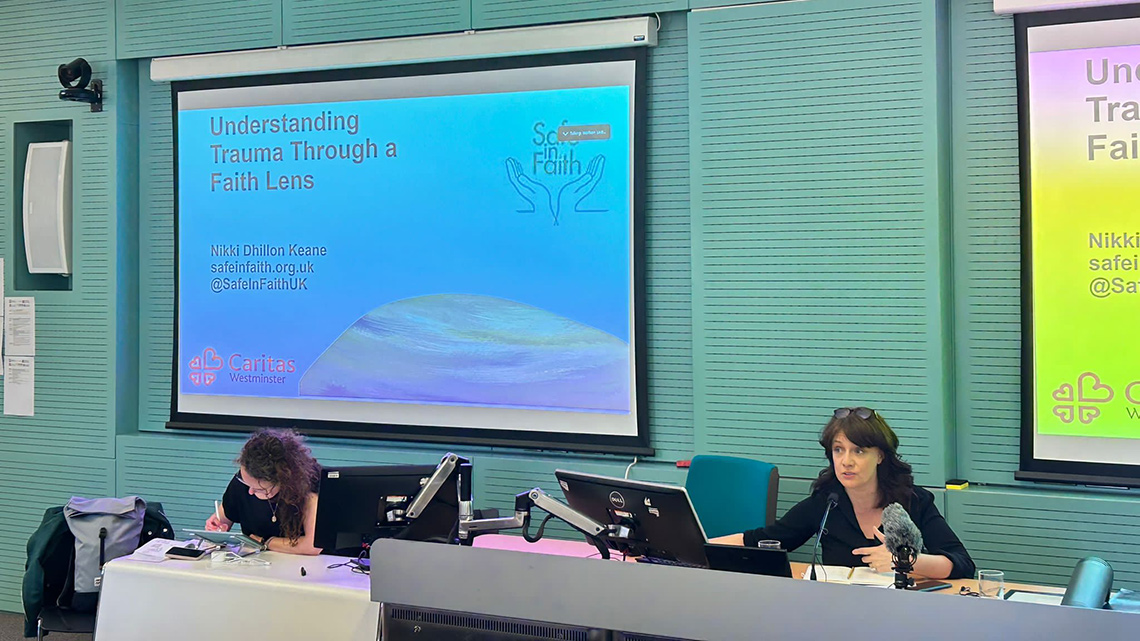
Nikki Dhillon Keane, founder of Safe in Faith UK, is a therapist who helps survivors of abuse and Head of Service at Caritas Safe in Faith on domestic abuse and assisted suicide.
‘The criminal justice system is just acknowledging the scale of possible criminal culpability in domestic abuse and suicide, while at the same time, a bunch of MPs seek to make it non-criminal.’
The questions raised by the proposed Terminally Ill Adults (End of Life) Bill are highly complex. It is difficult to imagine the deeply personal experience of terminal illness, for patients and their families. Raising questions about the safety of proposed legislation should in no way be viewed as a lack of compassion for people nearing the end of their lives; rather as an attempt to ensure that all people affected by this legislation, particularly the most vulnerable, are safe from harm.
There is one particularly vulnerable group for whom this legislation could significantly increase risk: victim/survivors of domestic abuse. Often invisible, they have, until very recently, been all but totally absent from the debate around assisted suicide. For many people being subjected to domestic abuse, however, this danger is all too evident.
Shortly after the evidence session of the Committee stage of the bill began. I found myself listening to Helena (not her real name), who was telling me why she was so worried about the bill: “It’s not for the same reason that other people have a problem with it,” she tells me.
Helena is a domestic abuse survivor, who used to live with her former husband in a country with legalised assisted dying. She explained her fear: “It is when your spouse wants to kill you, and the state gives them a totally legal way to do it…”
As a disabled woman, Helena had a higher risk of domestic abuse. In the UK, one in two deaf and disabled women experience domestic abuse during their lifetime. Helena continued: “My husband used to threaten to euthanise me if he got fed up with being my carer.” She tells me that legislation had expanded there to include chronic, not just terminal, illness – the all-too-familiar slippery slope.
For almost 20 years, Helena was subjected to coercive control by her then husband. Recognised in the UK as a criminal offence under the serious crimes act 2015, coercive control is the umbrella under which all the other forms of domestic abuse are perpetrated. Threats and isolation are common tactics, as is weaponising whatever is available for the perpetrator to gain and maintain control. If a victim has a disability or chronic illness, it is very common for that to be used by the perpetrator as part of the abuse, restricting access to medication, or aids such as wheelchairs or hearing aids. If the perpetrator also has the role of carer, escape – or even a chance to safely disclose abuse – can be almost impossible. Disability or illness can leave domestic abuse victims completely trapped with their abuser.
I have spent most of the last quarter century working with victim/survivors of domestic abuse. Coercive control, which tends to escalate slowly and subtly over time, can be extremely hard to recognise, even for those being subjected to it. It is even harder to prove. Any signs of physical harm are probably well hidden, or more often not present at all. Sometimes the first act of physical violence is the fatal one. More often, however, when domestic abuse becomes fatal, it is through suicide. An estimated three women take their life every week as a direct result of domestic abuse. A further 30 female domestic abuse survivors contemplate suicide every day. Recognition of the causal link between domestic abuse and suicide is a very recent development in British law. Domestic Abuse Related Death Reviews (which unlike Domestic Homicide Reviews, investigate domestic abuse related suicide) were only introduced in May 2024. While this development is welcome, most health and social work professionals receive little or no training in coercive control, missing opportunities to prevent further deaths.
Proposed amendments to the assisted suicide bill would require mandatory training for professionals to help them spot coercion. Most likely, this is intended as an important protection against relatives, motivated perhaps by thoughts of a dwindling inheritance, gently pressuring a terminally ill relative to consider the option of a swift assisted death, rather than expensive palliative care. However, training to help professionals recognise a terminally ill person wishing for death as the only escape from the torment of abuse is a more complex matter.
Macmillan Cancer Support has released a toolkit for professionals working with cancer patients to help them recognise domestic abuse. Just as they do with disabilities, domestic abuse perpetrators tend to weaponise critical or terminal illness as part of their abuse. Domestic abuse victims and perpetrators can be any age. Sometimes perpetrators abuse their spouse for decades. We need to be aware that there is a very real possibility that someone nearing the end of their life may also be a victim of domestic abuse, and that this is likely to affect decisions about assisted suicide.
Given the high levels of suicidality among victims, and the control that abusers have over them, it is easy to see how assisted suicide legislation could be twisted into a method for perpetrators to kill their spouse with impunity. Prof Jane Monkton-Smith, a specialist in fatal coercive control, has shared her fears about the bill on social media: “The CJS [criminal justice system] is just acknowledging the scale of possible criminal culpability in domestic abuse and suicide, whilst at the same time, a bunch of MPs seek to make it non-criminal.”
Currently, in the UK, a woman is murdered by her partner or former partner every five days. In countries where assisted suicide is legalised there is (perhaps unsurprisingly) a significant lack of research into any potential links between legally assisted suicides and domestic abuse. However, there is information from the UK regarding so-called “mercy killings”. This is a term used to describe someone being killed illegally but with the claimed intent to relieve suffering. A disturbing review of over 100 UK mercy killings by the research centre The Other Half found that “mercy killings are not the wanted, hastened deaths that need assisted dying. They are overwhelmingly violent domestic homicides of women by men”.
Whatever views people may have about what it means to die with dignity, it is clear that there are serious risks which would arise from passing the assisted suicide bill into legislation. As Helena put it: “I just don’t want anyone living with the fear and threats that I had. Whatever we do, we need to make sure that we don’t open the door to another way for men to harm women and get away with it.”
The evening of 14th November 2024 saw the third Diocese of Westminster ‘Love in Action’ Volunteering Awards, hosted by Caritas Westminster in Westminster Cathedral Hall. The event recognised volunteers from across the diocese for outstanding commitment to voluntary service, with finalists selected from a pool of over 60 nominations.
The ceremony opened with a welcome from Cardinal Vincent Nichols and Richard Harries, Director of Caritas Westminster, and included a speech by previous award-winner, Sharon Joseph.
Awards were distributed by Bishop Paul McAleenan, Chair of Caritas Westminster, with finalists, their nominators, family and friends joined by staff and supporters of Caritas Westminster.
The five categories recognised individuals and groups of volunteers who serve in a variety of contexts; from social action initiatives in parishes and schools to young volunteers, lifetime achievement and fulfilling a range of tasks for their communities.
Addressing the finalists, Bishop Paul said: ‘This evening is an acknowledgment of your achievements, and an affirmation of everything that you do. Thank you to all the participants for your great generosity in reaching out to others, and for bringing your goodness into the world.’
Winners included primary school students who participated in the Caritas Ambassadors programme, Sixth Form pupils involved in student chaplaincy, long-serving parishioners who are the backbone of their communities, and two projects founded during the pandemic to support the homeless and vulnerable.
The Young Volunteer of the Year Award went to Kai Shah, who at just 11 years old has already shown great dedication to preparing meals for and serving the homeless. This year’s Lifetime Achievement Award was named after Ernest Bernard Ronald Palmer, who volunteered at Caritas St Joseph’s for almost 40 years until the age of 103. The award was given to Mary Foster, for 50 years of service to her parish and for co-founding the charity Acton Homeless Concern.
‘Volunteers bring to life the Church’s teaching on the ministry of charity, and it is a privilege for Caritas Westminster to celebrate the efforts of parishioners who have gone the extra mile in loving their neighbours,’ said Richard Harries. ‘This year’s finalists are wonderful examples of love in action, and we are excited to support them and thousands of other social action volunteers across the diocese in the coming year.’
Meet the winners for each category here, or read about all of this year’s finalists here.
By Maggie Beirne, West London Justice and Peace Network Co-ordinator
“There is so much going on!” – the positive reaction of one of the participants at this weekend’s meeting online of the West London Justice and Peace Network.
Representatives of 10 parishes were joined by Richard Harries, CEO of Caritas Westminster, which encourages parishes to engage with their own social action projects. Also, Sr Silvana Dallanegra, a Religious of the Sacred Heart and a Development Worker of Caritas Westminster, covering seven deaneries.
Those present talked of their parishes’ efforts organising hustings in relation to the general election; Autumn efforts around the Season of Creation and Fairtrade Fortnight; CAFOD Harvest fundraising efforts; the DEC Appeal and action for the Middle East; and advance preparations for Advent and Christmas. Often big events were organised (eg a Green Living Fair); sometimes the parish newsletter and social media were used as vehicles to encourage reflection, prayer and fundraising efforts; sometimes Bidding Prayers, musical choices, or special liturgical events were planned to mark key events. Some parishes have been successful in drawing in their young parishioners – colouring books for the children’s liturgy; badges to promote Fairtrade and CAFOD; and looking at wider issues of diversity (in their church iconography etc).
Nearly all the parishes have a range of activities linked also to more immediate local concerns – with foodbank collections; winter night shelter arrangements; social gatherings to reduce isolation and so on. Most parish reps also reported how they had followed up in lobbying their local MPs in response to the Cardinal’s recent statement on Assisted Suicide.
The group also discussed common problems and exchanged practical suggestions about the way forward – how to avoid ‘funding fatigue’ when there are competing demands for second collections; should we hand out CAFOD envelopes in person, or is it better to attach them to all the newsletters; how do we get more volunteers to come on board; how do we best coordinate across Justice and Peace/CARITAS/SVP/Laudato Si locally without losing our distinct charisms? There was a lot of information shared about local, national and international resources available to help.
The network was particularly interested to hear more about the bishops’ statement, ‘Called to be Peace Makers,’ issued in May 2024. It is a very strong document sub-titled ‘A Catholic Approach to Arms Control and Disarmament,’ though several of those present had not been aware of it previously. Given how important this debate is currently, resources like this need to be more widely disseminated – both to those in the pews and to the wider world. It was suggested that the Bishops’ Conference might offer printed copies. Some members of the Network are particularly active in Pax Christi and Christian CND and are taking ahead specific projects – including a Nuclear Morality flowchart – and hoping to lobby parliament to move this issue further up their agenda.
So, to finish where we began with “so much going on!” Sometimes parishioners feel overwhelmed about the competing demands and needs for action – and particularly now when the world seems to be in a specially bad place on peace and environment issues, and people’s immediate concerns about cost of living, family, health, or work can be demanding. But three times a year, the network gets together virtually and by putting together all our individual scraps of ‘good news’ and activities, we are amazed at the result. It gives us all the energy and commitment to carry on and indeed increase our efforts for the coming of justice and peace in our hearts, homes and world!





 Diocese of Westminster Justice and Peace Commission