Bishop Curry says that when Christians pray for peace in the Holy Land, it can be both supplication and a cry of protest

Photo: CBCEW

Bishop Jim Curry is an auxiliary bishop in the Diocese of Westminster

Bishop Jim Curry, the Lead Bishop for the Holy Land for the Bishops’ Conference, has joined our former Middle East North Africa consultant, Dr Harry Hagopian, as a special guest on his monthly Middle East Analysis podcast. Contributing to a discussion on Gaza, the West Bank and the wider region of the Holy Land, Bishop Curry said that when Christians pray for peace, it can be both supplication and a cry of protest.

“Obviously, the Christian always wants to pray, and we can’t just dismiss prayer as fanciful. Prayer is a cry of protest as well as supplication,” says Bishop Curry. “The fact that we can pray in our churches publicly for the situation in Palestine and Gaza, in the West Bank, that we remember our Christian brothers and sisters and the wider community is important. So we can’t ever dismiss it.”

Bishop Curry also spoke about the Christian presence in the Holy Land as foundational and a vital part of the rich tapestry of the region:

“One of our fundamental tenets is to go on pilgrimage, because these lands are holy to us, they are holy to the Jews, and to Muslims. Christians have been part of the mosaic of those lands for over 2,000 years, they belong there. They’re not interlopers. They’ve built schools, they’ve built churches, they’ve built communities. So going to visit them is important for us. When we last visited [for the Holy Land Coordination], we were able to visit Bethlehem, Beit Jala, where the Latin Patriarch has a seminary, Aboud, and Taybeh. We were able to show that they are not forgotten. But I’m always conscious that afterwards, we walk away. We walk away and leave communities to struggle with lack of access to jobs, to security, to freedom of movement.”

The Bishop also shared his first impressions of the Palestinian city Ramallah, the administrative capital, that he visited in January 2025 as part of the Holy Land Coordination meeting, organised by the Bishops’ Conference:

“I’d never been to Ramallah, and as I looked around as we entered the city I saw a peaceful, busy, bustling city with cafes and buses, restaurants and shops, and people about their business.

“It was a warm day, with a blue sky, and I thought ‘that’s what normality looks like’. People don’t run away from normality. We were asking ourselves, ‘what would normality look like?’ And there we saw it. Someone whispered into my ear, ‘You should have seen Gaza. It was bigger and more well-organised’. Now all we see are these images of rubble and people being displaced – hungry and frightened. I’d seen a different reality in Ramallah, a place that worked. I’m sure people complain about the services there, but I saw something different and it stayed with me.”

In the face of conflict, death, destruction and extreme hardship, Bishop Curry offers a suggestion to enable us to cling to a shard of hope:

“What can we do? We can go on advocating that normality is possible, that people can live well together. People want to live well together… Everywhere we went, we heard this plea, ‘We just want to live normal lives. We want jobs, we want our kids to go to school, we want them to be able to play their part in this land when they come back after university’. It still comes back to me, that image of what normality is. People don’t run away from normality.”

He reserved special praise and heart-felt prayers for the small Catholic community of the Church of the Holy Family in Gaza:

“They are giving a witness to the possibility that our despair can’t be the final word about the human situation. That little community there, the Holy Family in Gaza, they are a living sign that human beings can live together, and they can work together for each other’s good.”

Listen

You can listen to the full June 2025 episode of Middle East Analysis on the Catholic Bishops’ website or on Soundcloud.
Bishop John Sherrington Appointed as new Archbishop of Liverpool

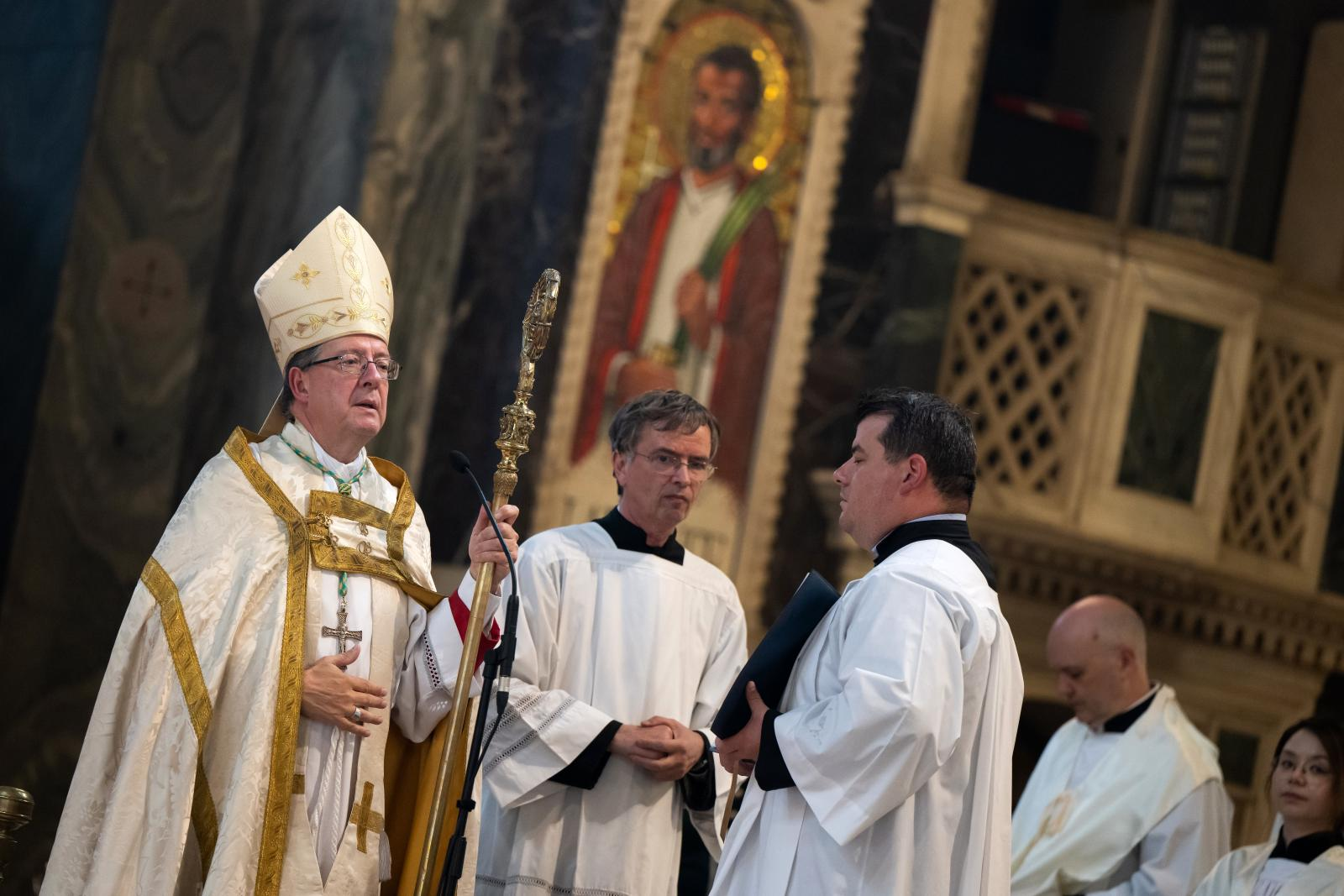
Bishop John Sherrington at Westminster Cathedral Photo: RCDOW

Source: CBCEW

His Holiness Pope Francis has appointed Bishop John Sherrington as Archbishop of Liverpool.

Ordained as a priest for the Diocese of Nottingham on 13 June 1987, Bishop Sherrington has been an Auxiliary Bishop of Westminster and Titular Bishop of Hilta since 14 September 2011.

Archbishop-elect Sherrington will become the tenth Archbishop of Liverpool in succession to Archbishop Malcolm McMahon OP, who has been Archbishop of Liverpool since 2014.

His Installation will take place in the Metropolitan Cathedral of Christ the King on Tuesday, 27 May at 12 noon.

Archbishop Malcolm McMahon OP said: “I am grateful to God and to the Holy Father, Pope Francis, for appointing a bishop to serve this local church, the Archdiocese of Liverpool. We are receiving a new Archbishop with considerable gifts, talents and skills, but most of all we are receiving a man of deep prayer who loves the Lord Jesus and who loves His Church. I have had the pleasure to serve with Archbishop-elect Sherrington in the Diocese of Nottingham and in the Catholic Bishops’ Conference of England and Wales and I am delighted to welcome him today.”

On hearing of his appointment, Archbishop-elect Sherrington said: “I thank Pope Francis for his trust in me on my appointment as Archbishop of Liverpool which I accept with humility and joy. We pray for our Holy Father at this time of sickness as he recuperates and prepares for Holy Week and Easter.

“I look forward to serving as shepherd of the historic and faith-filled Church in the Archdiocese of Liverpool which is rich in its heritage of the English martyrs, Irish immigration, and now looks to the future.

“Archbishop Malcolm McMahon OP has served Liverpool Archdiocese with love and generosity, and I am honoured to succeed him… I look forward to building on the foundations already laid in the synodal pastoral plan ‘Together on the Road’ to serve the Church and bring the hope and joy of Jesus Christ to all people.

“In this Jubilee Year, we are a people living the hope of Christ who has loved us, saved us and walks with us. We share this hope with other Christians and people of all faiths and good will. I welcome meeting and building friendships with leaders, both Christian and of other faiths, which has always been a strong dimension of the Church here.

“May we receive the fire of the Holy Spirit into our hearts to bring Christ to others.”

Cardinal Vincent Nichols, said about the appointment: “Those who have been following reports on the health of the Holy Father and keeping him in their prayers will know that he has continued his work, including the appointment of bishops.

“I am so pleased that he has appointed our Bishop John Sherrington to be the next Archbishop of Liverpool. Liverpool is, of course, my home diocese and I am delighted that it is to be led by Bishop John.

“In Westminster we know his gifts, dedication and utter generosity only too well. We will miss him greatly. Archbishop Malcolm will welcome him with great joy as, I’m sure, will everyone across the extensive Archdiocese of Liverpool.

“Today we offer our profound thanks to Bishop John for all that he has given to us over these last fourteen years, and we assure him, wholeheartedly, of our prayers and constant support.

“And, of course, we continue to hold Pope Francis very much in our prayers, too.”

Bishop John Sherrington was born in Leicester on 5 January 1958. Before entering the seminary, he graduated with a BA in mathematics from Queens’ College, Cambridge, where St John Fisher was once President. Upon graduation, he worked for a short period in management consultancy. Having been ordained a priest for the Diocese of Nottingham in 1987, and after a short period in a parish, he then completed an STL in Moral Theology at the Gregorian University, Rome.

He lectured in moral theology at All Hallows College, Dublin and St John’s Seminary, Wonersh where he was also a member of the formation staff, before serving as a parish priest from 2004-2011.

Bishop Sherrington was ordained as an Auxiliary Bishop of Westminster and Titular Bishop of Hilta on 14 September 2011 by the then-Archbishop Vincent Nichols, the co-consecrators being Cardinal Cormac Murphy-O’Connor and the then-Bishop Malcolm McMahon of Nottingham.

He has responsibility for the pastoral care of the parishes and deaneries of North London and is Moderator of the Curia and a Trustee of the Diocese. He is Chair of the Governing Body of Mater Ecclesiae College.

He served on the Methodist Roman Catholic International Commission (MERCIC) for ten years and was Co-Chair for five years. He was also, for some years, a Trustee of CAFOD which gave him further insight into the international mission of the Church.

Within the Catholic Bishops’ Conference of England and Wales, he is a member of the Department for Social Justice with responsibility for life issues since 2014, and a member of the Education Department since 2022. He is a member of the governing body of the Anscombe Centre, Oxford, and a Trustee of the Hospital of St John and St Elizabeth.

Internationally, he is a member of the Overseas Seminary Committee. He is also a Trustee of the Pontifical Beda College and Venerable English College in Rome, and a Trustee of the Royal English College in Valladolid, Spain.

Reflection on the Ministry of Archbishop Elect John Sherrington

Bishop Nicholas Hudson in the Holy Land

Source: CBCEW

Having touched down in the Holy Land to the news that a ceasefire had been brokered between Hamas and Israel in Gaza to come into effect from Sunday, 19 January, Bishop Nicholas Hudson greeted the news with cautious optimism.

On his first day in the Holy Land, Bishop Hudson, moderator of the annual Holy Land Co-ordination meeting, brought his prayers for a lasting and sustained peace to the Church of the Nativity in Bethlehem.

“It was a sad privilege, in a way, to go down into the grotto where Christ came into the world over 2,000 years ago, but it offered the consolation that we were able to pray deeply.

“I prayed there for peace, and as I knelt before the star – the star of hope that marks the place of Jesus’s birth – I prayed so deeply to the Prince of Peace that He might help this ceasefire to hold… I prayed as well for the families on either side that they might be reunited. I prayed that aid might now be allowed to flow into Gaza – poor, beleaguered Gaza – and that people on both sides of the conflict might now be able to rebuild their lives.”

The Holy Land Coordination, organised by the Catholic Bishops’ Conference of England and Wales through its Department for International Affairs, is an annual meeting of bishops from around the world that is defined by four Ps – presence, prayer, pilgrimage, and pressure. Bishop James Curry, an auxiliary Bishop of Westminster, is joining the group for the first time. The Co-ordination runs from 18-23 January.

On Thursday, Bishop Hudson and Bishop Curry alongside staff from the Bishops’ Conference, visited two projects in Bethlehem. The first stop was St Martha’s House, a day-care centre for elderly Christian ladies, mostly widows, who enjoy companionship and therapies provided by specialist staff and volunteers, including healthcare checks, haircare, podiatry, arts and crafts, and more. The group were the first visitors since October 2023 and there were smiles, tears and even dancing – almost a distraction from the suffering and difficulties that had come before.

Bishop Hudson led a small group to visit the Bethlehem Care and Hospice Trust, a Catholic charity registered in England and Wales, and Scotland, set up to bring compassionate care to those with life-limiting illness in the West Bank.

“The Bethlehem Care and Hospice Trust is a wonderful Christian initiative, with a number of Muslim volunteers and staff coming alongside them in their care for those who have terminal illnesses. It’s a model of palliative care, which I describe a bit like ‘hospice at home’, because it’s our hospice model from Western Europe adapted to a Middle East conviction that people who have terminal illnesses should be able to be looked after at home right until they die.

“We met the palliative team and went out with them to two different families to visit two elderly people who were dying, and I was able to bless them.”

Bishop Hudson’s final observation focussed on the obvious lack of pilgrims on the streets of both Jerusalem and Bethlehem:

“It brought home to me how hard it has been for places like Bethlehem these last 15 months, to not have pilgrims come to be with them, to not be able to support them economically – whether in cafés or shops – or to support St Martha’s House, or the hospice team. They were all saying the same thing, ‘You’re the first people who have come for such a long time. Thank you for coming. We need you to come more often.’ In a sense, it touched on one of our other Ps, the ‘P’ of pilgrimage, which we’ll be talking about more often during this Holy Land Co-ordination. We need to find ways of coming to be ‘present’ on pilgrimage now in the Holy Land – especially now that the ceasefire has been signed.”

The Catholic Ordinaries of the Holy Land, the local Church leaders, issued a declaration on the ceasefire in Gaza on 16 January 2025.

Hope, Humility, Trust – Bishop Nicholas reports from the Synod

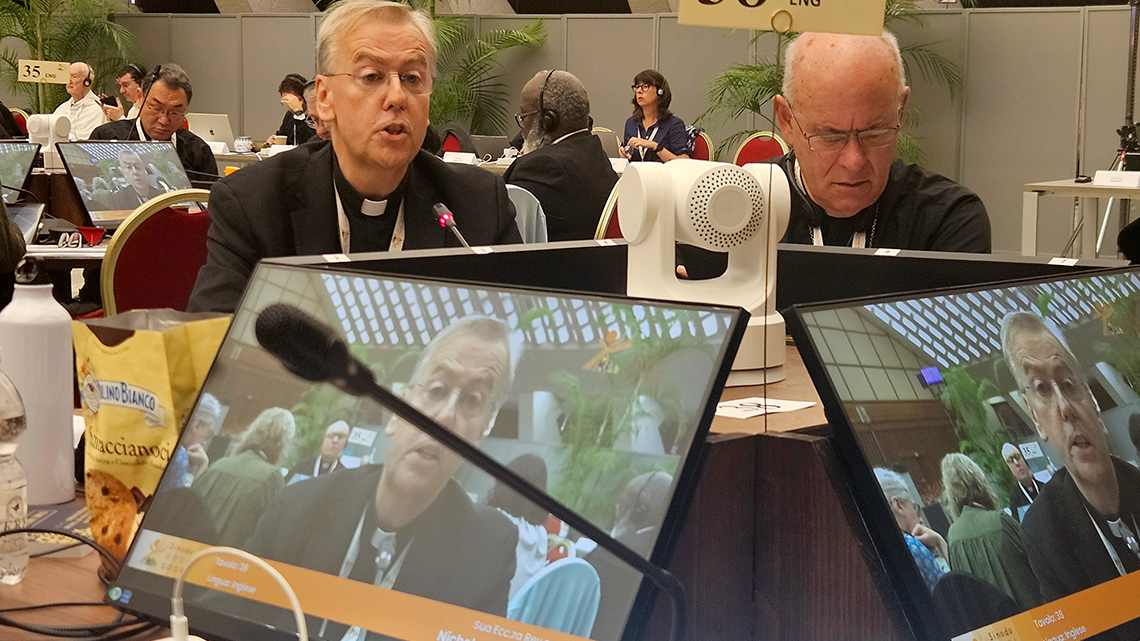
Bishop Nicholas at the Synod. ©synod.va/Lagarica

Source: RCDOW

We stand at the half-way point of the Second Assembly of the Synod of Bishops in Rome that is exploring ‘Synodality’, how the Catholic Church can be a missionary synodal Church in our times.

Bishop Nicholas Hudson, who was chosen by Pope Francis to be a Synod member, has sent back a fascinating insight on proceedings as the Synod enters its latter stages.

The Holy Father’s eyes lit up brightly when I told him about our online meeting for priests. 120 priests from across England and Wales had come together with Archbishop Wilson, Bishop Stock and me just before our departure for the Synod. This was to hear the reports of two priests, Fr Marcus Holden and Fr Anthony Rosso, who had attended a meeting recently at Sacrofano near Rome for priests from around the world to share perspectives on synodality. Pope Francis had asked that, on their return, priests come together from across our countries to share the fruits of this gathering. He was so pleased to hear we had achieved this!

Empower parishes to be synodal
I detected, in that meeting of priests, an openness to synodality; a desire to know how we can begin to be more synodal in our parishes, which is precisely the focus of our Synod. We have been asking, for two weeks now, how we can be a missionary Synodal Church. There is a strong sense in the Synod Hall that, at the end of this Assembly, we shall be wishing to communicate something which will be easy to comprehend; and able to empower parishes to embark on a more synodal approach.

It has been a fascinating journey already. We gathered first in retreat, led by the newly-named Cardinal, Fr Timothy Radcliffe OP. He urged us in this Synod to be above all good listeners. Echoing Paul, that ‘faith is born of listening’ (Romans 10, 7), he suggested we should listen in order not so much to reply as to learn.

The centrality of salvation
As we came together for the first experience of round-table sharing, it was moving to listen to one another recalling the fruits that had been harvested from last year’s session. These had been gathered up comprehensively in the ‘Foundations’ section of the Instrumentum Laboris, the working document which guides our journey. They included the centrality of salvation, which Fr Marcus had pointed out at Sacrofano to be missing from the report of last October’s Assembly, and which I was pleased to find mentioned frequently in this ‘Foundations’ section of the working document, a measure of how the creators of the Synod had listened to the priests. We recalled, in those first few days, major insights yielded by last year’s Assembly, insights into coresponsibility, the importance of including laypeople in discernment at all levels of the Church, the gift to the Church of Conversation in the Spirit, and so much more.

Collaboration between lay and ordained
Soon we found ourselves in the groups to which we would belong for a fortnight to navigate together the process of the Synod proper. My table has been facilitated impressively by a female lecturer from Australia, the group comprising: two other women, one from Jordan, the other, Sr Nathalie Becquart XMCJ, French Undersecretary of the Synod of Bishops; Cardinal Roche, and bishops from the US, Kyiv, South Sudan, Nigeria, and Pakistan; with a German Presbyterian minister as our ‘fraternal delegate’. I find myself recalling often the words of Pope Francis in his opening address, when he said the presence of so many committed laypeople emphasises the need for collaboration between lay and ordained.

Deepening of perspectives and friendships
It has been extraordinarily stimulating in this group to navigate together the three major sections, on ‘Relationships’, ‘Means’ and ‘Contexts’. The fact that we remain in the same group for all three modules is a development from last year; and has been deepening of both perspectives and friendships. I marvel at the breadth of Church experience represented at my table! It is a feeling I found well captured in the very first pages of the working document which describes a synodal Church as ‘a pilgrim people in every part of the world seeking synodal conversion for the sake of mission.’ It conjures up our table wonderfully!

Our consideration of ‘Relationships’ majored on the Trinitarian foundation of discipleship in baptism; that communion is for mission, initiation for mission. Discussion of the sharing of gifts between churches who share communion with us and with other ecclesial communities also yielded a sense of a deeply shared mission which we hold in common. Listening to one another’s understanding about the ‘Means’ by which to realise this mission was dominated by Formation.

Bishop Hudson’s intervention
In my intervention, I pointed out that the word ‘Evangelisation’ is entirely absent from the document; and yet a synodal Church must have the New Evangelisation at its core. I suggested Conversations in the Spirit might be understood as a most timely strategy for realising the call of successive popes for synodal conversation, not only among ourselves but also with members of other ecclesial communions, other faiths and people who profess no faith. Formation for this would be essential. Transparency and accountability also featured largely in the section.

Sharing perspectives, lastly, on ‘Contexts’ has yielded a striking sense that Church belonging is in many places no longer simply a matter of geography. The suggestion that the Church is ‘where we follow people to’ was brought home to me very movingly by the African Bishop in my group who said, ‘When the fishermen go hunting for fish, we follow them; when the miners abandon their village to pursue the goldrush, we go with them.’

The significance of digital media for evangelisation also featured highly. But there was a rootedness in our sharing too, an awareness that, where the Church is more stable, deep consideration needs to be given to how the diverse councils for discernment at our disposal might be made more synodal. We have yet to conclude the discussion of ‘Contexts’; and to see what it may continue to yield. Then we move back to our first groups to begin work on the document about which we shall vote. 

Hope, humility and trust
The Synod is a unique experience. It feels very much like a journey, a shared journey that we make together, much more a pilgrimage than a conference. It felt very pilgrimage-like to process, laypeople leading the bishops together into St Peter’s Square for the opening Mass; to celebrate a vigil of mercy, a penitential service, after our retreat; to come in prayer to the Basilica of St Mary Major on the eve of the anniversary of the 7th October Hamas terror attack in Israel to pray the rosary and all to fast the next day; to gather one evening on the site of St Peter’s martyrdom for an ecumenical vigil; and to meet for Mass in St Peter’s in diverse rites and languages across the month.

In his opening address, Pope Francis indeed chose to describe this journey as a ‘journey we make together with hope, humility and trust.’ Hope, humility and trust, these three words I have held onto and sought to aspire to; and find they capture wonderfully the spirit in which so many around me also seek to live this unique enterprise.

Bishops of Holy Land Co-ordination Call for Peace

Photo: Holy Family Church in Gaza (Mazur/CBCEW.org.uk)

Bishops of the Holy Land Coordination have issued a statement after two Christian women were killed in a sniper attack on the Holy Family Church compound in Gaza on 16th December 2023.

Holy Land Coordination Statement

The Bishops of the Holy Land Coordination were profoundly shocked and distressed at the killing by snipers on 16th December of two Christian women sheltering in the compound of the Holy Family church, Gaza. Messages were sent immediately to the Patriarch, His Eminence Cardinal Pierbattista Pizzaballa, and to the Parish Priest, Fr Gabriel Romanelli.

The Holy Land Coordination has been warmly welcomed by priests and parishioners on numerous occasions. We have witnessed firsthand the faith and commitment of the few parishioners who remain; and the dedicated care by the Missionaries of Charity of some fifty profoundly disabled people who live in the convent alongside the church.

The desecration of this compound and the destruction of the Sisters’ convent, ‘signalled’, according to the Patriarch, ‘as a place of worship since before the beginning of the war’, is profoundly disturbing. The shooting in cold blood of Nahida Anton and Samar Antoun, a mother and daughter seeking to enter the convent is unfathomable.

The Holy Land Coordination bishops represent a broad sweep of countries, each bishop committed to a just peace for all and to holding the plight of Christians of the Holy Land at the forefront of their governments’ concerns. We visit the Holy Land regularly to reassure these Christians that they are not forgotten. We seek also to understand better, and at first hand, the realities experienced by the people of three Abrahamic faiths sharing this Land; to fathom the possibility of hope in a two-state solution.

The atrocities perpetrated against Israeli Jews on 7th October and the subsequent killing by the Israeli Defence Force of nearly 20,000 Gazans, of whom 70% were women and children, would appear profoundly to jeopardise the prospects of any such resolution of this deep-seated conflict. Yet, the approaching celebration of Our Saviour’s birth two thousand years ago in the heart of the West Bank should serve as an incentive to people of faith, across the globe, to call down the Holy Spirit ever more fervently to move the hearts of all who can bring influence to bear on these lands and to find a way to cease the hostilities from all sides.

Bishop Nicholas Hudson (Chair of the Holy Land Coordination)
Auxiliary Bishop of Westminster
England and Wales

Bishop Nicolo Anselmi
Bishop of Rimini
Italy

Archbishop Udo Bentz
Archbishop-elect of Paderborn
Germany

Bishop Pierre Burcher
Bishop Emeritus of Reykjavik
Denmark, Finland, Iceland, Norway and Sweden

Bishop Christopher Chessun
Anglican Bishop of Southwark
Church of England

Bishop Michel Dubost
Bishop Emeritus of Evry-Corbeil-Essonnes
France

Archbishop Richard Gagnon
Archbishop of Winnipeg
Canada

Bishop William Kenney
Auxiliary Bishop Emeritus of Birmingham
England and Wales

Bishop Declan Lang
Bishop of Clifton
England and Wales

Bishop Donal McKeown
Bishop of Derry
Ireland

Archbishop William Nolan
Archbishop of Glasgow
Scotland

Archbishop Joan Enric Vives i Sicilia
Bishop of Urgell and Co-Prince of Andorra
Spain

Bishop Sithembele Sipuka    
Bishop of Mthatha
South Africa

Bishop Paul Terrio
Bishop Emeritus of St Paul
Canada

Since 1998, the Bishops’ Conference’s Department for International Affairs has organised the annual meeting of the Coordination of Episcopal Conferences in Support of the Church of the Holy Land.