Westminster Justice & Peace has two fully-funded free places to offer to young adults (18-35) at the forthcoming National Justice and Peace Network Conference, 25-27 July 2025.
In return, we invite you to help as a volunteer at the event with tasks such as running our stall at the Just Fair, stewarding or helping with music and liturgy.
The Conference is being held at the beautiful Hayes Conference Centre, Swanwick, Derbyshire, DE55 1AU
All expenses will be covered including conference fees, accommodation, meals and travel.
Applicants must live, work or worship within the Diocese of Westminster.
To apply – please send a short message to the Co-ordinator, Colette Joyce, giving your name, address, phone number and email address and a brief description of why you are interested in this opportunity. Short-listed applicants will be invited to an online interview. Email: colettejoyce@rcdow.org.uk
Closing Date: 2 July 2025
CONFERENCE INFORMATION
“War is a defeat for everyone” – Words of Pope Francis, quoted by Cardinal Giovanni Battista Re at His Holiness’ Requiem Mass on 26 April 2025.
“Peace be with all of you!” – The first words of Pope Leo XIV as he appeared on the balcony of St Peter’s in Rome having been just elected by the Conclave on 8 May 2025.
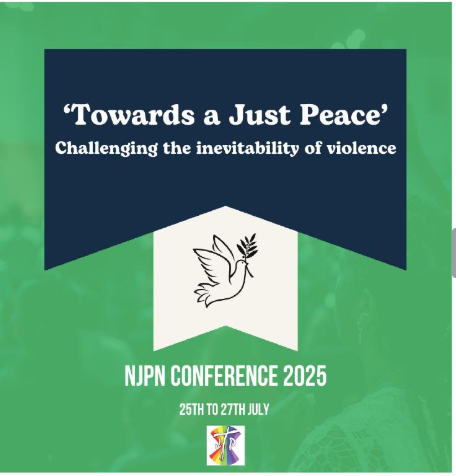
In this Jubilee Year, at a time of transition for the global Catholic community and great upheaval for the world, the National Justice and Peace Network invites you to our annual conference: ‘Towards a Just Peace – Challenging the Inevitability of Violence’
The weekend provides opportunities for networking and prayer with Catholics and others from across the country who share an interest in world peace and the promotion of social justice. There will be talks, workshops, prayer, a Just Fair with stalls from many different charities and organisations, and time for socialising.
Speakers this year include Dr Rowan Williams, former Archbishop of Canterbury, who will address the theme, and Dr Joanna Frew of Rethinking Security, who will explore what real security looks like today.
Workshop contributors include Richard Solly of Jesuit Missions and Ellen Teague of the Columban Justice, Peace and Ecology Team who will explore links between violence and environmental problems. Another workshop will listen to the voices of bereaved Israelis and Palestinians who are committed to working together for a Just Peace. Bokani Tshidzu of Operation Noah will explore ‘Investing in Peace through Climate Action.’ Quakers in Britain will look at how local interfaith and intercommunal relations in Britain are impacted by international conflicts.
NJPN says: “Journey with us this jubilee year as we open the doors to a just peace for current and future generations. Join us as we commit to taking restorative action to bring about peace and justice for migrants, or people living in poverty and inequality and for a world in climate crisis. We owe it to future generations to make this Jubilee permanent”.
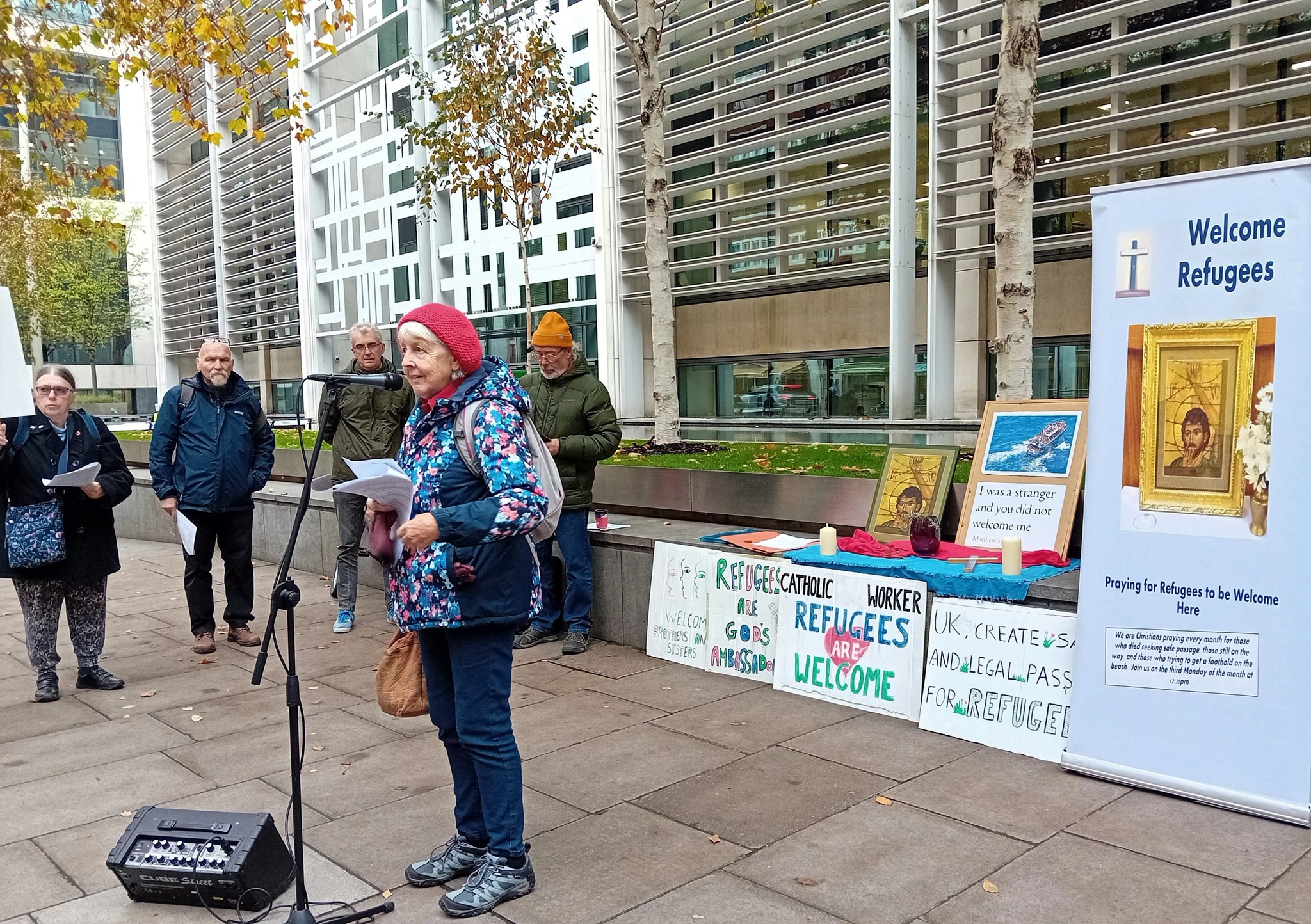
Monthly Prayer Vigil outside the Home Office – next Vigil 17 March 2025
Source: Ben Bano and Phil Kerton
According to the Pas-de-Calais prefecture, “in 2024, 77 people died trying to reach Great Britain aboard a small boat”, a record since the start in 2018 of the use of this means of crossing the Channel. According to British authorities, in 2024, 36,816 migrants managed to cross the Channel on boats, 25% more than in 2023.
According to the count of migrant aid associations, which also includes deaths on land, 89 exiles died on the coast of northern France in 2024. Support groups and political parties organised a march “for justice and dignity” in Calais recently to draw attention to these figures.
First deaths of 2025
The body of Abdul Raheem, a Yemeni aged around 24, was discovered on the morning of 22 January on the sand of Salines beach at Sangatte, facing England, where illegal boats regularly depart.
On the night of Friday to Saturday, 11 January, Suleiman, a Syrian migrant in his early twenties, died at Sangatte during an attempt to cross the Channel. He was one of about 60 people who left on a small boat, only to return very soon, soaked to the skin, leaving the victim on the floor of the boat in a state of cardio-respiratory arrest, probably crushed by the others.
In the early hours of 4 February, a Portuguese driver found the body of a migrant at the side of the A16 motorway near Calais. He was of Eritrean origin and had been hit by a truck.
The prefecture states that two people have been arrested as part of an investigation opened by the Boulogne public prosecutor’s office and entrusted to the office for combating illicit migrant trafficking.
Small boats
According to a 2024 report from the Global Initiative Against Transnational Organized Crime, there has been the rise in the use of ‘small hands’ – migrants who recruit others for the smuggling gangs, helping them to fill their boats. They recruit migrants of their own nationality or ethnicity and know the embarkation points from the beaches, working in groups to prepare and launch boats.
These middle men in the supply chain may charge for their service – a fee of between €1,000 and €1,500 for each boat that leaves the French shore. With up to four hands working on a boat, this is an additional cost for the smuggler of up to €6,000 (on condition that if the boat is intercepted no payment is made). The hands sometimes recruit a third person to act as ‘security’, for which they are paid €200 to €500, or a free passage on a boat after they have worked some shifts. The hands can make some extra cash by adding their own clients to the boats, increasing the overcrowding.
Some smugglers have developed low-cost options for poorer clients (for example, Sudanese and Eritreans), who are offered passage for around €1000. To make up the margins, smugglers may load the boats with more low-paying customers.
Allegedly, for those migrants, generally from sub-Saharan Africa, who cannot afford the crossing, even at a low fee, there is still hope in the shape of what are known in local jargon as ‘zig-zag’ brokers. For a fee of €100 to €400, these brokers take a migrant to a point on the coast where a boat is being prepared for launch, so that the migrant can attempt to board it, by force if necessary, without paying the fare. The migrants already on board often have little option but to comply.
The Vietnamese phenomenon
In recent months, more Vietnamese nationals have attempted to cross the Channel in small boats than any other nationality. Many wonder why so many risk their lives trying to reach Britain. On one hand, Vietnam is a rapidly growing economy, often referred to as “mini-China”. Over the past two decades, per capita income has increased eightfold and the country boasts beautiful landscapes and a vibrant culture, attracting tourists from around the world. Yet, despite these advancements, many Vietnamese feel a sense of “relative deprivation.”
The country is a one-party Communist state, where political dissent is not tolerated. While most Vietnamese have learned to navigate this system, the lack of political freedom and economic disparity between urban and rural areas drives many to seek opportunities abroad. Average wages remain low, especially in rural areas, where many workers lack job security.
The desire to migrate is deeply rooted in Vietnam’s history. In the 1970s and 1980s, many fled the country due to economic hardships and political repression. The shift in the economy in 1986, which opened Vietnam to global markets, fuelled a new wave of migration. The narrative of “catching up and getting rich” became prevalent, leading many to believe that success lay beyond their borders. Families pool resources to finance the migration of one member, hoping they will send money back home to improve living standards. This cycle perpetuates the desire to leave, even as the risks grow.
Events in Calais
Despite the hardcore survival conditions with storms and negative temperatures, the ‘Severe Cold Plan’ hangar was only open to take in people from the street for 15 nights. Furthermore, they have to take a bus to get there and must be gone by 9am sharp the next morning. When it is unoccupied (i.e. almost the rest of the year) the hangar is closed and monitored.
Harassment and evictions remain the norm. Every 48 hours, four to seven living spaces are cleared without a legal framework. People are arrested and tents, tarpaulins and personal belongings regularly stolen.
The ‘BMX Site’ near the Town Hall has been fenced off and cleared by order of the town council which has also requested the “evacuation” of migrants surviving under two bridges and on two quays. Likewise, the ‘Fontinettes’ camp has been cleared and fenced off to prevent people from resettling. Witnesses say that police turn up every morning in Black Mercedes, using batons to wake up and arrest people in tents.
Vocabulary in the UK
The word “illegal” has been one of the terms most strongly associated with migrants in UK parliamentary debates over the past 25 years, research by the Runnymede Trust has found.
After Theresa May’s 2012 pledge to “create a hostile environment for illegal immigrants”, media coverage containing hostile rhetoric around migration and migrants more than doubled (a 137% increase) compared with the two years before.
It seems plausible that the acceptance of such language may have supported growth in racial unrest, especially given a scarcity of well-presented factual media accounts that speak well of migrants.
Ben Bano writes:
The demonisation continues …
Have we lost all sense of proportion? Have we been infected by ‘Trumpism’? Across Europe migrants and refugees are seen as a threat to civil order and anyone who does not have a white skin is suspect. The narrative fostered by Angela Merkel has given way to something much more sinister which conflates migration with a threat to our society – never mind the fact that our care homes and farms would be severely affected by reductions in migration. We need to put a halt to the point scoring between the two major parties on who can do better on halting migration.
And can we find ways of being prophets of hope in responding to these events, as major parts of the world are affected by climate change, war, and much else? Those of us who are activists need to continue to speak out about the tragic effects of climate change which is an existential threat to so many, particularly in Africa. A recent estimate by the UN suggested that 420 million people are affected by climate change, drought, and war. The latest news from Goma in the Democratic Republic of Congo suggests that another tide of displaced people is very possible, adding to the millions who are seeking refuge from Syria, Sudan, and other war zones and areas of unrest.
We need to talk about global citizenship and our responsibilities to help those around us, not least to our MPs. In terms of awareness raising of the issues I fear that we are going backwards at a time when Trumpism and allied ideologies are making too much headway.
A Vigil sponsored by Westminster Justice and Peace, London Catholic Worker and the London Churches Refugee Fund, is held outside the Home Office from 12.30pm-1.30pm, 2 Marsham St SW1, on the third Monday of each month to pray for migrants who have died attempting to reach England. The next one will be on 17 March 2025.
Cardinal Nichols has called the way in which the assisted suicide bill is being handled ‘deeply irresponsible’ and a ‘shambles’.
Speaking to Christian Fellowship, a group at News UK, the Cardinal expressed serious concern that MPs had only spent a few hours debating assisted suicide when they spent more than a hundred times longer debating banning fox hunting in 2004.
He said:
‘I believe it is deeply irresponsible of any government to allow a change of this magnitude to be carried out without due, proper, government-supported parliamentary process’.
‘I think what’s happening, if it came to pass, would be the biggest change that this country has seen for many, many decades at least, probably more. On the back of what – five, six, seven hours’ debate?
‘I was told that the fox hunting bill [in 2004] endured 700 hours of debate.’
Despite these concerns, he hoped that the bill could still be defeated as it makes it way through the Houses of Parliament: ‘I don’t think that story’s over yet.’
The Hunting Act 2004 passed after 700 hours of parliamentary debate and a government inquiry – the Terminally Ill Adults (End of Life) bill, passed on November 29 by 330 to 275 last year after five hours of debate.
Cardinal Nichols added that there was ‘something deeply lacking in a government that isn’t prepared to guide and sponsor,if it wants to, this process of legal change’.
In October last year, Cardinal Nichols issued a pastoral letter to his diocese, encouraging Catholics to contact their MPs ahead of the debate.
In it, he raised concerns: ‘the right to die can become a duty to die’.
He said:
‘Once assisted suicide is approved by the law, a key protection of human life falls away. Pressure mounts on those who are nearing death, from others or even from themselves, to end their life in order to take away a perceived burden of care from their family, for the avoidance of pain, or for the sake of an inheritance.’
‘The radical change in the law now being proposed risks bringing about for all medical professionals a slow change from a duty to care to a duty to kill.’
The evening of 14th November 2024 saw the third Diocese of Westminster ‘Love in Action’ Volunteering Awards, hosted by Caritas Westminster in Westminster Cathedral Hall. The event recognised volunteers from across the diocese for outstanding commitment to voluntary service, with finalists selected from a pool of over 60 nominations.
The ceremony opened with a welcome from Cardinal Vincent Nichols and Richard Harries, Director of Caritas Westminster, and included a speech by previous award-winner, Sharon Joseph.
Awards were distributed by Bishop Paul McAleenan, Chair of Caritas Westminster, with finalists, their nominators, family and friends joined by staff and supporters of Caritas Westminster.
The five categories recognised individuals and groups of volunteers who serve in a variety of contexts; from social action initiatives in parishes and schools to young volunteers, lifetime achievement and fulfilling a range of tasks for their communities.
Addressing the finalists, Bishop Paul said: ‘This evening is an acknowledgment of your achievements, and an affirmation of everything that you do. Thank you to all the participants for your great generosity in reaching out to others, and for bringing your goodness into the world.’
Winners included primary school students who participated in the Caritas Ambassadors programme, Sixth Form pupils involved in student chaplaincy, long-serving parishioners who are the backbone of their communities, and two projects founded during the pandemic to support the homeless and vulnerable.
The Young Volunteer of the Year Award went to Kai Shah, who at just 11 years old has already shown great dedication to preparing meals for and serving the homeless. This year’s Lifetime Achievement Award was named after Ernest Bernard Ronald Palmer, who volunteered at Caritas St Joseph’s for almost 40 years until the age of 103. The award was given to Mary Foster, for 50 years of service to her parish and for co-founding the charity Acton Homeless Concern.
‘Volunteers bring to life the Church’s teaching on the ministry of charity, and it is a privilege for Caritas Westminster to celebrate the efforts of parishioners who have gone the extra mile in loving their neighbours,’ said Richard Harries. ‘This year’s finalists are wonderful examples of love in action, and we are excited to support them and thousands of other social action volunteers across the diocese in the coming year.’
Meet the winners for each category here, or read about all of this year’s finalists here.


 Diocese of Westminster Justice and Peace Commission