Brother Johannes Maertens gave the following reflection at the Vigil for Migrants outside the Home Office on 21 July 2025:
Reading: Luke 10:25–37 – The Parable of the Good Samaritan
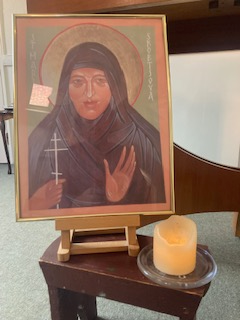
This year marks 80 years since the death of Mother Maria Skobtsova. The Church Times recently referred to her as an “eccentric, chain-smoking poet, monastic, and martyr” “whose theology—grounded in the dual command to love both God and neighbour”—remains startlingly relevant. And perhaps more urgently needed than ever.
In recent years, certain voices—some from pulpits, some from platforms of global influence—have begun to portray empathy as a liability. In 2018, an American pastor published a book titled The Sin of Empathy, describing compassion as potentially morally dangerous. Others have called mercy weak. More recently, tech billionaire Elon Musk described empathy as the “fundamental weakness of Western civilisation,” even criticising Germany’s funding of refugee rescue efforts in the Mediterranean. In response, Germany’s Foreign Office simply said: “Yes. And it’s called saving lives.”
Compassion, empathy… What most of us would consider a fundamental strength—a binding force in our cultures—is now labeled a threat by those in power. And these are not random comments. They are part of a wider push to redefine the moral imagination of society.
But contrast that with the Gospel— and our Gospel reading today —and the very life of Mother Maria Skobtsova.
The parable of the Good Samaritan reframes what it means to be a neighbour—not by nationality, proximity, or religious allegiance, but by mercy. “Who was neighbour to the man?” Jesus asks. And the answer is clear: “The one who showed him compassion.” Jesus, doesn’t answer the question “Who is your neighbour” – he tells you more how you would hope your neighbour is – and then Jesus says: “Go and do likewise.”
This command sits at the heart of Mother Maria Skobtsova’s radical theology. What she called “the sacrament of the brother.” She wrote: “Give from the heart, since each person is the very icon of God incarnate in the world.”
Let that sink in. Every human being—no matter how broken or marginalised—is an icon of Christ. For Mother Skobtsova, every encounter with another person becomes a kind of opportunity to be liturgy. She imagined the whole world as one altar. And to this altar, we offer not only bread and wine, but our hearts—so that they might be transformed into Christ’s love. A “kenotic love”—a love that empties itself.
In this vision, compassion is not weakness. It is sacrament. Mercy is not naive. It is resurrection.
She didn’t separate the altar from the street, the Eucharist from the soup kitchen, or the refugee-boats from the chalice. She saw Christ there—broken, waiting—and she responded.
When the Nazis invaded Paris, Mother Maria didn’t ask whether hiding Jewish children was politically wise. She saw the face of Christ and acted. And it cost her everything, she died in the Ravenbrouck concentration camp, where she was gazed to death around Easter 1945.
So we must ask: what do we see today?
Across the Mediterranean, in the English Channel, across borders, people are crossing treacherous waters in small inflatable boats. Fleeing war, persecution, and poverty. They too lie wounded along the road to Jericho. And we—we are the passers-by. The priests. The Levites.
We scroll past their faces. Hear their statistics. Debate their fate. But the Gospel doesn’t ask who deserves to be saved. It asks: Who will show compassion?
To offer mercy is to meet Christ. To bind a wound is to celebrate Eucharist. To open a door is to open heaven. This is not sentimental. It is spiritual courage.
So when we see a migrant in crisis, a stranger at the door, an outcast in pain—we must not pass by. We must be moved with compassion. Not because it’s trendy, or convenient. But because Christ is there.
Broken. Waiting.
And that is why we stand here today. In prayer. In solidarity. And in hope—for a more compassionate future, together.
Amen.
“But if at the center of the Church’s life there is this self-giving Eucharistic love, then where are the Church’s boundaries, where is the periphery of this center? Here it is possible to speak of the whole of Christianity as an eternal offering of a Divine Liturgy beyond church walls … It means that we must offer the bloodless sacrifice, the sacrifice of self-surrendering love not only in a specific place, upon the altar of a particular temple; the whole world becomes the single altar of a single temple, and for this universal liturgy we must offer our hearts, like bread and wine, in order that they may be transformed into Christ’s love, that he may be born in them, that they may become “God-manly” hearts, and that He may give these hearts of ours as food for the world…” ” (Mother Maria Skobtsova, Selected Writings, ed. Jim Forest, Chapter on Types of Monasticism, page 185)
Bishop Jim Curry is an auxiliary bishop in the Diocese of Westminster
Bishop Jim Curry, the Lead Bishop for the Holy Land for the Bishops’ Conference, has joined our former Middle East North Africa consultant, Dr Harry Hagopian, as a special guest on his monthly Middle East Analysis podcast. Contributing to a discussion on Gaza, the West Bank and the wider region of the Holy Land, Bishop Curry said that when Christians pray for peace, it can be both supplication and a cry of protest.
“Obviously, the Christian always wants to pray, and we can’t just dismiss prayer as fanciful. Prayer is a cry of protest as well as supplication,” says Bishop Curry. “The fact that we can pray in our churches publicly for the situation in Palestine and Gaza, in the West Bank, that we remember our Christian brothers and sisters and the wider community is important. So we can’t ever dismiss it.”
Bishop Curry also spoke about the Christian presence in the Holy Land as foundational and a vital part of the rich tapestry of the region:
“One of our fundamental tenets is to go on pilgrimage, because these lands are holy to us, they are holy to the Jews, and to Muslims. Christians have been part of the mosaic of those lands for over 2,000 years, they belong there. They’re not interlopers. They’ve built schools, they’ve built churches, they’ve built communities. So going to visit them is important for us. When we last visited [for the Holy Land Coordination], we were able to visit Bethlehem, Beit Jala, where the Latin Patriarch has a seminary, Aboud, and Taybeh. We were able to show that they are not forgotten. But I’m always conscious that afterwards, we walk away. We walk away and leave communities to struggle with lack of access to jobs, to security, to freedom of movement.”
The Bishop also shared his first impressions of the Palestinian city Ramallah, the administrative capital, that he visited in January 2025 as part of the Holy Land Coordination meeting, organised by the Bishops’ Conference:
“I’d never been to Ramallah, and as I looked around as we entered the city I saw a peaceful, busy, bustling city with cafes and buses, restaurants and shops, and people about their business.
“It was a warm day, with a blue sky, and I thought ‘that’s what normality looks like’. People don’t run away from normality. We were asking ourselves, ‘what would normality look like?’ And there we saw it. Someone whispered into my ear, ‘You should have seen Gaza. It was bigger and more well-organised’. Now all we see are these images of rubble and people being displaced – hungry and frightened. I’d seen a different reality in Ramallah, a place that worked. I’m sure people complain about the services there, but I saw something different and it stayed with me.”
In the face of conflict, death, destruction and extreme hardship, Bishop Curry offers a suggestion to enable us to cling to a shard of hope:
“What can we do? We can go on advocating that normality is possible, that people can live well together. People want to live well together… Everywhere we went, we heard this plea, ‘We just want to live normal lives. We want jobs, we want our kids to go to school, we want them to be able to play their part in this land when they come back after university’. It still comes back to me, that image of what normality is. People don’t run away from normality.”
He reserved special praise and heart-felt prayers for the small Catholic community of the Church of the Holy Family in Gaza:
“They are giving a witness to the possibility that our despair can’t be the final word about the human situation. That little community there, the Holy Family in Gaza, they are a living sign that human beings can live together, and they can work together for each other’s good.”
Brendan Metcalfe, CEO of Friends of the Holy Land writes:
It has been a very painful Holy Week and Easter for our brothers and sisters in the Holy Land; so, we ask you to show you care and seek for an end to this escalating war by joining us online in an historic ecumenical service to pray for a lasting peace during this time of brokenness and conflict.
This special ecumenical service will take place in Temple Church, London, on Tuesday 20th May. The event will feature a simulcast broadcast from the Co-Cathedral of the Most Holy Name of Jesus in the Latin complex, Jerusalem. The service will commence at 12pm BST in London and 2pm IDT in Jerusalem.
“This event marks the 1700th anniversary of the opening day of the Council of Nicaea (325 AD) and will bring together Christian leaders and communities for a profound moment of unity and prayer for peace, during this time of brokenness and conflict.” The Revd Robin Griffith-Jones, Master of the Temple
His Beatitude Cardinal Pierbattista Pizzaballa will lead the service in Jerusalem along with Archbishop Hosam Naoum of the Episcopal Diocese of Jerusalem, with invitations extended to the other leaders in the Holy City. In London, Cardinal Vincent Nichols will lead along with Bishop Christopher Chessun, leaders from the Orthodox Churches and from Churches Together in England.
HB Cardinal Pizzaballa in his Easter Homily said: “Following Jesus, even in our difficult trials, is as compelling as it gets. So let us not forget that the Gospel speaks of an overturned stone. Therefore, even though there are so many problems and difficulties that beset us, let us affirm with serene confidence and clear determination that nothing keeps us trapped in our tombs, that we are a living Church that does not give up in the face of the stones that lie before us.”
Please share the online joining details with your friends and family so they will be able to join us on this special occasion. The service can be watched either live or within 48 hours.
Religious think-tank, Theos, has published an open letter signed by over 100 women from different faith traditions voicing significant concerns over the current proposed legislation for Assisted Dying.
We believe that the Terminally Ill Adults Bill has insufficient safeguards to protect some of the most vulnerable in society, particularly women subject to gender-based violence.
Colette Joyce, Justice and Peace Co-ordinator for the Diocese of Westminster, and Nikki Dhillon-Keane, Head of Safe in Faith for Caritas Westminster, are among the signatories.
We write as a group of women of faith from different traditions and backgrounds passionate about care for people in vulnerable situations, many of whom have dedicated our professional lives to preventing male violence against women and girls.
We hold a variety of views on the principle of legalising assisted dying. However, we are all clear that the current legislation – The Terminally Ill Adults Bill – progressing through parliament, has insufficient safeguards to protect some of the most marginalised in society, particularly women subjected to gender–based violence, and abuse by a partner, who also experience intersecting barriers to a full and safe life.
We are concerned that the proposed legislation could create a new tool to harm vulnerable women, particularly those being subjected to domestic abuse and coercive control, by helping them to end their lives.
A report out last month showed that the number of domestic abuse victims who died by suicide in England and Wales was higher than the number of people killed by their abusive partner, for the second year running.
We know too that domestic abuse victims who are also women of faith can face a particular form of abuse[1] at the hands of their perpetrators, who may weaponise theologies and culture to harm and control their victims. We are concerned that the assisted dying legislation, as it stands, fails to take account of how faith and its role at the end of life, as well as its use by both perpetrators and the women they abuse, create complex dynamics that can lead to vulnerable women, who may also hold strong religious beliefs, seeing no way out but death.
We know that poverty and other inequalities increase the risk of women and girls being subjected to violence, ill health and the quality of care and support they receive from statutory institutions and civil society. We know too that in a society riven with inequalities, women who are from Black and minoritised communities, disabled women, migrant women and working–class women, struggle to be heard. Their voices are absent from conversations about this bill, and so too are those subjective to coercive control or violence. It is unclear to us how the legislation and its consultative process has taken account of the multiplicity of faiths, cultures, socio–economic and health backgrounds of our citizens and women who make up our country.
Much of the debate inside and outside parliament has been conducted by those empowered to speak of the importance of personal choice, without consideration of those who struggle to be heard in the public square. It is the voices of the unheard, ignored, and marginalised that we are compelled by our faith traditions and scriptures to listen and draw attention to, in the pursuit of good law–making for the common good – legislation that considers and protects the most vulnerable, not just those who speak loudest.
Having followed the progress of the bill through parliament, we are particularly concerned about:
The risk that people (mainly women) with controlling and abusive partners (mainly men) will be coerced into assisted death. While we welcome the adopted amendments that stipulate training for the assessing doctors and the panel members, this safeguard only comes into play after someone has already been coerced into declaring that they want an assisted death, and will clearly not catch all cases. We also know, from research and experience, that coercive control is a long–term process that is both insidious and subtle with women often unaware of it until the perpetrator’s behaviour escalates.
The reality that since 2016, deaths by suicide have been included in the scope of domestic homicide reviews and there is growing research on women who die by suicide as directly linked to having an abusive partner. We are concerned that if this legislation passes, women may seek assisted deaths to end their suffering at the hands of an abuser. Domestic Homicide Reviews also reveal the disproportionate number of Black and minoritised women who are failed by statutory and state agencies like the police, social services, health services and specialist services like substance misuse and mental health and women’s services despite their calls for help.
There are no longer High Court protections embedded in the Bill
There are insufficient protections for those with learning disabilities and people with anorexia.
The use of the vehicle of the Private Member’s Bill for this landmark legislation. This has resulted in the impact assessment being shared after the Bill Committee stage, which makes it difficult for all of us with concerns about inequalities to gauge how this legislation will affect Black and minoritised and faith communities, people with disabilities, and those experiencing economic disadvantage.
If assisted dying is seen as a response to alleviate suffering, without addressing the underlying structural issues that make life difficult and safeguard against harm, it could put undue pressure on vulnerable women to choose death over inadequate care.
This is no way to legislate, especially not on matters of life and death. We have serious concerns about the bill and its lack of safeguards. The bill has too much potential to hurt vulnerable people and so we are uniting as women from across faith traditions to speak up for vulnerable women, including victims of violence against women and girls, and disabled women, and raise our concerns publicly.
Signatories:
Chine McDonald, director, Theos
Bekah Legg, CEO, Restored
Huda Jawad, co–founder and executive director, Faith and VAWG Coalition
Sam Clifford, CEO, Jewish Women’s Aid
The Rt Revd and Rt Hon Dame Sarah Mullally DBE, Bishop of London
Dr Naomi Green, Assistant Secretary General, Muslim Council of Britain
Professor Sheila The Baroness Hollins, President, The Catholic Union of Great Britain
Rabbi Debbie Young–Somers
Zara Mohammed, former secretary general, Muslim Council of Britain
Hannah Rich, director, Christians on the Left
Revd Dr Helen Paynter, founding director, Centre for the Study of Bible and Violence
Naomi Lerer, CEO, Noa Girls
Amanda Jackson, senior advisor on diversity, World Evangelical Alliance
The Rt Revd Rachel Treweek, Lord Bishop of Gloucester and Anglican Bishop for HM Prisons
Commissioner Jenine Main, Territorial Leader, The Salvation Army, United Kingdom and Ireland
Louisa Collyer–Hamlin, Head of External Affairs, Catholic Union
Patricia Stoat, Science Health & Bioethics Committee of the National Board of Catholic Women
Rt Revd Rose Hudson–Wilkin, Bishop of Dover
Dr Sahira Dar, president, British Islamic Medical Association
Rachel Fink, CEO, S&P Sephardi Jewish Community
Tola Doll Fisher, Creative Director and Editor, Premier Woman Alive
Elizabeth Harris Sawczenko, OBE, Interfaith consultant
Nikki Dhillon Keane, Head of Caritas Safe in Faith
Jagbir Jhutti–Johal, Professor of Sikh Studies, University of Birmingham
Professor Tina Beattie, Professor Emerita of Catholic Studies, University of Roehampton, London
The Rt Revd Dr Joanne Woolway Grenfell, Bishop of Stepney and Lead Safeguarding Bishop for the Church of England
Natalie Collins, author and activist
Sian Rees, head of Bible Society Wales
Rt Revd Dr Jill Duff, Anglican Bishop of Lancaster
The Rt Revd Vivienne Faull, Lord Bishop of Bristol
Rev Catherine De Souza, CEO, Prison Fellowship England & Wales
Sally Hope, Domestic Abuse Practitioner and Writer
Dr Selina Stone, Lecturer in Theology and Ethics, University of Edinburgh
Dawn McAvoy, Both Lives UK
Mandy Marshall, Director for Gender Justice, Anglican Alliance and Anglican Communion
Revd Jenni Entrican, Former President of the European Baptist Federation
Alicia Edmund, Head of public policy Evangelical Alliance
Dr Madeleine Pennington, Quaker writer and head of research, Theos
Rev Leonora Wassell, Co–Chair, Methodist Women in Britain
Rebecca (Bex) Chapman, General Synod member and vice–chair, Christians in Media
Debra Green OBE, CEO, ROC
Alice Gray, palliative care doctor and assistant pastor, Oasis Church, Birmingham
Ruth Parrott, former president and co–chair, Methodist Women in Britain
Shermara Fletcher–Hoyte, Principal Officer for Pentecostal, Charismatic and Multi–cultural Relations, Churches Together in England
Catherine Butcher, author, lay reader, and member of General Synod
Faith Van Horne, PhD, Theology and Religion, University of Birmingham
Jamie Phear, writer and speaker
Rachel Muers, Professor of Divinity, University of Edinburgh
Jayne Manfredi, Anglican Deacon
Katharine Lock
Rev Cham Kaur–Mann, Co–Director, Next Leadership
The Rt Revd Esther Prior, Bishop of Aston
Rev Dr Kate Coleman, Co–Director, Next Leadership
Rosemary Nuamah–Williams, policy Adviser and advocate
Jo Chamberlain, National Environment Officer, Church of England Environment Programme
Dr Usha Reifsnider, Co regional Director, Lausanne Europe, Cultural Theology Consultant
Lucy Butt, CEO, Bramber Bakehouse
Dr Janet Soskice, Professor of Philosophical Theology, Emeritus, University of Cambridge
Stella Mbubaegbu CBE, FE College Principal & Chief Executive
Mary McHugh, National Board of Catholic Women of England and Wales
Hope Virgo, author, campaigner and Secretariat for the APPG for Eating Disorders
Rev Bev Thomas Ecumenical Minister & Social Justice Advocate
Rev Claire McClelland, Head of Chaplaincy, Newcastle upon Tyne Hospitals
Rev Jenny Kimble, Dean of Undergraduate Studies, Regents Theological College
Rev. Michelle Nunn, Principal, Regents Theological College, and Member of Elim’s National Leadership Team
The Venerable Karen Best, Archdeacon of Manchester
Dr Anne Richards, Policy Adviser, Church of England
Revd Dr Hannah Lewis, Lead Chaplain among the Deaf Community, Diocese of Oxford
Janie Oliver, CEO, Stewardship
Dr Calida Chu, Associate Editor, Practical Theology
The Revd Jessica Monopoli, Assistant Curate, St Mary’s Cockerton, and Clergy Lead at The Haven in Darlington, Co. Durham
Bobbi Kumari, founder, Living in Light
Barbara Earl, Croydon Quakers
Danielle Finch, freelance writer (disability, family & faith)
Rev. Rebecca Amoroso, Hospital Chaplain
Christina Mottram, retired lay Catholic hospital chaplain, Leicester Hospitals
Salomé Criddle, CEO, Thriving Women In Real Life
Revd Dr Joanne Cox– Darling, Methodist presbyter
Anupama Ranawana, Postdoctoral Researcher, Department of Theology and Religion, University of Durham
Danielle Wilson, Pioneer Pastor, Birmingham
Dr Claire Williams OMS, Lecturer in Practical Theology, Academic Inclusion Advocate, Regents Theological College
Reverend Joyce Fletcher, National Executive Director of Women and Family for the Church of God of Prophecy
Dionne Gravesande, trustee of Restored and co–chair, National Church Leader Forum
Dr Beverley Samways, Director, Unique Connections
Alianore Smith, member of the General Synod of the Church of England
Revd Novette Headley, Chair – Birmingham Methodist District
Colette Joyce, co–ordinator, Justice and Peace Commission, Diocese of Westminster
The Revd. Lis Goddard, vicar, St James the Less Pimlico
Doreen Patricia Waugh, domestic abuse practitioner, Justice and peace representative
Rev. Sarah Whittleston, National Elim Prayer Director
Dr Eve Poole OBE Lay Canon, York Minster
Revd Alexandra Lilley, Vicar, St George and All Saints Tufnell Park and Dean of Women’s Ministry
Michelle Dumont
Revd. Canon Kate Wharton, Vicar of St. Bartholomew’s Church, Roby, Liverpool, General Synod member, and Prolocutor of the Lower House of the Convocation of York.
Rani Joshi – South Asian Forum coordinator / Evangelical Alliance
Baroness Shaista Gohir – CEO, Muslim Women’s Network UK
This initiative follows a meeting organised in partnership with the Faith and Violence Against Women and Girls Coalition, and Restored, facilitated by Jewish Women’s Aid, and brought together by Theos.
London Catholic Worker members at the 17 March 2025 Home Office Vigil. Photo: LCW
The regular monthly Home Office Vigil was held on 17 March 2025, to commemorate the thousands of refugees who have died, trying to reach a place of safety in Europe.
Barbara Kentish writes:
We heard today from a brother who simply asks the international community for a humanitarian system, a recognition that ordinary people are destroyed in the current world order. And we heard from the gospel reading Jesus’s simple message – Be compassionate, as your heavenly Father is compassionate. Give and it will be given back to you.
How do we keep on being compassionate, calling for compassion, giving compassion in this broken world? I want to share an experience I had recently which struck a chord, and showed me one or two ways we manage to keep on feeling and showing this compassion.
A week ago we celebrated International Women’s Day, and I was asked to talk about our Home Office Vigil from a women’s perspective, which I found difficult, as the people we commemorate are women and men, probably more of the latter. And the people who come to pray are women and men. Reading through the months of stories for inspiration, however, I did come across stories such as this one that we read a few months ago, which seems very immediate, because it is one woman, and she is named, as is her child:
A mother and baby from Senegal, both called Touré, died on a boat adrift for over a week in the Mediterranean. A bag containing the baby’s food fell into the sea, and he starved to death. His mother died from exhaustion and grief. Their bodies were thrown into the sea. What an agony for that mother.
There seem to be more women recorded amongst the deaths of those travelling from Senegal via the Canary islands. Maybe this is a recent trend. Women travelling are nearly always more vulnerable than the men. Such desperation, to make them take to the boats. But to think of one example, one woman, one baby, brings home an immediacy that numbers can blunt. A name, a person.
In my Women’s day celebrations I met women involved in craft work, whether art, knitting or weaving. This resonated with me, as I love making things: I do lots of crochet work, making jumpers or cardigans. Creative work really restores the soul in some way, even though most of the finished products will never be seen in any art galleries. It’s our need to contribute something to the world, to celebrate the beauty around us. How do we create beauty in this broken asylum system, where so many lives are ground down or simply damaged? We create together, we cook together, we sing together. We make beauty. And that is where God gives back, a hundredfold, pressed down and running over.
I am going to read a poem by a Lutheran minister that was read at my gathering on International Women’s Day. It’s called ……
To Weavers Everywhere
God sits weeping The beautiful creation tapestry She wove with such joy Is mutilated, torn into shreds, Reduced to rags, Its beauty fragmented by force.
God sits weeping. But look! She is gathering up the shreds To weave something new.
She gathers The rags of hard work Attempts at advocacy, Initiatives for peace, Protests against injustice, All the seemingly little and weak Words and deeds offered Sacrificially In hope, in faith, in love.
And look! She is weaving them all With golden threads of Jubilation Into a new tapestry, A creation richer, more beautiful Than the old one was!
God sits weaving Patiently, persistently, With a smile that Radiates like a rainbow On her tear-streaked face.
And She invites us Not on1y to keep offering her the Shreds and rags of our suffering And our work,
But even more – To take our place beside Her At the Jubilee Loom, And weave with her The tapestry of the New Creation.
Marchiena Rienstra (Presbyterian minister and poet)
More Information
Monthly Memorial Prayer Vigil for Refugees and Asylum-Seekers On the 3rd Monday of every month outside the Home Office, SW1P 4DF, 12:30pm to 1:30pm
A consortium of charities are today warning that that high debt servicing costs are preventing Global South governments from spending on vital public services such as education and health and making investments to limit the impact of the climate emergency. Thirty-two African countries spend more on paying external debts than they do on healthcare.
UK charities including CAFOD, Christian Aid, Save the Children, Debt Justice and the international development network, Bond, are gathering outside the UK Treasury to launch a campaign calling for a debt cancellation initiative in the Jubilee year of 2025.
Debt payments for lower-income countries are at the highest level in 30 years. Private lenders are the largest group of creditors, with many based in the UK, and 90% of their contracts are governed by English law.
The campaign is calling on the UK government to champion major improvements to the debt cancellation process for lower-income countries, including legislating to ensure banks, hedge funds and oil traders participate.
In a joint statement, the charities say:
“We welcome the fact the UK government has made “tackling unsustainable debt” a major priority. However, this will not happen through business as usual but requires a complete change in the UK approach.”
The campaign calls on the UK government to:
“Champion a debt cancellation scheme that brings debt payments down to a genuinely sustainable level” and to “Pass legislation to ensure all private lenders participate in debt cancellation and suspend repayments to private lenders during debt cancellation negotiations.”
The South African government has made tackling the unsustainable debt crisis a key priority for its presidency of the G20 in 2025. 2025 is a Jubilee year in the Catholic Church, and Pope Francis has made achieving debt cancellation one of his key priorities for the year. World Bank Chief Economist Indermit Gill recently said:
“It’s time to face the reality: the poorest countries facing debt distress need debt relief if they are to have a shot at lasting prosperity… Sovereign borrowers deserve at least some of the protections that are routinely afforded to debt-strapped businesses and individuals under national bankruptcy laws. Private creditors that make risky, high-interest loans to poor countries ought to bear a fair share of the cost when the bet goes bad.”
Catholic development agencies CAFOD, SCIAF, and Caritas’ new report, Jubilee 2025: The New Global Debt Crisis and its Solutions, outlines the causes of cyclical global debt crises, the inadequacies in current global debt structures, and sets out six policies to build a fair and functional debt system.
LINKS
Debt Justice (formerly Jubilee Debt Campaign) is a UK charity working to end poverty caused by unjust debt through education, research and campaigning: https://debtjustice.org.uk/
Cardinal Vincent Nichols, Archbishop of Westminster, has co-signed a multi-faith letter ahead of the assisted suicide vote in parliament on Friday:
As leaders of faith communities we wish to express our concern at the Terminally Ill Adults (End of Life) bill, which will be debated by MPs on 29th November. We are aware of how complex and weighty this topic is. There are many dimensions to the bill, all of them of great ethical and practical importance. We hold in prayer all those across our country who may be personally affected, and our representatives in Parliament with profound decisions before them.
Part of the role of faith leaders in communities is to provide spiritual and pastoral care for the sick and for the dying. We hold the hands of loved ones in their final days, we pray with families both before and after death. It is to this vocation that we have been called, and it is from this vocation that we write.
Our pastoral roles make us deeply concerned about the impact the bill would have on the most vulnerable, opening up the possibility of life-threating abuse and coercion. This is a concern we know is shared by many people, with and without faith.
In the UK, it is estimated that 2.7 million older people have been subjected to abuse; many of these may also be vulnerable to pressure to end their lives prematurely. Disability campaigners and those working with women in abusive relationships have also highlighted the danger of unintended consequences should the law be changed. The experience of jurisdictions which have introduced similar legislation, such as Oregon and Canada, demonstrate how tragic these unintended consequences can be. Promised safeguards have not always protected the vulnerable and marginalised.
Even when surrounded by loving family and friends, people towards the end of their life can still feel like a burden. This is especially the case while adult social care remains underfunded. In this environment, it is easy to see how a ‘right to die’ could all too easily end in feeling you have a duty to die.
We are convinced that the current law provides much greater security for those who are vulnerable than the bill before Parliament. A bill which MPs will have had only three weeks to scrutinise before they vote on it. The most effective safeguard against life-threatening coercion or abuse is to keep the law as it is.
In supporting the state of the current law, we do not deny that some people experience a painful death, though we welcome the fact that these deaths are far less common than they used to be due to advances in palliative care.
Over decades we have witnessed how compassionate care, along with the natural processes of dying, allow those at the end of their life to experience important moments. We have seen relationships repair and families reconcile. We have seen lives end in love. Much can be lost by cutting these processes short.
We believe that a truly compassionate response to the end of life lies in the provision of high-quality palliative care services to all who need them. While there are many examples of excellent palliative care in this country, it remains worryingly underfunded. Investment in palliative care is the policy of a truly compassionate nation. It is the way to ensure that everyone in society, including the most vulnerable, receive the care they deserve at the end of life.
Sarah Mullally, Bishop of London and former Chief Nursing Officer; Cardinal Vincent Nichols Archbishop of Westminster; Ephraim Mirvis, Chief Rabbi of the United Hebrew Congregations of the Commonwealth. Sayed Abdul Saheb Al-Khoei, Secretary General of Al-Khoei Foundation; Archbishop Angaelos, Coptic Orthodox Church; Imam Qari Asim, Chair of MINAB (Mosques and Imams Advisory Board); Glyn Barrett, National Leader Assemblies of God; Anil Bhanot, Managing Trustee of the Hindu Council UK; Gavin Calver, CEO of Evangelical Alliance; Malcolm Deboo, President, Zoroastrian Trust Funds of Europe; Joseph Dweck, Senior Rabbi of the Spanish & Portuguese Sephardi Community; Pinchas Hackenbroch, Chair of the Rabbinical Council; Ross Hendry, CEO of CARE (Christian Action, Research and Education); Trevor Howard, Executive Vice-Chair of the Board, Churches in Communities International; Andrew John, Archbishop of Church in Wales; Nikitas Lulias, Archbishop of Great Britain, Greek Orthodox Church; Paul Main and Jenine Main, Territorial Leaders of The Salvation Army in the United Kingdom and Ireland; Patrick McKinney, Bishop of Nottingham, Roman Catholic Church; Zara Mohammed, Secretary General of the Muslim Council of Britain; Bhai Sahib Mohinder Singh Ahluwalia, Spiritual Leader & Chair, Guru Nanak Nishkam Sewak Jatha; Trupti Patel, President of the Hindu Forum of Britain; Mark Pugh, General Superintendent of Elim Pentecostal Churches; Mehool Sanghrajka, Chair of the Institute of Jainology; Venerable Bogoda Seelawimala, President of Sri Lankan Sangha Sabha of GB; Lord Singh of Wimbledon, Director of the Network of Sikh Organisations UK; Jonathan Wittenberg, Senior Rabbi of Masorti Judaism; Mar Awraham Youkhanis, Bishop of London, Assyrian Church of the East.
Faith representatives outside British Museum before the start of the march. Photo: ICN
Source: Jo Siedlecka, ICN
Faith groups were among thousands of climate justice campaigners who marched peacefully through central London on Saturday 16 November 2024, accompanied by colourful banners, chanting and drumming. They lobbied the UK government and world leaders to work towards climate justice, and to do it urgently. They included representatives of Christian Climate Action, Green Christian, Laudato Si Movement, Columban Justice, Peace and Ecology Team, Columban Sisters, Faithful Companion of Jesus Sisters, Quakers in Britain and Faith for the Climate Network.
The march was part of an annual Global Day of Action for Climate Justice which always takes place midway through the annual international United Nations Climate Conference, which this year is in Baku, Azerbaijan 11- 22 November. Other marches lobbied COP29 in 25 places across Britain, including Brighton, Southampton, Birmingham, Manchester, Newcastle, and Glasgow.
The London march – organised by more than 60 groups – started at the British Museum, which has a £50 million partnership with the oil company BP. Speakers argued that the fossil fuel industry has no place in the arts. And the route was via the HQ of Azerbaijani oil company SOCAR, co-owner of the BTC pipeline with BP, which supplies nearly 30% of Israel’s oil.
At its end in Downing Street, a rally called for the UK government to end its reliance on fossil fuels and to commit to paying climate reparations…
Cardinal Vincent Nichols and the other bishops of England and Wales are encouraging all to join them as they pause for an hour in the middle of their autumn plenary meeting, at 5.30pm on Wednesday, 13 November, to kneel in front of the Blessed Sacrament to pray for the dignity of human life and to uphold a culture of life in our countries.
They will gather in the Chapel of the Holy Family at Hinsley Hall, Leeds, to unite in compassionate action in light of the bill passing through parliament that seeks to legalise assisted suicide. The holy hour will end with Evening Prayer before a concluding Benediction.
Cardinal Vincent said: “We offer our prayers this holy hour for the dignity of human life. In particular our focus is on the end of life and praying together in front of the Blessed Sacrament that assisted suicide will not become law in our lands. This would greatly diminish the importance and innate value of every human person, akin to saying that our life is not a gift of God. Instead we would be asserting that life is our own possession to do with as we choose. But we are far more important than that. We are a gift of God – a gift that is freely given. Then, when God is ready, we are called back to him.
“During this holy hour, we pray that many minds and hearts will be open to this beautiful and great truth about the value, importance, and beauty of every human person. We pray passionately that we will not take a step in legislation that promotes a so-called ‘right to die’, that will quite likely become a duty to die and place pressure on doctors and medical staff to help take life rather than to care, protect, and heal.
“When you are praying, please remember those who offer such care and accompaniment to people facing their last days and hours. Especially pray for those who work in palliative care – nurses, doctors, people who are home visitors. They do a wonderful job with care and compassion, but they need more resources. That is what we should be investing in, not a piece of legislation that leaves us vulnerable and under pressure to seek an end to our life.
“This is an important moment in our history. Please write to your MP and express your view to that member of Parliament. Many have not yet made up their minds how to vote.
“May God bless us all, bless our countries, and bless those who make our laws with courage to embrace and uphold a culture of life.”
On Friday, 29 November, the House of Commons will hear the Second Reading of a new bill on assisted suicide tabled by Labour MP Kim Leadbeater. This is another attempt to legalise assisted suicide and we need you to contact your MP to voice your opposition.
Please visit the Bishops’ Conference resources on assisted suicide. Here you will find content that explains why we oppose assisted suicide, provides answers to FAQs, helps Catholics to quickly and easily contact their MP, provides further information on hospice care, and more.
Here you can download a simple two-page A4 PDF with suggested readings, intercessions and reflections to accompany your time of prayer, whether this is in church in front of the Blessed Sacrament, or in your own home.
There will be a Holy Hour at Farm Street Church, on Wednesday 13 November 2024, 5.00-6.00pm, with Exposition of the Blessed Sacrament and prayers for the dignity of human life at 5.30pm.
Members of the Westminster Justice and Peace network are particularly welcome to join us for this time of prayer, either in person or on the parish livestream.
Christians gathered for ecumenical prayers in St Matthews Church, Westminster, on Saturday, before joining the Christian Bloc on the latest National March for Palestine.
After a welcome by the Rector of St Matthews, Fr Philip Chester, this gathering statement was read, reminding all that it was All Souls Day when the Church comes together to remember all who have died:
“This day also marks the 107th anniversary of the Balfour Declaration… which was instrumental in the creation of the state of Israel, the dispossession of the Palestinian people and many decades of oppression and violence.
“With lament we recall the role played by Christian Zionist theology in this dark history. This same theology continues to be employed today as a pretext for ongoing ethnic cleansing, apartheid and genocide.
As we gather for prayers on this All Souls Day – mourning every life taken in Gaza, in the West Bank, in Lebanon and across the Middle East – we refuse to let our faith be used to justify so many atrocities. We are united in our belief in a gospel of liberation. None of us are free until all are free.”
After the service ended, participants from many denominations, including Anglicans, Catholics, Methodists, Quakers (and two dogs) processed out to join the main march to the American Embassy, led by a drummer.
One of the marchers, Jenny Rossiter from Kentish Town told ICN: “I had to join the service on All Souls Day to remember all those lives that have been cut short by this hideous conflict.”



 Diocese of Westminster Justice and Peace Commission