Clemente Attolico and colleagues with the delicious lunches they are taking to Farm Street.
By Nathalie Raffray
A prestigious Private Members Club in the heart of Mayfair has got involved with a project providing meals to people living on the streets.
Mark’s Club, in Charles Street, is one of several exclusive clubs to offer food donations to a homeless lunch project organised by the Central London Catholic Churches.
Annabel’s, George and Harry’s Bar, similarly exclusive clubs with a VIP list closed to most people, have also got involved, joining five-star hotels including the Connaught, Claridges and the Mandarin Oriental.
Set up in 2020 at the start of the coronavirus pandemic and supported by Westminster City Council, the homeless lunch service is run from Farm Street Church twice a week and can serve up to 180 people.
Clemente Attolico at Mark’s Club, told ICN that they heard about the project through Harry’s Bar.
They offer a variety of food, depending on the availability of the produce in the kitchen.
Clemente added: “We simply got involved so that we could participate more actively in our community’s wellbeing. A lot of properties were helping and it was only fair for us to participate as well. We are a small club, but we try to do our part.”
Father Dominic Robinson, parish priest at Farm Street church, said: “I’m so grateful to all the clubs for coming on board. It makes this such a wonderful community project which shows that a neighbourhood as wealthy as Mayfair also has a heart for the poorest.”
Besides the homeless lunch, served in the Arrupe Hall, the London Jesuit Centre, 114 Mount Street, also hosts the Cana Lounge Café downstairs where they serve tasty treats, hearty soups, sandwiches and hot cooked meals on Tuesday, Wednesday and Thursday between 11am and 2.30pm.
All items are offered for a reasonable recommended donation. All Café staff are volunteers, typically homeless or unemployed. The café’s mission is to help leverage skill development to get folks back into employment. Come and be a part of their journey. All food is made and prepared onsite. Daily specials, always fresh!
Takeaway and catering services are also available. For more details see links below.
l-r: Fr Michael Baggot, Jen Copestake, Fr Dominic Robinson, Dr Karen Singarayer, Matthew Sanders. Image: Diocese of Westminster
Dr Philip Crispin
From the outset of his pontificate, Pope Leo XIV has explained how the development of Artificial Intelligence (AI) inspired the choice of his papal name.
Speaking to the College of Cardinals after his election, he said: “I chose to take the name Leo XIV. There are different reasons for this, but mainly because Pope Leo XIII in his historic encyclical Rerum Novarum addressed the social question in the context of the first great industrial revolution.”
“In our own day, the Church offers to everyone the treasury of her social teaching in response to another industrial revolution and to developments in the field of artificial intelligence that pose new challenges for the defence of human dignity, justice, and labour.”
With serendipitous timing, the Catholic Union, in collaboration with Farm Street Church, Mayfair, hosted a panel discussion last Sunday 18th May entitled ‘AI, Faith and Ethics at a Crossroads: Discerning the Way Forward’ which explored the moral and spiritual challenges in this time of technological transformation. The event was convened and chaired by Farm Street Parish Priest, Fr Dominic Robinson SJ.
In her opening remarks, Dr Karen Singarayer, Vice-Chair of the Catholic Union of Great Britain, highlighted the opportunities and risks of the development of AI. She said: “The artificial intelligence revolution holds both promise and peril. The AI revolution seems to be impacting not only manual labourers but also professionals. The written word, once the exclusive realm of the human mind, is now increasingly the domain of machines. Video and audio too are more and more frequently AI-generated. Professions that long commanded social respect as learned or creative vocations now seem vulnerable in the face of the machine.”
She added: “These developments prompt us to ask difficult questions – what does it mean to be truly present to another human being? How are relationships, education, healthcare, and even evangelisation being reshaped by the advent of AI?”
Dr Singarayer paid tribute to the late Pope Francis as the leading moral voice regarding AI. He was ever mindful of the common good she said and noted his warning about the catastrophic consequences of allowing instruments of war to develop way beyond human oversight.
Jen Copestake, Correspondent at China Global Television Network Europe, said: “AI is no longer a matter of speculation; it is deeply embedded in all of our lives. We stand at a crossroads-not just technological, but moral and philosophical. As AI becomes more capable, present and even humanlike, the question is not just what it can do, but what should we do.”
She pointed to the pitfalls of AI which was not always programmed to embrace human diversity and posed the question whether soul-less machines with no human history could replicate human empathy and dignity.
Ms Copestake cited a prediction that, by 2030, 375 million workers globally would be forced to migrate or ‘transition’ and recollected that in Laudato Si Pope Francis had insisted that technological change should never render a person obsolete.
She spoke of the “seismic effect” of a predicted 70 per cent of jobs being transformed by AI and the imperative of protecting workers and the meaning behind the work they did which might, as Pope Francis had pondered, necessitate the move to introducing a universal basic income in order to preserve human dignity.
Furthermore, she continued, it was necessary to work upon improving the ecological impact of AI which was dependent on massive energy consumption. According to Catholic social teaching on ethical stewardship, harnessing the world’s resources should be sustainable not extractive.
Speaking on AI’s use in Evangelisation, Matthew Harvey Sanders, CEO of Longbeard, Creator of Magisterium AI, said: “What we found is that there’s a lot of people out there who aren’t ready to step into a church and talk to a priest or share their concerns, but they are ready to test their problem, their query out on a chatbot. . . . This isn’t a question of trying to replace the priest at all. It’s just recognizing where people are at. . . . We’ve seen testimonials of people who started a journey to the church or had misconceptions clarified. It’s been a beautiful project.”
He hailed the accelerated polyglot digitization of the Church’s library holdings and the World’s first Catholic language AI model Ephrem designed to offer deep insights into the teachings of the Church.
Fr Michael Baggot, Professor of Theology at Pontifical University of St Thomas Aquinas, Rome, spoke about how the Church is founded upon relationship, with God and each other. He said: “We are masters of communion. We are masters of relationship. We follow a God of relationship, not a solitary God, but a God who is eternal exchange of interpersonal love. If we’re made in the image of that God, we are called into being by a God of communion for communion-with that God and with the other persons made in the image of that God. We were made for interpersonal communion.”
The Church, he said, is “expert in humanity'” adding “I hope we know how to accompany people and their most profound needs.”
He warned against the abuses of AI’s virtual world, seductive and damaging as it moved from an attention economy to an affection economy but was lacking in compassion and an interior life.
Fr Baggot warned, too, against the possibility of “outsourcing” moral agency. While AI worked with data and statistical patterns it should never replace human responsibility. The Church insisted on equity, sexual and racial, he said.
Responding to audience questions, the panel hoped that greater efficiency through AI could liberate from certain forms of toil but feared that job losses could lead to social unrest and scapegoating. They feared, too, information overdrive and saturation.
AI should never replace the gift of humanity and personhood, underscored by the fundamental truth of the incarnational God, who took on our human flesh and blood, and served ‘fleshly’ human beings. Rather AI should be based upon human wisdom. Now was the time for discernment.
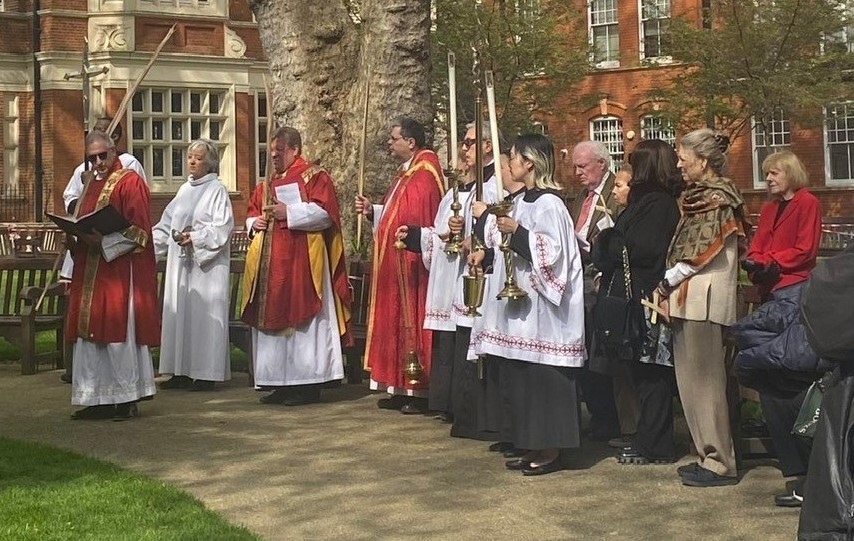
Ecumenical Blessing of Palms, Mount Street Gardens Photo: Luis Appiah
Fr Dominic Robinson, Chair of Westminster Justice and Peace Commission, delivered this homily at the Church of the Immaculate Conception, Farm Street, Mayfair on Palm Sunday:
Hosanna… the Messiah has arrived to save us, but come Wednesday the fear, doubt, betrayal… condemnation… death on a cross… we turn on our saviour and crucify him.
Where are we in this crowd?
Maybe take that away with us this weekend – what is my reaction as the baying crowd hails the King’s entry into the city and then turns on him?
Where am I in any crowd?
I find myself asking that question often and regularly. In a world where we’re expected to believe that some things cannot change, where the injustice of abject poverty amid outrageous wealth is just taken as an economic necessity, where I sit on my hands at the suggestion I can do something to save our planet from disaster, when I shrug my shoulders and say I’ve done all I can to write to my MP to plead for more time and discernment on assisted suicide, when I say I don’t understand the conflict in the Middle East and leave it to the experts, when I say let’s continue to pray for vocations to ministry and they will come, when I say the Churches are really united in a diversity that’s actually good, when I say the abuse crisis in the Church has nothing to do with me.
Being in the crowd means responsibility. The crowd lulls us into a herd mentality to go with whatever the person next to me is saying or thinking. And Christ ends up crucified because good people were complicit in bad deeds.
The Church, that is all of us wanting to walk together as pilgrims towards the heavenly city again in this Jubilee Year, embarks on this painful journey again, accompanying each other, striving yet again to listen better to the signs of our times, to discern the way forward. At our heart are the poorest, the weakest, those without a voice, loved especially by the God who embraces death all the way to the tomb.
Hosanna to this Messiah is our anthem this morning. Only the passage of time will lead us to what that Hosanna really means.
Cardinal Vincent Nichols and the other bishops of England and Wales are encouraging all to join them as they pause for an hour in the middle of their autumn plenary meeting, at 5.30pm on Wednesday, 13 November, to kneel in front of the Blessed Sacrament to pray for the dignity of human life and to uphold a culture of life in our countries.
They will gather in the Chapel of the Holy Family at Hinsley Hall, Leeds, to unite in compassionate action in light of the bill passing through parliament that seeks to legalise assisted suicide. The holy hour will end with Evening Prayer before a concluding Benediction.
Cardinal Vincent said: “We offer our prayers this holy hour for the dignity of human life. In particular our focus is on the end of life and praying together in front of the Blessed Sacrament that assisted suicide will not become law in our lands. This would greatly diminish the importance and innate value of every human person, akin to saying that our life is not a gift of God. Instead we would be asserting that life is our own possession to do with as we choose. But we are far more important than that. We are a gift of God – a gift that is freely given. Then, when God is ready, we are called back to him.
“During this holy hour, we pray that many minds and hearts will be open to this beautiful and great truth about the value, importance, and beauty of every human person. We pray passionately that we will not take a step in legislation that promotes a so-called ‘right to die’, that will quite likely become a duty to die and place pressure on doctors and medical staff to help take life rather than to care, protect, and heal.
“When you are praying, please remember those who offer such care and accompaniment to people facing their last days and hours. Especially pray for those who work in palliative care – nurses, doctors, people who are home visitors. They do a wonderful job with care and compassion, but they need more resources. That is what we should be investing in, not a piece of legislation that leaves us vulnerable and under pressure to seek an end to our life.
“This is an important moment in our history. Please write to your MP and express your view to that member of Parliament. Many have not yet made up their minds how to vote.
“May God bless us all, bless our countries, and bless those who make our laws with courage to embrace and uphold a culture of life.”
On Friday, 29 November, the House of Commons will hear the Second Reading of a new bill on assisted suicide tabled by Labour MP Kim Leadbeater. This is another attempt to legalise assisted suicide and we need you to contact your MP to voice your opposition.
Please visit the Bishops’ Conference resources on assisted suicide. Here you will find content that explains why we oppose assisted suicide, provides answers to FAQs, helps Catholics to quickly and easily contact their MP, provides further information on hospice care, and more.
Here you can download a simple two-page A4 PDF with suggested readings, intercessions and reflections to accompany your time of prayer, whether this is in church in front of the Blessed Sacrament, or in your own home.
There will be a Holy Hour at Farm Street Church, on Wednesday 13 November 2024, 5.00-6.00pm, with Exposition of the Blessed Sacrament and prayers for the dignity of human life at 5.30pm.
Members of the Westminster Justice and Peace network are particularly welcome to join us for this time of prayer, either in person or on the parish livestream.




 Diocese of Westminster Justice and Peace Commission