At a press conference following their pastoral visit to Gaza, the Greek Orthodox and Latin Patriarchs of Jerusalem issue a joint appeal to world leaders and decision makers, calling for “an end to the war, the release of detainees, and the beginning of a true healing process that restores life and dignity to Gaza and the entire Holy Land”.
“Christ is not absent from Gaza,” Cardinal Pierbattista Pizzaballa said on Tuesday. “He is there—crucified in the wounded, buried under rubble, and yet present in every act of mercy, every candle in the darkness, every hand extended to the suffering.”
The Latin Patriarch of Jerusalem was speaking at a press conference with Eastern Orthodox Patriarch Theophilos III, following the prelates’ recent pastoral visit to Gaza. In his opening remarks, Cardinal Pizzaballa insisted that the two patriarchs had travelled to the war-torn Palestinian territory not as politicians or diplomats, but as pastors. He insisted that the Church will never abandon the people of Gaza, emphasizing that their mission was not to a specific group, but to all: “Christians, Muslims, believers, doubters, refugees, children.”
‘Servants of the suffering Body of Christ’
His sentiments were echoed by Patriarch Theophilos, who said they had gone to Gaza “as servants of the suffering Body of Christ, walking among the wounded, the bereaved, the displaced, and the faithful, whose dignity remains unbroken despite their agony.” In Gaza, he said, “we encountered a people crushed by the weight of war, yet carrying within them the image of God.”
The Orthodox Patriarch explained that “the Church’s mission in times of devastation is rooted in the ministry of presence, of standing with those who mourn, of defending the sacredness of life, and of witnessing to the light that no darkness can extinguish.”
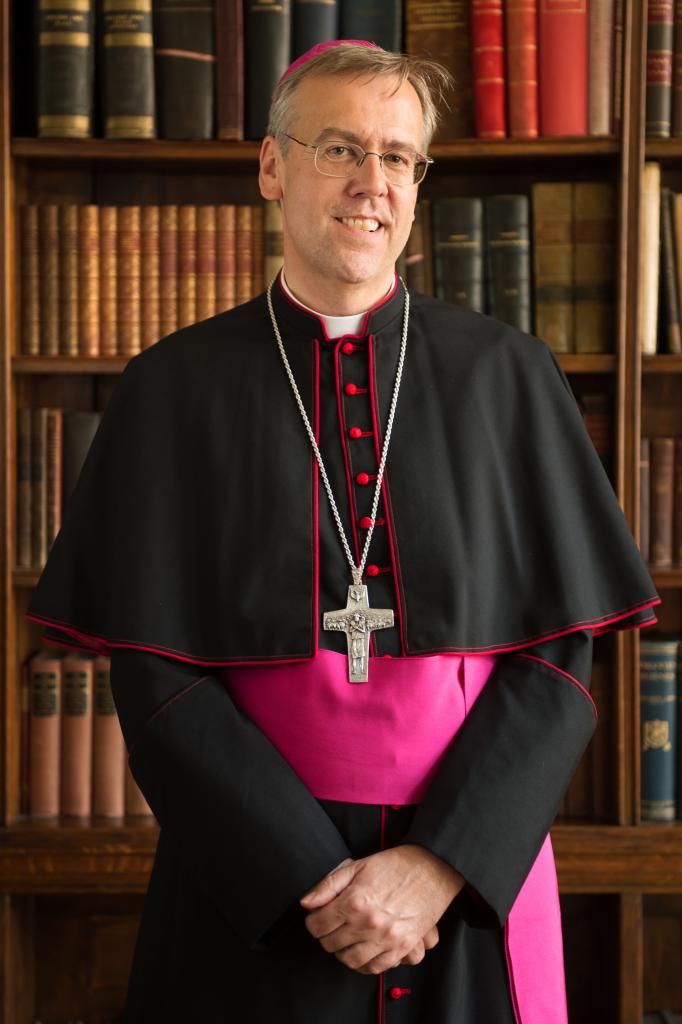
Bishop Nicholas Hudson, Auxiliary Bishop in Westminster with responsibility for Justice and Peace, Chair of the International Affairs Department of the Bishops’ Conference of England and Wales and Moderator of the Holy Land Coordination, has condemned the alarming escalation in settler violence taking place in the West Bank town of Taybeh.
On Tuesday, 8 July, priests representing the town’s three Christian churches issued a joint statement about the repeated attacks on their land, holy sites, and property. They reported an account of arson that threatened the 5th century church of Saint George (Al-Khadr), one of the oldest religious sites in Palestine, and highlighted an on-going campaign of violence and intimidation that impacts on the security and stability of Taybeh.
Bishop Nicholas Hudson learned about the challenges facing the town and the local community when he visited the Catholic Church of Christ the Redeemer in January as part of an international delegation of bishops meeting in the Holy Land.
He said: “Just six months ago, I was in Taybeh visiting what is now the last remaining entirely Christian town in the West Bank, as part of the annual Holy Land Co-ordination meeting.
“We were able to hear firsthand from Fr Bashar Fawadleh, parish priest of the Church of Christ the Redeemer, about the extreme pressure being placed on the local community by Israeli settlers acting with impunity.
“In recent days we have learned of an alarming escalation in settler violence and intimidation that is going unchecked by the authorities. The local churches have appealed to the international community for help and solidarity, and we wish them to know that we have heard their cry. We strongly condemn these attacks and all acts of intimidation perpetrated against civilians in Taybeh and across the West Bank, and we urge the relevant authorities to take decisive action to prevent such incidents from happening again.
“Taybeh, or ‘Ephraim’ as it is known in the Bible, holds deep significance to Christians. These deliberate and repeated attacks are a violation of human dignity and international law in a place that once offered shelter to Christ himself.
“The Palestinian Christians we encountered in January stressed to us that all they want to do is live and work in peace in their own lands, without the paralysing restriction of movement placed upon them, so they can provide for their families and live side-by-side with their neighbours.
“We encourage the Catholic faithful in England and Wales to pray for the suffering Christians and all those affected by this violence in the West Bank. Equally, we invite all people of goodwill to raise their voices in the face of oppression and injustice, urging our leaders to use their influence to bring an end to this persecution.
“It is important to echo the cry of the Taybeh church leaders when they say that the Holy Land cannot remain alive without its indigenous people. As they say, ‘Forcibly removing farmers from their land, threatening their churches, and encircling their towns is a wound to the living heart of this nation’. We stand in solidarity with the Christians of Taybeh and the wider Holy Land, who have a right to live in safety and security. With them, we have faith that truth with justice will prevail.”
Bishop Jim Curry is an auxiliary bishop in the Diocese of Westminster
Bishop Jim Curry, the Lead Bishop for the Holy Land for the Bishops’ Conference, has joined our former Middle East North Africa consultant, Dr Harry Hagopian, as a special guest on his monthly Middle East Analysis podcast. Contributing to a discussion on Gaza, the West Bank and the wider region of the Holy Land, Bishop Curry said that when Christians pray for peace, it can be both supplication and a cry of protest.
“Obviously, the Christian always wants to pray, and we can’t just dismiss prayer as fanciful. Prayer is a cry of protest as well as supplication,” says Bishop Curry. “The fact that we can pray in our churches publicly for the situation in Palestine and Gaza, in the West Bank, that we remember our Christian brothers and sisters and the wider community is important. So we can’t ever dismiss it.”
Bishop Curry also spoke about the Christian presence in the Holy Land as foundational and a vital part of the rich tapestry of the region:
“One of our fundamental tenets is to go on pilgrimage, because these lands are holy to us, they are holy to the Jews, and to Muslims. Christians have been part of the mosaic of those lands for over 2,000 years, they belong there. They’re not interlopers. They’ve built schools, they’ve built churches, they’ve built communities. So going to visit them is important for us. When we last visited [for the Holy Land Coordination], we were able to visit Bethlehem, Beit Jala, where the Latin Patriarch has a seminary, Aboud, and Taybeh. We were able to show that they are not forgotten. But I’m always conscious that afterwards, we walk away. We walk away and leave communities to struggle with lack of access to jobs, to security, to freedom of movement.”
The Bishop also shared his first impressions of the Palestinian city Ramallah, the administrative capital, that he visited in January 2025 as part of the Holy Land Coordination meeting, organised by the Bishops’ Conference:
“I’d never been to Ramallah, and as I looked around as we entered the city I saw a peaceful, busy, bustling city with cafes and buses, restaurants and shops, and people about their business.
“It was a warm day, with a blue sky, and I thought ‘that’s what normality looks like’. People don’t run away from normality. We were asking ourselves, ‘what would normality look like?’ And there we saw it. Someone whispered into my ear, ‘You should have seen Gaza. It was bigger and more well-organised’. Now all we see are these images of rubble and people being displaced – hungry and frightened. I’d seen a different reality in Ramallah, a place that worked. I’m sure people complain about the services there, but I saw something different and it stayed with me.”
In the face of conflict, death, destruction and extreme hardship, Bishop Curry offers a suggestion to enable us to cling to a shard of hope:
“What can we do? We can go on advocating that normality is possible, that people can live well together. People want to live well together… Everywhere we went, we heard this plea, ‘We just want to live normal lives. We want jobs, we want our kids to go to school, we want them to be able to play their part in this land when they come back after university’. It still comes back to me, that image of what normality is. People don’t run away from normality.”
He reserved special praise and heart-felt prayers for the small Catholic community of the Church of the Holy Family in Gaza:
“They are giving a witness to the possibility that our despair can’t be the final word about the human situation. That little community there, the Holy Family in Gaza, they are a living sign that human beings can live together, and they can work together for each other’s good.”
Colette Joyce, our Co-ordinator, attended this Service on behalf of Westminster Justice and Peace.
The Temple Church in London and Co-Cathedral of the Most Holy Name of Jesus in Jerusalem were the settings for an historic simultaneous ecumenical service on Tuesday 20th May 2025, marking the 1,700th anniversary of the Council of Nicaea. The event featured a livestream broadcast from the two churches and shown on screens.
At the Council of Nicaea, in the year 325, church leaders formally assembled to agree on Christian doctrine and endorse the Nicene Creed.
The choice of the Temple Church for this event was particularly significant. It was built in 1162 to recreate the Rotunda of the Holy Sepulchre, or Anastasis, in Jerusalem, commissioned by Constantine soon after the Council of Niceae.
Organisers at the Temple church said yesterday’s service was planned “to bring us all together in unity to pray for peace in the midst of the current troubles in the Holy Land and in our shared concern for the founding communities of our faith.”
As the clergy processed into both churches the Temple Singers led the hymn: Jerusalem the Golden.
In London, Cardinal Vincent Nichols welcomed those present with a blessing. He then delivered a message prepared for the occasion by the late Pope Francis in which he prayed for peace in the Holy Land and prayed this “commendable initiative” which he said “bears eloquent witness to the rich religious tapestry that characterises the land of Our Saviour’s birth and calls attention too the enduring desire for peace held dear by its citizen’s today.”
In Jerusalem Cardinal Pizzabella welcomed everyone in the first words of Pope Leo XIV as Pope:
“Peace be with all of you!”
He said: “Dearest brothers and sisters, this is the first greeting of the Risen Christ, the good shepherd who gave his life for God’s flock . I too would like this greeting of peace to enter your hearts, to reach your families, and all people whoever they are, all of the people all over the earth.
This is the peace of the Risen Christ, an unarmed peace and a disarming peace, humble and persevering .It comes from God. God, God who loves us all unconditionally . We still have in our ears that weak , but always courageous voice off Pope Francis as he blessed Rome!
The Pope who blessed Rome gave his blessing to the world that Easter morning. Allow me to follow up on that same blessing.: God loves us. God loves you all, and evil will not prevail.
We are all in the hands of God. Therefore without fear, united hand in hand with God and among ourselves we move forward. We are disciples of Christ.
Christ preceded us. The world needs his light. Humanity needs him as the bridge to allow it to be reached by God and his light.”
Ahead of the Sacred Triduum, when we contemplate Christ’s passion, death and resurrection, Bishop Nicholas Hudson, Chair of the International Affairs department of the Catholic Bishops’ Conference of England and Wales, offers this reflection on the Holy Land.
Reflection
In this holiest of weeks, our hearts turn naturally to the Holy Land, the land in which Christ died and rose for the redemption of humankind. Our hearts are deeply saddened to witness the immense suffering borne still by so many of its inhabitants.
Of the 251 Israelis taken hostage in the 7 October Hamas attack, 59 remain unaccounted for. Of these, just 24 are believed to be alive. We hold firmly in our prayers their relatives and all who mourn these dead hostages. We hold just as firmly in our prayers the families of the tens of thousands of Palestinians – countless women and children among them – killed by the ensuing disproportionate bombardment. It is with profound distress that we witness the continuing suffering of countless innocent civilians. We pray the Spirit released by Christ on the evening that he rose from the dead (cf. John 20, 22) might be released anew in these lands to bestow on them the just peace for which so many of its inhabitants yearn.
We are profoundly concerned that, despite extensive multilateral efforts to secure a lasting ceasefire and bring an end to hostilities, there remains no sign of peace. Pope Francis constantly reminds us: “War is a human defeat. War does not solve problems; war is evil; war destroys.” (Pope Francis, General Audience, 4 December 2024) Peace benefits all; it is a sign of God’s kingdom on earth and enables us all to flourish.
We call on the international community to recognise that all the people of these lands have the right to live in safety and peace. These are not mere aspirations – they are inalienable rights grounded in the dignity of every person; rights that must be upheld. We particularly pray for the West Bank Christians and their neighbours, where many are deeply fearful for their future, as they see their homes encircled by new and rapidly expanding settlements and their freedom of movement drastically restricted.
In his Lenten message, Cardinal Pizzaballa, the Latin Patriarch of Jerusalem, reminds us that hope is the daughter of faith. It is with hope in our hearts that we sing at our Easter Vigil, “at night there are tears but joy comes with dawn” (Psalm 30): as Christ’s body is laid in the earth, we await with hope his Resurrection from the dead. Our heartfelt prayer this Holy Week is that there rise up in these lands a renewed desire and yearning on all sides for the cessation of hostilities and the finding of ways to a just peace which honours the humanity redeemed by Christ.




 Diocese of Westminster Justice and Peace Commission