Brother Johannes Maertens – Reflection at the Home Office Vigil, Monday 21st July 2025

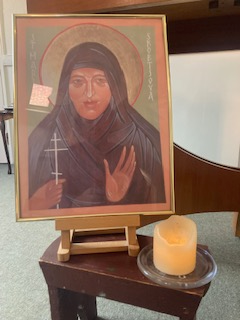
Mother Maria Skobtsova

Brother Johannes Maertens gave the following reflection at the Vigil for Migrants outside the Home Office on 21 July 2025:

Reading: Luke 10:25–37 The Parable of the Good Samaritan

This year marks 80 years since the death of Mother Maria Skobtsova. The Church Times recently referred to her as an “eccentric, chain-smoking poet, monastic, and martyr” “whose theology—grounded in the dual command to love both God and neighbour”—remains startlingly relevant. And perhaps more urgently needed than ever.

In recent years, certain voices—some from pulpits, some from platforms of global influence—have begun to portray empathy as a liability. In 2018, an American pastor published a book titled The Sin of Empathy, describing compassion as potentially morally dangerous. Others have called mercy weak. More recently, tech billionaire Elon Musk described empathy as the “fundamental weakness of Western civilisation,” even criticising Germany’s funding of refugee rescue efforts in the Mediterranean. In response, Germany’s Foreign Office simply said: “Yes. And it’s called saving lives.”

Compassion, empathy… What most of us would consider a fundamental strength—a binding force in our cultures—is now labeled a threat by those in power. And these are not random comments. They are part of a wider push to redefine the moral imagination of society.

But contrast that with the Gospel— and our Gospel reading today —and the very life of Mother Maria Skobtsova.

The parable of the Good Samaritan reframes what it means to be a neighbour—not by nationality, proximity, or religious allegiance, but by mercy. “Who was neighbour to the man?” Jesus asks. And the answer is clear: “The one who showed him compassion.” Jesus, doesn’t answer the question “Who is your neighbour” – he tells you more how you would hope your neighbour is – and then Jesus says: “Go and do likewise.”

This command sits at the heart of Mother Maria Skobtsova’s radical theology. What she called “the sacrament of the brother.” She wrote: “Give from the heart, since each person is the very icon of God incarnate in the world.”

Let that sink in. Every human being—no matter how broken or marginalised—is an icon of Christ. For Mother Skobtsova, every encounter with another person becomes a kind of opportunity to be liturgy. She imagined the whole world as one altar. And to this altar, we offer not only bread and wine, but our hearts—so that they might be transformed into Christ’s love. A “kenotic love”—a love that empties itself.

In this vision, compassion is not weakness. It is sacrament.
Mercy is not naive. It is resurrection.

She didn’t separate the altar from the street, the Eucharist from the soup kitchen, or the refugee-boats from the chalice. She saw Christ there—broken, waiting—and she responded.

When the Nazis invaded Paris, Mother Maria didn’t ask whether hiding Jewish children was politically wise. She saw the face of Christ and acted. And it cost her everything, she died in the Ravenbrouck concentration camp, where she was gazed to death around Easter 1945.

So we must ask: what do we see today?

Across the Mediterranean, in the English Channel, across borders, people are crossing treacherous waters in small inflatable boats. Fleeing war, persecution, and poverty. They too lie wounded along the road to Jericho. And we—we are the passers-by. The priests. The Levites.

We scroll past their faces. Hear their statistics. Debate their fate. But the Gospel doesn’t ask who deserves to be saved.
It asks: Who will show compassion?

To offer mercy is to meet Christ.
To bind a wound is to celebrate Eucharist.
To open a door is to open heaven.
This is not sentimental. It is spiritual courage.

So when we see a migrant in crisis, a stranger at the door, an outcast in pain—we must not pass by. We must be moved with compassion. Not because it’s trendy, or convenient. But because Christ is there.

Broken. Waiting.

And that is why we stand here today.
In prayer. In solidarity.
And in hope—for a more compassionate future, together.

Amen.

“But if at the center of the Church’s life there is this self-giving Eucharistic love, then where are the Church’s boundaries, where is the periphery of this center? Here it is possible to speak of the whole of Christianity as an eternal offering of a Divine Liturgy beyond church walls … It means that we must offer the bloodless sacrifice, the sacrifice of self-surrendering love not only in a specific place, upon the altar of a particular temple; the whole world becomes the single altar of a single temple, and for this universal liturgy we must offer our hearts, like bread and wine, in order that they may be transformed into Christ’s love, that he may be born in them, that they may become “God-manly” hearts, and that He may give these hearts of ours as food for the world…” ” (Mother Maria Skobtsova, Selected Writings, ed. Jim Forest, Chapter on Types of Monasticism, page 185)

Service Sheet

Bishop Curry says that when Christians pray for peace in the Holy Land, it can be both supplication and a cry of protest

Photo: CBCEW

Bishop Jim Curry is an auxiliary bishop in the Diocese of Westminster

Bishop Jim Curry, the Lead Bishop for the Holy Land for the Bishops’ Conference, has joined our former Middle East North Africa consultant, Dr Harry Hagopian, as a special guest on his monthly Middle East Analysis podcast. Contributing to a discussion on Gaza, the West Bank and the wider region of the Holy Land, Bishop Curry said that when Christians pray for peace, it can be both supplication and a cry of protest.

“Obviously, the Christian always wants to pray, and we can’t just dismiss prayer as fanciful. Prayer is a cry of protest as well as supplication,” says Bishop Curry. “The fact that we can pray in our churches publicly for the situation in Palestine and Gaza, in the West Bank, that we remember our Christian brothers and sisters and the wider community is important. So we can’t ever dismiss it.”

Bishop Curry also spoke about the Christian presence in the Holy Land as foundational and a vital part of the rich tapestry of the region:

“One of our fundamental tenets is to go on pilgrimage, because these lands are holy to us, they are holy to the Jews, and to Muslims. Christians have been part of the mosaic of those lands for over 2,000 years, they belong there. They’re not interlopers. They’ve built schools, they’ve built churches, they’ve built communities. So going to visit them is important for us. When we last visited [for the Holy Land Coordination], we were able to visit Bethlehem, Beit Jala, where the Latin Patriarch has a seminary, Aboud, and Taybeh. We were able to show that they are not forgotten. But I’m always conscious that afterwards, we walk away. We walk away and leave communities to struggle with lack of access to jobs, to security, to freedom of movement.”

The Bishop also shared his first impressions of the Palestinian city Ramallah, the administrative capital, that he visited in January 2025 as part of the Holy Land Coordination meeting, organised by the Bishops’ Conference:

“I’d never been to Ramallah, and as I looked around as we entered the city I saw a peaceful, busy, bustling city with cafes and buses, restaurants and shops, and people about their business.

“It was a warm day, with a blue sky, and I thought ‘that’s what normality looks like’. People don’t run away from normality. We were asking ourselves, ‘what would normality look like?’ And there we saw it. Someone whispered into my ear, ‘You should have seen Gaza. It was bigger and more well-organised’. Now all we see are these images of rubble and people being displaced – hungry and frightened. I’d seen a different reality in Ramallah, a place that worked. I’m sure people complain about the services there, but I saw something different and it stayed with me.”

In the face of conflict, death, destruction and extreme hardship, Bishop Curry offers a suggestion to enable us to cling to a shard of hope:

“What can we do? We can go on advocating that normality is possible, that people can live well together. People want to live well together… Everywhere we went, we heard this plea, ‘We just want to live normal lives. We want jobs, we want our kids to go to school, we want them to be able to play their part in this land when they come back after university’. It still comes back to me, that image of what normality is. People don’t run away from normality.”

He reserved special praise and heart-felt prayers for the small Catholic community of the Church of the Holy Family in Gaza:

“They are giving a witness to the possibility that our despair can’t be the final word about the human situation. That little community there, the Holy Family in Gaza, they are a living sign that human beings can live together, and they can work together for each other’s good.”

Listen

You can listen to the full June 2025 episode of Middle East Analysis on the Catholic Bishops’ website or on Soundcloud.

Bishop Jim Curry: The Suffering in Gaza Must End

Bishop Jim Curry (r). Photo: Mazur/cbcew.org.uk

Source: CBCEW

Auxiliary Bishop in Westminster and Lead Bishop for the Holy Land for the Bishops’ Conference, Bishop Jim Curry, has echoed Pope Leo XIV’s call for an immediate ceasefire in Gaza1:

“This is a humanitarian disaster. Desperately needed aid supplies must be allowed into Gaza to be urgently distributed to civilians. The human cost is intolerably high with tens of thousands of weary, regularly displaced people threatened with starvation. We need an immediate ceasefire to end the suffering.

“As Pope Leo said at his first General Audience2, children, the elderly and the sick are paying a very heavy price, and I would echo the Holy Father’s heartfelt appeal for ‘dignified’ humanitarian aid to be allowed to pass into Gaza – not just an inadequate trickle of food and supplies that has been promised in recent days.”

Bishop Curry also referenced Prime Minister Keir Starmer’s joint statement, with the leaders of Canada and France, on the situation in Gaza, released on 19 May:

“International humanitarian law has to be respected and a viable pathway to de-escalation and peace sought by Israel and Hamas, supported by the international community,” said Bishop Curry.

“The remaining hostages in Gaza, held for 19 months since the Hamas terror attack on 7 October, must be released to put an end to their suffering and that of their families. I welcome the statement by the UK Prime Minister and the leaders of France and Canada, particularly the assertion that the best hope of achieving this and alleviating the pain and hardship facing the civilians in Gaza is to work tirelessly for a long-term political solution.

“It is important not to lose sight of the legitimate right of Palestinians to self-determination. The Church has consistently advocated for a two-state solution to enable Palestinians and Israelis to live side by side in peace.”

Bishop Curry said he was also praying for the Christians of Gaza:

“I continue to pray for Fr Gabriel Romanelli and the Christian community sheltering in the compound of the Holy Family Church, north of the Wadi. It is a humbling inspiration to all of us outside the conflict zone to witness their strength of faith in the Risen Christ, and how they continue to lead a humble sacramental life despite the incredible hardship and distress they are facing.”

Bishop Jim Curry is the Lead Bishop for the Holy Land for the Catholic Bishops’ Conference of England and Wales and is a member of the Department for International Affairs.

References 

1 Pope Leo XIV, first Regina Coeli address, Sunday, 11 May 2025.

2 Pope Leo XIV, first General Audience, Wednesday, 21 May 2025.

10 May 2025: NJPN Day London – A Sustainable World for Future Generations

Source: Ellen Teague, NJPN

All are warmly invited to the third meeting in the National Justice and Peace Network (NJPN) series of events for this Jubilee Year of Hope The day at CAFOD’s office at Romero House, 55 Westminster Bridge Road, London SE1 7JB, on Saturday 10 May, 10.15am until 4.00pm.

This day will be facilitated by the NJPN Environment Group, and will include experience of being in a Live Simply parish; Tackling Debt and the Climate Crisis in the Jubilee Year; Greening Church Investments: fossil fuel divestment and investment in climate solutions; and Honouring our Covenants for Care of Creation.

A Filipino bishop who has played a key role in the implementation of Laudato Si’ in the Philippines and Avril De Torres (Deputy Executive Director of CEED Philippines) are to speak on the day’s theme of, ‘Opening doors to a sustainable world for future generations’. In the lead up to Laudato Si Week, Bishop Gerardo Alimane Alminaza of San Carlos will focus on extractive industries and the need for ethical investment, alongside Bokani Tshidzu of Operation Noah and James Buchanan of the Laudato Si Movement.

Shanon Shah, the Muslim Director of Faith for the Climate, will lead group work on creation-centred theology – taken from ‘Laudato Si’, ‘Laudato Deum’ and the Muslim document ‘Al Mizan: A Covenant with the Earth.’ Other speakers include Mary Finnerty, Lead Economist at CAFOD, and Mary and Peter Johnson of the Livesimply parish at Lexden in Brentwood Diocese and the Southern Dioceses Environment Network.

J&P activists from around England and Wales will be attending the day, which will be chaired by Paul Kelly of the Northern Dioceses Environment Group. Sr MaryAnne Francalanza of the FCJ Centre for Spirituality and EcoJustice at Euston and Colette Joyce (Westminster Justice & Peace) will lead liturgies. .

We are asking that you register to attend this Networking Day by emailing Sharon Chambers at admin@justice-and-peace.org.uk as we are limited to a certain number.

Tea and coffee will be provided, please bring your own lunch.

LINK

www.justice-and-peace.org.uk/meetings/opening-doors-to-a-sustainable-world-for-future-generations/

Bishop Nicholas Hudson Reflects on the Ongoing Conflict in the Holy Land

Image: Mazur/cbcew.org.uk

Source: CBCEW

Ahead of the Sacred Triduum, when we contemplate Christ’s passion, death and resurrection, Bishop Nicholas Hudson, Chair of the International Affairs department of the Catholic Bishops’ Conference of England and Wales, offers this reflection on the Holy Land.

Reflection

In this holiest of weeks, our hearts turn naturally to the Holy Land, the land in which Christ died and rose for the redemption of humankind. Our hearts are deeply saddened to witness the immense suffering borne still by so many of its inhabitants.

Of the 251 Israelis taken hostage in the 7 October Hamas attack, 59 remain unaccounted for. Of these, just 24 are believed to be alive. We hold firmly in our prayers their relatives and all who mourn these dead hostages. We hold just as firmly in our prayers the families of the tens of thousands of Palestinians – countless women and children among them – killed by the ensuing disproportionate bombardment. It is with profound distress that we witness the continuing suffering of countless innocent civilians. We pray the Spirit released by Christ on the evening that he rose from the dead (cf. John 20, 22) might be released anew in these lands to bestow on them the just peace for which so many of its inhabitants yearn.

We are profoundly concerned that, despite extensive multilateral efforts to secure a lasting ceasefire and bring an end to hostilities, there remains no sign of peace. Pope Francis constantly reminds us: “War is a human defeat. War does not solve problems; war is evil; war destroys.” (Pope Francis, General Audience, 4 December 2024) Peace benefits all; it is a sign of God’s kingdom on earth and enables us all to flourish.

We call on the international community to recognise that all the people of these lands have the right to live in safety and peace. These are not mere aspirations – they are inalienable rights grounded in the dignity of every person; rights that must be upheld. We particularly pray for the West Bank Christians and their neighbours, where many are deeply fearful for their future, as they see their homes encircled by new and rapidly expanding settlements and their freedom of movement drastically restricted.

In his Lenten message, Cardinal Pizzaballa, the Latin Patriarch of Jerusalem, reminds us that hope is the daughter of faith. It is with hope in our hearts that we sing at our Easter Vigil, “at night there are tears but joy comes with dawn” (Psalm 30): as Christ’s body is laid in the earth, we await with hope his Resurrection from the dead. Our heartfelt prayer this Holy Week is that there rise up in these lands a renewed desire and yearning on all sides for the cessation of hostilities and the finding of ways to a just peace which honours the humanity redeemed by Christ.

Fr Dominic Robinson SJ – Homily for Palm Sunday

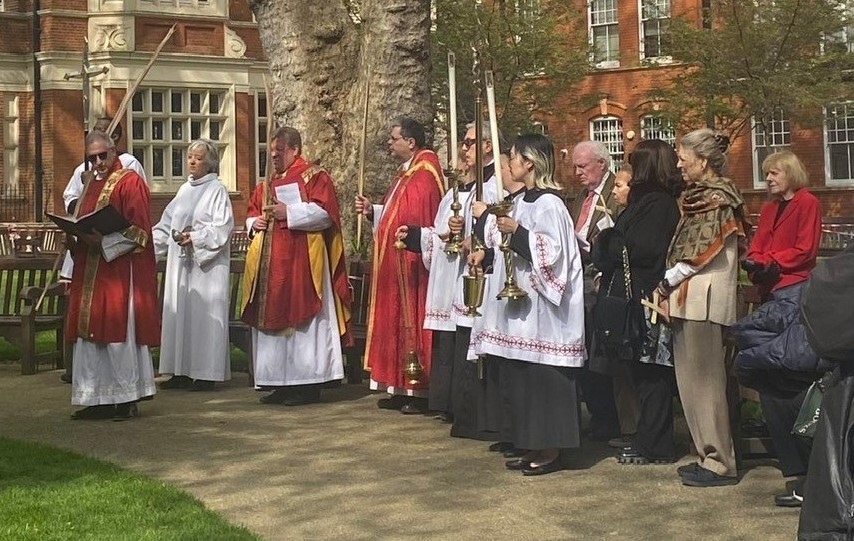
Ecumenical Blessing of Palms, Mount Street Gardens
Photo: Luis Appiah

Fr Dominic Robinson, Chair of Westminster Justice and Peace Commission, delivered this homily at the Church of the Immaculate Conception, Farm Street, Mayfair on Palm Sunday:

Hosanna… the Messiah has arrived to save us, but come Wednesday the fear, doubt, betrayal… condemnation… death on a cross… we turn on our saviour and crucify him.

Where are we in this crowd?

Maybe take that away with us this weekend – what is my reaction as the baying crowd hails the King’s entry into the city and then turns on him?

Where am I in any crowd?

I find myself asking that question often and regularly. In a world where we’re expected to believe that some things cannot change, where the injustice of abject poverty amid outrageous wealth is just taken as an economic necessity, where I sit on my hands at the suggestion I can do something to save our planet from disaster, when I shrug my shoulders and say I’ve done all I can to write to my MP to plead for more time and discernment on assisted suicide, when I say I don’t understand the conflict in the Middle East and leave it to the experts, when I say let’s continue to pray for vocations to ministry and they will come, when I say the Churches are really united in a diversity that’s actually good, when I say the abuse crisis in the Church has nothing to do with me.

Being in the crowd means responsibility. The crowd lulls us into a herd mentality to go with whatever the person next to me is saying or thinking. And Christ ends up crucified because good people were complicit in bad deeds.

The Church, that is all of us wanting to walk together as pilgrims towards the heavenly city again in this Jubilee Year, embarks on this painful journey again, accompanying each other, striving yet again to listen better to the signs of our times, to discern the way forward. At our heart are the poorest, the weakest, those without a voice, loved especially by the God who embraces death all the way to the tomb.

Hosanna to this Messiah is our anthem this morning. Only the passage of time will lead us to what that Hosanna really means.

LINK

Farm Street Church: www.farmstreet.org.uk/

Romero Week 2025 Report – Cardinal Fitzgerald Talk at St Martin-in-the-Fields Ecumenical Service

Cardinal Fitzgerald with Colette Joyce from Westminster J&P. Image ICN/JS

Cardinal Michael Fitzgerald M.Afr. gave the following talk on the Day of Martyrdom of Archbishop Oscar Romero, Saturday, 22 March, 2025, at St Martin in the Fields, Trafalgar Square.

All my hope on God is founded. On this day when we are celebrating the anniversary of the martyrdom of Archbishop Romero, which falls actually on Monday 24 March, we are concentrating on HOPE, because we badly need Hope in our world today and Archbishop Romero is a figure of hope.

We have heard a reading from St Paul to the Romans about Abraham who believed though it would seem that there was no room left for hope or belief. He was old, and his wife was old too, and yet he believed that she would bear him a child, since God had promised this.

We have heard recited a poem by a Palestinian about the people of Gaza:

My God is courage, patience, justice, the sumoud of a people.

We adore the same one God, though we understand this God differently.

Muslims say that God is al-samad, which could be translated “rock-like”; God is an all-encompassing refuge for us.

In the midst of this world, with all its difficulties, we are encouraged to take refuge in God.

As Christians, we say that this God has become one with us in Jesus Christ

So, we can truly say that our God is a stubborn refugee girl, her heart still yearning for the place she calls her own.

We can say that our God is a Gaza refugee wishing to share freedom with all of us.

We are called to believe like Abraham, our father; we are called to believe in life as Archbishop Romero did, hoping against hope that conditions will revive, conditions in Gaza, in Israel and Palestine, in Tigray in the North of Ethiopia, in Sudan and Eastern Congo, in Myanmar and Yemen conditions in El Salvador, conditions all around the world where there is conflict. We are encouraged to continue praying for the people in these areas of conflict, following the example of Pope Francis who, every Sunday, at the mid-day prayer, mentions these places and prays for their inhabitants.

We are called not only to pray, but to work for a renewal of life, as the Qur’an reminds us:

Have you considered the one who denies the Judgement? that is the one

who pushes aside the orphan and does not urge others to feed the needy

So woe to those who pray but are heedless of their prayer; those who are all show and forbid common kindnesses.

( Qur’an 107)

Many of us are familiar with the words of the Gospel:

Come… take for your heritage the kingdom prepared for you…: For I was hungry and you gave me food; I was thirsty and you gave me drink; I was a stranger and you made me welcome; naked and you clothed me; sick and you visited me, in prison, and you came to see me; I tell you solemnly, in so far as you did this to one of the least of these brothers [or sisters] of mine, you did it to me.

( Gospel according to Matthew, 25: 34-42)

This year, Ramadan and Lent fall together in the same period. We can remember that their contents are similar: fasting, prayer and alms-giving, but the reasons for engaging in these practices are different.

To fast every day during the month of Ramadan, to abstain during the hours of day-light from every intake of food or drink or of any substance is very demanding. The Christian is not asked to observe this. The Christian would be expected to forego some food or drink during the 40 days of Lent; avoiding alcohol, which is allowed at other times; avoiding chocolate or sweets; having a simple meal such as spaghetti and cheese and being able to share the amount saved with people who are in need.

There are other ways of fasting that can be chosen: avoiding watching television, curbing one’s use of social media.

All this is voluntary, by way of free choice. Whereas I understand that Ramadan is observed as an act of obedience to God: “You who believe, fasting is prescribed for you… so that you may be mindful of God (Q 2: 183).”

Ramadan is practised more collectively; families gather together to break the fast.

Lent is a more individual practice.

Lent is really a way of preparing for the celebration of the greatest feast of the Christian year, Easter, the commemoration of the Passion of Jesus, of his death on the Cross, his burial, and his rising to New Life.

Nevertheless, there are common prayers in both religious traditions. Special prayers are recited in the mosque, the tarâwîh, after the last prayer of the day.

Christians have a custom of gathering in church on Friday afternoons or evenings for what we call the Way of the Cross, recalling the different ways Jesus suffered for us.

At this time when Ramadan and Lent unite us, I should like to let the voice of Archbishop Romero resound again:

As long as there are mothers who are crying about the disappearance of their sons and daughters, as long as there are tortures in the headquarters of our security forces, as long as there is horrible disorder… there cannot be peace. We need to be rational and listen to the voice of God, to organize a more just society once more according to God’s heart.

(Through the Year with Oscar Romero, Daily Meditations CAFOD, D.L.T. Christian Aid 2006 p.14).

To return to our theme of Hope, we who believe in Hope, whether we are Christians or Muslims, or whatever religion we belong to, we pray earnestly to God for this gift of Hope, true hope which will generate justice-seeking solidarity, hope which may presage true peace.

In this way we shall be true to ourselves, true to our religions and true to Oscar Romero who has given us such a good example.

Michael Cardinal Fitzgerald, M.Afr.

LINKS:

Watch a recording of the service: www.facebook.com/stmartininthefields

Full programme for Romero Week: Archbishop Romero Trust: www.romerotrust.org.uk/

London Oscar Romero service: Let us not tire of preaching love: www.indcatholicnews.com/news/51999

Debt Justice – Cancel Debt, Choose Hope

Campaign Launch 27 January 2025. Image: CAFOD

Source: Debt Justice

A consortium of charities are today warning that that high debt servicing costs are preventing Global South governments from spending on vital public services such as education and health and making investments to limit the impact of the climate emergency. Thirty-two African countries spend more on paying external debts than they do on healthcare.

UK charities including CAFOD, Christian Aid, Save the Children, Debt Justice and the international development network, Bond, are gathering outside the UK Treasury to launch a campaign calling for a debt cancellation initiative in the Jubilee year of 2025.

Debt payments for lower-income countries are at the highest level in 30 years. Private lenders are the largest group of creditors, with many based in the UK, and 90% of their contracts are governed by English law.

The campaign is calling on the UK government to champion major improvements to the debt cancellation process for lower-income countries, including legislating to ensure banks, hedge funds and oil traders participate.

In a joint statement, the charities say:

“We welcome the fact the UK government has made “tackling unsustainable debt” a major priority. However, this will not happen through business as usual but requires a complete change in the UK approach.”

The campaign calls on the UK government to:

“Champion a debt cancellation scheme that brings debt payments down to a genuinely sustainable level” and to “Pass legislation to ensure all private lenders participate in debt cancellation and suspend repayments to private lenders during debt cancellation negotiations.”

The South African government has made tackling the unsustainable debt crisis a key priority for its presidency of the G20 in 2025. 2025 is a Jubilee year in the Catholic Church, and Pope Francis has made achieving debt cancellation one of his key priorities for the year. World Bank Chief Economist Indermit Gill recently said:

“It’s time to face the reality: the poorest countries facing debt distress need debt relief if they are to have a shot at lasting prosperity… Sovereign borrowers deserve at least some of the protections that are routinely afforded to debt-strapped businesses and individuals under national bankruptcy laws. Private creditors that make risky, high-interest loans to poor countries ought to bear a fair share of the cost when the bet goes bad.”

Catholic development agencies CAFOD, SCIAF, and Caritas’ new report, Jubilee 2025: The New Global Debt Crisis and its Solutions, outlines the causes of cyclical global debt crises, the inadequacies in current global debt structures, and sets out six policies to build a fair and functional debt system.

LINKS

Debt Justice (formerly Jubilee Debt Campaign) is a UK charity working to end poverty caused by unjust debt through education, research and campaigning: https://debtjustice.org.uk/

The statement and full list of signatories is at: https://debtjustice.org.uk/wp-content/uploads/2025/01/Jubilee-year-statement_27.01.25.pdf

Cardinal calls for an hour of prayer for the dignity of human life on Wednesday 13 November

Photo: RCDOW

Cardinal Vincent Nichols and the other bishops of England and Wales are encouraging all to join them as they pause for an hour in the middle of their autumn plenary meeting, at 5.30pm on Wednesday, 13 November, to kneel in front of the Blessed Sacrament to pray for the dignity of human life and to uphold a culture of life in our countries.

They will gather in the Chapel of the Holy Family at Hinsley Hall, Leeds, to unite in compassionate action in light of the bill passing through parliament that seeks to legalise assisted suicide. The holy hour will end with Evening Prayer before a concluding Benediction.

Cardinal Vincent said: “We offer our prayers this holy hour for the dignity of human life. In particular our focus is on the end of life and praying together in front of the Blessed Sacrament that assisted suicide will not become law in our lands. This would greatly diminish the importance and innate value of every human person, akin to saying that our life is not a gift of God. Instead we would be asserting that life is our own possession to do with as we choose. But we are far more important than that. We are a gift of God – a gift that is freely given. Then, when God is ready, we are called back to him.

“During this holy hour, we pray that many minds and hearts will be open to this beautiful and great truth about the value, importance, and beauty of every human person. We pray passionately that we will not take a step in legislation that promotes a so-called ‘right to die’, that will quite likely become a duty to die and place pressure on doctors and medical staff to help take life rather than to care, protect, and heal.

“When you are praying, please remember those who offer such care and accompaniment to people facing their last days and hours. Especially pray for those who work in palliative care – nurses, doctors, people who are home visitors. They do a wonderful job with care and compassion, but they need more resources. That is what we should be investing in, not a piece of legislation that leaves us vulnerable and under pressure to seek an end to our life.

“This is an important moment in our history. Please write to your MP and express your view to that member of Parliament. Many have not yet made up their minds how to vote.

“May God bless us all, bless our countries, and bless those who make our laws with courage to embrace and uphold a culture of life.”

On Friday, 29 November, the House of Commons will hear the Second Reading of a new bill on assisted suicide tabled by Labour MP Kim Leadbeater. This is another attempt to legalise assisted suicide and we need you to contact your MP to voice your opposition.

Please visit the Bishops’ Conference resources on assisted suicide. Here you will find content that explains why we oppose assisted suicide, provides answers to FAQs, helps Catholics to quickly and easily contact their MP, provides further information on hospice care, and more.

Here you can download a simple two-page A4 PDF with suggested readings, intercessions and reflections to accompany your time of prayer, whether this is in church in front of the Blessed Sacrament, or in your own home.

There will be a Holy Hour at Farm Street Church, on Wednesday 13 November 2024, 5.00-6.00pm, with Exposition of the Blessed Sacrament and prayers for the dignity of human life at 5.30pm.

Members of the Westminster Justice and Peace network are particularly welcome to join us for this time of prayer, either in person or on the parish livestream.

Farm Street Church

Watch the Cardinal’s Message on Youtube here: 

Bishops of Holy Land Co-ordination Call for Peace

Photo: Holy Family Church in Gaza (Mazur/CBCEW.org.uk)

Bishops of the Holy Land Coordination have issued a statement after two Christian women were killed in a sniper attack on the Holy Family Church compound in Gaza on 16th December 2023.

Holy Land Coordination Statement

The Bishops of the Holy Land Coordination were profoundly shocked and distressed at the killing by snipers on 16th December of two Christian women sheltering in the compound of the Holy Family church, Gaza. Messages were sent immediately to the Patriarch, His Eminence Cardinal Pierbattista Pizzaballa, and to the Parish Priest, Fr Gabriel Romanelli.

The Holy Land Coordination has been warmly welcomed by priests and parishioners on numerous occasions. We have witnessed firsthand the faith and commitment of the few parishioners who remain; and the dedicated care by the Missionaries of Charity of some fifty profoundly disabled people who live in the convent alongside the church.

The desecration of this compound and the destruction of the Sisters’ convent, ‘signalled’, according to the Patriarch, ‘as a place of worship since before the beginning of the war’, is profoundly disturbing. The shooting in cold blood of Nahida Anton and Samar Antoun, a mother and daughter seeking to enter the convent is unfathomable.

The Holy Land Coordination bishops represent a broad sweep of countries, each bishop committed to a just peace for all and to holding the plight of Christians of the Holy Land at the forefront of their governments’ concerns. We visit the Holy Land regularly to reassure these Christians that they are not forgotten. We seek also to understand better, and at first hand, the realities experienced by the people of three Abrahamic faiths sharing this Land; to fathom the possibility of hope in a two-state solution.

The atrocities perpetrated against Israeli Jews on 7th October and the subsequent killing by the Israeli Defence Force of nearly 20,000 Gazans, of whom 70% were women and children, would appear profoundly to jeopardise the prospects of any such resolution of this deep-seated conflict. Yet, the approaching celebration of Our Saviour’s birth two thousand years ago in the heart of the West Bank should serve as an incentive to people of faith, across the globe, to call down the Holy Spirit ever more fervently to move the hearts of all who can bring influence to bear on these lands and to find a way to cease the hostilities from all sides.

Bishop Nicholas Hudson (Chair of the Holy Land Coordination)
Auxiliary Bishop of Westminster
England and Wales

Bishop Nicolo Anselmi
Bishop of Rimini
Italy

Archbishop Udo Bentz
Archbishop-elect of Paderborn
Germany

Bishop Pierre Burcher
Bishop Emeritus of Reykjavik
Denmark, Finland, Iceland, Norway and Sweden

Bishop Christopher Chessun
Anglican Bishop of Southwark
Church of England

Bishop Michel Dubost
Bishop Emeritus of Evry-Corbeil-Essonnes
France

Archbishop Richard Gagnon
Archbishop of Winnipeg
Canada

Bishop William Kenney
Auxiliary Bishop Emeritus of Birmingham
England and Wales

Bishop Declan Lang
Bishop of Clifton
England and Wales

Bishop Donal McKeown
Bishop of Derry
Ireland

Archbishop William Nolan
Archbishop of Glasgow
Scotland

Archbishop Joan Enric Vives i Sicilia
Bishop of Urgell and Co-Prince of Andorra
Spain

Bishop Sithembele Sipuka    
Bishop of Mthatha
South Africa

Bishop Paul Terrio
Bishop Emeritus of St Paul
Canada

Since 1998, the Bishops’ Conference’s Department for International Affairs has organised the annual meeting of the Coordination of Episcopal Conferences in Support of the Church of the Holy Land.