Brother Johannes Maertens – Reflection at the Home Office Vigil, Monday 21st July 2025

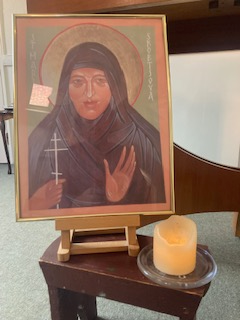
Mother Maria Skobtsova

Brother Johannes Maertens gave the following reflection at the Vigil for Migrants outside the Home Office on 21 July 2025:

Reading: Luke 10:25–37 The Parable of the Good Samaritan

This year marks 80 years since the death of Mother Maria Skobtsova. The Church Times recently referred to her as an “eccentric, chain-smoking poet, monastic, and martyr” “whose theology—grounded in the dual command to love both God and neighbour”—remains startlingly relevant. And perhaps more urgently needed than ever.

In recent years, certain voices—some from pulpits, some from platforms of global influence—have begun to portray empathy as a liability. In 2018, an American pastor published a book titled The Sin of Empathy, describing compassion as potentially morally dangerous. Others have called mercy weak. More recently, tech billionaire Elon Musk described empathy as the “fundamental weakness of Western civilisation,” even criticising Germany’s funding of refugee rescue efforts in the Mediterranean. In response, Germany’s Foreign Office simply said: “Yes. And it’s called saving lives.”

Compassion, empathy… What most of us would consider a fundamental strength—a binding force in our cultures—is now labeled a threat by those in power. And these are not random comments. They are part of a wider push to redefine the moral imagination of society.

But contrast that with the Gospel— and our Gospel reading today —and the very life of Mother Maria Skobtsova.

The parable of the Good Samaritan reframes what it means to be a neighbour—not by nationality, proximity, or religious allegiance, but by mercy. “Who was neighbour to the man?” Jesus asks. And the answer is clear: “The one who showed him compassion.” Jesus, doesn’t answer the question “Who is your neighbour” – he tells you more how you would hope your neighbour is – and then Jesus says: “Go and do likewise.”

This command sits at the heart of Mother Maria Skobtsova’s radical theology. What she called “the sacrament of the brother.” She wrote: “Give from the heart, since each person is the very icon of God incarnate in the world.”

Let that sink in. Every human being—no matter how broken or marginalised—is an icon of Christ. For Mother Skobtsova, every encounter with another person becomes a kind of opportunity to be liturgy. She imagined the whole world as one altar. And to this altar, we offer not only bread and wine, but our hearts—so that they might be transformed into Christ’s love. A “kenotic love”—a love that empties itself.

In this vision, compassion is not weakness. It is sacrament.
Mercy is not naive. It is resurrection.

She didn’t separate the altar from the street, the Eucharist from the soup kitchen, or the refugee-boats from the chalice. She saw Christ there—broken, waiting—and she responded.

When the Nazis invaded Paris, Mother Maria didn’t ask whether hiding Jewish children was politically wise. She saw the face of Christ and acted. And it cost her everything, she died in the Ravenbrouck concentration camp, where she was gazed to death around Easter 1945.

So we must ask: what do we see today?

Across the Mediterranean, in the English Channel, across borders, people are crossing treacherous waters in small inflatable boats. Fleeing war, persecution, and poverty. They too lie wounded along the road to Jericho. And we—we are the passers-by. The priests. The Levites.

We scroll past their faces. Hear their statistics. Debate their fate. But the Gospel doesn’t ask who deserves to be saved.
It asks: Who will show compassion?

To offer mercy is to meet Christ.
To bind a wound is to celebrate Eucharist.
To open a door is to open heaven.
This is not sentimental. It is spiritual courage.

So when we see a migrant in crisis, a stranger at the door, an outcast in pain—we must not pass by. We must be moved with compassion. Not because it’s trendy, or convenient. But because Christ is there.

Broken. Waiting.

And that is why we stand here today.
In prayer. In solidarity.
And in hope—for a more compassionate future, together.

Amen.

“But if at the center of the Church’s life there is this self-giving Eucharistic love, then where are the Church’s boundaries, where is the periphery of this center? Here it is possible to speak of the whole of Christianity as an eternal offering of a Divine Liturgy beyond church walls … It means that we must offer the bloodless sacrifice, the sacrifice of self-surrendering love not only in a specific place, upon the altar of a particular temple; the whole world becomes the single altar of a single temple, and for this universal liturgy we must offer our hearts, like bread and wine, in order that they may be transformed into Christ’s love, that he may be born in them, that they may become “God-manly” hearts, and that He may give these hearts of ours as food for the world…” ” (Mother Maria Skobtsova, Selected Writings, ed. Jim Forest, Chapter on Types of Monasticism, page 185)
Service Sheet

Home Office Vigil Prayers – 18 November 2024

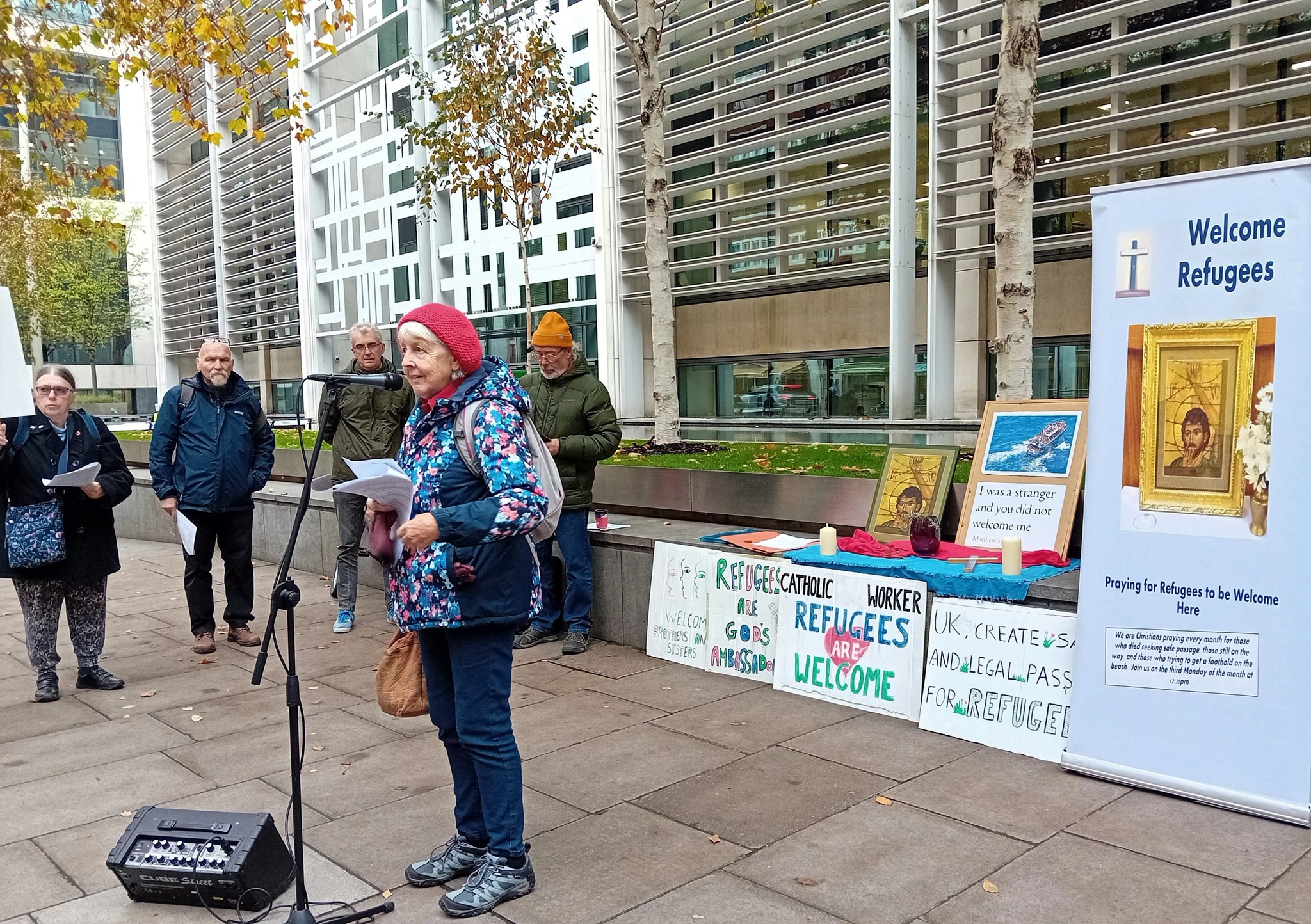
Barbara Kentish outside the Home Office 18 Nov 2024. Photo: Pat Gaffney

This month those gathered at the regular Prayer Vigil outside the Home Office remembered the following people who died a year ago, in November 2023, attempting to reach sanctuary in Europe:

DateDetails
?8 people from Gambia died of exhaustion during a 15-day boat journey from Gambia to the Canaries. Their bodies were thrown in the sea; 55 survived. 
3/11A boy died from exhaustion in hospital, having arrived at El Hierro (Spain) by boat from West Africa one day earlier; 83 survived.
4/11134 people from Senegal, including at least 3 children and 6 women, drowned when a Canaries-bound boat on the way from Senegal sank off Nouadhibou (Morocco);15 191 survived.   2 people died of unknown cause, their bodies found on board a boat during rescue off the Canary island of El Hierro. 2 others died on the way to hospital.   A man of 23 from Syria died, his body found by nature researchers in Białowieża Forest (Poland) near Narewka River at the Poland-Belarus border.
5/1115 people were presumed drowned off Nouadhibou (Morocco), missing from 7 canoes on the way from Senegal to the Canaries.   13 people, including 2 children, from sub-Saharan Africa died of hunger and thirst on the way to Spain, their bodies in state of decay found in boats off Nouadhibou.   A body, probably of a woman, wearing a white shirt & tied to a tire used as a life vest was found between rocks on the coast of Lampedusa (Italy).
6/11Dinh Anh Nguyen, a man of 37 from Vietnam, was hit by a train near Calais (France) while walking on railway tracks in the dark.   182 people from Guinea, Mali, and Senegal drowned off Gadaye (Senegal) on the way from Bargny (Senegal) to the Canary Islands (Spain). 87 survived.
8/1117 people from Algeria drowned when a boat went missing on the way to Murcia (Spain) after embarkation from Mostaganem (Algeria).   2 men, both aged around 30, drowned off Gadaye (Senegal) on the way to the Canary Islands, their bodies found at Diamalaye beach (Senegal); 87 survived.
9/11A body was found by the Spanish Civil Guard, after a boat from West Africa arrived south of El Hierro (Spain); 79 survived.   Mohammed Amine Saidat, a man of 26 from Morocco, was hit by a train in Bolzano (Italy) while looking for shelter for the night. He had camped near the site of his death.
10/11A man’s body was found by journalists while reporting in the Kupa Riverbed in Netretić (Croatia) on the Croatia-Slovenia border.
11/117 people, including an infant, drowned, their bodies recovered in the Mediterranean Sea off Sfax (Tunisia) by the Tunisian National Guard.   2 people from sub-Saharan Africa drowned on the way from Sfax (Tunisia) to Lampedusa (Italy) when they fell from a small boat when rescuers neared; 67 survived.
12/11A body was found by Belarus border guards in Belarus near the 82nd Belarusian pillar of the border fence with Latvia.   A man of about 30 from sub-Saharan Africa drowned off Gadaye (Senegal) on the way to the Canary Islands, his body found at Déni Guedj Nord beach (Senegal); 87 survived.   A man of 29 from Eritrea died of unknown causes on the way to Lampedusa (Italy), his body found on board a boat by Italian coast guards.
13/117 people from Liberia, Palestine, Syria and elsewhere, including a child and 2 women, drowned when a rubber boat on the way to Chios (Greece) sank in stormy weather off Cesme (Turkey); 6 survived.   Abdelbassit Mohammad, a man of 22 from Sudan, had his throat slit during a brawl between migrants under the Mollien bridge in Calais; his attacker fled.
14/1111 people from Algeria drowned in the Mediterranean sea, off Murcia (Spain) on the way from Mostaganem (Algeria).   16 people drowned when a boat hit rocks on the way from Senegal to the Canaries (Spain), their bodies found on a beach of Lagouera (Morocco).
15/11A person from Gambia died of exhaustion during a 15-day boat journey from Gambia to the Canaries, their body found during rescue; 55 survived.   19 people from Algeria drowned when a boat missing on the way to the Balearic Islands (Spain) after embarkation from Algiers (Algeria).
Mid Nov.A person died of unknown causes on the way from Africa to Lampedusa (Italy), buried in Palma on the island of Sicily.
16/1119 people from Algeria drowned when a boat went missing on the way to the Balearic Islands (Spain) after embarkation from Algiers (Algeria).
17/1135 people, including 2 children and 5 women, from Morocco and sub-Saharan Africa, drowned, when a boat capsized in high waves south of Guelmim (Morcco) on the way to the Canaries; 10 survived.   Baysal Recep, a man of 42, and Geçsöyler Mehmet Ali, a man of 37, both from Turkish Kurdistan, were hit by a truck and killed while walking on the emergency lane of the A16 near the Calais ferry terminal.   An Albanian man of 37 died in hospital after attempting suicide in Brook House removal centre in Gatwick in fear of deportation.
19/1118 people from north Africa went missing on the way to Alicante (Spain) after embarkation from Tipaza (Algeria).
20/11A girl of 2 from Guinea died of unknown causes on a rescue ship on the way to port after shipwreck off Capo Ponente (Italy); 43 survived   8 people from sub-Saharan Africa, including 2 children, drowned on the way from Sfax (Tunisia) to Lampedusa (Italy) after shipwreck off Capo Ponente (Italy); 43 survived.
21/11A woman of 36 drowned off Lampedusa (Italy) on the way from Sfax (Tunisia) when a metal boat sank during rescue; 46 people, including her sister, survived.
22/11Mulu Wolde Tsehaye, a woman of 34, and Eskiel Sebsbea Tsgaye, a woman of 37, both from Ethiopia, and a man named Aman, drowned when a Britain-bound boat capsized after leaving a beach near Equihen-Plage (France); 58 survived.
26/11Mikhail Zubchenko, a man of 24 from Russia, committed suicide after 14 months in Asylum Seekers Center in Echt (Netherland). He was a LGBT asylum seeker.
27/11A person from Egypt was found frozen to death in the outskirts of Sofia (Bulgaria), part of group of 10 migrants; 9 survived.
29/11A body was found on an inflatable boat during rescue off Gran Canaria (Spain); 50 survived.   2 people drowned, having been thrown into the sea near Cadiz (Spain) by traffickers using a fast drugs-smuggling boat from Morocco; 23 survived.

Service Sheet for the November 2024 Prayer Vigil

Sign up to receive email news & alerts of changes or cancellation at: homeofficevigil@gmail.com