
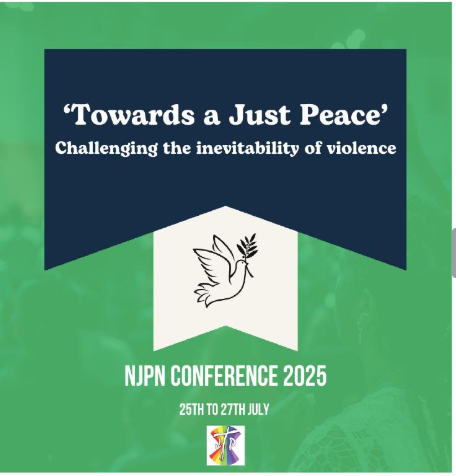
A little over a month ago, representatives from the Westminster Justice and Peace Commission attended the annual National Justice and Peace Network (NJPN) Conference, 25-27 July 2025, at The Hayes Conference Centre, Swanwick, Derbyshire. Two young adults from the Diocese received sponsored places to attend the Conference and recorded their impressions of the event.
The first report is by Alannah Travers, a postgraduate student at SOAS University
NJPN Conference 2025: Towards a Just Peace and challenging the inevitability of violence
I was delighted to attend the 2025 National Justice and Peace Network (NJPN) Conference, held from 25–27 July at The Hayes Conference Centre, Derbyshire. This year’s theme, “Towards a Just Peace: Challenging the Inevitability of Violence”, deeply connected with my own postgraduate research at SOAS University of London, where I study international humanitarian and human rights law with a focus on justice and accountability in post-conflict societies.
My place at the conference was generously funded through the Westminster Justice and Peace Commission’s initiative offering free places to young adults aged 18–35. I learned about the opportunity from Father Oscar Ardila, Catholic Chaplain at SOAS, whose encouragement I remain grateful for. As someone long interested in the intersection of peace, justice, and international law – especially in contexts such as Iraq – I was drawn to the conference’s commitment to confronting structures of violence and reimagining what peace might look like.
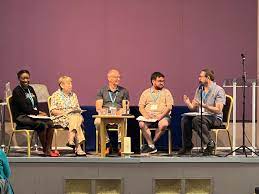
Throughout the weekend, I joined over 160 participants, including representatives from 17 dioceses, religious orders, Catholic agencies, and peace organisations, engaged in dialogue, worship, workshops, and collective action. Saturday’s powerful panel chaired by James Trewby (Columbans), with speakers including Andrew Jackson (Pax Christi) and Bokani Tshidzu (Operation Noah) challenged us to link spiritual non-violence to climate justice and community activism. The call to confront racialised climate injustice stood out as particularly urgent.
Another highlight was the contribution of Dr Joanna Frew from Rethinking Security, whom I have had the privilege of learning from in the past. I was grateful to attend her workshop, “A Just Peace After Empire?” held in a personal capacity. On Sunday she spoke on redefining “security” through cooperation, sustainability, and care, insisting that there is no security without a viable planet. As a Genocide is being committed in Gaza, Dr Frew’s call to move away from militarised logics of safety towards Gospel-rooted visions of peace felt especially timely this weekend.
The collective action component of the conference was also appreciated. Participants gathered for a symbolic “Red Line for Gaza” protest, condemning the systematic targeting and starvation of Palestinian civilians and calling on world leaders to uphold international law and human dignity. The visual display of solidarity, alongside prayers, petitions, and personal testimonies, demonstrated many participants’ holistic and spiritual approach to peace-making.
The weekend ended with an invitation to live out this year’s Jubilee theme as “pilgrims of hope.” I left feeling spiritually and intellectually renewed, grateful for the community of justice-seekers and the opportunity to reflect deeply on how I might integrate these values into both my academic work and wider life. I want to extend my sincere thanks to the Westminster Justice and Peace Commission, the NJPN team, and Father Oscar for supporting my participation.
Alannah Travers
 Diocese of Westminster Justice and Peace Commission