Bishop Jim Curry, Lead Bishop for the Holy Land for the Bishops’ Conference, has offered his reflections as the Holy Land Co-ordination pilgrimage passes its halfway point.
The Bishop delegates have learned of the struggles of Bedouin tribes in the West Bank and have celebrated Mass with the local Christians in Palestine’s only fully Christian town – Taybeh. They have listened to Jewish perspectives from groups like Rabbis for Human Rights and the Rossing Centre that advocates for interreligious peacebuilding. The group has also spent time with Hebrew-speaking Catholics at the Vicariate of St James in Jerusalem.
Many perspectives have been heard, and many experiences shared.
In a short video reflection, Bishop Curry processes what he’s heard over the past two days:
‘What we’re discovering is that Israel and Palestine – because of the 7 October attack, the war in Gaza, and the encroachment in the West Bank – are in a state of absolute shock and trauma. Communities have been paralysed. Conversations have stopped. And yet there are still small seeds of hope because communities and individuals are trying to reach out to each other, to re-engage with each other, to begin a process of healing – not ignoring what’s happened, seeking just solutions, seeking to embody the legitimate rights, both of Israel to security and safety, but also security and safety for the Palestinian people.
‘Because if those two peoples don’t have a mutual assurance of safety and respect, then the imbalance between them seems to promise yet more unease, more destructive behaviour, more a deterioration in the civic structure of this promised land.’
Solutions are in short supply, positions are entrenched, but Bishop Curry does recognise what true hope looks like:
‘The people we’ve met have shown a bravery, a faithfulness, a commitment to peace that is humbling. And the challenge they’ve given us is how can we be part of that peace? Hope is how we live. Hope is the choices we make. Hope is the way we treat each other. Hope is how we refrain from mistreating each other. Hope is who we are. And this land of promise is full of hope, but it’s a hope and a potential yet to be fully realised.’
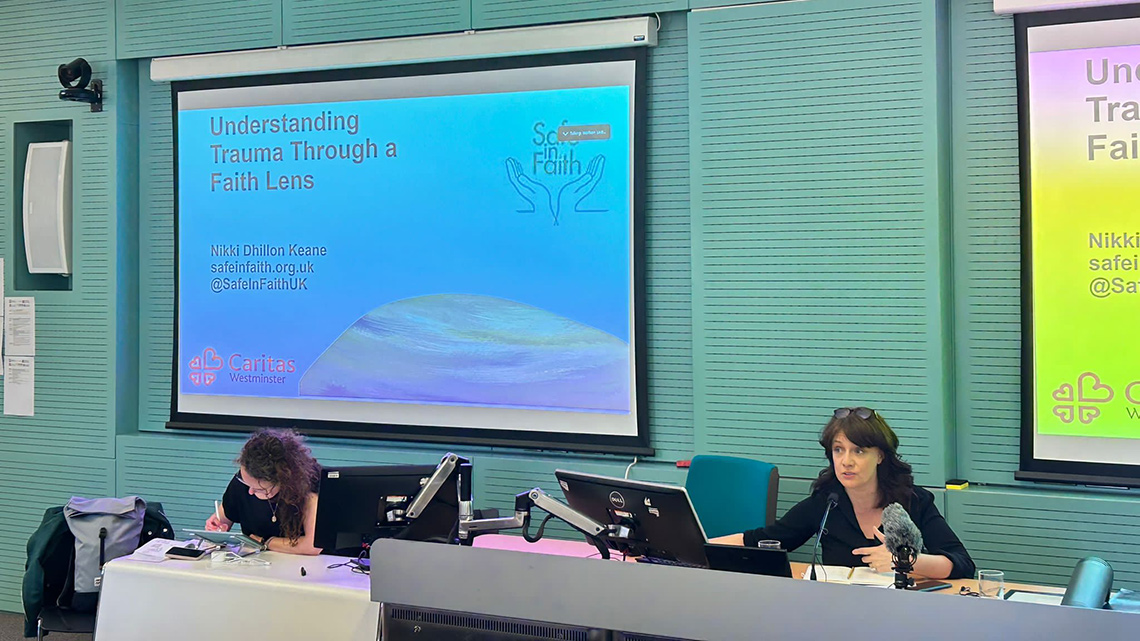
Nikki Dhillon Keane, founder of Safe in Faith UK, is a therapist who helps survivors of abuse and Head of Service at Caritas Safe in Faith on domestic abuse and assisted suicide.
‘The criminal justice system is just acknowledging the scale of possible criminal culpability in domestic abuse and suicide, while at the same time, a bunch of MPs seek to make it non-criminal.’
The questions raised by the proposed Terminally Ill Adults (End of Life) Bill are highly complex. It is difficult to imagine the deeply personal experience of terminal illness, for patients and their families. Raising questions about the safety of proposed legislation should in no way be viewed as a lack of compassion for people nearing the end of their lives; rather as an attempt to ensure that all people affected by this legislation, particularly the most vulnerable, are safe from harm.
There is one particularly vulnerable group for whom this legislation could significantly increase risk: victim/survivors of domestic abuse. Often invisible, they have, until very recently, been all but totally absent from the debate around assisted suicide. For many people being subjected to domestic abuse, however, this danger is all too evident.
Shortly after the evidence session of the Committee stage of the bill began. I found myself listening to Helena (not her real name), who was telling me why she was so worried about the bill: “It’s not for the same reason that other people have a problem with it,” she tells me.
Helena is a domestic abuse survivor, who used to live with her former husband in a country with legalised assisted dying. She explained her fear: “It is when your spouse wants to kill you, and the state gives them a totally legal way to do it…”
As a disabled woman, Helena had a higher risk of domestic abuse. In the UK, one in two deaf and disabled women experience domestic abuse during their lifetime. Helena continued: “My husband used to threaten to euthanise me if he got fed up with being my carer.” She tells me that legislation had expanded there to include chronic, not just terminal, illness – the all-too-familiar slippery slope.
For almost 20 years, Helena was subjected to coercive control by her then husband. Recognised in the UK as a criminal offence under the serious crimes act 2015, coercive control is the umbrella under which all the other forms of domestic abuse are perpetrated. Threats and isolation are common tactics, as is weaponising whatever is available for the perpetrator to gain and maintain control. If a victim has a disability or chronic illness, it is very common for that to be used by the perpetrator as part of the abuse, restricting access to medication, or aids such as wheelchairs or hearing aids. If the perpetrator also has the role of carer, escape – or even a chance to safely disclose abuse – can be almost impossible. Disability or illness can leave domestic abuse victims completely trapped with their abuser.
I have spent most of the last quarter century working with victim/survivors of domestic abuse. Coercive control, which tends to escalate slowly and subtly over time, can be extremely hard to recognise, even for those being subjected to it. It is even harder to prove. Any signs of physical harm are probably well hidden, or more often not present at all. Sometimes the first act of physical violence is the fatal one. More often, however, when domestic abuse becomes fatal, it is through suicide. An estimated three women take their life every week as a direct result of domestic abuse. A further 30 female domestic abuse survivors contemplate suicide every day. Recognition of the causal link between domestic abuse and suicide is a very recent development in British law. Domestic Abuse Related Death Reviews (which unlike Domestic Homicide Reviews, investigate domestic abuse related suicide) were only introduced in May 2024. While this development is welcome, most health and social work professionals receive little or no training in coercive control, missing opportunities to prevent further deaths.
Proposed amendments to the assisted suicide bill would require mandatory training for professionals to help them spot coercion. Most likely, this is intended as an important protection against relatives, motivated perhaps by thoughts of a dwindling inheritance, gently pressuring a terminally ill relative to consider the option of a swift assisted death, rather than expensive palliative care. However, training to help professionals recognise a terminally ill person wishing for death as the only escape from the torment of abuse is a more complex matter.
Macmillan Cancer Support has released a toolkit for professionals working with cancer patients to help them recognise domestic abuse. Just as they do with disabilities, domestic abuse perpetrators tend to weaponise critical or terminal illness as part of their abuse. Domestic abuse victims and perpetrators can be any age. Sometimes perpetrators abuse their spouse for decades. We need to be aware that there is a very real possibility that someone nearing the end of their life may also be a victim of domestic abuse, and that this is likely to affect decisions about assisted suicide.
Given the high levels of suicidality among victims, and the control that abusers have over them, it is easy to see how assisted suicide legislation could be twisted into a method for perpetrators to kill their spouse with impunity. Prof Jane Monkton-Smith, a specialist in fatal coercive control, has shared her fears about the bill on social media: “The CJS [criminal justice system] is just acknowledging the scale of possible criminal culpability in domestic abuse and suicide, whilst at the same time, a bunch of MPs seek to make it non-criminal.”
Currently, in the UK, a woman is murdered by her partner or former partner every five days. In countries where assisted suicide is legalised there is (perhaps unsurprisingly) a significant lack of research into any potential links between legally assisted suicides and domestic abuse. However, there is information from the UK regarding so-called “mercy killings”. This is a term used to describe someone being killed illegally but with the claimed intent to relieve suffering. A disturbing review of over 100 UK mercy killings by the research centre The Other Half found that “mercy killings are not the wanted, hastened deaths that need assisted dying. They are overwhelmingly violent domestic homicides of women by men”.
Whatever views people may have about what it means to die with dignity, it is clear that there are serious risks which would arise from passing the assisted suicide bill into legislation. As Helena put it: “I just don’t want anyone living with the fear and threats that I had. Whatever we do, we need to make sure that we don’t open the door to another way for men to harm women and get away with it.”
Cardinal Vincent Nichols, Archbishop of Westminster, has co-signed a multi-faith letter ahead of the assisted suicide vote in parliament on Friday:
As leaders of faith communities we wish to express our concern at the Terminally Ill Adults (End of Life) bill, which will be debated by MPs on 29th November. We are aware of how complex and weighty this topic is. There are many dimensions to the bill, all of them of great ethical and practical importance. We hold in prayer all those across our country who may be personally affected, and our representatives in Parliament with profound decisions before them.
Part of the role of faith leaders in communities is to provide spiritual and pastoral care for the sick and for the dying. We hold the hands of loved ones in their final days, we pray with families both before and after death. It is to this vocation that we have been called, and it is from this vocation that we write.
Our pastoral roles make us deeply concerned about the impact the bill would have on the most vulnerable, opening up the possibility of life-threating abuse and coercion. This is a concern we know is shared by many people, with and without faith.
In the UK, it is estimated that 2.7 million older people have been subjected to abuse; many of these may also be vulnerable to pressure to end their lives prematurely. Disability campaigners and those working with women in abusive relationships have also highlighted the danger of unintended consequences should the law be changed. The experience of jurisdictions which have introduced similar legislation, such as Oregon and Canada, demonstrate how tragic these unintended consequences can be. Promised safeguards have not always protected the vulnerable and marginalised.
Even when surrounded by loving family and friends, people towards the end of their life can still feel like a burden. This is especially the case while adult social care remains underfunded. In this environment, it is easy to see how a ‘right to die’ could all too easily end in feeling you have a duty to die.
We are convinced that the current law provides much greater security for those who are vulnerable than the bill before Parliament. A bill which MPs will have had only three weeks to scrutinise before they vote on it. The most effective safeguard against life-threatening coercion or abuse is to keep the law as it is.
In supporting the state of the current law, we do not deny that some people experience a painful death, though we welcome the fact that these deaths are far less common than they used to be due to advances in palliative care.
Over decades we have witnessed how compassionate care, along with the natural processes of dying, allow those at the end of their life to experience important moments. We have seen relationships repair and families reconcile. We have seen lives end in love. Much can be lost by cutting these processes short.
We believe that a truly compassionate response to the end of life lies in the provision of high-quality palliative care services to all who need them. While there are many examples of excellent palliative care in this country, it remains worryingly underfunded. Investment in palliative care is the policy of a truly compassionate nation. It is the way to ensure that everyone in society, including the most vulnerable, receive the care they deserve at the end of life.
Sarah Mullally, Bishop of London and former Chief Nursing Officer; Cardinal Vincent Nichols Archbishop of Westminster; Ephraim Mirvis, Chief Rabbi of the United Hebrew Congregations of the Commonwealth. Sayed Abdul Saheb Al-Khoei, Secretary General of Al-Khoei Foundation; Archbishop Angaelos, Coptic Orthodox Church; Imam Qari Asim, Chair of MINAB (Mosques and Imams Advisory Board); Glyn Barrett, National Leader Assemblies of God; Anil Bhanot, Managing Trustee of the Hindu Council UK; Gavin Calver, CEO of Evangelical Alliance; Malcolm Deboo, President, Zoroastrian Trust Funds of Europe; Joseph Dweck, Senior Rabbi of the Spanish & Portuguese Sephardi Community; Pinchas Hackenbroch, Chair of the Rabbinical Council; Ross Hendry, CEO of CARE (Christian Action, Research and Education); Trevor Howard, Executive Vice-Chair of the Board, Churches in Communities International; Andrew John, Archbishop of Church in Wales; Nikitas Lulias, Archbishop of Great Britain, Greek Orthodox Church; Paul Main and Jenine Main, Territorial Leaders of The Salvation Army in the United Kingdom and Ireland; Patrick McKinney, Bishop of Nottingham, Roman Catholic Church; Zara Mohammed, Secretary General of the Muslim Council of Britain; Bhai Sahib Mohinder Singh Ahluwalia, Spiritual Leader & Chair, Guru Nanak Nishkam Sewak Jatha; Trupti Patel, President of the Hindu Forum of Britain; Mark Pugh, General Superintendent of Elim Pentecostal Churches; Mehool Sanghrajka, Chair of the Institute of Jainology; Venerable Bogoda Seelawimala, President of Sri Lankan Sangha Sabha of GB; Lord Singh of Wimbledon, Director of the Network of Sikh Organisations UK; Jonathan Wittenberg, Senior Rabbi of Masorti Judaism; Mar Awraham Youkhanis, Bishop of London, Assyrian Church of the East.
In response to COP29’s final statement, Christian Aid has said: “People of the global south came to these talks needing a lifeboat out of the climate crisis. But all they got was a plank of wood to cling to.
“This summit has been hijacked by rich countries who have failed to negotiate in good faith. The cost of their actions here will be paid in the lives of vulnerable people on the front lines of climate breakdown.
“Developing countries are already responding day in and day out to the climate emergency, dealing with homes, crops and livelihoods destroyed due to droughts, storms and floods. They came here seeking solidarity and partnership to tackle a problem they didn’t create, but have left with scraps.
“Finance is the cornerstone of climate action. It is essential to help developing countries deal with the impacts of climate change. This level of funding simply won’t cut it.
“Rich countries knew they had all year to prepare for this meeting, where they were required by the Paris Agreement to agree a new finance goal that met the needs of the developing world. They have failed to do that with this paltry finance offer.”
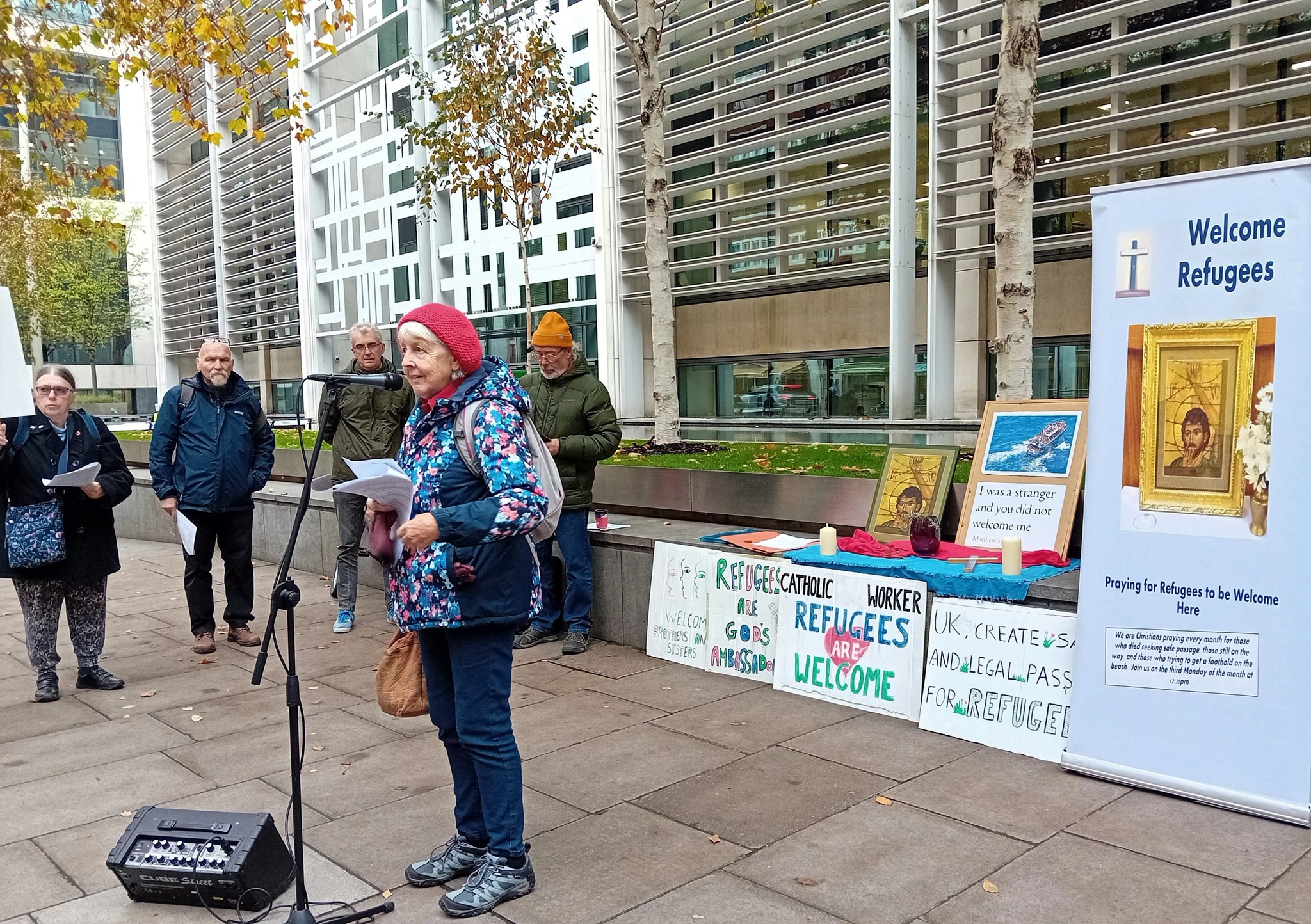
Barbara Kentish outside the Home Office 18 Nov 2024. Photo: Pat Gaffney
This month those gathered at the regular Prayer Vigil outside the Home Office remembered the following people who died a year ago, in November 2023, attempting to reach sanctuary in Europe:
Date
Details
?
8 people from Gambia died of exhaustion during a 15-day boat journey from Gambia to the Canaries. Their bodies were thrown in the sea; 55 survived.
3/11
A boy died from exhaustion in hospital, having arrived at El Hierro (Spain) by boat from West Africa one day earlier; 83 survived.
4/11
134 people from Senegal, including at least 3 children and 6 women, drowned when a Canaries-bound boat on the way from Senegal sank off Nouadhibou (Morocco);15 191 survived. 2 people died of unknown cause, their bodies found on board a boat during rescue off the Canary island of El Hierro. 2 others died on the way to hospital. A man of 23 from Syria died, his body found by nature researchers in Białowieża Forest (Poland) near Narewka River at the Poland-Belarus border.
5/11
15 people were presumed drowned off Nouadhibou (Morocco), missing from 7 canoes on the way from Senegal to the Canaries. 13 people, including 2 children, from sub-Saharan Africa died of hunger and thirst on the way to Spain, their bodies in state of decay found in boats off Nouadhibou. A body, probably of a woman, wearing a white shirt & tied to a tire used as a life vest was found between rocks on the coast of Lampedusa (Italy).
6/11
Dinh Anh Nguyen, a man of 37 from Vietnam, was hit by a train near Calais (France) while walking on railway tracks in the dark. 182 people from Guinea, Mali, and Senegal drowned off Gadaye (Senegal) on the way from Bargny (Senegal) to the Canary Islands (Spain). 87 survived.
8/11
17 people from Algeria drowned when a boat went missing on the way to Murcia (Spain) after embarkation from Mostaganem (Algeria). 2 men, both aged around 30, drowned off Gadaye (Senegal) on the way to the Canary Islands, their bodies found at Diamalaye beach (Senegal); 87 survived.
9/11
A body was found by the Spanish Civil Guard, after a boat from West Africa arrived south of El Hierro (Spain); 79 survived. Mohammed Amine Saidat, a man of 26 from Morocco, was hit by a train in Bolzano (Italy) while looking for shelter for the night. He had camped near the site of his death.
10/11
A man’s body was found by journalists while reporting in the Kupa Riverbed in Netretić (Croatia) on the Croatia-Slovenia border.
11/11
7 people, including an infant, drowned, their bodies recovered in the Mediterranean Sea off Sfax (Tunisia) by the Tunisian National Guard. 2 people from sub-Saharan Africa drowned on the way from Sfax (Tunisia) to Lampedusa (Italy) when they fell from a small boat when rescuers neared; 67 survived.
12/11
A body was found by Belarus border guards in Belarus near the 82nd Belarusian pillar of the border fence with Latvia. A man of about 30 from sub-Saharan Africa drowned off Gadaye (Senegal) on the way to the Canary Islands, his body found at Déni Guedj Nord beach (Senegal); 87 survived. A man of 29 from Eritrea died of unknown causes on the way to Lampedusa (Italy), his body found on board a boat by Italian coast guards.
13/11
7 people from Liberia, Palestine, Syria and elsewhere, including a child and 2 women, drowned when a rubber boat on the way to Chios (Greece) sank in stormy weather off Cesme (Turkey); 6 survived. Abdelbassit Mohammad, a man of 22 from Sudan, had his throat slit during a brawl between migrants under the Mollien bridge in Calais; his attacker fled.
14/11
11 people from Algeria drowned in the Mediterranean sea, off Murcia (Spain) on the way from Mostaganem (Algeria). 16 people drowned when a boat hit rocks on the way from Senegal to the Canaries (Spain), their bodies found on a beach of Lagouera (Morocco).
15/11
A person from Gambia died of exhaustion during a 15-day boat journey from Gambia to the Canaries, their body found during rescue; 55 survived. 19 people from Algeria drowned when a boat missing on the way to the Balearic Islands (Spain) after embarkation from Algiers (Algeria).
Mid Nov.
A person died of unknown causes on the way from Africa to Lampedusa (Italy), buried in Palma on the island of Sicily.
16/11
19 people from Algeria drowned when a boat went missing on the way to the Balearic Islands (Spain) after embarkation from Algiers (Algeria).
17/11
35 people, including 2 children and 5 women, from Morocco and sub-Saharan Africa, drowned, when a boat capsized in high waves south of Guelmim (Morcco) on the way to the Canaries; 10 survived. Baysal Recep, a man of 42, and Geçsöyler Mehmet Ali, a man of 37, both from Turkish Kurdistan, were hit by a truck and killed while walking on the emergency lane of the A16 near the Calais ferry terminal. An Albanian man of 37 died in hospital after attempting suicide in Brook House removal centre in Gatwick in fear of deportation.
19/11
18 people from north Africa went missing on the way to Alicante (Spain) after embarkation from Tipaza (Algeria).
20/11
A girl of 2 from Guinea died of unknown causes on a rescue ship on the way to port after shipwreck off Capo Ponente (Italy); 43 survived 8 people from sub-Saharan Africa, including 2 children, drowned on the way from Sfax (Tunisia) to Lampedusa (Italy) after shipwreck off Capo Ponente (Italy); 43 survived.
21/11
A woman of 36 drowned off Lampedusa (Italy) on the way from Sfax (Tunisia) when a metal boat sank during rescue; 46 people, including her sister, survived.
22/11
Mulu Wolde Tsehaye, a woman of 34, and Eskiel Sebsbea Tsgaye, a woman of 37, both from Ethiopia, and a man named Aman, drowned when a Britain-bound boat capsized after leaving a beach near Equihen-Plage (France); 58 survived.
26/11
Mikhail Zubchenko, a man of 24 from Russia, committed suicide after 14 months in Asylum Seekers Center in Echt (Netherland). He was a LGBT asylum seeker.
27/11
A person from Egypt was found frozen to death in the outskirts of Sofia (Bulgaria), part of group of 10 migrants; 9 survived.
29/11
A body was found on an inflatable boat during rescue off Gran Canaria (Spain); 50 survived. 2 people drowned, having been thrown into the sea near Cadiz (Spain) by traffickers using a fast drugs-smuggling boat from Morocco; 23 survived.
The evening of 14th November 2024 saw the third Diocese of Westminster ‘Love in Action’ Volunteering Awards, hosted by Caritas Westminster in Westminster Cathedral Hall. The event recognised volunteers from across the diocese for outstanding commitment to voluntary service, with finalists selected from a pool of over 60 nominations.
The ceremony opened with a welcome from Cardinal Vincent Nichols and Richard Harries, Director of Caritas Westminster, and included a speech by previous award-winner, Sharon Joseph.
Awards were distributed by Bishop Paul McAleenan, Chair of Caritas Westminster, with finalists, their nominators, family and friends joined by staff and supporters of Caritas Westminster.
The five categories recognised individuals and groups of volunteers who serve in a variety of contexts; from social action initiatives in parishes and schools to young volunteers, lifetime achievement and fulfilling a range of tasks for their communities.
Addressing the finalists, Bishop Paul said: ‘This evening is an acknowledgment of your achievements, and an affirmation of everything that you do. Thank you to all the participants for your great generosity in reaching out to others, and for bringing your goodness into the world.’
Winners included primary school students who participated in the Caritas Ambassadors programme, Sixth Form pupils involved in student chaplaincy, long-serving parishioners who are the backbone of their communities, and two projects founded during the pandemic to support the homeless and vulnerable.
The Young Volunteer of the Year Award went to Kai Shah, who at just 11 years old has already shown great dedication to preparing meals for and serving the homeless. This year’s Lifetime Achievement Award was named after Ernest Bernard Ronald Palmer, who volunteered at Caritas St Joseph’s for almost 40 years until the age of 103. The award was given to Mary Foster, for 50 years of service to her parish and for co-founding the charity Acton Homeless Concern.
‘Volunteers bring to life the Church’s teaching on the ministry of charity, and it is a privilege for Caritas Westminster to celebrate the efforts of parishioners who have gone the extra mile in loving their neighbours,’ said Richard Harries. ‘This year’s finalists are wonderful examples of love in action, and we are excited to support them and thousands of other social action volunteers across the diocese in the coming year.’
Meet the winners for each category here, or read about all of this year’s finalists here.
Faith representatives outside British Museum before the start of the march. Photo: ICN
Source: Jo Siedlecka, ICN
Faith groups were among thousands of climate justice campaigners who marched peacefully through central London on Saturday 16 November 2024, accompanied by colourful banners, chanting and drumming. They lobbied the UK government and world leaders to work towards climate justice, and to do it urgently. They included representatives of Christian Climate Action, Green Christian, Laudato Si Movement, Columban Justice, Peace and Ecology Team, Columban Sisters, Faithful Companion of Jesus Sisters, Quakers in Britain and Faith for the Climate Network.
The march was part of an annual Global Day of Action for Climate Justice which always takes place midway through the annual international United Nations Climate Conference, which this year is in Baku, Azerbaijan 11- 22 November. Other marches lobbied COP29 in 25 places across Britain, including Brighton, Southampton, Birmingham, Manchester, Newcastle, and Glasgow.
The London march – organised by more than 60 groups – started at the British Museum, which has a £50 million partnership with the oil company BP. Speakers argued that the fossil fuel industry has no place in the arts. And the route was via the HQ of Azerbaijani oil company SOCAR, co-owner of the BTC pipeline with BP, which supplies nearly 30% of Israel’s oil.
At its end in Downing Street, a rally called for the UK government to end its reliance on fossil fuels and to commit to paying climate reparations…
Fossil fuel companies should be taxed more to provide funds for countries on the frontline of the climate crisis, Anglican and Catholic bishops have told ministers.
In a letter to the government, the Rt Rev Graham Usher for the Church of England and Rt Rev John Arnold for the Catholic Church in England and Wales called for higher taxes on major polluters. The pair are lead bishops for environmental affairs in their respective churches.
The letter comes ahead of the start of the COP29 climate talks in Azerbaijan next week. Proposals to tax large polluters are expected to be included in negotiations at the summit on how to fill gaps in funding for developing countries hardest hit by the climate emergency – known as ‘international climate finance’.
Poorest communities ‘paying impossible price’ for climate crisis
Bishops Usher and Arnold argue in the letter that the funding gap means climate-vulnerable countries are “being forced to pay an impossible price for measures to protect their communities and rebuild from climate disasters”.
“The fact that those who have contributed least to causing the climate crisis, face an unaffordable bill for its impacts is an injustice we cannot tolerate as a country.
“We urge you to ensure your government plays the strongest possible role in remedying this injustice.”
Tax those ‘profiting from environmental damage’
Taxing polluting activities undertaken by the wealthiest companies and individuals would raise funds from those who are “profiting from environmental damage” and “help to incentivise the transition to renewables”, the bishops state.
The bishops also warn ministers that leaders at COP29 must agree to provide more climate finance as grants, arguing that loans will only “add to low-income countries’ existing and crippling debts”.
Providing further sources of finance by cancelling debts for countries facing a debt crisis would prevent such countries facing a “choice between paying huge interest bills to overseas lenders and paying to protect their communities from the climate crisis”, the bishops argue.
COP29 began in Baku, Azerbaijan on 11 November, and is due to finish on 22 November.
Christians gathered for ecumenical prayers in St Matthews Church, Westminster, on Saturday, before joining the Christian Bloc on the latest National March for Palestine.
After a welcome by the Rector of St Matthews, Fr Philip Chester, this gathering statement was read, reminding all that it was All Souls Day when the Church comes together to remember all who have died:
“This day also marks the 107th anniversary of the Balfour Declaration… which was instrumental in the creation of the state of Israel, the dispossession of the Palestinian people and many decades of oppression and violence.
“With lament we recall the role played by Christian Zionist theology in this dark history. This same theology continues to be employed today as a pretext for ongoing ethnic cleansing, apartheid and genocide.
As we gather for prayers on this All Souls Day – mourning every life taken in Gaza, in the West Bank, in Lebanon and across the Middle East – we refuse to let our faith be used to justify so many atrocities. We are united in our belief in a gospel of liberation. None of us are free until all are free.”
After the service ended, participants from many denominations, including Anglicans, Catholics, Methodists, Quakers (and two dogs) processed out to join the main march to the American Embassy, led by a drummer.
One of the marchers, Jenny Rossiter from Kentish Town told ICN: “I had to join the service on All Souls Day to remember all those lives that have been cut short by this hideous conflict.”
Dr Timothy Howles, the Associate director Laudato Si’ Research Institute (LRSI) at Campion Hall, Oxford, addressed the most recent meeting of the Southern Dioceses Environment Network on 14 October 2024.
Tim told us that the LRSI is a Catholic institute, set up by the Jesuits, but he is an ordained Anglican priest, and happy to be working in this project in an ecumenical way.
His slides covered the integral ecology paradigm which is increasingly used in Higher Education but with the theological basis found in Pope Francis’ 2015 encyclical, Laudato Si’.
Laudato Si’ stresses the need for an ecological conversion for all of us (LS 217) and invites us to care for those who are on the margins (LS62). Scientists are frustrated that their data is being ignored so as Prof Chris Rapley says, “We have to change who people are, we have to give them epiphanies”.
LS25 focuses on the idea of interconnectedness, that “we ourselves are part of nature,” and so have responsibility for the delicate equilibria of the world.
The Institute produces resources and books such “Faith-based participation in natural resource governance”, “Integral ecology approaches to the new science of gene drives”, “Endangered languages in North East India”.
They also host talks such as the upcoming lecture by Dr Vijay d’Souza SJ, who will be in Oxford for a lecture on 13 November, 5.30 – 6.30pm, which is both in-person and on livestream.
Future Meetings
Next month, we are pleased to welcome back Dr Emma Gardner, Head of Environment for the Diocese of Salford, who will tell us a little more about the work she does at the Laudato Si’ Centre, the beautiful project at Wardley Hall, near Manchester. For more details visits:





 Diocese of Westminster Justice and Peace Commission