Fr Romanelli (centre) on a visit to London last year with Bishop Nicholas Hudson (l). Photo: ICN
Pax Christi England and Wales
Pax Christi England and Wales and Pax Christi International have issued the following statements in response to the deadly attack on the Holy Family Church in Gaza yesterday.
This morning’s horrific news that the Israel Defence Forces (IDF) struck the Holy Family Church in Gaza is both shocking and shameful. We know that at least six people are injured, including Fr Romanelli, and that two people have been killed. Lord have mercy.
If we are ever to overcome the myth of redemptive violence, then our response is never revenge.
Our response is never apathy. Our response is never neutrality. Instead, we dare to proclaim the revolutionary power of Jesus’ way of nonviolence. The way of the cross, the way of redemptive suffering, that ultimately leads to joy, hope, peace and resurrection.
Today it might seem that we are in the darkness of the tomb. Yet even inside the tomb something is happening. Young people in Tel Aviv are burning their draft cards and refusing to fight for the IDF. Across the world people are non-violently resisting the sale of arms to Israel. Acts of solidarity, prayer and fasting are the tools by which we bring about a revolution of the heart – one person at a time.
Let us never forget the power we each have to make a difference. The works of war destroy lives, land, and futures. The works of mercy support life and bring hope. Let’s commit ourselves afresh to pray and act in every way possible to make real our solidarity with the suffering people of Gaza and bring an end to this genocide in which the UK government is complicit.
Pax Christi International
Pax Christi International supports the Latin Patriarchate in Jerusalem and strongly condemns today’s Israeli military strike on Holy Family Catholic Church in Gaza, a place of sanctuary for displaced civilians.
We stand in solidarity and prayer with all those Christians and Muslims sheltering in the parish compound.
We mourn those who have died, Mr Saad Salameh, Mrs Fumayya Ayaad and Najwa Abu Daoud. We pray that they will rest in peace and send our deepest condolences to their families and friends. We hope for a good recovery for Fr Gabriel and all those injured in the attack.
We echo Pope Leo XIV and the Latin Patriarchate in calling for an immediate and permanent ceasefire in Gaza.
As the Patriarch has said, ‘The time has come for leaders to raise their voices and to do all that is necessary in order to stop this tragedy, which is humanly and morally unjustified.’
Pax Christi calls on the international community, political and religious, to raise their voices and take urgent action to protect all civilians and humanitarian spaces to enable:
– An immediate and permanent ceasefire and immediate access to humanitarian aid for everyone in Gaza, to be distributed through UNWRA and other experienced NGOs; -The release of all hostages, Israeli and Palestinian; -A complete arms embargo on Israel; -An end to all trade with illegal Israeli settlements; -An end to the Israeli siege on Gaza and the occupation of the West Bank.
Following the recent publication of the government’s White Paper on immigration, Bishop Paul McAleenan, Lead Bishop for Migrants and Refugees, called on the government to reconsider the important role of immigration in shaping our shared history, and highlighted the vital contribution of those in low-wage, low-skilled employment.
Bishop McAleenan said:
“Whilst the Government’s commitment to skills training and education is understandable, I urge the government to carefully consider its approach to so-called ‘low-skilled work’ which is often carried out by those who come from abroad.
“We must remember the words of Pope Francis in Fratelli tutti, written in the wake of the Covid-19 pandemic: ‘…our lives are interwoven with and sustained by ordinary people valiantly shaping the decisive events of our shared history: doctors, nurses, pharmacists, storekeepers and supermarket workers, cleaning personnel, caretakers, transport workers, men and women working to provide essential services and public safety, volunteers, priests and religious… They understood that no one is saved alone.’
“The essential work carried out every day by people in low-paid, low-skilled roles must be recognised and valued. For many migrants, such jobs are the first step on the way to becoming fully integrated into our society. Without their contribution, dedication and hard work, our hospitals, schools, and care homes might not be able to function. The Catholic Church in England and Wales has been enriched by migrants throughout its recent history. Our ethnic chaplaincies, eparchies and schools have been models of integration.
“I also appeal to our political leaders, of all parties, whom we have entrusted with shaping the future of our country, to refrain from using rhetoric that risks sowing mistrust, fear, or division. Such language is unhelpful and serves only to create unnecessary fractures within our communities.
“To our Catholic community and all people of goodwill, I encourage you to welcome migrants into your communities with open hearts, offering friendship and support. In doing so, we help ensure that no one is left behind, undervalued or made to feel isolated.”
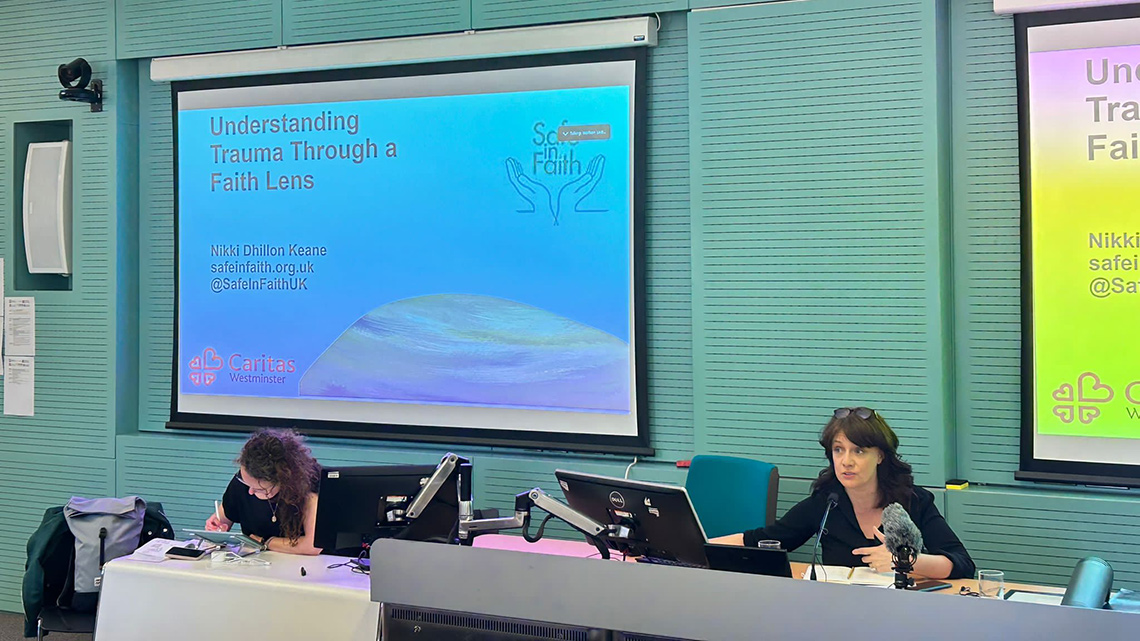
Nikki Dhillon Keane, founder of Safe in Faith UK, is a therapist who helps survivors of abuse and Head of Service at Caritas Safe in Faith on domestic abuse and assisted suicide.
‘The criminal justice system is just acknowledging the scale of possible criminal culpability in domestic abuse and suicide, while at the same time, a bunch of MPs seek to make it non-criminal.’
The questions raised by the proposed Terminally Ill Adults (End of Life) Bill are highly complex. It is difficult to imagine the deeply personal experience of terminal illness, for patients and their families. Raising questions about the safety of proposed legislation should in no way be viewed as a lack of compassion for people nearing the end of their lives; rather as an attempt to ensure that all people affected by this legislation, particularly the most vulnerable, are safe from harm.
There is one particularly vulnerable group for whom this legislation could significantly increase risk: victim/survivors of domestic abuse. Often invisible, they have, until very recently, been all but totally absent from the debate around assisted suicide. For many people being subjected to domestic abuse, however, this danger is all too evident.
Shortly after the evidence session of the Committee stage of the bill began. I found myself listening to Helena (not her real name), who was telling me why she was so worried about the bill: “It’s not for the same reason that other people have a problem with it,” she tells me.
Helena is a domestic abuse survivor, who used to live with her former husband in a country with legalised assisted dying. She explained her fear: “It is when your spouse wants to kill you, and the state gives them a totally legal way to do it…”
As a disabled woman, Helena had a higher risk of domestic abuse. In the UK, one in two deaf and disabled women experience domestic abuse during their lifetime. Helena continued: “My husband used to threaten to euthanise me if he got fed up with being my carer.” She tells me that legislation had expanded there to include chronic, not just terminal, illness – the all-too-familiar slippery slope.
For almost 20 years, Helena was subjected to coercive control by her then husband. Recognised in the UK as a criminal offence under the serious crimes act 2015, coercive control is the umbrella under which all the other forms of domestic abuse are perpetrated. Threats and isolation are common tactics, as is weaponising whatever is available for the perpetrator to gain and maintain control. If a victim has a disability or chronic illness, it is very common for that to be used by the perpetrator as part of the abuse, restricting access to medication, or aids such as wheelchairs or hearing aids. If the perpetrator also has the role of carer, escape – or even a chance to safely disclose abuse – can be almost impossible. Disability or illness can leave domestic abuse victims completely trapped with their abuser.
I have spent most of the last quarter century working with victim/survivors of domestic abuse. Coercive control, which tends to escalate slowly and subtly over time, can be extremely hard to recognise, even for those being subjected to it. It is even harder to prove. Any signs of physical harm are probably well hidden, or more often not present at all. Sometimes the first act of physical violence is the fatal one. More often, however, when domestic abuse becomes fatal, it is through suicide. An estimated three women take their life every week as a direct result of domestic abuse. A further 30 female domestic abuse survivors contemplate suicide every day. Recognition of the causal link between domestic abuse and suicide is a very recent development in British law. Domestic Abuse Related Death Reviews (which unlike Domestic Homicide Reviews, investigate domestic abuse related suicide) were only introduced in May 2024. While this development is welcome, most health and social work professionals receive little or no training in coercive control, missing opportunities to prevent further deaths.
Proposed amendments to the assisted suicide bill would require mandatory training for professionals to help them spot coercion. Most likely, this is intended as an important protection against relatives, motivated perhaps by thoughts of a dwindling inheritance, gently pressuring a terminally ill relative to consider the option of a swift assisted death, rather than expensive palliative care. However, training to help professionals recognise a terminally ill person wishing for death as the only escape from the torment of abuse is a more complex matter.
Macmillan Cancer Support has released a toolkit for professionals working with cancer patients to help them recognise domestic abuse. Just as they do with disabilities, domestic abuse perpetrators tend to weaponise critical or terminal illness as part of their abuse. Domestic abuse victims and perpetrators can be any age. Sometimes perpetrators abuse their spouse for decades. We need to be aware that there is a very real possibility that someone nearing the end of their life may also be a victim of domestic abuse, and that this is likely to affect decisions about assisted suicide.
Given the high levels of suicidality among victims, and the control that abusers have over them, it is easy to see how assisted suicide legislation could be twisted into a method for perpetrators to kill their spouse with impunity. Prof Jane Monkton-Smith, a specialist in fatal coercive control, has shared her fears about the bill on social media: “The CJS [criminal justice system] is just acknowledging the scale of possible criminal culpability in domestic abuse and suicide, whilst at the same time, a bunch of MPs seek to make it non-criminal.”
Currently, in the UK, a woman is murdered by her partner or former partner every five days. In countries where assisted suicide is legalised there is (perhaps unsurprisingly) a significant lack of research into any potential links between legally assisted suicides and domestic abuse. However, there is information from the UK regarding so-called “mercy killings”. This is a term used to describe someone being killed illegally but with the claimed intent to relieve suffering. A disturbing review of over 100 UK mercy killings by the research centre The Other Half found that “mercy killings are not the wanted, hastened deaths that need assisted dying. They are overwhelmingly violent domestic homicides of women by men”.
Whatever views people may have about what it means to die with dignity, it is clear that there are serious risks which would arise from passing the assisted suicide bill into legislation. As Helena put it: “I just don’t want anyone living with the fear and threats that I had. Whatever we do, we need to make sure that we don’t open the door to another way for men to harm women and get away with it.”
In the context of increasing complexity and geopolitical uncertainty surrounding peace in Ukraine, the Presidency of the Commission of the Bishops’ Conferences of the European Union (COMECE) issued a statement on Tuesday, 4 March 2025, expressing strong support for Ukraine.
“Ukraine’s struggle for peace will also be decisive for the fate of Europe and the world.” COMECE
The statement emphasises that “Ukraine’s struggle for peace and the defence of its territorial integrity is not only a fight for its own future. Its outcome will also be decisive for the fate of the entire European continent and of a free and democratic world.”
In a geopolitical landscape that the EU bishops describe as “complex” and marked by “the unpredictability of actions taken by some members of the international community”, the Presidency of COMECE calls on the European Union and its Member States to remain united in their commitment to supporting Ukraine and its people.
“Russia’s invasion of Ukraine is a blatant violation of international law. The use of force to alter national borders and the atrocious acts committed against the civilian population are not only unjustifiable but demand a consequent pursuit of justice and accountability,” the statement reads.
The EU bishops affirm that a comprehensive, just, and lasting peace in Ukraine can only be achieved through negotiations, which should be backed by strong transatlantic and global solidarity and must involve Ukraine. “In order to be sustainable and just – state the EU bishops – a future peace accord must fully respect international law and be underpinned by effective security guarantees to prevent the conflict from re-erupting.”
Furthermore, COMECE urges the international community to “continue to assist Ukraine in the reconstruction of the destroyed infrastructure” and specifies that Russia “must adequately participate in this effort.” The Presidency of COMECE emphasises that Ukraine is the victim in this war and Russia the aggressor, stressing that any attempts to distort the reality of this aggression must be firmly rejected.
Regarding Ukraine’s request to join the European Union and the internal reforms undertaken to achieve this goal, the EU bishops call on the EU “to advance with the enlargement process in a timely and fair manner alongside other candidate countries.”
The statement concludes by expressing hope that the European Union “will remain faithful to its vocation to be a promise of peace and an anchor of stability to its neighbourhood and to the world”, particularly at a time when the contours of a new global security architecture are being redrawn.
The declaration follows the recent interview (read the interview: EN – IT) with H.E. Mgr. Mariano Crociata, released last week to mark the third anniversary of Russia’s invasion of Ukraine. In the interview, the President of COMECE not only underscored the need for a just and lasting peace in Ukraine but also warned against “a disgraceful spectacle” that falsely portrays the victim as the aggressor.
Faith leaders hold vigil outside Foreign Office, calling on government to show leadership on climate justice
Source: Quakers in Britain
At a vigil outside the Foreign Office on Tuesday, Christian, Muslim, Hindu, Jewish, Sikh, and Buddhist representatives handed in a letter to Foreign Secretary David Lammy. Catholic signatories included Bishop John Arnold (Salford), spokesman on the environment for the Catholic Bishops Conference of England and Wales, and Colette Joyce, the Westminster Justice and Peace Co-ordinator.
The letter asks the foreign secretary to take the initiative at upcoming COP29 by contributing new funding to the International Loss and Damage Fund.
It’s time for the UK – and its wealthiest polluters – to pay our fair share- faith leaders
It must do this in the form of grants not loans and by taxing pollution and wealth, rather than repurposing official development assistance, the letter, co-ordinated by Quakers in Britain and the Faith for the Climate network, says.
The 21 signatories call on the UK government to champion a new “collective quantified goal” for climate finance for developing countries, including sufficient funding to respond to loss and damage.
“Our call to Make Polluters Pay is partly about our history,” the letter says. “When we factor in Britain’s colonial past, the UK is the fourth largest contributor to climate change.”
It is also about our present, faith leaders including Paul Parker, recording clerk of Quakers in Britain, write.
Two fossil fuel giants, Shell and BP, are based here, enjoying record-breaking profits.
“Meanwhile, many British households are struggling to heat their homes. At the same time, communities all around the world are being devastated by extreme weather events, such as flooding, super storms and forest fires.
“These inequalities need to be redressed, to acknowledge the intrinsic value of every living being on our precious and finite earth.”
The faith leaders conclude, “It’s time for the UK – and its wealthiest polluters – to pay our fair share.”
By Maggie Beirne, West London Justice and Peace Network Co-ordinator
“There is so much going on!” – the positive reaction of one of the participants at this weekend’s meeting online of the West London Justice and Peace Network.
Representatives of 10 parishes were joined by Richard Harries, CEO of Caritas Westminster, which encourages parishes to engage with their own social action projects. Also, Sr Silvana Dallanegra, a Religious of the Sacred Heart and a Development Worker of Caritas Westminster, covering seven deaneries.
Those present talked of their parishes’ efforts organising hustings in relation to the general election; Autumn efforts around the Season of Creation and Fairtrade Fortnight; CAFOD Harvest fundraising efforts; the DEC Appeal and action for the Middle East; and advance preparations for Advent and Christmas. Often big events were organised (eg a Green Living Fair); sometimes the parish newsletter and social media were used as vehicles to encourage reflection, prayer and fundraising efforts; sometimes Bidding Prayers, musical choices, or special liturgical events were planned to mark key events. Some parishes have been successful in drawing in their young parishioners – colouring books for the children’s liturgy; badges to promote Fairtrade and CAFOD; and looking at wider issues of diversity (in their church iconography etc).
Nearly all the parishes have a range of activities linked also to more immediate local concerns – with foodbank collections; winter night shelter arrangements; social gatherings to reduce isolation and so on. Most parish reps also reported how they had followed up in lobbying their local MPs in response to the Cardinal’s recent statement on Assisted Suicide.
The group also discussed common problems and exchanged practical suggestions about the way forward – how to avoid ‘funding fatigue’ when there are competing demands for second collections; should we hand out CAFOD envelopes in person, or is it better to attach them to all the newsletters; how do we get more volunteers to come on board; how do we best coordinate across Justice and Peace/CARITAS/SVP/Laudato Si locally without losing our distinct charisms? There was a lot of information shared about local, national and international resources available to help.
The network was particularly interested to hear more about the bishops’ statement, ‘Called to be Peace Makers,’ issued in May 2024. It is a very strong document sub-titled ‘A Catholic Approach to Arms Control and Disarmament,’ though several of those present had not been aware of it previously. Given how important this debate is currently, resources like this need to be more widely disseminated – both to those in the pews and to the wider world. It was suggested that the Bishops’ Conference might offer printed copies. Some members of the Network are particularly active in Pax Christi and Christian CND and are taking ahead specific projects – including a Nuclear Morality flowchart – and hoping to lobby parliament to move this issue further up their agenda.
So, to finish where we began with “so much going on!” Sometimes parishioners feel overwhelmed about the competing demands and needs for action – and particularly now when the world seems to be in a specially bad place on peace and environment issues, and people’s immediate concerns about cost of living, family, health, or work can be demanding. But three times a year, the network gets together virtually and by putting together all our individual scraps of ‘good news’ and activities, we are amazed at the result. It gives us all the energy and commitment to carry on and indeed increase our efforts for the coming of justice and peace in our hearts, homes and world!





 Diocese of Westminster Justice and Peace Commission