4 June 2025: Austen Ivereigh Speaks to the Northern and Southern Catholic Environment Groups

A very special combined event was hosted by the Southern Dioceses Environment Network and the Northern Dioceses Environment Group on 4th June 2025 to mark the tenth anniversary of Pope Francis Papal Encyclical ‘Laudato Si’ – On the Care of Our Common Home (2015).

Colette Joyce (Westminster) and Mark Wiggin (Salford) facilitated the meeting, with prayers led by Bernadette Jordan (Salford) and Siân Thomas-Cullinan (Brentwood).

We calculated that approximately 115 people registered for the event and we estimate 95 attended.

Our guest speaker, Austen Ivereigh, is a well-known Catholic journalist, writer and commentator with a special relationship with Pope Francis.

Austen helped us to reflect on where we have come in the last ten years and what we are being called to do in the next ten.

The publication of the papal encyclical Laudato Si‘ in 2015 galvanised Catholics around the world and in every country to unite with those of all other faiths and none in the common cause of caring for our home planet and all the people on it. Pope Francis urged us to integrate questions of justice into our debates on the environment, ‘so as to hear both the cry of the earth and the cry of the poor’ – for they are one and the same thing. (LS, 49). 

Austen deepened our reflection on the method that Pope Francis adopts to respond to the cry of the earth and the cry of the poor, using a broad SEE-JUDGE-ACT model. The first stage is to enter the crisis and open our eyes to places where there is pain and suffering. What is happening to our Earth? The second task is discernment: finding where God’s action can be seen and what frustrates God’s action. The third was to move to proposals for action in line with the Kingdom, confident that what is aligned with the arc of the Kingdom is never wasted.

He suggested that the Laudato Si’ apostolate can be considered as enabling these three tasks: (a) helping people to see what is happening to our Earth and to help people experience grief and the desire to repent; (b) helping people enter into an understanding of what is happening (as does Laudato Si’ in chapters three and four); and (c) enabling processes of synodal discernment that move through these two stages into concrete actions.

A full report by Ellen Teague can be found here on Independent Catholic News

Supplementary Reading

AI – Artificial Intelligence and the Church https://www.vatican.va/roman_curia/congregations/cfaith/documents/rc_ddf_doc_20250128_antiqua-et-nova_en.html

Synodality – The Vatican’s Final Document on the recent world-wide process: https://www.synod.va/content/dam/synod/news/2024-10-26_final-document/ENG—Documento-finale.pdf 

Austen Ivereigh’s Publications Include:

  • The Great Reformer- Francis and the Making of a Radical Pope (2014). Biography of Pope Francis.
  • Let Us Dream (2020). Pope Francis reflection on what we learnt during the Covid pandemic.
  • First Belong to God: On Retreat with Pope Francis (2024). An eight-day Ignatian retreat drawing on the wisdom of Pope Francis and the spiritual Exercises of St. Ignatius of Loyola. Pope Francis and St Ignatius encourage us recognise our triple belonging: to God, to Creation and one another.

LINKS

Austen Ivereigh Website

Southern Dioceses Environment Network

Northern Dioceses Environment Group

Opening prayer: Bernadette Jordan (Diocese of Salford)

Adapted from a prayer by David Kossoff in ‘You have a minute, Lord?’ 1977

Lord, a word.
It’s about the world.
Your world that you made in six days,
Resting on the seventh and being pleased with your work.
And rightly so Lord.
It is a beautiful world you made.
Beautiful.
Well, Lord, it’s getting dirty.
We’re dirtying it, Lord.
You made the seas and the creatures therein, Lord.
And we are choking the creatures
with filth and oil, Lord.
You made all the creatures that
fly and swim and live on land.
And you looked on them and said, ‘Good.’
Well Lord, there’s quite a few
You wouldn’t be able to find.
Extinctions have happened and are happening right now.
We try to improve on your work, Lord.
We make a lot of noise and a lot of smoke.
And a lot of what are called waste-products.
Pollutants, Lord. Effluents and such.
Wonderful gifts you have given us, Lord.
Riches beyond imagination
Now we have the fastest roads and
The fastest cars and the fastest planes.
But sometimes we don’t stop to see the wonders
that are with us every day.
Every Spring you make it all new again, Lord,
Every summer it all grows.
Every autumn you show us colours to
Catch the breath, to swell the heart.
Every winter you remind us of your presence.
We need reminding, Lord.
We litter the place.
We clash with the colours.
And worse, to be quite honest, Lord,
A lot of us don’t notice.

Reflection from Bernadette
Pope Francis raised our awareness in his encyclical Laudato Si’ and coming together in celebration gives us hope. The natural world springs back new each year on Earth’s untrodden ground. This fills me with gratitude and thanksgiving. We are called to Hope that is linked to love and to a sense of responsibility for those who come after us. Lord, let us tread lightly on the Earth by reducing our demands and living simply.

Closing Prayer: Siân Thomas-Cullinan (Brentwood Diocese)

Loving God, as we close this time together,
we pause to recognise Your presence among us.

In our conversations, in our questions, and in our
shared commitment to care for this beautiful, fragile world
we carry with us the vision of Laudato Si’
A vision of a world
where the earth is treated not as a resource to be used,
but as a gift to be cherished.

A world where the dignity of every person is honoured,
where the vulnerable are protected,
and where justice and sustainability walk hand in hand.

Together, we hold onto the hope of a world that is fairer,
greener, and more deeply connected, where communities flourish,
creation is respected, and future generations can live with joy and peace.

As we step back into our daily lives, give us the imagination to dream big,
the courage to act boldly, and the grace to stay rooted in love for You,
for each other, and for our common home. Amen

Event Report: Artificial Intelligence, Faith and Ethics at a Crossroads

l-r: Fr Michael Baggot, Jen Copestake, Fr Dominic Robinson, Dr Karen Singarayer, Matthew Sanders. Image: Diocese of Westminster

Dr Philip Crispin

From the outset of his pontificate, Pope Leo XIV has explained how the development of Artificial Intelligence (AI) inspired the choice of his papal name.

Speaking to the College of Cardinals after his election, he said: “I chose to take the name Leo XIV. There are different reasons for this, but mainly because Pope Leo XIII in his historic encyclical Rerum Novarum addressed the social question in the context of the first great industrial revolution.”

“In our own day, the Church offers to everyone the treasury of her social teaching in response to another industrial revolution and to developments in the field of artificial intelligence that pose new challenges for the defence of human dignity, justice, and labour.”

With serendipitous timing, the Catholic Union, in collaboration with Farm Street Church, Mayfair, hosted a panel discussion last Sunday 18th May entitled ‘AI, Faith and Ethics at a Crossroads: Discerning the Way Forward’ which explored the moral and spiritual challenges in this time of technological transformation. The event was convened and chaired by Farm Street Parish Priest, Fr Dominic Robinson SJ.

In her opening remarks, Dr Karen Singarayer, Vice-Chair of the Catholic Union of Great Britain, highlighted the opportunities and risks of the development of AI. She said: “The artificial intelligence revolution holds both promise and peril. The AI revolution seems to be impacting not only manual labourers but also professionals. The written word, once the exclusive realm of the human mind, is now increasingly the domain of machines. Video and audio too are more and more frequently AI-generated. Professions that long commanded social respect as learned or creative vocations now seem vulnerable in the face of the machine.”

She added: “These developments prompt us to ask difficult questions – what does it mean to be truly present to another human being? How are relationships, education, healthcare, and even evangelisation being reshaped by the advent of AI?”

Dr Singarayer paid tribute to the late Pope Francis as the leading moral voice regarding AI. He was ever mindful of the common good she said and noted his warning about the catastrophic consequences of allowing instruments of war to develop way beyond human oversight.

Jen Copestake, Correspondent at China Global Television Network Europe, said: “AI is no longer a matter of speculation; it is deeply embedded in all of our lives. We stand at a crossroads-not just technological, but moral and philosophical. As AI becomes more capable, present and even humanlike, the question is not just what it can do, but what should we do.”

She pointed to the pitfalls of AI which was not always programmed to embrace human diversity and posed the question whether soul-less machines with no human history could replicate human empathy and dignity.

Ms Copestake cited a prediction that, by 2030, 375 million workers globally would be forced to migrate or ‘transition’ and recollected that in Laudato Si Pope Francis had insisted that technological change should never render a person obsolete.

She spoke of the “seismic effect” of a predicted 70 per cent of jobs being transformed by AI and the imperative of protecting workers and the meaning behind the work they did which might, as Pope Francis had pondered, necessitate the move to introducing a universal basic income in order to preserve human dignity.

Furthermore, she continued, it was necessary to work upon improving the ecological impact of AI which was dependent on massive energy consumption. According to Catholic social teaching on ethical stewardship, harnessing the world’s resources should be sustainable not extractive.

Speaking on AI’s use in Evangelisation, Matthew Harvey Sanders, CEO of Longbeard, Creator of Magisterium AI, said: “What we found is that there’s a lot of people out there who aren’t ready to step into a church and talk to a priest or share their concerns, but they are ready to test their problem, their query out on a chatbot. . . . This isn’t a question of trying to replace the priest at all. It’s just recognizing where people are at. . . . We’ve seen testimonials of people who started a journey to the church or had misconceptions clarified. It’s been a beautiful project.”

He hailed the accelerated polyglot digitization of the Church’s library holdings and the World’s first Catholic language AI model Ephrem designed to offer deep insights into the teachings of the Church.

Fr Michael Baggot, Professor of Theology at Pontifical University of St Thomas Aquinas, Rome, spoke about how the Church is founded upon relationship, with God and each other. He said: “We are masters of communion. We are masters of relationship. We follow a God of relationship, not a solitary God, but a God who is eternal exchange of interpersonal love. If we’re made in the image of that God, we are called into being by a God of communion for communion-with that God and with the other persons made in the image of that God. We were made for interpersonal communion.”

The Church, he said, is “expert in humanity'” adding “I hope we know how to accompany people and their most profound needs.”

He warned against the abuses of AI’s virtual world, seductive and damaging as it moved from an attention economy to an affection economy but was lacking in compassion and an interior life.

Fr Baggot warned, too, against the possibility of “outsourcing” moral agency. While AI worked with data and statistical patterns it should never replace human responsibility. The Church insisted on equity, sexual and racial, he said.

Responding to audience questions, the panel hoped that greater efficiency through AI could liberate from certain forms of toil but feared that job losses could lead to social unrest and scapegoating. They feared, too, information overdrive and saturation.

AI should never replace the gift of humanity and personhood, underscored by the fundamental truth of the incarnational God, who took on our human flesh and blood, and served ‘fleshly’ human beings. Rather AI should be based upon human wisdom. Now was the time for discernment.

Watch the entire event HERE.

NEW DATE Announced – Wednesday 4th June, 7-9pm Celebrating Laudato Si’ with Austen Ivereigh

We are thrilled to announce that a new date has been set for the joint event hosted by the Northern Dioceses Environment Group and the Southern Dioceses Environment Network to celebrate the 10th anniversary of Pope Francis’ encyclical, Laudato Si’.

The event, originally scheduled for Thursday, 8th May, will now be held on Wednesday 4th June, 7.00-9.00pm.

All Catholics and our friends are welcome to join us for this online evening of celebration for the 10th Anniversary of Laudato Si’ – On the Care of Our Common Home.

Following the Papal Conclave, this will be the first scheduled event for each of our networks during the pontificate of Pope Leo XIV. Together we will explore the legacy of Pope Francis, especially on the environment.

We are delighted that Austen Ivereigh has been able to find a new date for us so soon after his recent labours as a commentator in Rome for the funeral of Pope Francis and on the Papal Conclave which elected Pope Leo XIV. We look forward to welcoming him as our guest speaker and facilitator.

The publication of the papal encyclical, Laudato Si‘, galvanised Catholics around the world and in every country to unite with those of all other faiths and none in the common cause of caring for our home planet and all the people on it. Pope Francis urged us to integrate questions of justice into our debates on the environment, ‘so as to hear both the cry of the earth and the cry of the poor’ – for they are one and the same thing. (LS, 49)

Both the Northern and Southern environment meetings grew out of a desire to put the teaching of the encyclical into practice. Austen will help us to reflect on where we have come in the last ten years and what we are being called to do in the next ten.

Those who booked for the 8th May meeting do not need to book again, but if you are able to confirm your attendance by rebooking via Eventbrite, then it will help us to get a better idea of numbers.

NEW DATE – Wednesday 4th June, 7-9pm, Celebrating Laudato Si’ with Austen Ivereigh.

Celebrating Laudato Si – Book with Eventbrite

Link

Southern Dioceses Environment Network

Bishop John Sherrington Appointed as new Archbishop of Liverpool

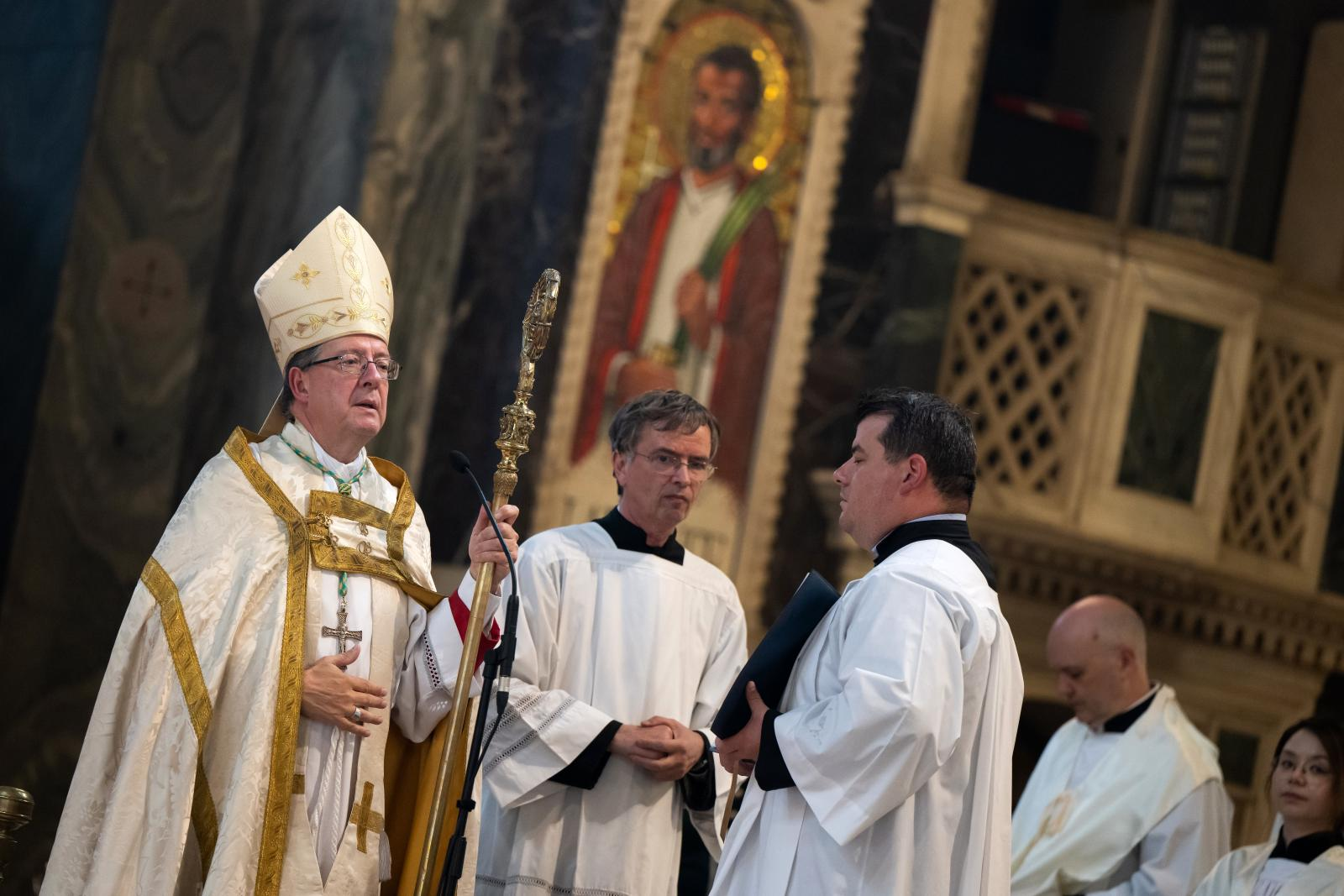
Bishop John Sherrington at Westminster Cathedral Photo: RCDOW

Source: CBCEW

His Holiness Pope Francis has appointed Bishop John Sherrington as Archbishop of Liverpool.

Ordained as a priest for the Diocese of Nottingham on 13 June 1987, Bishop Sherrington has been an Auxiliary Bishop of Westminster and Titular Bishop of Hilta since 14 September 2011.

Archbishop-elect Sherrington will become the tenth Archbishop of Liverpool in succession to Archbishop Malcolm McMahon OP, who has been Archbishop of Liverpool since 2014.

His Installation will take place in the Metropolitan Cathedral of Christ the King on Tuesday, 27 May at 12 noon.

Archbishop Malcolm McMahon OP said: “I am grateful to God and to the Holy Father, Pope Francis, for appointing a bishop to serve this local church, the Archdiocese of Liverpool. We are receiving a new Archbishop with considerable gifts, talents and skills, but most of all we are receiving a man of deep prayer who loves the Lord Jesus and who loves His Church. I have had the pleasure to serve with Archbishop-elect Sherrington in the Diocese of Nottingham and in the Catholic Bishops’ Conference of England and Wales and I am delighted to welcome him today.”

On hearing of his appointment, Archbishop-elect Sherrington said: “I thank Pope Francis for his trust in me on my appointment as Archbishop of Liverpool which I accept with humility and joy. We pray for our Holy Father at this time of sickness as he recuperates and prepares for Holy Week and Easter.

“I look forward to serving as shepherd of the historic and faith-filled Church in the Archdiocese of Liverpool which is rich in its heritage of the English martyrs, Irish immigration, and now looks to the future.

“Archbishop Malcolm McMahon OP has served Liverpool Archdiocese with love and generosity, and I am honoured to succeed him… I look forward to building on the foundations already laid in the synodal pastoral plan ‘Together on the Road’ to serve the Church and bring the hope and joy of Jesus Christ to all people.

“In this Jubilee Year, we are a people living the hope of Christ who has loved us, saved us and walks with us. We share this hope with other Christians and people of all faiths and good will. I welcome meeting and building friendships with leaders, both Christian and of other faiths, which has always been a strong dimension of the Church here.

“May we receive the fire of the Holy Spirit into our hearts to bring Christ to others.”

Cardinal Vincent Nichols, said about the appointment: “Those who have been following reports on the health of the Holy Father and keeping him in their prayers will know that he has continued his work, including the appointment of bishops.

“I am so pleased that he has appointed our Bishop John Sherrington to be the next Archbishop of Liverpool. Liverpool is, of course, my home diocese and I am delighted that it is to be led by Bishop John.

“In Westminster we know his gifts, dedication and utter generosity only too well. We will miss him greatly. Archbishop Malcolm will welcome him with great joy as, I’m sure, will everyone across the extensive Archdiocese of Liverpool.

“Today we offer our profound thanks to Bishop John for all that he has given to us over these last fourteen years, and we assure him, wholeheartedly, of our prayers and constant support.

“And, of course, we continue to hold Pope Francis very much in our prayers, too.”

Bishop John Sherrington was born in Leicester on 5 January 1958. Before entering the seminary, he graduated with a BA in mathematics from Queens’ College, Cambridge, where St John Fisher was once President. Upon graduation, he worked for a short period in management consultancy. Having been ordained a priest for the Diocese of Nottingham in 1987, and after a short period in a parish, he then completed an STL in Moral Theology at the Gregorian University, Rome.

He lectured in moral theology at All Hallows College, Dublin and St John’s Seminary, Wonersh where he was also a member of the formation staff, before serving as a parish priest from 2004-2011.

Bishop Sherrington was ordained as an Auxiliary Bishop of Westminster and Titular Bishop of Hilta on 14 September 2011 by the then-Archbishop Vincent Nichols, the co-consecrators being Cardinal Cormac Murphy-O’Connor and the then-Bishop Malcolm McMahon of Nottingham.

He has responsibility for the pastoral care of the parishes and deaneries of North London and is Moderator of the Curia and a Trustee of the Diocese. He is Chair of the Governing Body of Mater Ecclesiae College.

He served on the Methodist Roman Catholic International Commission (MERCIC) for ten years and was Co-Chair for five years. He was also, for some years, a Trustee of CAFOD which gave him further insight into the international mission of the Church.

Within the Catholic Bishops’ Conference of England and Wales, he is a member of the Department for Social Justice with responsibility for life issues since 2014, and a member of the Education Department since 2022. He is a member of the governing body of the Anscombe Centre, Oxford, and a Trustee of the Hospital of St John and St Elizabeth.

Internationally, he is a member of the Overseas Seminary Committee. He is also a Trustee of the Pontifical Beda College and Venerable English College in Rome, and a Trustee of the Royal English College in Valladolid, Spain.

Reflection on the Ministry of Archbishop Elect John Sherrington

Southern Dioceses Environment Network Report

 Dr Timothy Howles, the Associate director Laudato Si’ Research Institute (LRSI) at Campion Hall, Oxford, addressed the most recent meeting of the Southern Dioceses Environment Network on 14 October 2024.

Tim told us that the LRSI is a Catholic institute, set up by the Jesuits, but he is an ordained Anglican priest, and happy to be working in this project in an ecumenical way.

His slides covered the integral ecology paradigm which is increasingly used in Higher Education but with the theological basis found in Pope Francis’ 2015 encyclical, Laudato Si’.

Laudato Si’ stresses the need for an ecological conversion for all of us (LS 217) and invites us to care for those who are on the margins (LS62). Scientists are frustrated that their data is being ignored so as Prof Chris Rapley says, “We have to change who people are, we have to give them epiphanies”.

LS25 focuses on the idea of interconnectedness, that “we ourselves are part of nature,” and so have responsibility for the delicate equilibria of the world.

The Institute produces resources and books such “Faith-based participation in natural resource governance”, “Integral ecology approaches to the new science of gene drives”, “Endangered languages in North East India”.

They also host talks such as the upcoming lecture by Dr Vijay d’Souza SJ, who will be in Oxford for a lecture on 13 November, 5.30 – 6.30pm, which is both in-person and on livestream.

Future Meetings

Next month, we are pleased to welcome back Dr Emma Gardner, Head of Environment for the Diocese of Salford, who will tell us a little more about the work she does at the Laudato Si’ Centre, the beautiful project at Wardley Hall, near Manchester. For more details visits:

Southern Dioceses Environment Network

Second Monday of every month, except April and August.

Monday, 11 November, 12.45-2.00pm – Salford Diocese: Dr Emma Gardner
Monday, 9 December, 12.45-2.00pm – Advent Reflection & Xmas Fun

Monday, 14 January, 12.45-2.00pm – Feedback from COP29

Link

Laudato Si Research Institute

To contact Dr Timothy Howles: timothy.howles@campion.ox.ac.uk

Call for a Laudato Si’ Centre in every Diocese

Laudato Si’ Animators with Bishop John Arnold during visit to the Laudato Si’ Centre

A group of 24 Laudato Si’ Animators from around England, including some from the Diocese of Westminster, visited the Diocese of Salford’s Laudato Si’ Centre during the Season of Creation. They have undertaken to write to their bishops and push for a similar centre in other dioceses.

Laudato Si’ Animators are members of the Laudato Si Movement, a global community of prayer and action. They work to bring Pope Francis’s Encyclical Laudato Si’ to life. They are trained by the Laudato Si’ Movement to get the message of Pope Francis into the parishes. Most attend bi-monthly zoom meetings and take part in prayer vigils and marches about the climate and biodiversity.

Members of the Laudato Si’ Movement support local parishes and communities to engage in ecological spirituality, sustainable lifestyles and advocacy for climate and ecological justice.

On 29 September, a group of animators met with Bishop John Arnold of Salford, the bishops’ environmental lead in England and Wales.

Their visit to Salford’s Laudato Si’ Centre began with a tour of the Centre given by Emily Cahill, the Centre’s environmental and learning officer. She stressed that Bishop John Arnold’s vision for the Wardley Hall Centre was that it would be used by everyone as a centre for learning, spirituality and wellbeing.

In four years, a lawn has been converted into a thriving garden and a woodland area is ideal for groups. Over 3,000 people have visited the centre, especially school and parish groups.

The group was given leaves from various plants to attach to sheets on which they wrote what inspired them to be animators and what hopes they had for the future. After a simple vegan lunch when they were joined by the director of the centre, Emma Gardner, they split into groups and noted down responses. The rain brought them back into the outdoor classroom where Bishop John Arnold greeted the group and a photo was taken.

Sr Joan Kerley then gave an inspiring talk about St Hildegard of Bingen and St Kateri and the Haudenosaunee (Iroquois) Creation story. They sang two songs about creation and then started to answer the seven questions that Laudato Si’ Movement had suggested. They ended with prayers from the Haudenosaunee (Iroquois) Greetings to the Natural World.

If a diocese was to set up its own Laudato Si’ Centre it would need land owned by the Diocese, preferably with woodland and near to public transport. Trained staff would be needed to run the centre supported by volunteers. Disabled access and safeguarding are important. In terms of buildings, the outdoor classrooms and portaloos were perfectly adequate. But it was felt the most important needs would be for prayer and vision. It was felt that centres like the one in Salford would be wonderful for getting the message of Pope Francis out to clergy and laity?

A place like this in every diocese would help towards the UK Government’s commitment to rewild 30% of the nation’s land and sea by 2030, and would be a centre for peace, reconciliation and evangelisation.

Animator John Woodhouse said: “We all responded to the inspiring experience of being in creation. How many children never experience this? So many spend their lives glued to their phones and live in a virtual world. So many have mental health issues. Laudato Si’ needs to be seen as a spiritual and evangelical document. Our young people are pushing us to do so much more and they respond very positively to the message of Pope Francis.”

LINK

Laudato Si Centre, Salford: https://laudatosicentre.org.uk/

Laudato Si’ Movement: https://laudatosimovement.org/

Hope, Humility, Trust – Bishop Nicholas reports from the Synod

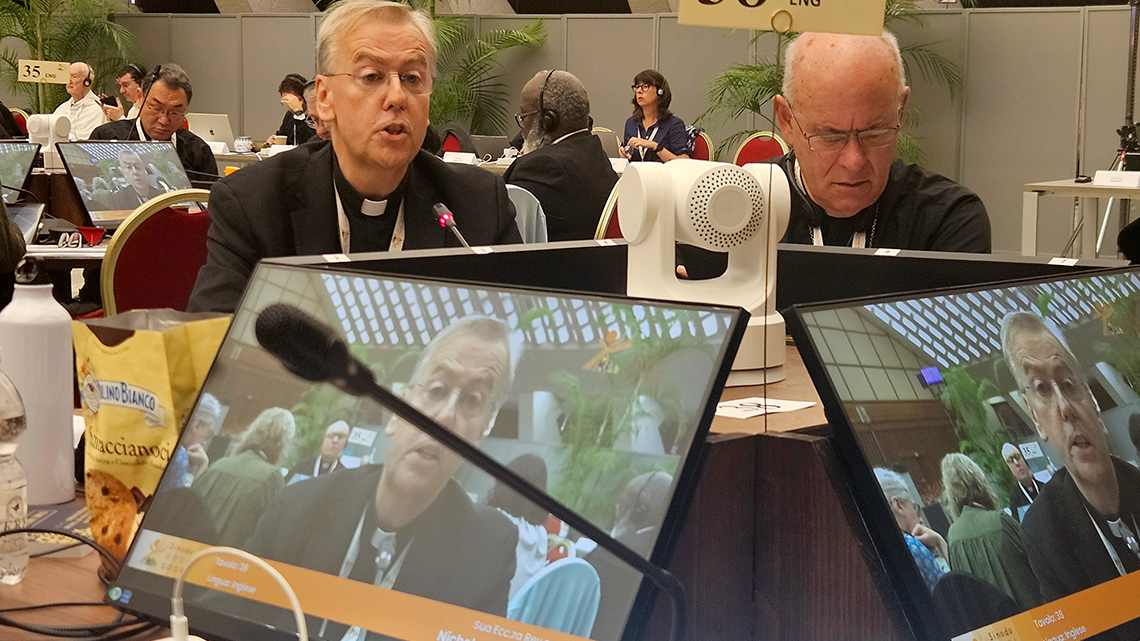
Bishop Nicholas at the Synod. ©synod.va/Lagarica

Source: RCDOW

We stand at the half-way point of the Second Assembly of the Synod of Bishops in Rome that is exploring ‘Synodality’, how the Catholic Church can be a missionary synodal Church in our times.

Bishop Nicholas Hudson, who was chosen by Pope Francis to be a Synod member, has sent back a fascinating insight on proceedings as the Synod enters its latter stages.

The Holy Father’s eyes lit up brightly when I told him about our online meeting for priests. 120 priests from across England and Wales had come together with Archbishop Wilson, Bishop Stock and me just before our departure for the Synod. This was to hear the reports of two priests, Fr Marcus Holden and Fr Anthony Rosso, who had attended a meeting recently at Sacrofano near Rome for priests from around the world to share perspectives on synodality. Pope Francis had asked that, on their return, priests come together from across our countries to share the fruits of this gathering. He was so pleased to hear we had achieved this!

Empower parishes to be synodal
I detected, in that meeting of priests, an openness to synodality; a desire to know how we can begin to be more synodal in our parishes, which is precisely the focus of our Synod. We have been asking, for two weeks now, how we can be a missionary Synodal Church. There is a strong sense in the Synod Hall that, at the end of this Assembly, we shall be wishing to communicate something which will be easy to comprehend; and able to empower parishes to embark on a more synodal approach.

It has been a fascinating journey already. We gathered first in retreat, led by the newly-named Cardinal, Fr Timothy Radcliffe OP. He urged us in this Synod to be above all good listeners. Echoing Paul, that ‘faith is born of listening’ (Romans 10, 7), he suggested we should listen in order not so much to reply as to learn.

The centrality of salvation
As we came together for the first experience of round-table sharing, it was moving to listen to one another recalling the fruits that had been harvested from last year’s session. These had been gathered up comprehensively in the ‘Foundations’ section of the Instrumentum Laboris, the working document which guides our journey. They included the centrality of salvation, which Fr Marcus had pointed out at Sacrofano to be missing from the report of last October’s Assembly, and which I was pleased to find mentioned frequently in this ‘Foundations’ section of the working document, a measure of how the creators of the Synod had listened to the priests. We recalled, in those first few days, major insights yielded by last year’s Assembly, insights into coresponsibility, the importance of including laypeople in discernment at all levels of the Church, the gift to the Church of Conversation in the Spirit, and so much more.

Collaboration between lay and ordained
Soon we found ourselves in the groups to which we would belong for a fortnight to navigate together the process of the Synod proper. My table has been facilitated impressively by a female lecturer from Australia, the group comprising: two other women, one from Jordan, the other, Sr Nathalie Becquart XMCJ, French Undersecretary of the Synod of Bishops; Cardinal Roche, and bishops from the US, Kyiv, South Sudan, Nigeria, and Pakistan; with a German Presbyterian minister as our ‘fraternal delegate’. I find myself recalling often the words of Pope Francis in his opening address, when he said the presence of so many committed laypeople emphasises the need for collaboration between lay and ordained.

Deepening of perspectives and friendships
It has been extraordinarily stimulating in this group to navigate together the three major sections, on ‘Relationships’, ‘Means’ and ‘Contexts’. The fact that we remain in the same group for all three modules is a development from last year; and has been deepening of both perspectives and friendships. I marvel at the breadth of Church experience represented at my table! It is a feeling I found well captured in the very first pages of the working document which describes a synodal Church as ‘a pilgrim people in every part of the world seeking synodal conversion for the sake of mission.’ It conjures up our table wonderfully!

Our consideration of ‘Relationships’ majored on the Trinitarian foundation of discipleship in baptism; that communion is for mission, initiation for mission. Discussion of the sharing of gifts between churches who share communion with us and with other ecclesial communities also yielded a sense of a deeply shared mission which we hold in common. Listening to one another’s understanding about the ‘Means’ by which to realise this mission was dominated by Formation.

Bishop Hudson’s intervention
In my intervention, I pointed out that the word ‘Evangelisation’ is entirely absent from the document; and yet a synodal Church must have the New Evangelisation at its core. I suggested Conversations in the Spirit might be understood as a most timely strategy for realising the call of successive popes for synodal conversation, not only among ourselves but also with members of other ecclesial communions, other faiths and people who profess no faith. Formation for this would be essential. Transparency and accountability also featured largely in the section.

Sharing perspectives, lastly, on ‘Contexts’ has yielded a striking sense that Church belonging is in many places no longer simply a matter of geography. The suggestion that the Church is ‘where we follow people to’ was brought home to me very movingly by the African Bishop in my group who said, ‘When the fishermen go hunting for fish, we follow them; when the miners abandon their village to pursue the goldrush, we go with them.’

The significance of digital media for evangelisation also featured highly. But there was a rootedness in our sharing too, an awareness that, where the Church is more stable, deep consideration needs to be given to how the diverse councils for discernment at our disposal might be made more synodal. We have yet to conclude the discussion of ‘Contexts’; and to see what it may continue to yield. Then we move back to our first groups to begin work on the document about which we shall vote. 

Hope, humility and trust
The Synod is a unique experience. It feels very much like a journey, a shared journey that we make together, much more a pilgrimage than a conference. It felt very pilgrimage-like to process, laypeople leading the bishops together into St Peter’s Square for the opening Mass; to celebrate a vigil of mercy, a penitential service, after our retreat; to come in prayer to the Basilica of St Mary Major on the eve of the anniversary of the 7th October Hamas terror attack in Israel to pray the rosary and all to fast the next day; to gather one evening on the site of St Peter’s martyrdom for an ecumenical vigil; and to meet for Mass in St Peter’s in diverse rites and languages across the month.

In his opening address, Pope Francis indeed chose to describe this journey as a ‘journey we make together with hope, humility and trust.’ Hope, humility and trust, these three words I have held onto and sought to aspire to; and find they capture wonderfully the spirit in which so many around me also seek to live this unique enterprise.

Sunday 29 September: World Day of Migrants and Refugees

In a message to mark the World Day of Migrants and Refugees, Bishop Paul McAleenan has praised the Catholic community in England and Wales for the generous welcome and kindness many offer to refugees and migrants.

“Fundamental to our Christian faith is the belief that we are all a pilgrim people on our journey to our true homeland. God is with us and we travel together,” says Bishop McAleenan, the Lead Bishop for Migrants and Refugees for the Bishops’ Conference. “They are looking for a place to settle, where they can live in peace with their families and have the opportunity to prosper. They are, indeed, a pilgrim people. And God walks with them.”

Bishop McAleenan believes that many parishes have responded positively to those fleeing harm and seeking sanctuary to rebuild their lives:

“I wish to thank all of you in parishes and communities who are providing support and welcome to migrants and refugees who reach these shores… There are many, many parishes in this country who have positively responded to the stranger seeking asylum… Surely through your actions, migrants and refugees who experience such hospitality can more easily believe that God is with them.”

Participation

The theme of the World Day of Migrants and Refugees is ‘God walks with His People’. We have many days of prayer in the Catholic calendar, so it is always useful to offer some practical advice to the faithful to encourage participation in the day.

“I’d like to suggest how you might celebrate this day in your parish, in your school or community,” says Bishop McAleenan. “Perhaps you can have a short prayer vigil, reflecting upon on a scripture passage which recounts how God accompanied his people on a long and dangerous journey through the desert and ask him to protect those on the move today.

“If you do have a prayer vigil, please invite migrants and refugees to join you. If your parish is blessed with grounds, you may consider having a procession – walking around the area in silence, or reciting an appropriate prayer – that would be a demonstration of solidary with all those on the move.

“If you know someone who is a refugee you may wish to invite them to join you and your friends for a tea or coffee. Why? Simply to encounter them – a word beloved by Pope Francis – to speak to them, to listen to their story, if they wish to share it.

“In such ways, we open our minds and hearts to our brothers and sisters and perhaps any prejudices or misunderstanding we may have will be dispelled.”

Saturday 28 September: An International Mass with the Ethnic Chaplaincies will be celebrated at Westminster Cathedral by Cardinal Vincent Nichols

Pope Francis Message to COP28: ‘Choose life, choose the future!’

Cardinal Parolin at COP28. Image: Vatican News

Cardinal Secretary of State Pietro Parolin delivered Pope Francis’ hard-hitting speech to delegates at the UN Climate Change Summit in Dubai today, urging world leaders not to postpone action any longer but to deliver concrete and cohesive responses for the well-being of our common home and future generations. The full text of the Pope’s address follows:

Mr President,

Mr Secretary-General of the United Nations,

Distinguished Heads of State and Government,

Ladies and Gentlemen,

Sadly, I am unable to be present with you, as I had greatly desired. Even so, I am with you, because time is short. I am with you because now more than ever, the future of us all depends on the present that we now choose. I am with you because the destruction of the environment is an offence against God, a sin that is not only personal but also structural, one that greatly endangers all human beings, especially the most vulnerable in our midst and threatens to unleash a conflict between generations. I am with you because climate change is “a global social issue and one intimately related to the dignity of human life” (Apostolic Exhortation Laudate Deum, 3). I am with you to raise the question which we must answer now: Are we working for a culture of life or a culture of death? To all of you I make this heartfelt appeal: Let us choose life! Let us choose the future! May we be attentive to the cry of the earth, may we hear the plea of the poor, may we be sensitive to the hopes of the young and the dreams of children! We have a grave responsibility: to ensure that they not be denied their future.

It has now become clear that the climate change presently taking place stems from the overheating of the planet, caused chiefly by the increase of greenhouse gases in the atmosphere due to human activity, which in recent decades has proved unsustainable for the ecosystem. The drive to produce and possess has become an obsession, resulting in an inordinate greed that has made the environment the object of unbridled exploitation. The climate, run amok, is crying out to us to halt this illusion of omnipotence. Let us once more recognize our limits, with humility and courage, as the sole path to a life of authentic fulfilment.

What stands in the way of this? The divisions that presently exist among us. Yet a world completely connected, like ours today, should not be un-connected by those who govern it, with international negotiations that “cannot make significant progress due to positions taken by countries which place their national interests above the global common good” (Encyclical Letter Laudato Si’, 169). We find ourselves facing firm and even inflexible positions calculated to protect income and business interests, at times justifying this on the basis of what was done in the past, and periodically shifting the responsibility to others. Yet the task to which we are called today is not about yesterday, but about tomorrow: a tomorrow that, whether we like it or not, will belong to everyone or else to no one.

Particularly striking in this regard are the attempts made to shift the blame onto the poor and high birth rates. These are falsities that must be firmly dispelled. It is not the fault of the poor, since the almost half of our world that is more needy is responsible for scarcely 10% of toxic emissions, while the gap between the opulent few and the masses of the poor has never been so abysmal. The poor are the real victims of what is happening: we need think only of the plight of indigenous peoples, deforestation, the tragedies of hunger, water and food insecurity, and forced migration. Births are not a problem, but a resource: they are not opposed to life, but for life, whereas certain ideological and utilitarian models now being imposed with a velvet glove on families and peoples constitute real forms of colonization. The development of many countries, already burdened by grave economic debt, should not be penalized; instead, we should consider the footprint of a few nations responsible for a deeply troubling “ecological debt” towards many others (cf. ibid., 51-52). It would only be fair to find suitable means of remitting the financial debts that burden different peoples, not least in light of the ecological debt that they are owed.

Ladies and Gentlemen, allow me to speak to you, as brothers and sisters, in the name of the common home in which we live, and to ask this question: What is the way out of this? It is the one that you are pursuing in these days: the way of togetherness, multilateralism. Indeed, “our world has become so multipolar and at the same time so complex that a different framework for effective cooperation is required. It is not enough to think only of balances of power… It is a matter of establishing global and effective rules (Laudate Deum, 42). In this regard, it is disturbing that global warming has been accompanied by a general cooling of multilateralism, a growing lack of trust within the international community, and a loss of the “shared awareness of being… a family of nations” (SAINT JOHN PAUL II, Address to the United Nations Organization for the Fiftieth Anniversary of its Establishment, New York, 5 October 1995, 14). It is essential to rebuild trust, which is the foundation of multilateralism.

This is true in the case of care for creation, but also that of peace. These are the most urgent issues and they are closely linked. How much energy is humanity wasting on the numerous wars presently in course, such as those in Israel and Palestine, in Ukraine and in many parts of the world: conflicts that will not solve problems but only increase them! How many resources are being squandered on weaponry that destroys lives and devastates our common home! Once more I present this proposal: “With the money spent on weapons and other military expenditures, let us establish a global fund that can finally put an end to hunger” (Encyclical Letter Fratelli Tutti, 262; cf. SAINT PAUL VI, Encyclical Letter Populorum Progressio, 51) and carry out works for the sustainable development of the poorer countries and for combating climate change.

It is up to this generation to heed the cry of peoples, the young and children, and to lay the foundations of a new multilateralism. Why not begin precisely from our common home? Climate change signals the need for political change. Let us emerge from the narrowness of self-interest and nationalism; these are approaches belonging to the past. Let us join in embracing an alternative vision: this will help to bring about an ecological conversion, for “there are no lasting changes without cultural changes” (Laudate Deum, 70). In this regard, I would assure you of the commitment and support of the Catholic Church, which is deeply engaged in the work of education and of encouraging participation by all, as well as in promoting sound lifestyles, since all are responsible and the contribution of each is fundamental.

Brothers and sisters, it is essential that there be a breakthrough that is not a partial change of course, but rather a new way of making progress together. The fight against climate change began in Rio de Janeiro in 1992, and the 2015 Paris Agreement represented “a new beginning” (ibid., 47). Now there is a need to set out anew. May this COP prove to be a turning point, demonstrating a clear and tangible political will that can lead to a decisive acceleration of ecological transition through means that meet three requirements: they must be “efficient, obligatory and readily monitored” (ibid., 59). And achieved in four sectors: energy efficiency; renewable sources; the elimination of fossil fuels; and education in lifestyles that are less dependent on the latter.

Please, let us move forward and not turn back. It is well-known that various agreements and commitments “have been poorly implemented, due to the lack of suitable mechanisms for oversight, periodic review and penalties in cases of non-compliance” (Laudato Si’, 167). Now is the time no longer to postpone, but to ensure, and not merely to talk about the welfare of your children, your citizens, your countries and our world. You are responsible for crafting policies that can provide concrete and cohesive responses, and in this way demonstrate the nobility of your role and the dignity of the service that you carry out. In the end, the purpose of power is to serve. It is useless to cling to an authority that will one day be remembered for its inability to take action when it was urgent and necessary to do so (cf. ibid., 57). History will be grateful to you. As will the societies in which you live, which are sadly divided into “fan bases”, between prophets of doom and indifferent bystanders, radical environmentalists and climate change deniers… It is useless to join the fray; in this case, as in the case of peace, it does not help to remedy the situation. The remedy is good politics: if an example of concreteness and cohesiveness comes from the top, this will benefit the base, where many people, especially the young, are already dedicated to caring for our common home.

May the year 2024 mark this breakthrough. I like to think that a good omen can be found in an event that took place in 1224. In that year, Francis of Assisi composed his ‘Canticle of the Creatures’. By then Francis was completely blind, and after a night of physical suffering, his spirits were elevated by a mystical experience. He then turned to praise the Most High for all those creatures that he could no longer see, but knew that they were his brothers and sisters, since they came forth from the same Father and were shared with other men and women. An inspired sense of fraternity thus led him to turn his pain into praise and his weariness into renewed commitment.

Shortly thereafter, Francis added a stanza in which he praised God for those who forgive; he did this in order to settle – successfully – an unbecoming conflict between the civil authorities and the local bishop. I too, who bear the name Francis, with the heartfelt urgency of a prayer, want to leave you with this message: Let us leave behind our divisions and unite our forces! And with God’s help, let us emerge from the dark night of wars and environmental devastation in order to turn our common future into the dawn of a new and radiant day. Thank you.