Brother Johannes Maertens – Reflection at the Home Office Vigil, Monday 21st July 2025

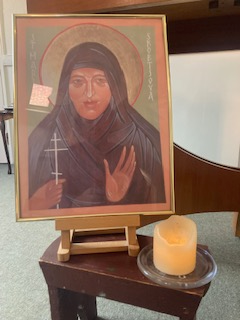
Mother Maria Skobtsova

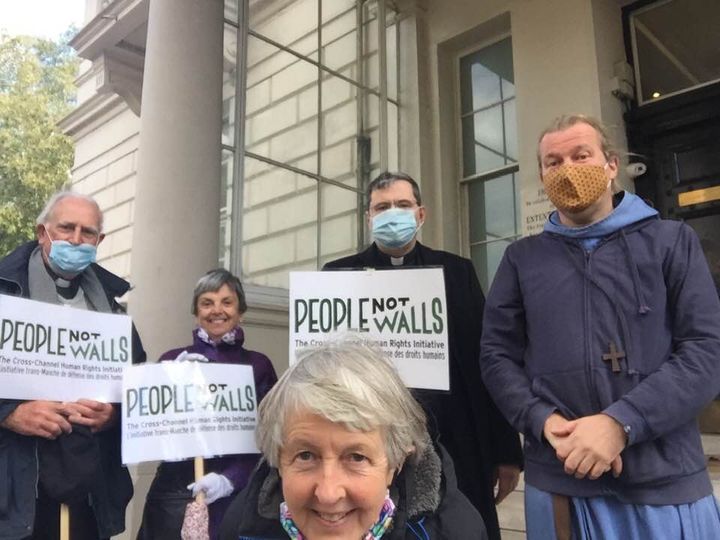
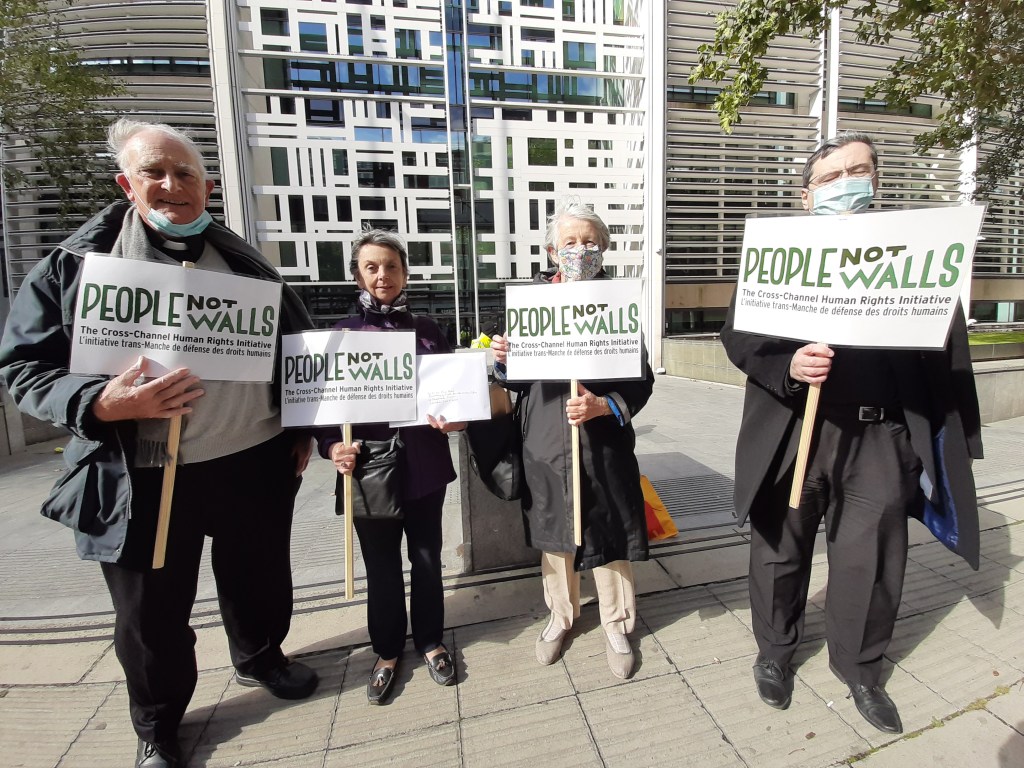
Brother Johannes Maertens gave the following reflection at the Vigil for Migrants outside the Home Office on 21 July 2025:

Reading: Luke 10:25–37 The Parable of the Good Samaritan

This year marks 80 years since the death of Mother Maria Skobtsova. The Church Times recently referred to her as an “eccentric, chain-smoking poet, monastic, and martyr” “whose theology—grounded in the dual command to love both God and neighbour”—remains startlingly relevant. And perhaps more urgently needed than ever.

In recent years, certain voices—some from pulpits, some from platforms of global influence—have begun to portray empathy as a liability. In 2018, an American pastor published a book titled The Sin of Empathy, describing compassion as potentially morally dangerous. Others have called mercy weak. More recently, tech billionaire Elon Musk described empathy as the “fundamental weakness of Western civilisation,” even criticising Germany’s funding of refugee rescue efforts in the Mediterranean. In response, Germany’s Foreign Office simply said: “Yes. And it’s called saving lives.”

Compassion, empathy… What most of us would consider a fundamental strength—a binding force in our cultures—is now labeled a threat by those in power. And these are not random comments. They are part of a wider push to redefine the moral imagination of society.

But contrast that with the Gospel— and our Gospel reading today —and the very life of Mother Maria Skobtsova.

The parable of the Good Samaritan reframes what it means to be a neighbour—not by nationality, proximity, or religious allegiance, but by mercy. “Who was neighbour to the man?” Jesus asks. And the answer is clear: “The one who showed him compassion.” Jesus, doesn’t answer the question “Who is your neighbour” – he tells you more how you would hope your neighbour is – and then Jesus says: “Go and do likewise.”

This command sits at the heart of Mother Maria Skobtsova’s radical theology. What she called “the sacrament of the brother.” She wrote: “Give from the heart, since each person is the very icon of God incarnate in the world.”

Let that sink in. Every human being—no matter how broken or marginalised—is an icon of Christ. For Mother Skobtsova, every encounter with another person becomes a kind of opportunity to be liturgy. She imagined the whole world as one altar. And to this altar, we offer not only bread and wine, but our hearts—so that they might be transformed into Christ’s love. A “kenotic love”—a love that empties itself.

In this vision, compassion is not weakness. It is sacrament.
Mercy is not naive. It is resurrection.

She didn’t separate the altar from the street, the Eucharist from the soup kitchen, or the refugee-boats from the chalice. She saw Christ there—broken, waiting—and she responded.

When the Nazis invaded Paris, Mother Maria didn’t ask whether hiding Jewish children was politically wise. She saw the face of Christ and acted. And it cost her everything, she died in the Ravenbrouck concentration camp, where she was gazed to death around Easter 1945.

So we must ask: what do we see today?

Across the Mediterranean, in the English Channel, across borders, people are crossing treacherous waters in small inflatable boats. Fleeing war, persecution, and poverty. They too lie wounded along the road to Jericho. And we—we are the passers-by. The priests. The Levites.

We scroll past their faces. Hear their statistics. Debate their fate. But the Gospel doesn’t ask who deserves to be saved.
It asks: Who will show compassion?

To offer mercy is to meet Christ.
To bind a wound is to celebrate Eucharist.
To open a door is to open heaven.
This is not sentimental. It is spiritual courage.

So when we see a migrant in crisis, a stranger at the door, an outcast in pain—we must not pass by. We must be moved with compassion. Not because it’s trendy, or convenient. But because Christ is there.

Broken. Waiting.

And that is why we stand here today.
In prayer. In solidarity.
And in hope—for a more compassionate future, together.

Amen.

“But if at the center of the Church’s life there is this self-giving Eucharistic love, then where are the Church’s boundaries, where is the periphery of this center? Here it is possible to speak of the whole of Christianity as an eternal offering of a Divine Liturgy beyond church walls … It means that we must offer the bloodless sacrifice, the sacrifice of self-surrendering love not only in a specific place, upon the altar of a particular temple; the whole world becomes the single altar of a single temple, and for this universal liturgy we must offer our hearts, like bread and wine, in order that they may be transformed into Christ’s love, that he may be born in them, that they may become “God-manly” hearts, and that He may give these hearts of ours as food for the world…” ” (Mother Maria Skobtsova, Selected Writings, ed. Jim Forest, Chapter on Types of Monasticism, page 185)

Service Sheet

Refugee Week Home Office Vigil Report – Reflection by Bishop Paul McAleenan

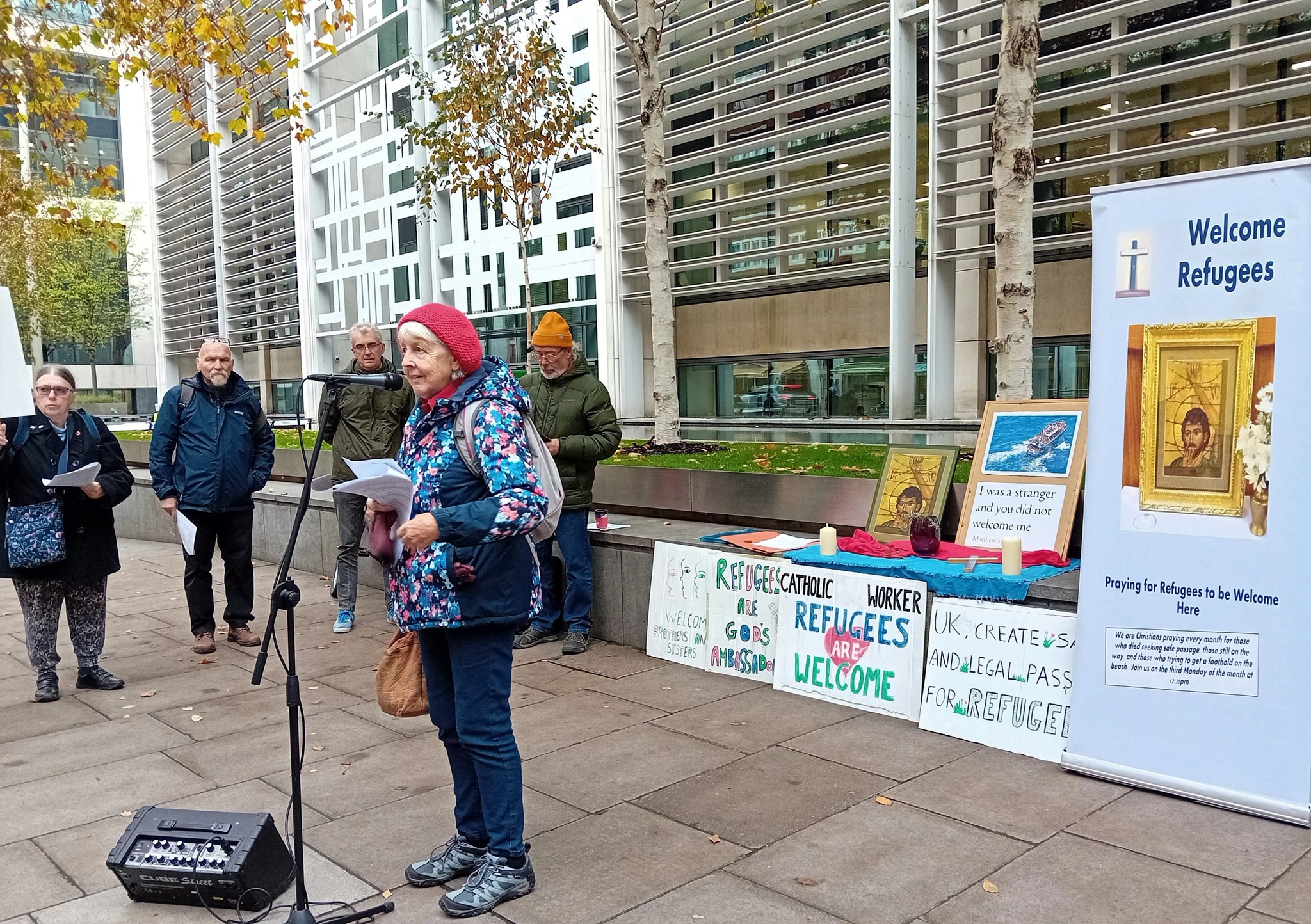
Refugee Week Prayer Vigil 2025
Bishop Paul McAleenan (l) and Br Johannes Maertens at the microphone

Source: Barbara Kentish

The list of names heard at the vigil on 16 June outside the Home Office were numerous and distressing. They were a selection of people who died trying to reach Europe over the year from June 2023 to May 2024. 

The list was followed by a two minute silence to let the tragedies sink in, and then we heard a reflection from Bishop Paul McAleenan, spokesperson on migration for the Catholic Bishops’ conference. 

Attended by over 40 people, the ecumenical vigil follows the Christian imperative to mourn the tragic and horrifying deaths happening daily on Europe’s borders.

Bishop Paul, referring to the scripture account of the Flight into Egypt, said: ‘ Rachel mourned for the children killed as Jesus escaped with his family to Egypt. You are all ‘Rachel, mourning for her children, as you lament so many people fleeing persecution and war.’

This is an ecumenical vigil, on the third Monday of the month at 12.30pm. All are welcome.

Next Home Office Vigil: Monday, 21st July, 12.30pm.

There will be a further vigil on 28th July 2025, from the same co-ordinating group and co-sponsored by Westminster Justice and Peace Commission, for those who have died in Gaza over the last year. This will take place at the Foreign and Commonwealth Office off Whitehall, also at 12.30pm.

For information contact barbarakentish11@gmail.com or johanmaertens@hotmail.com

Bishop Paul McAleenan’s Reflection

To understand a person you have to know them. Knowledge of others is a necessary step towards understanding them. Often when migrants and displaced persons are spoken of what rises to the surface is statistics. Statistics reveal the extent and depth of affliction suffered by so many, but we must never forget that migration is about real people. When we encounter them, we know them as they really are and come to understand them.

Today we begin Refugee Week, the theme, ‘Community as a Super Power’. We salute the communities who this week through events and campaigns and initiatives are making a special effort to educate themselves and understand the realities behind migration. We honour the communities and individuals whose language and outlook is not, ‘we must protect ourselves’ but ‘we must listen and understand’. In listening we learn that migration for those without documents and status is not the result of a free decision. Within the term ‘enforced migration’ falls well known reasons, war, persecution, climate emergency, famine.

What about those whose details have been supplied to us whose names are contained within these the handouts we have received? Here we read of the man who left his home in Pakistan to earn money to repay his debts and support his family, of another who left home to earn money to support his disabled brother, and again of the one whose desire was to work so that he could build a roof for his family home.

To have to leave your country so that your family can have decent life is also enforced migration. The resources of our planet as we know are not for the benefit of a few. The principle of Catholic Social Teaching ‘The Universal Destination of Goods’ meaning the earth’s resources must be shared is not a principle for academia and debate but one which must have practical application. In other words people have right to leave their country to seek better opportunities for themselves and their families, they may not want to but they have to.

When migration is not the result of a free decision there is an even greater need to support that migrant, to accompany them, building bridges not walls, to expand channels for safe and regular migration, as Pope Francis, to whom we are so greatly indebted for his leadership on this matter said.

A community ready to welcome, protect, promote and integrate the newly arrived immigrant is essential.

Unfortunately there is not always a welcoming community. We are aware of the events in Northern Ireland last week. Incidents that the PSNI denounced as ‘racist thuggery’.

As we stand outside this building today conscious of the plight of refugees we think also of recently issued White Paper on Immigration We counter the introductory remarks on the White Paper with the reminder that essential work carried out every day by people in low paid, low skilled roles must be recognised and valued. For many migrants such jobs are the first step to becoming fully integrated. Without their contribution, dedication and hard work our hospitals, schools and care homes might not function. Their lives have enriched ours.

As we begin this year’s Refugee Week we implore all those involved in migration issues, be cautious in your words, let them be devoid of attempts to gain party political advantage; have listening and understanding as an essential component in your dealings with compassion in your decisions.

Despite our concerns there is room for hope. Today we express our support and admiration for those communities in our country who in this Refugee Week are implementing initiatives which reach out to migrants, refugees and asylum seekers offering them a welcome.

Home Office Vigil Prayers – 18 November 2024

Barbara Kentish outside the Home Office 18 Nov 2024. Photo: Pat Gaffney

This month those gathered at the regular Prayer Vigil outside the Home Office remembered the following people who died a year ago, in November 2023, attempting to reach sanctuary in Europe:

DateDetails
?8 people from Gambia died of exhaustion during a 15-day boat journey from Gambia to the Canaries. Their bodies were thrown in the sea; 55 survived. 
3/11A boy died from exhaustion in hospital, having arrived at El Hierro (Spain) by boat from West Africa one day earlier; 83 survived.
4/11134 people from Senegal, including at least 3 children and 6 women, drowned when a Canaries-bound boat on the way from Senegal sank off Nouadhibou (Morocco);15 191 survived.   2 people died of unknown cause, their bodies found on board a boat during rescue off the Canary island of El Hierro. 2 others died on the way to hospital.   A man of 23 from Syria died, his body found by nature researchers in Białowieża Forest (Poland) near Narewka River at the Poland-Belarus border.
5/1115 people were presumed drowned off Nouadhibou (Morocco), missing from 7 canoes on the way from Senegal to the Canaries.   13 people, including 2 children, from sub-Saharan Africa died of hunger and thirst on the way to Spain, their bodies in state of decay found in boats off Nouadhibou.   A body, probably of a woman, wearing a white shirt & tied to a tire used as a life vest was found between rocks on the coast of Lampedusa (Italy).
6/11Dinh Anh Nguyen, a man of 37 from Vietnam, was hit by a train near Calais (France) while walking on railway tracks in the dark.   182 people from Guinea, Mali, and Senegal drowned off Gadaye (Senegal) on the way from Bargny (Senegal) to the Canary Islands (Spain). 87 survived.
8/1117 people from Algeria drowned when a boat went missing on the way to Murcia (Spain) after embarkation from Mostaganem (Algeria).   2 men, both aged around 30, drowned off Gadaye (Senegal) on the way to the Canary Islands, their bodies found at Diamalaye beach (Senegal); 87 survived.
9/11A body was found by the Spanish Civil Guard, after a boat from West Africa arrived south of El Hierro (Spain); 79 survived.   Mohammed Amine Saidat, a man of 26 from Morocco, was hit by a train in Bolzano (Italy) while looking for shelter for the night. He had camped near the site of his death.
10/11A man’s body was found by journalists while reporting in the Kupa Riverbed in Netretić (Croatia) on the Croatia-Slovenia border.
11/117 people, including an infant, drowned, their bodies recovered in the Mediterranean Sea off Sfax (Tunisia) by the Tunisian National Guard.   2 people from sub-Saharan Africa drowned on the way from Sfax (Tunisia) to Lampedusa (Italy) when they fell from a small boat when rescuers neared; 67 survived.
12/11A body was found by Belarus border guards in Belarus near the 82nd Belarusian pillar of the border fence with Latvia.   A man of about 30 from sub-Saharan Africa drowned off Gadaye (Senegal) on the way to the Canary Islands, his body found at Déni Guedj Nord beach (Senegal); 87 survived.   A man of 29 from Eritrea died of unknown causes on the way to Lampedusa (Italy), his body found on board a boat by Italian coast guards.
13/117 people from Liberia, Palestine, Syria and elsewhere, including a child and 2 women, drowned when a rubber boat on the way to Chios (Greece) sank in stormy weather off Cesme (Turkey); 6 survived.   Abdelbassit Mohammad, a man of 22 from Sudan, had his throat slit during a brawl between migrants under the Mollien bridge in Calais; his attacker fled.
14/1111 people from Algeria drowned in the Mediterranean sea, off Murcia (Spain) on the way from Mostaganem (Algeria).   16 people drowned when a boat hit rocks on the way from Senegal to the Canaries (Spain), their bodies found on a beach of Lagouera (Morocco).
15/11A person from Gambia died of exhaustion during a 15-day boat journey from Gambia to the Canaries, their body found during rescue; 55 survived.   19 people from Algeria drowned when a boat missing on the way to the Balearic Islands (Spain) after embarkation from Algiers (Algeria).
Mid Nov.A person died of unknown causes on the way from Africa to Lampedusa (Italy), buried in Palma on the island of Sicily.
16/1119 people from Algeria drowned when a boat went missing on the way to the Balearic Islands (Spain) after embarkation from Algiers (Algeria).
17/1135 people, including 2 children and 5 women, from Morocco and sub-Saharan Africa, drowned, when a boat capsized in high waves south of Guelmim (Morcco) on the way to the Canaries; 10 survived.   Baysal Recep, a man of 42, and Geçsöyler Mehmet Ali, a man of 37, both from Turkish Kurdistan, were hit by a truck and killed while walking on the emergency lane of the A16 near the Calais ferry terminal.   An Albanian man of 37 died in hospital after attempting suicide in Brook House removal centre in Gatwick in fear of deportation.
19/1118 people from north Africa went missing on the way to Alicante (Spain) after embarkation from Tipaza (Algeria).
20/11A girl of 2 from Guinea died of unknown causes on a rescue ship on the way to port after shipwreck off Capo Ponente (Italy); 43 survived   8 people from sub-Saharan Africa, including 2 children, drowned on the way from Sfax (Tunisia) to Lampedusa (Italy) after shipwreck off Capo Ponente (Italy); 43 survived.
21/11A woman of 36 drowned off Lampedusa (Italy) on the way from Sfax (Tunisia) when a metal boat sank during rescue; 46 people, including her sister, survived.
22/11Mulu Wolde Tsehaye, a woman of 34, and Eskiel Sebsbea Tsgaye, a woman of 37, both from Ethiopia, and a man named Aman, drowned when a Britain-bound boat capsized after leaving a beach near Equihen-Plage (France); 58 survived.
26/11Mikhail Zubchenko, a man of 24 from Russia, committed suicide after 14 months in Asylum Seekers Center in Echt (Netherland). He was a LGBT asylum seeker.
27/11A person from Egypt was found frozen to death in the outskirts of Sofia (Bulgaria), part of group of 10 migrants; 9 survived.
29/11A body was found on an inflatable boat during rescue off Gran Canaria (Spain); 50 survived.   2 people drowned, having been thrown into the sea near Cadiz (Spain) by traffickers using a fast drugs-smuggling boat from Morocco; 23 survived.

Service Sheet for the November 2024 Prayer Vigil

Sign up to receive email news & alerts of changes or cancellation at: homeofficevigil@gmail.com

Cardinal calls for an hour of prayer for the dignity of human life on Wednesday 13 November

Photo: RCDOW

Cardinal Vincent Nichols and the other bishops of England and Wales are encouraging all to join them as they pause for an hour in the middle of their autumn plenary meeting, at 5.30pm on Wednesday, 13 November, to kneel in front of the Blessed Sacrament to pray for the dignity of human life and to uphold a culture of life in our countries.

They will gather in the Chapel of the Holy Family at Hinsley Hall, Leeds, to unite in compassionate action in light of the bill passing through parliament that seeks to legalise assisted suicide. The holy hour will end with Evening Prayer before a concluding Benediction.

Cardinal Vincent said: “We offer our prayers this holy hour for the dignity of human life. In particular our focus is on the end of life and praying together in front of the Blessed Sacrament that assisted suicide will not become law in our lands. This would greatly diminish the importance and innate value of every human person, akin to saying that our life is not a gift of God. Instead we would be asserting that life is our own possession to do with as we choose. But we are far more important than that. We are a gift of God – a gift that is freely given. Then, when God is ready, we are called back to him.

“During this holy hour, we pray that many minds and hearts will be open to this beautiful and great truth about the value, importance, and beauty of every human person. We pray passionately that we will not take a step in legislation that promotes a so-called ‘right to die’, that will quite likely become a duty to die and place pressure on doctors and medical staff to help take life rather than to care, protect, and heal.

“When you are praying, please remember those who offer such care and accompaniment to people facing their last days and hours. Especially pray for those who work in palliative care – nurses, doctors, people who are home visitors. They do a wonderful job with care and compassion, but they need more resources. That is what we should be investing in, not a piece of legislation that leaves us vulnerable and under pressure to seek an end to our life.

“This is an important moment in our history. Please write to your MP and express your view to that member of Parliament. Many have not yet made up their minds how to vote.

“May God bless us all, bless our countries, and bless those who make our laws with courage to embrace and uphold a culture of life.”

On Friday, 29 November, the House of Commons will hear the Second Reading of a new bill on assisted suicide tabled by Labour MP Kim Leadbeater. This is another attempt to legalise assisted suicide and we need you to contact your MP to voice your opposition.

Please visit the Bishops’ Conference resources on assisted suicide. Here you will find content that explains why we oppose assisted suicide, provides answers to FAQs, helps Catholics to quickly and easily contact their MP, provides further information on hospice care, and more.

Here you can download a simple two-page A4 PDF with suggested readings, intercessions and reflections to accompany your time of prayer, whether this is in church in front of the Blessed Sacrament, or in your own home.

There will be a Holy Hour at Farm Street Church, on Wednesday 13 November 2024, 5.00-6.00pm, with Exposition of the Blessed Sacrament and prayers for the dignity of human life at 5.30pm.

Members of the Westminster Justice and Peace network are particularly welcome to join us for this time of prayer, either in person or on the parish livestream.

Farm Street Church

Watch the Cardinal’s Message on Youtube here: 

Delivering the petition on human rights on the French-UK borders

By Barbara Kentish, Westminster Justice & Peace Commission Lead on Refugees and Migrants

This image has an empty alt attribute; its file name is 120195500_10220219789258568_3826096059446201821_n-2.jpg
Delivering letter at the French Embassy

Five of us, obeying government guidelines on numbers, delivered our letter and petition as promised, to the French Embassy this morning. Pat Gaffney from Pax Christi, Fr Dominic Robinson SJ from Justice and Peace, Brother Johannes from London Catholic Worker, Fr Joe Ryan from West Green Tottenham parish and myself took the hundreds of signatures and our letter asking for French-British collaboration for a humanitarian outcome to the small-boat Channel crossings. We succeeded in handing it over to officials at the French Embassy in leafy Knightsbridge and had a pleasant walk across the park to the Home Office in Marsham Street. Here we found a very closed door. The head security officer told us, after he had investigated, that delivering petitions could only be done if accompanied by a solicitor! We had emailed earlier in the week, with copy of our letter, but this was not enough: you need your solicitor to go along too, so after a friendly chat with the security man, we beat a retreat. Rather like the rules on COVID 19, the UK Home Office can be extremely unpredictable. We will make an appointment of course, but this could be a long wait!

Turned back from the Home Office

There is still time to sign the petition until we get an appointment with Ms Priti Patel’s elusive staff!

Meanwhile, our friends on the other side of the Channel in Calais demonstrate for human rights in their city today (Saturday, 26 September.) We wish them well, and pray that they will be heard as they claim not only rights for migrants, but also for themselves, so they don’t pick up the infections.

Sign the petition here: www.change.org/p/demand-that-the-french-and-uk-governments-recognise-people-s-human-rights-and-safe-routes-to-asylum