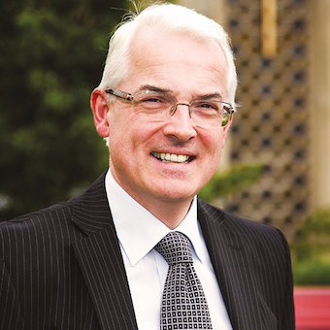
Caritas Social Action Network (CSAN) has announced the appointment of Raymond Friel as Chief Executive Officer to succeed Dr Phil McCarthy who will retire from the role at the end of March 2021 after over five years.
Raymond Friel was born in Scotland and after graduating from Glasgow University, has spent most of his professional life in England. He started teaching in London in 1990 and was a head teacher in Catholic secondary schools from 2002 until 2016. He was then General Secretary of the Catholic Independent Schools Conference for two years before becoming CEO of Plymouth CAST, a multi-academy trust of 36 Catholic schools until 2020. He is a published poet and the author of several influential books on Catholic education, including How to Survive in Leadership in a Catholic School.
Bishop Terry Drainey, the Chair of CSAN said: “The Board of Trustees is delighted to announce the appointment of Raymond Friel as CEO. He has a wealth of leadership experience and expertise, a wide knowledge of the Church and a deep commitment to the Gospels. I look forward to working with him to further Catholic social action across England & Wales.”
Sr Lynda Dearlove, Vice Chair of CSAN said: “CSAN has a crucial role animating and coordinating Catholic social action. The Board looks forward to working with Raymond to realizing Pope Francis’ vision of a ‘poor Church for the poor’.”
Raymond Friel said: “I am delighted to be taking up this new challenge. I look forward to contributing to this important part of our Church’s mission, which will be even more vital as our country recovers from the Covid-19 pandemic.”
Bishop Nicholas Hudson gave this homily at the JRS Advent Service, in Farm Street Church.
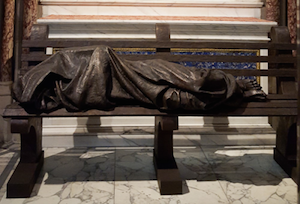
Ask any Refugee or Asylum Seeker what he or she likes best about this church, and I’m confident it will be this, the sculpture of the Homeless Jesus. The one who has nowhere to lay his head; not really to lay his head. Yes, he’s found a bench but as everyone knows who’s been homeless when you sleep rough, you sleep with one eye open your head is never truly resting. Jesus used that phrase about himself. If you remember ‘the Son of Man has nowhere to lay his head’, he said, meaning he would always need to be on the alert, always on the run.
As Jesus was arriving into this world, Luke tells us Mary and Joseph could find nowhere to lay him down. They had to settle on an outhouse where they could only lay his head in straw prepared for animals.
That’s why Saint John Chrysostom tells us as Christians to remember the poor. ‘Do you wish to honour the body of Christ?’ he asks, ‘then do not despise him when he is naked. Do not honour him here in the church building with silks only to neglect him outside when he is suffering from cold and from nakedness, for he who said “This is my body” is the same who said “you saw me a hungry man and you did not give me to eat”. Of what use is it to load the table of Christ? Feed the hungry and then come and decorate the table you are giving a golden chalice and you do not give a cup of cold water.
These are sobering words and they find an echo in another saintly man whom we’ve been thinking about much in recent years, Archbishop Oscar Romero. The Christmas before he died he spoke these words at Mass ‘If we wish to find the Child Jesus today, we should not expect to find him in beautiful crib figures. We should look for him rather among the malnourished children who went to bed tonight with nothing to eat. We should look for him among the poor newspaper boys who will sleep tonight on doorsteps wrapped in their papers’.
Pope Francis captures the essence of this when he urges us not to forget the words of Saint John of the Cross that ‘As we prepare to leave this life. We will be judged on the basis of love’. As we prepare to leave this life, we will be judged on the basis of love.
I was once in a prayer group where someone asked “How does God answer prayer?” “Through us” replied an older woman. He answers prayer through us and she should know she’d helped found the hospice movement. That was a marvellous movement which transformed the way the sick and dying were cared for in this country. Ever since this pandemic took root people of faith have been asking God to save us, to set us free from this contagion and now their prayer seems to be being answered through the inventors of not just one but several vaccines. We can look at scientists and say through them. He answered our prayers through them.
We call Jesus Emmanuel a name which means God is with us. But how is he with us? Through others. We know it instinctively. That’s why, if you think about it, every film representation of Jesus birth has a good woman from the town who comes to help Mary in her moment of need. I don’t know a single film of the Nativity which doesn’t insert this generous soul into the drama. When I see this saintly woman comforting Mary and tending the newborn baby, I think of words which Pope Francis has been saying ever since he became Pope. That when you reach out to the poor and needy you touch the wounded Body of Christ. When you give welcome to the homeless man or woman who comes knocking at your door you welcome the homeless Christ.
At the end of time we shall see Jesus risen from this bench now in all his glory accompanied by angels and we shall hear him say to us “Come you blessed of my father because I was hungry and you gave me to eat, thirsty and you gave me drink, sick and in prison and you visited me, a stranger and you made me welcome. Now, let me share with you my home forever.”
Every year we sing ‘O Little Town’ but how much do we really know about life in Bethlehem? As we journey through advent each year our thoughts turn to the place where Jesus was born. But how much do we actually know about Bethlehem today? A world apart from carols and Christmas cards is a living, breathing city in the West Bank whose people face unique challenges in a place like no other.
Justice and Peace Scotland invite you to join them on Sunday to hear voices from the Christian community in Bethlehem sharing their experiences and hopes for their city.
Speakers include:
Vera Baboun – A teacher and academic Vera Baboun became the first woman to be elected Mayor of Bethlehem leading a party list of both Christian and Muslim candidates from 2012-2017. Facing the challenges created by the security barrier, mass unemployment, and an exodus of the Christian population during her time in office she sought to improve infrastructure, create opportunities for young people to work, and to promote the cultural, historical and spiritual heritage of Bethlehem.
Laila Asfoura – A businesswoman and the Director of Laila Tours & Travels, Laila Asfoura is a dynamic member of the Christian community in Bethlehem, involved with establishing St Martha’s House, a centre for elderly women, many widowed and isolated from family who have moved abroad, to meet, spend time together and share their experience.
The event takes place on Sunday 13th December from 4.30pm – 6pm
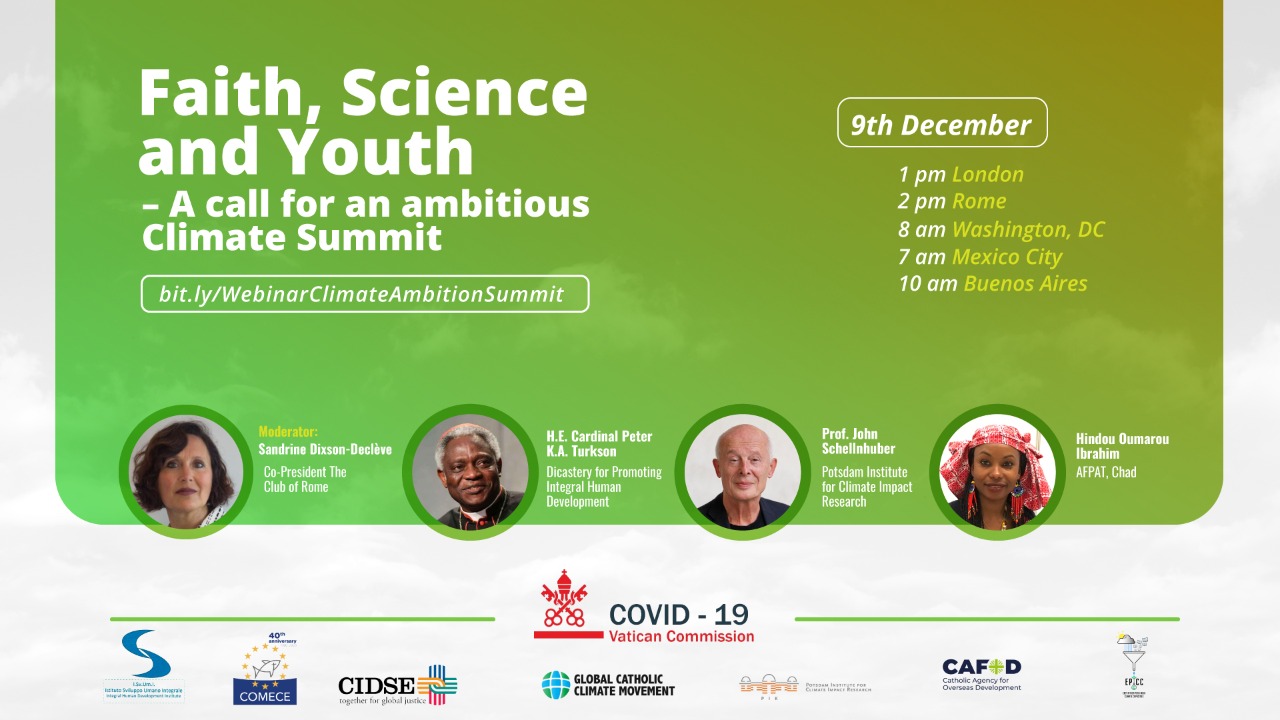
In occasion of the five years anniversary of the landmark Paris Agreement, adopted in Paris in December 2015 and ahead of the Climate Ambition Summit (12 December), the Vatican Covid-19 Commission (#VaticanCovidCommission) and its partners will highlight through this webinar the need to urge governments to raise ambition for tackling the climate emergency, through the points of view of:
H.E. Cardinal Peter K.A. Turkson – Prefect of the Vatican Dicastery for Promoting Integral Human Development, on how faith and Pope Francis’ messages can help address the climate crisis;
Prof. John Schellnhuber – Founding Director of the Potsdam Institute for Climate Impact Research, on what science is telling us today and what that means for world leaders, civil society and businesses;
Hindou Oumarou Ibrahim – Coordinator of AFPAT, on the impact of global warming on communities and the role of youth activism.
The webinar, moderated by Sandrine Dixson-Declève, Co-President: The Club of Rome, will provide a platform for a high-level exchange on the climate crisis in the context of the efforts to build a just and sustainable recovery. Participants will be able to engage with the speakers through a Q&As session.
What is the pandemic teaching us about the call to Justice and Peace? That was the question posed by Bishop Nicholas Hudson last Saturday at the start of an online meeting of the Westminster Justice and Peace Forum on the theme ‘Learning from the Pandemic’. Bishop Paul McAleenan was on the zoom too, along with around 60 clergy, religious and laity. It was great to see such a spread of interest across the diocese – Hertfordshire as well as London – and a few joined in from other dioceses – Southwark, Northampton and Brentwood were the ones I spotted. British Sign Language interpretation was provided throughout by Caritas Deaf Service.
Fr Dominic Robinson SJ, based at Farm Street church and the Chair of Westminster Justice and Peace Commission, led us through the morning event, helping us “to look back at what we have been learning and look at what we can do to rebuild.”
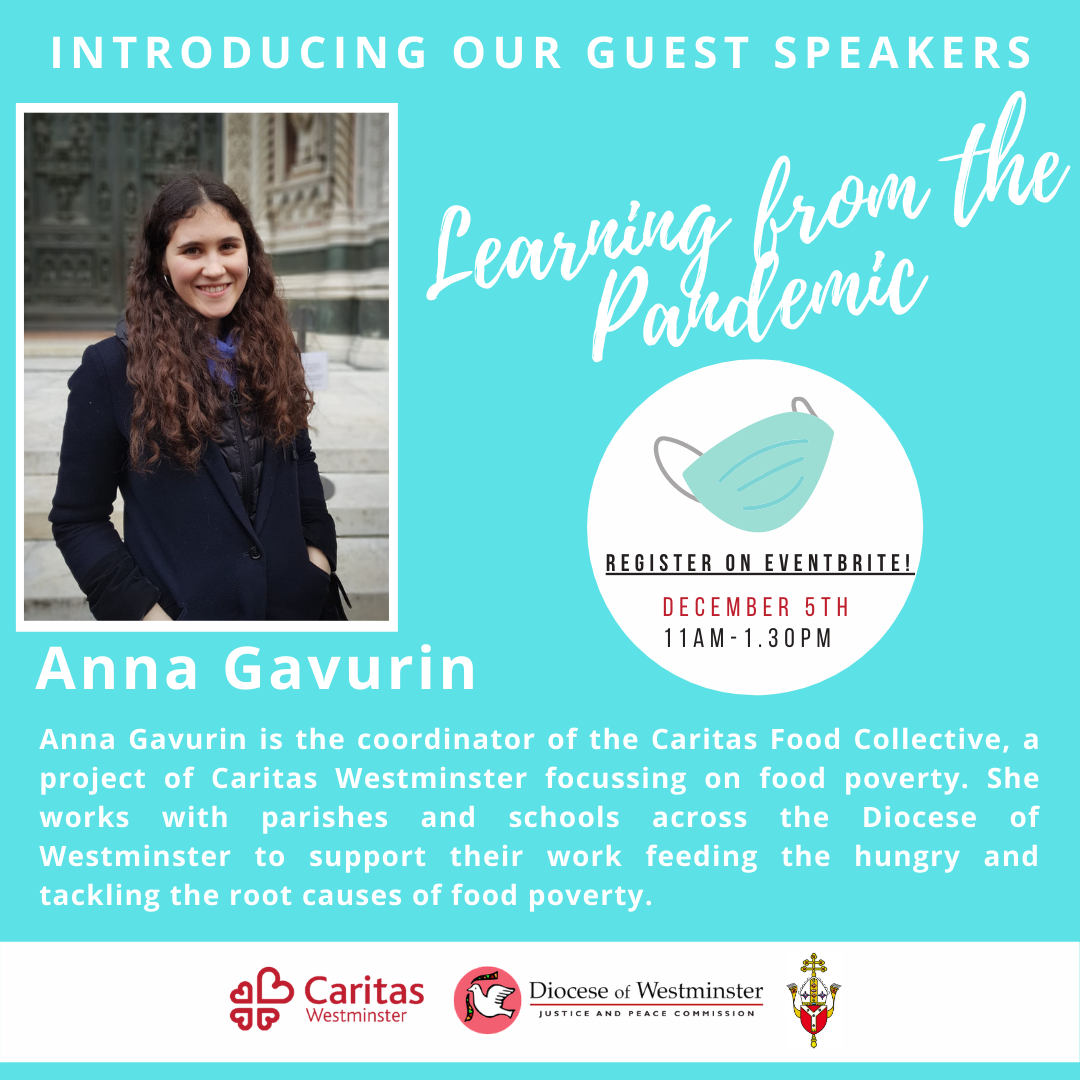
Anna Gavurin, of the Westminster Caritas Food Collective, was the first speaker. She highlighted that soon after pandemic restrictions came in more than 100 projects sprang up immediately. Catholic parishes and schools were well placed to recognise the hardship in their communities. She reported head teachers driving around with food parcels, supermarket vouchers being distributed by at least 120 parishes and schools, and Church foodbanks seeing a fourfold increase in demand. As well as the humanitarian response, she felt the pandemic shone a light on the causes of food poverty – especially people with no recourse to public funds and no access to, or delays to, benefits. Caritas organised training, helping parishes and schools to see what they could do in their local area. The issue of Justice came more and more to the fore in discussions, “challenging us to think why this is happening.” She learnt the extent to which the Church is a vibrant network, ready to respond in a crisis. Also, that the Church has a voice to influence and is using it. Into the future, Caritas Westminster has developed its Road to Resilience programme: www.caritasfoodcollective.org.uk/road-to-resilience-63.php.
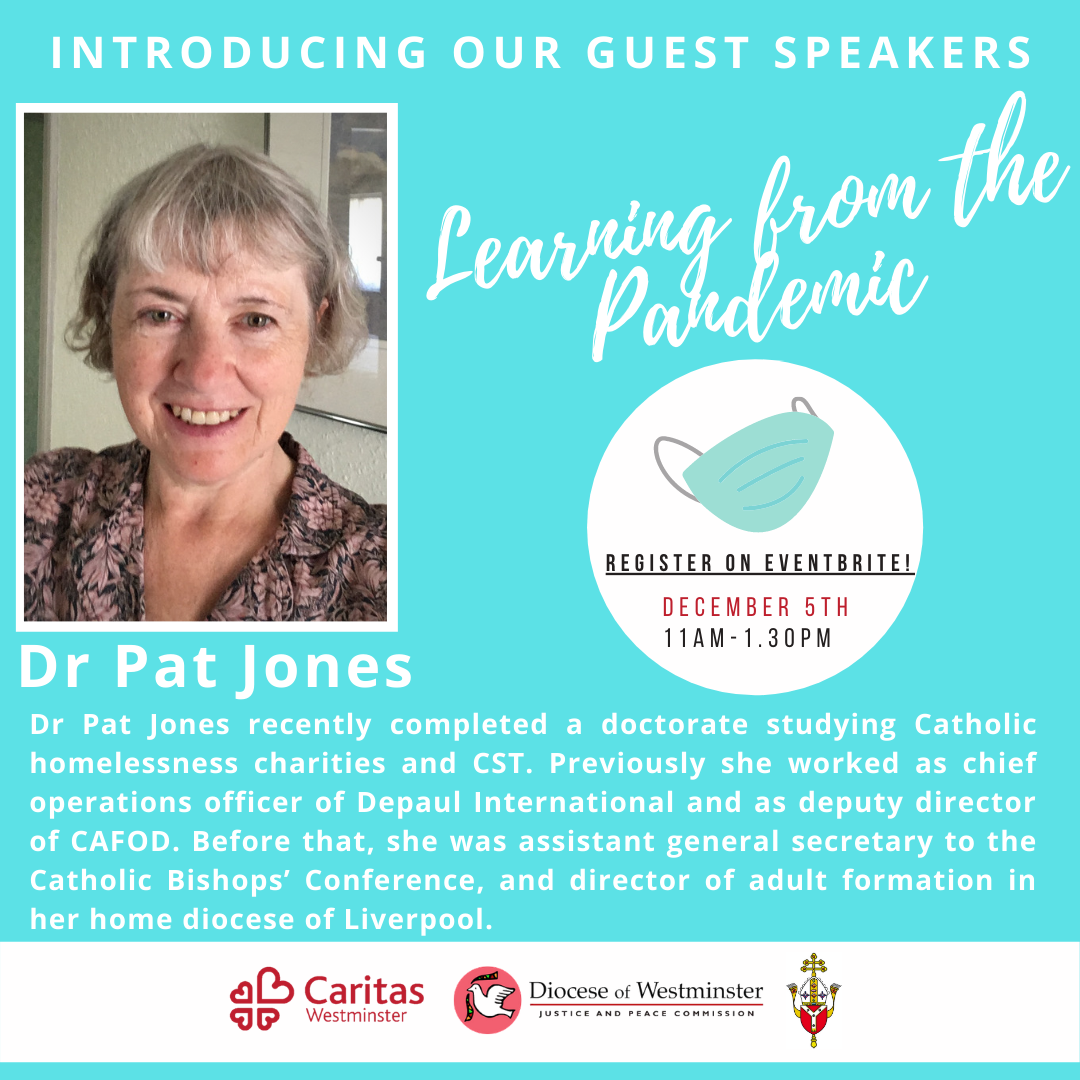
Dr Pat Jones, of the Centre for Catholic Studies at Durham University, talked about one of her brothers teaching in a deprived area of the North-West, and his experience of lessons being disrupted because of a “toast trolley” moving along the corridor outside to feed hungry children. She felt disturbed by that toast trolley and asked, “what has happened to the social safety net?”. Our social and economic systems are broken, she said, and “the pandemic prompts a radical reset for we must not forget what we have seen and heard and must not settle for the old normality.” She highlighted Pope Francis’ call for structural change, with a new emphasis on ‘Social Peace’ “which is built from below”. Pat deplored rising levels of domestic violence during the pandemic and the reduced number of refuges available for women fleeing partners. It was mentioned that the National Board of Catholic Women has responded with its recent publication, ‘Raising Awareness of Domestic Abuse’ and see the work of the Bishops’ Conference at www.cbcew.org.uk/home/our-work/domestic-abuse/.
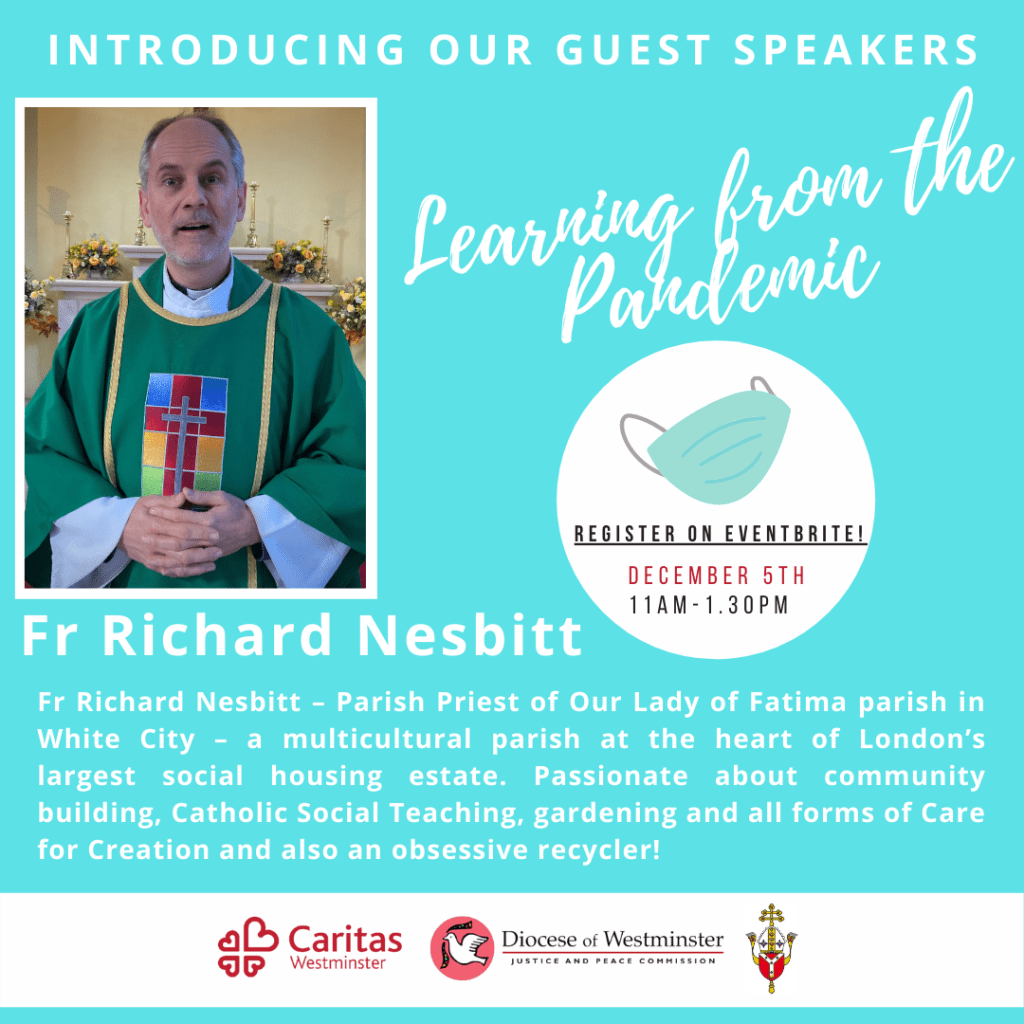
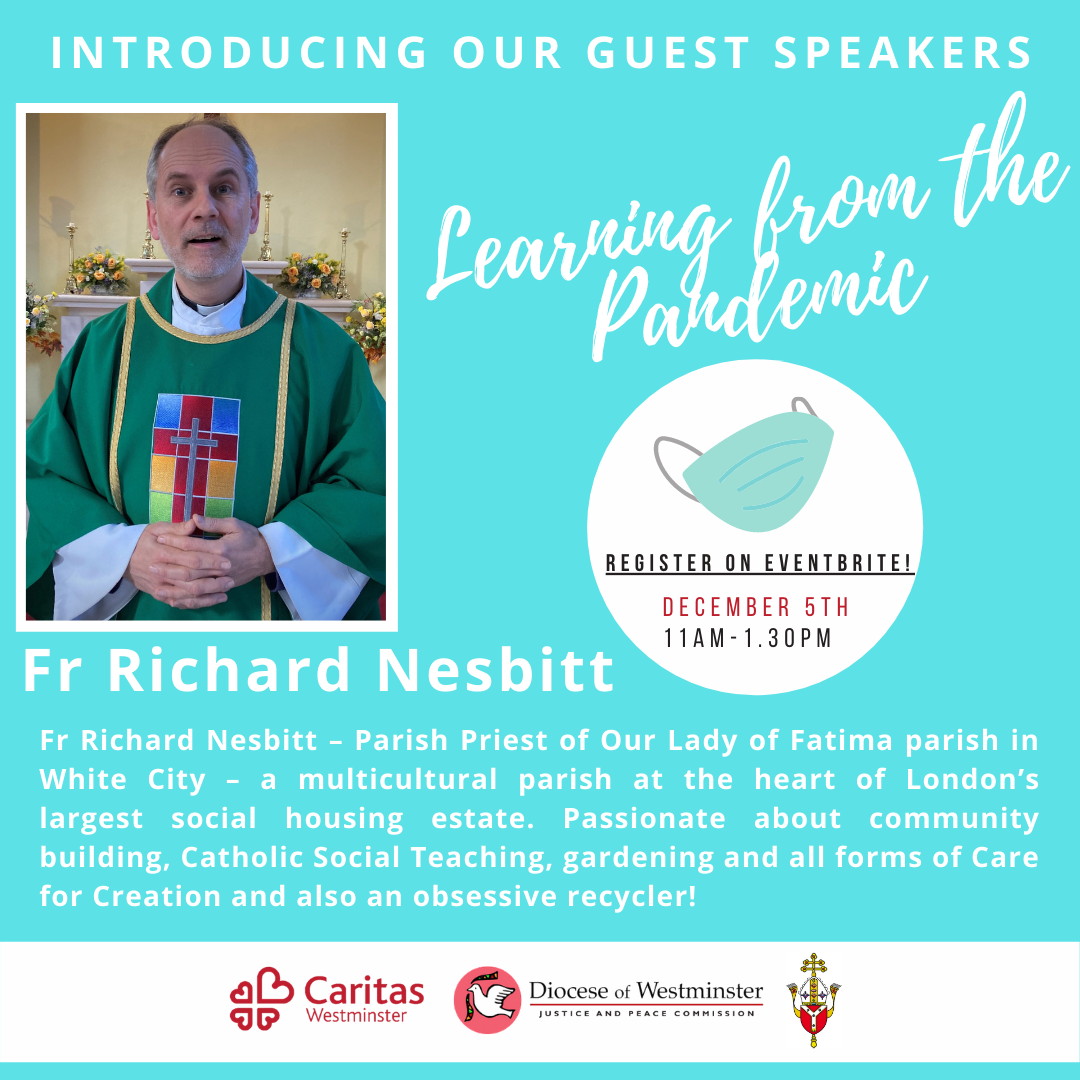
Fr Richard Nesbitt, parish priest of Our Lady of Fatima Parish at White City, highlighted the issue of racial justice and reported having his eyes opened by listening to the multicultural community in his parish. His parishioners spoke of the lack of black people in leadership roles in the Church; racial imagery in artwork in Church and in cards in the repository; little diversity of musical styles. It was pointed out to him that even in the Church’s charity work there was the danger of ‘white saviour’ syndrome. “Most shocking of all” he said “was where some black parishioners regularly experience rejection by white parishioners” at the Sign of Peace in the Mass. He quoted from US priest, Fr Bryan N Massingale, that, “Catholic Teaching on race suffers from a lack of passion”. He clarified what he meant by saying, “no one can doubt what the position is on Abortion – a major marker of Catholic identity – but Racism is marked by low institutional commitment, being tepid, lukewarm and half-hearted – and so not seen as a core component of Catholic identity.” Fr Richard reflected, “this has been a journey of conversion for me.”
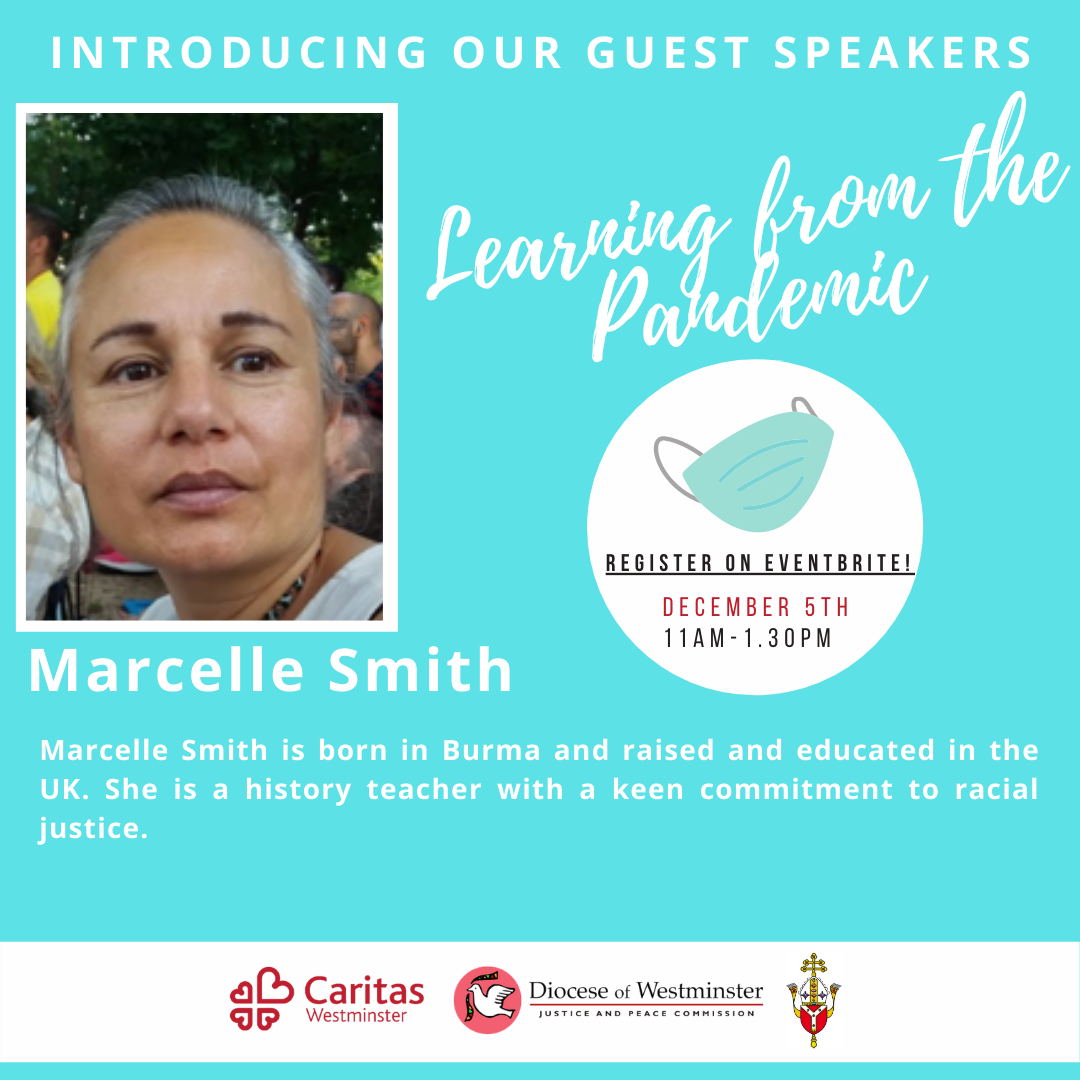
Marcelle Smith, gave a Catholic Schools perspective from her experience as a teacher in Colchester. She has been horrified by some materials used in classes which reinforce systemic racism. She called for more teachers from ethnic minorities and better Racial literacy teacher training. When asked about her hopes for the year ahead, she said, “Justice”.
At a break in the meeting two short videos were played which had won a Season of Creation 2020 diocesan video competition. One was from St Patrick’s Catholic Church in Neasden and the other from St Vincent’s Primary school in Ealing. In both of them participants saw the planting of seeds, bulbs and saplings. In the second a young child hoped, “that our work inspires other children to look after our ecosystem”. WOW! I didn’t even know that word ‘ecosystem’ when I was at school! See: https://westminsterjp.wordpress.com/season-of-creation-video-competition/
Colette Joyce, the Justice and Peace Coordinator for Westminster, reported that the four London dioceses – Arundel & Brighton, Brentwood, Southwark and Westminster – are planning to work together and with CAFOD next year on Climate Justice in preparation for COP26 in November at Glasgow. A Columban sister suggested that the question should be examined, ‘Is Climate Change racist?’
Feedback from groups suggested that the pandemic has highlighted for them the sheer scale of poverty and inequality in Britain; public budget priorities which would put military spending ahead of aid; Racism in society and in the Church; and a new awareness of who keyworkers are and their contribution to the common good of society. “So many people are close to the edge and our society’s fragility has been revealed” said one participant. There was a commitment to greater solidarity with vulnerable people and communities and making use of new technology for advocacy work. “How we connect digitally is really important” said another. Very specifically, there was a call to revisit the relationship between the Catholic Association for Racial Justice (CARJ) and the Bishops’ Conference of England and Wales. Perhaps Racial Justice Sunday should be reconnected directly with CARJ.
Liam Allmark, of the Bishops’ Conference summed up the learning from the pandemic. Quoting Pope Francis, he said, “this is a moment to dream big, act differently and a time to heal”. In his thanks, Bishop Paul McAleenan referred to the latest publication from Pope Francis ‘Let Us Dream’ where the three chapters take the titles – SEE, JUDGE, ACT. This process – sometimes called the Pastoral Cycle – is a key process for Justice and Peace work. The final prayer came from Laudato Si’. Exuberant hymns topped and tailed the meeting, led by Mary Pierre-Harvey, the Director of Parish Youth and the Caribbean Choir at St Michael and St Martin Parish, Hounslow. The gathering aimed to provide some direction for the year ahead. It certainly did!
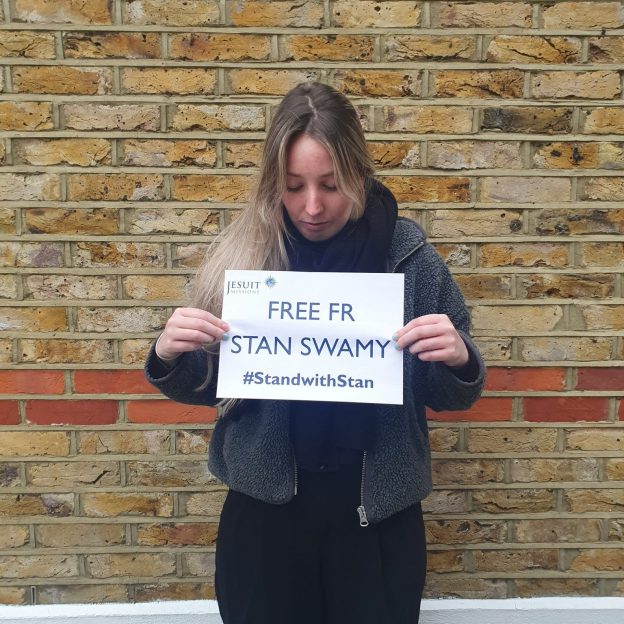
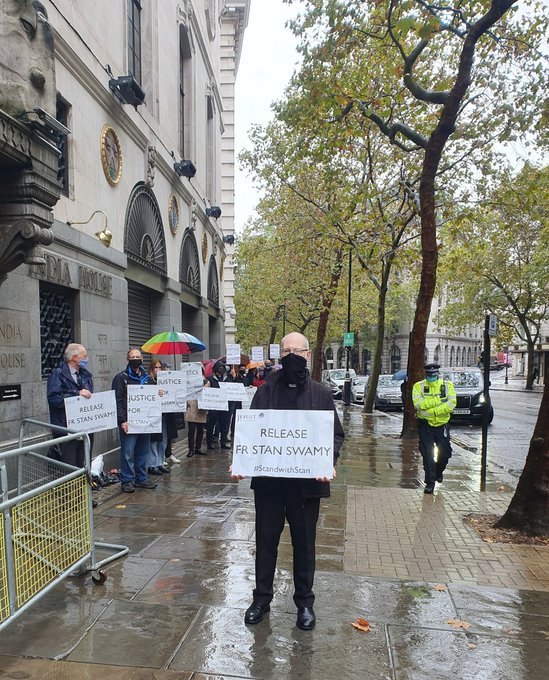
This Human Rights Day falls on the 10 December, and Jesuit Missions have asked for your help to take action to help free Fr Stan Swamy SJ from prison.
Fr Stan, a Jesuit priest and human rights activist, has been unfairly imprisoned by the National Investigation Agency in India since the 8 October.
He is 83 years old, in poor health and suffering from Parkinson’s disease. He needs your help.
What you can do
We want to raise awareness about what has happened to Fr Stan Swamy. This can be done in two ways.
Stand with Stan online
On Human Rights Day, we will be posting photos from Jesuit Mission supporters, Jesuit schools and parishes and others all standing with Stan. This will be part of an international online campaign and we are inviting you to get involved.
You can take action and #StandwithStan, by sending a photo of yourself with a poster, or sign that says #StandwithStan (you can download a poster below).
On the 10 December, all the photos of supporters will be tweeted to Ravi Shankar Prasad, Minister of Law and Justice in India calling him to take action for Stan on Human Rights Day.
To take part simply download and print our Stand with Stan poster, or create one yourself. Then, take a picture of yourself with the poster and send it to us using the link below!
Bishop Nicholas Hudson, lead Bishop for Justice & Peace in the Diocese of Westminster, writes:
Often, the parish community is the first place of encounter that the poor have with the face of Christ.” So says an interesting document called The Pastoral Conversion of the Parish Community in the Service of the Evangelising Mission of the Church. It comes from the Vatican’s Congregation for Clergy and is timely, because there is much reflection going on in our Diocesan community as to what it has meant to be a parish in time of pandemic; also what more we must do.
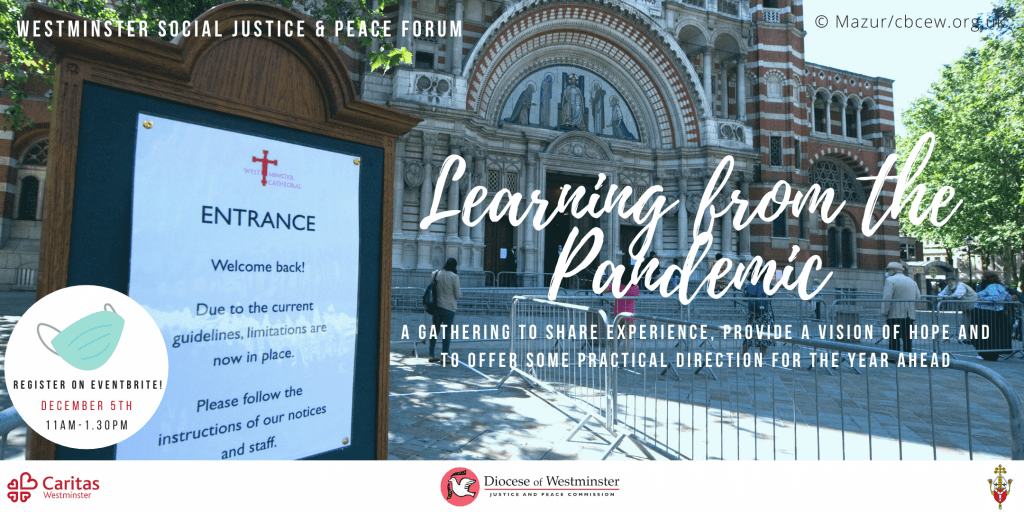
It is in this spirit of openness to conversion that we shall be coming together on 5th December to Learn from the Pandemic. We shall hear, from a rich array of speakers, what we have discovered about resourcing ourselves to meet the needs of the poor; how the pandemic has affected parishes seeking to embrace the New Evangelisation; what has been the impact of the amplified proclamation that Black Lives Matter; how the whole experience has refined our theology. We are grateful to be joined by Anna Gavurin from the Caritas Food Collective; Fr Richard Nesbitt, Parish Priest in White City; Catholic teacher Marcelle Smith, who has been empowering others to talk about racial justice and combating racism; and the theologian, Dr Pat Jones.
The question of the rich young man must remain our guiding light: “Master, what more must I do?” We need to be asking what more we must do, for example, for those who have no recourse to public funds, for those who seek to meet Christ in this time of disarray, for those who are persecuted on account of their race – and more. “What more must we do?” is the question which should guide our Learning from the Pandemic on 5th December and beyond. I hope as many agencies and groups within the Diocese as can will join us in this vital conversation.
Fr Dominic Robinson SJ, Chair of the Westminster Justice and Peace Commission responds to the Cardinal’s statement (below):
“The cutting of overseas aid by the British government amounts to £4 billion less for people in real need around the world. This is an issue that the Churches cannot ignore.
I am sure everyone concerned welcomes this full statement from the Cardinal.”
Cardinal Vincent Nichols, Archbishop of Westminster
Cardinal Vincent Nichols has written to the UK government expressing his concern at plans to reduce UK spending on overseas aid from 0.7% of gross national income to 0.5%. In today’s figures that amounts to a cut of around £4 billion in spending on help to the world’s poorest people.
The Cardinal writes: “A clear measure of a nation’s greatness is the manner in which it responds to the needs of its poorest. The same is true for the response to poverty between nations. If we truly wish to be a great nation, then cutting the overseas aid budget is a retrograde step. The great tragedies of forced mass migration and human trafficking must be tackled at their source. Carefully targeted and well managed overseas aid programmes are an essential part of this effort. In the face of these catastrophes, this is no time to reduce the UK’s contribution or effort.
“As Pope Francis said recently, ‘Poverty, decadence and suffering in one part of the earth are a silent breeding ground for problems that will end up affecting the entire planet. If we are troubled by the extinction of certain species, we should be all the more troubled that in some parts of our world individuals or peoples are prevented from developing their potential and beauty by poverty or other structural limitations. In the end, this will impoverish us all’. 1. Pope Francis Fratelli Tutti (2020, para 137)
“Promises were made by all parties on aid spending at the last election. In these extraordinarily difficult times, we should not now step back from our responsibilities to the world’s most vulnerable people, especially as combatting the spread of Covid-19 will necessarily mean richer countries supporting poorer ones in purchasing vaccines for their people and helping to roll out mass vaccination programmes. Combatting COVID-19 is an international endeavour and we cannot neglect those countries that benefit from our aid. I hope that compassionate and wise counsel will prevail.
“I realise the pressures which those holding elected office face in these times. Thank you for what you do and you remain in my prayers.”
OPEN INVITATION TO PARTICIPATE IN THE NEXT WESTMINSTER SOCIAL JUSTICE & PEACE FORUM SATURDAY 5TH DECEMBER 2020 11.00AM – 1.30PM Register with Eventbrite
Join us for an online gathering for everybody in the Diocese of Westminster (and our friends!) to share our experiences of the pandemic so far, provide a vision of hope and offer some practical direction for the year ahead. Our invited speakers will help us reflect on the impact the pandemic has had on our personal lives, our faith community and our pastoral practice.
What are the implications for our social justice-building and peace-making activity?
What have we learnt? Where do we go next?
Speakers helping to facilitate the Forum include Anna Gavurin (Caritas Food Collective), Dr Pat Jones (Catholic Social Teaching Researcher), Fr Richard Nesbitt (Parish Priest, Our Lady of Fatima, White City, London) and Fr Paschal Uche (Assistant Priest, St James the Less & St Helen, Colchester). Chair: Fr Dominic Robinson SJ (Chair of Westminster Justice & Peace). Summariser: Liam Allmark (Head of Public Affairs, Catholic Bishops Conference of England & Wales).
Forum Programme
10.45am Link Open
11.00am Prayer – led by Mary Pierre-Harvey (St Michael & St Martin, Hounslow, Youth and Caribbean Choir Leader)
11.15am Speakers
12.05pm Break
12.15pm Forum Discussion in Small Groups & Plenary
1.00pm Summary and Next Steps
1.20pm Prayer and Blessing
Hosted by Bishop Nicholas Hudson and Bishop Paul McAleenan
Co-sponsored by Caritas Westminster & Westminster Justice & Peace Commission
Accessibility – there will be British Sign Language interpretation at this event provided by Caritas Westminster Deaf Service






 Diocese of Westminster Justice and Peace Commission