Ekklesia in Trafalgar Square

By Fr Dominic Robinson SJ, published in The Pastoral Review

Palm Sunday 2020. Normally for the Christian community a day of processions often in beautiful early spring sunshine, and with the joyous expectation of Holy Week. A day when our church would normally be full and we would be looking forward to the busiest week of the year. Not so in 2020. Churches under lockdown, the streets deserted, and a sombre eerie feel of anxiety about what was to come.

The start of the lockdown was, to say the least, such an unsettling time for our parishes. Priests with no people to meet, greet, serve. Parish communities scattered and finding a way to live out eucharistic faith at a time of communal fast. Like the first Christians after the first Easter Sunday locked in behind closed doors, finding ways to share their faith, pray together, and be a community of believers in a new way. The source and summit of that faith for us, the Mass, was celebrated together by clergy and faithful but with the barrier of a movie camera between us, even most poignantly and painfully on those days of the Easter Triduum when the entire parish community should be gathered as one.

And yet amidst all this trauma there was something else, altogether more tragic and desperate. Walking out into the deserted city it became clear there was another population who were being forgotten. As the Christian community prepared to celebrate Holy Week and Easter with what hope we could muster there was a huge number of homeless left on the streets of London. Here, it became clear, was the stark reality of central London under lockdown, beyond the threshold of our closed doors and not caught on anyone’s video camera. The usually teeming streets now a ghost town – shops, pubs, restaurants locked up and displaying stark notices along the lines of “closed until further notice on account of the pandemic” and, anticipating the worst, “no cash is held here”. All offices closed and no workers on the streets. And in the midst of this, in pockets around the city, the most desperate who, in the panic of the exodus had simply been left behind. This group had no family to lock down with, were without shelter as all the night shelters had closed, and without food as soup runs had had to stop for safety’s sake and there were no businesses or people to beg from. In addition no public toilets were open from King’s Cross Station to the north to Victoria in the south. A Council official I spoke to on the ‘phone described the scene on the Strand as Armageddon and a police officer advised anyone visiting there alone would be in great danger.

Amidst all this it was also clear that much was being done to address the issues by national and local government. March 29th, Palm Sunday for the Christian community, was the date by which all homeless left on the streets would be housed in hotels and bed and breakfasts. This was the “everyone in” policy which we might have heard referred to on the news. Very many homeless were indeed housed and this was one of the great achievements of this time. Many die-hard homeless in normal times refusing help, a substantial group of whom would have entrenched addiction and mental health issues, really flourished during this time as they were given the tender loving care they surely always needed. And yet, despite the partial, very partial, success, media can cloud reality, especially at a time of great panic when our psychology is programmed to survival and part of that is to believe things are better than they are. What we hear through the media, even if it is partly true and partly fake news, becomes the true narrative.

I think it is worth stopping to reflect on this phenomenon of twisted narrative if we are to begin to comprehend the homeless issue during COVID. Palm Sunday is a helpful connector. For the crowd on that first Palm Sunday are surely victim to this phenomenon of fake news. How else would their singing hosannas to their Messiah lead to “crucify him” within just five days? Governments and politicians have always been good at this and learnt how to present what is not quite true as the Gospel. There are surely many parts of the world today where that is true and in the Church indeed, one must add with shame, we have seen how the truth can be masked by power and we end up trusting the least trustworthy and most heinous. In the midst of this, recognising how we are all sinners not just personally but socially, as society, as Church, as the human race, we are called to a new integrity which is the greatest form of truth in an age of so much fake news. That is why I think Pope Francis is reminding us especially at this time we are called not just to contribute to society through what we do but we are called to take the reins and build a new future. This must be a future of justice which exposes the truth and builds a new society in which all in society are given the respect the human being deserves as made in God’s image, and especially those who are weakest, who are forgotten, who are left in the gutter and consigned to the abyss. It is for me why, as John Bird, the founder of The Big Issue, puts it, we are called not simply to give handouts but give a hand up.

If we are guided by such a vision, the response of the Catholic community along with other Christian denominations and faiths, and importantly working together with secular and governmental authorities and organisations, has the opportunity to be truly prophetic. For me this experience of helping to rescue the homeless, in the midst of a time of great crisis, a ‘kairos’ in the biblical sense, has turned our minds and hearts back to the raw demands of the Gospel. It has called us to begin to embrace the truth about ourselves and our identity as human beings made in God’s image who are part of wider society, and to embrace what the Church can be.

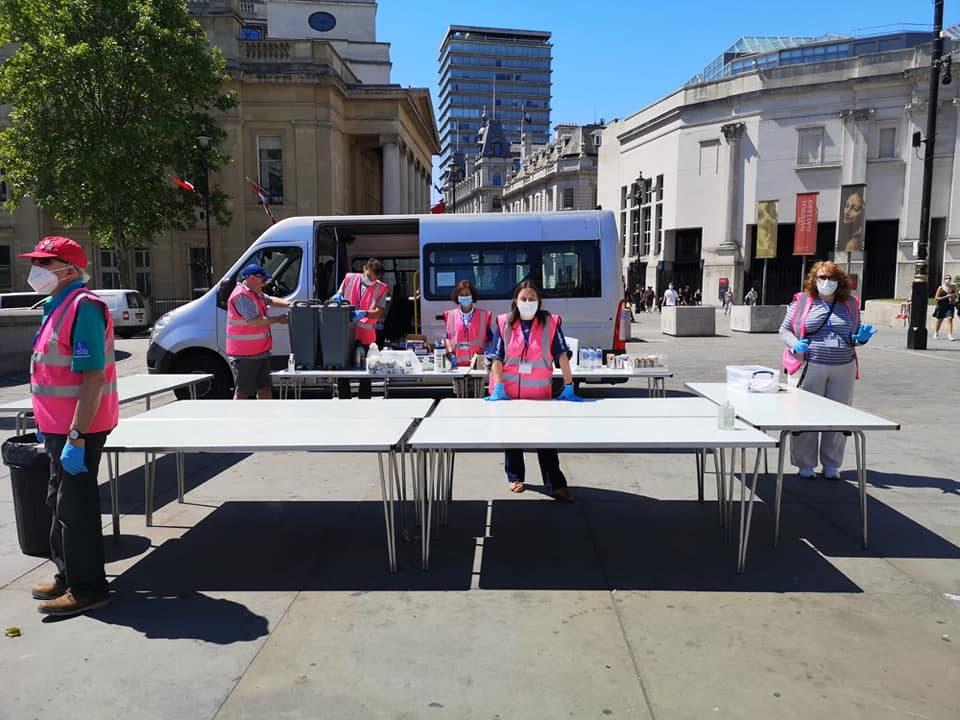
As soon as this crisis became evident our neighbouring parish St Patrick’s in Soho Square started feeding over 200 people a day. After a few weeks their resources were running low. Food was running out. Two large hotels in our parish stepped in straight away. While already housing and feeding NHS staff they volunteered to provide 200 meals twice a day for three months completely free. Our main managerial contact at the hotels is a Hindu but it was that common belief in what was just and true to our common calling which led him to make the offer. Soon we were using our knowledge of the local hospitality trade to work together with the authorities. In Soho Square there were significant antisocial behaviour complaints from neighbours, not surprisingly for a homeless population who had nowhere to go and where the nearest public toilets were two miles’ walk away. Westminster City Council asked us to help so we assembled a large team of volunteers from Farm Street and neighbouring Catholic parishes to service a new refreshments and pastoral care hub for the homeless in Trafalgar Square and this became the central mission of our parish and those parishes working with us for the time of the pandemic. The project has evolved into a homeless service under the name of Central London Catholic Churches as part of Westminster Diocesan Caritas.

Some have asked why the Church should be involved in this when it is really the job of the local authorities and national government? It is often framed as part of a larger question of why the Church should be involved in politics, or be involved in the real world, or have a mission. The answer relates to how we view our faith in Christ. For me the Spiritual Exercises of St Ignatius teach me to find Christ and my calling right in the heart of the now. This is simply the call of the Gospel. Christ is not to be found just within ourselves nor in our future hope but he is the hope of the world in the facts of everyday life. Our mission is in the present, in the midst of the battle between good and evil right now, under our noses as we are led to uncover the truth and discern what must be done to build that future now. This is a vital part of the role of the Church too who, as the Holy Father reminds us so often, simply would not exist if she did not have a mission in the heart of the world. So our mission to the homeless has been the only response the Church could give, taking account of the facts and knowing our calling as Church. And only the Church, acting as Church and not an NGO or any other organisation, could do this.

That mission has had various dimensions but I would highlight three of them. Firstly, and in common with so many secular homeless charities, we provide both material and pastoral care. This material help needs to be well discerned. The homeless need food and shelter but they also need advice on finding a job, so they need clothing and they need to be clean so need shower facilities. So, discerning the material need, our service has moved into a more personal holistic model.

The holistic model must involve one-to-one personal care. If we believe the essence of the Church’s work of charity is to respect the dignity of every human person, and especially the most vulnerable, our service of the weakest wants to develop a relationship with each individual. This human care is why the “everyone in” scheme was successful for those who were given the opportunity to stay in the hotels and B&Bs. In Trafalgar Square our wonderful team of volunteers would get to know the guests and there we touch that belief in the dignity of the human person in reality. We realise that this woman or man in the queue for food could have been me with just a few wrong turns. Everyone has a story. Relationships have broken down, finance has run out, jobs lost, mental health issues set in. And this is the person in front of us. This is Christ in front of us. And we are called to show that person how much they are loved, how much they are worth.

Secondly, again in common with many homeless services, we have a duty to work with the local authorities and to hold them to account. As Church we have the duty to advocate for these individuals individually and as society. Here the Church cannot but be involved in politics but must be aware that her role must never take on the role of party politics. Looking at the facts and advocating for a just future is very much the Church’s role as we represent our flock and take our place confidently in society. During the pandemic we got to know so many homeless still on the streets, heard their stories, and realised that the “everyone in” scheme was not for everyone. And after a certain time there was a risk that, unless there was pressure from those working with the homeless, “everyone in” would turn very quickly to “everyone out”. In addition we were meeting more and more new homeless, women and men in their 20s and 30s who had lost their jobs and were destitute.

We discovered that many on the streets, and many who were in danger of being evicted from temporary accommodation, at a time of great public health risk, had no recourse to public funds, often due to unsettled immigration status. It was our duty to show our support for them not just through handouts but by campaigning for a temporary reprieve for those in this category. This is not an issue to be used as a political football but is an issue of profound importance to the Christian who, at this extraordinary time of crisis, needs to put aside political views on benefit eligibility and immigration and show the human being in the midst of this the dignity they deserve.

Thirdly the Church has given something very distinctive to our service of the homeless at this time, as she does in all of our work in this sector. All that we have been doing is also a work of evangelisation through which all of us, volunteers and guests, grow in faith. There was one day when we had a large queue in Trafalgar Square. Because the volunteers had built up a very good relationship with the regular guests, they were chatting quite freely, getting to know them. And a guest was having some rosary beads he had requested blessed. Then some more guests got interested in this and started talking with us about the rosary and about faith. So you realized there was that connection being made between the Church and the Catholic faith and this charitable work. That was really quite inspiring to experience.

It’s also been wonderful to see the great generosity of our volunteers. This is what they needed to do to practise their faith at this time. Many parishioners have found this a very traumatic time for all sorts of reasons. I have heard much too about how we have been “starved of the Eucharist”. For all the good the livestreaming has done it is not a substitute for being gathered physically as ‘ekklesia’, as Church. And yet our volunteers gathered five times a week in the heart of the city and lived the Eucharist in such a powerful way. This was not just where the Church found a place to do charitable work as something to do during the lockdown. No, Trafalgar Square was where the Church, the ‘ekklesia’, was, and where the multitude was fed, welcomed to the sheepfold and tended.

So what can we do going forward? I would suggest three concrete things. Firstly, we must pray for the homeless and all involved in this – local and national government, NGOs, the Church and other faith groups’ services.

Secondly, we must raise awareness and find accurate information about what’s going on amid fake news and fuzzy statistics.

Thirdly, we really must learn from this dreadful time. We need to keep advocating for this most vulnerable group of people, and we need to keep our message Gospel inspired, hopeful, and in robust dialogue with those who have tough decisions to make on the issues. In doing so we must never forget above all that those we serve are human beings made in God’s image who could very easily be you or me.

Fr Dominic Robinson SJ is Parish Priest, at Farm Street Church of the Immaculate Conception and Chair, Justice & Peace Commission, Diocese of Westminster. This article was first published in the Pastoral Review and is republished here with permission.

LINKS

Farm Street Church – www.farmstreet.org.uk/

The Pastoral Review – www.thepastoralreview.org/

E-Bulletin October 2020

Deacon Adrian Cullen, Evangelisation Co-ordinator, Agency of Evangelisation, Diocese of Westminster, writes in this month’s E-Bulletin:

At the heart of the ‘The God Who Speaks’ Year of the Word 2020-21 is the figure of St Jerome whose Feast Day on 30th September marks 1600 years since his death. It was Jerome whose tireless work to interpret the Bible, and translate it from Greek, Hebrew and Aramaic into Latin, opened the Scriptures for the people of his age, and through the centuries since. 

In the practical work of bringing justice and peace to our world, it is lines of wisdom, stories of courage, and the sayings of Christ, so wonderfully brought to us by Jerome, that feed our every action. There will be words, phrases and paragraphs from the Old and New Testaments that play around in our mind; we may not even realise they are there, but they support us, guide us and encourage us in our work of bringing God’s Kingdom into the World.

In our world where it appears that the divide between rich and poor is ever widening, and that for many people God seems to be irrelevant, the words of the herdsman and prophet Amos, who faced similar issues, may to come to mind: “let justice roll down like waters, and righteousness like an ever-flowing stream”.  This too, is what we strive for… Read in full

The God Who Speaks of Justice and Peace – Year of the Word 2020-2021

By Deacon Adrian Cullen, Evangelisation Co-ordinator, Agency of Evangelisation, Diocese of Westminster

At the heart of the ‘The God Who Speaks’ Year of the Word 2020-21 is the figure of St Jerome whose Feast Day on 30th September marks 1600 years since his death. It was Jerome whose tireless work to interpret the Bible, and translate it from Greek, Hebrew and Aramaic into Latin, opened the Scriptures for the people of his age, and through the centuries since.  Pope Francis, celebrating this anniversary, tells us that Jerome continues to be ‘a figure of enduring relevance for us, the Christians of the twenty-first century’. Jerome’s “living and tender love” for the written word, was not just a personal devotion to sacred Scripture for its own sake, but a revealing of Jesus Christ himself.  For, as Jerome says, it is through knowing Holy Scripture, that we come to know Christ, who reveals to us the power and wisdom of God.

In the practical work of bringing justice and peace to our world, it is lines of wisdom, stories of courage, and the sayings of Christ, so wonderfully brought to us by Jerome, that feed our every action. There will be words, phrases and paragraphs from the Old and New Testaments that play around in our mind; we may not even realise they are there, but they support us, guide us and encourage us in our work of bringing God’s Kingdom into the World.

In our world where it appears that the divide between rich and poor is ever widening, and that for many people God seems to be irrelevant, the words of the herdsman and prophet Amos, who faced similar issues, may to come to mind: “let justice roll down like waters, and righteousness like an ever-flowing stream”.  This too, is what we strive for.

Maybe there are phrases of St Paul that hover in our thoughts. We may not be sure from which of his letters they come, or even if the order of the words is correct; but they surface in our mind in times of need, when the work we do is tiring and thankless, but we know it is the right thing to do: “By contrast, the fruit of the Spirit is love, joy, peace, patience, kindness, generosity, faithfulness,” – Galatians 5:22.

And there will be times when the words of Jesus himself whisper in our heart: ‘Truly I tell you, just as you did it to one of the least of these who are members of my family, you did it to me.’ – Matthew 25:40. And then, in that moment, The God Who Speaks, is speaking to us.

Pope Francis encourages us to always carry a Bible – a book, or on a smartphone, so that whenever we have a few minutes to spare in the day – each day, then we can turn to God and hear him speak to us.

And in this time of global pandemic, Pope Francis, in the first of a series of reflections he has given over the past few months, turns to the Bible, so that we can learn to “heal the world”, not just of pandemic, but of all its injustices:

Thus, we must keep our gaze firmly fixed on Jesus (see Heb 12:2): in the midst of this pandemic, our eyes on Jesus; and with this faith embrace the hope of the Kingdom of God that Jesus Himself brings us (see Mk 1:5; Mt 4:17; CCC 2816). A Kingdom of healing and of salvation that is already present in our midst (see Lk 10:11). A Kingdom of justice and of peace that is manifested through works of charity, which in their turn increase hope and strengthen faith (see 1 Cor 13:13). 

Pope Francis, Catechesis: “To Heal the World”

The Year of the Word has been extended to January 2022, during which, Catholics, and all of us working for justice and peace, are encouraged to explore and become more familiar with Holy Scripture, and so be ever listening to words that come to us from The God Who Speaks.

Westminster Justice & Peace among those attending first Ethical Investment Webinar

Report from Independent Catholic News

Operation Noah and partner organisations hosted the first part of a webinar series on Catholic investment for an integral ecology on Tuesday, 22 September. The series is sponsored by Operation Noah, CAFOD, Global Catholic Climate Movement, the Catholic Impact Investing Collaborative, the Conference of Religious, Association of Provincial Bursars, Trocaire, National Justice & Peace Network and Justice & Peace Scotland.

The first webinar, entitled Fossil fuel divestment: Accelerating the clean energy transition, brought together Catholic organisations to learn more and share experiences of divesting from the fossil fuel industry and supporting a just recovery from Covid-19. Speakers included Fr Augusto Zampini, Dr Lorna Gold, Stephen Power SJ and Sr Susan Francois CSJP.

More than 200 participants from around the world attended, including provincials, bursars and other members of Catholic religious orders, diocesan financial trustees and lay people.

The second webinar in the series, on Wednesday 21 October, will focus on impact investing, exploring how Catholic organisations can make investments with positive environmental and social impacts.

Earlier this week, the Vatican’s first-ever set of comprehensive environmental guidelines, including an endorsement of fossil fuel divestment, were made available in English. The Vatican guidelines on Journeying Towards Care for Our Common Home: Five Years After Laudato Sì, include the following recommendation (on p.177-178): ‘Promote ethical, responsible, and integral criteria for invesment decision making, taking care not to support companies that harm human or social ecology (for example, through abortion or the arms trade), or environmental ecology (for example, through the use of fossil fuels)’.

More than 190 Catholic organisations around the world have now made commitments to divest from fossil fuels. In May 2020, 42 institutions (including 21 from the UK) announced their decision to divest from fossil fuels. The group included Jesuits in Britain, Sisters of St Joseph of Peace (UK) and the Diocese of Arundel and Brighton, which became the third Catholic diocese in England and Wales to divest.

Fr Augusto Zampini, Co-Secretary of the Vatican Dicastery for Promoting Integral Human Development, provided the theological underpinnings for the Vatican’s recommendation decision to divest, framing the issue in the context of a just recovery from Covid-19. He said: “We need to divest from what is damaging and invest in what is not damaging, in what makes a positive social and environmental impact.’ He linked fossil fuel divestment to making resources available to finance renewable and circular sources of energy.”

Dr Lorna Gold, Vice Chair of the Global Catholic Climate Movement, shared how the Irish Catholic Bishops’ Conference divested from fossil fuels in 2018. She reminded participants that at this time of the global response to Covid-19, there is also a “waking up to the beauty of life which is the essence of an integral ecology, and translating it into hope filled action is what moving our capital or investment is all about.”

Stephen Power SJ, former Treasurer of Jesuits in Britain who manages the Jesuits’ ethical investment strategy, shared the practical steps taken by Jesuits in Britain in divesting from fossil fuels in February 2020. He highlighted the financial risk of investing in fossil fuels, as investors risk being left with “stranded assets”. He added: ‘It is important not to forget the prophetic [statement]… We need to keep bolstering ourselves with what Laudato Si’ helps us to remember… Pope Francis notes the climate being a common good belonging to all.”

Sr Susan Francois CSJP, Assistant Congregation Leader and Congregation Treasurer of the Sisters of St Joseph of Peace, shared how the UK region’s decision to divest was informed by the congregation’s charism. She said: “We are called to a conversion of heart and a change in behaviour. So our decision making must put sustainability of ecosystems before profit.’ She shared how this approach had also resulted in better financial performance.”

James Buchanan, Bright Now Campaign Manager at Operation Noah shared key findings of the report Church investments in major oil companies: Paris compliant or Paris defiant? He highlighted that major oil companies are continuing to explore for new reserves of fossil fuels, despite the vast majority of known reserves needing to remain in the ground, as Pope Francis highlighted to oil company CEOs in 2018.

Operation Noah and the Global Catholic Climate Movement invited Catholic religious orders and dioceses to join the next global divestment announcement for faith organisations in November 2020.

The webinar is available to watch again and can be viewed here: www.youtube.com/watch?v=XoSWjJQMnjU

Webinar Part 2: Investment for a green recovery: Innovation in impact investing takes place on Wednesday 21 October.

Register to join here: www.eventbrite.co.uk/e/part-2-investment-for-a-green-recovery-innovation-in-impact-investing-registration-118552167725

Carmel-in-the-City Ecumenical Creation Prayer Walk 3rd October 2020

The Carmelite Spirituality Group, Carmel-in-the-City, based at St Joseph’s Church, Bunhill Row, near London’s Barbican, will make the close of the Season of Creation with a Mass of Creation and an Ecumenical Creation Prayer Walk.

This will take place on Saturday, 3 October 2020 beginning with Quiet Prayer at 11.30am, followed by a Mass of Creation, Bring-Your-Own-Lunch, and the Creation Prayer Walk at 2pm.

The Walk will include Wesley’s Chapel Garden, a local Wild-life Garden, and St Joseph’s Quiet Garden in memory of Cardinal Basil Hume. The afternoon ends at 3.30pm. ALL ARE WELCOME !

For more information
phone: 07889 436 165
website: www.carmelinthecity.org.uk
email: info@carmelinthecity.org.uk

Housing and Homelessness Media Statement

Homeless Jesus, Farm Street Jesuit Church, Mayfair, London, UK

Fr Dominic Robinson SJ, Parish Priest of Farm Street and Chair of the Justice and Peace Commission said, “During the pandemic Central London Catholic Churches Homeless Services have worked with other faith groups, agencies, hospitality businesses and Westminster City Council to feed and provide showers, clothing and human care for some 300 homeless left on the streets of London.”

Colette Joyce, Co-ordinator of the Justice and Peace Commission, commented, “We are very concerned that, while there was a real success story at the beginning of lockdown with about 90% of homeless people given a temporary hotel place, as this crisis continues to unfold, we are witnessing more and more new destitute on the streets who are losing jobs, livelihoods and homes as a direct result of the pandemic. With night shelters closed, day centres and public services operating greatly reduced services, we are seeing the beginnings of a new underclass who, through no fault of their own, find themselves without a safety net in their hour of need.”

Fr Dominic added, “With the lifting of the ban on evictions from rented property, the end of the furlough scheme, and no move from national government on giving a reprieve to those with no recourse to public funds, the numbers of homeless on the streets and on the fragile line between just managing and destitution will get worse and worse.  It promises to be a huge humanitarian crisis on a grand scale.  Everybody wants to end rough sleeping forever – homeless agencies, faith groups, local authorities – and the united effort over the summer has shown we can work well together and find solutions.” 

Charities, such as Shelter, have taken steps this week to update their services with advice and guidance for those who now face eviction or have become newly homeless, but the support available is limited.

The Jesuit Refugee Service is calling attention, in particular, to the plight of thousands of people recently refused asylum who are now facing evictions from Home Office accommodation (as reported in The Guardian on 19/08/20). Evictions were paused in March due to the COVID-19 pandemic. Evictions recommence at the same time as the government is discussing fresh lockdown measures due to a rise in COVID-19 cases.

Sarah Teather, JRS UK’s director, said: “Manufactured homelessness should never be considered an acceptable tool of immigration enforcement, and it is deeply troubling that anyone should face renewed homelessness in the middle of a global pandemic.”

With the possibility of a second lockdown looming in some form, we continue to call for a temporary reprieve for the duration of the pandemic from the no recourse to public funds rules so that Councils, housing associations and charities can respond to all those who present as homeless. We further urge an immediate halt to the evictions of asylum seekers from hostels who have nowhere else to go. The ban on evictions of other tenants should be reinstated immediately in the event of any increase of pandemic measures. With Citizens UK, we ask those with the power to do so to provide these concessions and to avert a further crisis which will overwhelm all who want to help. 

Everyone in society deserves to be treated with dignity and respect and we need to put policies in place so that together we can ensure this. 

Statement from the Jesuit Refugee Service

Statement from Citizens UK

Bishop MacAleenan prays at Dover Migrants Memorial

Report from Independent Catholic News

Bishop Paul McAleenan visited Dover on Tuesday to meet with some of those working to help people who have arrived there to claim asylum. The gathering was organised by Seeking Sanctuary and hosted by the parish priest, Fr Jeff Cridland.

A TV team preparing for a coming episode of ‘Songs of Praise’ was also in Dover on the same day. Deb Barry posted the following reflection on the Care4Humanity’ Facebook page.

Bishop Paul is the Catholic bishop who leads on migration issues for fellow bishops in England and Wales wanted to meet with the organisations working with refugees. Care4humanity was asked to participate in the discussion groups, along with other local faith and community leaders, representatives from the Anglican diocese of Canterbruy, Seeking Sanctuary, KRAN and Samphire (organisations supporting refugees in Kent).

Key messages that everyone agreed on today included the need to remember that each of these refugees is an individual, they have an identity and their own unique story. Youth can play a really instrumental role in humanitarian work and advocacy, they are our future leaders and can be mobilized now to help refugees in so many ways and be a real example of peace and acceptance. Refugee work continues to be a global issue and we need to work across countries, faiths, governments, civil society and ethnicity, only as we come together in peace and a desire to truly help each other, can we find lasting solutions.

At the conclusion of the meetings, we then went down to Dover promenade where we met with the BBC Songs of Praise crew. We stood by the memorials to those who had lost their lives while making that crossing from France to the UK in order to seek sanctuary. The Bishop then said a prayer at the memorial and reminded all of us of the importance of each of these people’s lives. He prayed that people would be able to understand and assist those who have journeyed for a new and better life. He also prayed for all those who help, the policy makers and the opinion formers.

It was lovely to be able to stand together today, technology has allowed us to still operate during this time, but seeing so many people social distancing and standing in a circle today was a great strength.

We are excited at Care4Humanity to continue to work with so many different groups of people and stand together in peace to bring change.

The programme that includes the material filmed in Dover is scheduled to be aired on Songs of Praise on 11th October 2020 in the UK

Bishop McAleenan gave us this short reflection and prayer.

Listen

Soundcloud

Reflection

My name’s Bishop Paul McAleenan and I’m responsible for migrants and refugees for the Catholic Bishops’ Conference of England and Wales.

Yesterday was 15 September, the Feast of Our Lady of Sorrows – Mary who stood beneath the Cross as her son was dying. The Cross of Jesus and Our Lady of Sorrows always go together.

Here in Dover, it has been most edifying to meet those who, like Our Blessed Lady, have thrown in their lot with the refugees and are willing to support them, speak on their behalf and advocate for their cause.

On this beautiful afternoon, I met so many people who spoke movingly about their work and their intention to continue to spread the message that it’s so necessary for us to support migrants and refugees. Through their work, meeting with refugees, they have discovered the truth – that they are God’s children. We are all brothers and sisters in Jesus and we support them.

Let us pray.

We pray for volunteers who work for refugees here in the Dover area and in northern France, and for those who go to the rescue of those in danger.

We pray for policy-makers and opinion-formers.

May they provide a system whereby no-one needs to risk their lives in the quest for safety and freedom.

This prayer we make through Christ Our Lord who stretched out His hand to Peter on the Sea of Galilee and gives us the will to do likewise on the English coast.

Amen.

I thank you for joining me in this reflection and I ask you to continue to pray for migrants and refugees – and to remind you that on 27 September it’s the World Day of Prayer for Migrants and Refugees.

Text from Catholic Bishop’s Conference of England and Wales