Prizes have been agreed for the Season of Creation video competition in the Diocese of Westminster. Winning Schools and Parishes will get garden centre vouchers worth First Prize=£250, Second Prize=£100, Third Prize=£50. We would love to see how your school or your parish cares for creation. Get creative and get your entries in by 1st October. Winners announced on 4th October for the Feast of St Francis of Assisi.
Here is an excellent 3-minute video report summarising the basic points of Pope Francis’ new encyclical Fratelli tutti, due to be published on 3rd October 2020, the Vigil of the Feast of St Francis of Assisi. The encyclical, it seems, will focus on issues of justice defining the Church’s mission as we emerge from the pandemic. It is expected that the encyclical will consolidate the teaching on solidarity and respect for the earth’s resources which Pope Francis has been delivering during his weekly catecheses at the Papal Audiences this month.
We look forward to using this teaching to help inform and shape our action and reflection throughout the Diocese in the coming months.
The message so far is that the Pope is proposing 3 pillars:
1) Saying no to selfishness 2) Spreading hope 3) Taking action
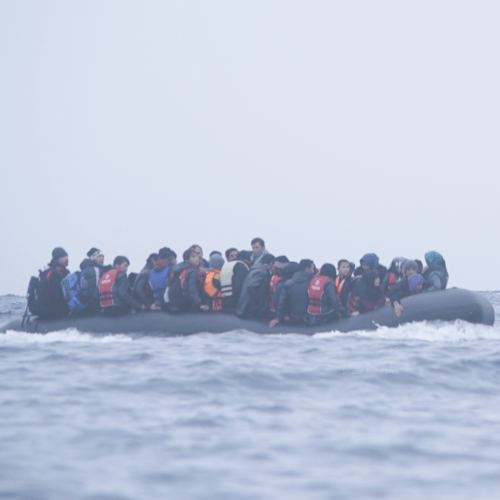
Death of young Sudanese man on Calais coast as he tries to reach the UK – Report by Barbara Kentish
The memorial plaques on the Dover seafront are a respectful reminder of the tragic deaths which now occur far too often in the English Channel between France and England, as people try to reach our shores. Representatives of Westminster Justice and Peace have taken part in remembrance services there, including just two months ago for the 20th anniversary of the 58 Chinese migrants found dead in a lorry at Dover, so that those who die far from home are given the dignity they deserve.
Now floral tributes have been laid at the newest memorial in memory of Abdulfatah Hamdallah (known as “Wadji”). He was a young man from Sudan who drowned while attempting to cross the Channel from France to seek asylum in the UK a few days ago. The wreath, in the colours of the Sudanese flag, carries a message based upon his last Facebook post: “On the palm of fate we walk, and don’t know what’s written. Your’s was written too short, may your freedom in the Hereafter long live”.
Ben Bano, Co-Director of Seeking Sanctuary, and partner, through People Not Walls, with Justice and Peace, commented: `This tragic death reminds us of the risks that desperate people take in order to find sanctuary. A life full of hope and opportunity has been lost, like many others who have in recent years. Let us mourn them and remember them – in the words of Pope Francis, “Every migrant has a name, a face and a story.”
French NGOs, some now having to organise a funeral, and welcome mourning relatives from overseas, will mount a protest on September 26th against the denial of basic water, food and sanitation to those fleeing persecution on the north coast. Here in England we plan to do the same. People wonder why so many little boats are arriving on our shores. Humanitarian abuses on the north coast of France raise instead the question as to why more don’t come, and whether we will see further tragedies, such as that of Abdulfatah Hamdallah. May all those who are travelling at such risk reach safe havens.
Edward de Quay, Project Manager for the Bishops’ Conference Environmental Advisory Group, looks at how Catholics in England and Wales have responded to Laudato Si’ and how each of us can be part of that response.
This article, written by Edward De Quay, first appearing in The Pastoral Review in May 2020 and re-circulated by the Catholic Bishops Conference of England and Wales during the Season of Creation in September 2020, focuses on the legacy of Laudato Si’ in England and Wales.
To those keenly waiting for the publication of Laudato Si’ (LS) the text was a relief. Led by Scripture and grounded in science, it identified care for creation as key to our faith, recognising that “science and religion, with their distinctive approaches to understanding reality, can enter into an intense dialogue fruitful for both” (LS 62). By accepting the signs of the times and understanding them through the lens of our faith, Pope Francis presented a powerful case to care for our common home.
Equally important was his insight that the ecological crisis we face is a human one; that climate change is a symptom of a problem that cannot be solved without addressing the root cause, which is our way of living and thinking and interacting with the world: “The violence present in our hearts, wounded by sin, is also reflected in the symptoms of sickness evident in the soil, in the water, in the air and in all forms of life” (LS 2). Drawing on the teaching of Pope St John Paul II, we are asked to embark on the journey of a “profound interior conversion”, leading to an “ecological conversion” (LS 217).
So far so good. Laudato Si’ was also a call to action, to wake up to climate change and understand that the cry of the poor – which we have always prided ourselves on being responsive to – is intertwined with the cry of the earth, which has been perhaps more difficult to identify. This article will focus on the practical imprint the document has made on the Catholic Church in England and Wales over the past five years.
Laudato Si’ is incredibly challenging at a personal level, and this has been evident in the difficulty many have found in engaging friends, family and parishes in its themes. In 2017 the Bishops’ Conference convened an Environmental Advisory Group, and while progress has been made in the following three years under the guidance of Bishop John Arnold, there is still a mountain to climb.
In principle, we are well poised to be agents for change. Globally there are 1.3 billion baptised Catholics, or 17.7 per cent of the world population. This is also, perhaps, a rare topic where we are in agreement with a prevailing societal view – that climate change is a fundamental problem to be addressed urgently. More than this, we have been ahead of the times in terms of our teaching.
In 1971, Pope Paul VI noted in his apostolic letter Octoagesima Adveniens: “Man is suddenly becoming aware that by an ill-considered exploitation of nature he risks destroying it and becoming in his turn the victim of this degradation.” Pope St John Paul II and Pope Benedict XVI, too, were outspoken on the topic. Pope Francis was able to bring together the threads of his predecessors into the tapestry of Laudato Si’, developing their understanding of care for creation and human development being two sides of the same coin, and criticising the consumerist mentality which fails to acknowledge this reality. There is no need to leave this topic to David Attenborough and Greta Thunberg. Catholics have a rich understanding of how care for our common home contributes to a life lived well. The science is important, but it’s only half the conversation.
On top of this, Pope Francis is a well-liked diplomat, and the political significance of Laudato Si’ should not be understated. The document was released, it is safe to assume, deliberately in the run-up to the UN Conference on Climate Change (COP21) in Paris in 2015, where it was acknowledged as influential and inspirational to the delegates. Archbishop Bernardito Auza, then Apostolic Nuncio and Permanent Observer of the Holy See to the United Nations, described how “not only had practically every delegate heard of Laudato Si’; Pope Francis was cited by more than thirty Heads of State or Government in their Interventions at the Plenary Session”. The resulting ‘Paris Agreement’ was a milestone in climate diplomacy, and is due to come into force when the UK hosts the twenty-sixth conference in Glasgow in November 2020.
Nationally too, Laudato Si’ has been influential. In 2018, the then secretary of State for the Environment, Food and Rural Affairs, Michael Gove, gave the Theos annual lecture on the environment, heavily referencing Laudato Si’, which he considers “remarkable for the depth of thought which goes into addressing the twin challenges of climate and social justice, for considering in depth both the science and theology of climate change, and for exploring the spiritual, ethical and religious dimensions of one of the greatest challenges facing the world”. He went on to state that “the Pope’s solutions in Laudato Si’ are clear and sensible, and ones on which I think we can all agree”.
We have another incentive to act – particularly in England and Wales. Quoting the bishops of Bolivia, Pope Francis states that “the countries which have benefited from a high degree of industrialization, at the cost of enormous emissions of greenhouse gases, have a greater responsibility for providing a solution to the problems they have caused” (LS 170). The Prime Minister has in fact committed us to this, acknowledging in his speech to launch COP26 that as we were first to industrialise, it is proper that we are the first major economy to meet net-zero by 2050.
Our own Bishops renewed their commitment to care for creation in 2019, with the written statement Guardians of God’s Creation, in which they call for the development of a “Christian spirituality of ecology” which begins in “personal and family life”. Perhaps this appears to be passing the buck, but the “interior conversion” needed to tackle the ecological crisis is a personal responsibility for everyone. Furthermore, it is in the schools that we see perhaps the most engaged action, where, at primary level at least, students can explore the issue outside of grown up concepts like ‘realistic expectations’, ‘economic progress’ or ‘funding constraints’. “Let the little children come to me and do not hinder them, for to such belongs the kingdom of heaven” (Mt 19.14). Like children, we should ask “why?” more, questioning the prevailing logic of the world and looking for truth and beauty. In a recent homily, Pope Francis reflected on the ‘apostasy of Solomon’ passage in the first book of Kings, saying that “for us this slippery slide in life is directed toward worldliness. This is the grave sin: ‘Everyone is doing it. Don’t worry about it; obviously it’s not ideal, but…’ We justify ourselves with these words, at the price of losing our faithfulness to the one and only God.” This ‘Christian spirituality of ecology’, both the key and biggest obstacle to engaging in the ecological crisis, must start in personal and family life, inspired by bold leadership.
In Guardians of God’s Creation, the Bishops committed themselves and invited their people to engage in this urgent challenge, “so that together we show leadership by our actions”, looking to “avoid the worst consequences of this ecological crisis by engaging now and over the next decade on this ‘long path to renewal’”. Some dioceses already have environmental policies in place, such as Middlesbrough and Hexham and Newcastle, and others have committed their dioceses to action through pastoral letters and Diocese-wide events.
As far back as 2007, Clifton Diocese organised a year-long series of events exploring our relationship to the natural world through the eyes of faith, under the title ‘The Sound of Many Waters’. CAFOD, too, have been running their livesimply award to celebrate parishes living simply, sustainably and in solidarity with the poorest since 2006. In Lent 2019, Bishop John Arnold issued a pastoral letter in which he challenged every parish to help “make the Diocese of Salford a flagship for ways to heal and care for our common home”, as well as announcing the development of a ‘Laudato Si’ Centre’ in the grounds of Wardley Hall. In Advent 2019, Bishop Richard Moth issued a similar challenge to his Diocese of Arundel and Brighton, urging it to “wake up” to our ecological crisis, as well as launching the ‘Journey to 2030’ project. Run by Catholic youth in the Diocese, it commits to a decade of action, and provides a simple ‘getting started guide’ for parishes at journeyto2030.org.
One way the Bishops’ Conference has indicated the importance of engaging with this topic is through the commissioning of two films produced by Catholic Faith Exploration (CaFE). Global Healing (2018) and Global Caring (2019) are TV-quality films engaging in the spirituality and practicalities of Laudato Si’, in a format designed to promote discussion and community-building in a parish setting. The Jesuits in Britain have also taken on the educational challenge, launching the Laudato Si’ Research Institute at Campion Hall, Oxford and an MA in Theology, Ecology and Ethics at Roehampton University last year.
Another national response has been the work done by the Catholic Church’s energy procurement group, Inter-diocesan Fuel Management (IFM), which supplies 2,800 churches with green electricity and gas, including landmarks such as Westminster, Nottingham and Plymouth Cathedrals. This contract is also available to Catholic schools, institutions and religious orders. The cost is kept down by buying energy together, so the more buildings we have on the scheme the better it becomes. Two dioceses, Lancaster and Middlesbrough, and several religious orders have also gone one stage further by announcing that their investment portfolios will no longer include fossil fuel companies.
There are many inspiring stories from schools and parishes across England and Wales, which deserve to be told. It is important to celebrate what we do achieve, be this improving recycling rates, insulating our churches and schools better or generating greener energy, opening allotments, banning plastics from parish activities, holding film and information nights and promoting eco-friendly behaviours, all while building a sense of community in the parish. All of this happens and happens well.
To return to the idea of asking “why?” more often, this can be as grand as challenging economic systems and as simple as looking at the contents of your own shopping basket. Often, there are no definitive answers, and the best approach is to allow those that have the skills and the time to engage in the issue and to come up with a locally workable solution. Even simple question like “why do we buy cut flowers?” could lead to interesting conversations. Perhaps this will come about by looking at what the parish buys, where it comes from, how it was traded, and whether better, more ethical, sustainable alternatives are available. Perhaps not every parish will come up with the same solution, but by engaging in the problem we learn more about the issues and our responsibilities as Christians to care for our neighbour.
This problem of unethical sourcing driven by the ‘culture of consumerism’ is criticised by Pope Francis in Laudato Si’ and returned to in his recent apostolic exhortation Querida Amazonia (QA), or ‘Beloved Amazonia’, a region of the world directly affected by our consumerist behaviour. “The globalized economy shamelessly damages human, social and cultural richness” (QA 39). “The land has blood, and it is bleeding; the multinationals have cut the veins of our mother earth” (QA 42). Speaking at a press conference to launch the document, Bishop John Arnold added that “the environmental questions are enormous because what they’ve been doing in the Amazon is not sustainable. The use of fossil fuels and the mining cannot be sustained and is doing dreadful damage. We’ve got to be aware of our role in that, that so many of the products of the Amazon are consumed by us, and are not even for the benefit of the people of that region.”
Changing our consumer habits helps bring pressure on those who wield political, economic and social power. Pope Francis argues that “this is what consumer movements accomplish by boycotting certain products. They prove successful in changing the way businesses operate, forcing them to consider their environmental footprint and their patterns of production. When social pressure affects their earnings, businesses clearly have to find ways to produce differently. This shows us the great need for a sense of social responsibility on the part of consumers. Purchasing is always a moral – and not simply economic – act” (LS 206).
Alongside our individual and community efforts, it is right that we are active politically. CAFOD have taken Laudato Si’ to heart, concentrating effort through their ‘Our Common Home’ campaign. A current action is a petition to the Prime Minister addressing issues raised in Querida Amazonia around support for local, sustainable agriculture and clean energy. This campaign recognises that it is the poorest and most vulnerable who pay the price of climate change, despite having done the least to cause the problems. CAFOD is also active in interfaith and wider society action, such as the ‘Time is Now’ lobby last June, where over 380 members of parliament came out to talk to their constituents about climate change. The National Justice and Peace Network is also focusing on ecology at their annual conference this June, entitled ‘2020 vision – Action for Life on Earth’.
This is another important part of asking “why?” like children and being awake to the ways our society affects our global neighbours. In the run-up to COP26, it is especially important to make our voices heard, and Pope Francis encourages us to do this:
“For this reason, all of us should insist on the urgent need to establish a legal framework which can set clear boundaries and ensure the protection of ecosystems … otherwise, the new power structures based on the techno-economic paradigm may overwhelm not only our politics, but also freedom and justice” (QA 52).
When we stand back and look at the big picture, as illustrated by this entirely insufficient overview, it is of a church in motion. There is something everyone can do to encourage this ‘profound interior conversion’, no matter how small, as there is a “nobility in the duty to care for creation through little daily actions, and it is wonderful how education can bring about real changes in lifestyle.” (LS 211)
To conclude and re-emphasise, this article lists a tiny fragment of the Church’s efforts both from organisations and individuals. Every parishioner’s efforts build up the collective action of the Church.
“Many long-standing Catholic members of The East London Citizens Organisation (TELCO) feature in a new film released this week, marking the eighth anniversary of London hosting the Olympic and Paralympic Games.
Staff and pupils from St Antony’s Primary School, Newham, St Bonaventure’s School, Forest Gate and St Stephen’s Manor Park, [in the Diocese of Brentwood], are among those highlighting the broken promises made in 2005, and call on policymakers to honour the pledges they made and work with them for a new deal on the Olympic Park.”
This powerful short film also addresses the roots of the ‘affordable’ housing crisis and looks at the change of mindset that will be required to prioritise houses as homes for people rather than sources of profit.
The awarding of the 2012 Games to London promised much for communities but has not yet delivered. Now that the Tokyo Games have been pushed forward to 2021, we have given another year to reflect on the legacy of our own Games and another opportunity to create a ‘new normal’ as we ‘build back better’ following our pandemic lockdown experience.
What lessons have we learnt?
Housing developing is resuming again around the Olympic site, as elsewhere in London and the rest of the UK, so there has never been time to campaign for the homes we truly need.
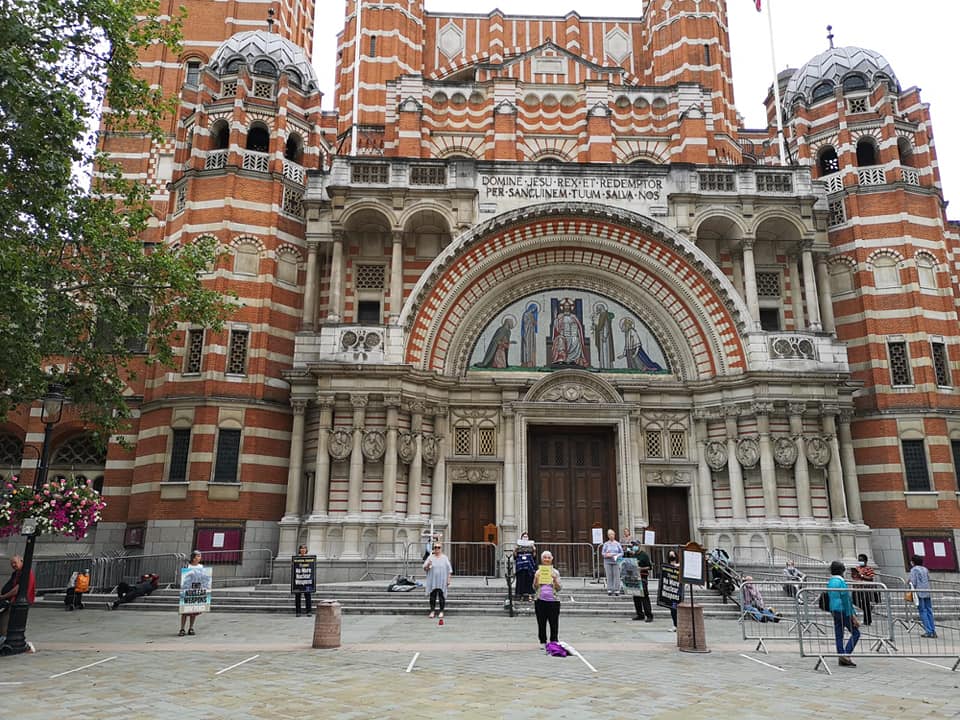
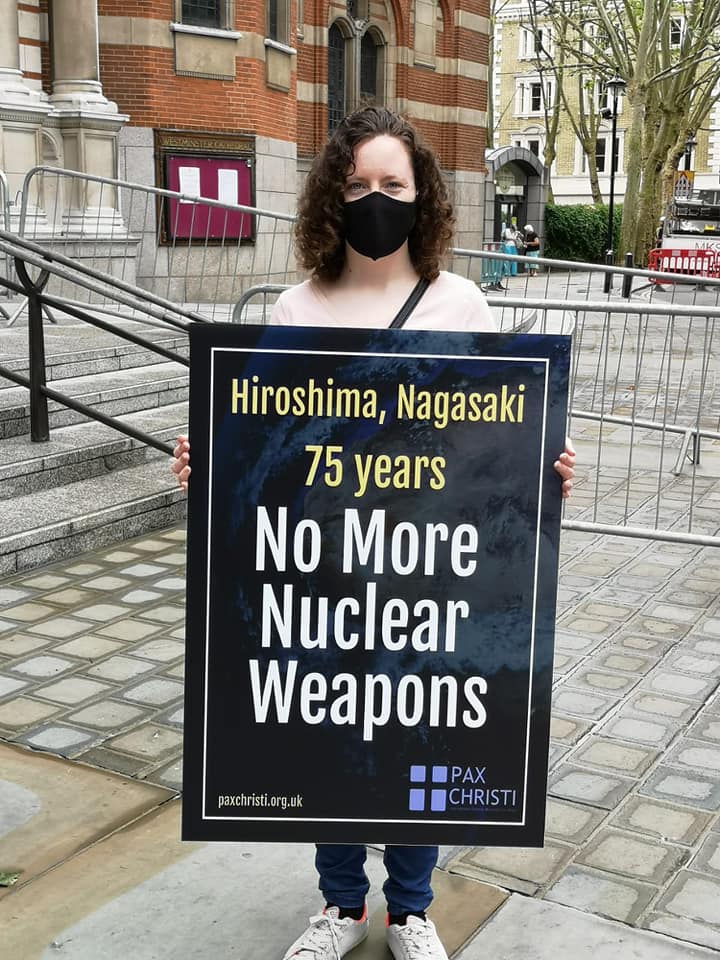
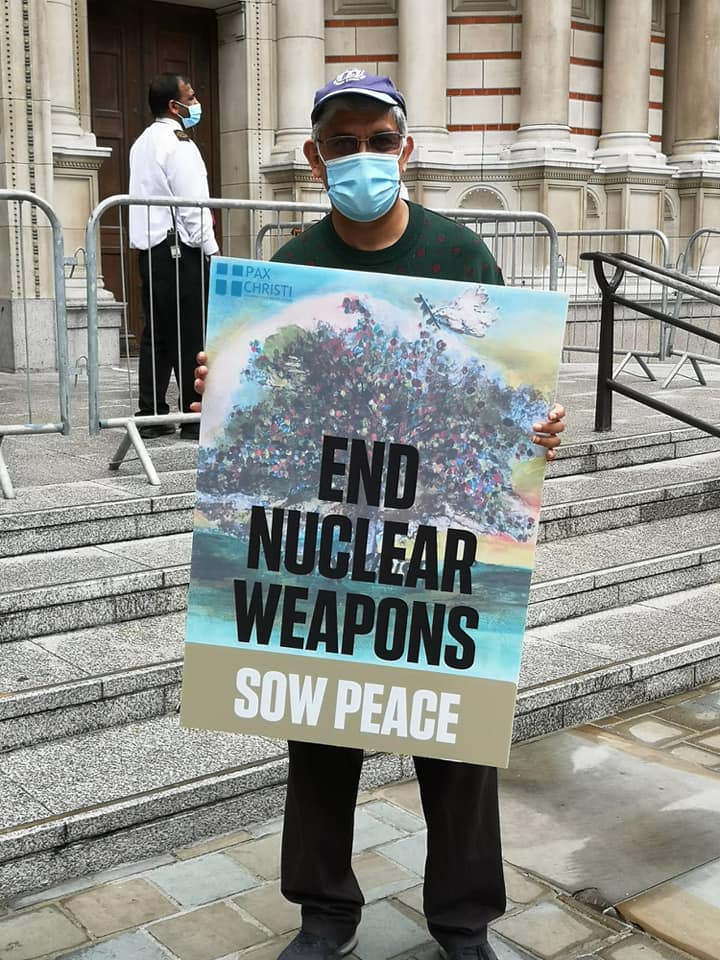
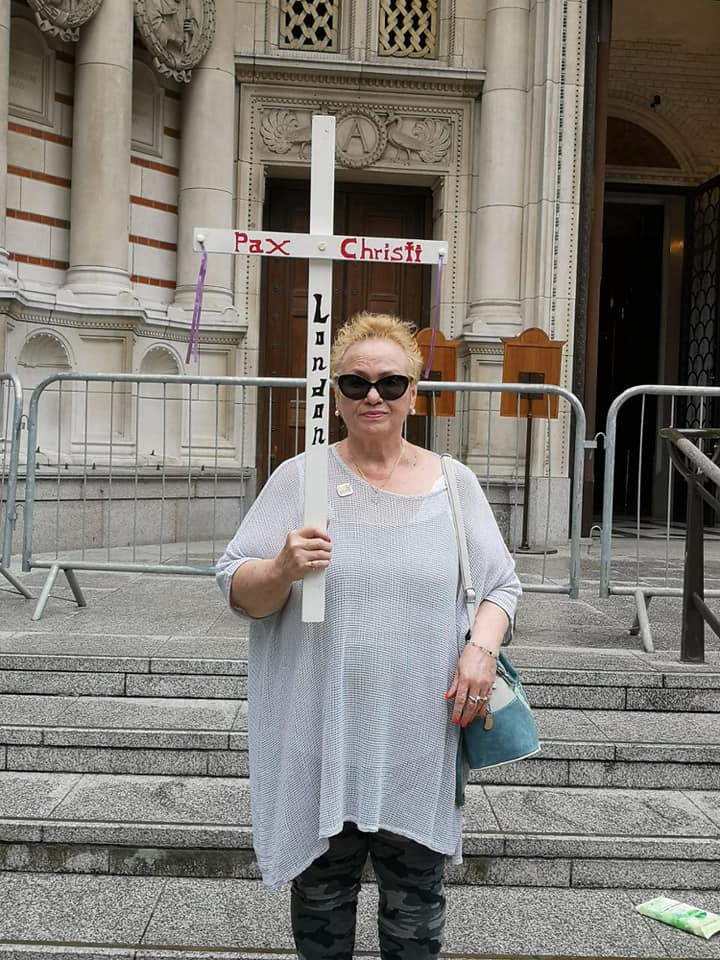
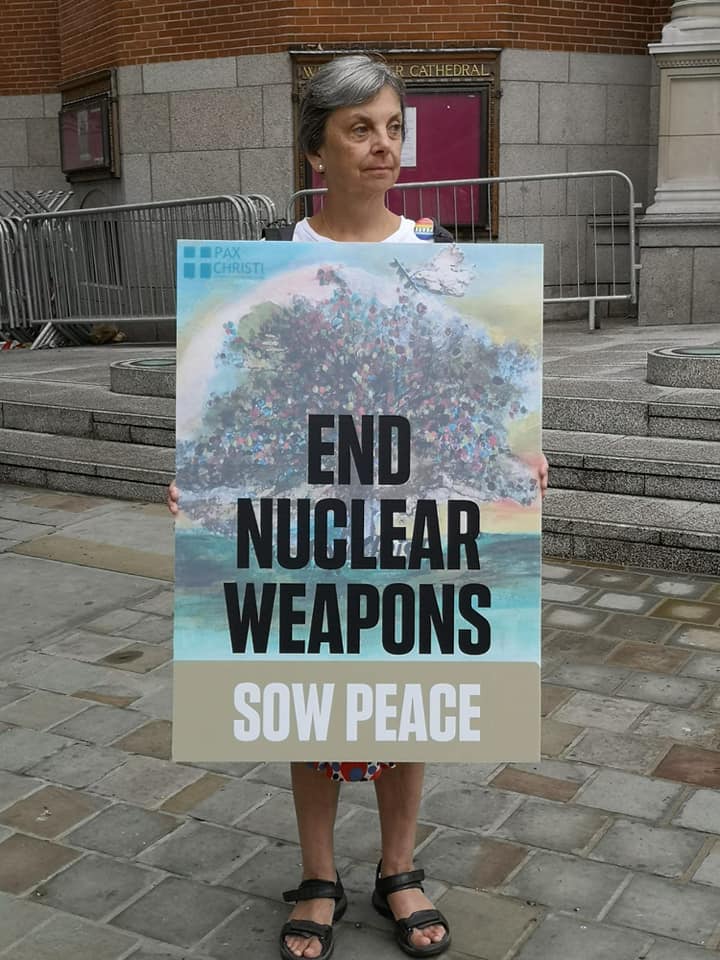
Peace campaigners stood in the Piazza outside Westminster Cathedral on Sunday for the annual vigil commemorating those who died when the second atomic bomb was dropped on Nagasaki killing about 80,000 people. A vigil was also held outside the Cathedral on Thursday 6 August, marking the first atomic bomb on Hiroshima which left 146,000 dead.
Pat Gaffney, former general secretary of Pax Christi, told ICN: “It was good to be with members of Pax Christi and Westminster J&P for the annual Nagasaki vigil outside Westminster Cathedral. To witness to the horror and suffering inflicted on that city was especially important this year, the 75 anniversary.
“Our messages were clearly presented in a safely distanced way to those waiting to attend the two Masses in the Cathedral. Our call and prayer were for the abolition of nuclear weapons with the practical ask to our own Government to become a signatory to the Treaty on the Abolition of Nuclear Weapons.”
Pax Christi and J & P members outside Westminster Cathedral, 6th August 2020
Westminster Justice & Peace joined Pax Christi this morning for a silent witness outside Westminster Cathedral to remember those who died in the nuclear bombing of the Japanese city Hiroshima 75 years ago today, and to call for a ban on nuclear weapons. We will return on Sunday for another witness to recall the bombing of the second city, Nagasaki.
Statement from the Westminster Justice and Peace Commission:
In August we as a country will want to mark the 75th anniversary of the atom bomb attacks on Hiroshima and Nagasaki. This was the world’s first, and only ever, use of nuclear weapons in conflict. Pope Francis visited both cities last year, laid a wreath at the memorials, and prayed for the more than 200,000 people who died instantly or in the months after the two attacks. He said “this place makes us deeply aware of the pain and horror that we human beings are capable of inflicting upon one another”.
In marking this important anniversary, we commend to our fellow Catholics, and all people of goodwill, Pope Francis’ call for a world without nuclear weapons. We can surely all agree with Pope Francis when he said that “In a world where millions of children and families live in inhumane conditions, the money that is squandered and the fortunes made through the manufacture, upgrading, maintenance and sale of ever more destructive weapons, are an affront crying out to heaven”.
75 years on from Hiroshima and Nagasaki, we have an opportunity now to demonstrate creative moral courage. We have a particular responsibility to reflect on Pope Francis’ conviction that possessing or deploying nuclear weapons “is immoral”. So as we look forward to the UN Treaty for the Prohibition of Nuclear Weapons passing into international law soon, we call on the government, along with the other nuclear powers, to sign the treaty and be part of a future built on just international relationships and the common good of all humanity.
Pax Christi England and Wales have organised a series events from 6-9th August 2020 to mark 75 years since the first atomic bombs were dropped on the Japanese cities of Hiroshima and Nagasaki at the end of the Second World War.
Thursday 6th August 10.00-11.30am:Hiroshima. There will be a silent, outdoor, socially-distanced presence outside Westminster Cathedral. If you can safely join us, please come and stand in silence for a while. The plaza space is large so you will be able to maintain a distance. You might like to bring a candle, some flowers, or a sign, but just to be present will be enough.
Sunday 9th August 10.00-11.30am:Nagasaki. There will be a silent, outdoor, socially-distanced presence outside Westminster Cathedral. If you can safely join us, please come and stand in silence for a while. The plaza space is large so you will be able to maintain a distance. You might like to bring a candle, some flowers, or a sign, but just to be present will be enough.
‘Come, Lord, for it is late, and where destruction has abounded, may hope also abound today that we can write and achieve a different future. Come, Lord, Prince of Peace! Make us instruments and reflections of your peace!’





 Diocese of Westminster Justice and Peace Commission