By Amy Smith, Westminster Justice and Peace Communications Volunteer
Today, 22nd April, is Earth Day – an annual event that shines a light on the serious environmental issues that our world is facing and what actions we can take as individuals and organisation to keep temperature rises below 1.5 C and promote a greener future.
It involves a wide range of events involving 1 billion people in more than 193 countries.
The official theme for 2022 is ‘Invest in Our Planet’.
Every Earth Day can drive a year of energy, enthusiasm and commitment to create a new plan of action for our planet.
Earth Day works in countries around the world to drive meaningful action for our planet across a range of issues. For more information on the campaigns and to find out what is happening in your area this Earth Day: https://earthday.org/earth-day-2022
Earth Day Video – “We can still get the job done…”
Join the Southern Dioceses Environment Network for monthly prayer, sharing and discussion on all matters concerning the Catholic response to care of creation. Next meeting: Monday 9th May, 12.45-2.00pm. Click here for full details
Bishop Paul McAleenan at Dover memorial to refugees drowned in the Channel. Photo: Mazur/CBCEW.org.uk
Bishop Paul McAleenan, Lead Bishop for Migrants and Refugees for the Bishops’ Conference of England and Wales, has followed other faith leaders to object to the UK government’s plan to send some asylum seekers to Rwanda. He said in a statement today: “The proposal to send some of those seeking asylum to Rwanda is at odds with the line from the Prophet Isaiah which we read as we prepare for Easter, ‘He does not break the crushed reed nor quench the wavering flame’.
“Despite presenting the plan as a humanitarian need to combat trafficking, this scheme will compound the difficulties of those arriving on our shores hoping for a new beginning. The actions of the people of this country show that they wish to lift up those in need, decisions of the government should do likewise.
“I am reminded of a memorial plaque on the promenade in Dover honouring those who died at sea seeking refuge. ‘Every migrant has a name, a face, a story’. This should be our starting point. We need to make it convenient for them to tell their story (their Asylum claim) remembering we are dealing with individuals made in God’s image who have endured great hardships in their own country and on their travels.
“The UK Government and the whole international community, motivated by the desire to uphold the dignity of human life, need to address the problems which cause people to flee their homes.
“We pray for all refugees whose sole aim is to survive each day. Led by the Christian spirit, manifested so powerfully at Easter, we should help and not discourage them.”
In his Easter Vigil Homily, Cardinal Vincent made it clear that those who seek solutions to these challenges must do so with compassion and regard for human dignity, saying that ‘this policy announcement simply lacks these qualities.’
Last week, the UK government announced its plans to send people seeking asylum in this country to Rwanda, where their asylum requests would be processed by local authorities there instead. Such plans would effectively exile those who have come to the UK seeking sanctuary (many of whom have already been forced to flee their homes due to war and persecution) to places such as Rwanda, where they will be detained whilst their asylum claims are looked into – with little safeguards offered against potential human rights infringements and abuses.
Caritas Westminster condemns policies such as ‘offshoring’ asylum claims, which are both lacking in compassion and respect for human dignity.
“Caritas Westminster stands in solidarity with all people who seek humane and just solutions for those fleeing conflict and persecution. We are dismayed at the Government’s plans to deport those seeking asylum in the UK to Rwanda for resettlement. This is clearly a case of punishing the victim, not the perpetrator, and does little to recognise the underlying causes of why people are forced to migrate.
“The policy falls far too short of being compassionate and fair, and will serve only to undermine the innate God-given humanity and dignity of those individuals who will be affected by it.”
John Coleby, Director of Caritas Westminster
In his homily at the Easter Vigil – whereby he spoke of the various injustices afflicting individuals around the world – Cardinal Vincent Nichols, too, referenced the new policy, and called on Catholics to,
“Pray that those who seek solutions do so with compassion, and with regard for the dignity which is innate to every human being. This week’s policy announcement simply lacks these qualities.”
This policy proposal is part of wider government immigration reform, embodied by the Nationality and Borders Bill, which is returning to the House of Commons for final amendments to be considered on Wednesday 20th April. If passed in its current form, the Bill would create a plethora of new barriers for refugees seeking sanctuary in the UK, rather than addressing the root causes of forced migration and trafficking.
Caritas Westminster, once again, calls upon the UK government to implement a compassionate and just asylum system, rooted in our common humanity, with the following issues addressed:
The asylum system should never penalise people for arriving spontaneously or without documents, or differentiate asylum claims on the basis of how people got here. Most refugees have no choice of how they travel.
Asylum claimants should have safe and dignified accommodation within British communities.
Secure safe routes to the UK and prevent dangerous Channel crossings. We need ambitious, compassionate and detailed plans that will meaningfully expand safe routes to the UK for refugees – until then, people will continue to risk dangerous journeys to reach protection and loved ones.
“Amid the pain of the war, there are also encouraging signs, such as the open doors of all those families and communities that are welcoming migrants and refugees throughout Europe. May these numerous acts of charity become a blessing for our societies, at times debased by selfishness and individualism, and help to make them welcoming to all.”
There is still time for you to make a difference – join us and our partners in making our society one which is welcoming to all, by opposing the Nationality and Borders Bill today, and calling on your MP to do the same, by clicking here!
For more information about:
The Nationality and Borders Bill and its potential impact on our asylum system, click here.
Volunteering at projects supporting asylum seekers and refugees, click here.
Image: Faiths in Manchester, Bishop John Arnold (far left)
By Hannan Brown. Source: JPIT
Senior Church leaders have written to all MPs ahead of Wednesday’s vote on the Nationality and Borders Bill, urging them to use their influence to make changes to the Bill.
The Nationality and Borders Bill is due to come before MPs on Wednesday 20th April, to allow them to vote on amendments proposed by the House of Lords. The Bill is in its final stages and continues to be backed by the government, despite having suffered multiple defeats in the House of Lords.
The Church leaders who have signed the letter represent a range of denominations and traditions in the UK, many of whom have been outspoken about the Bill over the past year. The letter has been sent to every MP currently elected to the House of Commons.
You can read the full text of the letter below.
We are writing as a group of Christian leaders, from denominations and traditions across the UK, ahead of the vote on the Nationality and Borders Bill in the House of Commons this week. We want to take this last opportunity to make it clear where we stand on the Nationality and Borders Bill. We urge you to use your influence to encourage concessions to the Bill ahead of the vote, and to support the changes made to the Bill in the House of Lords.
Faith groups have been outspoken on our concerns about the Bill since the start of the process. We have made it clear how we feel the Bill fails to uphold the principles and values of the UK by creating hostility and fostering discrimination against some of the most vulnerable people in the world. Only in the last few weeks we have witnessed the seemingly limitless compassion and commitment shown by UK citizens as they have welcomed Ukrainian refugees into their lives and homes. Yet the Nationality and Borders Bill directly contradicts this approach. We find it challenging to understand how the policies within the Bill will work in practice, except that they will cause hardship, criminalise innocent people and fracture families.
The amendments made in the House of Lords will improve the Bill as they seek to bring it in line with international convention, compassion and care for our common humanity. In particular, we support amendments made to expand and protect family reunion rights, to enable asylum seekers to work after waiting six months for their application outcome, to establish a target for resettlement and to amend the two-tier system proposed for asylum seekers. Each of these amendments recognises that the trauma and need of a person seeking asylum should be prioritised, and that we should do all we can to offer opportunities for people and families to restore their lives in a place of safety. In supporting these amendments, we urge you not to vote against the lives of vulnerable children, men, women and families who are in desperate need of our support.
At this time of Easter, as Christians we celebrate new life and new hope. Our faith tells us that our God-given hope in new life should influence the way we treat our neighbour, wherever they come from. As the Nationality and Borders Bill comes before you this week, we ask you to consider how your vote demonstrates how you care for those most vulnerable in our world.
Regardless of the outcome of this week’s vote, we will not stop advocating for love to be shown to our neighbour through the policies and practices in our asylum system. Churches across the UK will continue to come alongside those who remain in desperate need of our friendship and welcome.
We wish to encourage you in your role, and hold you in our prayers during this time.
With Regards, Bishop John Arnold, Roman Catholic Bishop of Salford Nicola Brady, General Secretary, Churches Together in Britain and Ireland Dr Patrick Coyle, Chair, Cytûn – Churches Together in Wales Revd Clare Downing, General Assembly Moderator of the United Reformed Church Barbara Easton, Vice-President of the Conference of the Methodist Church in Great Britain Rt Revd Olivia Graham, Bishop of Reading Revd Lynn Green, General Secretary, The Baptist Union of Great Britain Rev Ruth Harvey, Leader, the Iona Community Revd Sonia Hicks, President of the Conference of the Methodist Church in Great Britain The Bishop of Dover, The Rt Revd Rose Hudson-Wilkin The Most Revd Andrew John, Archbishop of Wales and Bishop of Bangor Paul Parker, Recording Clerk, Quakers in Britain The Rt Revd Dr John Perumbalath, Bishop of Bradwell, Chair of Churches Refugee Network UK & Ireland Bishop Mike Royal, General Secretary of Churches Together in England Lord Bishop of St Albans, Dr Alan Smith Most Rev Mark Strange, Bishop of Moray, Ross and Caithness, and Primus of the Scottish Episcopal Church Lord Wallace of Tankerness, Moderator of the General Assembly of the Church of Scotland
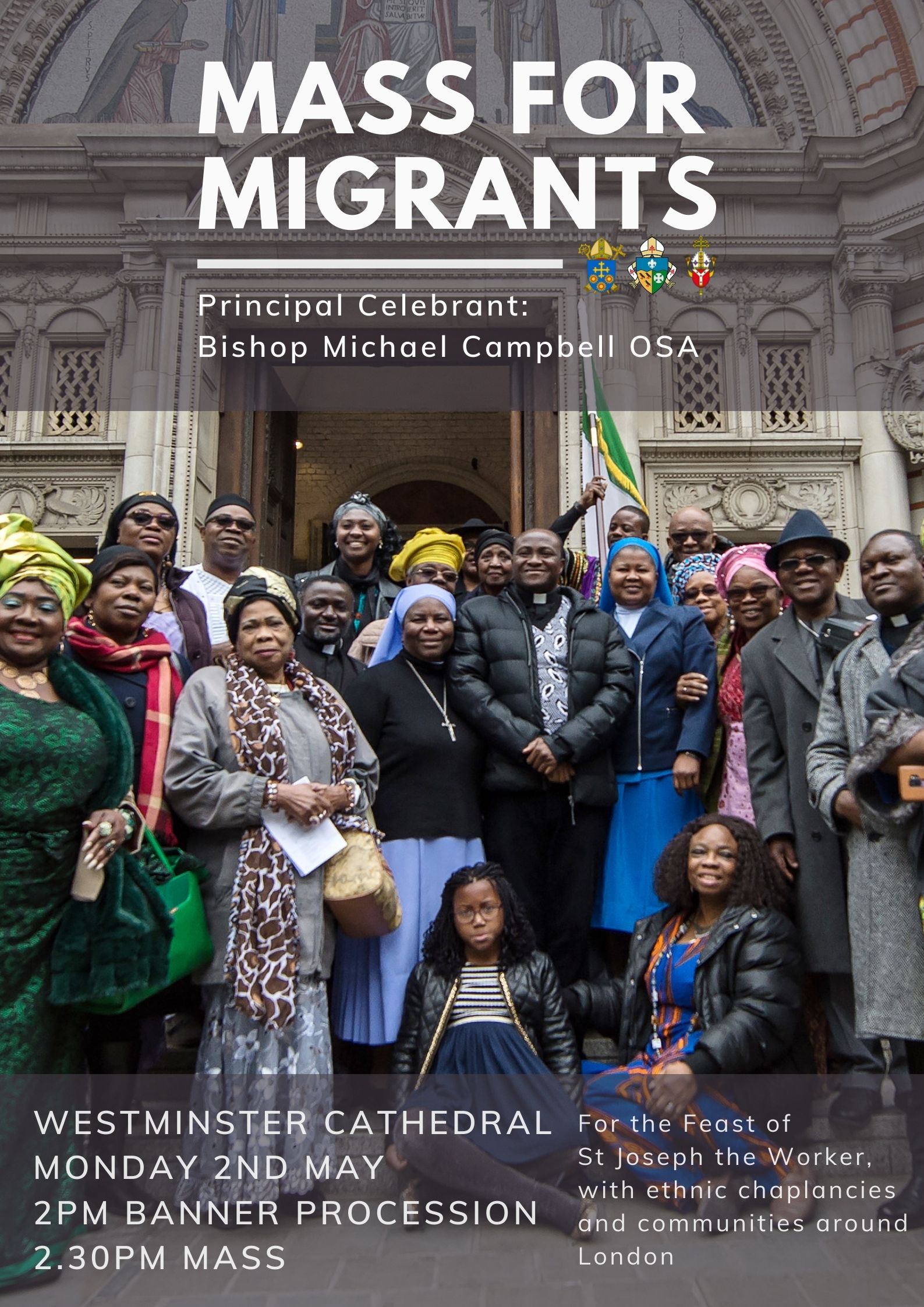
APOLOGY Regrettably, we are unable to livestream the Mass for Migrants on this occasion, as previously advertised.
All are welcome to join the Dioceses and Ethnic Chaplaincies of Brentwood, Southwark and Westminster for a celebration of the annual Mass for Migrants on Monday, 2nd May 2022.
The Mass this year is hosted by the Diocese of Westminster and the celebrant is Bishop Michael Campbell OSA.
Banner bearers are invited to gather in Westminster Cathedral Hall between 1-2pm.
Please be seated in the Cathedral before the banner procession at 2pm. Mass begins at 2.30pm.
On Monday of Holy Week, 11th April 2022, Bishop Kenneth Nowakowski (centre) of the Ukrainian Eparchy of the Holy Family was joined by Cardinal Vincent Nichols, Anglican Bishop of London Sarah Mullally, Archbishop Angaelos of the Coptic Orthodox Church, and a number of leaders of other Christian denominations in an hour of ecumenical prayer in a demonstration of solidarity and support for the people of Ukraine.
Prior to the service, Cardinal Vincent Nichols was interviewed for Sky News
Interviewer: Why did the Church leaders decide it was important to have this hour of prayer?
Cardinal Vincent: Well it’s important to understand that we’re meeting in the Ukrainian Catholic Cathedral, and this is an important centre here, right in the middle of London, where they’re trying to become a focus for the those in need and those who are arriving here. So the place of prayer is important, the prayer itself is important and the wide range of Christian leadership that will be present here this morning is also significant. We are very united in this determination to support the people of Ukraine as they face this terrible evil onslaught.
Interviewer: And this hour of prayer, is it open to the public? Can anyone walk in and join?
Cardinal Vincent: Certainly it’s open to the public and it’s placed now at midday hopefully that some people in their lunch break will come in. There’s been some publicity for it, and this church is always open, and it’s a Catholic Church but it’s a Ukrainian Rite Catholic Church. So the pattern of prayer here is a bit different and that for some people will be a good experience as well. But it’s the fervour, it’s the intensity of the prayer that reflects the horror and intensity of the challenge that we all face.
Interviewer: Have you had any word on how the Catholic community in Ukraine is faring?
Cardinal Vincent: Well that is exactly what Bishop Kenneth here and his staff are very, very much in touch with. And it depends obviously on the different parts of the country in Ukraine. I’m not familiar with the details of every place, but I know that there is a great affinity always between Catholics across the world and we along with everybody else are responding as generously and as rapidly as we can to the appeals for finance, for practical assistance, and for a welcome here. Despite the difficulties involved in getting Ukrainian refugees here that you have been talking about earlier in the programme.
Interviewer: Were you surprised when the Pope himself on Sunday, called for an Easter truce in Ukraine? That he so publicly came out and gave his voice?
Cardinal Vincent: No, I was not at all surprised and I think it’s very important that what he asked for was a truce not a ceasefire. He said we don’t need a ceasefire in which people re-arm themselves, we want a genuine truce, an end to these hostilities so that there’s space for humanity’s needs to come to the fore. And that means people giving way on the stands they might have taken initially, for the good of humanity, for the good of the people of Ukraine, who in some places are suffering the most appalling atrocities as we know day by day.
Interviewer: Exactly, the picture, the footage, the stories they’re so horrific. What would you say to the people who hear you’re holding an hour of prayer and say, well that is a lovely gesture but you need to do more, the Catholic community needs to do more, the global community needs to do more?
Cardinal Vincent: Please don’t misunderstand, that prayer doesn’t excuse us from every other effort. But prayer adds dimensions to these struggles. It gives an inner strength and it opens up a wider horizon. It tells us that the immediate moment and how we respond to it, is not the whole story. It’s a very important part of the story, but prayer generates hope and prayer generates courage and prayer generates solidarity. And those three things hope, courage and solidarity are needed in every practical effort as well.
Interviewer: Cardinal, just before we spoke to you we played a package about refugees trying to get to the UK and some statistics: nearly 80,000 people have applied but only 12,000 have got here. Do you think we as the United Kingdom could and should do more and should have done more?
Cardinal Vincent: I think that’s perfectly clear, that the process is overcomplicated. I know friends of mine have applied and they are experts at filling in forms, and they are very, very frustrated that somehow the promises that were made a couple of weeks ago are not being worked out. Now, I don’t know whether this is to do with incompetence or whether it’s to do with fear and excessive caution. But I think the heart of most people in this country is to say let them come, just let them come. We are ready to receive and welcome and do our best. Of course there has to be prudent caution but that should not be obstructive and this is a time I think, when this system really ought to be reviewed and put into working order.
Prayer for Ukraine
Almighty and Great God, accept our gratitude for your boundless mercy towards us. Hear the supplication of our afflicted hearts for the land and people of Ukraine, as they confront foreign aggression and invasion. Open the eyes of those who have been overtaken by a spirit of deception and violence, that they be horrified by their works. Grant victory over the powers of evil that have arisen and bless Ukraine with your gifts of liberty, peace, tranquillity and good fortune.
We implore you, O Merciful God, look with grace upon those who courageously defend their land. Remember the mothers and fathers, the innocent children, widows and orphans, the disabled and helpless, those seeking shelter and refuge, who reach out to you and to their fellow human beings looking for mercy and compassion. Bless the hearts of those who have already shown great generosity and solidarity, and those who prepare to receive their Ukrainian brothers and sisters in Ukraine’s greatest time of need. Bring us together as your children, your creation, and instil in us your strength, wisdom and understanding. May you be praised and glorified, now and forever, and to the ages of ages. Amen.
At the last meeting of the London Church Leaders, it was decided that an Ecumenical Hour of Prayer for Ukraine will take place at the Ukrainian Catholic Cathedral on Monday 11th April at noon.
The Hour of Prayer will begin with the chanting of the Sixth Hour Office of the Ukrainian Church by the Cathedral Clergy led by the Rt Rev Kenneth Nowakowski Bishop of the Ukrainian Catholic Eparchy of the Holy Family of London.
After the Office there will be prayers led by:
– The Archbishop of Westminster, His Eminence Cardinal Vincent Nichols
– The Bishop of London, The Rt Rev’d Dame Sarah Mullally
– Archimandrite Niphon Tsimalis, Secretary to HE The Archbishop of Thyatira and Great Britain
– The Moderator of the United Reform Church North Synod, The Rev’d George Watt
– An opportunity for open prayer from other leaders
– Archimandrite Niphon Tsimalis, Secretary to HE The Archbishop of Thyatira and Great Britain
– The Moderator of the United Reform Church North Synod, The Rev’d George Watt
– An opportunity for open prayer from other leaders
The Leaders will then join together to pray the Prayer for Ukraine of the Ukrainian Catholic Church.
Blog by Amy Smith, Westminster Justice and Peace Communications Volunteer
As we approach Easter 2022 we are living through very challenging times. The world faces a war in the heart of Europe instigated by an unjust aggressor; which is destroying countless innocent lives and raising the threat of nuclear war. Here, at home, we are facing a host of other challenges including economic insecurity and climate change, with their potential long term consequences haunting our future. The poor and vulnerable across the world will likely suffer the worst consequences. After witnessing so much suffering or being directly affected, where can we find hope during this Easter season?
Perhaps there are some similarities between the Easter story and these troubled times. Jesus was executed by those in power as his words and actions were seen as a threat to their leadership. It is through His resurrection that God embraces the suffering and trials of our existence and the brokenness of our world. He showed that the love of God can overcome the powers of sin and death. He was not defeated but triumphed over the oppressive powers that nailed him to the cross. His death demonstrates the difference between God and earthly power. Jesus isn’t indifferent to our pain, he suffers with us, His love for us is so strong that he became one of us even experiencing his own torture and execution. During these difficult times we can place our hope and trust in the risen Christ.
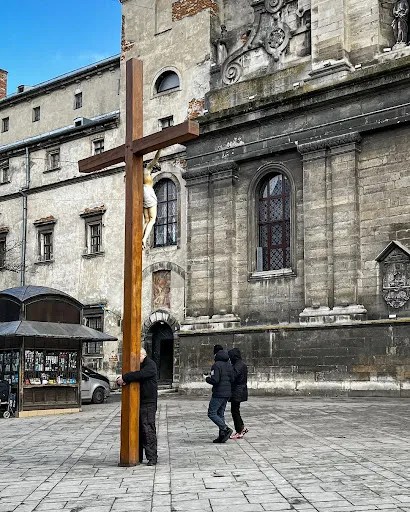
A man hugs a cross outside a monastery in Lviv, Ukraine, on Feb. 24, 2022, on the first day of Russia’s invasion. The photographer, Dennis Melnichuk, snapped the image outside the Catholic Bernardine monastery and church. Then, he shared it with the world in a Facebook post.
Stations of the Cross written by Fr Richard Nesbitt, Parish Priest of Our Lady of Fatima, White City, West London
Introduction
These reflections are entitled ‘Stations of the Cross in a time of War’. We pray them in solidarity with all those whose lives are being torn apart in the world at this time by the misery and madness of war, especially in Ukraine. We remember that Jesus also lived in a land occupied by a brutal foreign power, which sought to eradicate the Jewish people’s identity and traditions. It was a power which also used extreme violence and intimidation to try to break the spirit of the people whose land it occupied. Then as now, it is often innocent civilians – families, children and the elderly who are the targets and victims of this violence. In the midst of such suffering, darkness and agony, Jesus shows us another way – a way of non-violence, of service and self-sacrifice, of love and compassion for all.
As we walk with Jesus, may we learn from him this way of peace, this way of reconciliation with each other and with God.
I – Jesus is condemned to death
We adore you, O Christ, and we praise you.
Because by your holy cross you have redeemed the world.
Defenceless, defeated it seems – Jesus, a prisoner with hands bound, stands before Pontius Pilate, the “evil empire’s” regional commander-in-chief. All the power seems to be in Pilate’s hands – the power to condemn or release. And yet it is Jesus who is at peace, his conscience untroubled, his mission clear. And Pilate? He is caught in compromise, his conscience dulled and dismissed. As Jesus is led away, Pilate washes his hands in guilt. He will never know peace again.
The first victim of war is truth. Violence and brutality construct a convenient story to justify themselves. Propaganda. Lies. But conflict begins in the battles of the individual human heart. What are the lies and deceptions of my own life?
I love you, Jesus, my love above all things. I repent with my whole heart for having offended you. Never permit me to separate myself from you again. Grant that I am may love you always and then do with me whatever you wish.
II – Jesus takes up his cross (We adore you…)
How perverse, how sadistic it is to make the condemned carry the instrument of their own execution. Yet while others recoil from their cross, Jesus embraces the rough, splintering beam – like a soldier being issued with the weapon that can bring his deliverance. As the jagged cross cuts through his skin, Jesus momentarily closes his eyes in prayer before taking the first steps towards Calvary.
At the outbreak of war, people instinctively reach for different things – for loved ones, for food and water, for weapons, for news… In the face of danger would my first thought be for my own self-preservation or of solidarity with the suffering and the weak? I love you, Jesus…
III – Jesus falls for the first time (We adore you…)
The Son of God stumbles and crashes to the ground, the weight of the cross crushing him against the stone cobbles. Deprived of sleep, weakened by the beatings and baiting of the soldiers and guards, a cacophony of abuse ringing in his ears, Jesus is overwhelmed by this blitzkrieg of pain. There are many watching the scene who delight in his fall – this man who has been such a threat to their authority now being publically humiliated and shamed. This should be the end of all that.
In war there is a need not just to overcome your enemy but to break their spirit and bring them to their knees. Victory comes from the total annihilation of the other – this is the way of war. Have there been times when I have delighted in the falls and defeats of others? Take from me, Lord, any envy or jealousy towards others. Lord, teach me how to humble my pride. I love you, Jesus…
IV – Jesus meets his mother (We adore you…)
Wives and mothers are often sent away from the battle zone for their own safety, leaving the men in the firing line. But Mary will not, cannot leave her son in his hour of need. Fearlessly and faithfully, she comes forward to offer Jesus, through a tender touch and a gentle gaze, the love and support she has given him since the very first moment of his life in her. Love is more powerful than any threat or force. Love is stronger than death itself. Her heart pierced with grief, Mary unites herself with every mother who has lost a child through tragedy or violence.
War tears families and friendships apart. The deepest human bonds ruptured through separation and exile, loved ones taken away perhaps never to be seen again. Desolation and despair. Let us pray for all families who grieve at this time, for all families who have been separated by war. We entrust them to Mary’s motherly care. Hail Mary, full of grace…
V – Simon of Cyrene helps Jesus to carry his cross (We adore you…)
War is like an earthquake, sending out shock waves far from its epicentre. More and more people are shaken by its impact. And so it was that Simon of Cyrene, an innocent passer-by, was dragged from the crowd and forced to help Jesus carry his cross. The soldiers, seeing their prisoner’s frailty, fear he will not make it to the place of execution. Simon is a conscript, forced into service against his will, but these brief moments by Jesus’ side will change his life for ever. In the condemned man’s determination and dignity, Simon sees that this is a life not taken by force but freely given in love. He is the first to be healed by Jesus’ saving blood.
In a time of war there are no bystanders in the heat of the battle. Lord, help us not to be passive observers, passers-by in the struggle between good and evil, between life and death but to walk by your side and, like Simon, help those in need, the weak and the wounded, to carry their cross. I love you, Jesus…
VI – Veronica wipes the face of Jesus (We adore you…)
Brutality cannot be stopped by yet more atrocity but it can be exposed and shamed by tenderness and compassion. Such was the effect of Veronica’s daring to step out of the crowd to offer Jesus the soothing balm of her dampened cloth on his bloodied and beaten face. An exquisite sensation of relief, of human care shielding him from the shrapnel and shards of others’ rejection. He has inspired in Veronica this heroic act of service through his own example of selfless care for so many. She stands there on behalf of all whom Jesus has touched and transformed through his own healing mercy.
Survivors of conflict often tell stories of those who, in the midst of humanity’s most barbaric actions, perform acts of heroic courage and self-sacrifice. Lord, help us to live in the spirit of Veronica, not afraid to stand out from the crowd and reach out to those in need whatever others may say. May we too respond to carnage with compassion.
I love you, Jesus…
VII – Jesus falls for the second time (We adore you…)
Once again Jesus collapses under the burden of it all, this relentless bombardment of human hate. His bloodied body stains the ground, his open wounds and lacerated skin turning crimson. How fragile, how soft and fleshy our bodies are when our defences and securities are taken away from us. We are so easily cut apart. Who could imagine there was so much blood in one human body?
The walls and floors of military and civilian hospitals in war zones are smeared with blood. So many who die in war die from bleeding. Shrapnel cutting through veins and arteries. Civilians are the softest target – bombed in their homes and schools, caught by snipers while risking a search in the open street for food or water. Soldiers too – their helmets and jackets no match for bullets and bombs. Let us pray for all medical and emergency teams who try to patch up and save the fallen, bleeding casualties of war. Heal us, Lord, of our human hatred through your saving blood.
I love you, Jesus…
VIII – Jesus meets the women of Jerusalem (We adore you…)
The spectacle of condemned criminals carrying their cross to their place of execution outside the city walls has become almost a routine, even a daily occurrence at festival times. It is a constant reminder to the Jewish people of the consequences of rebellion and resistance against their Roman oppressors. But people still find ways to show their opposition, such as this band of women, mostly mothers, who have their established station on the execution route where they mourn and lament the prisoners as they pass by. It is their own act of defiance against this institutionalised slaughter.
We might expect Jesus to thank the women for their resistance to power, and solidarity with the condemned, but instead he warns them that the time will come when they and their children will also become victims of this violence. Evil, like a virus, seeks to multiply and spread – it is voracious and all-consuming. War is a cancer which, once started, we struggle to contain. Lord, help us to realise that there are no winners only losers in war – it is a tragedy for us all. We are all invaded. We are all infected. I love you, Jesus…
IX – Jesus falls for the third time (We adore you…)
Calvary is in sight, not far to go now. But Jesus is surrounded, under siege from all sides. The human spirit can cope with so much, but when the attacks become relentless and our life-lines are cut, we become overwhelmed and everything falls apart under the sheer pressure of it all. Jesus too is on the brink of breakdown – trembling, barely able to take another step. And yet from within he hears his Father’s voice and picks himself up for one last push.
So many people are on the edge of collapse, fighting for survival in our world today. Victims of war, hunger, crime… The climate around them changing beyond their control. Refugees forced from their communities and homes by crippling poverty, the threat of starvation or the atrocities of persecution and conflict. Torn away from their roots, they seek sanctuary in unknown lands at the mercy of human traffickers and gangs. Lord, guide all refugees, guide all those living on the edge to find the hope and help they so desperately need. May they also hear the Father’s voice and know his loving hand in theirs. I love you, Jesus…
X – Jesus is stripped of his garments (We adore you…)
Exhausted, his head throbbing with the incessant noise and dehydration, Jesus finally reaches the hill of Calvary. Now the soldiers begin their sacrificial rite. First his body is stripped naked – nothing left to hide behind or give any sense of human dignity. Total exposure, the removal not only of his blood soaked garments, but also of any human rights.
The victims of war likewise lose all they have – their home, possessions, food, water, health care, family… Stripped of all, they become totally defenceless. This is not just individuals but also whole peoples – the majority of humanity dispossessed and vulnerable while the powerful few look on and cast lots for their clothing.
Lord, help us to respond with compassion not indifference to those stripped bare in our world today. To clothe the naked, feed the hungry and welcome the stranger… To restore dignity to the broken and bleeding. This is the mission we are called to by Jesus. I love you, Jesus…
XI – Jesus is nailed to the cross (We adore you…)
The Creator of the universe is pinned to the cross, his hands and feet immobile, impotent. The soldiers with well-trained efficiency hammer the iron nails through flesh and bone, inflicting pain beyond pain on the condemned. And then the raising of the cross into the ground with a shuddering jolt which tears at the prisoners’ wounds. Now the real torture begins – the slow asphyxiation as the prisoners struggle to pull themselves up to breathe. Every gasp for air costs them so much.
As war becomes more desperate, more extreme tactics are used, such as the deployment of chemical weapons, often on civilians – toxic weapons which burn the lungs and skin of their victims. These weapons are designed to cause the most horrific pain and suffering to break the spirit of those they are used against. Lord, take from our human hearts this terrible desire to make others suffer. Cleanse us of cruelty and inhumanity. Restore in us your image and likeness.
I love you, Jesus…
XII – Jesus dies on the cross (We adore you…)
For three hours Jesus hangs on the cross, conserving every bit of energy so as to have the strength to speak his final words and, in his dying, give the most powerful lesson of his life. To love to his final breath, to continue to minister to both friend and foe, to care for those closest to him. And above all to live his loyalty and love for the Father to the very end.
In war there are clearly defined sides – opposing armies with different uniforms, weapons, languages and military objectives. But on the cross, as throughout all his life, Jesus does not divide people into sides. He prays for all – the righteous and the unjust, the oppressors and the oppressed, Gentile and Jew. Beneath the different armour and uniforms we are simply men and women, flesh and blood, fathers and mothers, sons and daughters – Jesus offers his life for us all. Lord, help us, faced with so many divisions in our world today, to remember our common humanity, our shared dignity as children of the one God as we pray together Our Father…
XIII – Jesus is taken down from the cross (We adore you…)
The finality of death. A body which even a short time before had breathed and pulsed with life now stiffens and shrinks. A mere shell it seems, left behind as the soul journeys on… And yet the respect and reverence we naturally show to a corpse speaks of its continued sacredness. This has been a work of God’s hands, a temple of the Holy Spirit. With what sadness but defiant care Joseph of Arimathea and Nicodemus take charge of Jesus’ body, a public declaration of their faith in him. They gently lower him down from the cross and, for a short time, place his body, already cool to the touch, in his mother’s arms. Jesus ends his life as he began it – in Mary’s tender care.
In war some of the fallen are honoured with a dignified funeral, even a hero’s farewell. But for so many there is no much ceremony as they are entombed in rubble and ruins, or hastily hidden in unmarked graves by alien hands. How many loved ones wait in vain for them ever to be found or identified. There should be dignity in death as in life. Lord, help us to show reverence to every human life, at every stage and state of life. I love you, Jesus…
XIV – Jesus is laid in the tomb (We adore you…)
The crowds have all gone home – rushing to prepare for the Passover feast before the sun sets. There is a sudden silence and stillness where before there was so much rage and raw emotion. Jesus’ body is brought to a garden and laid in the earth, like a seed which will bear fruit in due time.
Lord, at this time when the skies over Ukraine thunder and roar with missiles and bombs, when families and communities are torn apart by the carnage of war, we pray for peace to return to Ukraine and to all countries and peoples plagued by war in the world today. Silence once more the weapons of war. Change the hearts of those who choose war. Comfort and console all who suffer, on all sides. May birdsong replace the din of bombardment, bullets and bombs; may freedom and hope be restored and renewed on Ukrainian soil. And may we, as a human family, reject division and empire, greed and domination. May we walk once again the path of peace. Lead all those involved in this terrible war on the road to reconciliation. Just as out of the tomb you rose to new life, so too, we pray, that out of this darkness, Lord, you may bring light. For this we pray.
I love you, Jesus…
We unite our prayers with those of all the Church, as we pray for the Holy Father’s intentions:







 Diocese of Westminster Justice and Peace Commission