Bishop Curry says that when Christians pray for peace in the Holy Land, it can be both supplication and a cry of protest

Photo: CBCEW

Bishop Jim Curry is an auxiliary bishop in the Diocese of Westminster

Bishop Jim Curry, the Lead Bishop for the Holy Land for the Bishops’ Conference, has joined our former Middle East North Africa consultant, Dr Harry Hagopian, as a special guest on his monthly Middle East Analysis podcast. Contributing to a discussion on Gaza, the West Bank and the wider region of the Holy Land, Bishop Curry said that when Christians pray for peace, it can be both supplication and a cry of protest.

“Obviously, the Christian always wants to pray, and we can’t just dismiss prayer as fanciful. Prayer is a cry of protest as well as supplication,” says Bishop Curry. “The fact that we can pray in our churches publicly for the situation in Palestine and Gaza, in the West Bank, that we remember our Christian brothers and sisters and the wider community is important. So we can’t ever dismiss it.”

Bishop Curry also spoke about the Christian presence in the Holy Land as foundational and a vital part of the rich tapestry of the region:

“One of our fundamental tenets is to go on pilgrimage, because these lands are holy to us, they are holy to the Jews, and to Muslims. Christians have been part of the mosaic of those lands for over 2,000 years, they belong there. They’re not interlopers. They’ve built schools, they’ve built churches, they’ve built communities. So going to visit them is important for us. When we last visited [for the Holy Land Coordination], we were able to visit Bethlehem, Beit Jala, where the Latin Patriarch has a seminary, Aboud, and Taybeh. We were able to show that they are not forgotten. But I’m always conscious that afterwards, we walk away. We walk away and leave communities to struggle with lack of access to jobs, to security, to freedom of movement.”

The Bishop also shared his first impressions of the Palestinian city Ramallah, the administrative capital, that he visited in January 2025 as part of the Holy Land Coordination meeting, organised by the Bishops’ Conference:

“I’d never been to Ramallah, and as I looked around as we entered the city I saw a peaceful, busy, bustling city with cafes and buses, restaurants and shops, and people about their business.

“It was a warm day, with a blue sky, and I thought ‘that’s what normality looks like’. People don’t run away from normality. We were asking ourselves, ‘what would normality look like?’ And there we saw it. Someone whispered into my ear, ‘You should have seen Gaza. It was bigger and more well-organised’. Now all we see are these images of rubble and people being displaced – hungry and frightened. I’d seen a different reality in Ramallah, a place that worked. I’m sure people complain about the services there, but I saw something different and it stayed with me.”

In the face of conflict, death, destruction and extreme hardship, Bishop Curry offers a suggestion to enable us to cling to a shard of hope:

“What can we do? We can go on advocating that normality is possible, that people can live well together. People want to live well together… Everywhere we went, we heard this plea, ‘We just want to live normal lives. We want jobs, we want our kids to go to school, we want them to be able to play their part in this land when they come back after university’. It still comes back to me, that image of what normality is. People don’t run away from normality.”

He reserved special praise and heart-felt prayers for the small Catholic community of the Church of the Holy Family in Gaza:

“They are giving a witness to the possibility that our despair can’t be the final word about the human situation. That little community there, the Holy Family in Gaza, they are a living sign that human beings can live together, and they can work together for each other’s good.”

Listen

You can listen to the full June 2025 episode of Middle East Analysis on the Catholic Bishops’ website or on Soundcloud.

Bishop Hudson says peacebuilding is a vital aspect of international security

Source: CBCEW

Bishop Nicholas has responsibility for Justice & Peace in the Diocese of Westminster

In response to the government’s recently announced Strategic Defence Review, Bishop Nicholas Hudson, Chair of the International Affairs Department at CBCEW, expressed the strong hope that the government will not neglect international peacebuilding efforts.  

Bishop Hudson said: “I understand that the government has a very difficult decision to make given the current fiscal position and international environment.” 

“However, if defence spending is to increase, it should not be at the expense of other ways of promoting peace and justice. Peacebuilding is a vital aspect of international security that must not be sacrificed to an increased emphasis on defence.” 

Earlier this month the government announced the review, with wide-ranging measures, including building 12 attack submarines and a commitment to raise defence spending to 2.5% by 2027-28 with the aim of 3% by the next parliament. 

Bishop Hudson added: “It is important to ensure that the expansion of military funding does not result in the diversion of resources away from foreign aid and support for the world’s poorest people. Without a balanced investment in diplomacy, multilateralism, and assistance to the poor as vital means of securing peace, we risk deepening the very crises we seek to prevent. 

“I also hope that the UK approaches the development of autonomous weapon systems with great caution, always upholding the principle that machines must never replace human moral judgment or responsibility in matters of life and death.

“I urge our government leaders to remember that true security comes not only from strength, but also from compassion and active peacebuilding.” 

Read the Catholic Bishops’ document on disarmament and the ethical use of weapons:

 ‘Called to Be Peacemakers’

West London Justice and Peace Network: ‘So much going on!’

‘Called to be Peacemakers’ cover image. CBCEW

By Maggie Beirne, West London Justice and Peace Network Co-ordinator

“There is so much going on!” – the positive reaction of one of the participants at this weekend’s meeting online of the West London Justice and Peace Network.

Representatives of 10 parishes were joined by Richard Harries, CEO of Caritas Westminster, which encourages parishes to engage with their own social action projects. Also, Sr Silvana Dallanegra, a Religious of the Sacred Heart and a Development Worker of Caritas Westminster, covering seven deaneries.

Those present talked of their parishes’ efforts organising hustings in relation to the general election; Autumn efforts around the Season of Creation and Fairtrade Fortnight; CAFOD Harvest fundraising efforts; the DEC Appeal and action for the Middle East; and advance preparations for Advent and Christmas. Often big events were organised (eg a Green Living Fair); sometimes the parish newsletter and social media were used as vehicles to encourage reflection, prayer and fundraising efforts; sometimes Bidding Prayers, musical choices, or special liturgical events were planned to mark key events. Some parishes have been successful in drawing in their young parishioners – colouring books for the children’s liturgy; badges to promote Fairtrade and CAFOD; and looking at wider issues of diversity (in their church iconography etc).

Nearly all the parishes have a range of activities linked also to more immediate local concerns – with foodbank collections; winter night shelter arrangements; social gatherings to reduce isolation and so on. Most parish reps also reported how they had followed up in lobbying their local MPs in response to the Cardinal’s recent statement on Assisted Suicide.

The group also discussed common problems and exchanged practical suggestions about the way forward – how to avoid ‘funding fatigue’ when there are competing demands for second collections; should we hand out CAFOD envelopes in person, or is it better to attach them to all the newsletters; how do we get more volunteers to come on board; how do we best coordinate across Justice and Peace/CARITAS/SVP/Laudato Si locally without losing our distinct charisms? There was a lot of information shared about local, national and international resources available to help.

The network was particularly interested to hear more about the bishops’ statement, ‘Called to be Peace Makers,’ issued in May 2024. It is a very strong document sub-titled ‘A Catholic Approach to Arms Control and Disarmament,’ though several of those present had not been aware of it previously. Given how important this debate is currently, resources like this need to be more widely disseminated – both to those in the pews and to the wider world. It was suggested that the Bishops’ Conference might offer printed copies. Some members of the Network are particularly active in Pax Christi and Christian CND and are taking ahead specific projects – including a Nuclear Morality flowchart – and hoping to lobby parliament to move this issue further up their agenda.

So, to finish where we began with “so much going on!” Sometimes parishioners feel overwhelmed about the competing demands and needs for action – and particularly now when the world seems to be in a specially bad place on peace and environment issues, and people’s immediate concerns about cost of living, family, health, or work can be demanding. But three times a year, the network gets together virtually and by putting together all our individual scraps of ‘good news’ and activities, we are amazed at the result. It gives us all the energy and commitment to carry on and indeed increase our efforts for the coming of justice and peace in our hearts, homes and world!

LINKS

‘Called to be Peacemakers’: www.cbcew.org.uk/wp-content/uploads/sites/3/2024/05/Called-to-be-Peacemakers.pdf

Nuclear Morality flowchart: www.nuclearmorality.com

Caritas Westminster: https://caritaswestminster.org.uk/

November 1 Lecture with Baroness Scotland at Farm Street. https://westminsterjusticeandpeace.org/2024/09/26/inaugural-westminster-justice-and-peace-lecture-friday-1-november-2024-7pm-farm-street-church/

Westminster Justice and Peace E-Bulletin October 2024

Fr Dominic writes,

A new year begins.

Our schools reopen, our parishes restart catechetical programmes, search for new volunteers and, in some cases, welcome new priests.

The work of Justice and Peace goes on in and out of season as does the Church’s mission in the world but a new year is also an opportunity to pause, reflect, discern priorities, and, strengthened hopefully by holidays, we take up our work again with a new enthusiasm.

One event which aims to draw together as many as possible involved in the work of Justice and Peace in our diocese is our inaugural lecture at Farm Street Church on November 1st by Baroness Scotland, the Commonwealth Secretary General. Baroness Scotland has a huge experience and an enormous heart for putting Catholic Teaching into action. We really hope you can make it.

Ash Wednesday Witness


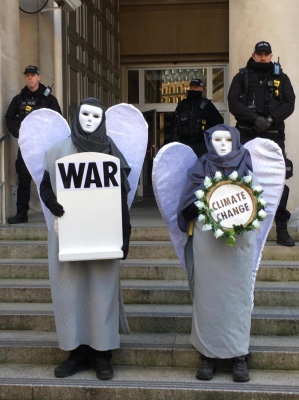
These Angels helped us to demonstrate and protest the links between war, the excessive demands made on the planet’s resources by militarisation, and the current climate emergency.

The annual Ash Wednesday procession through Whitehall Gardens and prayer vigil outside the Ministry of Defence (MoD) took place yesterday. Organised by Pax Christi, Christian CND and the London Catholic Worker –  the message of peace and reconciliation was emphasised with fresh urgency this year by the haunting presence of two ‘Ash Angels’ a performance art project of XR Peace. 

The event began with a liturgy in Embankment Gardens. Water and ashes were blessed by Fr Joe Ryan, former Chair of Westminster Justice and Peace, and distributed ‘as a sign of repentance’ before the group processed to the MoD, led by Theresa Alessandro, director of Pax Christi. Read more…